Continuing my chronological Bible study:
(Genesis 28:1) And Isaac called Jacob and blessed him, and charged him, and said to him, "You shall not take a wife of the daughters of Canaan."
At the end of the last chapter, Rebekah had thought of a way to send Jacob away so that Esau would not kill him because of Jacob's deceit and trickery in stealing his blessing. She told Isaac she just could not bear it if Jacob married a Canaanite woman. Isaac therefore called Jacob and it appears that he willingly confirmed his blessing upon him, and told him that he was not to take a wife from among the Canaanite women.
(2) "Arise, go to Padan Aram, to the house of Bethuel your mother's father; and take you a wife from there of the daughters of Laban your mother's brother. (3) And God Almighty bless you, and make you fruitful and multiply you, that you may be a multitude of people; (4) And give you the blessing of Abraham, to you and to your descendants with you, that you may inherit the land in which you are a stranger, which God gave to Abraham." (5) And Isaac sent Jacob away, and he went to Padan Aram to Laban, son of Bethuel the Syrian, the brother of Rebekah, Jacob's and Esau's mother.
Isaac told Jacob to go to Padan Aram to Laban in the house of Bethuel, Rebekah's father, and marry one of the daughters of Rebekah's brother, Laban. Isaac blessed his son Jacob with the Abrahamic promise that had been passed from Abraham to Isaac and now to Jacob, that he would be fruitful and his descendants would be many, and that they would ultimately inherit the land of Canaan, the land in which they were only sojourners then. Then Isaac did indeed send Jacob away to Padan Aram.
(6) When Esau saw that Isaac had blessed Jacob and sent him away to Padan Aram to take himself a wife from there, and that as he blessed him he gave him a charge, saying, "You shall not take a wife from the daughters of Canaan," (7) And that Jacob obeyed his father and his mother and had gone to Padan Aram, (8) And Esau seeing that the daughters of Canaan did not please his father Isaac, (9) Then Esau went to Ishmael and took Mahalath the daughter of Ishmael, Abraham's son, the sister of Nebajoth, to be his wife in addition to the wives he had.
Esau saw that his father had blessed Jacob and that he had sent him away to find a wife in order that he not take a wife from among the Canaanite women. With that he realized that his father was not pleased with the Canaanite women as wives for his sons, as Esau had previously taken, so he took another wife. This time he married the daughter of his father's brother, Ishmael. Ishmael was now dead, so when Esau "went to Ishmael", it was as Jacob going to the house of Bethuel. Esau went to the house of Ishmael, probably directly to Nebajoth, who was Ishamel's oldest son, and took Mahalath, Nebajoth's sister, to be his wife. Esau may have been trying to please his father, but daughters of Ishmael would not have been the most favorable as Ishmael had been separated from the house of Abraham and was not included in the Abrahamic promise, another indication that Esau just didn't understand the spiritual importance of his birthright and the blessing of the firstborn in the line of Abraham.
(10) And Jacob went out from Beersheba and went toward Haran. (11) And he lighted upon a certain place and tarried there all night because the sun was set; and he took of the stones of that place, and put it for his pillows, and lay down in that place to sleep.
Jacob left Beersheba and went toward Haran. He apparently couldn't make it in one day, and happened upon a certain place casually, and not necessarily intentionally, and decided to stay there for the night as the sun was setting. He took a stone for a pillow as he evidently didn't have other provisions.
(12) And he dreamed, and behold, a ladder was set up on the earth, and the top of it reached to heaven; and behold the angels of God were ascending and descending on it. (13) And behold, the LORD stood above it and said, "I am the LORD God of Abraham your father and the God of Isaac; the land on which you lie I will give to you and your descendants. (14) And your descendants shall be as the dust of the earth, and you will spread abroad to the west and to the east, and to the north and to the south; and in you and in your seed all the families of the earth will be blessed. (15) And, behold, I am with you and will keep you in all places wherever you go, and will bring you again to this land, for I will not leave you until I have done that of which I have spoken to you."
Jacob dreamed of a ladder that was set up on earth and reached to heaven with angels going up and down it. The Lord stood above it and spoke to Jacob. He confirmed His promise to Abraham now to Jacob. The land on which Jacob lay that may have been accidental for him, was providential in that the Lord told him this very land would be given to him and his descendants. As God had told Abraham, Jacob's descendants would be as the dust of the earth, too numerous to count, and they would spread in all directions. As He had told Abraham, God told Jacob that through him and his descendants would all the families of the earth be blessed, which is a reference to the Messiah who would come from this line and in Whom all may be saved. The Lord told Jacob He was with him and would be with him wherever he went, and that He would bring him back to this land. The line of angels going up and down the ladder in Jacob's dream was a picture of the constant ministering spirits and line of communication that would always be between God and Jacob. More than that, it is a picture of Jesus Christ Who would become the direct line from us to God.
(16) And Jacob awoke out of his sleep and said, "Surely the LORD is in this place, and I did not know it." (17) And he was afraid and said, "How dreadful is this place! This is none other than the house of God, and this is the gate of heaven."
Once again what was a casual nondescript place in Jacob's mind was a place where the Lord showed Himself to Jacob unexpectedly. He realized that the Lord was certainly in that place and that apparently surprised him. I left the original KJV words "afraid" and "dreadful" in my study. Although I usually don't think of them as "fright" and "awful" as we have come to interpret those words, sometimes I think our modern translations diminish the intended meaning of the original words. Jacob was afraid; he had fear. Yes, I agree with the common idea that it was a reverential fear, but it was more than that. I don't think we today quite understand that awestruck fear of knowing that you have just come in contact with the One who literally holds your life in His Hands. How could we when we so flippantly disregard all the things He told us in His Word? We keep Him only in church and bring Him out only when we really need something; we pretend that He shouldn't be a part of our daily public lives and decisions. How preposterous! Just think of how far our country has gone in rejecting God. We've come to accept the idea that He doesn't belong in schools or in the public square because someone might be offended. Would we care if we really feared God and saw Him as the Master of the Universe? We actually kill millions of babies and call it a RIGHT! Does anyone really think that God would approve of killing the most innocent because it is not convenient to let that child be born right now? Does anyone think that God is going to bless a country that promotes and celebrates same-sex "marriage" as equality and a RIGHT even though He called it an abomination? Do we think a country can survive without God's blessing? Do we think God understands that the times have changed and we are such a wiser people now? Suppose you had to confront God and ask Him face to face if it was okay to kill your baby and "marry" your lesbian lover. Does that strike fear in your heart? If it doesn't, it should! I have to wonder if some of the people out there cheering on these horrible Godless acts ever really think about what God would say, or do they just try to ignore that. Or have they really reached a point where they don't care? Oh, they would care if God presented Himself as the awesome terror that He is! He IS Someone to be dreaded! He does hold your life in His hand; He holds our country in His hand; He holds the entire planet in His hand! And God will not be mocked! Oh, He is patient, oh-so patient that people forget that the things of God matter, but they do! And there will come a time when EVERYONE will know that!
For it is written, "As I live, says the LORD, every knee shall bow to Me, and every tongue shall confess to God." So then every one of us shall give account of himself to God. - Romans 14:11-12
And that is a reference to Isaiah 45:23 which says:
"I have sworn by Myself, the word has gone out of my mouth in righteousness, and shall not return, that unto Me every knee shall bow, every tongue shall swear."
Can you imagine that? Just by the sheer force of His majesty, everyone will be on his knees before the Lord. EVERYONE, not just believers, not just Christians, EVERYONE! And everyone will give an account of just why they did what they did. That ought to strike fear in us to our very cores. But surely God will understand a changing culture. Surely God will understand taking a baby's life until a time when it is more convenient. After all you don't have time to properly love that child now. Surely God will understand that there had to be separation of church and state and that is why we fought to keep prayer out of schools and references to Him out of the public square! Surely God understands that it is because you are so loving and tolerant that you believe you should fight for same-sex marriage even though He called it an abomination. I'm not suggesting that any of these things can't be forgiven by God, and He did give us Jesus as our Mediator so that our sinful selves can come into His presence. But He is still the same God and we have to realize when we are sinning against Him and repent, which means change! Yes, Jesus gives us grace so that we don't have to fear God, but only when we see our sin, see our need for Him to cover our sin, and REPENT! A repentant heart is one that is truly sorry and seeks to change. We know what is right. Isaiah 45:24 goes on to say that after we all bow before the Lord, "and all that are incensed against Him shall be ashamed". We will know He is God; we will bow before Him; and we will be ashamed. I'm just imagining how we would act in this country if we had to be on our knees in the presence of God before every decision we made. Or maybe just every night to explain why we did what we did. Do you think we'd act a lot differently? God gives us free will; it's true. But that doesn't change what is right and true. And if we truly had the fear of God as we should, we wouldn't dare do what we do in this day and age.
(18) And Jacob rose up early in the morning, and took the stone that he had put for his pillows, and set it up for a pillar, and poured oil on the top of it. (19) And he called the name of that place Bethel, but the name of that city was called Luz at first.
Jacob took the stone he had used for a pillow and turned it into an upright erect position as a monument to God or as a reminder to him of the greatness of God and of his vision. He called the place Bethel, which literally meant "house of God". It had previously been called Luz, which was the word for a kind of nut, an almond or a hazel nut, which probably grew there.
(20) And Jacob made a vow, saying, "If God will be with me, and will keep me in this way that I am going, and will give me bread to eat and clothing to put on, (21) So that I come again to my father's house in peace, then the LORD shall be my God. (22) And this stone which I have set as a pillar shall be God's house, and of all that You give me I will surely give a tenth to You."
The wording of Jacob's vow sounds like he is making it a condition that IF God will be with him, then he Jacob will do... I don't think that was Jacob's intention. He has just heard from God and God has promised to be with him and keep him and bring him to this place again, so that was Jacob's way of saying that because the Lord was going to be with him, etc., so that he would come again, that the Lord was his God. The little word translated as "if" by the KJV translators actually does also mean "when", "lo", or "verily", words all meaning Jacob was sure that God would do what He said in his vision. This was more of a demonstrative statement rather than a conditional one. The stone Jacob had set up would be God's house. He may have meant that in the future he would make it God's house as later in scripture, it is said that he went to Bethel and made an altar to God (Gen. 35:3), but he may have meant that it would forever be a place where God had appeared to him and therefore was God's house, because everywhere that God is, is His house.
Jacob did vow to give a tithe of 10% of all that the Lord gave him. All blessings come from the Lord. Ten represents the whole and 1/10 is given in acknowledgment of the Lord and His sovereign right to it all. It is given in gratitude to Him and is used for the support of worship to Him, as in building an altar or church, or in providing a sacrifice, or in giving to the poor or needy, or for any need or service in which God may be glorified. I personally believe the tithe is still relevant today, although the Apostle Paul said in the New Testament that it should be given according to how God has prospered, and as one feels led in his heart, so that he does not give begrudgingly, but cheerfully. There is a lot of discussion today about whether or not the tithe is still required or if it is an Old Testament law that is not necessary today. Today the law is written on our hearts, and I believe that is what Paul was saying in 1 Corinthians 16:2 and 2 Corinthians 9:7. Since the tithe is only given as the Lord has given us, and not as a regular bill that is due whether or not we get paid, it is easy to give back. It is all God's anyway, and by giving 1/10 back in acknowledgment and thanksgiving, I believe we are saying that we trust God with all of it. I can say from personal experience that God can do amazing things with very little when I trust Him! Can you imagine the good that would be done in the world today if everyone tithed only 10% to God instead of giving 20-30% to a corrupt government that forces people to give for ungodly things like abortions for the poor?

Showing posts with label Ishmael. Show all posts
Showing posts with label Ishmael. Show all posts
Saturday, April 6, 2013

Sunday, March 3, 2013
Genesis 25: Priorities and Choices and How You Can Overcome Your Lot in Life (or Reject It!)
Continuing a chronological Bible study:
(Genesis 25:1) Then again Abraham took a wife, and her name was Keturah. (2) And she bore him Zimran, Jokshan, Medan, Midian, Ishbak, and Shuah. (3) And Jokshan begat Sheba and Dedan. And the sons of Dedan were Asshurim, Letushim, and Leummim. (4) And the sons of Midian were Ephah, Epher, Hanoch, Abidah, and Eldaah. All these were the children of Keturah.
"THEN" Abraham took a wife, obviously after the death of Sarah and probably after the marriage of Isaac, as well. Keturah gave Abraham six more sons in his very old age, it would seem at first glance. Obviously, she could have been much younger than Abraham, but we were told earlier in scripture that Abraham's body was dead when Sarah conceived Isaac, and that he was very old and well stricken with age when his servant went to find a wife for Isaac. I have to believe as some of the old Bible scholars suggest that Keturah was a concubine and bore children much earlier in life, while Sarah was alive, and she became Abraham's wife after the death of Sarah. Later in scripture, in 1 Chronicles 1:32, Keturah is called his concubine. She was a concubine who probably gave him these children earlier, and became his wife at this time after the death of Sarah.
(5) And Abraham gave all that he had to Isaac.
Isaac was Abraham's only begotten son of his wife, Sarah, and the heir to the promise, and Abraham had given him all he had, especially his right to the land of Canaan, and his "flocks, herds, silver, gold, menservants, maidservants, camels, and donkeys", as had been reported by his servant to Rebekah's family. However, Abraham must have reserved some for himself, as he gave gifts to the sons of his concubines:
(6) But Abraham gave gifts to the sons of the concubines which Abraham had; and while he yet lived, sent them away from Isaac his son, eastward to the east country.
Abraham remembered his other sons, these sons of Keturah above mentioned, as well as Hagar's son Ishmael. While he was still living, to avoid disputes after his death, he gave his sons their inherited gifts and sent all his other sons eastward away from his son, Isaac. The land of promise was to be only Isaac's.
(7) And these are the days of the years of Abraham's life which he lived, one hundred and seventy-five years. (8) Then Abraham gave up the ghost and died in a good old age, an old man and full of years, and was gathered to his people.
Abraham gave up the ghost, or breathed his last breath and died at 175 years of age, "in a good old age". While that seems quite old in our day and age, Adam Clarke in his "Commentary on the Bible", points out that Abraham died at the youngest age of all the patriarchs. That word "good" is not to be interpreted to mean that Abraham lived to an extremely old age, but that it was a good and full age. His life had been full and satisfying and he was ready to depart this world. He died at a good age, not having to endure a total decrepitness of mind and body. Being gathered to one's people was probably a way of saying that he joined those ancestors who went before him in death. There was much discussion in the old commentaries about the exact meaning of the phrase because surely Abraham wasn't literally gathered to his ancestors who were buried in Chaldea and not in Canaan, nor did it mean he was gathered to Sarah who was alone in a cave. Some said it meant he was "gathered to the spirits of just men made perfect". More recent scholars really make a big deal of the wording "was gathered" as opposed to other places where a person "shall be gathered" as if to say this proves whether we go to heaven when we die or wait to be resurrected at the end. I have to believe this was just a saying and it meant Abraham went the way of death as all his people before him went.
(9) And his sons Isaac and Ishmael buried him in the cave of Machpelah, in the field of Ephron the son of Zohar the Hittite, which is before Mamre, (10) The field which Abraham purchased from the sons of Heth; there Abraham was buried, and Sarah his wife.
Even though Ishmael and his mother had been sent away from Abraham's family, the brothers came together at this time to bury their father in the cave in the field Abraham had previously purchased when he needed a place to bury Sarah.
(11) And it came to pass, after the death of Abraham, that God blessed his son Isaac; and Isaac dwelt by the well Lahai Roi.
God blessed Abraham's son Isaac, the heir to the promise of God. Isaac lived by the well Lahai Roi, which was the same as Beer Lahai Roi, the place where the angel of the Lord came to Hagar and told her about the son she was carrying.
(12) Now these are the generations of Ishmael, Abraham's son, whom Hagar the Egyptian, Sarah's handmaid, bore to Abraham: (13) And these are the names of the sons of Ishmael, by their names, according to their generations: The firstborn of Ishmael, Nebajoth; and Kedar, Adbeel, Mibsam, (14) And Mishma, Dumah, and Massa, (15) Hadar, Tema, Jetur, Naphish, and Kedemah. (16) These are the sons of Ishmael, and these are their names, by their towns and by their castles, twelve princes according to their nations.
Ishmael had twelve sons, heads of twelve tribes of the Arab nation. God had promised Hagar that He would bless Ishmael and make him fruitful, and that he would beget twelve princes and become a great nation (Genesis 17:20), and so it was. Many of these sons, or princes, will be mentioned later in the Bible. Nebajoth and Kedar are mentioned in Isaiah. I have read that in old Jewish writings, the Arabic language is most frequently called the language of Kedar. Dumah is a place mentioned in Isaiah and was probably named after Ishmael's son. Interestingly, Tema and Temanites were mentioned in Job, meaning that, chronologically, I should have been studying Abraham before Job! Jetur and Naphish are mentioned in 1 Chronicles as part of the Hagarites who warred against the Israelites. The descendants of Kedemah may have lived at Kedemoth, a place mentioned in Deuteronomy.
(17) And these are the years of the life of Ishmael, one hundred and thirty-seven years, and he gave up the ghost and died, and was gathered to his people. (18) And they dwelt from Havilah to Shur, that is before Egypt as you go toward Assyria; and he died in the presence of all his brethren.
Ishmael lived to 137 years of age, and also gave up the ghost and was gathered to his people, as was Abraham. I believe these have to be merely expressions that were used in the day and were not meant to have a significant meaning as to the kind of life each man lived. I am picturing "giving up the ghost" as giving up the spirit of life or breath, breathing one's last breath. As was discussed above, I believe that being gathered to one's people must just mean to go the way of death as his ancestors before him. "They" in verse 18 would have to be the descendants of Ishmael and not his people before him. The Ishmaelites lived in the country that extended from east to west from Havilah to Shur. From what I have read and viewed on a map, this looks to be the northern region between Havilah arcing northward (as you go toward Assyria) to Shur next to Egypt. I found an excellent map at http://www.bible.ca/archeology/bible-archeology-exodus-route-wilderness-of-shur-ishmaelites-midianites-amalekites.htm with references to other scriptures which shows where this region must have been:
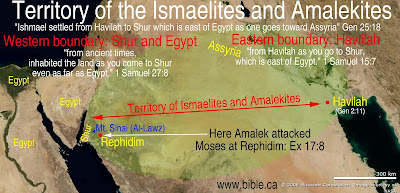
Ishmael died in the presence of all his brethren. This is a fulfillment of prophecy from Genesis 16:12 when the angel of the Lord told Hagar that Ishmael would "be a wild man; his hand will be against every man, and every man's hand against him; and he shall dwell in the presence of all his brethren." Among "all" his brethren probably means that he lived his wild and turbulent life and held his own in an area among Abraham's other children. He died as he lived, in the presence of or amongst all his brethren. Many of the old commentaries suggest that the pronoun "he" from verse 18 should have been read "it" and it meant that his lot fell among all his brethren. They believe this because although verse 17 speaks of Ishmael, verse 18 speaks of the place where the Ishmaelites dwelt. Additionally, the same word "naphal" that is translated as "died" here also means to divide by lot, and was used that way in another verse in the Bible; Joshua 23:4 states, "Behold, I have divided to you by lot these nations that remain, to be an inheritance for your tribes, from the Jordan, with all the nations that I have cut off, even to the great sea westward." So perhaps the true meaning of verse 18b is that his lot or inheritance was assigned him by God to be in the midst of all Abraham's other children. It is true that even though Ishmael was not the promised seed, God blessed him and made of him a great nation that lives today. Indeed Ishmael is the father of the Arab nation!
(19) And these are the generations of Isaac, Abraham's son: Abraham begat Isaac; (20) And Isaac was forty years old when he took Rebekah to be his wife, the daughter of Bethuel the Syrian of Padan Aram, the sister of Laban the Syrian.
We had a genealogy of Abraham's son Ishmael, and now begins one of Isaac. We have a brief genealogical synopsis of what we have read of Isaac to this point.
(21) And Isaac entreated the LORD for his wife, because she was barren; and the LORD was entreated for him, and Rebekah his wife conceived.
Now we pick up the story of Isaac's family after he and Rebekah were married. Apparently they lived 20 years together as man and wife before having a child. We were told that Isaac was 40 when he married Rebekah, and later in scripture we are told that he was 60 when his sons were born (verse 26). Isaac earnestly prayed to the Lord for Rebekah to have a child and the Lord granted his request and she conceived.
(22) And the children struggled together within her; and she said, "If it be well, why am I this way?" And she went to inquire of the LORD. (23) And the LORD said to her, "Two nations are in your womb, and two manner of people shall be separated from your body; and the one people shall be stronger than the other people; and the older shall serve the younger."
Apparently Rebekah felt a commotion inside her that did not feel normal, so she asked the Lord if everything was okay. The Lord told her there were two babies in her womb, two different babies, not identical twins. They would be different in appearance and in manner of life. More than just twins, God was prophesying that from the babies would spring two different nations. Two babies struggling in the womb would become two nations struggling with each other, one stronger than the other in physical strength, but the older would come to serve the younger.
24) And when her days to be delivered were fulfilled, behold, there were twins in her womb. (25) And the first came out red, like a hairy garment all over; and they called his name Esau.
Sure enough, Rebekah delivered twins. The first baby was red and hairy all over, and they called him "Esau", which literally means "rough" or "hairy".
(26) And after that his brother came out, and his hand took hold of Esau's heel, and his name was called Jacob; and Isaac was sixty years old when she bore them.
The second baby came out with his hand grabbing hold of the first baby's heel, the perfect picture of Jacob trying to pull back his older brother so that he might be the first, which was of course, a prophetic picture of what was to happen. Even Jacob's name was prophetic; it literally means "supplanter". To supplant is to overthrow by tripping up or to take the place of another by scheming or strategy. His parents may have named him Jacob only because of the way he grabbed his brother's heel and it just looked like he was trying to pull his brother back to be first, sort of like parents today might say, "Oh, isn't that cute; he wants to supplant his brother". However, God had told Rebekah that two nations struggled within her womb and that the older would serve the younger, so she may have seen the action of baby Jacob as prophecy fulfillment in the making and named him accordingly.
(27) And the boys grew; and Esau was a cunning hunter, a man of the field, and Jacob was a plain man, dwelling in tents.
I was tempted to use "better" adjectives for my study, but since the original words can mean a variety of things, I decided to leave them as the KJV translators translated them and I would explore all the meanings of the original words. Esau was a cunning hunter. The original word for "cunning" is "yada", which has a huge variety of meanings, but they all stem from the root word "to know". So he really knew about hunting; he was a skillful and experienced hunter. He was a man of the field, an outdoorsman. Jacob was a "plain" man. It is very interesting that the KJV translators used the word "plain" to define the original "tam", as it doesn't seem to begin to define the word completely. They were probably striving for the sense of "gentle" or "mild", which would be considered in contrast to the skillful hunter and outdoorsman, but they are considered secondary meanings of the word. "Tam" is most often used in other scriptures as "perfect and complete".
(28) And Isaac loved Esau, because he ate of his venison, but Rebekah loved Jacob.
This scripture always bothered me. How could a parent love one child over another? But when you consider what we have already learned about the boys, it may make sense that each parent was more attached to one son more than the other. Esau was Isaac's firstborn and he brought him good venison to eat. Isaac evidently really enjoyed that and Esau probably sought to please his father in this way. On the other hand, Jacob was probably more at home with his mother and of a milder and gentler disposition. It may have been natural for the parents to be a little more attached to one child over the other, but there may have been more to this, and there are different ways to look at it. Rebekah had received the prophetic word from God that the older son would eventually serve the younger son. Perhaps she saw Jacob as blessed by God and she loved and sought to nurture the son chosen by God. However, Adam Clarke wrote an interesting spin on this: "This is an early proof of unwarrantable parental attachment to one child in preference to another. Isaac loved Esau, and Rebekah loved Jacob; and in consequence of this the interests of the family were divided, and the house set in opposition to itself. The fruits of this unreasonable and foolish attachment were afterwards seen in a long catalogue of both natural and moral evils among the descendants of both families." Perhaps the moral lesson in this is that the parents should not have loved one over the other, but as God gives prophecy as events will happen and not necessarily as they should happen, and also because He makes things work to the good for those who love and follow Him, the blessings will follow Jacob, but there will be much strife.
(29) And Jacob made a stew, and Esau came from the field, and he was faint. (30) And Esau said to Jacob, "Please feed me with that same red stew, for I am faint." Therefore his name was called Edom.
Jacob, perhaps being the homebody that he was or maybe for some other reason, but certainly by Godly design, had made a stew. Esau came in from the field, having toiled but obviously having nothing to eat, and he was faint, we can assume from hunger. We are told that he was called "Edom" which literally means "red" because of this red stew. We were previously told that he was born red and hairy. Esau was the name for "hairy", and Edom was the name for "red".
(31) And Jacob said, "Sell me this day your birthright." (32) And Esau said, "Look, I am at the point of dying, so what profit will this birthright do to me?" (33) And Jacob said, "Swear to me this day." And he swore to him, and he sold his birthright to Jacob. (34) Then Jacob gave Esau bread and stew of lentils, and he ate and drank, and rose up, and went his way; thus Esau despised his birthright.
Jacob obviously took advantage of the fact that Esau was starving to death, as he had put it, and it can be argued that he did not act righteously. However, it must be noted that Esau had the choice to accept or decline Jacob's proposal. Could he have not said, "Are you crazy, giving up my birthright for a meal?" and grabbed some bread or a fruit from the field to alleviate his hunger? Jacob didn't force Esau to sell his birthright, but perhaps pressured him to decide just how important it really was. Maybe as Isaac's favorite, Esau didn't consider the "birthright" as necessary, but it was very important to Jacob. The birthright generally meant a double portion of inheritance, authority over the rest of the family, and his father's blessing. If that was all there was to it, perhaps Esau was right from a worldly and temporal point of view. What worldly things in this life really are that important, especially if Esau really thought he was starving to death? But there were also spiritual blessings. Exodus 13:2 and 22:29 show that the firstborn children were consecrated to God. When you really think about how God determined where and when we would be born, and that He determined who would be the firstborn in each family, how could we just throw that away? The parental blessing in this birthright was especially important with the promises of the Messiah and the inheritance of the land of Canaan. Rebekah knew that these things were designed for Jacob; she knew that the older son would serve the younger, and she had probably told Jacob of it, as well. Jacob seized this opportunity to get the birthright, and it was obviously not as important to Esau, who "despised" his birthright. Furthermore, he is called a profane person in Hebrews 12:16 because he sold his birthright "for one morsel of meat". Other meanings of the original word translated as "profane" here are "heathenish", "wicked", and "ungodly". Esau totally dismissed the spiritual things of God, as would a heathen.
Although God decides our birth order, it is obvious that He still gives us the choice to do with it what we will. Esau saw no value in it, and Jacob sought it and fought for it all his life, as we will see in coming scriptures. It must also be pointed out that God Himself may choose whomever He pleases to do His will as in the case of David, the youngest of several brothers. As a matter of fact, God often uses the weakest things to confound the mighty (1 Corinthians 1:27). So while we should never look upon the position God gave us in this world lightly, we must never consider it a hopeless lot in life. Acts 17:26 states, "And He has made from one blood every nation of men to dwell on all the face of the earth, and has determined their preappointed times and the boundaries of their habitation." Therefore, as I always like to say, "You were born for such a time as this!" That, of course, is from the story of Esther, but how true that is for each and every one of us. God chose this time for us, so when you think of all that is going on in the world today, remember that God purposed that each one of us would be here now at this particular time in all of history, and in our particular place in the world. How awesome is that to contemplate His purpose for us at this time?
The more I have studied and thought about this, the more instances I have found where the younger sibling seemed to rise above the firstborn. You could go all the way back to Cain and Abel! Then there's Ishmael and Isaac, and Esau and Jacob, and still to come in scripture, you might consider Leah and Rachel in this category. It was interesting to read some of the different takes on this, especially from some sites that were more sympathetic toward Islam. It was insinuated that the entire book of Genesis was about the reversal of the birth order law through some devious sort of predestination and that the poor firstborn were losers through no fault of their own. I believe the lesson in all these cases is that while some are born with special blessings of God, as in being the firstborn, or being one of God's chosen people, it is still our choice whether we desire the things of God or worldly things. Just because one might be firstborn and a blessed child of God's chosen people does not automatically guarantee him a place of honor with God. In the New Testament the Pharisees argued that they were children of Abraham and they didn't see the need for Jesus to make them free. Jesus in John 8:37 agreed that they were indeed the seed of Abraham, yet He told them their father was the devil! When John the Baptist preached about the coming of Christ (Matthew 3 and Luke 3), he told them they could not rely on the fact that Abraham was their father, but that they must repent of their sins. Additionally, even if one is born without certain apparent blessings of God, he may still come to God through salvation in Christ; that is the Good News that fills the New Testament! It is always amazing to me to see God's love and His plan from the beginning, that is, Jesus and salvation in Christ, in the Old Testament! Indeed God has never changed!
(Genesis 25:1) Then again Abraham took a wife, and her name was Keturah. (2) And she bore him Zimran, Jokshan, Medan, Midian, Ishbak, and Shuah. (3) And Jokshan begat Sheba and Dedan. And the sons of Dedan were Asshurim, Letushim, and Leummim. (4) And the sons of Midian were Ephah, Epher, Hanoch, Abidah, and Eldaah. All these were the children of Keturah.
"THEN" Abraham took a wife, obviously after the death of Sarah and probably after the marriage of Isaac, as well. Keturah gave Abraham six more sons in his very old age, it would seem at first glance. Obviously, she could have been much younger than Abraham, but we were told earlier in scripture that Abraham's body was dead when Sarah conceived Isaac, and that he was very old and well stricken with age when his servant went to find a wife for Isaac. I have to believe as some of the old Bible scholars suggest that Keturah was a concubine and bore children much earlier in life, while Sarah was alive, and she became Abraham's wife after the death of Sarah. Later in scripture, in 1 Chronicles 1:32, Keturah is called his concubine. She was a concubine who probably gave him these children earlier, and became his wife at this time after the death of Sarah.
(5) And Abraham gave all that he had to Isaac.
Isaac was Abraham's only begotten son of his wife, Sarah, and the heir to the promise, and Abraham had given him all he had, especially his right to the land of Canaan, and his "flocks, herds, silver, gold, menservants, maidservants, camels, and donkeys", as had been reported by his servant to Rebekah's family. However, Abraham must have reserved some for himself, as he gave gifts to the sons of his concubines:
(6) But Abraham gave gifts to the sons of the concubines which Abraham had; and while he yet lived, sent them away from Isaac his son, eastward to the east country.
Abraham remembered his other sons, these sons of Keturah above mentioned, as well as Hagar's son Ishmael. While he was still living, to avoid disputes after his death, he gave his sons their inherited gifts and sent all his other sons eastward away from his son, Isaac. The land of promise was to be only Isaac's.
(7) And these are the days of the years of Abraham's life which he lived, one hundred and seventy-five years. (8) Then Abraham gave up the ghost and died in a good old age, an old man and full of years, and was gathered to his people.
Abraham gave up the ghost, or breathed his last breath and died at 175 years of age, "in a good old age". While that seems quite old in our day and age, Adam Clarke in his "Commentary on the Bible", points out that Abraham died at the youngest age of all the patriarchs. That word "good" is not to be interpreted to mean that Abraham lived to an extremely old age, but that it was a good and full age. His life had been full and satisfying and he was ready to depart this world. He died at a good age, not having to endure a total decrepitness of mind and body. Being gathered to one's people was probably a way of saying that he joined those ancestors who went before him in death. There was much discussion in the old commentaries about the exact meaning of the phrase because surely Abraham wasn't literally gathered to his ancestors who were buried in Chaldea and not in Canaan, nor did it mean he was gathered to Sarah who was alone in a cave. Some said it meant he was "gathered to the spirits of just men made perfect". More recent scholars really make a big deal of the wording "was gathered" as opposed to other places where a person "shall be gathered" as if to say this proves whether we go to heaven when we die or wait to be resurrected at the end. I have to believe this was just a saying and it meant Abraham went the way of death as all his people before him went.
(9) And his sons Isaac and Ishmael buried him in the cave of Machpelah, in the field of Ephron the son of Zohar the Hittite, which is before Mamre, (10) The field which Abraham purchased from the sons of Heth; there Abraham was buried, and Sarah his wife.
Even though Ishmael and his mother had been sent away from Abraham's family, the brothers came together at this time to bury their father in the cave in the field Abraham had previously purchased when he needed a place to bury Sarah.
(11) And it came to pass, after the death of Abraham, that God blessed his son Isaac; and Isaac dwelt by the well Lahai Roi.
God blessed Abraham's son Isaac, the heir to the promise of God. Isaac lived by the well Lahai Roi, which was the same as Beer Lahai Roi, the place where the angel of the Lord came to Hagar and told her about the son she was carrying.
(12) Now these are the generations of Ishmael, Abraham's son, whom Hagar the Egyptian, Sarah's handmaid, bore to Abraham: (13) And these are the names of the sons of Ishmael, by their names, according to their generations: The firstborn of Ishmael, Nebajoth; and Kedar, Adbeel, Mibsam, (14) And Mishma, Dumah, and Massa, (15) Hadar, Tema, Jetur, Naphish, and Kedemah. (16) These are the sons of Ishmael, and these are their names, by their towns and by their castles, twelve princes according to their nations.
Ishmael had twelve sons, heads of twelve tribes of the Arab nation. God had promised Hagar that He would bless Ishmael and make him fruitful, and that he would beget twelve princes and become a great nation (Genesis 17:20), and so it was. Many of these sons, or princes, will be mentioned later in the Bible. Nebajoth and Kedar are mentioned in Isaiah. I have read that in old Jewish writings, the Arabic language is most frequently called the language of Kedar. Dumah is a place mentioned in Isaiah and was probably named after Ishmael's son. Interestingly, Tema and Temanites were mentioned in Job, meaning that, chronologically, I should have been studying Abraham before Job! Jetur and Naphish are mentioned in 1 Chronicles as part of the Hagarites who warred against the Israelites. The descendants of Kedemah may have lived at Kedemoth, a place mentioned in Deuteronomy.
(17) And these are the years of the life of Ishmael, one hundred and thirty-seven years, and he gave up the ghost and died, and was gathered to his people. (18) And they dwelt from Havilah to Shur, that is before Egypt as you go toward Assyria; and he died in the presence of all his brethren.
Ishmael lived to 137 years of age, and also gave up the ghost and was gathered to his people, as was Abraham. I believe these have to be merely expressions that were used in the day and were not meant to have a significant meaning as to the kind of life each man lived. I am picturing "giving up the ghost" as giving up the spirit of life or breath, breathing one's last breath. As was discussed above, I believe that being gathered to one's people must just mean to go the way of death as his ancestors before him. "They" in verse 18 would have to be the descendants of Ishmael and not his people before him. The Ishmaelites lived in the country that extended from east to west from Havilah to Shur. From what I have read and viewed on a map, this looks to be the northern region between Havilah arcing northward (as you go toward Assyria) to Shur next to Egypt. I found an excellent map at http://www.bible.ca/archeology/bible-archeology-exodus-route-wilderness-of-shur-ishmaelites-midianites-amalekites.htm with references to other scriptures which shows where this region must have been:
Ishmael died in the presence of all his brethren. This is a fulfillment of prophecy from Genesis 16:12 when the angel of the Lord told Hagar that Ishmael would "be a wild man; his hand will be against every man, and every man's hand against him; and he shall dwell in the presence of all his brethren." Among "all" his brethren probably means that he lived his wild and turbulent life and held his own in an area among Abraham's other children. He died as he lived, in the presence of or amongst all his brethren. Many of the old commentaries suggest that the pronoun "he" from verse 18 should have been read "it" and it meant that his lot fell among all his brethren. They believe this because although verse 17 speaks of Ishmael, verse 18 speaks of the place where the Ishmaelites dwelt. Additionally, the same word "naphal" that is translated as "died" here also means to divide by lot, and was used that way in another verse in the Bible; Joshua 23:4 states, "Behold, I have divided to you by lot these nations that remain, to be an inheritance for your tribes, from the Jordan, with all the nations that I have cut off, even to the great sea westward." So perhaps the true meaning of verse 18b is that his lot or inheritance was assigned him by God to be in the midst of all Abraham's other children. It is true that even though Ishmael was not the promised seed, God blessed him and made of him a great nation that lives today. Indeed Ishmael is the father of the Arab nation!
(19) And these are the generations of Isaac, Abraham's son: Abraham begat Isaac; (20) And Isaac was forty years old when he took Rebekah to be his wife, the daughter of Bethuel the Syrian of Padan Aram, the sister of Laban the Syrian.
We had a genealogy of Abraham's son Ishmael, and now begins one of Isaac. We have a brief genealogical synopsis of what we have read of Isaac to this point.
(21) And Isaac entreated the LORD for his wife, because she was barren; and the LORD was entreated for him, and Rebekah his wife conceived.
Now we pick up the story of Isaac's family after he and Rebekah were married. Apparently they lived 20 years together as man and wife before having a child. We were told that Isaac was 40 when he married Rebekah, and later in scripture we are told that he was 60 when his sons were born (verse 26). Isaac earnestly prayed to the Lord for Rebekah to have a child and the Lord granted his request and she conceived.
(22) And the children struggled together within her; and she said, "If it be well, why am I this way?" And she went to inquire of the LORD. (23) And the LORD said to her, "Two nations are in your womb, and two manner of people shall be separated from your body; and the one people shall be stronger than the other people; and the older shall serve the younger."
Apparently Rebekah felt a commotion inside her that did not feel normal, so she asked the Lord if everything was okay. The Lord told her there were two babies in her womb, two different babies, not identical twins. They would be different in appearance and in manner of life. More than just twins, God was prophesying that from the babies would spring two different nations. Two babies struggling in the womb would become two nations struggling with each other, one stronger than the other in physical strength, but the older would come to serve the younger.
24) And when her days to be delivered were fulfilled, behold, there were twins in her womb. (25) And the first came out red, like a hairy garment all over; and they called his name Esau.
Sure enough, Rebekah delivered twins. The first baby was red and hairy all over, and they called him "Esau", which literally means "rough" or "hairy".
(26) And after that his brother came out, and his hand took hold of Esau's heel, and his name was called Jacob; and Isaac was sixty years old when she bore them.
The second baby came out with his hand grabbing hold of the first baby's heel, the perfect picture of Jacob trying to pull back his older brother so that he might be the first, which was of course, a prophetic picture of what was to happen. Even Jacob's name was prophetic; it literally means "supplanter". To supplant is to overthrow by tripping up or to take the place of another by scheming or strategy. His parents may have named him Jacob only because of the way he grabbed his brother's heel and it just looked like he was trying to pull his brother back to be first, sort of like parents today might say, "Oh, isn't that cute; he wants to supplant his brother". However, God had told Rebekah that two nations struggled within her womb and that the older would serve the younger, so she may have seen the action of baby Jacob as prophecy fulfillment in the making and named him accordingly.
(27) And the boys grew; and Esau was a cunning hunter, a man of the field, and Jacob was a plain man, dwelling in tents.
I was tempted to use "better" adjectives for my study, but since the original words can mean a variety of things, I decided to leave them as the KJV translators translated them and I would explore all the meanings of the original words. Esau was a cunning hunter. The original word for "cunning" is "yada", which has a huge variety of meanings, but they all stem from the root word "to know". So he really knew about hunting; he was a skillful and experienced hunter. He was a man of the field, an outdoorsman. Jacob was a "plain" man. It is very interesting that the KJV translators used the word "plain" to define the original "tam", as it doesn't seem to begin to define the word completely. They were probably striving for the sense of "gentle" or "mild", which would be considered in contrast to the skillful hunter and outdoorsman, but they are considered secondary meanings of the word. "Tam" is most often used in other scriptures as "perfect and complete".
(28) And Isaac loved Esau, because he ate of his venison, but Rebekah loved Jacob.
This scripture always bothered me. How could a parent love one child over another? But when you consider what we have already learned about the boys, it may make sense that each parent was more attached to one son more than the other. Esau was Isaac's firstborn and he brought him good venison to eat. Isaac evidently really enjoyed that and Esau probably sought to please his father in this way. On the other hand, Jacob was probably more at home with his mother and of a milder and gentler disposition. It may have been natural for the parents to be a little more attached to one child over the other, but there may have been more to this, and there are different ways to look at it. Rebekah had received the prophetic word from God that the older son would eventually serve the younger son. Perhaps she saw Jacob as blessed by God and she loved and sought to nurture the son chosen by God. However, Adam Clarke wrote an interesting spin on this: "This is an early proof of unwarrantable parental attachment to one child in preference to another. Isaac loved Esau, and Rebekah loved Jacob; and in consequence of this the interests of the family were divided, and the house set in opposition to itself. The fruits of this unreasonable and foolish attachment were afterwards seen in a long catalogue of both natural and moral evils among the descendants of both families." Perhaps the moral lesson in this is that the parents should not have loved one over the other, but as God gives prophecy as events will happen and not necessarily as they should happen, and also because He makes things work to the good for those who love and follow Him, the blessings will follow Jacob, but there will be much strife.
(29) And Jacob made a stew, and Esau came from the field, and he was faint. (30) And Esau said to Jacob, "Please feed me with that same red stew, for I am faint." Therefore his name was called Edom.
Jacob, perhaps being the homebody that he was or maybe for some other reason, but certainly by Godly design, had made a stew. Esau came in from the field, having toiled but obviously having nothing to eat, and he was faint, we can assume from hunger. We are told that he was called "Edom" which literally means "red" because of this red stew. We were previously told that he was born red and hairy. Esau was the name for "hairy", and Edom was the name for "red".
(31) And Jacob said, "Sell me this day your birthright." (32) And Esau said, "Look, I am at the point of dying, so what profit will this birthright do to me?" (33) And Jacob said, "Swear to me this day." And he swore to him, and he sold his birthright to Jacob. (34) Then Jacob gave Esau bread and stew of lentils, and he ate and drank, and rose up, and went his way; thus Esau despised his birthright.
Jacob obviously took advantage of the fact that Esau was starving to death, as he had put it, and it can be argued that he did not act righteously. However, it must be noted that Esau had the choice to accept or decline Jacob's proposal. Could he have not said, "Are you crazy, giving up my birthright for a meal?" and grabbed some bread or a fruit from the field to alleviate his hunger? Jacob didn't force Esau to sell his birthright, but perhaps pressured him to decide just how important it really was. Maybe as Isaac's favorite, Esau didn't consider the "birthright" as necessary, but it was very important to Jacob. The birthright generally meant a double portion of inheritance, authority over the rest of the family, and his father's blessing. If that was all there was to it, perhaps Esau was right from a worldly and temporal point of view. What worldly things in this life really are that important, especially if Esau really thought he was starving to death? But there were also spiritual blessings. Exodus 13:2 and 22:29 show that the firstborn children were consecrated to God. When you really think about how God determined where and when we would be born, and that He determined who would be the firstborn in each family, how could we just throw that away? The parental blessing in this birthright was especially important with the promises of the Messiah and the inheritance of the land of Canaan. Rebekah knew that these things were designed for Jacob; she knew that the older son would serve the younger, and she had probably told Jacob of it, as well. Jacob seized this opportunity to get the birthright, and it was obviously not as important to Esau, who "despised" his birthright. Furthermore, he is called a profane person in Hebrews 12:16 because he sold his birthright "for one morsel of meat". Other meanings of the original word translated as "profane" here are "heathenish", "wicked", and "ungodly". Esau totally dismissed the spiritual things of God, as would a heathen.
Although God decides our birth order, it is obvious that He still gives us the choice to do with it what we will. Esau saw no value in it, and Jacob sought it and fought for it all his life, as we will see in coming scriptures. It must also be pointed out that God Himself may choose whomever He pleases to do His will as in the case of David, the youngest of several brothers. As a matter of fact, God often uses the weakest things to confound the mighty (1 Corinthians 1:27). So while we should never look upon the position God gave us in this world lightly, we must never consider it a hopeless lot in life. Acts 17:26 states, "And He has made from one blood every nation of men to dwell on all the face of the earth, and has determined their preappointed times and the boundaries of their habitation." Therefore, as I always like to say, "You were born for such a time as this!" That, of course, is from the story of Esther, but how true that is for each and every one of us. God chose this time for us, so when you think of all that is going on in the world today, remember that God purposed that each one of us would be here now at this particular time in all of history, and in our particular place in the world. How awesome is that to contemplate His purpose for us at this time?
The more I have studied and thought about this, the more instances I have found where the younger sibling seemed to rise above the firstborn. You could go all the way back to Cain and Abel! Then there's Ishmael and Isaac, and Esau and Jacob, and still to come in scripture, you might consider Leah and Rachel in this category. It was interesting to read some of the different takes on this, especially from some sites that were more sympathetic toward Islam. It was insinuated that the entire book of Genesis was about the reversal of the birth order law through some devious sort of predestination and that the poor firstborn were losers through no fault of their own. I believe the lesson in all these cases is that while some are born with special blessings of God, as in being the firstborn, or being one of God's chosen people, it is still our choice whether we desire the things of God or worldly things. Just because one might be firstborn and a blessed child of God's chosen people does not automatically guarantee him a place of honor with God. In the New Testament the Pharisees argued that they were children of Abraham and they didn't see the need for Jesus to make them free. Jesus in John 8:37 agreed that they were indeed the seed of Abraham, yet He told them their father was the devil! When John the Baptist preached about the coming of Christ (Matthew 3 and Luke 3), he told them they could not rely on the fact that Abraham was their father, but that they must repent of their sins. Additionally, even if one is born without certain apparent blessings of God, he may still come to God through salvation in Christ; that is the Good News that fills the New Testament! It is always amazing to me to see God's love and His plan from the beginning, that is, Jesus and salvation in Christ, in the Old Testament! Indeed God has never changed!
Tuesday, December 4, 2012
No Man Is an Island
Continuing a Bible study of Abraham:
(Genesis 21:1) And the LORD visited Sarah as He had said, and the LORD did to Sarah as He had spoken. (2) For Sarah conceived and bore Abraham a son in his old age, at the set time of which God had spoken to him.
Sarah bore a son as God had promised. Note the Lord Himself did this; after all, Sarah was 90 years old by this time! Dr. John Gill, in his Biblical commentary, brought to my attention something of which I had never given much thought. Notice how the scripture tells us twice that the Lord visited Sarah as He had said, and that the Lord did to Sarah as He had spoken (actually three times if you count that Sarah bore a son at the time God had told Abraham). Dr. Gill says the repetition is made to cause attention to God's fulfillment of His promise, but that reminded me of something more I have come to learn in scripture. God always states something at least twice, for "in the mouth of two or three witnesses shall every word be established" (Deut. 19:15, Matt. 18:16, 2 Cor. 13:1). When I was looking up references to that truth in scripture, I found that even that principle of God's is found three times in the Bible! I marvel at how God is always so steady and so true!
In Bible study, I have found the above fact to be a great aid in determining what is really meant in scripture. In the past, I have stumbled over obscure passages or ones that seem to state something contrary to what I thought I knew about God and the Bible. I now know that if it is something God wants to be an established fact, then it will be repeated. If it is only stated in one place and it seems to be an odd, obscure, or contradictory statement, then I know that we have probably interpreted it wrong. How exciting it is that God makes it so plain and easy for us!
(3) And Abraham called the name of his son who was born to him, whom Sarah bore to him, Isaac.
Isaac is the name God had directed Abraham to name his son (Gen. 17:19). The original word for our Anglicized "Isaac" is "yitschaq", and it means "laughter" or "he laughs". We remember that Abraham laughed for joy at the promise of having a son in his old age. Additionally, Sarah laughed in mockery and disbelief. Again it is Dr. John Gill who writes an interesting observation on the fact that the name "might presignify the joy and laughter that would be expressed by others at his birth; and perhaps also that he would be the object of the laughter and derision of his brother; such a number of events agreeing with his name." Isn't that often the way with God? He is so much more complex than we are, and most times there are multiple meanings and lessons derived from each part of His Word. That is how you can read the Bible again and again and always find new pearls of wisdom each time.
(4) And Abraham circumcised his son Isaac being eight days old, as God had commanded him. (5) And Abraham was a hundred years old when his son Isaac was born to him.
Again Abraham strictly observed a command God gave him (Gen. 17:12). Isaac was the first that we read of in scripture who was circumcised on the eighth day after his birth. All others were circumcised at the time God gave the command. God's covenant with Abraham was established with the birth of Isaac in his old age, and he is cheerfully obedient to his Lord.
(6) And Sarah said, "God has made me laugh, and all who hear will laugh with me." (7) And she said, "Who would have said to Abraham that Sarah would nurse children? For I have borne him a son in his old age."
Here we have Sarah's interpretation of Isaac's name, either that God made her laugh with the prophecy, or perhaps that she now laughed for joy at the birth of her son. All who hear the news will rejoice with her. A year before no one would have thought it possible that Sarah would nurse her own baby of Abraham's, but the miracle had occurred.
(8) And the child grew and was weaned. And Abraham made a great feast the same day that Isaac was weaned. (9) And Sarah saw the son of Hagar the Egyptian, whom she had borne to Abraham, mocking.
Ishmael was 14 years older than Isaac, and we know this because we were told earlier in scripture that he was born when Abraham was 86. We can assume that Isaac was weaned by 2 or 3 years, so Ishmael was about 16 or 17 years of age when he mocked either little Isaac, or perhaps his old mother; we are not really told the exact object of his mocking or what he said. Either way, Sarah didn't like it.
(10) Therefore she said to Abraham, "Cast out this bondwoman and her son, for the son of this bondwoman shall not be heir with my son, namely with Isaac." (11) And the thing was very grievous in Abraham's sight because of his son.
The child of Abraham by Hagar might be considered as having a right at least to a part of Abraham's inheritance, and Sarah wanted there to be no possibility of that. However, the idea of casting them out greatly grieved Abraham, for after all, Ishmael was his son, too.
(12) And God said to Abraham, "Let it not be grievous in your sight because of the lad and because of your bondwoman; in all that Sarah has said to you, hearken to her voice, for in Isaac shall your seed be called. (13) And also of the son of the bondwoman will I make a nation, because he is your seed."
It is indicated here that it is God's will for Ishmael and his mother to be turned out, for it is Isaac alone from whom God's promised seed would come. This is not to say that it was initially God's will to be cruel in allowing Sarah's harsh intentions to come to fruition. We must remember that it was Abraham and Sarah who brought this dilemma upon themselves. God will also bless Ishmael; He reiterated His promise that from Ishmael will also come a nation.
(14) And Abraham rose up early in the morning, and took bread, and a bottle of water, and gave it to Hagar, putting it on her shoulder, and the child, and sent her away; and she departed, and wandered in the wilderness of Beersheba.
Abraham rose early the morning after God spoke to him, and did send Hagar on her way, with provisions, and with her son.
(15) And the water was gone in the bottle, and she cast the child under one of the shrubs. (16) And she went and sat down across from him at a distance of about a bowshot; for she said, "Let me not see the death of the child." And she sat across from him, and lifted up her voice and wept.
Scripture states that Hagar wandered in the wilderness. Surely, Abraham had given Hagar enough water to reach the next well, but she wandered around in the wilderness. However, regardless of whether or not she had been given enough provisions, when God tells us to do something, we should do it, and rest assured that God will take it from there. So now we find Hagar at the end of her rope, so to speak. She expects she and her son will die, and she can't bear to face the death of her child, so she pushed him under a shrub and sat a little distance away from him, crying.
(17) And God heard the voice of the lad, and the angel of God called to Hagar out of heaven, and said to her, "What ails you, Hagar? Fear not, for God has heard the voice of the lad where he is. (18) Arise, lift up the lad and hold him in your hand, for I will make him a great nation." (19) And God opened her eyes, and she saw a well of water; and she went, and filled the bottle with water, and gave the lad a drink.
God did indeed hear their distress, as the scripture says He heard the lad, who probably cried, also. God's angel spoke to Hagar to comfort her. He told her not to fear, because God knew where the child was. We must remember that nothing ever catches God unaware; He always knows where we are. He instructed Hagar to get up, raise her son up, and take him by the hand. It's as if it's sort of an instruction to pick herself up by the boot straps and push onward, and in doing so, she saw the well. God also repeated His promise that her son would be a great nation, which meant he would not die, so stirring her to action to get up and take care of him. Often in despair and hopelessness, we cannot see or think clearly. Usually when we get calm and quiet (and get in prayer), God helps us to see. There's no indication that Hagar or the child actually prayed to God, but this was the promise He had made to Abraham, and it was His will that the child live and this He helped Hagar to see.
(20) And God was with the lad; and he grew, and dwelt in the wilderness, and became an archer. (21) And he dwelt in the wilderness of Paran; and his mother took him a wife out of the land of Egypt.
Ishmael lived in the wilderness of Paran, a desert region of Arabia near Mount Sinai, where God was with him, and he grew and prospered in health and in ability as he became an archer. Hagar found a wife for him of the women of her own country, Egypt.
(22) And it came to pass at that time that Abimelech and Phichol, the chief captain of his army, spoke to Abraham, saying, "God is with you in all that you do. (23) Now therefore, swear to me here by God that you will not deal falsely with me, nor with my son, nor with my son's son; but according to the kindness that I have done to you, you shall do to me and to the land in which you have dwelt." (24) And Abraham said, "I will swear."
Sometime after Abraham and Sarah had left Abimelech and dwelt in the land of their choosing, Abimelech and the chief captain of his army spoke to Abraham. They could see that God was surely with Abraham and blessed him in all that he did. Seeing he was a powerful man of God (or with God, he was powerful), they wanted him on their side. The fact that Abimelech wanted Abraham's word not just now, but for future generations, makes me wonder if Abimelech knew or had heard of God's promise to give the whole land of Canaan to him and his posterity, and therefore wanted to insure that his own posterity would not be driven out. Abraham, undoubtedly mindful of Abimelech's fair treatment of him, agreed that he would always deal fairly with Abimelech and his future generations.
(25) And Abraham rebuked Abimelech because of a well of water which Abimelech's servants had violently taken away.
It appears to be at the same time that Abraham is swearing to deal as kindly to Abimelech as Abimelech has dealt with him, that Abraham points out that Abimelech's servants have not dealt so kindly concerning a well they had seized.
(26) And Abimelech said, "I do not know who has done this thing; neither did you tell me, neither had I heard of it until today."
Abimelech claimed to have known nothing about the seizing of the well. From all we have seen up to this point, I believe we can assume that this man found the fear of God by observing His work in and through Abraham, and truly wished to deal fairly with Abraham, and probably truly did not know his servants were doing things not so fairly.
(27) And Abraham took sheep and oxen, and gave them to Abimelech, and both of them made a covenant.
It appears that Abraham believed Abimelech to be truthful about the well as he agreed to enter into a covenant with him.
(28) And Abraham set seven ewe lambs of the flock by themselves. (29) And Abimelech said to Abraham, "What is the meaning of these seven ewe lambs which you have set by themselves?" (30) And he said, "For these seven ewe lambs you shall take from my hand, that they may be a witness to me that I have dug this well."
Abraham gave Abimelech sheep and oxen, but he made it a point to separate seven ewes from the rest of the flock. The original word for "seven" is "shibah" or "sheba", and it means "the sacred full and complete thing". Nothing could be added to it or taken from it. Abimelech asked about the separate ewes and with Abraham's explanation, it is established by both men that these were to be a testimony that the well that had been taken away from Abraham was one that he had dug, and was his property, and Abimelech acknowledged this by his acceptance of these seven ewes.
(31) Therefore he called that place Beersheba because there they swore both of them.
The actual meaning of the name appears to me to be "well of seven", but by the explanation in the verse, it was intentioned to mean "well of the sacred agreed upon complete oath". Those are my words, but that pretty much sums it up for me.
(32) Thus they made a covenant at Beersheba; then Abimelech rose up, and Phichol the chief captain of his army, and they returned to the land of the Philistines. (33) And Abraham planted a grove in Beersheba, and called there on the name of the LORD, the everlasting God. (34) And Abraham dwelled in the land of the Philistines many days.
Abimelech and the chief of his army left the place of his and Abraham's covenant, but Abraham remained there. He planted a grove, and I believe that was to mark this place and it gave him a physical place to worship his Lord, and I believe it was, in his heart, a place to honor his Lord, the everlasting God. Maybe it was to be a public display of the acknowledgement of God while he dwelled in the land of the Philistines, and left as a memorial to Him after he left.
As I read over these scriptures and my notes, I saw that this chapter contained two different "stories", one about the turning out of Hagar and Ishmael, and the other about the covenant between Abimelech and Abraham, but I was struck by a similarity and connection of the two. Abraham, as a blessed friend of God, brought blessings to the people who were associated with him! He was a blessing to others! Some blessings were due to his direct actions, but others were due to God's blessing of Abraham that brought blessing to those close to Abraham. What a beautiful thought that not only can we be (or bring) a physical blessing to others, but that they might be blessed because we are blessed by God! I am always in awe about how God moves in such intricate ways. No man is an island, for sure! The fact that our little individual portions of the earth can bless others is an awesome truth of our sweet everlasting Lord!
(Genesis 21:1) And the LORD visited Sarah as He had said, and the LORD did to Sarah as He had spoken. (2) For Sarah conceived and bore Abraham a son in his old age, at the set time of which God had spoken to him.
Sarah bore a son as God had promised. Note the Lord Himself did this; after all, Sarah was 90 years old by this time! Dr. John Gill, in his Biblical commentary, brought to my attention something of which I had never given much thought. Notice how the scripture tells us twice that the Lord visited Sarah as He had said, and that the Lord did to Sarah as He had spoken (actually three times if you count that Sarah bore a son at the time God had told Abraham). Dr. Gill says the repetition is made to cause attention to God's fulfillment of His promise, but that reminded me of something more I have come to learn in scripture. God always states something at least twice, for "in the mouth of two or three witnesses shall every word be established" (Deut. 19:15, Matt. 18:16, 2 Cor. 13:1). When I was looking up references to that truth in scripture, I found that even that principle of God's is found three times in the Bible! I marvel at how God is always so steady and so true!
In Bible study, I have found the above fact to be a great aid in determining what is really meant in scripture. In the past, I have stumbled over obscure passages or ones that seem to state something contrary to what I thought I knew about God and the Bible. I now know that if it is something God wants to be an established fact, then it will be repeated. If it is only stated in one place and it seems to be an odd, obscure, or contradictory statement, then I know that we have probably interpreted it wrong. How exciting it is that God makes it so plain and easy for us!
(3) And Abraham called the name of his son who was born to him, whom Sarah bore to him, Isaac.
Isaac is the name God had directed Abraham to name his son (Gen. 17:19). The original word for our Anglicized "Isaac" is "yitschaq", and it means "laughter" or "he laughs". We remember that Abraham laughed for joy at the promise of having a son in his old age. Additionally, Sarah laughed in mockery and disbelief. Again it is Dr. John Gill who writes an interesting observation on the fact that the name "might presignify the joy and laughter that would be expressed by others at his birth; and perhaps also that he would be the object of the laughter and derision of his brother; such a number of events agreeing with his name." Isn't that often the way with God? He is so much more complex than we are, and most times there are multiple meanings and lessons derived from each part of His Word. That is how you can read the Bible again and again and always find new pearls of wisdom each time.
(4) And Abraham circumcised his son Isaac being eight days old, as God had commanded him. (5) And Abraham was a hundred years old when his son Isaac was born to him.
Again Abraham strictly observed a command God gave him (Gen. 17:12). Isaac was the first that we read of in scripture who was circumcised on the eighth day after his birth. All others were circumcised at the time God gave the command. God's covenant with Abraham was established with the birth of Isaac in his old age, and he is cheerfully obedient to his Lord.
(6) And Sarah said, "God has made me laugh, and all who hear will laugh with me." (7) And she said, "Who would have said to Abraham that Sarah would nurse children? For I have borne him a son in his old age."
Here we have Sarah's interpretation of Isaac's name, either that God made her laugh with the prophecy, or perhaps that she now laughed for joy at the birth of her son. All who hear the news will rejoice with her. A year before no one would have thought it possible that Sarah would nurse her own baby of Abraham's, but the miracle had occurred.
(8) And the child grew and was weaned. And Abraham made a great feast the same day that Isaac was weaned. (9) And Sarah saw the son of Hagar the Egyptian, whom she had borne to Abraham, mocking.
Ishmael was 14 years older than Isaac, and we know this because we were told earlier in scripture that he was born when Abraham was 86. We can assume that Isaac was weaned by 2 or 3 years, so Ishmael was about 16 or 17 years of age when he mocked either little Isaac, or perhaps his old mother; we are not really told the exact object of his mocking or what he said. Either way, Sarah didn't like it.
(10) Therefore she said to Abraham, "Cast out this bondwoman and her son, for the son of this bondwoman shall not be heir with my son, namely with Isaac." (11) And the thing was very grievous in Abraham's sight because of his son.
The child of Abraham by Hagar might be considered as having a right at least to a part of Abraham's inheritance, and Sarah wanted there to be no possibility of that. However, the idea of casting them out greatly grieved Abraham, for after all, Ishmael was his son, too.
(12) And God said to Abraham, "Let it not be grievous in your sight because of the lad and because of your bondwoman; in all that Sarah has said to you, hearken to her voice, for in Isaac shall your seed be called. (13) And also of the son of the bondwoman will I make a nation, because he is your seed."
It is indicated here that it is God's will for Ishmael and his mother to be turned out, for it is Isaac alone from whom God's promised seed would come. This is not to say that it was initially God's will to be cruel in allowing Sarah's harsh intentions to come to fruition. We must remember that it was Abraham and Sarah who brought this dilemma upon themselves. God will also bless Ishmael; He reiterated His promise that from Ishmael will also come a nation.
(14) And Abraham rose up early in the morning, and took bread, and a bottle of water, and gave it to Hagar, putting it on her shoulder, and the child, and sent her away; and she departed, and wandered in the wilderness of Beersheba.
Abraham rose early the morning after God spoke to him, and did send Hagar on her way, with provisions, and with her son.
(15) And the water was gone in the bottle, and she cast the child under one of the shrubs. (16) And she went and sat down across from him at a distance of about a bowshot; for she said, "Let me not see the death of the child." And she sat across from him, and lifted up her voice and wept.
Scripture states that Hagar wandered in the wilderness. Surely, Abraham had given Hagar enough water to reach the next well, but she wandered around in the wilderness. However, regardless of whether or not she had been given enough provisions, when God tells us to do something, we should do it, and rest assured that God will take it from there. So now we find Hagar at the end of her rope, so to speak. She expects she and her son will die, and she can't bear to face the death of her child, so she pushed him under a shrub and sat a little distance away from him, crying.
(17) And God heard the voice of the lad, and the angel of God called to Hagar out of heaven, and said to her, "What ails you, Hagar? Fear not, for God has heard the voice of the lad where he is. (18) Arise, lift up the lad and hold him in your hand, for I will make him a great nation." (19) And God opened her eyes, and she saw a well of water; and she went, and filled the bottle with water, and gave the lad a drink.
God did indeed hear their distress, as the scripture says He heard the lad, who probably cried, also. God's angel spoke to Hagar to comfort her. He told her not to fear, because God knew where the child was. We must remember that nothing ever catches God unaware; He always knows where we are. He instructed Hagar to get up, raise her son up, and take him by the hand. It's as if it's sort of an instruction to pick herself up by the boot straps and push onward, and in doing so, she saw the well. God also repeated His promise that her son would be a great nation, which meant he would not die, so stirring her to action to get up and take care of him. Often in despair and hopelessness, we cannot see or think clearly. Usually when we get calm and quiet (and get in prayer), God helps us to see. There's no indication that Hagar or the child actually prayed to God, but this was the promise He had made to Abraham, and it was His will that the child live and this He helped Hagar to see.
(20) And God was with the lad; and he grew, and dwelt in the wilderness, and became an archer. (21) And he dwelt in the wilderness of Paran; and his mother took him a wife out of the land of Egypt.
Ishmael lived in the wilderness of Paran, a desert region of Arabia near Mount Sinai, where God was with him, and he grew and prospered in health and in ability as he became an archer. Hagar found a wife for him of the women of her own country, Egypt.
(22) And it came to pass at that time that Abimelech and Phichol, the chief captain of his army, spoke to Abraham, saying, "God is with you in all that you do. (23) Now therefore, swear to me here by God that you will not deal falsely with me, nor with my son, nor with my son's son; but according to the kindness that I have done to you, you shall do to me and to the land in which you have dwelt." (24) And Abraham said, "I will swear."
Sometime after Abraham and Sarah had left Abimelech and dwelt in the land of their choosing, Abimelech and the chief captain of his army spoke to Abraham. They could see that God was surely with Abraham and blessed him in all that he did. Seeing he was a powerful man of God (or with God, he was powerful), they wanted him on their side. The fact that Abimelech wanted Abraham's word not just now, but for future generations, makes me wonder if Abimelech knew or had heard of God's promise to give the whole land of Canaan to him and his posterity, and therefore wanted to insure that his own posterity would not be driven out. Abraham, undoubtedly mindful of Abimelech's fair treatment of him, agreed that he would always deal fairly with Abimelech and his future generations.
(25) And Abraham rebuked Abimelech because of a well of water which Abimelech's servants had violently taken away.
It appears to be at the same time that Abraham is swearing to deal as kindly to Abimelech as Abimelech has dealt with him, that Abraham points out that Abimelech's servants have not dealt so kindly concerning a well they had seized.
(26) And Abimelech said, "I do not know who has done this thing; neither did you tell me, neither had I heard of it until today."
Abimelech claimed to have known nothing about the seizing of the well. From all we have seen up to this point, I believe we can assume that this man found the fear of God by observing His work in and through Abraham, and truly wished to deal fairly with Abraham, and probably truly did not know his servants were doing things not so fairly.
(27) And Abraham took sheep and oxen, and gave them to Abimelech, and both of them made a covenant.
It appears that Abraham believed Abimelech to be truthful about the well as he agreed to enter into a covenant with him.
(28) And Abraham set seven ewe lambs of the flock by themselves. (29) And Abimelech said to Abraham, "What is the meaning of these seven ewe lambs which you have set by themselves?" (30) And he said, "For these seven ewe lambs you shall take from my hand, that they may be a witness to me that I have dug this well."
Abraham gave Abimelech sheep and oxen, but he made it a point to separate seven ewes from the rest of the flock. The original word for "seven" is "shibah" or "sheba", and it means "the sacred full and complete thing". Nothing could be added to it or taken from it. Abimelech asked about the separate ewes and with Abraham's explanation, it is established by both men that these were to be a testimony that the well that had been taken away from Abraham was one that he had dug, and was his property, and Abimelech acknowledged this by his acceptance of these seven ewes.
(31) Therefore he called that place Beersheba because there they swore both of them.
The actual meaning of the name appears to me to be "well of seven", but by the explanation in the verse, it was intentioned to mean "well of the sacred agreed upon complete oath". Those are my words, but that pretty much sums it up for me.
(32) Thus they made a covenant at Beersheba; then Abimelech rose up, and Phichol the chief captain of his army, and they returned to the land of the Philistines. (33) And Abraham planted a grove in Beersheba, and called there on the name of the LORD, the everlasting God. (34) And Abraham dwelled in the land of the Philistines many days.
Abimelech and the chief of his army left the place of his and Abraham's covenant, but Abraham remained there. He planted a grove, and I believe that was to mark this place and it gave him a physical place to worship his Lord, and I believe it was, in his heart, a place to honor his Lord, the everlasting God. Maybe it was to be a public display of the acknowledgement of God while he dwelled in the land of the Philistines, and left as a memorial to Him after he left.
As I read over these scriptures and my notes, I saw that this chapter contained two different "stories", one about the turning out of Hagar and Ishmael, and the other about the covenant between Abimelech and Abraham, but I was struck by a similarity and connection of the two. Abraham, as a blessed friend of God, brought blessings to the people who were associated with him! He was a blessing to others! Some blessings were due to his direct actions, but others were due to God's blessing of Abraham that brought blessing to those close to Abraham. What a beautiful thought that not only can we be (or bring) a physical blessing to others, but that they might be blessed because we are blessed by God! I am always in awe about how God moves in such intricate ways. No man is an island, for sure! The fact that our little individual portions of the earth can bless others is an awesome truth of our sweet everlasting Lord!
Monday, July 23, 2012
Arabs and Jews: The Very Beginning
Continuing a Bible study of Abraham:
(Genesis 17:1) And when Abram was ninety-nine years old, the LORD appeared to Abram and said to him, "I am the Almighty God; walk before Me and you be perfect. (2) And I will make My covenant between Me and you, and will multiply you exceedingly."
Thirteen years have passed since Hagar gave birth to Ishmael. Abram is now 99 years old and Sarai would be 89. The Lord reiterates His promise to Abram, but note the covenant is mutual. Abram is to walk before the Lord, upright and blameless, and the Lord will multiply Abram exceedingly.
(3) And Abram fell on his face, and God talked with him, saying, (4) "As for Me, behold, My covenant is with you, and you will be a father of many nations."
Abram fell on his face before the Lord, in total reverence or perhaps overcome by the divine glory of His Lord, and God assured Abram of His covenant with him and told him he would indeed be a father of many nations. In the first verse God told Abram to walk before Him and He will make His covenant with him. In verses 3 and 4, Abram fell on his face before the Lord indicating his willingness to follow Him, actually probably to continue following Him, and God confirmed the covenant.
(5) "No more will your name be called Abram, but your name shall be Abraham; for I have made you a father of many nations."
"Abram" meant "high or exalted father". God declared that Abram's name should now be "Abraham", meaning "father of a multitude".
(6) "And I will make you exceedingly fruitful, and I will make nations of you, and kings will come out of you. (7) And I will establish My covenant between Me and you and your seed after you in their generations, for an everlasting covenant, to be a God to you and to your descendants after you. (8) And I will give to you and to your seed after you, the land in which you are a stranger, all the land of Canaan, for an everlasting possession; and I will be their God."
Among Abraham's descendants will be many nations and kings. The covenant is not only established with Abraham, but also with his descendants after him. It is an everlasting covenant. God will give them all the land of Canaan for an everlasting possession, and He will be their God. However, from verse 1, Abraham's (and therefore his descendants') part in the covenant was to follow God, and that is why there were times when they did not actually possess the land. When they were disobedient, they were carried captive from it, but when they returned to their Lord, they would return to the land to possess it. I cannot help but think about this everlasting covenant when I read and hear about all the fighting over Israel's borders. Many people would choose to ignore this promise of God, even some self-proclaimed Christians. They would say the covenant was spiritual and that it changed with the death of Christ. However, the more I study, the more I see that the God portrayed in the Old Testament never changed. Never was it stated in scripture that all God had said in the Old Testament didn't matter now; He just gave us a way to be forgiven when we didn't measure up to His standards:
(God said) "For I am the LORD, I do not change"... - Malachi 3:6a
(Jesus said) "Do not think that I came to destroy the Law or the Prophets. I did not come to destroy but to fulfill. For verily I say to you, till heaven and earth pass away, one jot or one tittle will by no means pass from the law till all is fulfilled." - Matthew 5:17-18
Just because we are forgiven and have mercy and grace, it does not give us a pass and allow us to ignore all that God said:
"What then? Shall we sin because we are not under law but under grace? God forbid. Do you not know that to whom you yield yourselves servants to obey, you are that one's servants whom you obey, whether of sin unto death, or of obedience unto righteousness?" - Romans 6:15-16
(9) And God said to Abraham: "You shall keep My covenant therefore, you and your seed after you, in their generations. (10) This is My covenant which you shall keep, between Me and you and your seed after you; every male child among you shall be circumcised; (11) And you will circumcise the flesh of your foreskin; and it will be a token of the covenant between Me and you."
Abraham's and his descendants' sign that they intended to honor their covenant with God is that every male child be circumcised. Quoting Dr. John Gill, "...this was the first institution of circumcision, and it was an institution of God, and not of man." Apparently, some historians have claimed that the Egyptians were the first to circumcise, but from everything I have read from Biblical scholars, there is no evidence of it before the Egyptians learned it from the Jews in the time of Joseph.
(12) "And he who is eight days old will be circumcised among you, every male child in your generations, he who is born in the house or bought with money from any stranger who is not of your seed. (13) He who is born in your house and he who is bought with your money must be circumcised, and My covenant will be in your flesh for an everlasting covenant."
The reason they were to be circumcised on the eighth day will be learned later in scripture when the Levitical laws are detailed. Leviticus 12:2-3 says, "...If a woman has conceived, and borne a male child, then she shall be unclean seven days; as in the days of her customary impurity she shall be unclean. And on the eighth day the flesh of his foreskin shall be circumcised."
Dr. John Gill points out something very interesting about the servants who were to be circumcised among Abraham and his descendants. Babies born in the household were to be circumcised on the eighth day and babies and children older than eight days were to be circumcised when they were purchased and brought into the household. However, grown servants were given a choice. They did not have to be circumcised and forced to accept the true religion of Almighty God. If the servant was unwilling to submit to circumcision, the owner could keep him for up to a year, at which time the servant must be circumcised or be sent back "to the heathens". I love that even among Old Testament slaves, there was still freedom of choice. God has never forced Himself on anyone! We have always been free to choose between life or death!
(14) "And the uncircumcised male child whose flesh of his foreskin is not circumcised, that soul shall be cut off from his people; he has broken My covenant."
Any who chose not to be circumcised were cut off from his people, and therefore God's blessings, because that was a sign he had broken the covenant with God. Obviously an 8-day old child could not be held responsible for such a decision. Dr. John Gill again wrote a more detailed explanation of the law: "...if a father does not circumcise his son, the sanhedrim are bound to circumcise him; and if they do not circumcise him, he is obliged when he is grown up to circumcise himself; and if he does not circumcise himself, he is guilty of cutting off."
(15) And God said to Abraham, "As for Sarai your wife, you shall not call her name Sarai, but Sarah shall be her name. (16) And I will bless her and also give you a son of her; yes, I will bless her, and she shall be a mother of nations; kings of people shall be of her."
Sarai meant "princess", thought of as "my princess", but Sarah had a stronger meaning of a princess, noblewoman, or even queen of a multitude. Incredibly, at 89 years of age, God tells Abraham that Sarah will bear a son, and as Abraham will be a father of many nations, Sarah will be a mother of nations.
(17) Then Abraham fell on his face and laughed, and said in his heart, "Shall a child be born to him who is a hundred years old? And shall Sarah, who is ninety years old, bear?"
Verse 1 states that Abraham is 99 years old at this time, so either he is rounding up or he is indicating the age at which he will actually have the child. When Abraham laughed, it was from joy! There was no scorn or disbelief at the prophecy. Abraham fell on his face out of reverence for his Lord and possibly from overjoyed amazement of what had just been told to him. We are told in Romans 4:19-22 of this account, and Abraham was said to have never wavered in his faith in the Lord to achieve what He had promised, so we know with assurance that Abraham was not laughing disrespectfully here.
(18) And Abraham said to God, "Oh, that Ishmael might live before You!"
In his joy over this news, the father Abraham remembers his other son and hopes that he, too, may live before the Lord in worship and share in His blessings.
(19) And God said, "Sarah your wife shall bear you a son indeed, and you shall call his name Isaac; and I will establish My covenant with him for an everlasting covenant, and with his descendants after him. (20) And as for Ishmael, I have heard you. Behold, I have blessed him, and will make him fruitful, and will multiply him exceedingly; he shall beget twelve princes, and I will make him a great nation. (21) But My covenant I will establish with Isaac, whom Sarah will bear to you at this set time next year."
God reiterates that Sarah will bear Abraham a son and it is through Isaac that the covenant will be established. By the way, Isaac means "laughter". Additionally, God indicates that He has heard Abraham's desire and will bless Ishmael and will make a great nation of him, too. Twelve princes will be named later, true to this prophecy, and the nation that stems from Ishmael is the Arab nation. It is very interesting to note that there will be twelve Arab princes as there will likewise be twelve patriarchs of the Jewish nation. Bishop Newton wrote of the Arab tribes descended from Ishmael:
"It was somewhat wonderful, and not to be foreseen by human sagacity, that a man’s whole posterity should so nearly resemble him, and retain the same inclinations, the same habits, and the same customs, throughout all ages! These are the only people besides the Jews who have subsisted as a distinct people from the beginning, and in some respects they very much resemble each other 1. The Arabs, as well as the Jews, are descended from Abraham, and both boast of their descent from the father of the faithful. 2. The Arabs, as well as the Jews, are circumcised, and both profess to have derived this ceremony from Abraham. 3. The Arabs, as well as the Jews, had originally twelve patriarchs, who were their princes or governors. 4. The Arabs, as well as the Jews, marry among themselves, and in their own tribes. 5. The Arabs, as well as the Jews, are singular in several of their customs, and are standing monuments to all ages of the exactness of the Divine predictions, and of the veracity of Scripture history. We may with more confidence believe the particulars related of Abraham and Ishmael when we see them verified in their posterity at this day. This is having, as it were, ocular demonstration for our faith.”
In addition, I can't help but think about the tension between the Arabs and the Jews to this day, that started with Sarah's impatience with the fulfillment of God's promise.
(22) And He finished talking with him, and God went up from Abraham.
God "went up" from Abraham! It sounds as if God Himself, in whatever form He chose in which to talk to Abraham, ascended to heaven in his presence. This was no earthly messenger who talked with Abraham!
(23) And Abraham took Ishmael his son, and all who were born in his house and all who were bought with his money, every male among the men of Abraham's house, and circumcised the flesh of their foreskins that very same day, as God had said to him.
Abraham immediately complied with his part of the covenant and circumcised all the males in his household, beginning with his son, Ishmael. The scripture states that all were circumcised, so not one servant rejected this excruciatingly painful rite, as we have previously read was their right to do. Obviously, they must have been convinced by Abraham that God Himself ordained it.
(24) And Abraham was ninety-nine years old when he was circumcised in the flesh of his foreskin. (25) And Ishmael his son was thirteen years old when he was circumcised in the flesh of his foreskin.
Because Ishmael was circumcised at 13, so began the Arab tradition of circumcising their males at that age.
(26) That very same day Abraham was circumcised, and Ishmael his son; (27) And all the men of his house, born in the house, and bought with money from a stranger, were circumcised with him.
God's covenant with Abraham and his descendants was confirmed by Him, and Abraham immediately confirmed his part with the physical sign of circumcision. Circumcision was just a sign that they intended to follow God. Salvation and life are in the Lord Himself; circumcision was to be an everlasting sign in their flesh of their promise to follow God and of His great covenant with them.
(Genesis 17:1) And when Abram was ninety-nine years old, the LORD appeared to Abram and said to him, "I am the Almighty God; walk before Me and you be perfect. (2) And I will make My covenant between Me and you, and will multiply you exceedingly."
Thirteen years have passed since Hagar gave birth to Ishmael. Abram is now 99 years old and Sarai would be 89. The Lord reiterates His promise to Abram, but note the covenant is mutual. Abram is to walk before the Lord, upright and blameless, and the Lord will multiply Abram exceedingly.
(3) And Abram fell on his face, and God talked with him, saying, (4) "As for Me, behold, My covenant is with you, and you will be a father of many nations."
Abram fell on his face before the Lord, in total reverence or perhaps overcome by the divine glory of His Lord, and God assured Abram of His covenant with him and told him he would indeed be a father of many nations. In the first verse God told Abram to walk before Him and He will make His covenant with him. In verses 3 and 4, Abram fell on his face before the Lord indicating his willingness to follow Him, actually probably to continue following Him, and God confirmed the covenant.
(5) "No more will your name be called Abram, but your name shall be Abraham; for I have made you a father of many nations."
"Abram" meant "high or exalted father". God declared that Abram's name should now be "Abraham", meaning "father of a multitude".
(6) "And I will make you exceedingly fruitful, and I will make nations of you, and kings will come out of you. (7) And I will establish My covenant between Me and you and your seed after you in their generations, for an everlasting covenant, to be a God to you and to your descendants after you. (8) And I will give to you and to your seed after you, the land in which you are a stranger, all the land of Canaan, for an everlasting possession; and I will be their God."
Among Abraham's descendants will be many nations and kings. The covenant is not only established with Abraham, but also with his descendants after him. It is an everlasting covenant. God will give them all the land of Canaan for an everlasting possession, and He will be their God. However, from verse 1, Abraham's (and therefore his descendants') part in the covenant was to follow God, and that is why there were times when they did not actually possess the land. When they were disobedient, they were carried captive from it, but when they returned to their Lord, they would return to the land to possess it. I cannot help but think about this everlasting covenant when I read and hear about all the fighting over Israel's borders. Many people would choose to ignore this promise of God, even some self-proclaimed Christians. They would say the covenant was spiritual and that it changed with the death of Christ. However, the more I study, the more I see that the God portrayed in the Old Testament never changed. Never was it stated in scripture that all God had said in the Old Testament didn't matter now; He just gave us a way to be forgiven when we didn't measure up to His standards:
(God said) "For I am the LORD, I do not change"... - Malachi 3:6a
(Jesus said) "Do not think that I came to destroy the Law or the Prophets. I did not come to destroy but to fulfill. For verily I say to you, till heaven and earth pass away, one jot or one tittle will by no means pass from the law till all is fulfilled." - Matthew 5:17-18
Just because we are forgiven and have mercy and grace, it does not give us a pass and allow us to ignore all that God said:
"What then? Shall we sin because we are not under law but under grace? God forbid. Do you not know that to whom you yield yourselves servants to obey, you are that one's servants whom you obey, whether of sin unto death, or of obedience unto righteousness?" - Romans 6:15-16
(9) And God said to Abraham: "You shall keep My covenant therefore, you and your seed after you, in their generations. (10) This is My covenant which you shall keep, between Me and you and your seed after you; every male child among you shall be circumcised; (11) And you will circumcise the flesh of your foreskin; and it will be a token of the covenant between Me and you."
Abraham's and his descendants' sign that they intended to honor their covenant with God is that every male child be circumcised. Quoting Dr. John Gill, "...this was the first institution of circumcision, and it was an institution of God, and not of man." Apparently, some historians have claimed that the Egyptians were the first to circumcise, but from everything I have read from Biblical scholars, there is no evidence of it before the Egyptians learned it from the Jews in the time of Joseph.
(12) "And he who is eight days old will be circumcised among you, every male child in your generations, he who is born in the house or bought with money from any stranger who is not of your seed. (13) He who is born in your house and he who is bought with your money must be circumcised, and My covenant will be in your flesh for an everlasting covenant."
The reason they were to be circumcised on the eighth day will be learned later in scripture when the Levitical laws are detailed. Leviticus 12:2-3 says, "...If a woman has conceived, and borne a male child, then she shall be unclean seven days; as in the days of her customary impurity she shall be unclean. And on the eighth day the flesh of his foreskin shall be circumcised."
Dr. John Gill points out something very interesting about the servants who were to be circumcised among Abraham and his descendants. Babies born in the household were to be circumcised on the eighth day and babies and children older than eight days were to be circumcised when they were purchased and brought into the household. However, grown servants were given a choice. They did not have to be circumcised and forced to accept the true religion of Almighty God. If the servant was unwilling to submit to circumcision, the owner could keep him for up to a year, at which time the servant must be circumcised or be sent back "to the heathens". I love that even among Old Testament slaves, there was still freedom of choice. God has never forced Himself on anyone! We have always been free to choose between life or death!
(14) "And the uncircumcised male child whose flesh of his foreskin is not circumcised, that soul shall be cut off from his people; he has broken My covenant."
Any who chose not to be circumcised were cut off from his people, and therefore God's blessings, because that was a sign he had broken the covenant with God. Obviously an 8-day old child could not be held responsible for such a decision. Dr. John Gill again wrote a more detailed explanation of the law: "...if a father does not circumcise his son, the sanhedrim are bound to circumcise him; and if they do not circumcise him, he is obliged when he is grown up to circumcise himself; and if he does not circumcise himself, he is guilty of cutting off."
(15) And God said to Abraham, "As for Sarai your wife, you shall not call her name Sarai, but Sarah shall be her name. (16) And I will bless her and also give you a son of her; yes, I will bless her, and she shall be a mother of nations; kings of people shall be of her."
Sarai meant "princess", thought of as "my princess", but Sarah had a stronger meaning of a princess, noblewoman, or even queen of a multitude. Incredibly, at 89 years of age, God tells Abraham that Sarah will bear a son, and as Abraham will be a father of many nations, Sarah will be a mother of nations.
(17) Then Abraham fell on his face and laughed, and said in his heart, "Shall a child be born to him who is a hundred years old? And shall Sarah, who is ninety years old, bear?"
Verse 1 states that Abraham is 99 years old at this time, so either he is rounding up or he is indicating the age at which he will actually have the child. When Abraham laughed, it was from joy! There was no scorn or disbelief at the prophecy. Abraham fell on his face out of reverence for his Lord and possibly from overjoyed amazement of what had just been told to him. We are told in Romans 4:19-22 of this account, and Abraham was said to have never wavered in his faith in the Lord to achieve what He had promised, so we know with assurance that Abraham was not laughing disrespectfully here.
(18) And Abraham said to God, "Oh, that Ishmael might live before You!"
In his joy over this news, the father Abraham remembers his other son and hopes that he, too, may live before the Lord in worship and share in His blessings.
(19) And God said, "Sarah your wife shall bear you a son indeed, and you shall call his name Isaac; and I will establish My covenant with him for an everlasting covenant, and with his descendants after him. (20) And as for Ishmael, I have heard you. Behold, I have blessed him, and will make him fruitful, and will multiply him exceedingly; he shall beget twelve princes, and I will make him a great nation. (21) But My covenant I will establish with Isaac, whom Sarah will bear to you at this set time next year."
God reiterates that Sarah will bear Abraham a son and it is through Isaac that the covenant will be established. By the way, Isaac means "laughter". Additionally, God indicates that He has heard Abraham's desire and will bless Ishmael and will make a great nation of him, too. Twelve princes will be named later, true to this prophecy, and the nation that stems from Ishmael is the Arab nation. It is very interesting to note that there will be twelve Arab princes as there will likewise be twelve patriarchs of the Jewish nation. Bishop Newton wrote of the Arab tribes descended from Ishmael:
"It was somewhat wonderful, and not to be foreseen by human sagacity, that a man’s whole posterity should so nearly resemble him, and retain the same inclinations, the same habits, and the same customs, throughout all ages! These are the only people besides the Jews who have subsisted as a distinct people from the beginning, and in some respects they very much resemble each other 1. The Arabs, as well as the Jews, are descended from Abraham, and both boast of their descent from the father of the faithful. 2. The Arabs, as well as the Jews, are circumcised, and both profess to have derived this ceremony from Abraham. 3. The Arabs, as well as the Jews, had originally twelve patriarchs, who were their princes or governors. 4. The Arabs, as well as the Jews, marry among themselves, and in their own tribes. 5. The Arabs, as well as the Jews, are singular in several of their customs, and are standing monuments to all ages of the exactness of the Divine predictions, and of the veracity of Scripture history. We may with more confidence believe the particulars related of Abraham and Ishmael when we see them verified in their posterity at this day. This is having, as it were, ocular demonstration for our faith.”
In addition, I can't help but think about the tension between the Arabs and the Jews to this day, that started with Sarah's impatience with the fulfillment of God's promise.
(22) And He finished talking with him, and God went up from Abraham.
God "went up" from Abraham! It sounds as if God Himself, in whatever form He chose in which to talk to Abraham, ascended to heaven in his presence. This was no earthly messenger who talked with Abraham!
(23) And Abraham took Ishmael his son, and all who were born in his house and all who were bought with his money, every male among the men of Abraham's house, and circumcised the flesh of their foreskins that very same day, as God had said to him.
Abraham immediately complied with his part of the covenant and circumcised all the males in his household, beginning with his son, Ishmael. The scripture states that all were circumcised, so not one servant rejected this excruciatingly painful rite, as we have previously read was their right to do. Obviously, they must have been convinced by Abraham that God Himself ordained it.
(24) And Abraham was ninety-nine years old when he was circumcised in the flesh of his foreskin. (25) And Ishmael his son was thirteen years old when he was circumcised in the flesh of his foreskin.
Because Ishmael was circumcised at 13, so began the Arab tradition of circumcising their males at that age.
(26) That very same day Abraham was circumcised, and Ishmael his son; (27) And all the men of his house, born in the house, and bought with money from a stranger, were circumcised with him.
God's covenant with Abraham and his descendants was confirmed by Him, and Abraham immediately confirmed his part with the physical sign of circumcision. Circumcision was just a sign that they intended to follow God. Salvation and life are in the Lord Himself; circumcision was to be an everlasting sign in their flesh of their promise to follow God and of His great covenant with them.
Sunday, July 15, 2012
Example of What Happens When We Are Impatient with God
Continuing my chronological Bible study, I begin this post in Genesis 16, with the continuing story of Abraham.
(Genesis 16:1) Now Sarai, Abram's wife, bore him no children; and she had an Egyptian maidservant whose name was Hagar.
Biblical scholar Adam Clarke writes a ponderance about Hagar. Since she is Egyptian, it is very likely that she was one of the maidservants that Pharaoh gave Abram for Sarai's sake, when they sojourned in Egypt. The name Hagar is a Hebrew name, and it means "foreigner" or "stranger", so Abram (or someone in his household) probably gave her the name.
(2) And Sarai said to Abram, "See now, the LORD has restrained me from bearing children; please go in to my maid; it may be that I may obtain children by her." And Abram hearkened to the voice of Sarai.
Wow! Here begins the trouble with impatience with respect to waiting upon the Lord, and when one gets too focused on the "thing" promised, rather than just trusting the Lord to accomplish it. Sarai apparently believes that the Lord will give them an heir, but she fails by limiting God to the bounds of human nature. Oh, how often we do that! We try to put God in our little human box and try to limit Him to what we know and think best! Adam Clarke points out that female slaves were the property of the mistress of the household, so Sarai had the absolute right to dispose of her servant as she saw fit, with her husband having no authority in this case. Abram was just a willing participant in this crazy mixed-up scheme! Sarai's female servant being her personal property, she also had absolute right to the possession of her servant's children.
(3) And Sarai, Abram's wife, took Hagar her maid, the Egyptian, and gave her to her husband Abram to be his wife, after Abram had dwelt ten years in the land of Canaan.
Talk about patience! Sarai had waited 10 years in the land of Canaan for the fulfillment of the promise that they would have a child! She was now 75 years old! We know this because of a combination of scriptures that indicate Abram was 85 years old at this time, and Sarai was 10 years younger than he was. I get tickled to think how we can be so impatient in this day and age that we think God has forsaken us if things don't happen our way in a week or a month or even a year. My husband and I have an inside joke about his lack of patience, actually mine, too, but it started with regard to his patience. He always says, "I've already done that", meaning he has had patience already and now looks to the fruit of that patience. Oh, but the patience demonstrated in the Bible often meant decades! Another word for "patience" used in the Bible is "longsuffering", meaning "LONG (emphasis on LONG) suffering"!
(4) And he went in to Hagar, and she conceived; and when she saw that she had conceived, her mistress was despised in her eyes.
While it may be that Hagar acted scornfully insolent toward her mistress, I wonder if it may just be she despised her because she knew she had the absolute right to take her baby from her.
(5) And Sarai said to Abram, "My wrong be upon you! I have given my maid into your embrace; and when she saw that she had conceived, I was despised in her eyes. The LORD judge between you and me."
Sarai tries to blame Abram for what has happened. Indeed, he apparently did take Hagar willingly, but as pointed out before, it was totally Sarai's right to give her maid as she wished. It was never Abram's right to take her.
(6) But Abram said to Sarai, "Behold, your maid is in your hand; do to her as you please." And when Sarai dealt harshly with her, she fled from her presence.
Abram pointed out that Hagar was Sarai's property and that she could do with her what she wished. Hagar ran away when Sarai dealt harshly with her.
(7) And the angel of the LORD found her by a fountain of water in the wilderness, by the fountain on the way to Shur. (8) And He said, "Hagar, Sarai's maid, where have you come from, and where will you go?" And she said, "I flee from the presence of my mistress Sarai." (9) And the angel of the LORD said to her, "Return to your mistress, and submit yourself under her hand."
God told Hagar to return to her mistress, even though she may be mistreated. God has asked Hagar to do her part, her best, if you will, to do what she has been called to do in her life at this time, and that is to submit to her authority. That is what we must all do. I think about this when there is conflict between two parties, especially in the case of a husband and wife. The wife may think that it is unfair that she has to endure certain behaviors from her husband, but she is called by God to submit to her husband, and let God deal with her husband. Likewise with a husband who has a disrespectful and unloving wife, he is called to love her as Christ loved the church, and he must let God deal with her heart. All we can do is what we are called to do; we have no power over the other party. If we are obedient to God, He takes care of the rest. When we fight for our "rights", we make a bigger mess of things.
(10) And the angel of the LORD said to her, "I will multiply your descendants exceedingly, so that they shall not be counted for multitude." (11) And the angel of the LORD said to her, "Behold, you are with child, and will bear a son, and you shall call his name Ishmael, because the LORD has heard your affliction."
The angel of the Lord prophesies to Hagar that she will have a son named Ishmael, and his descendants will be too numerous to count. "Ishmael" means "God will hear". God did hear Hagar's distress, but His answer to her is that she do her best part by going back and submitting to her mistress, and let God deal with Sarai.
(12) "And he will be a wild man; his hand will be against every man, and every man's hand against him; and he will dwell in the presence of all his brethren."
The angel of the Lord further prophesies that Hagar's son will be a wild man, untamed and fearing no man. He will be a fighter, fighting against all others and them against him. His people will be a separate people. Indeed, the Ishmaelites were a wild and wandering people.
(13) And she called the name of the LORD who spoke to her, "You God see me", for she said, "Have I also here seen Him who sees me?"
The meaning here is a little unclear. The NKJV translators supposed that Hagar actually gave the Lord a name, "You-Are-the-God-Who-Sees", but this may mean that Hagar called upon the name of the Lord, realizing that she had just seen and heard from God Almighty, the One who sees all and saw her in her distress.
(14) Therefore the well was called Beer Lahai Roi; behold, it is between Kadesh and Bered.
The name of the well literally meant “well of the Living One seeing me”.
(15) And Hagar bore Abram a son; and Abram called his son's name, whom Hagar bore, Ishmael. (16) And Abram was eighty-six years old when Hagar bore Ishmael to Abram.
I find it interesting to ponder if Abram's wife's slave would dare to tell Abram what the name of the child should be according to the word of the Lord. I don't find that likely at all. Therefore, it was purely prophetic that Hagar should know the name of her son before Abram gave him the name. How awesome is that?
(Genesis 16:1) Now Sarai, Abram's wife, bore him no children; and she had an Egyptian maidservant whose name was Hagar.
Biblical scholar Adam Clarke writes a ponderance about Hagar. Since she is Egyptian, it is very likely that she was one of the maidservants that Pharaoh gave Abram for Sarai's sake, when they sojourned in Egypt. The name Hagar is a Hebrew name, and it means "foreigner" or "stranger", so Abram (or someone in his household) probably gave her the name.
(2) And Sarai said to Abram, "See now, the LORD has restrained me from bearing children; please go in to my maid; it may be that I may obtain children by her." And Abram hearkened to the voice of Sarai.
Wow! Here begins the trouble with impatience with respect to waiting upon the Lord, and when one gets too focused on the "thing" promised, rather than just trusting the Lord to accomplish it. Sarai apparently believes that the Lord will give them an heir, but she fails by limiting God to the bounds of human nature. Oh, how often we do that! We try to put God in our little human box and try to limit Him to what we know and think best! Adam Clarke points out that female slaves were the property of the mistress of the household, so Sarai had the absolute right to dispose of her servant as she saw fit, with her husband having no authority in this case. Abram was just a willing participant in this crazy mixed-up scheme! Sarai's female servant being her personal property, she also had absolute right to the possession of her servant's children.
(3) And Sarai, Abram's wife, took Hagar her maid, the Egyptian, and gave her to her husband Abram to be his wife, after Abram had dwelt ten years in the land of Canaan.
Talk about patience! Sarai had waited 10 years in the land of Canaan for the fulfillment of the promise that they would have a child! She was now 75 years old! We know this because of a combination of scriptures that indicate Abram was 85 years old at this time, and Sarai was 10 years younger than he was. I get tickled to think how we can be so impatient in this day and age that we think God has forsaken us if things don't happen our way in a week or a month or even a year. My husband and I have an inside joke about his lack of patience, actually mine, too, but it started with regard to his patience. He always says, "I've already done that", meaning he has had patience already and now looks to the fruit of that patience. Oh, but the patience demonstrated in the Bible often meant decades! Another word for "patience" used in the Bible is "longsuffering", meaning "LONG (emphasis on LONG) suffering"!
(4) And he went in to Hagar, and she conceived; and when she saw that she had conceived, her mistress was despised in her eyes.
While it may be that Hagar acted scornfully insolent toward her mistress, I wonder if it may just be she despised her because she knew she had the absolute right to take her baby from her.
(5) And Sarai said to Abram, "My wrong be upon you! I have given my maid into your embrace; and when she saw that she had conceived, I was despised in her eyes. The LORD judge between you and me."
Sarai tries to blame Abram for what has happened. Indeed, he apparently did take Hagar willingly, but as pointed out before, it was totally Sarai's right to give her maid as she wished. It was never Abram's right to take her.
(6) But Abram said to Sarai, "Behold, your maid is in your hand; do to her as you please." And when Sarai dealt harshly with her, she fled from her presence.
Abram pointed out that Hagar was Sarai's property and that she could do with her what she wished. Hagar ran away when Sarai dealt harshly with her.
(7) And the angel of the LORD found her by a fountain of water in the wilderness, by the fountain on the way to Shur. (8) And He said, "Hagar, Sarai's maid, where have you come from, and where will you go?" And she said, "I flee from the presence of my mistress Sarai." (9) And the angel of the LORD said to her, "Return to your mistress, and submit yourself under her hand."
God told Hagar to return to her mistress, even though she may be mistreated. God has asked Hagar to do her part, her best, if you will, to do what she has been called to do in her life at this time, and that is to submit to her authority. That is what we must all do. I think about this when there is conflict between two parties, especially in the case of a husband and wife. The wife may think that it is unfair that she has to endure certain behaviors from her husband, but she is called by God to submit to her husband, and let God deal with her husband. Likewise with a husband who has a disrespectful and unloving wife, he is called to love her as Christ loved the church, and he must let God deal with her heart. All we can do is what we are called to do; we have no power over the other party. If we are obedient to God, He takes care of the rest. When we fight for our "rights", we make a bigger mess of things.
(10) And the angel of the LORD said to her, "I will multiply your descendants exceedingly, so that they shall not be counted for multitude." (11) And the angel of the LORD said to her, "Behold, you are with child, and will bear a son, and you shall call his name Ishmael, because the LORD has heard your affliction."
The angel of the Lord prophesies to Hagar that she will have a son named Ishmael, and his descendants will be too numerous to count. "Ishmael" means "God will hear". God did hear Hagar's distress, but His answer to her is that she do her best part by going back and submitting to her mistress, and let God deal with Sarai.
(12) "And he will be a wild man; his hand will be against every man, and every man's hand against him; and he will dwell in the presence of all his brethren."
The angel of the Lord further prophesies that Hagar's son will be a wild man, untamed and fearing no man. He will be a fighter, fighting against all others and them against him. His people will be a separate people. Indeed, the Ishmaelites were a wild and wandering people.
(13) And she called the name of the LORD who spoke to her, "You God see me", for she said, "Have I also here seen Him who sees me?"
The meaning here is a little unclear. The NKJV translators supposed that Hagar actually gave the Lord a name, "You-Are-the-God-Who-Sees", but this may mean that Hagar called upon the name of the Lord, realizing that she had just seen and heard from God Almighty, the One who sees all and saw her in her distress.
(14) Therefore the well was called Beer Lahai Roi; behold, it is between Kadesh and Bered.
The name of the well literally meant “well of the Living One seeing me”.
(15) And Hagar bore Abram a son; and Abram called his son's name, whom Hagar bore, Ishmael. (16) And Abram was eighty-six years old when Hagar bore Ishmael to Abram.
I find it interesting to ponder if Abram's wife's slave would dare to tell Abram what the name of the child should be according to the word of the Lord. I don't find that likely at all. Therefore, it was purely prophetic that Hagar should know the name of her son before Abram gave him the name. How awesome is that?
Subscribe to:
Posts (Atom)