Showing posts with label Ner. Show all posts

Friday, May 22, 2026

David Made King Over Judah and Ishbosheth Made King Over Israel

Continuing a chronological Bible study:

(2 Samuel 5:4) David was thirty years old when he began to reign; he reigned forty years.

King Saul had been killed, and now David began his reign at thirty years of age.  He reigned as king for forty years.

(1 Chronicles 29:27) And the time that he reigned over Israel was forty years; seven years he reigned in Hebron, and thirty-three years he reigned in Jerusalem.

This scripture also spoke of David having reigned over Israel forty years.  Here it was added that he reigned in Hebron for seven of those years and in Jerusalem for 33 years.  It is interesting to note that Jesus began his ministry at age 30.  Also Hebron was the city of priests (Joshua 21:28), and Jerusalem was the city of the kings, of the law.  David's reign was a perfect foreshadowing of the gospel state that would come with Jesus.

(2 Samuel 2:1) And it came to pass after this, that David enquired of the Lord, saying, "Shall I go up into any of the cities of Judah?" And the Lord said to him, "Go up." And David said, "Where shall I go up?" And He said, "To Hebron."

David had been living in Ziklag in the land of the Philistines while he was hiding out from Saul.  Now that Saul was dead, he asked the Lord if he should go back to Judah, and if so, where?  The Lord told him to go to Hebron, a city of priests and a city of refuge (Joshua 21:13).

(2) So David went up there, and his two wives also, Ahinoam the Jezreelitess, and Abigail, Nabal's wife, the Carmelite.

So David did as the Lord told him and went from Ziklag to Hebron, taking his wives, Ahinoam and Abigail.

(3) And his men who were with him David brought up, every man with his household, and they dwelt in the cities of Hebron.

The men who were with David also went to Hebron with their households and dwelt in the towns and villages around Hebron.

(4) And the men of Judah came, and there they anointed David king over the house of Judah. And they told David, saying, "The men of Jabesh Gilead were the ones who buried Saul."

The men of Judah came to David in Hebron and anointed him king over their tribe, Judah.  They did not take it upon themselves to make him the king of all Israel even though that was God's plan.  They seemed to have thought like David, not to force him upon all of Israel at once, but the Lord would provide the way in His timing.  The men of Judah told David that Saul had been buried by the men of Jabesh Gilead.

(5) And David sent messengers to the men of Jabesh Gilead, and said to them, "Blessed you of the Lord, that you have showed this kindness to your lord, to Saul, and have buried him. (6) And now the Lord show kindness and truth to you, and I also will requite you this kindness because you have done this thing. (7) Therefore now, let your hands be strengthened and be valiant, for your master Saul is dead, and also the house of Judah has anointed me king over them."

David sent word to the men of Jabesh Gilead to offer blessings to them for their kindness in burying Saul.  David told them that the Lord would bless them for their kind deed and that he would also repay them for their kindness.  He told them to be strong and valiant, probably meaning not to be afraid of the Philistines who had killed Saul, that although their king was dead, the house of Judah had made him their king, implying that he would now be their protector.

(8) But Abner, the son of Ner, captain of Saul's host, took Ishbosheth the son of Saul and brought him over to Mahanaim, (9) And made him king over Gilead, and over the Ashurites, and over Jezreel, and over Ephraim, and over Benjamin, and over all Israel.

Abner, Saul's first cousin, had been the captain of his army.  Perhaps he felt a fierce loyalty to Saul, and against David, or maybe it was for his own power and position, but he felt that Saul's only living heir should be made king over Israel.  That was Ishbosheth, or Eshbaal as in 1 Chronicles 8:33.  Dr. John Gill, in his Exposition of the Bible, expounded further than I have seen on the reasoning for the change of names.  Ish/Esh are essentially the same.  Baal was the name of a despicable and shameful false idol.  Bosheth meant "shame."  Perhaps rather than saying the name of a shameful idol, a word that meant the same was substituted, so Esh-baal became Ish-bosheth, as Jerub-baal, as Gideon became known (Judges 6:32), became Jerub-besheth in 2 Samuel 11:21.  Merib-baal became Mephi-bosheth, although there was a slight change to the first part of the name, as well.

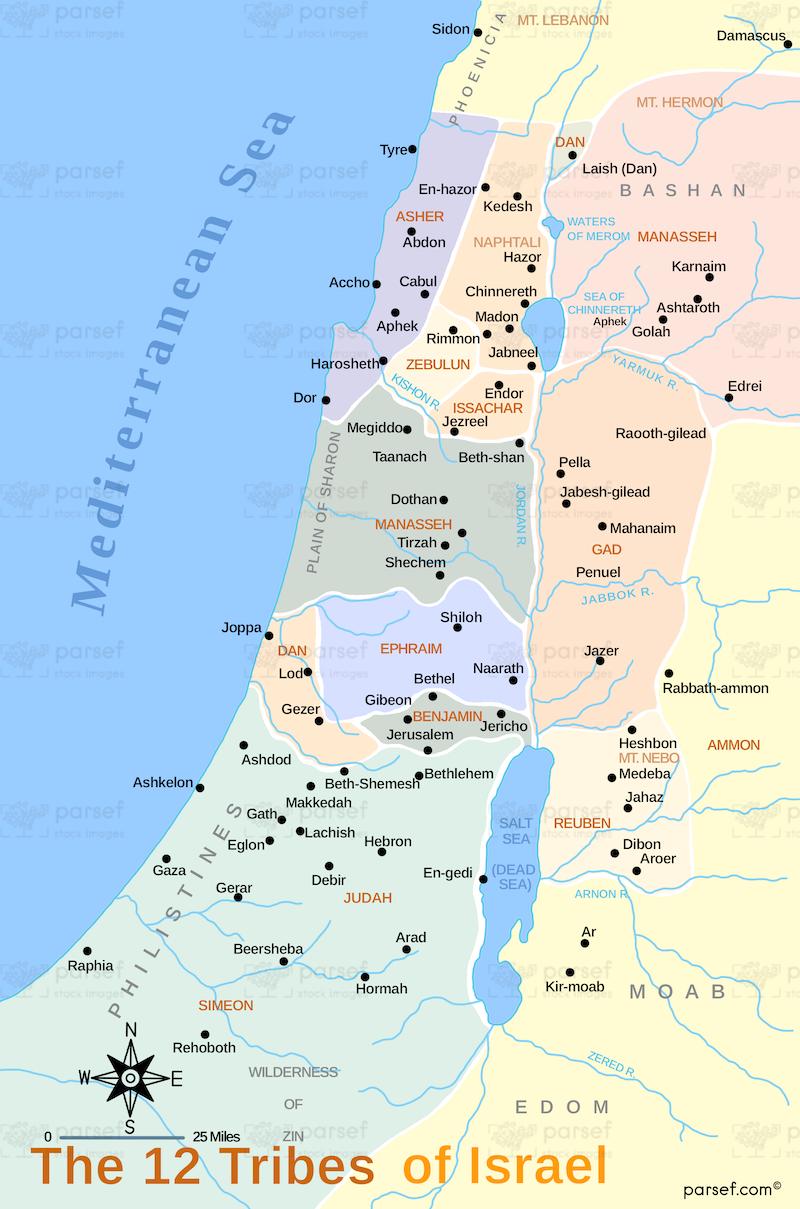
Abner took Ishbosheth to Mahanaim which was in Gad on the other side of the Jordan, perhaps because it was close to Jabesh Gilead where Saul was buried, and maybe because it was away from David at Hebron, as seen on this map borrowed from Free Bible:


Abner apparently had the power, or at least he took it upon himself, to make Ishbosheth king of all Israel with the exception of Judah where David had been made king.

(10) Ishbosheth Saul's son was forty years old when he began to reign over Israel and reigned two years. But the house of Judah followed David. (11) And the time that David was king in Hebron over the house of Judah was seven years and six months.

Ishbosheth was forty years old when he began to reign over Israel, and he reigned for two years.  The tribe of Judah considered David their king, and he reigned over Judah for seven years and six months.  Evidently, it was a common belief that Ishbosheth reigned over Israel the whole time that David reigned over Judah, so perhaps the meaning is that Ishbosheth reigned two years before the following took place:

(12) And Abner the son of Ner and the servants of Ishbosheth the son of Saul went out from Mahanaim to Gibeon. (13) And Joab the son of Zeruiah and the servants of David went out and met together at the pool of Gibeon, and they sat down, the one on the one side of the pool and the other on the other side of the pool.

Abner, now the commander of Ishbosheth's army, along with the servants of Ishbosheth, went out from Mahanaim to the other side of the Jordan to Gibeon.  Zeruiah was David's sister, and it appears that Joab her son was the captain of David's army.  Joab and the servants of David went to the pool of Gibeon where Abner's army was, and they sat by the pool on one side across from Abner and his army.

(14) And Abner said to Joab, "Let the young men now arise and play before us." And Joab said, "Let them arise."

Abner told Joab to let the young men arise and "play," as gladiators or duelers might, to see who was the most skilled in the use of the sword.  Joab agreed to let his men arise and play.

(15) And then there arose and went over by number twelve of Benjamin of Ishbosheth the son of Saul, and twelve of the servants of David.

Twelve men from Ishbosheth's army went over the pool to meet twelve men of David's army.

(16) And they caught every one his fellow by the head and thrust his sword into his fellow's side so they fell down together; therefore that place was called Helkathhazzurim, which is in Gibeon.

The twelve of David's men each caught their opponent by the head and thrust his sword into his opponent's side so that all twelve of Abner's men fell down together.  They called that place Helkathhazzurim, which literally meant "Field of Swords" in Gibeon.

(17) And there was a very sore battle that day, and Abner was beaten and the men of Israel, before the servants of David. 

There was a very severe battle that day, and in the end, David's men won the "game" defeating Abner's men.

(18) And there were three sons of Zeruiah there, Joab, and Abishai, and Asahel; and Asahel was as light of foot as a wild roe.

There were actually three sons of David's sister there, Joab, Abishai, and Asahel.  Asahel was said to be as swift of foot as a wild deer.

(19) And Asahel pursued after Abner, and in going he turned not to the right hand nor to the left from following Abner.

Asahel pursued after Abner, straight after him, not turning his attention to the right or the left.

(20) Then Abner looked behind him, and said, "Are you Asahel?" And he answered, "I am." (21) And Abner said to him, "Turn aside to your right hand or to your left, and lay hold of one of the young men, and take his armor." But Asahel would not turn aside from following him.

Abner looked behind him and saw Asahel, and Asahel confirmed that it was indeed him.  Abner told him to turn aside to the left or right and take hold of one of his soldiers and take his armor, rather than pursuing him, but Asahel would not turn aside from following Abner.

(22) And Abner said again to Asahel, "Turn aside from following me, for why should I strike you to the ground? How then should I hold up my face to Joab your brother?"

Abner warned Asahel to turn from following him or else he would be forced to strike him, which he apparently did not really want to do.  After all, neither he nor Joab had been "playing," and he did not want to have to face Joab if he struck Asahel.

(23) However, Asahel refused to turn aside; therefore Abner with the hinder end of the spear struck him under the fifth rib that the spear came out behind him, and he fell down there and died in the same place; and it came to pass, as many as came to the place where Asahel fell down and died, stood still.

Asahel refused to turn aside, and he, being swift as a wild deer, was surely gaining on Abner, and Abner felt he must strike or be killed himself.  It seems as if Abner's spear had a pointed head on both ends, and he struck Asahel behind him by thrusting his spear backwards at him.  He struck Asahel under the fifth rib, and the spear went all the way through him, coming out his back, and he fell down and died.  All who came up to the place where he died were dumbfounded and just stood there, not pursuing Abner or any of his men.

(24) Joab also and Abishai pursued after Abner, and the sun went down when they had come to the hill of Ammah that lies before Giah by the way of the wilderness of Gibeon.

However, it seems that Joab and Abishai, Asahel's brothers, had been pursuing after Abner behind Asahel, and they continued pursuing him.  The sun had gone down when they reached the hill of Ammah before Giah by the road of the wilderness of Gibeon.  The exact locations of these places are unknown, but they must have been near to Gibeon.

(25) And the children of Benjamin gathered themselves together after Abner and became one troop and stood on the top of a hill.

Men from the tribe of Benjamin came out behind Abner and formed a troop at the top of a hill against Joab and Abishai and their men.

(26) Then Abner called to Joab, and said, "Shall the sword devour forever? Don't you know that it will be bitterness in the latter end? How long shall it be then until you bid the people return from following their brethren?"

Abner called out to Joab asking if they should continue the battle of the swords forever until it resulted in a bitter end, with the killing of a great number more men and perhaps even him and Joab themselves.  He asked how long it would be before Joab called off his men from following their brethren.  He now called the men of Israel and the men of Judah brethren, but that didn't seem to bother him when he first suggested the brethren "play."

(27) And Joab said, "As God lives, unless you had spoken, surely then in the morning the people would have gone up every one from following his brother."

Joab answered, and I believe the sense is that had Abner not spoken as he had, Joab's army would have pursued all night and not quit until the morning.  Or perhaps he meant that had Abner not spoken in the first place to have the men "play," Joab's men would never have pursued them that morning or day.

(28) So Joab blew a trumpet, and all the people stood still, and pursued after Israel no more, neither did they fight anymore.

So Joab blew a trumpet which signaled his men to stop from pursuing and fighting with the men of Israel.

(29) And Abner and his men walked all that night through the plain and passed over Jordan and went through all Bithron, and they came to Mahanaim.

So Abner and his men walked all night through the plain and across the Jordan River, back to their place in Mahanaim.

(30) And Joab returned from following Abner, and when he had gathered all the people together, there lacked of David's servants nineteen men and Asahel. (31) But the servants of David had struck of Benjamin and of Abner's men, three hundred and sixty men who died.

Joab returned from following Abner, and when he gathered all his men together, he found that nineteen men plus Asahel had been killed.  However, they had killed 360 of Abner's men and the men of Benjamin.

(32) And they took up Asahel and buried him in the sepulchre of his father which was in Bethlehem. And Joab and his men went all night, and they came to Hebron at break of day.  

Joab and his men took the body of Asahel and buried him in the sepulcher of his father, Zeruiah's husband, which was in Bethlehem.  Then they walked all night and came back to Hebron at daybreak the next morning.

The Lord had rejected Saul and now he was dead, but David, the Lord's choice for king, the man after His own heart, still was not made king over all Israel.  In fact, it seems a civil war was brewing between Judah and Israel.  Abner, probably more for his own benefit and power, set up Saul's son Ishbosheth as king of Israel.  God allowed this testing and refining time for David.  After all, David had been just a shepherd boy.  He had a heart for the Lord, but he needed time to mature and develop the leadership qualities to be king.  After all, he was to become Israel's greatest king and from his line of descendants would come the Messiah.  God was preparing David for his awesome role in Biblical history.

Saturday, April 18, 2026

David Spares Saul's Life Again

Continuing a chronological Bible study:

(1 Samuel 26:1) And the Ziphites came to Saul to Gibeah, saying, "Does David not hide himself in the hill of Hachilah, before Jeshimon?"

David had gone to Carmel where he met and married Abigail.  He apparently then hid out in a hill of Hachilah before Jeshimon which was a wilderness north of Hachilah.  Being in close proximity to Ziph, the Ziphites knew David's movements and went to Saul a second time to tell on David (1 Samuel 23:19).  It seems strange that David would hide out in the same area where the Ziphites had told on him before, but perhaps he wanted to stay close to Abigail's home.  This map at Bible Hub shows where Ziph and Hachilah were in relation to Carmel:


(2) Then Saul arose and went down to the wilderness of Ziph, having three thousand chosen men of Israel with him, to seek David in the wilderness of Ziph.

So much for the good will Saul had seemed to offer after David had spared his life in the cave (1 Samuel 24:17-20), when he heard where David was hiding, his anger toward David was renewed, and he went to the wilderness of Ziph to seek him, taking 3000 choice men, meaning surely men of war, with him.

(3) And Saul pitched in the hill of Hachilah before Jeshimon, by the road.  But David abode in the wilderness, and he saw that Saul came after him into the wilderness.

Saul encamped at the hill of Hachilah by the road.  David had moved to the wilderness around Hachilah and saw that Saul had come after him.

(4) David therefore sent out spies and understood that Saul had indeed come. (5) And David arose and came to the place where Saul had pitched, and David beheld the place where Saul lay, and Abner, the son of Ner, the captain of his host; and Saul lay in the trench, and the people pitched round about him.

David had sent out spies who confirmed that Saul had indeed come.  He then went to where Saul was encamped and saw him in the trench with Abner, the captain of his army, and the rest of his army pitched around him.

(6) Then David answered and said to Ahimelech the Hittite and to Abishai the son of Zeruiah, brother to Joab, saying, "Who will go down with me to Saul to the camp?" And Abishai said, "I will go down with you."

David spoke to two men with him, Ahimelech, probably a Hittite at birth who had converted, and Abishai, who was the son of David's sister, Zeruiah, as was Joab.  He asked which one of them would go with him down to Saul's camp, and his nephew, Abishai, said he would go with him.

(7) So David and Abishai came to the people by night, and behold, Saul lay sleeping within the trench and his spear stuck in the ground at his bolster, and Abner and the people lay round about him.

David and Abishai went to Saul's camp at night.  Saul was sleeping in the trench with his spear stuck in the ground at his pillow, or whatever he was using as a headrest.  Abner and the rest of his army lay all around him.

(8) Then Abishai said to David, "God has delivered your enemy into your hand this day; now therefore, let me strike him, I pray you, with the spear even to the earth at once, and I will not strike him the second time."

I believe the sense of what Abishai said to David was that the Lord had delivered Saul to him, and he asked that he be allowed to strike Saul with a spear clear to the ground, and he would not have to strike a second time because Saul would surely be dead.

(9) And David said to Abishai, "Do not destroy him, for who can stretch forth his hand against the Lord's anointed and be guiltless?"

However, David told Abishai not to kill Saul, because he believed no one was able to raise a hand against the Lord's anointed king and not incur guilt for his actions.

(10) David said furthermore, "As the Lord lives, the Lord shall strike him, or his day shall come to die, or he shall descend into battle and perish. (11) The Lord forbid that I should stretch forth my hand against the Lord's anointed, but I pray you, take now the spear that is at his bolster, and the jug of water, and let us go."

David told Abishai the Lord would take his own anointed king in His time in His manner, so he would not dream of doing it himself.  However, he did tell Abishai to take Saul's spear and a jug of water which would be sufficient to let Saul know they had been there and what they could have done if they so desired.

(12) So David took the spear and the jug of water from Saul's bolster, and they got away, and no man saw nor knew, neither awaked, for they were all asleep because a deep sleep from the Lord had fallen upon them.

It was David, in fact, who took the spear and the jug of water.  Perhaps the meaning of verse 11 was more like, "let us take the spear...and go."  Even though Saul was surrounded by his captain and all his army, none of them awakened because the Lord had caused a deep sleep to come over them.  David and Abishai got away unnoticed.

(13) Then David went over to the other side and stood on the top of a hill afar off, a great space between them, (14) And David cried to the people and to Abner, the son of Ner, saying, "Do you not answer, Abner?" Then Abner answered and said, "Who are you who cries to the king?"

David went away from the camp and stood on a hill far away, but close enough, that the people would hear him when he shouted.  It seems David must have been crying out before Abner actually heard him, as he cried out to Abner to answer him as if he had not answered his previous call.  Abner asked who it was who was calling to the king.  Again, it seems evident David had been calling out to Saul before he was heard or was acknowledged.

(15) And David said to Abner, "Are you not a man? And who is like you in Israel? Why then have you not kept your lord, the king? For there came one of the people in to destroy the king your lord. (16) This thing is not good that you have done. As the Lord lives, you are worthy to die because you have not kept your master, the Lord's anointed. And now see where the king's spear is and the jug of water that was at his bolster."

David sarcastically asked Abner if he was a man like no other in Israel, and if so, why then had he let someone have access to the king to destroy him?  David told Abner he was worthy of death because he had not protected the king.  He then showed him where the king's spear and jug of water were that had been at the king's headrest while he slept.

(17) And Saul knew David's voice, and said, "Is this your voice, my son David?" And David said, "My voice, my lord, O king."

Saul knew David's voice and called out to ask if it was indeed David's voice he heard.  It's interesting that Saul still called him, "my son," even though he had given David's wife to someone else and pursued him to kill him.  David answered that it was indeed him.

(18) And he said, "Why does my lord thus pursue after his servant? For what have I done? Or what evil in my hand? (19) Now therefore, I pray you, let my lord the king hear the words of his servant. If the Lord has stirred you up against me, let Him accept an offering, but if the children of men, cursed they before the Lord, for they have driven me out this day from abiding in the inheritance of the Lord, saying, 'Go serve other gods.'"

David asked Saul why he pursued him and what he had done to stir him up against him.  He said if it was the Lord who had stirred Saul up against him, then let Him receive an offering, probably meaning himself that he would give if it was indeed the Lord's will.  I don't think David would have used such flippant language if he was sincere about an offering to the Lord to appease His anger toward himself or Saul, either one.  His point was that if God had stirred Saul to kill him, then so be it.  However, if it was men by lies and slanders, then let them be cursed before God because they had driven an innocent man away from his inheritance and forced him to dwell among pagan idolaters.

(20) "Now therefore, do not let my blood fall to the earth before the face of the Lord, for the king of Israel has come out to seek a flea, as when one hunts a partridge in the mountains."

David asked that Saul not spill his blood before the Lord who knew who was righteous and would surely avenge his death.  And that was because Saul hunted someone as insignificant as a flea, or as one out bird hunting.

(21) Then Saul said, "I have sinned. Return, my son David, for I will no more do you harm because my soul was precious in your eyes this day. Behold, I have played the fool and have erred exceedingly."

Saul once again softened toward David, even acknowledging his sin this time which is more than he did the first time David spared his life (1 Samuel 24:17).  He told David to return to his home for he would do him no harm because he had spared his life that day.  He admitted that he had been foolish and mistaken about David.

(22) And David answered and said, "Behold the king's spear! Let one of the young men come over and fetch it."

David returned Saul's spear to him.  However, he asked that one of Saul's young men go and fetch it from David, as he was not so trusting of Saul's apparent change of heart to go down and deliver it to him himself.

(23) "The Lord render to every man his righteousness and his faithfulness, for the Lord delivered you into my hand today but I would not stretch forth my hand against the Lord's anointed. (24) And behold, as your life was much set by this day in my eyes, so let my life be much set by in the eyes of the Lord, and let Him deliver me out of all tribulation."

David went on to suggest that the Lord be the one to render judgment to every man, or perhaps his point was that he had faith that the Lord would render to him according to his faithfulness.  After all, the Lord had delivered Saul into his hand that day, but he would not dare to strike the Lord's anointed.  Then he proposed to Saul that as he had valued Saul's life that day, so let the Lord value his (David's) life and deliver him out of his tribulation.  It's noteworthy that he did not say that Saul should value his life as David had valued his.  He had no confidence in Saul to do the fair thing, but he knew he could depend on his Lord.

(25) Then Saul said to David, "Blessed you, my son David; you shall both do great and also shall still prevail." So David went on his way, and Saul returned to his place.

Saul offered a blessing to David and called him his son again.  He acknowledged that David would go on to do great things, and he would prevail, which seems to be a realization that David would prevail against Saul himself and all his enemies.  So he returned to his palace, and David went on his way.  John Wesley, in his Notes on the Bible, tells us that this was the last time Saul and David saw each other.  It seems Saul may have finally come to the full realization that the Lord was with David, and he would indeed prevail against him and his army of David's enemies.

Monday, October 6, 2025

Jonathan Defeats the Philistines

Continuing a chronological Bible study:

(1 Samuel 14:1) Now it came to pass one day that Jonathan, the son of Saul, said to the young man who bore his armor, "Come and let us go over to the Philistines' garrison that is on the other side." But he did not tell his father.

At the end of the last chapter, three companies of Philistines had pretty much surrounded Saul, Jonathan, and their small army of six hundred men.  The Philistines were busy plundering the land and not immediately intent on attacking Saul and his men.  It appears they must have remained like that for at least a couple of days or more, because "one day" Jonathan, Saul's son, decided it was time to do something.  He told his armor-bearer that they should go over to the Philistine garrison that was on the other side of them.  However, he did not tell his father of his plan.

(2) And Saul tarried in the uttermost part of Gibeah under a pomegranate tree in Migron, and the people with him were about six hundred men, (3) And Ahijah, the son of Ahitub, Ichabod's brother, the son of Phinehas, the son of Eli, the Lord's priest in Shiloh, wearing an ephod. And the people did not know that Jonathan was gone.

Saul waited in the uppermost part of Gibeah under a pomegranate tree in Migron which was north of Gibeah in the field of Gibeah.  He still had his six hundred men, no more or no less, and that included Ahijah the priest.  He came from the line of Eli who had been the Lord's priest in Shiloh.  Ichabod was the child that Phinehas's wife bore prematurely on hearing the news that the ark had been taken and that her husband and Eli, her father-in-law, had died (1 Samuel 4:19).  Ichabod apparently had an older brother named Ahitub, whose son was Ahijah.  Saul and the people with him did not know that Jonathan was gone.

(4) And between the passages, by which Jonathan sought to go over to the Philistines' garrison, a sharp rock on the one side and a sharp rock on the other side, and the name of the one Bozez and the name of the other Seneh. 

I believe "the passages" refers to the common passageways from one place to another that were now obstructed by the Philistines.  Jonathan had to find another way to cross over to the Philistine garrison.  Between the passages were two large sharp rocks that were known and even named, one Bozez meaning "shining" which might suggest smooth and slippery, and the other Seneh meaning "thorn" or "bramble."  

(5) The forefront of the one was situated northward opposite Michmash and the other southward opposite Gibeah.

I believe the sense is that both rocks were in the way between the passages, not across from each other, but the northern one faced Michmash and the southern one faced Gibeah.

(6) And Jonathan said to the young man who bore his armor, "Come and let us go over to the garrison of these uncircumcised; it may be that the Lord will work for us, for there is no restraint to the Lord to save by many or by few."

Jonathan again told his armor bearer that they should go over to the garrison of the Philistines, and in additional encouragement, he said that the Lord might do the work for them, as there was no limit to God's power.  God could save with an army or with just a few men.  That shows that Jonathan had great faith in the Lord.  He hadn't said that the Lord would definitely do the work for them, because he had not received a word from the Lord, but he had no doubt that his Lord was well able if it was in His will to do so.

(7) And his armorbearer said to him, "Do all that is in your heart; turn, behold, I am with you according to your heart."

Jonathan's armor bearer told Jonathan to do what was in his heart to do, to turn the way he wanted to go, and he would willingly follow him.

(8) Then Jonathan said, "Behold, we will pass over to these men, and we will let them discover us. (9) If they say thus to us, 'Wait until we come to you,' then we will stand still in our place and will not go up to them. (10) But if they say thus, 'Come up to us,' then we will go up, for the Lord has delivered them into our hand, and this be a sign to us."

Jonathan told his armor bearer that they would pass over to the Philistines and let them discover them.  Then if the Philistines told them to wait there until they came to them, they would stand there and not go to them.  However, if they said, "Come up to us," they would see that as a sign that the Lord had delivered the Philistines into their hands, and they would indeed go to the Philistines.  That would be a sign from the Lord telling them what they should do.

It's funny; my first instinct was that Jonathan should have prayed to the Lord, that it was a bit arrogant to set up his own scheme and expect the Lord to go along with it.  Well, for one thing, we don't know that Jonathan didn't pray first.  He probably did have some sort of leading to make him take such a bold step.  But then I also realized that I have done the same thing.  When the Lord doesn't speak directly to you, then asking Him to show you the right way between two choices with a sign from Him seems perfectly acceptable and shows faith in Him to direct your paths, "In all your ways acknowledge Him, and He shall direct your paths" (Proverbs 3:6).  Jonathan did acknowledge God and His power to save them (verse 6), and he had faith that He would direct them in the way they should go.

(11) And both of them showed themselves to the garrison of the Philistines, and the Philistines said, "Behold, the Hebrews come forth out of the holes where they had hid themselves."

Jonathan and his armor bearer did indeed reveal themselves to the Philistines at that post, and the Philistines took note among themselves that the Hebrews had come out of hiding.

(12) And the men of the garrison answered Jonathan and his armor bearer, and said, "Come up to us, and we will show you something." And Jonathan said to his armor bearer, "Come up after me, for the Lord has delivered them into the hand of Israel."

The men at the garrison responded to Jonathan and his armor bearer's presence, by telling them to come up to them and they would show them something.  Jonathan told his armor bearer to follow him, as he had full faith and confidence that the Lord had delivered those Philistines into Israel's hand.  Not that it made a difference in the way the Philistines told them to come to them, but they did use the exact phrase "Come up to us" that Jonathan had put forth in his plan (verse 10). 

(13) And Jonathan climbed up upon his hands and upon his feet, and his armor bearer after him, and they fell before Jonathan, and his armor bearer slew after him.

Jonathan climbed up on his hands and knees in a way not easily accessible.  He didn't go the way the Philistines would have expected him to go on the main passageway.  He evidently caught the men off guard, and they fell before him.  Obviously, we know Who really knocked them down.  His armor bearer then killed the men.

(14) At that first slaughter which Jonathan and his armor bearer made, was about twenty men, within as it were a half acre of land.

Jonathan and his armor bearer killed about twenty men at that garrison and within half an acre from it.

(15) And there was trembling in the host, in the field, and among all the people. The garrison and the spoilers, they also trembled, and the earth quaked, so it was a very great trembling.

The Philistine host trembled with fear, those in the field, and among all the people.  Men inside the garrison who had not been outside and killed, and the plunderers who ravaged the land, were also terrified and panic-stricken, especially when the earth began to quake, as well, which was surely by God.

(16) And the watchmen of Saul in Gibeah of Benjamin looked, and behold, the multitude melted away, and they went on stampeding.

The watchmen of Saul at Gibeah saw the Philistine army melting away, as they fled and stampeded over one another.

(17) Then Saul said to the people with him, "Number now, and see who is gone from us." And when they had numbered, behold, Jonathan and his armor bearer were not there.

Saul then ordered a roll be taken, and when it was, it was discovered that Jonathan and his armor bearer were not there.

(18) And Saul said to Ahijah, "Bring the ark of God here" (for the ark of God was at that time with the children of Israel).

Saul told the priest Ahijah to bring the ark of God to him, for the Israelites had brought the ark with them.

(19) And it came to pass, while Saul talked to the priest, that the noise in the host of the Philistines went on and increased, and Saul said to the priest, "Withdraw your hand."

While Saul was talking to the priest, the noise of the Philistines grew louder, and Saul told the priest to stop what he was doing, which was surely to inquire of the Lord over the ark.  Saul once again showed some impatience.

(20) And Saul and all the people with him assembled themselves, and they came to battle, and behold, every man's sword was against his fellow, very great confusion.

Saul and his men assembled themselves to battle against the Philistines, but they witnessed their enemy fighting themselves because there was so much confusion.  God, whom Saul was too impatient to hear from, had already taken care of the matter.

(21) Moreover, the Hebrews who were with the Philistines before that time, who went up with them into the camp from round about, even they also turned to be with the Israelites who were with Saul and Jonathan.

The Israelites who had been with the Philistines as their servants, had also gone with the Philistines to their camp from the areas round about the camp.  They then went and joined Saul and Jonathan.

(22) Likewise, all the men of Israel who had hid themselves in Mount Ephraim, when they heard that the Philistines fled, even they also followed hard after them in the battle.

Additionally, the men of Israel who had been hiding in Mount Ephraim, in caves, rocks, thickets, and pits (1 Samuel 13:6), when they heard that the Philistines had fled, they also joined Saul's army and chased after the fleeing Philistines.  The historian Josephus wrote that at this time Saul's army had increased to 10,000.

(23) So the Lord saved Israel that day, and the battle passed over to Beth Aven. 

So the Lord had saved Israel that day with only two men, as Jonathan had had faith He could (verse 6).  Now the battle shifted to Beth Aven. 

(24) And the men of Israel were distressed that day for Saul had adjured the people, saying, "Cursed the man who eats food until evening, that I may be avenged on my enemies." So none of the people tasted food.

It appears that when Saul had assembled his people to pursue the Philistines (verse 20), he had given them a strict order that none of them was to eat anything until the evening so that no time would be lost in making victory over the Philistines, that "he" might be avenged on "his" enemies.  That sounds a bit arrogant and self-centered considering it had been Jonathan and his armor bearer who had thus far done the avenging.

(25) And all the land came to a wood, and there was honey on the ground. (26) And when the people had come into the wood, behold, the honey dropped, but no man put his hand to his mouth, for the people feared the oath.

As the people were pursuing the Philistines, they came into a wooded area where there was honey on the ground.  Honey was dripping all over, but no one dared pick up any to eat because of the severe command of Saul that carried with it a curse (verse 24).

(27) But Jonathan had not heard when his father charged the people with the oath; therefore he put forth the end of the rod that was in his hand and dipped it in a honeycomb and put his hand to his mouth, and his eyes were enlightened.

Jonathan had not heard his father's order, and he took his rod and dipped the end of it in a honeycomb and ate the honey.  His eyes brightened as he became refreshed.

(28) Then answered one of the people who said, "Your father straitly charged the people with an oath, saying, 'Cursed the man who eats food this day.'" And the people were faint.

Someone spoke up and told Jonathan that his father had ordered that no one eat until the evening and had issued the order with a curse. And all the people were faint with hunger.

(29) Then Jonathan said, "My father has troubled the land. See, I pray you, how my eyes have been enlightened because I tasted a little of this honey. (30) How much more, if the people had eaten freely today of the spoil of their enemies which they found? For now would there not have been a much greater slaughter among the Philistines?"

Jonathan said that his father had distressed the people with his order.  He told the people to observe how his eyes had brightened because he was refreshed with a little bit of honey.  He added that had the people been allowed to eat freely of the spoil of the Philistines as they came upon it, there would probably have been a much greater slaughter of their enemies by that time.

(31) And they struck the Philistines that day from Michmash to Aijalon, and the people were very faint.

The people struck the Philistines from Michmash, the place where the camp of the Philistines was when Jonathan first attacked them, to Aijalon in Judah, about twelve miles.  It appears the people did not eat the honey as Jonathan had encouraged them to do.  By this time, they were extremely faint.  

(32) And the people flew upon the spoil, and took sheep, and oxen, and calves, and killed them on the ground, and the people ate them with the blood.

The people were so starved they rushed upon the spoil of the Philistines and took sheep, oxen, and calves, and killed them on the spot and ate them raw with the blood still in them, which was against God's law.  

(33) Then they told Saul, saying, "Behold, the people sin against the Lord in that they eat with the blood." And he said, "You have transgressed; roll a great stone to me this day." (34) And Saul said, "Disperse yourselves among the people, and say to them, 'Bring me here every man's ox, and every man's sheep, and slaughter them here, and eat, and do not sin against the Lord in eating with the blood.'" And all the people brought every man his ox with him that night and killed them there.

It was told to Saul that the people had sinned against the Lord in eating flesh with the blood.  Saul then told the people that they had sinned and asked that a large stone be rolled to him.  He then sent word among the people to bring their oxen and their sheep, whatever they intended to eat, and slaughter them there on the stone where they could properly drain the blood, and thusly not sin against the Lord.  All the people brought their animals that night to the stone and killed them there. 

So it was night by the time the people flew upon the spoil of the Philistines and ate ravenously flesh of the animals with the blood.  So they had waited to eat until the evening.  Note that the people feared the order of Saul more than they feared sinning against the Lord.   

(35) And Saul built an altar to the Lord; the same was the first altar that he built to the Lord.

Saul built an altar to the Lord.  It was the first one he had built himself.  He had before sacrificed at altars that were already there, but this was the first he built himself.   

(36) And Saul said, "Let us go down after the Philistines by night and plunder them until the morning light, and let us not leave a man of them." And they said, "Do whatever seems good to you." Then the priest said, "Let us draw near here to God."

Saul then proposed that they go after the Philistines by night and plunder them all night long until the morning light and not leave a man of them alive.  The people agreed to do whatever Saul thought was right.  Then the priest suggested that they should draw near to God to ask what He wanted them to do.

(37) And Saul asked counsel of God, "Shall I go down after the Philistines? Will You deliver them into the hand of Israel?" But He did not answer him that day.

Saul had already made up his mind what he wanted to do.  He just wanted God to bless his plan.  He had not inquired of God first what he should do.  He went through the motions now that the priest had suggested it, and he asked God if he should go after the Philistines, and would He deliver them into the hand of Israel.  But God did not answer him.  From the beginning, Saul had not waited for instruction from the Lord.  In verse 19, he was too impatient to wait for the priest to inquire of the Lord and had gone through with his own plan.  He had made a foolish strict order that caused the people to sin.  He now made a decision to go after the Philistines that night and now made a show of pretending that he sought the Lord's guidance.  The Lord did not play that game.

(38) And Saul said, "Draw near here, all the chief of the people, and know and see where this sin has been this day. (39) For as the Lord lives who saves Israel, though it be in Jonathan my son, he shall surely die." But not a man among all the people answered him.

Saul called all the chiefs of the people together to determine what sin had been committed that day, for he concluded that the reason the Lord didn't answer was because there was sin among them.  He never considered it might be his own.  Then Saul made another rash oath.  He said as the Lord who saved Israel lived, even if the sin was found in his own son, even he would die.  But none of the people answered him.  They knew Jonathan had eaten honey against his father's order, but he had done it unknowingly, and besides, they probably had affection for him as he was the one who had truly saved them that day.

Saul did proclaim that the Lord was the one who saved Israel, but in his arrogance, he was more concerned about someone not obeying his order than any real sin against God.  If someone disobeyed his order, was that really a sin?  It always seems that Saul gives a show of religion, but God is not the true object of his heart.  It always seems to be about Saul first.  Jesus said in Matthew 15:9, "But in vain they do worship Me, teaching for doctrines the commandments of men."  James said in James 1:26, "If any man among you seems to be religious and does not bridle his tongue, but deceives his own heart, this man's religion is vain."  Those seem to sum up Saul pretty well.

(40) Then he said to all Israel, "You be on one side, and I and Jonathan my son will be on the other side." And the people said to Saul, "Do what seems good to you." (41) Therefore Saul said to the Lord God of Israel, "Give a perfect lot." And Saul and Jonathan were taken, but the people escaped.

Then Saul spoke to all the people, instructing them to divide into two groups, he and Jonathan on one side against all the people on the other.  The people again told Saul he should do what seemed good to him.  Saul then asked the Lord to give a perfect lot, as if He didn't always, and have it land on the guilty party.  The lot showed that the guilty party was among Saul and Jonathan, and the people were shown to be innocent.

(42) And Saul said, "Cast between me and Jonathan my son." And Jonathan was taken.

Saul, having no sense of his own guilt, would have his own son put to death because he did not obey his order.  It's interesting that God would show Jonathan as the guilty one.  Eating the honey was not a sin against God.  However, it wasn't God's intention that Jonathan be killed, but rather to reveal Saul's arrogant rashness in making such an oath.

(43) Then Saul said to Jonathan, "Tell me what you have done." And Jonathan told him, and said, "I only tasted a little honey with the end of the rod in my hand; lo, I must die."

Saul asked Jonathan what he had done to have the lot fall to him, what "sin" had he committed?  Jonathan told him that he had only tasted a little honey with the end of his rod, and for that, he must die.  Jonathan didn't even try to defend himself with the fact he had not heard his father's order.  He willingly accepted his fate.  Or was he rather pointing out that for so trivial a matter, he must die, pointing out the absurdity of so harsh a punishment for something that was not a sin against God.  Since God was using this as a lesson for Saul, I'm sure His spirit could have been directing responses.

(44) And Saul answered, "God do so and more also, for you shall surely die, Jonathan."

Saul's point was that God may do even more evil if he did not follow through with his oath, so he told Jonathan he must surely die.

(45) And the people said to Saul, "Shall Jonathan die, who has wrought this great salvation in Israel? God forbid! As the Lord lives, there shall not one hair of his head fall to the ground, for he has worked with God this day." So the people rescued Jonathan that he did not die.

The people spoke up for Jonathan, asking if Jonathan with whom God had surely worked to bring salvation to Israel should die.  It was obvious that he had not offended God, but God had used him mightily to save Israel.  Adam Clarke put it this way, in his Commentary on the Bible, "Here was a righteous and impartial jury, who brought in a verdict according to the evidence."  After all, no man should die except for a breach of the law of God, and Jonathan had not broken any law of God, so he should not die.  So the people rescued Jonathan from his death penalty, but actually, it was God who saved him by exposing Saul's arrogance and recklessness.

(46) Then Saul went up from following the Philistines, and the Philistines went to their own place.

Saul gave up following the Philistines since he did not get an answer from the Lord, and he probably thought he had lost the opportunity, since his plan had been to attack at night.  The Philistines who remained went back to their own place.

(47) So Saul took the kingdom over Israel and fought against all his enemies on every side, against Moab, and against the children of Ammon, and against Edom, and against the kings of Zobah, and against the Philistines, and wherever he turned himself, he vexed them. (48) And he gathered a host and struck the Amalekites and delivered Israel out of the hands of those who plundered them.

Saul established his sovereignty over Israel.  It seemed to have been taken from him when he was in Gibeah with only 600 men and surrounded by Philistines.  Having obtained victory over the Philistines, he recovered his kingdom and resumed his administration.  He fought his enemies on all sides, defending Israel against them.  Wherever he turned, he troubled his enemies.  He assembled an army and struck the Amalekites, as well, delivering Israel out of the hands of all who plundered them.

(49) Now the sons of Saul were Jonathan, and Ishui, and Malchishua, and the names of his two daughters were, the name of the firstborn Merab, and the name of the younger Michal.

Saul had three sons, Jonathan, Ishui, and Malchishua, and two daughters, Merab and Michal.  Actually, Dr. John Gill, in his Exposition of the Bible, pointed out that Saul had other children.  He had another son named Ishbosheth, sometimes called Eshbaal.  The commentators I study presume that the reason he wasn't mentioned here is because the author intended to mention only Saul's sons who went with him into the battles.  Saul also had other children by a concubine, or second wife, Rizpah.

(50) And the name of Saul's wife was Ahinoam, the daughter of Ahimaaz, and the name of the captain of his army was Abner, the son of Ner, Saul's uncle. (51) And Kish, the father of Saul, and Ner, the father of Abner, were the sons of Abiel.

Saul's wife was Ahinoam, the daughter of Ahimaaz.  The captain of his army was Abner, the son of Saul's uncle Ner, making Abner his cousin.  Saul's father Kish and his uncle Ner were brothers and the sons of Abiel.

(52) And there was fierce war against the Philistines all the days of Saul, and when Saul saw any strong man, or any valiant man, he took him to him.

Saul continued to fight fierce battles against the Philistines all the days of his life.  Whenever he saw any strong or valiant man, he took them for his purposes, just as Samuel had forewarned the people he would do, in 1 Samuel 8:11, "This will be the manner of the king who shall reign over you: he will take your sons and appoint them for himself..."