Showing posts with label Jesse. Show all posts

Sunday, June 14, 2026

David Anointed King Over All of Israel

Continuing a chronological Bible study:

(2 Samuel 5:1) Then came all the tribes of Israel to David to Hebron, and spoke, saying, "Behold we, your bone and your flesh."

In the last chapter and post, Ishbosheth, the acting king of all Israel except for Judah where David was king, had been murdered, and David had the murderers executed for their crime.  Now representatives of all the tribes of Israel came to David.  They spoke to David and began by telling him they acknowledged that they were all part of the family of Israel.

(2) "Also in time past, when Saul was king over us, you were he who led out and brought in Israel, and the Lord said to you, 'You shall feed My people Israel, and you shall be a captain over Israel.'"

The reps told David that they realized that when Saul was king of all Israel, it had been David who led out the armies of Israel to fight against their enemies, obtained victories, and brought them home again.  They also acknowledged that the Lord had said that David was to tend His flock, His people Israel, and that He was to reign over them.  Once again, as in 2 Samuel 3:18, we have words quoted as the Lord's words of which we don't find in the Bible.  The Lord probably did say those words at some point, and they had become known by the people.

(3) So all the elders of Israel came to the king to Hebron, and King David made a league with them in Hebron before the Lord, and they anointed David king over Israel.

Then all the elders of Israel came to David at Hebron, and David made an agreement with them, surely promising to rule over all of Israel justly and righteously, and this he did before the Lord and in His name, I'm sure.  So the elders anointed David king over all of Israel. 

(1 Chronicles 11:1) Then all Israel gathered themselves to David to Hebron, saying, "Behold we, your bone and your flesh."

This same incident is recorded in 1 Chronicles 11.  Representatives of all Israel, as all the people of Israel could not have all come, came to David acknowledging that they were all of one family of Israel.

(2) "And moreover in time past, even when Saul was king, you were he who led out and brought in Israel, and the Lord your God said to you, 'You shall feed My people Israel, and you shall be ruler over My people Israel." (3) Therefore came all the elders of Israel to the king to Hebron, and David made a covenant with them in Hebron before the Lord, and they anointed David king over Israel, according to the word of the Lord by Samuel.

As stated before, the reps acknowledged that even when Saul was king, it was David who had led the troops to victories and brought them home again.  They also knew that the Lord had told David he was to rule over Israel.  So the elders of Israel came to David, and David made a covenant with all Israel, and they anointed him king of all Israel as the Lord had determined when He spoke to the prophet Samuel (1 Samuel 16:1).

(1 Chronicles 12:23) And these are the numbers of the bands ready armed for war who came to David to Hebron to turn the kingdom of Saul to him, according to the word of the Lord.

1 Chronicles 12 numbers the men who were able men of war who came to David in Hebron to make him king over all of Israel in the following verses.

(24) The children of Judah who bore shield and spear, six thousand and eight hundred, ready armed for war.

From the tribe of Judah that had already made David their king, 6800 armed men ready for war came to David.

(25) Of the children of Simeon, mighty men of valor for war, seven thousand and one hundred. (26) Of the children of Levi, four thousand and six hundred.

From the tribe of Simeon, 7100 valiant men of war came to David.  Even from the tribe of Levi, who were the priests and their attendants, 4600 men came to David.

(27) And Jehoiada was the leader of the Aaronites, and with him, three thousand and seven hundred; (28) And Zadok, a young man mighty of valor, and of his father's house, twenty-two captains.

The Aaronites were Levites, but these would have been direct descendants of Aaron.  Jehoiada was captain over that family, and he alone brought 3700 men with him.  Also from the tribe of Levi came Zadok, a young man of valor, and 22 captains from his father's house.

(29) And of the children of Benjamin, the kindred of Saul, three thousand (for until then the greatest part of them had kept the ward of the house of Saul).

Only 3000 men came from the tribe of Benjamin, as it seems being of the family of Saul, most men maintained their allegiance to the house of Saul up to that point.

(30) And of the children of Ephraim, twenty thousand and eight hundred mighty men of valor, famous throughout the house of their fathers. 

From the tribe of Ephraim, a whopping 20,800 famous men of valor came to David in Hebron.

(31) And of the half tribe of Manasseh, eighteen thousand who were expressed by name to come and make David king.

From the half tribe of Manasseh that was on the same side of the Jordan River, 18,000 men who were expressly named, either specifically called by name for the purpose, or by volunteering by name, came to David to make him king.

(32) And of the children of Issachar who had understanding of the times to know what Israel ought to do, the heads of them were two hundred, and all their brethren were at their command.

The men of the tribe of Issachar it seems had a unique understanding of the times to know what Israel should do.  There were two hundred heads, and the rest were at their command, apparently having full confidence in their leaders' direction.  Perhaps this meant only 200 went to David to make him king, but all the tribe would have been in agreement that he should be made king.

(33) Of Zebulun, such as went forth to battle, expert in war, with all instruments of war, fifty thousand who could keep rank, not of double heart.

The tribe of Zebulun sent 50,000 men of war who were experts in all instruments of war and ready to organize and go to war if necessary.  These men were steadfast in their loyalty to David.

(34) And of Naphtali, a thousand captains, and with them with shield and spear, thirty-seven thousand.

The tribe of Naphtali sent 1000 captains and 37,000 armed men with them.

(35) And of the Danites, expert in war, twenty-eight thousand and six hundred. (36) And of Asher, such as went forth to battle, expert in war, forty thousand.

From the tribe of Dan came 28,600, and from Asher, 40,000, all men expert in war.

(37) And on the other side of Jordan, of the Reubenites, and the Gadites, and of the half tribe of Manasseh, with all manner of instruments of war for the battle, a hundred and twenty thousand.

From the eastern side of the Jordan River came 120,000 men from the tribes of Reuben, Gad, and the other half tribe of Manasseh, with all manner of instruments of war with them.

(38) All these men of war who could keep rank, came with a perfect heart to Hebron to make David king over all Israel, and all the rest also of Israel were of one heart to make David king.

All these mighty men of valor, well-disciplined and well able to organize for war, if necessary, came with a perfect heart and one mind to make David king over all of Israel.  And it seems that by that time, all of Israel was unanimous in making David king, even the tribe of Benjamin, Saul's tribe.

(39) And there they were with David three days, eating and drinking, for their brethren had prepared for them. (40) Moreover, they who were near them, even to Issachar and Zebulun and Naphtali, brought bread on asses, and on camels, and on mules, and on oxen, meat, meal, cakes of figs, and bunches of raisins, and wine, and oil, and oxen, and sheep abundantly, for there was joy in Israel.

All these tens of thousands of men were with David for three days, celebrating, eating, and drinking, for their brethren who were near enough to them, even as far as the tribes of Issachar, Zebulun, and Naphtali, brought huge amounts of food and wine on all animals that could carry it.  There was great joy in Israel for the people were united again as one people Israel under King David.  This map borrowed from Maps of the World shows the twelve tribes at this time:

(1 Chronicles 29:26) Thus David the son of Jesse reigned over all Israel.

From that point onward, David reigned over all of Israel.

(2 Samuel 5:5) In Hebron he reigned over Judah seven years and six months, and in Jerusalem he reigned thirty-three years over all Israel and Judah.

David had reigned over Judah in Hebron for seven years and six months.  He was about to begin his reign over all of Israel which would last thirty-three years.

Thursday, May 14, 2026

The Death of Saul

Continuing a chronological Bible study:

(1 Samuel 31:1) Now the Philistines fought against Israel, and the men of Israel fled from before the Philistines and fell down slain in Mount Gilboa.

When we last left the Philistines and the Israelites, the Philistines had positioned themselves to attack Israel, and Saul had gone to a medium to find out what he should do, as the Lord would no longer answer him.  This is likely the next day, as he had received word of what would happen to him the next day after his consultation.  The Philistines began their attack on the Israelites, and the Israelites had fled from them but were evidently caught and killed at Mount Gilboa.

(2) And the Philistines followed hard on Saul and on his sons, and the Philistines killed Jonathan, and Abinadab, and Malchishua, Saul's sons.

The Philistines pushed hard on Saul and his sons, and eventually killed Saul's sons, Jonathan, Abinadab, and Malchishua.

(3) And the battle went sore against Saul, and the archers hit him, and he was sore wounded of the archers.

The battle went badly for Saul, and he was hit by Philistine archers.  He was evidently severely wounded by the archers.

(4) Then Saul said to his armorbearer, "Draw your sword and thrust me through with it, lest these uncircumcised come and thrust me through and abuse me." But his armorbearer would not, for he was sore afraid. Therefore Saul took a sword and fell upon it.

Saul told his armorbearer to draw his sword and finish him off so that the uncircumcised (pagan) Philistines would not have a chance to abuse and kill him.  However, his armorbearer was afraid to do such a thing, so Saul took a sword himself and fell upon it.

(5) And when his armorbearer saw that Saul was dead, he fell likewise upon his sword and died with him. (6) So Saul died, and his three sons, and his armorbearer, and all his men, that same day together.

When Saul's armorbearer saw that Saul was dead, he fell upon his sword also and died with Saul.  So it was that Saul, his three sons, his armorbearer, and all his men, all died that same day, as had been foretold by the spirit supposedly conjured up by the medium (1 Samuel 28:19).

(7) And when the men of Israel on the other side of the valley and those on the other side of the Jordan, saw that the men of Israel fled and that Saul and his sons were dead, they forsook the cities and fled, and the Philistines came and dwelt in them.

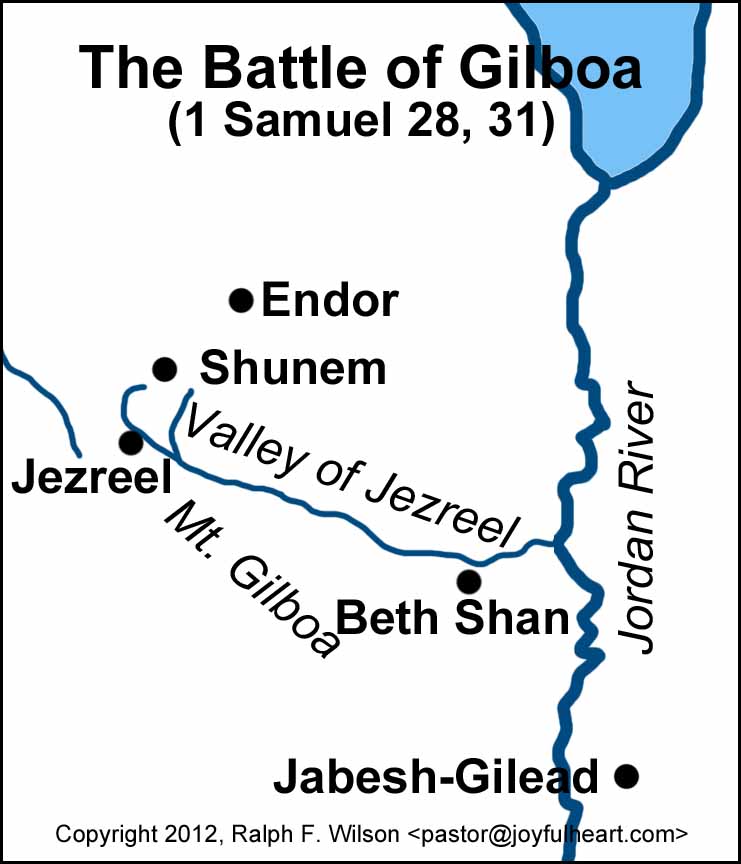
When the Israelites who were on the other side of the valley from where the battle took place, as well as those just over the Jordan River in that area, saw that their brethren fled and that Saul and his sons were dead, they, too, fled from their cities, and the Philistines came and dwelt in them.  This map previously borrowed from Jesus Walk shows that area:


(8) And it came to pass on the next day, when the Philistines came to strip the slain, that they found Saul and his three sons fallen in Mount Gilboa. (9) And they cut off his head and stripped off his armor and sent into the land of the Philistines round about, to publish it in the house of their idols and among the people. (10) And they put his armor in the house of Ashtaroth, and they fastened his body to the wall of Beth Shan.

The next day, when the Philistines went to strip all the bodies to take what was valuable as their spoil, they found Saul and his sons dead at Mount Gilboa.  They cut off Saul's head and stripped off his armor and proclaimed the news throughout the land of the Philistines round about them, and in the house of their idols to whom they surely ascribed the success they had.  They then took Saul's body and hung it on a wall in Beth Shan where they then dwelt.  They put his armor in the house of their idol, much like Goliath's sword had been placed in the tabernacle (1 Samuel 21:9).  I find it sad that Saul had wanted to kill himself so that the Philistines would not abuse his body, but they had still abused it in death.

(11) And when the inhabitants of Jabesh Gilead heard of that which the Philistines had done to Saul, (12) All the valiant men arose and went all night and took the body of Saul and the bodies of his sons from the wall of Beth Shan and came to Jabesh and burned them there.

When the inhabitants of Jabesh, which was further south and on the other side of the Jordan, as seen on the map above, heard what the Philistines had done to Saul, valiant men rose up and traveled all night to Beth Shan, and they took Saul's body and the bodies of his sons, which it seems were also hung on the wall, back to Jabesh and burned them there.  It was out of respect and gratitude to their king that they removed his body and the bodies of his sons that had been hung as trophies for the Philistines.  There was no time or safe place or perhaps it was even too late to embalm the bodies and give them a safe burial, but it was also a sign of respect that they burned the mutilated bodies and prevented any possible further abuse from the enemy.

(13) And they took their bones and buried them under a tree at Jabesh and fasted seven days.

The men of Jabesh Gilead then took the bones of Saul and his sons and buried them under a tree there, and they fasted for seven days in honor and mourning for Saul.

(1 Chronicles 10:1) Now the Philistines fought against Israel; and the men of Israel fled from before the Philistines, and fell slain on Mount Gilboa.

1 Chronicles 10:1-14 retells the incidence of Saul's death.  The Philistines fought against Israel, and the Israelites fled from before them and were killed at Mount Gilboa.

(2) And the Philistines followed hard after Saul and after his sons, and the Philistines killed Jonathan, and Abinadab, and Malchishua, the sons of Saul.

The Philistines pushed hard after Saul and his sons, and they killed his three sons, Jonathan, Abinadab, and Malchishua.

(3) And the battle went sore against Saul, and the archers hit him, and he was wounded by the archers. (4) Then Saul said to his armorbearer, “Draw your sword, and thrust me through with it, lest these uncircumcised come and abuse me." But his armorbearer would not, for he was sore afraid. So Saul took a sword and fell upon it. (5) And when his armorbearer saw that Saul was dead, he also fell on his sword and died. (6) So Saul died, and his three sons, and all his house died together.

1 Chronicles 10:3-6 retells the killing of Saul, almost verbatim.  The Philistine archers had wounded him, and he asked his armorbearer to finish him off so that the Philistines would not abuse him.  However, the armorbearer could not bring himself to do it, so Saul fell on a sword himself and died.  Thus Saul, his three sons, and all his house died together.

(7) And when all the men of Israel who were in the valley saw that they had fled and that Saul and his sons were dead, they forsook their cities and fled, and the Philistines came and dwelt in them. (8) And it came to pass on the next day, when the Philistines came to strip the slain, that they found Saul and his sons fallen in Mount Gilboa. (9) And when they had stripped him, they took his head, and his armor, and sent into the land of the Philistines round about, to carry tidings to their idols, and to the people.

When the Israelites all around the region saw their brethren fleeing and heard what had happened to Saul and his sons, they too fled, and the Philistines took over the cities.  The Philistines went the next day and stripped Saul of his armor and cut off his head, and they sent word round about in the land of the Philistines to let their people and their idols know what they had done.

(10) And they put his armor in the house of their gods and fastened his head in the temple of Dagon.

The Philistines put Saul's armor in the house of their gods, Ashtaroth being named specifically in the account recorded in 1 Samuel 31.  Here in 1 Chronicles 10, a new bit of information is added in that the Philistines fastened Saul's head in the temple of their god, Dagon.

(11) And when all Jabesh Gilead heard all that the Philistines had done to Saul, (12) They arose, all the valiant men, and took away the body of Saul, and the bodies of his sons, and brought them to Jabesh, and buried their bones under the oak in Jabesh, and fasted seven days.

With the combination of 1 Samuel 31:11-13 and 1 Chronicles 10:11-12, we have a more complete account of what the valiant men of Jabesh Gilead did when they heard what the Philistines had done to Saul.  They traveled all night and took the body of Saul and the bodies of his sons from the wall of Beth Shan and came to Jabesh and burned them there.  Then they took the bones of Saul and his sons and buried them under an oak tree there, and they fasted for seven days in honor and mourning for Saul.

(13) So Saul died for his transgression which he committed against the Lord, against the word of the Lord which he did not keep, and also for asking of a familiar spirit to enquire, (14) And enquired not of the Lord; therefore He slew him and turned the kingdom to David the son of Jesse.

Thus Saul died for his transgressions, acting at least three times in direct contradiction to the commandments of the Lord, not waiting on Samuel to offer a burnt offering (1 Samuel 13:12-13), sparing the king of Amalek as well as the choice livestock (1 Samuel 15:3), and by consulting a medium (Leviticus 19:31).  Verse 14 suggests that Saul did not enquire of the Lord, but he did, and the Lord would not answer him (1 Samuel 28:6).  However, the idea is that one must not inquire of witches, wizards, or fortune-tellers, but only of the Lord their God.  And had Saul enquired of the Lord long before he did, he would have avoided his desperation in the end.  The Lord had finally taken Saul out, giving the kingdom to David, as He had planned for a long time (1 Samuel 15:28).  He likely would not have killed Saul, had he been more humble and gracious and compliant to God's will.

And thus ends the reign of Saul, chosen by God against His will, to teach the people how an earthly king would always fail because he was nothing but a flawed human, but the people had chosen that for themselves rather than to be led by their perfect God (1 Samuel 8:7).  Saul was at first a good and humble man when God chose him to reign over His people (1 Samuel 9:17), but he became proud and jealous over time and even somewhat deranged in the end.  Now God would have David to reign over His people, a man after His own heart, but still a flawed man.

Sunday, April 12, 2026

David and Abigail

Continuing a chronological Bible study:

(1 Samuel 25:1) And Samuel died, and all the Israelites were gathered together and lamented him and buried him in his house at Ramah. And David arose and went down to the wilderness of Paran.

David had spared Saul's life and returned to his stronghold.  Meanwhile, Samuel had died.  All the Israelites had gathered together to mourn his death, and they buried him at his house in Ramah.  The first 24 chapters of the book of Samuel were thought to have been written by Samuel himself, but obviously he could not have written the rest of 1 Samuel and 2 Samuel after he died.  Those have been attributed to the prophets Nathan and Gad.  

David came out of his hiding place and went down to the wilderness of Paran.  Scripture doesn't say specifically that he went there upon hearing of Samuel's death or that he went there to mourn him.  The wilderness of Paran was far south of Ramah.

(2) And was a man in Maon whose possessions were in Carmel, and the man very great, and he had three thousand sheep and a thousand goats, and he was shearing his sheep in Carmel.

Meanwhile, there was a man in Maon, north of the wilderness of Paran, in the tribe of Judah, who was very wealthy and had 3000 sheep and 1000 goats.  His possessions were in Carmel, just north of Maon, and he was there in Carmel shearing his sheep.

(3) Now the name of the man was Nabal, and the name of his wife, Abigail, a woman of good understanding and of a beautiful countenance, but the man was churlish and evil in his doings, and he was of the house of Caleb.

The name of the man was Nabal, and he was a rude and evil man of the house of Caleb.  Interestingly, his name meant "fool."  His wife was Abigail, and it appears she was a knowledgeable woman with common sense.  She was also beautiful.

(4) And David heard in the wilderness that Nabal was shearing his sheep, (5) And David sent out ten young men, and David said to the young men, "Get up to Carmel, and go to Nabal, and greet him in my name."

David heard that Nabal was shearing his sheep in Carmel, and he sent out ten men to go to Carmel to meet with Nabal and greet him in David's name.

(6) And thus you shall say to him who lives, "Peace to you, and peace to your house, and peace to all that you have. (7) And now I have heard that you have shearers. Now your shepherds who were with us, we did not hurt them, neither was anything missing from them, all the while they were in Carmel."

David told the ten young men to first offer a blessing of peace to Nabal and to his house and all that he had.  Evidently, David had had occasion to be with Nabal's shepherds, probably because the sheep were feeding near the wilderness of Paran which was not far from Maon and Carmel.  David wanted his messengers to tell Nabal this, and to let him know that he and his army had not hurt the shepherds, nor taken anything from them.

(8) "Ask your young men, and they will show you. Therefore, let the young men find favor in your eyes, for we come on a good day. Give, I pray you, whatever comes to your hand to your servants and to your son David."

David, through his messengers, would ask that Nabal ask his own shepherds to verify that he and his army had not harmed them in any way.  Therefore, David hoped one good turn deserved another and his messengers found favor in his eyes.  They had gone to Nabal on a good day when he would be making a feast for his shearers, as was the custom.  David would have his messengers ask if they might be given whatever was at hand that might be spared for David and his men.

(9) And when David's young men came, they spoke to Nabal according to all those words in the name of David and ceased.

David's messengers went to Nabal and told him all that David had told them to say.  Then they waited for Nabal's reply.

(10) And Nabal answered David's servants, and said, "Who is David? And who is the son of Jesse? There are many servants nowadays who break away every man from his master. (11) Shall I then take my bread and my water and my flesh that I have killed for my shearers and give it to men whom I do not know where they are from?"

However, Nabal answered David's servants with haughtiness and disdain.  Could it be that he actually did not know David and Jesse, or was it his way of saying that it meant nothing to him whoever had sent them?  That appears to be the more likely case.  After all, David and Nabal were from the same tribe, and surely he knew the fame of David who had slain his ten thousands (1 Samuel 21:11).  He suggested that David and his men were nothing more than rebellious servants who had broken away from their master, and he would never consider giving any of his food and drink that he had prepared for his own shearers to just anyone from who knows where.

(12) So David's young men turned their way and went again and came and told him all those sayings.

David's messengers left Nabal and went back to David and told him all that Nabal had said.

(13) And David said to his men, "Gird you every man his sword." And they girded on every man his sword, and David also girded on his sword, and there went up after David about four hundred men, and two hundred stayed by the stuff.

David did not take Nabal's rudeness and condescension lightly.  He instructed his men to gird themselves with their swords, which four hundred of them did while the other two hundred remained with their supplies.

(14) But one of the young men told Abigail, Nabal's wife, saying, "Behold, David sent messengers out of the wilderness to salute our master, and he railed on them."

One of Nabal's men told Abigail, Nabal's wife, about David sending messengers to salute her husband.  The original word "barak" that was translated as "salute" means more completely "to bless, to kneel," so David's men had certainly conveyed humility, kindness, and respect toward Nabal.  However, Nabal had berated them with contempt.

(15) "But the men were very good to us, and we were not hurt, neither did we miss anything, as long as we were conversant with them when we were in the fields. (16) They were a wall to us both by night and day all the while we were with them keeping the sheep."

The young man told Abigail how David and his men had been very good to them while they had been in close proximity to them in the wilderness.  They did not hurt them nor take anything from them all the while they were near them in the fields.  As a matter of fact, they had been a wall of protection to them, protecting and defending them against those who might have done them harm.

(17) "Now therefore, know and consider what you will do, for evil is determined against our master and against all his household, for he is a son of Belial that one cannot speak to him."

The young man told Abigail that something bad was about to happen because of how her husband had treated David and his men.  It's interesting that a servant of her husband felt comfortable enough to call him a son of Belial, an evil worthless man, to his wife.  She obviously knew what kind of man her husband was and that no one could speak to him reasonably and rationally.  The man told Abigail to consider what she should do to prevent destruction to her household.

(18) Then Abigail made haste and took two hundred loaves, and two bottles of wine, and five sheep ready dressed, and five measures of parched grain, and a hundred clusters of raisins, and two hundred cakes of figs, and laid them on asses. (19) And she said to her servants, "Go on before me; behold, I come after you." But she did not tell her husband Nabal.

Abigail hurriedly gathered many provisions, loaves, wine, dressed sheep, parched corn, raisins, and fig cakes, and laid them upon donkeys.  She sent her servants on before her, saying she would come after them.  She did not tell her husband Nabal what she was doing.

(20) And it was as she rode on the ass, that she came down by the cover of the hill, and behold, David and his men came down toward her, and she met them.

I believe the sense is that Abigail came on her donkey on the side of the hill under a cover of bushes or trees and saw David and his men before they saw her.  Then she met them.

(21) Now David had said, "Surely in vain have I kept all that he had in the wilderness, so that nothing was missed of all that was his, and he has requited me evil for good. (22) So and more also do God to the enemies of David if I leave of all that is his by the morning light any who pisses against the wall."

David HAD said, so I don't believe he said this to Abigail, but these were the things he had said and was intending to do at that moment.  David felt he had foolishly been good to Nabal's men expecting good in return, but Nabal had returned evil for David's good.  I believe the sense of what David said after that was that he wished the Lord to bless his enemies and perhaps pour evil on himself if he left even one male, man or beast, before the morning.  This was obviously rash and excessive anger on David's part that, and if followed through, would have brought death and destruction to many innocent people.

(23) And when Abigail saw David, she hasted, and lighted off the ass, and fell before David on her face, and bowed herself to the ground, (24) And fell at his feet, and said, "On me, my lord, on me this iniquity! And let your handmaid, I pray you, speak in your audience, and hear the words of your handmaid."

When Abigail saw David, she hurried and dismounted her donkey and fell on her face at David's feet.  She pleaded with him to put all the blame of her husband's actions on her and to allow her to speak in her defense.  She calls him her lord as a sign of respect and reverence to him, probably to atone for her husband's rudeness in speaking of him as a runaway servant (verse 10).

(25) "Let not my lord, I pray you, regard this man of Belial, Nabal, for as his name is, so is he; Nabal his name, and folly with him, but I your handmaid did not see the young men of my lord whom you sent."

Abigail pleaded with David not to pay any attention to such a foolish and worthless man as her husband.  She said he was just as his name indicated, a fool, and therefore his actions were foolish.  However, she said, she had not seen the young men David had sent to her husband.

(26) "Now therefore, my lord, as the Lord lives and your soul lives, seeing the Lord has withheld you from coming to bloodshed and from avenging yourself with your own hand, now let your enemies and they who seek evil to my lord, be as Nabal. (27) And now this blessing which your handmaid has brought to my lord, let it be given to the young men who follow my lord."

Abigail said that as surely as the Lord lived (and David), the Lord had so far withheld David from committing the bloodshed he had intended to avenge himself.  Therefore she prayed a curse upon the enemies of David, either that they be as foolish and utterly impotent to hurt David as was her husband, or that David's anger toward Nabal and his vengeance fall upon his enemies who deserved it more than this foolish man, her husband.  Then as a blessing, she asked that all that she had brought with her (verse 18) be given to David's men.

(28) "I pray you, forgive the trespass of your handmaid, for the Lord will certainly make my lord a sure house, for my lord fights the battles of the Lord, and evil has not been found in you all your days. (29) Yet a man has risen to pursue you and to seek your soul, but the soul of my lord shall be bound in the bundle of life with the Lord your God; and the souls of your enemies, them shall He sling out, as from the middle of a sling."

Abigail asked that David forgive her intrusion in troubling him with her petition.  She either knew the fame of David and that he was blessed by God, or she spoke under influence of the Holy Spirit.  It was probably a bit of both.  She told him that the Lord was going to make an enduring house of David because he fought the battles of the Lord.  She knew no evil had been found in him, yet a man (Saul) had risen up to pursue him and to ultimately kill him.  However, she knew that David's life was bound up in the bundle of life with the Lord, precious to Him, favored and preserved by Him.  But the lives of his enemies the Lord would cast out as quickly and forcefully as a stone slung from a slingshot.

(30) "And it shall come to pass, when the Lord shall have done to my lord according to all the good that He has spoken concerning you, and shall have appointed you ruler over Israel, (31) That this shall be no grief to you, nor offense of heart to my lord, either that you have shed blood without cause, or that my lord has avenged himself. But when the Lord shall have dealt well with my lord, then remember your handmaid."

Abigail continued with her plea to David.  She asked that when the Lord had fulfilled His promise to make him ruler over Israel, that this incident be of no grief or regret to him because he had avenged himself and shed innocent blood without cause.  However, when the Lord had dealt well with David in delivering him out of the hands of his enemies and seating him as king of Israel, she wished for him to remember her and her plea and advice not to shed blood.

(32) And David said to Abigail, "Blessed the Lord God of Israel, who sent you this day to meet me. (33) And blessed is your advice, and blessed are you, because you have kept me this day from coming to bloodshed and from avenging myself with my own hand."

David recognized the hand of the Lord in sending Abigail to meet him and praised Him.  He was also thankful to Abigail for giving him such good advice and preventing him from doing something he would surely have regretted if he had shed innocent blood just to avenge himself because of one foolish man.

(34) "For indeed, as the Lord of Israel lives, who has kept me back from hurting you, except you had hasted and come to meet me, surely there would not have been left to Nabal by the morning light any that pisses against the wall."

David admitted that as surely as the Lord lived, He who had kept David from hurting Abigail, had she not hurried and come to meet him, he would have killed Nabal and all the males of men and beasts in his house and in his employ by morning light.

(35) So David received of her hand what she had brought him, and said to her, "Go up in peace to your house; see, I have hearkened to your voice and have respected your person."

David received the gifts that Abigail had brought on her donkeys.  After all, that is all he had requested of Nabal, even less (verse 8).  He told her to go back to her house in peace for he had respected her and listened to her and had done what she requested.

(36) And Abigail came to Nabal, and behold, he held a feast in his house, like the feast of a king, and Nabal's heart was merry within him, for he was very drunk; therefore, she told him nothing, less or more, until the morning light.

When Abigail returned to her house to Nabal, she found he had held a great feast in his house, and he was very drunk.  Therefore she told him nothing of her encounter with David.

(37) But it came to pass in the morning, when the wine had gone out of Nabal, and his wife had told him these things, that his heart died within him, and he became as a stone.

The next morning, when Nabal was sober again, Abigail told him all that had transpired between her and David.  Nabal, probably terrified at the notion of what he had barely escaped and perhaps feared it might still happen, passed out and became motionless as a stone.

(38) And it came to pass about ten days after, that the Lord struck Nabal that he died.

After being in a comatose state for about ten days, the Lord struck Nabal with death.

(39) And when David heard that Nabal was dead, he said, "Blessed the Lord, who has pleaded the cause of my reproach from the hand of Nabal and has kept his servant from evil, for the Lord has returned the wickedness of Nabal upon his own head. And David sent and communed with Abigail to take her to him as wife.

When David heard that Nabal was dead, he praised the Lord for preventing him from doing evil but taking up his cause Himself and issuing judgment. "'Vengeance is Mine,' saith the Lord" (Romans 12:19).  And the Lord's way was much more just, as He just took out Nabal and no one else in his family or household.  David then sent messengers to Abigail and asked her to be his wife.

(40) And when the servants of David had come to Abigail to Carmel, they spoke to her, saying, "David sent us to you, to take you to him as wife." (41) And she arose and bowed herself on her face to the earth, and said, "Behold, your handmaid, a servant to wash the feet of the servants of my lord."

David had sent servants to Abigail at her home in Carmel, and they told her that David had sent for her to be his wife.  With the same humility she had shown to David when she met with him, Abigail bowed herself before the servants and said she considered herself only worthy to be a servant to wash the feet of David's servants.  It was as Abigail had requested, "...when the Lord shall have dealt well with my lord, then remember your handmaid." (verse 31)  The Lord had Himself dealt with this man who had done David wrong and brought this good woman to him to be his wife.

(42) And Abigail hurried, and arose, and rode on an ass, with five damsels of hers who went after her, and she went after the messengers of David, and became his wife.

Abigail hurried and rode on a donkey after the messengers of David and brought with her five damsels or maidservants who rode after her.  She indeed became David's wife.

(43) David also took Ahinoam of Jezreel, and they were also both of them his wives.

David also took Ahinoam of Jezreel, a town of Judah near Carmel.  This was not the same Ahinoam as was married to Saul (1 Samuel 14:50).  So both Abigail and Ahinoam were David's wives.

(44) But Saul had given Michal his daughter, David's wife, to Phalti, the son of Laish, who was of Gallim.

It seems that Saul had previously given David's wife Michal, who was Saul's daughter, to another man in marriage, Phalti or Phaltiel, as called elsewhere.  David’s taking of two wives could be seen as indicative of his growing power and importance, although he was still being pursued by Saul.

Saturday, January 10, 2026

Saul Kills the Priests at Nob

Continuing a chronological Bible study:

David had returned to the land of Judah, his own tribe, upon the counsel of the prophet Gad.

(1 Samuel 22:6) When Saul heard that David was discovered, and the men with him (now Saul abode in Gibeah under a tree in Ramah, having his spear in his hand, and all his servants standing about him), 

Saul's residence was in Ramah.  He was there, with a spear forever in his hand, it seems, and all his servants were around him.  He heard that David's whereabouts had been discovered.

(7) Then Saul said to his servants who stood about him, "Hear now, you Benjamites, will the son of Jesse give every one of you fields and vineyards, and make you all captains of thousands and captains of hundreds? (8) That all of you have conspired against me and none who shows me that my son has made a league with the son of Jesse, and none of you is sorry for me, or shows to me that my son has stirred up my servant against me, to lie in wait, as at this day?"

Upon hearing the whereabouts of David, Saul asked his servants if David would give them fields and vineyards and make them captains so that they would betray Saul and conspire against him.  He suspected that his son Jonathan was in league with David, yet none of his servants would tell him what they knew.  Were they at all concerned for him that they wouldn't tell him what they knew about Jonathan stirring up David against him, as he assumed was the case.

(9) Then answered Doeg the Edomite, who was set over the servants of Saul, and said, "I saw the son of Jesse coming to Nob to Ahimelech the son of Ahitub. (10) And he enquired of the Lord for him and gave him victuals and gave him the sword of Goliath the Philistine."

Doeg, Saul's chief herdsman (1 Samuel 21:7), had seen David when he was with Ahimelech.  He now spoke up and told Saul about it.  He told him that the priest had given David food and the sword of Goliath, but he also added that Ahimelech had inquired of the Lord for David, but we were not told that that had happened.

(11) Then the king sent to call Ahimelech the priest, the son of Ahitub, and all his father's house, the priests in Nob, and they came all of them to the king.

Saul then sent for Ahimelech the priest and all his family who were also priests in Nob, and they all came to him.  It is important to note that these priests were the descendants of Eli, the priest to whom Hannah had dedicated her son Samuel so that he might minister to the Lord all his life.

(12) And Saul said, "Hear now, you son of Ahitub." And he answered, "Here I am, my lord." (13) And Saul said to him, "Why have you conspired against me, you and the son of Jesse, in that you have given him bread, and a sword, and have enquired of God for him, that he should rise against me, to lie in wait, as at this day?"

Saul asked Ahimelech why he had conspired against him to help David to give him bread, a sword, and had inquired of the Lord for him, so that he could rise up in rebellion against him, and to lie in wait, waiting for an opportunity to seize his crown and kingdom, as Saul supposed were David's intentions.

(14) Then Ahimelech answered the king, and said, "And who is so faithful among all the servants as David who is the king's son-in-law and goes at your bidding and is honorable in your house? (15) Did I then begin to enquire of God for him? Be it far from me; let not the king impute anything to his servant, nor to all the house of my father, for your servant knew nothing of all this, less or more."

Ahimelech answered the king, first telling him that he knew David to be the honorable son-in-law of the king, faithful to do whatever the king asked of him.  However, he said that it was far from him to have inquired of the Lord for him, which I suppose must have been a duty which he owed to Saul alone as king of Israel.  He then asked Saul not to charge him or his family with any treason against the king, as he knew nothing about ill feelings between Saul and his son-in-law.

(16) And the king said, "You shall surely die, Ahimelech, you and all your father's house." (17) And the king said to the footmen who stood about him, "Turn and slay the priests of the Lord because their hand also is with David, and because they knew when he fled, and did not show it to me." But the servants of the king would not put forth their hand to fall upon the priests of the Lord.

Saul told Ahimelech that he and his family would die because of what he considered treason against the king.  He told his footmen who were standing around him to kill all the priests of the Lord who were before him because he considered them conspirators with David against him.  He accused them of knowing where David had fled and not telling him where.  However, the footmen would not kill the priests of the Lord.

(18) And the king said to Doeg, "You turn and fall upon the priests!" And Doeg the Edomite turned, and he fell upon the priests and killed on that day eighty-five men who wore a linen ephod.

Saul then told Doeg to kill the priests, which he did, eighty-five of them.  This fulfilled a promise of God that He would end Eli's descendants' reign as priests because of the iniquity of his sons, and Eli had done nothing to restrain them (1 Samuel 3:12-14).  The Biblical commentators I study pointed out that Doeg was again called the Edomite to separate him from the nation of Israel.  The Edomites were a brutal and violent people who hated Israel.  They descended from Esau, Jacob's brother, who traded his birthright for red stew.  He was called Edom after that which meant "red."  Doeg had no problem killing any Israelites even if they were priests.

(19) And Nob, the city of priests, he struck with the edge of the sword, both men and women, children and infants, and oxen, and donkeys, and sheep, with the edge of the sword.

So ruthless was Doeg that he killed all the inhabitants of Nob, even women, children, and even babies, and all animals.  However, the order surely came from Saul which made this the most wicked and cruel act of his, showing he was totally under the influence of the evil spirit that plagued him.

Tuesday, December 16, 2025

Jonathan Warns David, and David Leaves

Continuing a chronological Bible study:

(1 Samuel 20:1) And David fled from Naioth in Ramah and came and said before Jonathan, "What have I done? What is my iniquity? And what is my sin before your father that he seeks my life?"

When we last left David, Saul had his servants surrounding David's house at night waiting to kill him the next morning, but his wife Micah let him down out a window where he fled to Samuel in Ramah, and then Samuel and David went to Naioth.  Saul went to Naioth after him, but the Lord put a spirit of prophecy on Saul, and he was detained a day and a night, giving David time to escape from Naioth.  He came to Jonathan and begged to know what he had done that made Saul seek to kill him.

(2) And he said to him, "God forbid, you shall not die; behold, my father will do nothing either great or small, but that he will show it to me; and why should my father hide this thing from me? It is not so."

Jonathan told David he was sure his father was not trying to kill him because his father always told him his plans, great or small, and he could not believe that his father would hide so great a thing from him.  He was sure it was not true.

(3) And David swore moreover, and said, "Your father certainly knows that I have found grace in your eyes, and he said, 'Do not let Jonathan know this, lest he be grieved,' but truly, as the Lord lives and your soul lives, there is but a step between me and death."

David swore to Jonathan that he knew it to be true.  He told him that his father surely knew that David had found great favor with Jonathan and that he had hidden his intentions from Jonathan because of their great friendship.  He swore to him that he knew his life was in imminent danger.

(4) Then Jonathan said to David, "Whatever your soul desires, I will do for you." (5) And David said to Jonathan, "Behold, tomorrow is the new moon, and I should not fail to sit with the king at the meal, but let me go that I may hide myself in the field until the third day at evening."

Jonathan assured David he would do whatever David asked him to do.  David told him that the next day was the new moon which was the first day of the month, as the months of the Hebrews were lunar months, counted from new moon to new moon.  On the new moon they offered sacrifices and had a feast (Numbers 28:11), and David said he would be expected to join the king at the feast.  However, he asked Jonathan to let him go and hide out until the third day when the feast was over.

(6) "If your father at all misses me, then say, 'David earnestly asked of me that he might run to Bethlehem his city, for a yearly sacrifice there for all the family.'"

David told Jonathan that if his father asked about him, to tell him that David wanted to go to Bethlehem for a yearly sacrifice there for all his family.  That may have been true and not just an excuse as his family did indeed make yearly sacrifices (1 Samuel 1:21).

(7) "If he says thus, 'It is well,' your servant shall have peace, but if he is very angry, be sure that evil is determined by him."

David told Jonathan that if his father said that it was well and good that David should go to his family feast, then he knew he would be safe.  However, if his father became very angry, then Jonathan could be sure that Saul determined evil against David.

(8) "Therefore you shall deal kindly with your servant, for you have brought your servant into a covenant of the Lord with you; notwithstanding, if there is in me iniquity, slay me yourself, for why should you bring me to your father?"

David knew that Jonathan would deal kindly with him because of a covenant of friendship between Jonathan and David, of which Jonathan had been the initiator.  However, David said that if there was any iniquity found in him, he implored that Jonathan kill him himself rather than bring him to his father.

(9) And Jonathan said, "Far be it from you! For if I knew certainly that evil was determined by my father to come upon you, then wouldn't I tell you?"

Jonathan told David that thought should be far from him that he would conceal his father's ill intentions against him.  If he had known of any such intentions, he would have certainly told David.

(10) Then David said to Jonathan, "Who shall tell me? Or what if your father answers you roughly?"

David asked Jonathan how he would know how Saul had responded when he wasn't at the feast.  What if his father dealt with him harshly because he knew that he loved David and may have protected him?

(11) And Jonathan said to David, "Come and let us go out into the field." And both of them went out into the field. (12) And Jonathan said to David, "O Lord God of Israel, when I have sounded out my father anytime tomorrow or the third day, and behold, if there is good toward David, and then I do not send to you and show it to you, (13) The Lord do so and much more to Jonathan, but if it please my father to do you evil, then I will show it to you and send you away, that you may go in peace, and the Lord be with you, as He has been with my father."

Jonathan asked David to go out into the field with him, probably so that they could talk more freely, not being overheard by Saul's servants.  They went out to the field, and Jonathan assured David by the Lord God of Israel, that when he knew the mood and intentions of his father, he would certainly tell him.  Let the vengeance of the Lord fall on him if he failed to tell David.  He would tell him if the news was good, and if it was bad, he would tell him and help him get away, that he may go in peace.  He added the blessing that the Lord be with him as He had been with his father, suggesting that he might be aware that David was to succeed his father as king.

(14) "And you shall not only while I yet live show me the kindness of the Lord, that I not die, (15) But you shall not cut off your kindness from my house forever; no, not when the Lord has cut off the enemies of David every one from the face of the earth."

For David's part in this covenant, Jonathan asked that he show kindness to him when he came to the throne and not take away his life.  He asked that David not cut off that kindness from his family forever, or for as long as he was on the throne.  Not even after the Lord had cut off all his enemies and presumably then he had peace, he was never to cut off his kindness to Jonathan's posterity.

(16) So Jonathan made a covenant with the house of David, "Let the Lord even require at the hand of David's enemies."

It appears that this covenant was to go beyond David's time on the throne and was to continue with his descendants, "the house of David."  If either side broke this covenant, Jonathan asked that the Lord punish the violators by the hand of David's enemies.

(17) And Jonathan caused David to swear again because he loved him, for he loved him as he loved his own soul.

Jonathan asked David to swear to this oath, for he loved him like a brother or even closer, like himself, and he desired that their families continue to observe their covenant throughout their generations.

(18) Then Jonathan said to David, "Tomorrow is the new moon, and you shall be missed because your seat will be empty. (19) And when you have stayed three days, you shall go down quickly and come to the place where you did hide yourself when the business was and shall remain by the stone Ezel."

Jonathan reiterated the fact that the next day was the new moon and that David would not be at the feast.  He went on to instruct him to wait three days and then go down to the place where he had hidden before when the business of Saul seeking David's life first became known to them (1 Samuel 19:2).  He told him to remain at a stone called Ezel.

(20) "And I will shoot three arrows to the side, as though I shot at a mark. (21) And behold, I will send a lad, 'Go find the arrows.' If I expressly say to the lad, 'Behold, the arrows are on this side of you, take them,' then you come, for there is peace to you and no hurt, as the Lord lives. (22) But if I say thus to the young man, 'Behold, the arrows are beyond you,' go your way for the Lord has sent you away."

Jonathan devised a signal for David.  After the three days, he would go out to the field and shoot three arrows.  He would tell the servant with him to go fetch the arrows.  If he expressly told the young man that the arrows were to the side of him, then David was to come forth because Jonathan meant that it was safe and no harm would come to him; as sure as the Lord lived, he could be assured of his safety.  However, if he said to the young man that the arrows were beyond him, that was David's signal to go away, for it was not safe.  Jonathan said it would mean that the Lord had sent him away.  They assigned everything to the will of God.  If Saul became angry at David's absence, it would be the will of God that David should leave.

(23) "And the matter which you and I have spoken of, behold, the Lord be between you and me forever."

Jonathan added, as if it might be the only parting message he could make if David was to flee after his signal, that the Lord was the witness to their covenant that should remain forever.

(24) So David hid himself in the field, and when the new moon had come, the king sat down to eat the meal. (25) And the king sat upon his seat as at other times, upon a seat by the wall, and Jonathan arose, and Abner sat by Saul's side, and David's place was empty.

David hid in the field as he and Jonathan had planned.  The new moon came the following day, and Saul sat down to eat the feast.  He sat at his usual place by the wall.  Jonathan arose, probably out of respect for his father who had come to the table.  Abner, Saul's cousin and the captain of his army, sat by Saul's side, and David's place was empty.

(26) Nevertheless, Saul spoke not anything that day, for he thought, "Something has befallen him; he is not clean, surely, he is not clean."

However, Saul didn't say anything about David not being there.  He assumed something had happened that made him unclean and not lawful for him to attend the feast.

(27) And it came to pass on the next day, the second day of the month, that David's place was empty, and Saul said to Jonathan his son, "Why has the son of Jesse not come to eat, neither yesterday nor today?" (28) And Jonathan answered Saul, "David earnestly asked leave of me to go to Bethlehem. (29) And he said, 'Let me go, I pray you, for our family has a sacrifice in the city, and my brother has commanded me to be there, and now, if I have found favor in your eyes, let me get away, I pray you, and see my brethren.' Therefore he comes not to the king's table."

On the second day of the feast, when David was absent again, Saul asked Jonathan why he was not there for two days in a row.  Jonathan gave Saul the prearranged story that David had asked to return to his home for a sacrifice his family was having, saying that his brother had commanded his attendance.  David had pleaded with Jonathan, and in Saul's absence, Jonathan gave him permission to go.

(30) Then Saul's anger was kindled against Jonathan, and he said to him, "You son of the perverse rebelliousness! Do I not know that you have chosen the son of Jesse to your own shame and to the shame of your mother's nakedness?"

Saul became angry with Jonathan, calling him rebellious and saying that he knew he had chosen David over his own family and had brought shame to himself and to his mother.  After all, Jonathan should have succeeded Saul to the throne, so what would men think?  They might assume Jonathan had no right to the throne, that a son-in-law took his place, perhaps because his mother had played the whore, and he was no son of Saul.  Saul felt that Jonathan had brought shame on the entire family.

(31) "For as long as the son of Jesse lives upon the ground, you shall not be established, nor your kingdom. Now, therefore, send and fetch him to me, for he shall surely die."

Indeed, Saul told Jonathan that as long as David lived, Jonathan would never be established as king.  Therefore, he told Jonathan to go get David and bring him back to him, as he must die.

(32) And Jonathan answered Saul his father, and said to him, "Why shall he be killed? What has he done?" (33) And Saul cast a javelin at him to strike him, by which Jonathan knew that it was determined of his father to kill David.

Jonathan asked Saul why David should be killed, what he had done to deserve death.  Saul was so angry that he cast his javelin at Jonathan with the intention of hitting him with it.  Jonathan knew without a doubt that Saul intended to kill David.

(34) So Jonathan arose from the table in fierce anger and ate no food the second day of the month, for he was grieved for David because his father had done him shame.

Jonathan was also very angry and arose from the table without eating of the feast.  He grieved for David, and he was angry because of what his father had done to him in calling him perverse and rebellious and even trying to kill him in his anger.

(35) And it came to pass in the morning, that Jonathan went out into the field at the time appointed with David, and a little lad with him. (36) And he said to the lad, "Run, find out now the arrows which I shoot." As the lad ran, he shot an arrow beyond him.

The next morning Jonathan went out to the field with a lad with him, as he had prearranged with David.  He told the lad to run ahead and fetch the arrows he was going to shoot.  He then shot an arrow beyond the lad as he was running.

(37) And when the lad had come to the place of the arrow which Jonathan had shot, Jonathan cried after the lad, and said, "Isn't the arrow beyond you?"

The young man went to the place at which the arrow had been shot, but Jonathan cried out to him that he thought the arrow was beyond him, which of course was the signal to David that he should run away.

(38) And Jonathan cried after the lad, "Make speed, haste, do not stay!" And Jonathan's lad had gathered up the arrows and came to his master. (39) But the lad did not know anything. Only Jonathan and David knew the matter. (40) And Jonathan gave his artillery to his lad and said to him, "Go, carry them to the city."

Jonathan then called to his lad to get the arrows quickly, which he did and came back to Jonathan.  The lad knew nothing of David in the field and that Jonathan had just given him a signal.  Jonathan gave his bow and arrows to the young man and told him to take them back to the city.

(41) As soon as the lad was gone, David arose out of a place toward the south and fell on his face to the ground and bowed himself three times, and they kissed one another and wept with one another until David exceeded.

As soon as the young man left, David came out from hiding and fell on his face to the ground.  He bowed himself three times before Jonathan, probably reverencing him as the prince who could have had him killed, but instead was his great faithful friend.  They kissed one another and wept until David's emotions exceeded.  He was losing more than his friend Jonathan.  He had lost his wife and his family before that.  He had lost the altar of God as he was to be in exile.

(42) And Jonathan said to David, "Go in peace, since we have sworn both of us in the name of the Lord, saying, 'The Lord be between you and me, and between my descendants and your descendants forever.'" And he arose and departed, and Jonathan went into the city.

Jonathan told David he could go in peace because of the covenant that he and David had made that would remain throughout their generations of descendants.  David rose up and departed, and Jonathan went to the city. 

Monday, November 3, 2025

David and Goliath

Continuing a chronological Bible study after a brief interlude of psalms:

(1 Samuel 17:1) Now the Philistines gathered together their armies to battle and were gathered together at Shochoh in Judah and pitched between Shochoh and Azekah in Ephes Dammim.

In chapter 16, David had been anointed to be the next king and had meanwhile gone to live in the palace of King Saul as his musician, Saul not knowing David was to replace him.  Chapter 17 reverts back to the Philistine wars (1 Samuel 14:52).  The Philistines gathered their armies together at Shochoh, a city in the tribe of Judah, and actually camped between Shochoh and Azekah in a place called Ephes Dammim.

(2) And Saul and the men of Israel were gathered together and pitched by the valley of Elah and set the battle in array against the Philistines.

Saul gathered his men together and they camped by the valley of Elah, also called the valley of Terebinth for the terebinth or turpentine trees.  Saul set his army in array, prepared to go against the Philistines.

(3) And the Philistines stood on a mountain on one side, and Israel stood on a mountain on the other side, and a valley between them.

The Philistines stood on a mountain on one side, apparently at or near Ephes Dammim, and the Israelites apparently went up a mountain from the valley of Elah and faced the Philistines, with the valley of Elah between them.

(4) And there went out a champion out of the camp of the Philistines, named Goliath, of Gath, whose height was six cubits and a span.

Someone called a champion of the Philistines, named Goliath, went forth out of the camp of the Philistines.  He was a giant of a man, six cubits and a span in height.  A cubit was the length from the cubitus (the elbow) to the end of the middle finger, about eighteen inches.  A span was the span of a hand, from the tip of the middle finger to the bottom of the thumb at the wrist.  That was generally thought to be about half a cubit, or nine inches.  Therefore Goliath was about nine feet nine inches tall.

(5) And a helmet of brass on his head and armed with a coat of mail, and the weight of the coat five thousand shekels of brass.

Goliath wore a helmet of brass on his head and a coat of chain mail that weighed 5000 shekels of brass, or 156 pounds, meaning Goliath must have been a very strong man to carry all that weight.

(6) And greaves of brass on his legs, and a target of brass between his shoulders, 

Goliath had shin armor of brass on his legs and something of brass between his shoulders.  The original word "kiydon" that was translated as "target" was most often translated as "spear" or "shield."  It was likely something of brass to protect his neck.

(7) And the staff of his spear like a weaver's beam, and his spear's head six hundred shekels of iron, and one bearing a shield went before him.

The staff of Goliath's spear was like a weaver's beam on which the weaver's cloth was rolled, but there is no consensus on the exact size of that.  The spear's head weighed 600 shekels of iron, or about eighteen pounds.  One carrying a shield went before Goliath.

(8) And he stood and cried to the armies of Israel, and said to them, "Why have you come out to set battle in array? Am not I a Philistine, and you servants to Saul? Choose you a man for you, and let him come down to me."

Goliath stood in the valley between the two mountains of armies and cried out to the army of Israel.  Why had they set a battle line as if to fight the Philistines?  He seemed to be suggesting that it was needless as he was a Philistine and their dispute could be settled by a battle between just him and a servant to Saul, as he called the Israelites.  He told them to choose a man and send him down into the valley to Goliath.

(9) "If he is able to fight with me and to kill me, then will we be your servants, but if I prevail against him and kill him, then shall you be our servants and serve us."

Goliath proposed that the Israelites send one man out to fight him, and if he was able to kill him, the Philistines would become the servants of Israel.  However, if Goliath was able to kill the Israelite man, then Israel would be servants to the Philistines.

(10) And the Philistine said, "I defy the armies of Israel this day; give me a man that we may fight together."

Goliath taunted the Israelites, challenging them to send one man to fight him.

(11) When Saul and all Israel heard those words of the Philistine, they were dismayed and greatly afraid.

When Saul and the Israelites heard those words of Goliath, they were disheartened and afraid.  Saul had formerly behaved with much courage against his enemies, but now the Spirit of God had left him, and he was afraid.  

(12) Now David was the son of that Ephrathite of Bethlehem Judah, whose name was Jesse, and he had eight sons, and the man went among men an old man in the days of Saul. (13) And the three eldest sons of Jesse followed Saul to the battle, and the names of his three sons who went to the battle, Eliab the firstborn, and next to him Abinadab, and the third Shammah.

David was the youngest son of Jesse, the Ephrathite from Bethlehem Judah.  Jesse had eight sons, and he was considered an old man among men in the days of Saul, maybe said to explain that he was too old for war, but his three oldest sons, Eliab, Abinadab, and Shammah, followed Saul to battle.

(14) And David was the youngest, and the three oldest followed Saul. (15) But David went and returned from Saul to feed his father's sheep at Bethlehem.

David, Jesse's youngest son, did not follow Saul to battle, but left Saul's palace to return to his father to tend his sheep.

(16) And the Philistine drew near morning and evening and presented himself forty days.

Meanwhile, the Philistine Goliath came near the Israelite camp every morning and evening for forty days, daring them to send down a man to fight with him, and probably taunting and ridiculing them for their cowardice in not doing it.

(17) And Jesse said to David his son, "Take now for your brethren an ephah of this parched grain, and these ten loaves, and run to the camp to your brethren, (18) And carry these ten cheeses to the captain of their thousand, and see how your brethren fare and take their pledge."

Jesse told David to take some food out to his brothers at the Israelite camp.  He told him to also take ten cheeses to the captain of one thousand men under whom his brothers fought.  He told him to see how his brothers were faring and bring back what they had to say in return.

(19) Now Saul, and they, and all the men of Israel, were in the valley of Elah, fighting with the Philistines.

Saul, David's brothers, and all the army of Israel, were in the valley of Elah, or probably actually in array on the mountain just above the valley because they weren't actually in battle yet but prepared for it, as it appears that only Goliath was in the valley calling on someone to come down and fight him.

(20) And David rose up early in the morning and left the sheep with a keeper and took and went as Jesse had commanded him, and he came to the trench as the host was going forth to the fight and shouted for the battle. (21) For Israel and the Philistines had put the battle in array, army against army.

David rose up early in the morning, leaving his father's sheep in the care of a keeper, and took the provisions Jesse had told him to take, and went to where the Israelite army was.  He came to the trench of the army just as they were preparing to go forth to battle and shouted for it, for the Israelites and the Philistines had put themselves in battle lines to go forth against each other.

(22) And David left his carriage in the hand of the keeper of the carriage and ran into the army and came and saluted his brothers.

The original word "keliy" that was translated as carriage, actually more precisely meant anything prepared, any apparatus--utensils, vessels, bags, furniture, tools, weapons, etc.  In this case, I'm sure it rather meant the vessels in which were the provisions he brought.  He probably left those in the care of the keeper of such things for the army and ran to greet his brothers among the army.

(23) And as he talked with them, behold, there came up the champion, the Philistine of Gath, Goliath by name, out of the armies of the Philistines, and spoke according to the same words, and David heard.

As David talked to his brothers, Goliath came forth, speaking the same words he had been speaking for forty days, telling the Israelite army to send one man out to fight him.  David heard him.

(24) And all the men of Israel, when they saw the man, fled from him and were sore afraid. (25) And the men of Israel said, "Have you seen this man who has come up? Surely to defy Israel has he come up, and it shall be, the man who kills him, the king will enrich him with great riches and will give him his daughter and make his father's house free in Israel."

When they saw Goliath come forth, all the Israelites were afraid and fled from him.  However, they spoke among themselves, probably trying to encourage one another, that the king had said he would reward the man who killed Goliath, enriching him with great riches, giving him his daughter in marriage, and making his father's house free from tributes or taxes.

(26) And David spoke to the men who stood by him, saying, "What shall be done to the man who kills this Philistine and takes away the reproach from Israel? For who is this uncircumcised Philistine that he should defy the armies of the living God?" (27) And the people answered him after this manner, saying, "So shall it be done to the man who kills him."

David spoke to the men near him and asked what was to be done with the man who killed Goliath and took away the dishonor that the uncircumcised pagan Philistine was doing to Israel, for that detestable man was not one to be defying the armies of the one true living God.  The people told David what they had been discussing in verse 25, that the king would enrich such a man who killed Goliath and reward him and his father's house. 

(28) And Eliab, his oldest brother, heard when he spoke to the men, and Eliab's anger was kindled against David, and he said, "Why did you come down here? And with whom have you left those few sheep in the wilderness? I know your pride and the haughtiness of your heart, for you have come down that you might see the battle."

David's oldest brother Eliab heard what David had been saying to the men, and he grew angry, probably because he felt what David had said was a reproach of him and the others who did not have the courage to fight Goliath.  He asked David why he had come there.  He suggested that he had been negligent in the care of his father's sheep, that perhaps he was too proud to be merely a shepherd, and he had come down to see the battle for selfish reasons.

(29) And David said, "What have I done now? Is there not a cause?"

David asked Eliab what blameworthy thing he had done.  He had merely spoken what he felt.  Was there not a reason for his indignation against this uncircumcised Philistine and a concern for the glory of God and the honor of the people of Israel?

(30) And he turned from him toward another and spoke after the same manner, and the people answered him again after the former manner.

David turned from Eliab and spoke to another man near him, asking him what was to be done about this Philistine and the man who should attempt to kill him, and probably also communicating to him his indignation against the pagan wretch who defied the one true living God and His people.  People told him the same thing about how the king wished to reward the man who killed Goliath.

(31) And when the words were heard which David spoke, they reported them to Saul, and he sent for him.

Eventually the words that David had been speaking reached Saul, and he sent for David.

(32) And David said to Saul, "Let no man's heart fail because of him; your servant will go and fight with this Philistine."

When David came before Saul, he told him that no more should men be afraid of Goliath, nor should Saul worry about who to send, for he volunteered to go fight him.  

(33) And Saul said to David, "You are not able to go against this Philistine to fight with him, for you a youth, and he a man of war from his youth."

Saul told David he was not able to go against Goliath as he was but a youth, and Goliath, besides being a giant of a man, had been an experienced man of war since his youth.

(34) And David said to Saul, "Your servant kept his father's sheep, and there came a lion, and a bear, and took a lamb out of the flock, (35) And I went out after it, and struck it, and delivered it out of its mouth, and when it arose against me, I caught it by its beard, and struck it, and killed it."

David told Saul that as a shepherd of his father's sheep, he had opportunities to fight and kill dangerous beasts who would take lambs from the flock, and he had been successful and rescued the lambs.

(36) "Your servant killed both the lion and the bear, and this uncircumcised Philistine shall be as one of them, seeing he has defied the armies of the living God."

David went on to tell Saul that he had killed a lion and a bear, and he saw the Philistine Goliath as just another beast deserving of death because he had defied the armies of the one true living God.

(37) David said moreover, "The Lord who delivered me out of the paw of the lion, and out of the paw of the bear, He will deliver me out of the hand of this Philistine." And Saul said to David, "Go, and the Lord be with you."

David went on to add that He knew that the Lord who had delivered him from the lion and the bear, would deliver him out of the hand of that Philistine.  David had complete faith that the Lord would give him victory over Goliath.  Saul, seeing that great faith and assuredness of victory, told David to proceed and prayed the Lord be with him.

(38) And Saul armed David with his armor, and he put a helmet of brass upon his head; also he armed him with a coat of mail.

Saul armed David with his own personal armor.  He put a brass helmet on his head and covered him with a chain mail coat.

(39) And David girded his sword upon his armor, and he assayed to go, for he had not proved it. And David said to Saul, "I cannot go with these, for I have not proved them." And David put them off him.

David girded his sword onto the armor and appraised how it would work on him since he had not before tested it.  He then told Saul that he could not use the armor because he had not ever tested and practiced with such armor.  He took the armor off.

(40) And he took his staff in his hand and chose him five smooth stones out of the brook and put them in a shepherd's bag which he had, even in a pouch, and his sling was in his hand, and he drew near to the Philistine.

Having taken off the armor, David took his staff in his hand and picked up five smooth stones out of the brook.  He put them in a shepherd's pouch that he had, and with his sling in his hand, he drew near to the Philistine.

(41) And the Philistine came on and drew near to David, and the man who bore the shield before him. (42) And when the Philistine looked about and saw David, he disdained him for he was a youth, and ruddy, and of fair countenance. (43) And the Philistine said to David, "Am I a dog that you come to me with sticks?" And the Philistine cursed David by his gods.

The Philistine came toward David, with a man bearing a shield before him.  When Goliath the Philistine saw David, that this fresh-faced good-looking kid was going to fight him, he had disdain for David.  He asked him sarcastically if he was dog to be beaten by David's stick or staff.  Goliath then cursed David by his pagan gods.

(44) And the Philistine said to David, "Come to me and I will give your flesh to the fowls of the air and to the beasts of the field."

The Philistine, probably having so much disdain for so pitiful a combatant, that he would not go forth as if to consider this an actual battle, told David to come to him, and he would give his flesh to the birds and the beasts.

(45) Then David said to the Philistine, "You come to me with a sword and with a spear and with a shield, but I come to you in the name of the Lord of hosts, the God of the armies of Israel, whom you have defied. (46) This day will the Lord deliver you into my hand, and I will strike you and take your head from you, and I will give the carcasses of the host of the Philistines this day to the fowls of the air and to the wild beasts of the earth, that all the earth may know that there is a God in Israel."

Then David told Goliath that although he had come to David with a sword and a spear and a shield, he, David, had come in the name of the Lord of all the hosts, the heavenly hosts and the hosts of the world, and particularly the armies of Israel whom Goliath had defied.  And rather than Goliath giving David's flesh to the birds and the beasts, the Lord would deliver Goliath to David, and he would give the carcasses of the Philistines to the birds and the beasts, so that all the world would know that there was the all-powerful living God in Israel.

(47) "And all this assembly shall know that the Lord saves not with sword and spear, for the battle is the Lord's, and He will give you into our hands."

David went on to add that everyone there would know that the Lord did not need the swords and spears of men, for this battle was His and His alone, and He Himself would deliver the Philistines into Israel's hand.

(48) And it came to pass, when the Philistine arose and came and drew near to meet David, that David hasted and ran toward the army to meet the Philistine.

Then the Philistine Goliath came toward David, and David ran toward him and the Philistine army.  So confident in his complete faith of the Lord to deliver him and Israel, he ran directly toward the enemy and did not flee as the Israelite army had done.

(49) And David put his hand in his bag and took from there a stone and slung it and struck the Philistine on his forehead, that the stone sunk into his forehead, and he fell upon his face to the earth.

David then retrieved a stone from his pouch and using his sling, slung the stone and struck Goliath on his forehead.  The stone went deep into his forehead, and Goliath fell on his face to the ground.  Dr. John Gill, in his Exposition of the Bible, pointed out what he called a difficulty, with how David could strike Goliath in the forehead if he was wearing a brass helmet (verse 5).  I see no such difficulty as he could have struck him in between his eyes or even in his eye, as the original word "metsach" also meant "brow."  If David struck right underneath the brow of Goliath's eye, it would account for how the stone could sink deep into Goliath's head, into his brain, and kill him instantly.

(50) So David prevailed over the Philistine with a sling and with a stone and struck the Philistine and killed him, but no sword in the hand of David.

Thus David killed Goliath with just a sling and a stone; he had no sword or spear, nor any such weapon.  The Lord, working through David and his great faith, killed the Philistine just as David said He would in verse 47, "not with sword and spear."

(51) Therefore David ran and stood upon the Philistine and took his sword and drew it out of its sheath and killed him and cut off his head with it. And when the Philistines saw their champion was dead, they fled.

David ran toward the body of Goliath and stood on it.  He took Goliath's sword out of its sheath and cut off his head with his own sword.  When the Philistines saw that their champion had been killed, they fled.

(52) And the men of Israel and of Judah arose and shouted and pursued the Philistines until you come to the valley and to the gates of Ekron. And the wounded of the Philistines fell down by the way to Shaaraim, even to Gath and to Ekron.

The men of Israel and Judah rose up out of their camps and their trenches, shouted, and pursued the fleeing Philistines back to the gates of their own city, Ekron, one of the five principalities of the Philistines.  The wounded of the Philistines fell down by the way to Shaaraim, a city in Judah, and to the borders of Gath and Ekron, Philistine cities.

(53) And the children of Israel returned from chasing after the Philistines, and they spoiled their tents.

The Israelites returned from chasing the Philistines and plundered their camp.

(54) And David took the head of the Philistine and brought it to Jerusalem, but he put his armor in his tent.

David took the head of Goliath to Jerusalem, and he kept Goliath's armor in his own tent.

(55) And when Saul saw David go forth against the Philistine, he said to Abner, the captain of the host, "Abner, whose son is this youth?" And Abner said, "As your soul lives, O king, I cannot tell." (56) And the king said, "Enquire whose son the stripling is."

When Saul had seen David go forth against Goliath, he asked the captain of his army, whose son he was.  Saul had evidently not recognized David when he tried to arm him with his armor.  That seems a bit strange, but then Saul employed David when his mind was plagued by the evil spirit, and even then he may not have had occasion to actually see much of David.  I can imagine servants whisking David into the room of the king who was sitting or lying down and having him play his harp behind the king.  Abner, the captain of his army, said that he did not know whose son David was, so the king sent him on a mission to find out.

(57) And as David returned from the slaughter of the Philistine, Abner took him and brought him before Saul with the head of the Philistine in his hand.

As David returned from killing Goliath and with his head in his hand, Abner took him aside and brought him before the king, Saul.

(58) And Saul said to him, "Whose son are you, young man?" And David answered, "I am the son of your servant Jesse the Bethlehemite."

Saul asked David whose son he was, and David told him he was the son of Jesse, the Bethlehemite, which I suppose differentiated him from any other Jesse.  Perhaps this refreshed Saul's memory of David, but we aren't told that specifically.

Robert Hawker, in his Poor Man's Commentary, made the observation of how illustrative David and this encounter were of the coming Messiah.  Goliath, with his bold and open defiance of Israel and with his taunting of the people, was symbolic of Satan who goes about as a roaring lion, seeking whom he may devour (1 Peter 5:8).  David who was very indignant that no one defended the Lord's honor is likened to Jesus in the prophecy in Isaiah 63:5, he "looked and there was none to help...therefore my own arm brought salvation to me..."  

I saw even more similarities in the event.  As the Messiah defeated Satan without a sword, so David defeated Goliath, actually the Lord Himself through David.  And when David stood upon the body of Goliath, I couldn't help but think of Genesis 3:15 when God prophesied and cursed the serpent in the garden of Eden that the eminent seed of the woman, the Messiah, would bruise the head of the serpent, the devil.  You can just picture Jesus crushing the head of the serpent, and David cut off the head of Goliath.  I am always in awe of the many places you find Jesus in the Old Testament!

Sunday, October 19, 2025

David is Secretly Anointed

Continuing a chronological Bible study:

(1 Samuel 16:1) And the Lord said to Samuel, "How long will you mourn for Saul, seeing I have rejected him from reigning over Israel? Fill your horn with oil and go; I will send you to Jesse the Bethlehemite, for I have provided Me a king among his sons."

At the end of the last chapter, the Lord had completely rejected Saul as king over Israel after he had disobeyed the Lord's commandment again.  Samuel had cried to the Lord and still mourned for Saul, how long the scripture doesn't say, but in 1 Samuel 13:14, when Samuel first told Saul his kingdom would not continue, and God had sought a man after his own heart to replace him, David was not yet born.  And now the Lord was telling Samuel to fill his horn with oil to make ready for a journey and go and see Jesse the Bethlehemite, the father of David.  God told Samuel he had made one of Jesse's sons His king.

Something else that struck me about this verse was that the Lord in effect told Samuel to stop mourning because He had rejected Saul.  For one, it was useless to continue mourning when God had made His decision and was not going to change it.  But also, to keep mourning over someone who had rejected God and whom God rejected seems to elevate that person over God.  There comes a time when we must give such people over to God and trust He will deal with them righteously, which He will because He is completely righteous, just, loving, merciful, and all good.  He also wishes all people to be saved, but some people are more hard-headed, and it takes a little more trouble in their lives to turn them.  God knows what they need and we must trust Him to deal with them, and we must turn our attention back to God and what we should be doing for His kingdom.

(2) And Samuel said, "How can I go? If Saul hears, he will kill me." And the Lord said, "Take a heifer with you and say, 'I have come to sacrifice to the Lord.'"

Samuel wondered how he would be able to do what God instructed when surely Saul would kill him if he heard about it.  The Lord told Samuel to take a heifer with him, and if questioned, just say he was going to sacrifice it to the Lord.  In those times, there were occasions when a sacrifice might be made anywhere for different reasons, so that should satisfy Saul.

(3) "And call Jesse to the sacrifice, and I will show you what you shall do; you shall anoint to Me whom I name to you."

The Lord told Samuel to call Jesse to the sacrifice, and He would tell Samuel what to do.  He was to anoint the person whom the Lord named to him at that time.

(4) And Samuel did that which the Lord spoke and came to Bethlehem. And the elders of the town trembled at his coming, and said, "Do you come peaceably?"

Samuel did what the Lord had told him to do, and he went to Bethlehem with a heifer.  The elders of the town were fearful of why Samuel might be coming to them.  As a prophet of the Lord, he might have come to denounce them and bring some judgment on them for their sins.  Therefore, they asked if he had come to them peaceably.

(5) And he said, "Peaceably. I have come to sacrifice to the Lord; sanctify yourselves and come with me to the sacrifice." And he sanctified Jesse and his sons and called them to the sacrifice.

Samuel said he had come peaceably to sacrifice to the Lord, and he invited the elders to sanctify themselves and go with him to the sacrifice.  Sanctifying themselves would probably have consisted of washing themselves and changing to clean garments and preparing their hearts and minds to offer acceptably to the Lord.  Samuel then called Jesse and his sons to sanctify themselves and go to the sacrifice, as well.

(6) And it came to pass, when they had come, that he looked on Eliab and said, "Surely the Lord's anointed is before Him."

When Jesse and his sons came, Samuel took notice of Jesse's oldest son, Eliab, and thought that he must have been the one that God wanted anointed as king.

(7) But the Lord said to Samuel, "Do not look on his countenance or on the height of his stature because I have refused him; for not as man sees, for man looks on the outward appearance, but the Lord looks on the heart."

However, the Lord told Samuel not to look at Eliab's appearance or his height as qualifications for being king.  The Lord had not chosen Eliab because He did not look at the outward appearance of a man, but rather He looked at the heart.

(8) Then Jesse called Abinadab and made him pass before Samuel. And he said, "Neither has the Lord chosen him." (9) Then Jesse made Shammah pass by. And he said, "Neither has the Lord chosen him."

Jesse called his second son, Abinadab, to pass before Samuel, but he said that the Lord had not chosen him.  The same with Jesse's third son, Shammah; Samuel said the Lord had not chosen him either.

(10) Again, Jesse made seven of his sons pass before Samuel. And Samuel said to Jesse, "The Lord has not chosen these." (11) And Samuel said to Jesse, "Are all your children here?" And he said, "There remains yet the youngest, and behold, he keeps the sheep." And Samuel said to Jesse, "Send and fetch him, for we will not sit down till he comes here."

One by one, Jesse had seven of his sons pass before Samuel, but each time Samuel told him the Lord had not chosen them.  He then asked Jesse if all his sons were there.  Jesse told him there was only the youngest left who was tending the sheep.  Samuel told Jesse to send for him, for they would not sit down at the table to eat of that part of the peace offerings which belonged to Samuel as he had offered the sacrifice, and which he had invited Jesse and his sons to partake of, until the youngest son joined them.

(12) And he sent and brought him in. Now he was ruddy and with a beautiful countenance and good-looking. And the Lord said, "Arise, anoint him, for this is he."

Jesse sent for his youngest son, David, and brought him to Samuel.  David had a ruddy complexion and was good-looking with a beautiful countenance.  It's funny, I always thought of ruddy as sort of rough and ruddy or red, more like Esau (Genesis 25:25), whom I pictured red, rough, and hairy.  However, the dictionary definition of ruddy is "having a fresh, healthy red color."  That seems more fitting for young David, fresh-faced and good-looking.  The Lord told Samuel that David was the one He wanted anointed.

(13) Then Samuel took the horn of oil and anointed him in the midst of his brethren, and the Spirit of the Lord came upon David from that day forward. So Samuel rose up and went to Ramah.

Samuel took the horn of oil he had carried with him and anointed David in the midst of his brothers.  Dr. John Gill in his Exposition of the Bible, wrote that the sense was more like he "anointed him from the midst of his brethren," as in he was chosen from the midst of his brothers.  Or I suppose that if he did anoint him in the midst of his brothers, that they had no idea it was because he was to be king, for there was "secrecy with which Samuel was directed to manage this affair, and which was necessary to observe, to keep it from the knowledge of Saul."  The Spirit of the Lord came upon David that day and was with him from that day forward.  Samuel, having done his duty, rose up and went back to Ramah.

(14) But the Spirit of the Lord departed from Saul, and an evil spirit from the Lord troubled him.

However, the Spirit of the Lord departed from Saul.  It's not as if the Lord had only so much Spirit to give, and when He gave it to David, it must come from Saul.  But David was now God's chosen leader, His anointed, and Saul no longer was because of his disobedience.  An evil spirit then troubled Saul.  It is said to be from the Lord, but I imagine that just withdrawing His Holy Spirit would make Saul susceptible to evil spirits.  I think of it as like it was for Job; God gave Satan permission to torment him.  God doesn't have an evil spirit, but evil spirits are definitely under His command, and He could call them at any time to exact His purposes. 

(15) And Saul's servants said to him, "Behold now, an evil spirit from God troubles you. (16) Let our lord command your servants before you to seek out a man, a skillful player on a harp, and it shall come to pass, when the evil spirit from God is upon you, that he shall play with his hand, and you shall be well."

Saul's servants observed that he was troubled by an evil spirit.  They asked that they be allowed to seek out a harpist who would play when the evil spirit was upon him, as “music hath charms to sooth the savage breast.”

(17) And Saul said to his servants, "Provide me now a man who can play well and bring him to me." (18) Then answered one of the servants, and said, "Behold, I have seen a son of Jesse the Bethlehemite who is skillful in playing, a mighty valiant man, a man of war, prudent in matters, a handsome person, and the Lord is with him."

Saul told his servants to find him such a man.  One of his servants said he knew of a son of Jesse who was skillful in playing, as well as a valiant man of war who spoke well and was handsome, and most of all, the Lord was with him.  He had all the qualities that would make him fit to be in the palace of the king.  I find it interesting that the servants could tell that the Lord was with David, and that He had sent an evil spirit to Saul.  They could discern spirits, and it seemed just a simple matter of fact.

(19) Therefore Saul sent messengers to Jesse, and said, "Send me David your son, who is with the sheep." (20) And Jesse took a donkey with bread, a bottle of wine, and a kid, and sent them by David his son to Saul.

Saul sent messengers to Jesse and told him to send his son David to him.  Jesse took a donkey and loaded on it bread, a bottle of wine, and a kid goat, as gifts to the king, and he sent David with them to Saul.

(21) And David came to Saul and stood before him, and he loved him greatly, and he became his armor bearer. (22) And Saul sent to Jesse, saying, "Let David, I pray you, stand before me, for he has found favor in my sight."

When David came before Saul, the king was very pleased with him, and he put him into his service.  The original word "keliy" that was translated as "armor" actually was transcribed most often as "vessel" or "instrument."  There is no evidence that David was an armor bearer for Saul, so it is most likely that he became a personal servant to Saul, bearing household vessels, or it may just be that he was a bearer of musical instruments.  Saul sent word to Jesse asking that David be allowed to stay with him as he had found favor with him.

(23) And it came to pass, when the spirit from God was upon Saul, that David took a harp and played with his hand, so Saul was refreshed and was well, and the evil spirit departed from him.

David did stay with Saul, and whenever the evil spirit came upon Saul, David would play his harp for him, and Saul would become refreshed and well, and the evil spirit left him.  Certainly, it appears that Saul knew nothing of David's being anointed as his successor.  I believe it can be safely assumed that his anointing was done privately.  Had even his brothers known that David was to be king, that word would have spread quickly.

Sunday, May 4, 2025

Boaz Marries Ruth

Continuing a chronological Bible study:

(Ruth 4:1) Then Boaz went up to the gate and sat down there, and behold, the kinsman of whom Boaz spoke came by, to whom he said, "Ho, such a one! Turn aside, sit down here." And he turned aside and sat down.

At the end of the last chapter and post, Ruth had let Boaz know he was her next of kin, and by law, should marry her.  Boaz, in turn, let Ruth know that although he was her kin, he knew she had one who was nearer in kin to her than he was.  So Boaz went to the city gate and sat and waited until that kinsman he had spoken of came by.  He did indeed come by, and Boaz said something to the effect of he was the one Boaz had been looking for, and he asked him to sit down.  The man did as Boaz asked and sat down with him.

(2) And he took ten men of the elders of the city, and said, "Sit down here." And they sat down.

Boaz also called ten elders of the city to come and sit by him.  His purpose was to call a court to determine whether or not Ruth's next of kin would assume his responsibility as laid out in Deuteronomy 25:7-9.

(3) And he said to the kinsman, "Naomi, who has come again out of the country of Moab, sells a parcel of land which was our brother Elimelech's, (4) And I thought to advise you, saying, 'Buy it before the inhabitants and before the elders of my people. If you will redeem it, redeem it, but if you will not redeem it, tell me that I may know, for there is no one to redeem it besides you, and I after you.'" And he said, "I will redeem it."

Boaz began by explaining to his kinsman that Naomi who had come back from Moab was now needing to sell a parcel of land that had belonged to their mutual kinsman, Elimelech.  He had come to inform Elimelech's nearest kinsman that he might buy it and redeem it, preserving the inheritance in the family according to the law (Leviticus 25:25).  Boaz asked his kinsman to tell him then and there if he would redeem the land, for if he didn't, then it was Boaz's responsibility to redeem it as he was the nearest of kin after the kinsman to whom he now spoke.  The kinsman said he would indeed redeem it.

(5) Then said Boaz, "What day you buy the field of the hand of Naomi, you must buy also of Ruth the Moabitess, the wife of the dead, to raise up the name of the dead upon his inheritance."

Boaz went on to explain that on the day the kinsman bought the field from Naomi, he was also buying it from Ruth, as her husband had been the rightful heir of Elimelech's land upon his passing.  Now that her husband was also dead, it was the redeemer's duty to raise up the name of Ruth's husband and Naomi's son, Mahlon, perpetuating it according to the law (Deuteronomy 25:5).

(6) And the kinsman said, "I cannot redeem it for myself, lest I mar my own inheritance; you redeem my right to yourself as I cannot redeem it."

At that, the kinsman said he would not be able to redeem the land, for he had his own inheritance to think of and pass on to the next generation.  He was surely married and had children and thought that marrying Ruth and raising up children in her husband's name would greatly diminish his own inheritance for his children.

(7) Now this was the custom in former time concerning redeeming and concerning changing, for to confirm all things, a man plucked off his shoe and gave it to his neighbor, and this was a testimony in Israel.

The custom at that time concerning redemption and the exchanging of property, in order to confirm the transaction, a man was to take off his shoe and give it to the other party, in this case Boaz, to confirm that he had refused his right of redemption and allowed it to pass to Boaz.  In Deuteronomy 25:8-9, we saw a stricter version of this custom that was the law, where the widow of the brother of the man who refused to uphold his responsibility in taking his brother's widow as his wife, she herself took off her brother-in-law's shoe and spit in his face because he refused to do his duty in perpetuating his brother's name.  As this kinsman was not a brother to Mahlon, he was therefore not obliged to take Ruth as his wife, but it appears that it remained a custom in the transferring of property to remove the shoe and pass it to the other party to confirm the transaction in the presence of the elders in Israel.

(8) Therefore the kinsman said to Boaz, "Buy it for yourself." So he drew off his shoe. 

So the kinsman told Boaz to buy the land for himself, and he took off his shoe to confirm that he was relinquishing his right to the land and giving Boaz the right to redeem it.

(9) And Boaz said to the elders and all the people, "You are witnesses this day that I have bought all that was Elimelech's and all that was Chilion's and Mahlon's, of the hand of Naomi. (10) Moreover, Ruth the Moabitess, the wife of Mahlon, have I purchased to be my wife, to raise up the name of the dead upon his inheritance, that the name of the dead not be cut off from among his brethren, and from the gate of this place, you are witnesses this day."

Boaz then said to the elders and thus in testimony to all the people of Israel that they were witnesses to the fact that he had bought all that had been Elimelech's, and all that would have been passed down to his sons, Chilion and Mahlon, from Elimelech's widow, Naomi.  In addition, he was purchasing the right to make Ruth his wife and agreeing to raise up the names of Mahlon and his father Elimelech, so that their names would not be cut off and forgotten among their brethren.  From their position at the gate of the city, the elders and the people present were witnesses to those facts that day.

(11) And all the people who were in the gate and the elders said, "We are witnesses. Lord make the woman who is coming into your house like Rachel and like Leah, the two who built the house of Israel, and may you do worthily in Ephratah and be famous in Bethlehem, (12) And let your house be like the house of Pharez whom Tamar bore to Judah, of the seed which the Lord shall give you of this young woman."

The elders and the people present at the gate of the city declared they were indeed witnesses.  They blessed the union of Boaz and Ruth.  The fact that they wished that Ruth who was coming into his house be like Rachel and Leah seems to indicate that Boaz had married before this time, and their wish was that both women would continue to build up the house of Israel as Rachel and Leah had done.  They wished that Boaz might do well in Ephratah and Bethlehem, which were one and the same place, where Rachel had died and was buried, according to Genesis 35:19.  The elders and the people also wished that Boaz's house might be like that of Pharez, the son of Judah, by Tamar who was actually Judah's daughter-in-law.  When Tamar's husband Er died, the other sons of Judah and Judah himself refused to do their duty to Tamar to raise up an inheritance to her dead husband.  However, she tricked Judah into impregnating her when he did not know it was his daughter-in-law.  This event was detailed in Genesis 38.  The people wished that Boaz's house might be like that of Pharez who was the result of the union between his mother and a redeemer, although an unwitting one.  May he as Ruth's redeemer have descendants as numerous as Judah by Pharez.  The fact that Ruth was a Moabitess, although often mentioned, seems to be of no concern, as Ruth had obviously become a proselyte or convert to the Jewish religion.  

(13) So Boaz took Ruth, and she was his wife, and when he went in to her, the Lord gave her conception, and she bore a son.

Boaz took Ruth as his wife, and he performed his conjugal duty.  As the ultimate proof that God blessed this union, it is said that He gave her conception, and she bore a son.

(14) And the women said to Naomi, "Blessed be the Lord who has not left you this day without a kinsman, that his name may be famous in Israel. (15) And he shall be to you a restorer of life and a nourisher of your old age, for your daughter-in-law who loves you, who is better to you than seven sons, has borne him."

The women of Bethlehem, neighbors of Naomi, told her that the Lord had not abandoned her and left her without descendants after all.  Through her daughter-in-law Ruth, who so loved her, and was better to her than seven sons would have been, she had a grandson.  They wished that his name be famous in Israel as he was to her a restorer of life and nourisher to her in her old age at a time when she had felt alone and abandoned.

(16) And Naomi took the child and laid him in her bosom and became nurse to him.

Naomi took the baby and laid him in her bosom as a sign of her tender love and affection for him, and she became a nurse to him, aiding Ruth in her care of him.

(17) And the women her neighbors gave him a name, saying, "There is a son born to Naomi," and they called his name Obed; he is the father of Jesse, the father of David.

The neighbor women suggested a name for the baby that was indeed adopted by Ruth and Boaz.  They suggested the name of Obed which meant "serving," as they saw him serving, nourishing, and comforting Naomi in her old age as they had wished for her in verse 15.  However, the name had greater significance than they knew as Obed's grandson, David, was God's beloved servant.  Life was restored to Naomi's name as a son, actually a grandson, was born to her son's wife.  Obed would go on to have a son Jesse, and Jesse was the father of David.  In this would Obed's name become famous in Israelite history as the grandfather of David, as the women neighbors had wished (v. 14).

(18) Now these are the generations of Pharez: Pharez begat Hezron,

The author of Ruth now inserted a descendant genealogy of Pharez, the son of Judah and Tamar, whose house the people of Israel wished for the descendants of Boaz and Ruth to mirror (v. 12).  Pharez's son was Hezron.

(19) And Hezron begat Ram, and Ram begat Amminadab, (20) And Amminadab begat Nahshon, and Nahshon begat Salmon, (21) And Salmon begat Boaz, and Boaz begat Obed,

Pharez's son Hezron had a son Ram who produced Amminadab, who produced Nahshon, and Nahshon produced Salmon, the father of Boaz.  And of course, Boaz's son was Obed.

(22) And Obed begat Jesse, and Jesse begat David.

Completing the genealogy from Judah (by his son Pharez) to David, Obed would go on to have a son Jesse, who was the father of David.  How beautiful and fitting that Ruth the Moabitess should play a prominent role in the genealogy of David which would also extend to Jesus, the Son of David, the Lion of Judah.  Of course, Ruth had converted to Judaism, so was not really a Moabite at the time she married Boaz.  But this shows how the Gentile, someone not originally of the Jewish faith, was grafted into the line of Jesus, just as Jesus offered his salvation to the Gentiles and allowed them to be grafted into His living vine (Romans 11).  As the author of Ruth linked her to her great-grandson David, we know her book was written after David's anointing which agrees with Jewish tradition that the prophet Samuel may have written it.