Continuing a chronological Bible study:
(1 Samuel 31:1) Now the Philistines fought against Israel, and the men of Israel fled from before the Philistines and fell down slain in Mount Gilboa.
When we last left the Philistines and the Israelites, the Philistines had positioned themselves to attack Israel, and Saul had gone to a medium to find out what he should do, as the Lord would no longer answer him. This is likely the next day, as he had received word of what would happen to him the next day after his consultation. The Philistines began their attack on the Israelites, and the Israelites had fled from them but were evidently caught and killed at Mount Gilboa.
(2) And the Philistines followed hard on Saul and on his sons, and the Philistines killed Jonathan, and Abinadab, and Malchishua, Saul's sons.
The Philistines pushed hard on Saul and his sons, and eventually killed Saul's sons, Jonathan, Abinadab, and Malchishua.
(3) And the battle went sore against Saul, and the archers hit him, and he was sore wounded of the archers.
The battle went badly for Saul, and he was hit by Philistine archers. He was evidently severely wounded by the archers.
(4) Then Saul said to his armorbearer, "Draw your sword and thrust me through with it, lest these uncircumcised come and thrust me through and abuse me." But his armorbearer would not, for he was sore afraid. Therefore Saul took a sword and fell upon it.
Saul told his armorbearer to draw his sword and finish him off so that the uncircumcised (pagan) Philistines would not have a chance to abuse and kill him. However, his armorbearer was afraid to do such a thing, so Saul took a sword himself and fell upon it.
(5) And when his armorbearer saw that Saul was dead, he fell likewise upon his sword and died with him. (6) So Saul died, and his three sons, and his armorbearer, and all his men, that same day together.
When Saul's armorbearer saw that Saul was dead, he fell upon his sword also and died with Saul. So it was that Saul, his three sons, his armorbearer, and all his men, all died that same day, as had been foretold by the spirit supposedly conjured up by the medium (1 Samuel 28:19).
(7) And when the men of Israel on the other side of the valley and those on the other side of the Jordan, saw that the men of Israel fled and that Saul and his sons were dead, they forsook the cities and fled, and the Philistines came and dwelt in them.
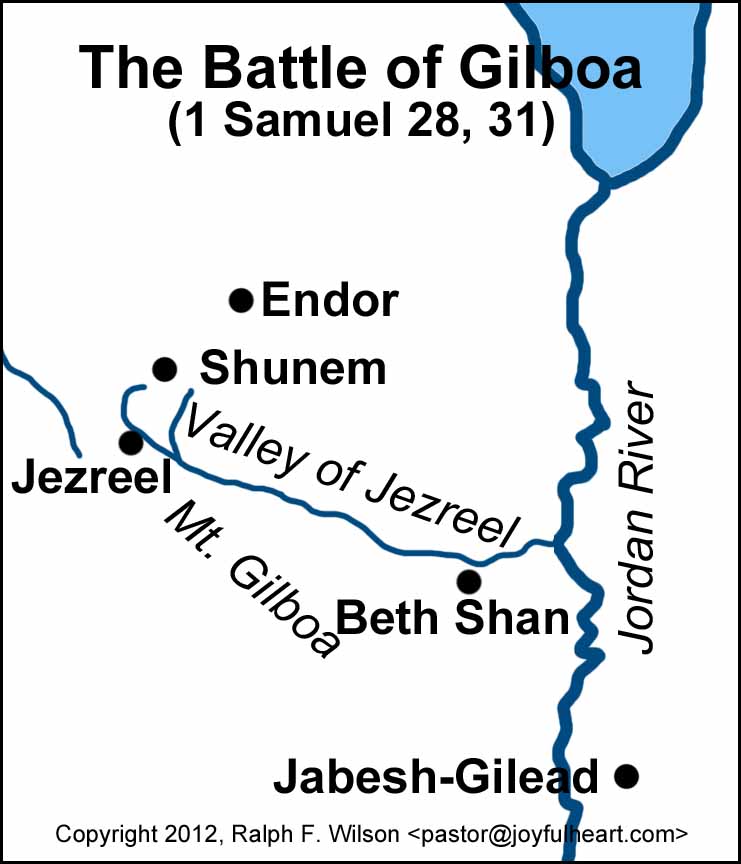
When the Israelites who were on the other side of the valley from where the battle took place, as well as those just over the Jordan River in that area, saw that their brethren fled and that Saul and his sons were dead, they, too, fled from their cities, and the Philistines came and dwelt in them. This map previously borrowed from Jesus Walk shows that area:
(8) And it came to pass on the next day, when the Philistines came to strip the slain, that they found Saul and his three sons fallen in Mount Gilboa. (9) And they cut off his head and stripped off his armor and sent into the land of the Philistines round about, to publish it in the house of their idols and among the people. (10) And they put his armor in the house of Ashtaroth, and they fastened his body to the wall of Beth Shan.
The next day, when the Philistines went to strip all the bodies to take what was valuable as their spoil, they found Saul and his sons dead at Mount Gilboa. They cut off Saul's head and stripped off his armor and proclaimed the news throughout the land of the Philistines round about them, and in the house of their idols to whom they surely ascribed the success they had. They then took Saul's body and hung it on a wall in Beth Shan where they then dwelt. They put his armor in the house of their idol, much like Goliath's sword had been placed in the tabernacle (1 Samuel 21:9). I find it sad that Saul had wanted to kill himself so that the Philistines would not abuse his body, but they had still abused it in death.
(11) And when the inhabitants of Jabesh Gilead heard of that which the Philistines had done to Saul, (12) All the valiant men arose and went all night and took the body of Saul and the bodies of his sons from the wall of Beth Shan and came to Jabesh and burned them there.
When the inhabitants of Jabesh, which was further south and on the other side of the Jordan, as seen on the map above, heard what the Philistines had done to Saul, valiant men rose up and traveled all night to Beth Shan, and they took Saul's body and the bodies of his sons, which it seems were also hung on the wall, back to Jabesh and burned them there. It was out of respect and gratitude to their king that they removed his body and the bodies of his sons that had been hung as trophies for the Philistines. There was no time or safe place or perhaps it was even too late to embalm the bodies and give them a safe burial, but it was also a sign of respect that they burned the mutilated bodies and prevented any possible further abuse from the enemy.
(13) And they took their bones and buried them under a tree at Jabesh and fasted seven days.
The men of Jabesh Gilead then took the bones of Saul and his sons and buried them under a tree there, and they fasted for seven days in honor and mourning for Saul.
(1 Chronicles 10:1) Now the Philistines fought against Israel; and the men of Israel fled from before the Philistines, and fell slain on Mount Gilboa.
1 Chronicles 10:1-14 retells the incidence of Saul's death. The Philistines fought against Israel, and the Israelites fled from before them and were killed at Mount Gilboa.
(2) And the Philistines followed hard after Saul and after his sons, and the Philistines killed Jonathan, and Abinadab, and Malchishua, the sons of Saul.
The Philistines pushed hard after Saul and his sons, and they killed his three sons, Jonathan, Abinadab, and Malchishua.
(3) And the battle went sore against Saul, and the archers hit him, and he was wounded by the archers. (4) Then Saul said to his armorbearer, “Draw your sword, and thrust me through with it, lest these uncircumcised come and abuse me." But his armorbearer would not, for he was sore afraid. So Saul took a sword and fell upon it. (5) And when his armorbearer saw that Saul was dead, he also fell on his sword and died. (6) So Saul died, and his three sons, and all his house died together.
1 Chronicles 10:3-6 retells the killing of Saul, almost verbatim. The Philistine archers had wounded him, and he asked his armorbearer to finish him off so that the Philistines would not abuse him. However, the armorbearer could not bring himself to do it, so Saul fell on a sword himself and died. Thus Saul, his three sons, and all his house died together.
(7) And when all the men of Israel who were in the valley saw that they had fled and that Saul and his sons were dead, they forsook their cities and fled, and the Philistines came and dwelt in them. (8) And it came to pass on the next day, when the Philistines came to strip the slain, that they found Saul and his sons fallen in Mount Gilboa. (9) And when they had stripped him, they took his head, and his armor, and sent into the land of the Philistines round about, to carry tidings to their idols, and to the people.
When the Israelites all around the region saw their brethren fleeing and heard what had happened to Saul and his sons, they too fled, and the Philistines took over the cities. The Philistines went the next day and stripped Saul of his armor and cut off his head, and they sent word round about in the land of the Philistines to let their people and their idols know what they had done.
(10) And they put his armor in the house of their gods and fastened his head in the temple of Dagon.
The Philistines put Saul's armor in the house of their gods, Ashtaroth being named specifically in the account recorded in 1 Samuel 31. Here in 1 Chronicles 10, a new bit of information is added in that the Philistines fastened Saul's head in the temple of their god, Dagon.
(11) And when all Jabesh Gilead heard all that the Philistines had done to Saul, (12) They arose, all the valiant men, and took away the body of Saul, and the bodies of his sons, and brought them to Jabesh, and buried their bones under the oak in Jabesh, and fasted seven days.
With the combination of 1 Samuel 31:11-13 and 1 Chronicles 10:11-12, we have a more complete account of what the valiant men of Jabesh Gilead did when they heard what the Philistines had done to Saul. They traveled all night and took the body of Saul and the bodies of his sons from the wall of Beth Shan and came to Jabesh and burned them there. Then they took the bones of Saul and his sons and buried them under an oak tree there, and they fasted for seven days in honor and mourning for Saul.
(13) So Saul died for his transgression which he committed against the Lord, against the word of the Lord which he did not keep, and also for asking of a familiar spirit to enquire, (14) And enquired not of the Lord; therefore He slew him and turned the kingdom to David the son of Jesse.
Thus Saul died for his transgressions, acting at least three times in direct contradiction to the commandments of the Lord, not waiting on Samuel to offer a burnt offering (1 Samuel 13:12-13), sparing the king of Amalek as well as the choice livestock (1 Samuel 15:3), and by consulting a medium (Leviticus 19:31). Verse 14 suggests that Saul did not enquire of the Lord, but he did, and the Lord would not answer him (1 Samuel 28:6). However, the idea is that one must not inquire of witches, wizards, or fortune-tellers, but only of the Lord their God. And had Saul enquired of the Lord long before he did, he would have avoided his desperation in the end. The Lord had finally taken Saul out, giving the kingdom to David, as He had planned for a long time (1 Samuel 15:28). He likely would not have killed Saul, had he been more humble and gracious and compliant to God's will.
And thus ends the reign of Saul, chosen by God against His will, to teach the people how an earthly king would always fail because he was nothing but a flawed human, but the people had chosen that for themselves rather than to be led by their perfect God (1 Samuel 8:7). Saul was at first a good and humble man when God chose him to reign over His people (1 Samuel 9:17), but he became proud and jealous over time and even somewhat deranged in the end. Now God would have David to reign over His people, a man after His own heart, but still a flawed man.


No comments:
Post a Comment