Showing posts with label Abigail. Show all posts

Saturday, June 6, 2026

Abner Joins David, But Joab Murders Him

Continuing a chronological Bible study:

(2 Samuel 3:1) Now there was long war between the house of Saul and the house of David, but David waxed stronger and stronger, and the house of Saul waxed weaker and weaker.

In the last chapter and post, David had been anointed king over Judah, and even though Saul was dead, the captain of his army, Abner, made Saul's son Ishbosheth king over Israel, all of Israel except Judah, that is.  There was war between the two factions, but it seems David's men must have usually won the battles as David grew stronger and the house of Saul grew weaker.

(2) And to David were sons born in Hebron, and his firstborn was Amnon of Ahinoam the Jezreelitess;

While David reigned in Hebron, sons were born to him.  His firstborn son was Amnon, and his mother was Ahinoam, David's wife, the Jezreelitess.

(3) And his second, Chileab, of Abigail the wife of Nabal the Carmelite; and the third Absalom the son of Maacah the daughter of Talmai king of Geshur;

David's second son was born to his wife Abigail, the widow of Nabal, and his name was Chileab.  Apparently, David took a third wife, Maacah, daughter of Talmai king of Geshur, and she gave him his son, Absalom.

(4) And the fourth, Adonijah the son of Haggith; and the fifth, Shephatiah the son of Abital; (5) And the sixth, Ithream, by Eglah David's wife. These were born to David in Hebron.

It appears that David married as many wives as he had sons, or rather vice versa.  His fourth wife was Haggith and she gave him Adonijah; his fifth wife Abital gave him Shephatiah, and his sixth wife, Eglah, gave him Ithream.  These six sons were born to David in Hebron.

(1 Chronicles 3:1) Now these were the sons of David who were born to him in Hebron, the firstborn Amnon of Ahinoam the Jezreelitess; the second Daniel, of Abigail the Carmelitess;

1 Chronicles 3 also named David's sons.  However, Chileab, the son of Abigail, is called Daniel here.  Daniel is probably his real given name.  Chileab means "like his father," so that may have been a nickname as Junior might be now because he was so much like his father.

(2) The third Absalom the son of Maacah, the daughter of Talmai, king of Geshur; the fourth, Adonijah the son of Haggith; (3) The fifth, Shephatiah of Abital; the sixth, Ithream by Eglah his wife. (4) These six were born to him in Hebron, and there he reigned seven years and six months, and in Jerusalem he reigned thirty-three years.

The rest of David's sons who were born to him in the seven and a half years he reigned in Hebron are repeated.  David then reigned in Jerusalem for thirty-three years.

(2 Samuel 3:6) And it came to pass, while there was war between the house of Saul and the house of David, that Abner made himself strong for the house of Saul.

During the time there was war between the house of David and the house of Saul, Abner was strong in his support for the house of Saul.

(7) And Saul had a concubine whose name was Rizpah, the daughter of Aiah; and Ishbosheth said to Abner, "Why have you gone in to my father's concubine?"

Saul had a concubine whose name was Rizpah, and it seems that Abner had had sexual relations with her, and Saul's son Ishbosheth demanded to know why he had done such a thing.

(8) Then was Abner very angry for the words of Ishbosheth, and said, "Am I a dog's head, which against Judah do show kindness this day to the house of Saul your father, to his brethren, and to his friends, and have not delivered you into the hand of David, that you charge me today with a fault concerning this woman?"

Abner was angry with Ishbosheth because of his accusation against him, although he did not really deny it.  He asked Ishbosheth if he was no better than the head of a dead dog who did not care with whom he lay.  He who had defended the house of Saul, his brethren, and his friends, against the tribe of Judah, and had not allowed him to be delivered into the hand of David, he that loyal supporter of Saul, that is who Ishbosheth dared to accuse of fault concerning Saul's concubine.  Abner might have actually been owning up to the fact that he had had sexual relations with Saul's concubine, but that it could not be seen as a fault because of his fierce loyalty to the house of Saul.

(9) "So do God to Abner, and more also, except, as the Lord has sworn to David, even so I do to him, (10) To transfer the kingdom from the house of Saul, and to set up the throne of David over Israel and over Judah, from Dan to Beersheba."

Abner was so angry that he wished God to destroy him if he did not see that the kingdom of Saul was transferred to David to be king over all of Israel.  It's interesting that he apparently knew all along what the will of God was, but he was actively working against it to set up Ishbosheth as king.  That confirms that he had probably been doing it for only his own self-interests.  Now God used Abner's desire for revenge against Ishbosheth to bring forth His will to have David king over all Israel.

(11) And he could not answer Abner a word again because he feared him.

Ishbosheth had nothing to say to Abner because he feared him.  After all, it was Abner who had made him king, and with the king's army at his command, Abner could easily take him out.

(12) And Abner sent messengers to David on his behalf, saying, "Whose is the land?" Saying, "Make your league with me, and behold, my hand will be with you to bring about all Israel to you."

Abner then sent messengers to David on his own behalf, not from Ishbosheth.  I believe his point was that he was acknowledging that the land was David's, and that he now desired to make a covenant of friendship with him, and he would do everything he could to bring all of Israel under his reign.

(13) And he said, "Well, I will make a league with you, but one thing I require of you, that is, you shall not see my face except you first bring Michal Saul's daughter, when you come to see my face."

David agreed it was well and good to join with Abner, but first before that could happen, Abner must bring David's wife Michal, Saul's daughter, to him.  It seems that even though David had had six wives since Michal, he must have still cared for her, or perhaps it was to demonstrate honor to Saul's family that his daughter might share with him the benefits of his reign.

(14) And David sent messengers to Ishbosheth Saul's son, saying, "Deliver my wife Michal whom I espoused to me for a hundred foreskins of the Philistines."

David then sent messengers to Ishbosheth telling him to deliver his wife Michal to him.  David added that he had purchased her at a great expense and danger to his life by killing a hundred Philistines and bringing their foreskins to Saul as he required in order to marry his daughter (1 Samuel 18:25).

(15) And Ishbosheth sent and took her from her husband, from Phaltiel the son of Laish.

Ishbosheth had Michal removed from her husband, Phaltiel, or Phalti, as he was called in 1 Samuel 25:44, when it was first told that Saul had given his daughter to him.

(16) And her husband went with her along weeping behind her to Bahurim. Then Abner said to him, "Go, return." And he returned.

Michal's current husband went along with her as far as Bahurim, a city in the tribe of Benjamin, because he evidently loved her very much and did not want to lose her, but he was forced to give her up by command of the king and the king's captain.

(17) And Abner had communication with the elders of Israel, saying, "You sought for David in times past to be king over you. (18) Now then do it, for the Lord has spoken of David, saying, 'By the hand of my servant David I will save My people Israel out of the hand of the Philistines and out of the hand of all their enemies.'"

Abner communicated with the elders of Israel, reminding them that it was generally known that David had been anointed to be king over Israel, certainly after Saul's death.  He encouraged them to now make David their king, implying he would no longer oppose him.  He reminded them of the words of the Lord declaring that it would be David who would save Israel out of the hand of the Philistines and all their enemies.  There is no record in the Bible of the Lord saying those words, but He probably did say them to Samuel when He first said He wanted David as king, and they were not recorded, but probably verbally passed down and now general knowledge.

(19) And Abner also spoke in the ears of Benjamin, and Abner went also to speak in the ears of David in Hebron all that seemed good to Israel and that seemed good to the whole house of Benjamin.

Abner spoke these same words especially to the tribe of Benjamin of which was the family of Saul.  He spoke these same words in the hearing of David, or perhaps the meaning is rather that after speaking to the elders of the other tribes, he brought the news to David that all were agreeable that David should be king over them.

(20) So Abner came to David to Hebron, and twenty men with him. And David made Abner and the men with him a feast. (21) And Abner said to David, "I will arise and go and will gather all Israel to my lord the king, that they may make a league with you, and that you may reign over all that your heart desires." And David sent Abner away, and he went in peace.

Abner went to David in Hebron with twenty men.  David received them and made a feast for them.  Abner told David that he would go and do all he could to gather all of Israel to come into agreement with David as their king.  He said he would do this so that David could reign over all that his heart desired, although David had not expressed any impatience to take over the entire kingdom, but had been content to wait on God's timing.  David sent Abner on his way in peace, having made a covenant of peace with him.

(22) And behold, the servants of David and Joab came from a troop and brought in a great spoil with them, but Abner was not with David in Hebron, for he had sent him away, and he was gone in peace. (23) When Joab and all the host with him had come, they told Joab, saying, "Abner the son of Ner came to the king, and he has sent him away, and he has gone in peace."

After Abner had left David, Joab, the captain of David's army, came with his men, apparently after some military excursion against the enemy, and they brought in a very large spoil after evidently conquering the enemy.  Some in David's court told Joab about Abner coming to David, and instead of seizing him, David had allowed him to go in peace.

(24) Then Joab came to the king, and said, "What have you done? Behold, Abner came to you; why is it you have sent him away, and he is quite gone?"

Joab asked David what he had done in allowing Abner to come to him and letting him go in peace, implying that he should have seized him as the enemy.

(25) "You know Abner the son of Ner, that he came to deceive you and to know your going out and your coming in and to know all that you do."

Joab told David that surely Abner had come to deceive him and to learn his movements in order to surely destroy him.

(26) And when Joab had come out from David, he sent messengers after Abner who brought him again from the well of Sirah, but David did not know it.

When Joab left David, he sent messengers after Abner who was apparently at the well of Sirah, which the historian Josephus said was two and a half miles from Hebron.  The messengers brought him from there back to Joab, but David did not know any of this.

(27) And when Abner was returned to Hebron, Joab took him aside in the gate to speak with him quietly and struck him there under the fifth rib that he died, for the blood of Asahel his brother.

When the messengers brought Abner back to Hebron, Joab met him at the gate and pulled him aside supposedly to speak to him in private, but he stabbed him under the fifth rib, in the same place Abner had struck Joab's brother Asahel, and he died.

(28) And afterward, when David heard, he said, "I and my kingdom are guiltless before the Lord forever from the blood of Abner the son of Ner; (29) Let it rest on the head of Joab and on all his father's house, and let there not fail from the house of Joab one who has an issue, or who is a leper, or who leans on a staff, or who falls on the sword, or lacks bread."

When David heard what Joab had done, he declared that he and his kingdom were guiltless before God forever for the murder of Abner, that it was wholly on the head of Joab and his father's house.  It may be that David made that declaration publicly because Joab was his general, and he wanted it known that he did not command that his general kill Abner, that it was totally on Joab.  David went on to curse the family of Joab, wishing that there would always be one who had an issue of blood, or gonorrhea, as it sometimes meant, or one who was a leper, or one who was lame or fell on a sword or lacked food.  David said this in his anger, but I can't help but think he should have cursed Joab alone, not his innocent family after him.

(30) So Joab and Abishai his brother killed Abner because he had slain their brother Asahel at Gibeon in the battle.

It appears that Abishai was in on the plan to murder Abner because he had killed Asahel, the brother of Joab and Abishai, sons of David's sister, Zeruiah.  So it would appear that David's curse would be on his sister's house, all the more reason he should have directed his anger to Joab and maybe Abishai only.  But he had said it in anger; it was not meant as a prophetic curse.

(31) And David said to Joab and to all the people who were with him, "Rend your clothes, and gird yourself with sackcloth, and mourn before Abner." And King David followed the bier.

David told Joab and all the people with him to mourn Abner by the usual expressions of mourning, by tearing their clothes and putting on sackcloth.  King David followed the bed on which Abner's body was laid and carried to the grave.

(32) And they buried Abner in Hebron; and the king lifted up his voice and wept at the grave of Abner, and all the people wept.

They buried Abner in Hebron.  David wept loudly at the grave of Abner, and all the people with him wept.

(33) And the king lamented over Abner, and said, "Did Abner die as a fool dies?"

David lamented over Abner and said words over his grave.  He asked if Abner had died as a fool dies.  The word that was translated as "fool" is "nabal" and also meant stupid and wicked.  I believe David's point was that Abner had not died as a criminal or for any wickedness he had done.  He was unjustly murdered before his time.

(34) "Your hands were not bound nor your feet put into fetters; as a man falls before wicked men, so you fell." And all the people wept again over him.

Abner had not been bound and fettered as a criminal who knew his fate.  He had fallen as one murdered by wicked men.  This made the people weep again over Abner.  This he said in the presence of Joab whom he had told to mourn Abner with him.

(35) And when all the people came to cause David to eat food while it was yet day, David swore, saying, "So do God to me and more also, if I taste bread or anything else till the sun be down."

The people came to David to persuade him to eat, but he refused, swearing an oath that he wished for God to do the greatest evils against him if he even tasted bread before sundown, as he would continue his mourning for Abner until then.

(36) And all the people took notice, and it pleased them, as whatever the king did pleased all the people. (37) For all the people and all Israel understood that day that it was not of the king to kill Abner the son of Ner.

The people took notice of how David conducted himself throughout the entire death and burial of Abner, and it pleased them, for they understood that David had never intended for Abner to be killed.

(38) And the king said to his servants, "Do you not know that there is a prince and a great man fallen this day in Israel?"

Perhaps in explanation to his servants as to why he mourned the man who had so recently been considered an enemy, David explained that Abner had been a great man and even a prince in the house of Saul, as he was Saul's first cousin and a member of the royal family, as well as having the important position as Saul's general.

(39) "And I am this day weak, though anointed king, and these men the sons of Zeruiah are too hard for me. The Lord shall reward the doer of evil according to his wickedness."

Although David had been anointed king, he was very new to the kingdom and had not yet been fully accepted by all of Israel, but Abner had been working on that.  Joab and Abishai, the sons of David's sister Zeruiah, were yet too powerful for David to make one of his first acts as king to punish them.  He said that the Lord would take care of their just punishment.

Friday, May 22, 2026

David Made King Over Judah and Ishbosheth Made King Over Israel

Continuing a chronological Bible study:

(2 Samuel 5:4) David was thirty years old when he began to reign; he reigned forty years.

King Saul had been killed, and now David began his reign at thirty years of age.  He reigned as king for forty years.

(1 Chronicles 29:27) And the time that he reigned over Israel was forty years; seven years he reigned in Hebron, and thirty-three years he reigned in Jerusalem.

This scripture also spoke of David having reigned over Israel forty years.  Here it was added that he reigned in Hebron for seven of those years and in Jerusalem for 33 years.  It is interesting to note that Jesus began his ministry at age 30.  Also Hebron was the city of priests (Joshua 21:28), and Jerusalem was the city of the kings, of the law.  David's reign was a perfect foreshadowing of the gospel state that would come with Jesus.

(2 Samuel 2:1) And it came to pass after this, that David enquired of the Lord, saying, "Shall I go up into any of the cities of Judah?" And the Lord said to him, "Go up." And David said, "Where shall I go up?" And He said, "To Hebron."

David had been living in Ziklag in the land of the Philistines while he was hiding out from Saul.  Now that Saul was dead, he asked the Lord if he should go back to Judah, and if so, where?  The Lord told him to go to Hebron, a city of priests and a city of refuge (Joshua 21:13).

(2) So David went up there, and his two wives also, Ahinoam the Jezreelitess, and Abigail, Nabal's wife, the Carmelite.

So David did as the Lord told him and went from Ziklag to Hebron, taking his wives, Ahinoam and Abigail.

(3) And his men who were with him David brought up, every man with his household, and they dwelt in the cities of Hebron.

The men who were with David also went to Hebron with their households and dwelt in the towns and villages around Hebron.

(4) And the men of Judah came, and there they anointed David king over the house of Judah. And they told David, saying, "The men of Jabesh Gilead were the ones who buried Saul."

The men of Judah came to David in Hebron and anointed him king over their tribe, Judah.  They did not take it upon themselves to make him the king of all Israel even though that was God's plan.  They seemed to have thought like David, not to force him upon all of Israel at once, but the Lord would provide the way in His timing.  The men of Judah told David that Saul had been buried by the men of Jabesh Gilead.

(5) And David sent messengers to the men of Jabesh Gilead, and said to them, "Blessed you of the Lord, that you have showed this kindness to your lord, to Saul, and have buried him. (6) And now the Lord show kindness and truth to you, and I also will requite you this kindness because you have done this thing. (7) Therefore now, let your hands be strengthened and be valiant, for your master Saul is dead, and also the house of Judah has anointed me king over them."

David sent word to the men of Jabesh Gilead to offer blessings to them for their kindness in burying Saul.  David told them that the Lord would bless them for their kind deed and that he would also repay them for their kindness.  He told them to be strong and valiant, probably meaning not to be afraid of the Philistines who had killed Saul, that although their king was dead, the house of Judah had made him their king, implying that he would now be their protector.

(8) But Abner, the son of Ner, captain of Saul's host, took Ishbosheth the son of Saul and brought him over to Mahanaim, (9) And made him king over Gilead, and over the Ashurites, and over Jezreel, and over Ephraim, and over Benjamin, and over all Israel.

Abner, Saul's first cousin, had been the captain of his army.  Perhaps he felt a fierce loyalty to Saul, and against David, or maybe it was for his own power and position, but he felt that Saul's only living heir should be made king over Israel.  That was Ishbosheth, or Eshbaal as in 1 Chronicles 8:33.  Dr. John Gill, in his Exposition of the Bible, expounded further than I have seen on the reasoning for the change of names.  Ish/Esh are essentially the same.  Baal was the name of a despicable and shameful false idol.  Bosheth meant "shame."  Perhaps rather than saying the name of a shameful idol, a word that meant the same was substituted, so Esh-baal became Ish-bosheth, as Jerub-baal, as Gideon became known (Judges 6:32), became Jerub-besheth in 2 Samuel 11:21.  Merib-baal became Mephi-bosheth, although there was a slight change to the first part of the name, as well.

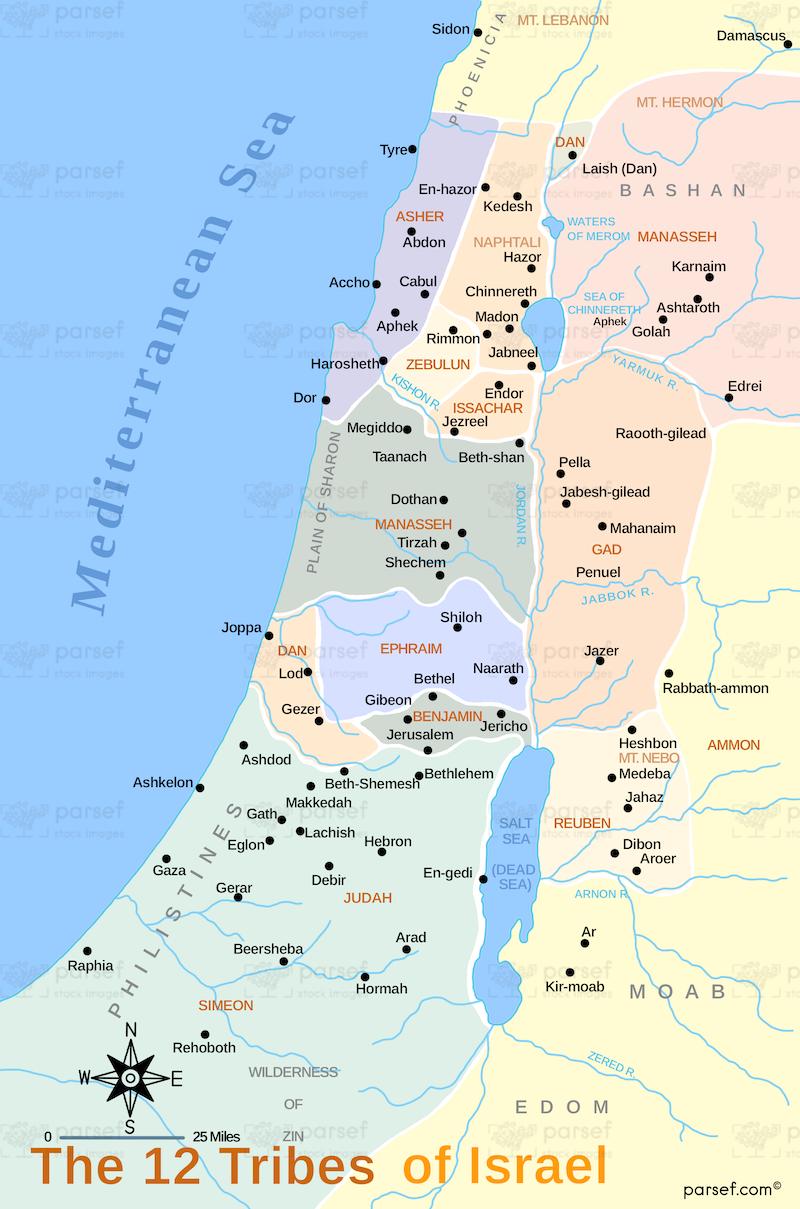
Abner took Ishbosheth to Mahanaim which was in Gad on the other side of the Jordan, perhaps because it was close to Jabesh Gilead where Saul was buried, and maybe because it was away from David at Hebron, as seen on this map borrowed from Free Bible:


Abner apparently had the power, or at least he took it upon himself, to make Ishbosheth king of all Israel with the exception of Judah where David had been made king.

(10) Ishbosheth Saul's son was forty years old when he began to reign over Israel and reigned two years. But the house of Judah followed David. (11) And the time that David was king in Hebron over the house of Judah was seven years and six months.

Ishbosheth was forty years old when he began to reign over Israel, and he reigned for two years.  The tribe of Judah considered David their king, and he reigned over Judah for seven years and six months.  Evidently, it was a common belief that Ishbosheth reigned over Israel the whole time that David reigned over Judah, so perhaps the meaning is that Ishbosheth reigned two years before the following took place:

(12) And Abner the son of Ner and the servants of Ishbosheth the son of Saul went out from Mahanaim to Gibeon. (13) And Joab the son of Zeruiah and the servants of David went out and met together at the pool of Gibeon, and they sat down, the one on the one side of the pool and the other on the other side of the pool.

Abner, now the commander of Ishbosheth's army, along with the servants of Ishbosheth, went out from Mahanaim to the other side of the Jordan to Gibeon.  Zeruiah was David's sister, and it appears that Joab her son was the captain of David's army.  Joab and the servants of David went to the pool of Gibeon where Abner's army was, and they sat by the pool on one side across from Abner and his army.

(14) And Abner said to Joab, "Let the young men now arise and play before us." And Joab said, "Let them arise."

Abner told Joab to let the young men arise and "play," as gladiators or duelers might, to see who was the most skilled in the use of the sword.  Joab agreed to let his men arise and play.

(15) And then there arose and went over by number twelve of Benjamin of Ishbosheth the son of Saul, and twelve of the servants of David.

Twelve men from Ishbosheth's army went over the pool to meet twelve men of David's army.

(16) And they caught every one his fellow by the head and thrust his sword into his fellow's side so they fell down together; therefore that place was called Helkathhazzurim, which is in Gibeon.

The twelve of David's men each caught their opponent by the head and thrust his sword into his opponent's side so that all twelve of Abner's men fell down together.  They called that place Helkathhazzurim, which literally meant "Field of Swords" in Gibeon.

(17) And there was a very sore battle that day, and Abner was beaten and the men of Israel, before the servants of David. 

There was a very severe battle that day, and in the end, David's men won the "game" defeating Abner's men.

(18) And there were three sons of Zeruiah there, Joab, and Abishai, and Asahel; and Asahel was as light of foot as a wild roe.

There were actually three sons of David's sister there, Joab, Abishai, and Asahel.  Asahel was said to be as swift of foot as a wild deer.

(19) And Asahel pursued after Abner, and in going he turned not to the right hand nor to the left from following Abner.

Asahel pursued after Abner, straight after him, not turning his attention to the right or the left.

(20) Then Abner looked behind him, and said, "Are you Asahel?" And he answered, "I am." (21) And Abner said to him, "Turn aside to your right hand or to your left, and lay hold of one of the young men, and take his armor." But Asahel would not turn aside from following him.

Abner looked behind him and saw Asahel, and Asahel confirmed that it was indeed him.  Abner told him to turn aside to the left or right and take hold of one of his soldiers and take his armor, rather than pursuing him, but Asahel would not turn aside from following Abner.

(22) And Abner said again to Asahel, "Turn aside from following me, for why should I strike you to the ground? How then should I hold up my face to Joab your brother?"

Abner warned Asahel to turn from following him or else he would be forced to strike him, which he apparently did not really want to do.  After all, neither he nor Joab had been "playing," and he did not want to have to face Joab if he struck Asahel.

(23) However, Asahel refused to turn aside; therefore Abner with the hinder end of the spear struck him under the fifth rib that the spear came out behind him, and he fell down there and died in the same place; and it came to pass, as many as came to the place where Asahel fell down and died, stood still.

Asahel refused to turn aside, and he, being swift as a wild deer, was surely gaining on Abner, and Abner felt he must strike or be killed himself.  It seems as if Abner's spear had a pointed head on both ends, and he struck Asahel behind him by thrusting his spear backwards at him.  He struck Asahel under the fifth rib, and the spear went all the way through him, coming out his back, and he fell down and died.  All who came up to the place where he died were dumbfounded and just stood there, not pursuing Abner or any of his men.

(24) Joab also and Abishai pursued after Abner, and the sun went down when they had come to the hill of Ammah that lies before Giah by the way of the wilderness of Gibeon.

However, it seems that Joab and Abishai, Asahel's brothers, had been pursuing after Abner behind Asahel, and they continued pursuing him.  The sun had gone down when they reached the hill of Ammah before Giah by the road of the wilderness of Gibeon.  The exact locations of these places are unknown, but they must have been near to Gibeon.

(25) And the children of Benjamin gathered themselves together after Abner and became one troop and stood on the top of a hill.

Men from the tribe of Benjamin came out behind Abner and formed a troop at the top of a hill against Joab and Abishai and their men.

(26) Then Abner called to Joab, and said, "Shall the sword devour forever? Don't you know that it will be bitterness in the latter end? How long shall it be then until you bid the people return from following their brethren?"

Abner called out to Joab asking if they should continue the battle of the swords forever until it resulted in a bitter end, with the killing of a great number more men and perhaps even him and Joab themselves.  He asked how long it would be before Joab called off his men from following their brethren.  He now called the men of Israel and the men of Judah brethren, but that didn't seem to bother him when he first suggested the brethren "play."

(27) And Joab said, "As God lives, unless you had spoken, surely then in the morning the people would have gone up every one from following his brother."

Joab answered, and I believe the sense is that had Abner not spoken as he had, Joab's army would have pursued all night and not quit until the morning.  Or perhaps he meant that had Abner not spoken in the first place to have the men "play," Joab's men would never have pursued them that morning or day.

(28) So Joab blew a trumpet, and all the people stood still, and pursued after Israel no more, neither did they fight anymore.

So Joab blew a trumpet which signaled his men to stop from pursuing and fighting with the men of Israel.

(29) And Abner and his men walked all that night through the plain and passed over Jordan and went through all Bithron, and they came to Mahanaim.

So Abner and his men walked all night through the plain and across the Jordan River, back to their place in Mahanaim.

(30) And Joab returned from following Abner, and when he had gathered all the people together, there lacked of David's servants nineteen men and Asahel. (31) But the servants of David had struck of Benjamin and of Abner's men, three hundred and sixty men who died.

Joab returned from following Abner, and when he gathered all his men together, he found that nineteen men plus Asahel had been killed.  However, they had killed 360 of Abner's men and the men of Benjamin.

(32) And they took up Asahel and buried him in the sepulchre of his father which was in Bethlehem. And Joab and his men went all night, and they came to Hebron at break of day.  

Joab and his men took the body of Asahel and buried him in the sepulcher of his father, Zeruiah's husband, which was in Bethlehem.  Then they walked all night and came back to Hebron at daybreak the next morning.

The Lord had rejected Saul and now he was dead, but David, the Lord's choice for king, the man after His own heart, still was not made king over all Israel.  In fact, it seems a civil war was brewing between Judah and Israel.  Abner, probably more for his own benefit and power, set up Saul's son Ishbosheth as king of Israel.  God allowed this testing and refining time for David.  After all, David had been just a shepherd boy.  He had a heart for the Lord, but he needed time to mature and develop the leadership qualities to be king.  After all, he was to become Israel's greatest king and from his line of descendants would come the Messiah.  God was preparing David for his awesome role in Biblical history.

Monday, May 11, 2026

David's Victory over the Amalekites

Continuing a chronological Bible study:

(1 Samuel 30:1) And it came to pass, when David and his men had come to Ziklag on the third day, that the Amalekites had invaded the south and Ziklag and struck Ziklag and burned it with fire, (2) And had taken the women captives, those who were there; they did not kill any, either great or small, but carried them away and went on their way.

In the last chapter and post, David had left his home in Ziklag and had gone with Achish to fight against the Philistines' enemy which was Saul and the Israelites.  The Philistine princes did not trust David to fight for them, so the king had sent him back to his home.  It seems David had been gone only three days, or perhaps it was the third day of his trip back to Ziklag, when he came back to find that the Amalekites had invaded Ziklag and burned it, and they had taken all the women who were left there, young and old, as captives, but they did not kill them.  While living in Ziklag, David had gone out and struck the Amalekites, killing every one of them (1 Samuel 27:8-9), so these Amalekites were probably a wandering band of raiders, the ones mentioned in 1 Chronicles 12:21.  They had struck Ziklag and the south, which judging from this map borrowed from Braman's Wanderings, was probably Israelite territory:


(3) So David and his men came to the city, and behold, it was burned with fire, and their wives, and their sons, and their daughters, were taken captives. (4) Then David and the people who were with him lifted up their voice and wept until they had no more power to weep. (5) And David's two wives were taken captives, Ahinoam the Jezreelitess, and Abigail the wife of Nabal the Carmelite.

When David and his men came to Ziklag and saw the destruction and that all their wives and children had been taken, they shrieked and cried until they had no more tears to cry.  David's two wives, Ahinoam and Abigail were also taken.

(6) And David was greatly distressed, for the people spoke of stoning him because the soul of all the people was grieved, every man for his sons and his daughters, but David encouraged himself in the Lord his God.

David was greatly distressed, not only because of what had happened, but also because the men spoke of stoning him, blaming him for what had happened to their families.  He was the one who had provoked the Amalekites in the first place, and then he chose to go with Achish and bring his men with him, leaving their families defenseless.  David turned to the Lord for encouragement.

(7) And David said to Abiathar the priest, Ahimelech's son, "I pray you, bring me here the ephod." And Abiathar brought there the ephod to David. (8) And David enquired of the Lord, saying, "Shall I pursue after this troop? Shall I overtake them?" And He answered him, "Pursue, for you shall surely overtake them and without fail, recover all."

Abiathar had undoubtedly been with David and his men as he would have otherwise been carried away with the women and children.  David asked him to bring him the ephod in which were the Urim and Thummim, something akin to lots that were cast to determine the will of God.  David asked the Lord if he should pursue the band of raiders, and if he would overtake them.  Had David been consulting the Lord before this, he probably wouldn't have been in the trouble he was now, but the Lord was merciful to him and told him to pursue the Amalekites, that he would overtake them, and would recover everyone.

(9) So David went, he and the six hundred men who were with him, and came to the brook Besor, where those who were left behind stayed. (10) But David pursued, he and four hundred men, for two hundred abode behind, who were so faint that they could not go over the brook Besor.

I would have thought that the number of his army would have grown by now as the men from Manasseh had joined him (1 Chronicles 12:19-20), but I suppose 600 was a rounded number.  The Besor Brook was south of Ziklag as seen on the map above.  200 of his men were so faint after all they had been through that they stayed behind at the Besor Brook, and David and 400 men went on after the band of Amalekites. 

(11) And they found an Egyptian in the field, and brought him to David, and gave him bread, and he did eat, and they made him drink water, (12) And they gave him a piece of a cake of figs and two clusters of raisins. And when he had eaten, his spirit came again to him, for he had eaten no bread, nor drunk water, three days and three nights.

Some of David's men found an Egyptian in the field, and they brought him to David.  He was apparently very faint from hunger as he had not eaten for three days and nights.  They gave him food and water, and he was revived.

(13) And David said to him, "To whom do you belong? And where are you from?" And he said, "I am a young man of Egypt, servant to an Amalekite, and my master left me because three days ago I fell sick."

David asked the Egyptian where he came from and to whom he belonged.  He told him he had been a servant to an Amalekite who just left him there to die because he fell sick three days prior.

(14) "We made an invasion on the south of the Cherethites, and on what belongs to Judah, and on the south of Caleb, and we burned Ziklag with fire."

The Egyptian servant then went on to tell David what he and his master's party had done.  They had made an invasion south of the Cherethites, which were probably a group within the Philistines, on what belonged to Judah, on the south of Caleb which included Hebron seen on the map above, and he admitted they had burned Ziklag.

(15) And David said to him, "Can you bring me down to this company?" And he said, "Swear to me by God that you will neither kill me nor deliver me into the hands of my master, and I will bring you down to this company."

David asked the Egyptian if he would take him to the company he had been with when they did all he had described.  The Egyptian said he would take him if he would swear not to kill him or take him back to his master.  Apparently, David agreed:

(16) And when he had brought him down, behold, they were spread abroad upon all the earth, eating and drinking and dancing, because of all the great spoil that they had taken out of the land of the Philistines and out of the land of Judah.

The Egyptian brought David and his men to where the band of Amalekites were.  They were at ease spread across the land, eating, drinking, and dancing, because of all the great spoil they had taken from Ziklag in the land of the Philistines and from Judah.

(17) And David struck them from the twilight even to the evening of the next day, and there escaped not a man of them except four hundred young men who rode on camels and fled.

David and his men struck the Amalekites for apparently over 24 hours, and there must have been a very great number of them they destroyed, for the scriptures reads that none of them escaped except 400 who rode away on camels.  400 is no small number, considering that was the number of David's army that attacked them, and the way scripture is worded that not a man of them escaped except 400, certainly sounds like there must have been initially a very great number of them.

(18) And David recovered all that the Amalekites had carried away, and David rescued his two wives.

David and his men recovered all that the Amalekites had taken from them, and David also rescued his two wives.

(19) And there was nothing lacking to them, neither small nor great, neither sons nor daughters, neither spoil, nor anything that they had taken from them; David recovered all. (20) And David took all the flocks and the herds they drove before those other cattle, and said, "This is David's spoil."

David and his men had recovered everything that was taken from them.  Nothing or no one was missing.  I believe the sense of verse 20 is that in addition to their own flocks and herds that the Amalekites had taken from them, David also took the herds that the Amalekites had before they stole from Ziklag, considering them spoil from the battle.

(21) And David came to the two hundred men who were so faint that they could not follow David, whom they also had made to abide at the brook Besor, and they went forth to meet David and to meet the people who were with him, and when David came near to the people, he saluted them.

David and his men came back to the 200 men who had not gone with them to fight the Amalekites because they had been too faint to fight.  They had evidently been told to stay there at the Besor Brook and probably look after any personal supplies they had taken with them when they had left Ziklag and had gone with Achish.  They came forward to meet David upon his return from battling the Amalekites, and David saluted them.

(22) Then answered all the wicked men and men of Belial, of those who went with David, and said, "Because they did not go with us, we will not give them any of the spoil that we have recovered, except for every man his wife and his children, that they may lead them away and depart."

Then some of David's men who had gone with him to fight the Amalekites, with selfish and greedy hearts, men of Belial, which meant wicked and morally worthless, said they did not want to give the 200 men any of the spoil because they had not gone with them to fight the Amalekites.  They wanted them to take what was originally theirs that was recovered and just leave.

(23) Then said David, "You shall not do so, my brethren, with that which the Lord has given us, who has preserved us, and delivered the company that came against us into our hand. (24) For who will hearken to you in this matter? But as his part who goes down to the battle, so his part who tarries by the stuff; they shall part alike."

David told the men they would not be allowed to do as they wished in that matter, for after all, it was the Lord who had delivered the Amalekites into their hands and therefore provided them with the spoil.  It was not theirs to decide who would receive of it and who wouldn't.  David resolved that as some men did their part in going to battle, it was just as important to have men doing their part to guard their supplies, and that all the men would share in the spoil.

(25) And it was from that day forward, that he made it a statute and an ordinance for Israel to this day. (26) And when David came to Ziklag, he sent of the spoil to the elders of Judah, to his friends, saying, "Behold a present for you of the spoil of the enemies of the Lord."

So it was from that time forward, that he who stayed at home and defended home and property had an equal right to share in the spoils of war as the one who went to battle.  Then David went even further and sent some of the spoil to elders of Judah whom he considered friends, who had been kind to him when he had sojourned among them.  He told them it was a present of the spoil of the enemies of the Lord, not his personal enemies, but enemies of the Lord and all His people.

(27) To those who were in Bethel, and to those who were in south Ramoth, and to those who were in Jattir, (28) And to those who were in Aroer, and to those who were in Siphmoth, and to those who were in Eshtemoa, (29) And to those who were in Rachal, and to those who were in the cities of the Jerahmeelites, and to those who were in the cities of the Kenites, (30) And to those who were in Hormah, and to those who were in Chorashan, and to those who were in Athach, (31) And to those who were in Hebron, and to all the places where David himself and his men were accustomed to rove.

There must have been a very large spoil as it was not only shared with all six hundred of his men, but also with those who were most likely elders, as with the elders of Judah, and friends, to all those who had sheltered and relieved him and his men in the times of their distress.  Six hundred men in one place could have been quite an imposition on the inhabitants, and David showed his gratitude to them by sharing his spoil.

Wednesday, April 29, 2026

David Flees to the Philistines

Continuing a chronological Bible study:

(1 Samuel 27:1) And David said in his heart, "I shall now perish one day by the hand of Saul; nothing better for me than that I should speedily escape into the land of the Philistines, and Saul shall despair of me, to seek me anymore in any coast of Israel; so shall I escape out of his hand."

In the last chapter, David had just spared Saul's life a second time.  Although Saul had said he would no longer seek to harm him (1 Samuel 26:21), David had true reason not to trust him.  It appears here that David feared that Saul would kill him someday and that he must escape to a place where he thought Saul would not desire to pursue him.  How could he believe this when God had so protected him and had promised he would be king of Israel?  As happens to the best of us, our faith slips sometimes in the midst of troubles.  As the father of the possessed son said to Jesus, "Lord, I believe; help my unbelief!" (Mark 9:24), we all need supernatural divine help sometimes to have total faith.  Oh, that we would learn to trust the Lord because He has always been trustworthy!  Then again, could it be that this was just another of David's hiding places, that he might have always thought if he stayed where he was, Saul would surely find him and kill him, so he moved on to the next place?  But again, then again, a prophet of God had told David to leave a pagan country, Moab, and go to Judah (1 Samuel 22:5), so surely God did not wish for David to go to another pagan land in which to dwell.  However, as David had previously said when he blamed Saul for driving him away from his inheritance into the land of pagans serving false gods (1 Samuel 26:19), he believed he was being driven out again, and he decided to quickly escape to the land of the Philistines where he hoped Saul would not seek to pursue him.

(2) And David arose, and he passed over with the six hundred men who were with him to Achish, the son of Maoch, king of Gath. (3) And David dwelt with Achish at Gath, he and his men, every man with his household, and David with his two wives, Ahinoam the Jezreelitess, and Abigail the Carmelitess, Nabal's wife.

David and his six hundred men went to the king of Gath, Achish, the son of Maoch.  He had fled to him before (1 Samuel 21:10) but he had cast him out when David feigned madness because he feared Achish.  But now with his six hundred men with him, David must have appeared a safe bet; especially if he knew David to be an enemy of Saul's, he might feel better protected against Saul with David and his men in his city.  So David and his wives, along with his men and their households, dwelt in Gath.

(4) And it was told Saul that David had fled to Gath, and he sought him no more again.

When Saul was told that David was in Gath, he did not try to go after him.  Was it because he had indeed had a change of heart for David after he had spared his life twice?  Or had David been wise in going there calculating that Saul would not want to pursue him there?  I am certain that God would have protected him in Judah, and God through a prophet had sent him to Judah in the first place, so I don't believe it was God's will that David go to a pagan country, but it appears that God blessed and protected him, regardless.

(5) And David said to Achish, "If I have now found grace in your eyes, let them give me a place in some town in the country that I may dwell there, for why should your servant dwell in the royal city with you?" (6) Then Achish gave him Ziklag that day; therefore Ziklag pertains to the kings of Judah to this day. (7) And the time that David dwelt in the country of the Philistines was a full year and four months. 

David asked the king Achish to let him have a town in the country in which to dwell, rather than living in the royal city.  Achish gave him Ziklag, twelve miles from Gath, which actually was originally Israelite land (Joshua 15:31) but must have come into the hands of the Philistines.  But now David had it back, and it remained his at least to the writing of this account.  It still makes me wonder if David had been wrong about going to a pagan land, and God blessed him anyway, or if this was a divinely inspired plan to retake some of their land.  Most likely, God just used this opportunity, knowing that David would do what he did, but it would not have been His preferred will to have David live in a pagan land.  David stayed with the Philistines for a year and four months.

(8) And David and his men went up and invaded the Geshurites, and the Gezrites, and the Amalekites, for those were of old the inhabitants of the land, as you go to Shur, even to the land of Egypt.

From Ziklag, David and his men went up and invaded the Geshurites, the Gezrites, and the Amalekites, some of the old inhabitants of the land of Canaan that had not been expelled from the promised land.  I can't say that I see any fault on David's part at this juncture, as God intended that these lands be possessed by the Israelites (Joshua 13).

(9) And David struck the land and left neither man nor woman alive, and took away the sheep, and the oxen, and the asses, and the camels, and the apparel, and returned and came to Achish.

David struck those lands, killing everyone, man and woman, and took all the livestock, camels, and apparel, and went to Achish.  According to the word of God, none of these pagan nations in the promised land were to be spared (Deuteronomy 7:2), so perhaps David felt he was finishing a job left undone.  However, the Amalekites seem to have been spread far and wide, as they will rear their ugly heads again.

(10) And Achish said, "Where have you made a road today?" And David said, "Against the south of Judah, and against the south of the Jerahmeelites, and against the south of the Kenites."

Achish asked where David had been that day.  The original word "pashat" transcribed as "road" more completely meant "to strip, invade, spread out," so in that way David had made an inroad, and Achish wanted to know where.  David told him that he had gone against people in the south of Judah, against the Jerahmeelites who were the descendants of Jerahmeel, the son of Hezron, the grandson of Judah, and the Kenites who were the posterity of Jethro, Moses's father-in-law.  This obviously wasn't exactly true.  Yes, he had been south of Judah, but not against the Jerahmeelites and the Kenites, but rather against the Geshurites, the Gezrites, and the Amalekites.  This map borrowed from Jesus Walk shows where David had actually been and where he told Achish he had been:


(11) And David saved neither man nor woman alive to bring to Gath, saying, "Lest they should tell on us, saying, 'So did David, and so his manner all the while he dwells in the country of the Philistines.'"

David did not allow any man or woman of the Geshurites, the Gezrites, and the Amalekites, to live, for fear that they would tell Achish what he had actually done.  And of course, the king and the people would expect that to be David's behavior all the while he was in the country of the Philistines.

(12) And Achish believed David, saying, "He has made his people Israel utterly abhor him; therefore he shall be my servant forever."

Achish believed David, supposing he had made his own people Israel to hate him, so he felt he was secure with a servant and ally in David.  This made David's sin of lying all the more grievous.  While Achish was a Philistine and an enemy to the Israelites, David used the king's gracious hospitality in giving him Ziklag and allowing him to stay in his country for a year and four months.  That is certainly no way to make proselytes!  Christians should always act Christ-like.  To do otherwise is hypocritical and leaves a stain on Christianity in the eyes of non-believers.  God would have certainly protected David had he stayed in Judah.  At this point, I don't know of any definite negative effects of his lying, but at the very least, it had a negative impact on David's faith and closeness with his Lord and on his conscience as he later would plead with the Lord to remove from him the way of lying (Psalm 119:29).

(1 Chronicles 12:1) Now these were they who came to David to Ziklag while he kept himself close because of Saul, the son of Kish, and they among the mighty men, helpers of the war. (2) Armed with bows and could use both the right hand and the left with the bow, of Saul's brethren of Benjamin.

1 Chronicles 12 tells of mighty men of war who joined David while he was at Ziklag hiding out from Saul.  These men were skillful with bows and could use either hand which was an advantage to them.  They were of Saul's tribe of Benjamin.

(3) The chief was Ahiezer, then Joash, the sons of Shemaah the Gibeathite; and Jeziel and Pelet, the sons of Azmaveth; and Berachah, and Jehu the Antothite, (4) And Ismaiah the Gibeonite, a mighty man among the thirty and over the thirty; and Jeremiah, and Jahaziel, and Johanan, and Josabad the Gederathite, (5) Eluzai, and Jerimoth, and Bealiah, and Shemariah, and Shephatiah the Haruphite, (6) Elkanah, and Jesiah, and Azareel, and Joezer, and Jashobeam, the Korhites, (7) And Joelah, and Zebadiah, the sons of Jeroham of Gedor.

It appears there were thirty Benjamite men who came to David at Ziklag even though only 23 are named.  Ismaiah the Gibeonite appears to have been the commander over the thirty men.  These particular men were not mentioned elsewhere in scripture, although some have the same names as others mentioned.  The only exception might be Azmaveth, but he wasn't one of the men who came to David but the father of two of his sons who did.

At this point in his season of life, things seem to be going well with David.  His plan had worked, and Saul no longer sought him.  However, he had to lie to maintain his safety, and of course, that lie would have to be maintained for the sixteen months he lived in Gath.  That would have to take a spiritual toll and cause some sort of separation from God.  He had lost faith in God to protect him and bless him and had taken matters into his own hands.  Probably the worst thing that could happen was that it had worked!  It would keep him among his enemies, lying to have peace, separated from his people and most importantly from his Lord.  Although the Lord seems to have still blessed David at this point, and perhaps even used him to conquer some territory the Israelites had failed to take, up to this point, his lack of faith and his deceits would have to take a toll and would have consequences as we will most likely see in coming chapters.  God's commands are not about His being a dictator over us; they are designed to give us a perfect and peaceful life with all the blessings of the Lord.  David could not enjoy perfect peace while living among the enemy and lying to cover his tracks.  Only in complete faith in the protection and provision of our Lord may we find perfect joy and peace.  But, as always, David's life gives us confidence that even when we sometimes fail Him, God still loves us and forgives us.  Through Jesus our intercessor, He is able to still see us as pure.  That's not to say that we have free reign to do as we want, but God knows our hearts, just as He knew that David was a man after His own heart, even though he often failed Him.

Sunday, April 12, 2026

David and Abigail

Continuing a chronological Bible study:

(1 Samuel 25:1) And Samuel died, and all the Israelites were gathered together and lamented him and buried him in his house at Ramah. And David arose and went down to the wilderness of Paran.

David had spared Saul's life and returned to his stronghold.  Meanwhile, Samuel had died.  All the Israelites had gathered together to mourn his death, and they buried him at his house in Ramah.  The first 24 chapters of the book of Samuel were thought to have been written by Samuel himself, but obviously he could not have written the rest of 1 Samuel and 2 Samuel after he died.  Those have been attributed to the prophets Nathan and Gad.  

David came out of his hiding place and went down to the wilderness of Paran.  Scripture doesn't say specifically that he went there upon hearing of Samuel's death or that he went there to mourn him.  The wilderness of Paran was far south of Ramah.

(2) And was a man in Maon whose possessions were in Carmel, and the man very great, and he had three thousand sheep and a thousand goats, and he was shearing his sheep in Carmel.

Meanwhile, there was a man in Maon, north of the wilderness of Paran, in the tribe of Judah, who was very wealthy and had 3000 sheep and 1000 goats.  His possessions were in Carmel, just north of Maon, and he was there in Carmel shearing his sheep.

(3) Now the name of the man was Nabal, and the name of his wife, Abigail, a woman of good understanding and of a beautiful countenance, but the man was churlish and evil in his doings, and he was of the house of Caleb.

The name of the man was Nabal, and he was a rude and evil man of the house of Caleb.  Interestingly, his name meant "fool."  His wife was Abigail, and it appears she was a knowledgeable woman with common sense.  She was also beautiful.

(4) And David heard in the wilderness that Nabal was shearing his sheep, (5) And David sent out ten young men, and David said to the young men, "Get up to Carmel, and go to Nabal, and greet him in my name."

David heard that Nabal was shearing his sheep in Carmel, and he sent out ten men to go to Carmel to meet with Nabal and greet him in David's name.

(6) And thus you shall say to him who lives, "Peace to you, and peace to your house, and peace to all that you have. (7) And now I have heard that you have shearers. Now your shepherds who were with us, we did not hurt them, neither was anything missing from them, all the while they were in Carmel."

David told the ten young men to first offer a blessing of peace to Nabal and to his house and all that he had.  Evidently, David had had occasion to be with Nabal's shepherds, probably because the sheep were feeding near the wilderness of Paran which was not far from Maon and Carmel.  David wanted his messengers to tell Nabal this, and to let him know that he and his army had not hurt the shepherds, nor taken anything from them.

(8) "Ask your young men, and they will show you. Therefore, let the young men find favor in your eyes, for we come on a good day. Give, I pray you, whatever comes to your hand to your servants and to your son David."

David, through his messengers, would ask that Nabal ask his own shepherds to verify that he and his army had not harmed them in any way.  Therefore, David hoped one good turn deserved another and his messengers found favor in his eyes.  They had gone to Nabal on a good day when he would be making a feast for his shearers, as was the custom.  David would have his messengers ask if they might be given whatever was at hand that might be spared for David and his men.

(9) And when David's young men came, they spoke to Nabal according to all those words in the name of David and ceased.

David's messengers went to Nabal and told him all that David had told them to say.  Then they waited for Nabal's reply.

(10) And Nabal answered David's servants, and said, "Who is David? And who is the son of Jesse? There are many servants nowadays who break away every man from his master. (11) Shall I then take my bread and my water and my flesh that I have killed for my shearers and give it to men whom I do not know where they are from?"

However, Nabal answered David's servants with haughtiness and disdain.  Could it be that he actually did not know David and Jesse, or was it his way of saying that it meant nothing to him whoever had sent them?  That appears to be the more likely case.  After all, David and Nabal were from the same tribe, and surely he knew the fame of David who had slain his ten thousands (1 Samuel 21:11).  He suggested that David and his men were nothing more than rebellious servants who had broken away from their master, and he would never consider giving any of his food and drink that he had prepared for his own shearers to just anyone from who knows where.

(12) So David's young men turned their way and went again and came and told him all those sayings.

David's messengers left Nabal and went back to David and told him all that Nabal had said.

(13) And David said to his men, "Gird you every man his sword." And they girded on every man his sword, and David also girded on his sword, and there went up after David about four hundred men, and two hundred stayed by the stuff.

David did not take Nabal's rudeness and condescension lightly.  He instructed his men to gird themselves with their swords, which four hundred of them did while the other two hundred remained with their supplies.

(14) But one of the young men told Abigail, Nabal's wife, saying, "Behold, David sent messengers out of the wilderness to salute our master, and he railed on them."

One of Nabal's men told Abigail, Nabal's wife, about David sending messengers to salute her husband.  The original word "barak" that was translated as "salute" means more completely "to bless, to kneel," so David's men had certainly conveyed humility, kindness, and respect toward Nabal.  However, Nabal had berated them with contempt.

(15) "But the men were very good to us, and we were not hurt, neither did we miss anything, as long as we were conversant with them when we were in the fields. (16) They were a wall to us both by night and day all the while we were with them keeping the sheep."

The young man told Abigail how David and his men had been very good to them while they had been in close proximity to them in the wilderness.  They did not hurt them nor take anything from them all the while they were near them in the fields.  As a matter of fact, they had been a wall of protection to them, protecting and defending them against those who might have done them harm.

(17) "Now therefore, know and consider what you will do, for evil is determined against our master and against all his household, for he is a son of Belial that one cannot speak to him."

The young man told Abigail that something bad was about to happen because of how her husband had treated David and his men.  It's interesting that a servant of her husband felt comfortable enough to call him a son of Belial, an evil worthless man, to his wife.  She obviously knew what kind of man her husband was and that no one could speak to him reasonably and rationally.  The man told Abigail to consider what she should do to prevent destruction to her household.

(18) Then Abigail made haste and took two hundred loaves, and two bottles of wine, and five sheep ready dressed, and five measures of parched grain, and a hundred clusters of raisins, and two hundred cakes of figs, and laid them on asses. (19) And she said to her servants, "Go on before me; behold, I come after you." But she did not tell her husband Nabal.

Abigail hurriedly gathered many provisions, loaves, wine, dressed sheep, parched corn, raisins, and fig cakes, and laid them upon donkeys.  She sent her servants on before her, saying she would come after them.  She did not tell her husband Nabal what she was doing.

(20) And it was as she rode on the ass, that she came down by the cover of the hill, and behold, David and his men came down toward her, and she met them.

I believe the sense is that Abigail came on her donkey on the side of the hill under a cover of bushes or trees and saw David and his men before they saw her.  Then she met them.

(21) Now David had said, "Surely in vain have I kept all that he had in the wilderness, so that nothing was missed of all that was his, and he has requited me evil for good. (22) So and more also do God to the enemies of David if I leave of all that is his by the morning light any who pisses against the wall."

David HAD said, so I don't believe he said this to Abigail, but these were the things he had said and was intending to do at that moment.  David felt he had foolishly been good to Nabal's men expecting good in return, but Nabal had returned evil for David's good.  I believe the sense of what David said after that was that he wished the Lord to bless his enemies and perhaps pour evil on himself if he left even one male, man or beast, before the morning.  This was obviously rash and excessive anger on David's part that, and if followed through, would have brought death and destruction to many innocent people.

(23) And when Abigail saw David, she hasted, and lighted off the ass, and fell before David on her face, and bowed herself to the ground, (24) And fell at his feet, and said, "On me, my lord, on me this iniquity! And let your handmaid, I pray you, speak in your audience, and hear the words of your handmaid."

When Abigail saw David, she hurried and dismounted her donkey and fell on her face at David's feet.  She pleaded with him to put all the blame of her husband's actions on her and to allow her to speak in her defense.  She calls him her lord as a sign of respect and reverence to him, probably to atone for her husband's rudeness in speaking of him as a runaway servant (verse 10).

(25) "Let not my lord, I pray you, regard this man of Belial, Nabal, for as his name is, so is he; Nabal his name, and folly with him, but I your handmaid did not see the young men of my lord whom you sent."

Abigail pleaded with David not to pay any attention to such a foolish and worthless man as her husband.  She said he was just as his name indicated, a fool, and therefore his actions were foolish.  However, she said, she had not seen the young men David had sent to her husband.

(26) "Now therefore, my lord, as the Lord lives and your soul lives, seeing the Lord has withheld you from coming to bloodshed and from avenging yourself with your own hand, now let your enemies and they who seek evil to my lord, be as Nabal. (27) And now this blessing which your handmaid has brought to my lord, let it be given to the young men who follow my lord."

Abigail said that as surely as the Lord lived (and David), the Lord had so far withheld David from committing the bloodshed he had intended to avenge himself.  Therefore she prayed a curse upon the enemies of David, either that they be as foolish and utterly impotent to hurt David as was her husband, or that David's anger toward Nabal and his vengeance fall upon his enemies who deserved it more than this foolish man, her husband.  Then as a blessing, she asked that all that she had brought with her (verse 18) be given to David's men.

(28) "I pray you, forgive the trespass of your handmaid, for the Lord will certainly make my lord a sure house, for my lord fights the battles of the Lord, and evil has not been found in you all your days. (29) Yet a man has risen to pursue you and to seek your soul, but the soul of my lord shall be bound in the bundle of life with the Lord your God; and the souls of your enemies, them shall He sling out, as from the middle of a sling."

Abigail asked that David forgive her intrusion in troubling him with her petition.  She either knew the fame of David and that he was blessed by God, or she spoke under influence of the Holy Spirit.  It was probably a bit of both.  She told him that the Lord was going to make an enduring house of David because he fought the battles of the Lord.  She knew no evil had been found in him, yet a man (Saul) had risen up to pursue him and to ultimately kill him.  However, she knew that David's life was bound up in the bundle of life with the Lord, precious to Him, favored and preserved by Him.  But the lives of his enemies the Lord would cast out as quickly and forcefully as a stone slung from a slingshot.

(30) "And it shall come to pass, when the Lord shall have done to my lord according to all the good that He has spoken concerning you, and shall have appointed you ruler over Israel, (31) That this shall be no grief to you, nor offense of heart to my lord, either that you have shed blood without cause, or that my lord has avenged himself. But when the Lord shall have dealt well with my lord, then remember your handmaid."

Abigail continued with her plea to David.  She asked that when the Lord had fulfilled His promise to make him ruler over Israel, that this incident be of no grief or regret to him because he had avenged himself and shed innocent blood without cause.  However, when the Lord had dealt well with David in delivering him out of the hands of his enemies and seating him as king of Israel, she wished for him to remember her and her plea and advice not to shed blood.

(32) And David said to Abigail, "Blessed the Lord God of Israel, who sent you this day to meet me. (33) And blessed is your advice, and blessed are you, because you have kept me this day from coming to bloodshed and from avenging myself with my own hand."

David recognized the hand of the Lord in sending Abigail to meet him and praised Him.  He was also thankful to Abigail for giving him such good advice and preventing him from doing something he would surely have regretted if he had shed innocent blood just to avenge himself because of one foolish man.

(34) "For indeed, as the Lord of Israel lives, who has kept me back from hurting you, except you had hasted and come to meet me, surely there would not have been left to Nabal by the morning light any that pisses against the wall."

David admitted that as surely as the Lord lived, He who had kept David from hurting Abigail, had she not hurried and come to meet him, he would have killed Nabal and all the males of men and beasts in his house and in his employ by morning light.

(35) So David received of her hand what she had brought him, and said to her, "Go up in peace to your house; see, I have hearkened to your voice and have respected your person."

David received the gifts that Abigail had brought on her donkeys.  After all, that is all he had requested of Nabal, even less (verse 8).  He told her to go back to her house in peace for he had respected her and listened to her and had done what she requested.

(36) And Abigail came to Nabal, and behold, he held a feast in his house, like the feast of a king, and Nabal's heart was merry within him, for he was very drunk; therefore, she told him nothing, less or more, until the morning light.

When Abigail returned to her house to Nabal, she found he had held a great feast in his house, and he was very drunk.  Therefore she told him nothing of her encounter with David.

(37) But it came to pass in the morning, when the wine had gone out of Nabal, and his wife had told him these things, that his heart died within him, and he became as a stone.

The next morning, when Nabal was sober again, Abigail told him all that had transpired between her and David.  Nabal, probably terrified at the notion of what he had barely escaped and perhaps feared it might still happen, passed out and became motionless as a stone.

(38) And it came to pass about ten days after, that the Lord struck Nabal that he died.

After being in a comatose state for about ten days, the Lord struck Nabal with death.

(39) And when David heard that Nabal was dead, he said, "Blessed the Lord, who has pleaded the cause of my reproach from the hand of Nabal and has kept his servant from evil, for the Lord has returned the wickedness of Nabal upon his own head. And David sent and communed with Abigail to take her to him as wife.

When David heard that Nabal was dead, he praised the Lord for preventing him from doing evil but taking up his cause Himself and issuing judgment. "'Vengeance is Mine,' saith the Lord" (Romans 12:19).  And the Lord's way was much more just, as He just took out Nabal and no one else in his family or household.  David then sent messengers to Abigail and asked her to be his wife.

(40) And when the servants of David had come to Abigail to Carmel, they spoke to her, saying, "David sent us to you, to take you to him as wife." (41) And she arose and bowed herself on her face to the earth, and said, "Behold, your handmaid, a servant to wash the feet of the servants of my lord."

David had sent servants to Abigail at her home in Carmel, and they told her that David had sent for her to be his wife.  With the same humility she had shown to David when she met with him, Abigail bowed herself before the servants and said she considered herself only worthy to be a servant to wash the feet of David's servants.  It was as Abigail had requested, "...when the Lord shall have dealt well with my lord, then remember your handmaid." (verse 31)  The Lord had Himself dealt with this man who had done David wrong and brought this good woman to him to be his wife.

(42) And Abigail hurried, and arose, and rode on an ass, with five damsels of hers who went after her, and she went after the messengers of David, and became his wife.

Abigail hurried and rode on a donkey after the messengers of David and brought with her five damsels or maidservants who rode after her.  She indeed became David's wife.

(43) David also took Ahinoam of Jezreel, and they were also both of them his wives.

David also took Ahinoam of Jezreel, a town of Judah near Carmel.  This was not the same Ahinoam as was married to Saul (1 Samuel 14:50).  So both Abigail and Ahinoam were David's wives.

(44) But Saul had given Michal his daughter, David's wife, to Phalti, the son of Laish, who was of Gallim.

It seems that Saul had previously given David's wife Michal, who was Saul's daughter, to another man in marriage, Phalti or Phaltiel, as called elsewhere.  David’s taking of two wives could be seen as indicative of his growing power and importance, although he was still being pursued by Saul.