
Continuing a chronological Bible study:
(2 Samuel 5:6) And the king and his men went to Jerusalem to the Jebusites, the inhabitants of the land, who spoke to David, saying, "Except you take away the blind and the lame, you shall not come in here," thinking, "David cannot come in here."
David had just been made king over all of Israel, and it appears he and his men immediately went to Jerusalem which was still ruled by the Jebusites. I believe the sense of what the Jebusites said to him was that even the blind and the lame of them would prevent David and his men from entering their city. From what follows, it may be that the lame and the blind were placed at the walls to guard them. The Jebusites were so confident in the strength of their fortifications that even the blind and the lame would prevent David from entering their city.
(7) Nevertheless David took the stronghold of Zion, the same the City of David.
However, David took the stronghold of Zion outside the city which would later be called the City of David. The taking of it probably facilitated the taking of the city.
(8) And David said on that day, "Whoever gets up to the gutter and strikes the Jebusites and the lame and the blind, hated of David's soul, shall be chief and captain." Therefore they say, "The blind and the lame shall not come into the house."
This is a rather difficult verse to interpret. The words "shall be chief and captain" aren't in the original but were supplied by the KJV translators because that is what it said in the Chronicles version of this incident. David was obviously calling for someone to get up to the gutter and strike the Jebusites, and the text adds "and the lame and the blind" (emphasis on "and" mine) who were hated by David. It seems that the lame and the blind would have been Jebusites. Perhaps the better interpretation never included "and" but just meant for someone to get up to the gutter and strike those blind and lame Jebusites on the wall. Why it became a saying that the blind and lame should not come into the house, I'm not sure. Because they were hated by David as being the wicked pagan inhabitants who still inhabited part of the promised land, maybe it became a reference to anyone hated or despised.
Some commentators believe that the lame and the blind referred to idols and images, which had eyes but did not see and feet but did not walk. In many ways that makes sense. The Jebusites might have had their gods on the walls thinking they would protect their city. David would have greatly despised those false idols, and they never would have been allowed back into the house. However, what does not make sense is that the Jebusites themselves would not have called their gods "the blind and the lame" (verse 6), but I suppose whoever wrote this account might have.
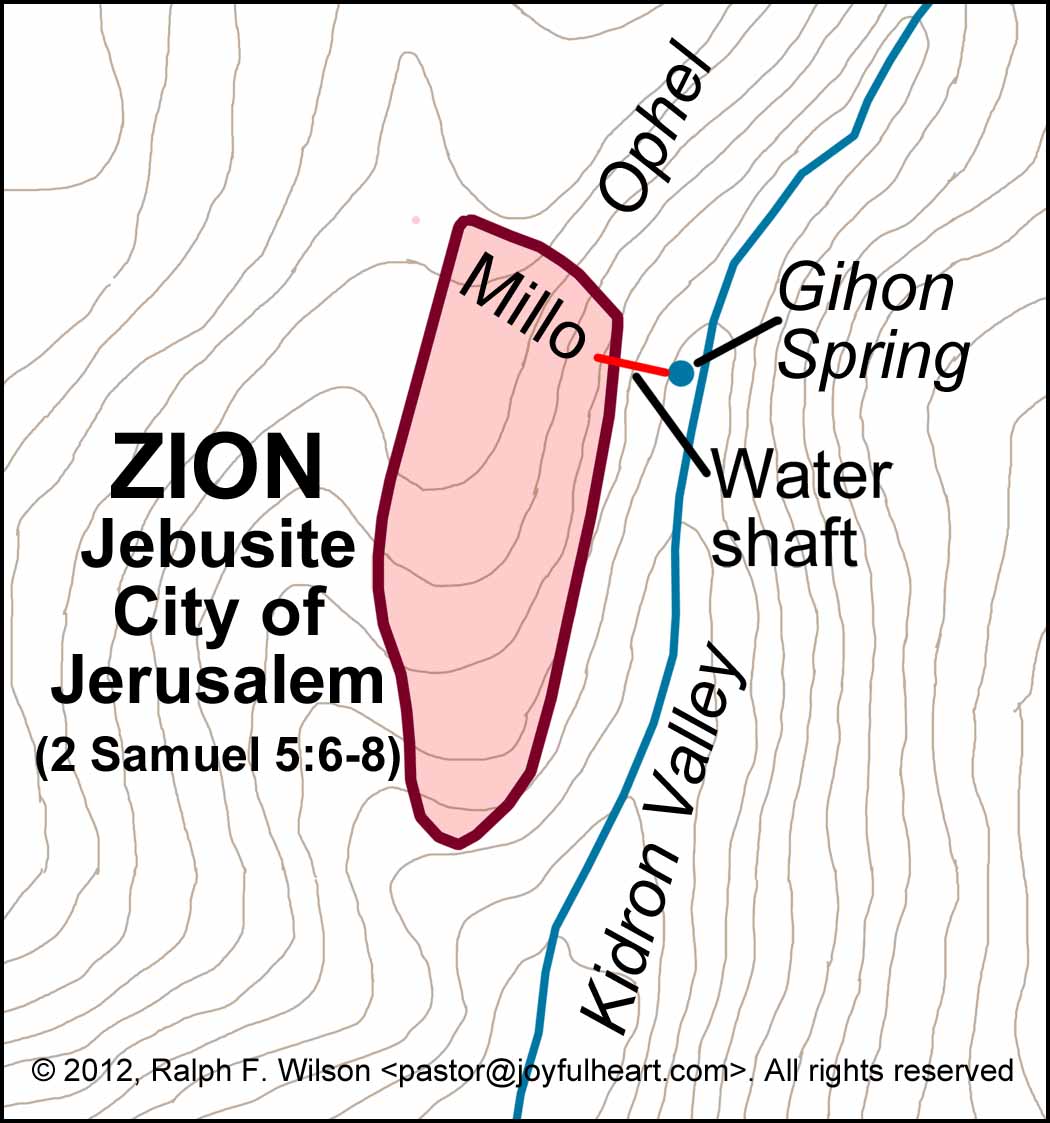
(9) So David dwelt in the fort and called it the City of David. And David built round about from Millo and inward.
David dwelt in that stronghold he had taken from the Jebusites and called it the City of David. He built round about his fort from Millo in the north inward to the city. See this map borrowed from JesusWalk:

No comments:
Post a Comment