Showing posts with label Ephraim. Show all posts

Saturday, August 1, 2026

Moving the Ark of the Lord to Jerusalem

Continuing a chronological Bible study:

(2 Samuel 6:1) Again David gathered together all the chosen of Israel, thirty thousand.

David had become established as king of all Israel.  He had just defeated the Philistines in and around Jerusalem.  He had proposed to all the people that they should bring the ark of the covenant to them in Jerusalem.  He now gathered thirty thousand of the choicest men of Israel.

(2) And David arose and went with all the people who were with him from Baale of Judah to bring up from there the ark of God, whose name is called by the name of the Lord of hosts who dwells between the cherubim.

David went with the thirty thousand men he had gathered to him to Baale of Judah to bring the ark from there.  This was the same as Baalah in Judah that was also known as Kirjath Jearim according to Joshua 15:9.  God's name is Jehovah which is the original Hebrew for Lord.  He dwelt between the cherubim that overshadowed the mercy seat which was above the ark.

(1 Chronicles 13:5) So David gathered all Israel together from Shihor of Egypt to the entering of Hamath to bring the ark of God from Kirjath Jearim.

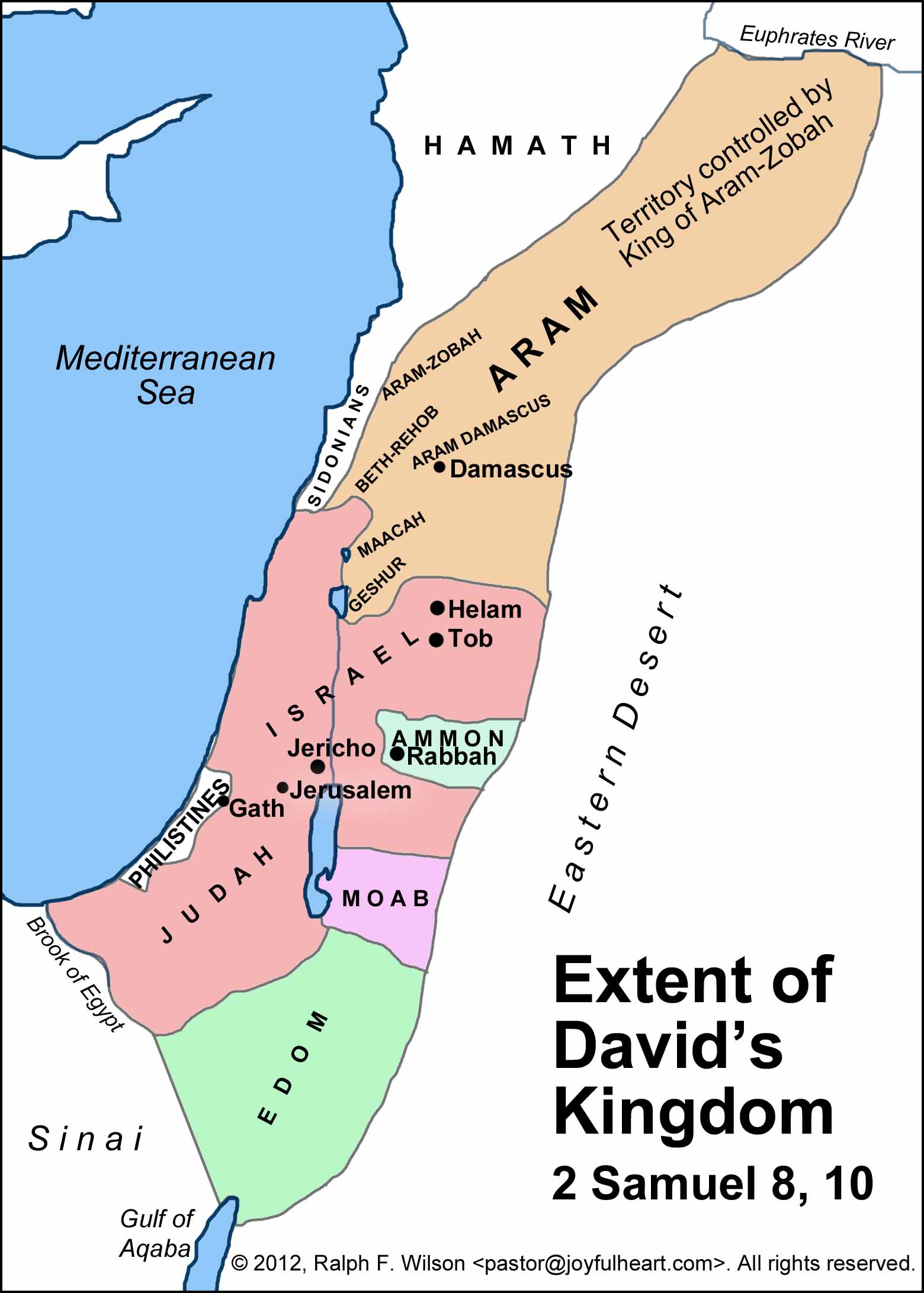
1 Chronicles 13 also told of the event.  Rather than all the people, it was likely the thirty thousand representatives of them whom David gathered together from the southern border at Egypt to the northern border at Hamath as seen on this map borrowed from JesusWalk:


Shihor is believed to be the Brook of Egypt.  David had gathered the thirty thousand men from all over Israel for the purpose of bringing the ark of God from Kirjath Jearim, which was said to be located about 7–9 miles west-northwest of Jerusalem.

(6) And David went up and all Israel to Baalah, to Kirjath Jearim, which belonged to Judah, to bring up from there the ark of God the Lord who dwells between the cherubim whose name is proclaimed.

David and the 30,000 representatives of all Israel went to Kirjath Jearim in Judah to the ark of God the Lord, Jehovah, whose name was proclaimed there where He dwelt between the cherubim above the mercy seat.

(2 Samuel 6:3) And they set the ark of God upon a new cart and brought it out of the house of Abinadab that was in Gibeah, and Uzzah and Ahio, the sons of Abinadab, drove the new cart.

The people brought the ark out of the house of Abinadab in Gibeah, which was a prominent hill in Kirjath Jearim.  They set the ark of God on a new cart, thinking to honor the ark of God by placing it on a cart never before used for anything else.  However, the priests were to have carried it on their shoulders, according to Numbers 7:9.  They should not have put it in a cart, even new, like any common thing.  Uzzah and Ahio, the sons of Abinadab, drove the cart.

(4) And they brought it out of the house of Abinadab, which was at Gibeah, accompanying the ark of God, and Ahio went before the ark.

They brought the cart out of the house of Abinadab which had held the ark of God, and it appears that Ahio actually went before the ark while Uzzah drove the cart.

(5) And David and all the house of Israel played before the Lord on all manner of fir wood, even on harps, and on psalteries, and on timbrels, and on cornets, and on cymbals.

David and all the house of Israel with him played before the Lord on musical instruments made of fir wood, on harps, on other stringed instruments, on tambourines, on cornets, and on cymbals. Once again, they thought they were honoring God, but even David who would seem was well versed in the law of God, had failed to properly honor the ark.  

(1 Chronicles 13:7) And they carried the ark of God in a new cart out of the house of Abinadab, and Uzzah and Ahio drove the cart. (8) And David and all Israel played before God with all their might, and with singing, and with harps, and with psalteries, and with timbrels, and with cymbals, and with trumpets.

1 Chronicles 13 told of the same incident.  Rather than finishing the story, my chronological study takes me to Psalm 78:

(Psalm 78:1) (Maschil of Asaph) Give ear, O my people, to my law; incline your ears to the words of my mouth.

This psalm was already studied in full in this chronological study by Skip Andrews, so I'm not sure why it would be repeated now.  Asaph was a Levite, appointed by David as one of the chief musicians responsible for leading worship before the Ark of the Covenant.  I suppose that is why it might be relevant at this chronological time.  Asaph wrote a few of the psalms, and he wrote this maschil, an instructive psalm.  He called on the people to listen to the doctrine he was about to deliver.

(2) I will open my mouth in a parable; I will utter dark sayings of old, (3) Which we have heard and known, and our fathers have told us.

Asaph would speak freely and openly with analogies, metaphors, and examples.  When you think about it, the entire Old Testament was purposefully analogous to the lives of believers after the coming of Jesus.  "All scripture is given by inspiration of God, and is profitable for doctrine, for reproof, for correction, for instruction in righteousness..." (2 Timothy 3:16).  Those who want to discard the Old Testament because it is not relevant anymore are very much in error as God intended it to be used for teaching us.  

This scripture actually was prophecy referring to Jesus and why He spoke in parables as it says in Matthew 13:34-35, "All these things Jesus spoke to the multitude in parables; and without a parable He did not speak to them, that it might be fulfilled which was spoken by the prophet, saying, 'I will open my mouth in parables; I will utter things which have been kept secret from the foundation of the world.'"  Asaph would speak of dark sayings, or perplexing things, of old, from the foundation of the world, things they had only heard of, such as the fall of man by means of Satan, and how he continued to steal, kill, and destroy (John 10:10).  Perhaps he would speak prophetically of the Gospel which was kept secret until the Messiah came but had been ordained even before the world (1 Corinthians 2:7). 

(4) We will not hide them from their children, showing to the generation to come the praises of the Lord, and His strength, and His wonderful works that He has done.

The people of that present time would not hide those mysteries from their children and from their children's children but would pass on their knowledge of such things to future generations.  They would demonstrate to them how praiseworthy their Lord was, how strong He was, and all the wonderful things He had done for His people.

(5) For He established a testimony in Jacob and appointed a law in Israel, which He commanded our fathers that they should make them known to their children.

The Lord had established a testimony in the house of Jacob, or Israel, as Jacob was the patriarch.  He had appointed a law in Israel which He commanded fathers to teach their children (Deuteronomy 6:7).

(6) That the generation to come might know them, even the children who should be born who should arise and declare them to their children.

Then the next generation would know those mysteries of old and would pass them on to any children they would have who would, in turn, pass them on to their children.  I believe that is what has become lost in this world; so many people do not know the real truth of God because they have never heard the truth.

(7) That they might set their hope in God and not forget the works of God but keep His commandments.

By teaching every generation, they would continue to set their hope in God and never forget His wondrous works, and they would keep His commandments.  Once again, I can't help but think how this has become lost, and that is the reason why so many people are without hope in our day and age.

(8) And might not be as their fathers, a stubborn and rebellious generation, a generation that did not set their heart aright and whose spirit was not steadfast with God.

If the future generations were taught the wonders of their Lord, they would not have to be like their forefathers, a stubborn and rebellious generation like those Israelites in the wilderness and those who rejected Christ, those who did not set their hearts to seek after their Lord to walk in faithfulness with Him.

(9) The children of Ephraim, armed, carrying bows, turned back in the day of battle. (10) They kept not the covenant of God and refused to walk in His law. (11) And forgot His works and His wonders that He had showed them.

The children of the tribe of Ephraim, although armed and well equipped with the best weapons of the time, failed in faith and courage and retreated before the enemy, possibly referring to the failure of Ephraim to drive out the Canaanites from their promised land (Judges 1:29).  It may be that Ephraim here means all of Israel just as Jacob did.  In that case, it might refer to the time the Israelites fled before the Philistines and the ark of the Lord was taken.  That might be the most appropriate meaning here.  They had failed in their faith and did not keep the covenant of the Lord, forgetting all His wondrous works that proved He would always be there for them.

(67) Moreover, He refused the tabernacle of Joseph and chose not the tribe of Ephraim, (68) But chose the tribe of Judah, the Mount Zion which He loved.

The chronological study then skips forward to verse 67.  If this refers to the ark, the Lord refused the tribe of Ephraim, the son of Joseph, therefore also refusing him, where the ark had formerly been in Shiloh.  He now chose the tribe of Judah, specifically Mount Zion, the city of David, for His ark to dwell.

(69) And He built His sanctuary like high, like the earth which He has established forever.

The Lord built His sanctuary exalted, as if it were on a high hill, prominent and permanent, not to be moved from place to place as the tabernacle had been but established as firmly as the earth itself.

(70) He chose David also His servant and took him from the sheepfolds, (71) From following the ewes great with young He brought him, to feed Jacob His people, and Israel His inheritance.

The Lord had chosen David out of the sheep fields; from tending to pregnant ewes, the Lord brought him to rather tend to His people Israel.

(72) So he fed them according to the integrity of his heart and guided them by the skillfulness of his hands.

David led the people according to the integrity of his heart, striving to be upright and pure in the administration of his government, and guided them by the skillfulness of his hands, which represented his power and actions.

Once again, I feel like this chronological order is rather disjointed and even disruptive of the historical event unfolding here.  While David led the people according to the integrity of his heart, in this case, he had forgotten the law of the Lord as we will soon understand in the coming study.

Wednesday, May 28, 2025

Gideon Defeats the Midianites

Continuing a chronological Bible study:

(Judges 7:1) Then Jerub-Baal, who is Gideon, and all the people with him, rose up early and pitched beside the well of Harod, so that the host of the Midianites were on the north side of them, by the hill of Moreh in the valley.

In the last chapter and post, God had called Gideon to deliver His people from the Midianites, and he had subsequently called tribes of large numbers of men to accompany him.  Gideon had cast down the altar of Baal, and his father called him Jerub-Baal.  Now Gideon, with all his men, rose up early in the morning and pitched a tent beside the well of Harod.  No one can say exactly where this well was located, but it was a location that put the Midianites on the north side of them, by the hill of Moreh which was in the valley of Jezreel.

(2) And the Lord said to Gideon, "The people with you are too many for Me to give the Midianites into their hands, lest Israel vaunt themselves against Me, saying, 'My own hand has saved me.'"

The Lord told Gideon that he had gathered too many men for His purpose to deliver Midian into Israel's hand.  Their numbers might so overpower the Midianites that they would think it was by their own might that they were able to defeat the Midianites.  However, it would be God who defeated them by the hand of a self-described poor and insignificant nobody (Judges 6:15).

(3) "Now therefore go to proclaim in the ears of the people, saying, 'Whoever is fearful and afraid, let him return and depart early from Mount Gilead.'" And there returned of the people twenty-two thousand, and there remained ten thousand.

Because there were too many men for His purpose, God told Gideon to go proclaim to the people that if any of them were fearful, they were free to leave Mount Gilead, which was apparently where they were at the time.  This cannot be the Mount Gilead on the eastern side of the Jordan River but must have been another by the same name.  22,000 people subsequently left, leaving 10,000 men.

(4) And the Lord said to Gideon, "The people are yet too many; bring them down to the water, and I will try them for you there, and it shall be of whom I say to you, 'This one shall go with you,' the same shall go with you, and of whomever I say, 'This one shall not go with you,' the same shall not go."

The Lord told Gideon there were still too many men.  He told him to bring them down from the hill to the water where He Himself would tell Gideon who was to go with him and who was not to go.

(5) So he brought down the people to the water, and the Lord said to Gideon, "Everyone who laps of the water with his tongue as a dog laps, him shall you set by himself; likewise everyone who bows down on his knees to drink." (6) And the number of them who lapped, their hand to their mouth, were three hundred men, but all the rest of the people bowed down on their knees to drink water.

Gideon brought all the men down to the water, and the Lord told him to separate the men into groups according to how they drank water from the stream.  Everyone who lapped water with his tongue was to be set aside in one group, and those who knelt down to drink were in another group.  The point was not so much the action of the tongue in lapping, but whether they scooped up water in their hand and did a quick lap or slurp or if they took the time to kneel down and drink water from the stream.  It might be that those who stood and took a quick lap from their hands would appear to be of greater stamina and haste to get the job done than those who took the time to get down on their knees to drink their fill.  Three hundred men stood and lapped a handful of water, ready to go forth into battle, while the rest of the men were kneeling at the creek and drinking.

(7) And the Lord said to Gideon, "By the three hundred men who lapped I will save you and deliver the Midianites into your hand, and let all the others go every man to his place."

Indeed, the Lord told Gideon that He would save him and the children of Israel and deliver the Midianites into his hand by the three hundred men who stood and lapped the water from their hand.  Interestingly, I now read that the historian Josephus wrote that the three hundred represented the most fearful men, taking a quick swipe of water, while the more courageous men knelt down, not so afraid of their surroundings.  With this reasoning, God would choose the weakest men so that there was no doubt that it was God alone who delivered the Midianites into Gideon's hand.  Whatever the reasoning, and perhaps there was none other than to separate some men into a small group, God chose the group of three hundred men to accompany Gideon.  Regardless of how strong and courageous they were, they were only three hundred against 135,000 according to Judges 8:10, so there was no doubt that it was God alone who would deliver Israel.

(8) So the people took provisions in their hand and their trumpets, and he sent all Israel every man to his tent, and retained those three hundred men; and the host of Midian was beneath him in the valley.

This would appear to be the three hundred men who gathered provisions and their trumpets and perhaps gathered of those of the people not chosen, and Gideon sent all the rest of the people back to their tents.  The Midianite army was below Gideon and his three hundred men in the valley of Jezreel.

(9) And it came to pass the same night that the Lord said to him, "Arise, get down to the host, for I have delivered it into your hand. (10) But if you fear to go down, go with Purah your servant down to the host."

That night the Lord came to Gideon and told him to get up and go down to the Midianite army for He had already delivered them into Gideon's hand.  One would think that assurance that it was a done deal would be enough for this hero of faith (Hebrews 11:32), but God gave him another option if he was too fearful to go forth toward the enemy.  I find this amazing!  The Lord showed such incredible patience with Gideon from the beginning of His call to him.  He allowed his requests for multiple signs and now He offered him another option if he was too afraid, even after God had assured him that the huge Midianite army was delivered into his hand.  This should give us so much encouragement that the Lord can be so patient with our fears even though He constantly commands that we "fear not."  It all comes down to the heart that the Lord can see.  He can see our trembling faith, and if it is sincere but just needs a little boost of courage, He is gracious and patient to give us what we need.  God told Gideon if he was afraid to go forth with his small army, that he and his servant Purah could first go down privately.

(11) "And you shall hear what they say, and afterward shall your hands be strengthened to go down to the host." Then he went down with Purah his servant to the outside of the armed men in the host.

The Lord continued with what Gideon could choose to do if he was afraid.  He could take his servant and go down secretly to hear what the Midianites said, and then he would be strengthened by what he heard.  Gideon indeed chose to take his servant Purah and went down to the edge of the Midianite army.

(12) And the Midianites and the Amalekites and all the children of the east lay along in the valley like grasshoppers for multitude and their camels without number as the sand by the seaside for multitude.

Gideon saw that the Midianites, Amalekites, and Arabians, and all their camels lay in the valley as numerous as grains of sand on the seashore.  That sight could have put even more fear in Gideon's heart, but the Lord had told him to listen to what they said.

(13) And when Gideon had come, behold, a man told his dream to his companion, and said, "Behold, I dreamed a dream, and lo, a cake of barley bread tumbled into the host of Midian and came to a tent and struck it that it fell, and overturned it that the tent lay along." (14) And his companion answered and said, "This is nothing else but the sword of Gideon the son of Joash, a man of Israel, for into his hand has God delivered Midian and all the host."

When Gideon had come to the edge of the huge army, he heard a man telling his companion that he had had a dream.  He saw a small simple loaf of barley bread tumble into the Midianite army and take down a tent.  His companion interpreted the dream the only way he saw possible, that it must represent the small army of Gideon, a man of Israel, and the fact that God had delivered Midian into his hand.  The dream, as well as the interpretation, had surely been put into the minds of the Midianite soldiers by God to increase Gideon's courage and confidence.  It may have also had the effect of frightening the Midianites.

(15) And it was so, when Gideon heard the telling of the dream and the interpretation of it, that he worshiped and returned to the host of Israel, and said, "Arise, for the Lord has delivered into your hand the host of Midian."

Gideon was indeed strengthened after hearing the dream and its interpretation.  He worshiped God, surely thanking Him for giving him this extra sign of confirmation.  He then returned to the small Israelite army and told them to rise up for the Lord had delivered the army of the Midianites into their hand, and it was now the time to go take it.

(16) And he divided the three hundred men into three companies, and he put a trumpet in every man's hand, with empty pitchers, and lamps within the pitchers.

Gideon divided the three hundred men into three companies, probably one hundred in each company.  He put a trumpet in every man's hand.  There were enough trumpets for every man to have one because they had gathered them from the people not chosen (verse 8).  He gave every man a pitcher empty of any liquid and put lamps inside each one.  As it was night, the lamps would provide a little light for the small army, yet the light would be concealed from the enemy as they approached them.

(17) And he said to them, "Look on me and do likewise, and behold, when I come to the outside of the camp, it shall be, as I do, so shall you do. (18) When I blow a trumpet, I and all who are with me, then blow the trumpets also on every side of all the camp, and say, 'The sword of the Lord and of Gideon!'"

Gideon told the men in his army to watch him and do just what he did, especially when he came to the outside of the Midianite camp.  Then it appears that the two other companies than the one Gideon was with were to go on other sides of the Midianite camp.  Then when Gideon and his company blew their trumpets, the other companies were to blow their trumpets at the same time, and cry out, "The sword of the Lord and of Gideon!"

(19) So Gideon and the hundred men with him came to the outside of the camp in the beginning of the middle watch, and they had but newly set the watch, and they blew the trumpets and broke the pitchers in their hands. (20) And the three companies blew the trumpets and broke the pitchers and held the lamps in their left hands and the trumpets in their right hands to blow, and they cried, "The sword of the Lord and of Gideon!"

Gideon and his company came to the outside of the Midianite camp in the beginning of the midnight watch.  In the Old Testament the night was divided into three watches, the first watch being the hours after sunset, the middle watch included the hours around midnight, and then there was the pre-dawn watch.  The middle watch had just begun when Gideon and his company blew their trumpets and broke the pitchers, and the other companies blew their trumpets and broke their pitchers and held their lamps in their left hands.  They all cried out, "The sword of the Lord and of Gideon!"  What a fearsome sight and sound this must have been that awakened the Midianites.  Three hundred trumpets, three hundred breaking pitchers, and three hundred men all yelling at once, as well as three hundred lights surrounding their camp.

(21) And they stood every man in his place around the camp, and all the host ran and cried and fled.

All of Gideon's army stood every man in his place while the Midianites cried out and ran.

(22) And the three hundred blew the trumpets, and the Lord set every man's sword against his fellow throughout all the host, and the host fled to Beth Shittah in Zererah to the border of Abel Meholah to Tabbath.

Gideon's three hundred men continued blowing their trumpets, and the Lord so confused the Midianites that they used their swords against one another throughout the whole Midianite army.  Those who remained of the Midianites fled to places most of which were unknown by the Biblical commentators I study, but they went as far as Abel Meholah which was in the Jordan valley.

(23) And the men of Israel gathered themselves together out of Naphtali, and out of Asher, and out of all Manasseh, and pursued after the Midianites.

The men of Israel, probably the same ones Gideon had initially called (Judges 6:35) before the Lord cut them down to size, gathered themselves together out of the tribes of Naphtali, Asher, and Manasseh, and pursued the Midianites who had fled.  It appears that the tribe of Zebulun did not accompany the Israelite army this time.

(24) And Gideon sent messengers throughout all Mount Ephraim, saying, "Come down against the Midianites and take before them the waters to Beth Barah and Jordan." Then all the men of Ephraim gathered themselves together and took the waters to Beth Barah and Jordan.

Gideon sent messengers throughout Mount Ephraim telling them to go down against the Midianites cutting them off at the Jordan River before they had a chance to cross over it back to Midian.  The men of the tribe of Ephraim did just that.

(25) And they took two princes of the Midianites, Oreb and Zeeb, and they killed Oreb on the rock Oreb, and Zeeb they killed at the winepress of Zeeb, and pursued Midian and brought the heads of Oreb and Zeeb to Gideon on the other side of the Jordan.

The Israelites killed two princes of the Midianites, Oreb and Zeeb.  They killed Oreb on the rock of Oreb, and they killed Zeeb at the winepress of Zeeb.  They killed these princes at places that would afterward be called by those names, or more likely they pursued them into Midian, as they brought the heads of those princes to Gideon "on the other side of the Jordan."

(Judges 8:1) And the men of Ephraim said to him, "Why have you served us thus that you did not call us when you went to fight with the Midianites?" And they did chide him sharply.

Then the men of Ephraim asked Gideon why he had done such a thing as to not call them when he went to fight the Midianites.  The fact that they chided him so sharply shows that this was probably out of pride rather than a desire to help.  They didn't like the fact that they had played a subordinate part and that Gideon would get all the glory.

(2) And he said to them, "What have I done now in comparison to you? Is not the gleaning of the grapes of Ephraim better than the vintage of Abiezer? (3) God has delivered into your hands the princes of Midian, Oreb and Zeeb, and what was I able to do in comparison to you?" Then their anger was abated toward him when he had said that.

Gideon gave the tribe of Ephraim a calm and gentle answer, as "a soft answer turns away wrath..." (Proverbs 15:1).  There could have been an all-out civil war between the tribes if Gideon had become puffed up himself, telling Ephraim they had no right to question him as, after all, God had chosen him to deliver Israel.  But he downplayed his part, asking what he had done in comparison to them.  After all, God Himself delivered the princes of Midian, Oreb and Zeeb, into their hands.  Wasn't the gleaning of the grapes by Ephraim, that final act of finishing up the harvest, better than the entire vintage or campaign?  I am struck by Gideon's meekness and the fact that God chose such a meek and gentle man for this task.  Gideon constantly downplayed himself.  He called himself poor and the least in his father's house when God initially called him (Judges 6:15).  He called for multiple signs to be sure that it was God calling him.  God, knowing Gideon's heart, obviously did not take these requests as a lack of faith, as He was quite patient in granting them, and he was called one of the heroes of faith in Hebrews 11.  If there was any lack of faith on Gideon's part, it was a lack of faith in himself.  He wanted to be sure he was acting in God's will and not some misplaced will of his own.  In Gideon's calm and humble answer in the above verse, he gives the bulk of the glory to Ephraim and averts what could have been a civil war among the tribes.  God, in His great wisdom, of course, chose the right man for the job.

(4) And Gideon came to Jordan and passed over, he and the three hundred men who were with him, faint, yet in pursuit.

Gideon and his army of three hundred crossed the Jordan River pursuing the remaining Midianites.  They were getting fatigued having been up all night.

(5) And he said to the men of Succoth, "Give, I pray you, loaves of bread to the people who follow me, for they are faint, and I am pursuing after Zebah and Zalmunna, kings of Midian."

When they came to Succoth on the east side of the Jordan River in the tribe of Gad, he asked the men there to please give his army of men loaves of bread as they were fatigued and hungry, but they were still in pursuit of Zebah and Zalmunna, kings of Midian.

(6) And the princes of Succoth said, "Are the hands of Zebah and Zalmunna now in your hand that we should give bread to your army?"

The chief magistrates of Succoth, men of Israel, refused them!  Once they saw that they had captured Zebah and Zalmunna, then maybe they would give bread to Gideon's army.  I imagine that they did not see how so little an army was a match for the Midianites and feared if they helped their brethren, they would surely pay for it and their bondage would be harder than it was before.  It was very cruel of them to show no sympathy or compassion for their brethren, and it demonstrated selfishness and concern only for themselves.  John Wesley, in his Notes on the Bible, wrote that these men had to be worshippers of Baal to turn their backs on God's own people, their brethren.

(7) And Gideon said, "Therefore when the Lord has delivered Zebah and Zalmunna into my hand, then I will tear your flesh with the thorns of the wilderness and with briers."

The humble and meek Gideon was brought to righteous anger.  He told the men of Succoth that when the Lord had delivered Zebah and Zalmunna into his hands, as he had no doubt He would, he would return to tear their flesh with the thorns and briers of the wilderness.  Dr. John Gill, in his Exposition of the Bible, suggested that Succoth may have been known for all the thorns and briers that grew in the wilderness near the city, as "succoth" or "sukkah" was used by Job in Job 41:7 to mean "barbed irons."

(8) And he went up from there to Penuel and spoke to them likewise, and the men of Penuel answered him as the men of Succoth had answered.

Gideon and his army then went from Succoth to the city of Penuel, also inhabited by his Israelite brethren, and asked them for bread to feed his fatigued army, and they shockingly also refused him.

(9) And he spoke also to the men of Penuel, saying, "When I come again in peace, I will break down this tower."

Gideon spoke to the men of Penuel with the same righteous anger as he had spoken to the men of Succoth and told them that when he had returned their way in peace after conquering all his enemies, he would break down a tower in their city.

(10) Now Zebah and Zalmunna were in Karkor and their hosts with them, about fifteen thousand, all who were left of all the hosts of the children of the east, for there fell a hundred and twenty thousand men who drew sword.

The kings of Midian, Zebah and Zalmunna, were in a place called Karkor, the location of which is not known by the Biblical scholars I study.  All their armies of men were with them, about 15,000, which was all that were left of the original armies, as 120,000 of those who had fought against Israel had fallen.

(11) And Gideon went up by the way of those who dwelt in tents on the east of Nobah and Jogbehah and struck the host, for the host was secure.

Gideon and his small army went by the way of the wilderness where the Arabians dwelt in tents on the east of Nobah and Jogbehah, which were in the tribes of Manasseh and Gad, respectively.  They were able to strike the Midianites because their guard was down as they felt secure in their location.

(12) And when Zebah and Zalmunna fled, he pursued after them and took the two kings of Midian, Zebah and Zalmunna, and discomfited all the host.

Gideon's army threw the Midianite host into a panic and the kings, Zebah and Zalmunna, fled, and Gideon pursued them and eventually took them.

(13) And Gideon the son of Joash returned from battle before the sun was up, (14) And caught a young man of the men of Succoth and enquired of him, and he described to him the princes of Succoth and the elders, seventy-seven men.

Gideon returned from battle before sun-up.  As he came to Succoth, he caught a young man of the city and questioned him about the chiefs of the city.  The young man described to him the princes and elders of the city, a total of seventy-seven men.

(15) And he came to the men of Succoth, and said, "Behold, Zebah and Zalmunna, with whom you did upbraid me, saying, 'Are the hands of Zebah and Zalmunna now in your hand, that we should give bread to your men?'" (16) And he took the elders of the city and thorns of the wilderness and briers, and with them he taught the men of Succoth.

Gideon then went to the elders of Succoth and told them that he now had Zebah and Zalmunna in his hand, and reminded them about how they had refused to give his weary men bread when they noted that he did not yet have the kings in his custody and insinuated that his small army never would have them (verse 6).  He then took the elders of the city and with the thorns and briers of the wilderness, taught them a lesson.  We often learn the best lessons through adversity.  Actually, the Hebrew characters for the word translated as "taught" are very similar to the characters translated as "tore," and as the latter agrees with what Gideon said he would do to the men in verse 7, it is likely that is what is meant here.

(17) And he beat down the tower of Penuel and killed the men of the city.

Gideon, true to his word (verse 8), also went to Penuel and beat down its tower.  He also killed men of the city, probably only the ones who tried to stop him from tearing down the tower.

(18) Then he said to Zebah and Zalmunna, "What manner of men whom you killed at Tabor?" And they answered, "As you, so they; each one resembled the son of a king."

Gideon then asked the kings what manner of men they had killed at Mount Tabor.  That particular event was not detailed in scripture, but I imagine it took place sometime after the Israelites had been forced to hide out in dens they made in the mountains (Judges 6:2).  The kings replied that they were like Gideon himself, and that each one looked like the son of a king, probably meaning they were graceful and dignified even in the lowly state to which they were relegated.

(19) And he said, "They were my brethren, the sons of my mother. As the Lord lives, if you had saved them alive, I would not kill you."

Gideon told the kings that they had been his brethren whom they had killed.  He added "the sons of my mother" to indicate he did not mean brethren in the larger sense, but these were his immediate family.  He added that had the kings saved his brethren alive, he would not have killed them, but the logical conclusion is that because they had killed his brothers, he would kill them.

(20) And he said to Jether, his firstborn, "Up, kill them!" But the youth did not draw his sword for he was afraid because he was still a youth.

Gideon called on Jether, his firstborn son, to slay the kings, perhaps to give him honor for avenging his family's blood, but he was young and afraid and did not draw his sword.

(21) Then Zebah and Zalmunna said, "Rise yourself and fall on us, for as the man, so is his strength." And Gideon arose and killed Zebah and Zalmunna and took away the ornaments on their camels' necks.

If they must die, the kings asked that Gideon do it.  Perhaps they feared that the strength of the youth would not be enough to kill them at once and instantly put them out of their misery.  They might have died a lingering and painful death at the hands of Jether.  Gideon did indeed rise up and kill the kings, and he took the ornaments that were on their camels' necks.

(22) Then the men of Israel said to Gideon, "Rule over us, both you and your son, and your son's son also, for you have delivered us from the hand of Midian."

The men of Israel then asked that Gideon and his son rule over them, as well as their posterity after them.  Their reasoning for wanting him to be as a king over them was because he had delivered them from the hand of the Midianites.  Indeed, God had used Gideon to deliver His people from the Midianites, but it was obviously God Himself who had done the delivering.  How else could three hundred men defeat 135,000 (verse 10)?  The Lord was their King and had always defended and protected them, but they were awed by the success of a man who was merely God's instrument.

(23) And Gideon said to them, "I will not rule over you, neither shall my son rule over you; the Lord shall rule over you."

Gideon, in fact, did tell the people that neither he nor his son would agree to rule over them.  Only the Lord God of Israel would rule over them.

(24) And Gideon said to them, "I would desire a request of you, that you would give me every man the earrings of his prey. (For they had golden earrings because they were Ishmaelites.)

However, Gideon did make another request of them.  If they wanted to do something for him, they could give him the earrings of their prey.  They had golden earrings of the Ishmaelites who were spoken of here as the same as the Midianites.  The Ishmaelites were the progeny of Ishmael, the son of Abraham and the maidservant Hagar.  Abraham sent Hagar and Ishmael into the wilderness where an angel of the Lord appeared to Hagar and told her that Ishmael would become a great nation.  Genesis 16:12 said that Ishmael would be a wild man with his hand against every man, and he would dwell in the presence of his brethren.  The Ishmaelites at this time resided in Moab next to the Midianites, and as Arabs, they wore earrings and nose-rings.

(25) And they answered, "We will willingly give." And they spread a garment and cast in it every man the earrings of his prey.

The people told Gideon they would willingly give their golden earrings.  They spread out a garment and every man put his earrings into it.

(26) And the weight of the golden earrings that he requested was a thousand and seven hundred gold, besides ornaments, and collars, and purple raiment that had been on the kings of Midian, and besides the chains about their camels' necks.

The weight of the golden earrings gathered totaled 1700 weights of gold.  Most of the Bible translations added the word "shekels," but the original does not say what standard was used.  Even if it were measured in shekels, there is not a consensus as to exactly how much that would be. The word "shekel" itself just means "weight."  I've seen among the commentators I study estimates of 43 to 100 pounds of gold that was gathered just from the golden earrings.  The people also collected ornaments, collars, and purple raiment from the kings of Midian, as well as the chains from the camels' necks. 

(27) And Gideon made an ephod of it and put it in his city, in Ophrah, and all Israel went there a whoring after it, which thing became a snare to Gideon and to his house.

Gideon made a golden ephod out of all the gold.  An ephod was an apron like vestment worn on the outside of the clothing.  With it being perhaps 100 pounds in weight, Gideon did not wear it but placed it in his city of Ophrah as a monument of his victories.  The people made an idol of it, which is the meaning of "a whoring" in the Bible.  They committed adultery and worshiped a false god or idol of the golden ephod.  Thus it became a snare to Gideon and his house.  At the very least, it seems that calling for all that gold to make an ephod that would be set up as a kind of trophy, was an act of pride.  And Gideon was responsible for making that idol that the people would begin to worship.

(28) Thus was Midian subdued before the children of Israel, so that they lifted up their heads no more. And the country was in quietness forty years in the days of Gideon.

The Midianites were subdued by the Lord using the hand of Gideon and his small army, and they did not regain their strength.  Israel had peace for forty years during the days of Gideon.

(29) And Jerub-Baal the son of Joash went and dwelt in his own house.  

After his victory, Gideon, here called by the name his father Joash had given him, Jerub-Baal (Judges 6:32), went back to his house and dwelled there.

(30) And Gideon had seventy sons begotten of his body, for he had many wives. (31) And his concubine in Shechem also bore him a son, whose name he called Abimelech.

Gideon had a total of seventy sons because he had many wives.  He also had a concubine who did not live in his house in Ophrah but lived in Shechem.  She also bore him a son whom he called Abimelech.

(32) And Gideon the son of Joash died in a good old age and was buried in the sepulchre of Joash his father in Ophrah of the Abiezrites.

Gideon lived a long life and died at a good old age.  He was buried in his father's sepulcher in his city, Ophrah, in the family of the Abiezrites.

(33) And it came to pass, as soon as Gideon was dead, that the children of Israel turned again and went a whoring after the Baals and made Baal-Berith their god.

It seems the Israelites wasted no time returning to their wicked ways after the death of Gideon.  They started worshipping the various Baals, the false gods of the Canaanites, eventually making Baal-Berith their ultimate god.

(34) And the children of Israel did not remember the Lord their God who had delivered them out of the hands of all their enemies on every side. 

The children of Israel did not remember their Lord God to worship Him; they did not remember how He had delivered them from the hands of their enemies time and time again.  We might find this hard to believe that the Israelites could actually turn from their Lord after all the things He had done for them, after all His love and mercy and providence.  However, if we look honestly within ourselves, we will see how we might not pray as much or think about God as much when things are going well.  We begin to spend more time on things other than God, and those things become idols, as the very definition of "idol" is any person or thing regarded with admiration and adoration.

(35) Neither did they show kindness to the house of Jerub-Baal, Gideon, according to all the goodness which he had shown to Israel.

It appears that the people also did not show any kindness or gratitude to the family of Gideon after all Gideon had done for them in allowing himself to be used by God to deliver his people from the Midianites.

As so often the case, we see in Gideon another flawed person who God used to do great things.  Why wouldn't this be the running theme throughout the whole Bible when we know that all humans are flawed and sinful (Ecclesiastes 7:20)?  Gideon seemed to be at the very least not very confident in himself as God's choice to deliver Israel.  He needed multiple signs from God to bolster his courage; however, that was not seen by God as a lack of faith in Him, but perhaps just in himself to discern whether or not he was truly hearing from God.  He was sometimes fearful (Judges 7:10).  It seems he became a little prideful after his victory.  Although he did refuse kingship offered by the people, he requested they give him lots of gold with which he made an elaborate golden ephod that stood as a monument to his success.  He had multiple wives and a concubine in another city, which was common in his day, but certainly can't be considered as a sign of model moral character.  Gideon was certainly not the worst of characters; he was just human with some of the human characteristics that befall us all.  However, that should give us all hope and encouragement that God can use us, and He will meet us where we are in life, and He will supply us with all things necessary to carry out His will for us.  Amen!

Saturday, May 17, 2025

Song of Deborah

Continuing a chronological Bible study:

(Judges 5:1) Then sang Deborah and Barak the son of Abinoam on that day, saying,

In the last chapter, Deborah and Barak had just defeated the king of Canaan and his army and its captain, Sisera, by the hand of the Lord who delivered their enemy to them.  Deborah wrote a song of praise that was sung by both her and Barak:

(2) "Praise you, the Lord, for the avenging of Israel, when the people willingly offered themselves."

Deborah began by praising the Lord for taking vengeance on Jabin king of Canaan, when, led by the Lord, the children of Israel willingly went to fight against their enemies for Israel.

(3) "Hear, O you kings! Give ear, O you princes! I, even I, will sing to the Lord; I will sing praise to the Lord God of Israel."

Deborah desired that all kings and princes hear her song of praise, that all might know the wonderful works of the Lord God of Israel.

(4) "Lord, when You went out of Seir, when You marched out of the field of Edom, the earth trembled, and the heavens dropped; the clouds also dropped water."

Seir and Edom are the same place, and Deborah here acknowledged that the Lord had led His people from there to their land in Canaan.  All the way, He struck dread in the hearts of their enemies with earthquakes and rain and hail storms.

(5) "The mountains melted from before the Lord, that Sinai from before the Lord God of Israel."

Even the mountains trembled and melted before the Lord, just as Mount Sinai had trembled and quaked at the presence of God on it.

(6) "In the days of Shamgar the son of Anath, in the days of Jael, the highways were unoccupied, and the travelers walked through byways."

Shamgar succeeded Ehud as judge, but did not appear to rule long or accomplish much (Judges 3:31), or at least not a perfect and complete deliverance of Israel.  But during his time and that of Jael, the wife of Heber (Judges 4:17), the highways were unoccupied by the Israelites because they were dangerous, occupied by their enemies who wished to do them harm.  They were forced to travel by less frequented paths.

(7) "The villages ceased; they ceased in Israel until that I, Deborah, arose, that I arose a mother in Israel."

Life in their villages as it once was ceased because the Israelites were so oppressed by their enemy.  That is, until Deborah rose up; being raised up by God, she was as a mother to the children of Israel, instructing, ruling, and protecting them.  

(8) "They chose new gods, then was war in the gates; was there a shield or spear seen among forty thousand in Israel?"

The children of Israel chose the false gods of the enemy, called new gods because they were new and previously unknown to them.  It's not as if they simply submitted to worshiping them when their enemy forced them, but it seems they willingly chose them.  There was war within the gates of their cities for they were completely taken over by their enemy.  Apparently, their enemy had totally disarmed the Israelites, as well.

(9) "My heart is toward the governors of Israel who offered themselves willingly among the people. Bless you the Lord!"

Deborah had a heart for the rulers of Israel who had offered themselves willingly to do the work of their Lord.  The original word "chaqaq" that was translated as "governors" came from a root that meant "engrave."  So she might have meant that she had a heart for the wise men and scribes who willingly taught the word of God and His commandments.  She blessed the Lord for giving those "governors" hearts to willingly engage in service to Him, whatever it might be.

(10) "Speak, you who ride on white donkeys, you who sit in judgment and walk by the way."

Deborah called for nobles and magistrates, or perhaps it was the wise men and scribes, who rode on white donkeys to speak out.  The original word that was translated as "judgment" was "mad," and it most often referred to garments or clothing.  I believe what is meant here is that Deborah called for the upper class of nobles and leaders, described as having white donkeys and fine raiment, who walked among the common people, to tell of God's great works.

(11) "From the noise of archers in the places of drawing water, there shall they rehearse the righteous acts of the Lord, the righteous acts of His villages in Israel; then shall the people of the Lord go down to the gates."

I'm not sure whether this means the places of drawing water were free from the noise of the archers who attacked the people, and there the nobles could celebrate the righteous acts of the Lord, or if even in spite of the noise of the attacks of their enemies, they were to celebrate the Lord.  "Celebrate" is a better translation of the original word "tanah" that was translated as "rehearse."  Most of the Biblical commentators I study see this as celebration after the Lord delivered them, but as the next verse calls on Deborah and Barak to rise up, I see this as happening before they were delivered.  Deborah had called on the nobles to speak out even in the people's oppression.  This they did, and the people cried out to the Lord (Judges 4:3).  Then they would be able to go in and out of the gates when the Lord delivered them.

(12) "Awake, awake, Deborah! Awake, awake, utter a song. Arise, Barak, and lead your captivity captive, you son of Abinoam."

Once again, I disagree with the commentators I study about the meaning of this verse.  They believe Deborah is stirring herself to more zeal and enthusiasm in her song after the Lord had delivered Israel.  Why then would the verse continue with raising up Barak against the enemy if that had already been done?  The commentators admit that there are some difficulties in the text of the song which probably lost something in translation.  However, I see this as Deborah relating the chronological order of things in her song.  She was called to rise up, and yes, she would eventually utter a song upon victory, but I believe it's also possible this was a call for her to prophesy when she was raised up.  Then she called on Barak to rise up and make those who held the children of Israel captive, themselves captive.

(13) "Then He made him who remained have dominion over the nobles among the people; the Lord made me have dominion over the mighty."

Then the Lord made those who remained of the Israelites after the oppression of the Canaanites to have dominion over the nobles and officers of the enemy among them.  The Lord had raised up Deborah to have dominion over their mighty enemy.

(14) "Out of Ephraim a root of them against Amalek; after you, Benjamin, among your people; out of Machir came down governors, and out of Zebulun they who handle the pen of the writer."

Out of the tribe of Ephraim, of which Deborah was a member, came the root and foundation of the campaign against the Amalekites, chief enemies of Israel among the Canaanites.  Then the tribe of Benjamin joined forces with the tribe of Ephraim against their enemy.  Machir, the son of Manasseh, represented his tribe on the west of the Jordan, and they sent leaders, probably meaning military leaders, to aid in the campaign against the Canaanites.  Even the tribe of Zebulun where normally clerks and scribes and those mighty with the pen dwelled, sent troops to aid Barak in his campaign against Jabin king of Canaan.

(15) "And the princes of Issachar were with Deborah, even Issachar, and also Barak, he was sent on foot into the valley. For the divisions of Reuben, great thoughts of heart."

The leaders of Issachar, as well as Issachar in general, were with Deborah in her campaign.  Barak of the tribe of Naphtali, which I believe means to include the whole tribe of Naphtali, were an integral part of the campaign, and they were sent forth into the valley of the river of Kishon where the Lord would draw Sisera of King Jabin's army to them (Judges 4:7).  Among the clans of Reuben, it appears there were many conflicting thoughts about the campaign, and they did not join their brothers on the western side of the Jordan against Sisera.

(16) "Why did you abide among the sheepfolds to hear the bleating of the flocks? For the divisions of Reuben, great searchings of heart."

Deborah chided the tribe of Reuben, asking why they would sit there with their flocks of sheep and not go to help their brethren.  Again, she mentions the great searchings of heart.  Either she was disappointed that they couldn't agree to accompany her, or perhaps she and Barak and the other tribes with them were the ones having to search their hearts for what they felt about their brethren who would not help them.

(17) "Gilead abode beyond Jordan, and why did Dan remain in ships? Asher continued on the seashore and abode in his breaches."

The land of Gilead belonged to Gad and the half tribe of Manasseh on the east side of the Jordan River.  Deborah was proclaiming that those tribes stayed put and did not join the campaign.  Neither did the tribes of Dan or Asher.  The tribe of Dan continued in its work in ships on the Mediterranean Sea, as did Asher tend to its business on the shore of the sea.  They abode in their breaks in the shore and ignored their brothers fighting against Canaan.

(18) "Zebulun and Naphtali, a people who jeopardized their lives to the death in the high places of the field."

Deborah commended the tribes of Zebulun and Naphtali who were the chief fighters in the war against Sisera, the 10,000 soldiers initially called by Deborah and Barak (Judges 4:6).  They jeopardized their lives in the height of battle in the battlefield while some of their brethren dwelt in safety within their tribes.

(19) "The kings came and fought, then fought the kings of Canaan in Taanach by the waters of Megiddo; they took no gain of money."

I believe both mentions of the kings refer to the kings of Canaan who came from diverse places within Canaan to fight Israel in Taanach not far from the Kishon River.  They were unable to win any spoils; they lost it all.

(20) "They fought from heaven; the stars in their courses fought against Sisera."

The Lord fought for Israel from heaven when what Deborah described as the stars themselves fought against Sisera.  I believe this lends credence to Josephus's assertion that Sisera's army was hit with rain and hail from heaven (see Judges 4:15).

(21) "The river of Kishon swept them away, that ancient river, the river Kishon. O my soul, you have trodden down strength."

The Kishon River may have swept away some dead bodies of the enemy, but I rather think this was a somewhat poetic way of saying that the enemy was conquered there because that is where the Lord drew them for battle (Judges 4:7).  An ancient river, although not a necessarily great one, that is where a strong and mighty army was totally trodden down and crushed.

(22) "Then were horse hooves broken by the means of the galloping, the galloping of their mighty ones."

The enemy's horses' hooves were broken because of their violent galloping, the violent galloping of their strong and mighty horses.  Or perhaps the second part meant they were broken because of the violent galloping through the rain and hail, driven hard by their mighty soldiers.

(23) "'Curse you, Meroz,' said the angel of the Lord, 'Curse you bitterly its inhabitants because they did not come to the help of the Lord against the mighty.'"

Meroz was apparently a city close to where they fought, but none of the Bible commentators I study know where exactly it was.  John Wesley, in his Notes on the Bible, suggested that it may have been part of the curse that there should be no remembrance of it left.  The angel of the Lord called it to be cursed, which was either Deborah's way of describing what the Spirit of the Lord had said to her, or perhaps Barak was called the angel of the Lord because he had been called by Him to deliver His people.  Meroz was cursed because they did not come to the aid of God's people against Sisera even though they had surely been called by the Lord.

(24) "Blessed above women shall Jael the wife of Heber the Kenite be, blessed shall she be above women in the tents."

However, Jael was blessed because she had helped Israel, even though she had not been initially called.  She was blessed above women in tents, women whose jobs were to take care of their homes, not to be as soldiers.

(25) "He asked water, she gave milk; she brought forth butter in a lordly dish."

Sisera had asked Jael for water, and she gave him milk.  It seems it was a very rich milk, cream, that she brought to him in a nice dish, rather than just a drink of water from a ladle or simple cup.  It was probably just meant to be a kind act on her part, but as God was about to direct her to do otherwise, the rich milk probably helped to make him sleepy.

(26) "She put her hand to the nail, and her right hand to the workmen's hammer, and with the hammer she struck Sisera; she smote off his head when she had pierced and stricken through his temples."

Jael had taken a tent spike and a hammer and struck the spike into Sisera's temple which went through and out the other temple, pinning him to the floor.  In that way she crushed his head, which is actually a better translation of the original word "machaq" which was translated as "smote off" by the King James translators.

(27) "At her feet he bowed, he fell, he lay down; at her feet he bowed, he fell; where he bowed, there he fell down dead."

After Jael had struck him, it was as if Sisera bowed before her feet.  Bible commentators struggled to explain how he must had stood up to bow down and fall.  However, again, I think Deborah is just being poetic in song.  Jael could not have stricken Sisera through the temples and pinned him to the floor (Judges 4:21) unless he was lying down.  Sisera fell dead at Jael's feet.

(28) "The mother of Sisera looked out at a window and cried through the lattice, 'Why is his chariot long in coming? Why do the wheels of his chariots tarry?'"

Deborah imagined Sisera's mother looking out a window and crying through the lattice that covered it, wondering why Sisera was so long in returning.  She wondered why she did not hear the clatter of the wheels of his nine hundred chariots returning.

(29) "Her wise ladies answered her, 'Yes,' she returned answer to herself, (30) 'Have they not sped, have they divided the prey, to every man a damsel or two, to Sisera a prey of diverse colors, a prey of diverse colors of needlework, of diverse colors of needlework on both sides for the necks of the spoilers?'"

Deborah imagined that Sisera's mother's wise maidens or women attending her would answer, and she answered herself that yes, Sisera and his army had surely sped through to victory and were still dividing the spoils.  The soldiers were probably taking the women, and Sisera was taking fine, beautiful, and colorful linens and garments either to be worn on his neck, but probably more likely to be carried on the necks or backs of the soldiers.

(31) "So let all of Your enemies perish, O Lord, but those who love Him as the sun when it goes forth in its might." And the land had rest for forty years.

Deborah ended her song with her desire that all the Lord's enemies perish as Sisera and his army had.  And she wished that all those who loved the Lord be as the sun at its brightest and hottest, with intense love and as a bright light to the world.  And then the land had rest from their enemies for forty years.

Friday, March 21, 2025

Cities Allotted to Levi

Continuing a chronological Bible study:

(Joshua 21:1) Then came near the heads of the fathers of the Levites to Eleazar the priest and to Joshua the son of Nun and to the heads of the fathers of the tribes of the children of Israel.

In the past chapters and posts, Eleazar the high priest and Joshua, along with heads of the tribes, had divided the land and given inheritance to each of the tribes.  Then the people appointed cities of refuge among their tribes.  Now the heads of the Levites came to Eleazar, and Joshua, and those heads of the other tribes.

(2) And they spoke to them at Shiloh in the land of Canaan, saying, "The Lord commanded by the hand of Moses to give us cities to dwell in, with the suburbs of them for our cattle."

The Levites reminded them that the Lord had commanded through Moses that they should have cities and suburbs within the other tribes, to live in and keep livestock.  The Levites had not been given a lot of their own as had been given the other tribes, because as the priests, God was to be their inheritance.  However, God did provide for them cities in which to dwell within the other tribes (Numbers 35:2).

(3) And the children of Israel gave to the Levites out of their inheritance at the commandment of the Lord, these cities and their suburbs.

The Israelites indeed gave to the Levites cities out of their inheritance in which to dwell, descriptions of which follow.

(4) And the lot came out for the families of the Kohathites, and the children of Aaron the priest of the Levites had by lot out of the tribe of Judah, and out of the tribe of Simeon, and out of the tribe of Benjamin, thirteen cities.

The first lot came out for the Kohathites, descendants of Kohath, a son of Levi.  The children of Aaron the priest, son of Amram who was a son of Kohath, were the only priests of the Levites.  The other Levites assisted the priests and acted as ministers for the people.  The children of Aaron, the priests, were given cities out of the tribes of Judah, Simeon, and Benjamin, thirteen cities in all.

(5) And the rest of the children of Kohath had by lot out of the families of the tribe of Ephraim, and out of the tribe of Dan, and out of the half tribe of Manasseh west of the Jordan River, ten cities.

The rest of the Kohathites, Levites, but not priests, had their cities assigned by lot within the tribes of Ephraim, Dan, and the half tribe of Manasseh, ten cities in all.

(6) And the children of Gershon had by lot out of the families of the tribe of Issachar, and out of the tribe of Asher, and out of the tribe of Naphtali, and out of the half tribe of Manasseh in Bashan, thirteen cities.

The children of Gershon, another son of Levi, had cities assigned by lot within the tribes of Issachar, Asher, Naphtali, and the half tribe of Manasseh east of the Jordan River.

(7) The children of Merari by their families, had out of the tribe of Reuben, and out of the tribe of Gad, and out of the tribe of Zebulun, twelve cities.

The children of Merari, the third son of Levi, were given cities within the tribes of Reuben, Gad, and Zebulun, twelve cities in all.  All the tribes were to give cities to the Levites as a sort of tithe.  They were to provide for the priests and the ministers who attended the priests and ministered to the people within each tribe.  Although it was a benefit to the other tribes to have Levite ministers living among them, it was the fulfillment of a curse made by Jacob, that because of their anger and cruel wrath, they would be scattered throughout Israel (Genesis 49:7).  A total of forty-eight cities were given to the Levites according to the commandment of the Lord (Numbers 35:7).

(8) And the children of Israel gave by lot to the Levites these cities with their suburbs, as the Lord commanded by the hand of Moses.

The Israelites gave by lot cities along with their suburbs within each of their tribes, just as the Lord had commanded.

(9) And they gave out of the tribe of the children of Judah, and out of the tribe of the children of Simeon, these cities which are mentioned by name, (10) Which the children of Aaron of the families of the Kohathites of the children of Levi had, for theirs was the first lot. (11) And they gave them the city of Arba the father of Anak, which is Hebron, in the hills of Judah with the suburbs of it round about it.

The Israelites gave the children of Aaron who were of the Kohathites, cities, names which follow in the text, out of the tribes of Judah and Simeon.  First, they gave them the city and suburbs of Kirjath Arba, "city of Arba," Arba being a son of the Anakims, a race of giants among whom Arba was chief.  It was renamed Hebron (Joshua 14:15) and it lay in the hill country of Judah.  

(12) But the fields of the city, and its villages, they gave to Caleb the son of Jephunneh for his possession.

However, the fields and villages surrounding Hebron belonged to Caleb (Joshua 14:13).  He had been given Hebron, but as with all the tribes, he gave a city in which the Levites could dwell.  According to Biblical scholars, the suburbs of the Levitical cities were generally 2000 cubits, about 1000 yards.  Anything beyond that belonged to the tribe that was giving the city for Levitical use.

(13) Thus they gave to the children of Aaron the priest Hebron with her suburbs, a city of refuge for the slayer, and Libnah and her suburbs.

The Israelites gave the children of Aaron, the priests, the city of Hebron which was also a city of refuge (Joshua 20:7) and the city of Libnah and their suburbs.

(14) And Jattir with her suburbs, and Eshtemoa with her suburbs, (15) And Holon with her suburbs, and Debir with her suburbs, (16) And Ain with her suburbs, and Juttah with her suburbs, Beth Shemesh with her suburbs, nine cities out of those two tribes.

The priests also had the cities of Jattir, Eshtemoa, Holon, Debir, Ain, Juttah, and Beth Shemesh, in which to live and dwell.  They had a total of nine cities within the tribes of Judah and Simeon, Simeon being within Judah.

(17) And out of the tribe of Benjamin, Gibeon with her suburbs, Geba with her suburbs, (18) Anathoth with her suburbs, and Almon with her suburbs; four cities.

Out of the tribe of Benjamin, the Levitical priests had the cities of Gibeon, Geba, Anathoth, and Almon, four cities and their suburbs.  Anathoth and Almon were not listed among the cities within Benjamin's tribe in chapter 18 and must have been a couple of the smaller villages that were said to be part of the larger cities.  The cities within Benjamin were described as cities with their villages rather than cities with their suburbs.

(19) All the cities of the children of Aaron, the priests, were thirteen cities with their suburbs.

All the cities of the children of Aaron, the priests, totaled thirteen cities with their suburbs.

(20) And the families of the children of Kohath, the Levites which remained of the children of Kohath, even they had the cities of their lot out of the tribe of Ephraim.

The rest of the Kohathites, those who were not of Aaron and the priests, also had cities, theirs from the tribe of Ephraim.

(21) For they gave them Shechem with her suburbs in mount Ephraim, a city of refuge for the slayer, and Gezer with her suburbs.

The rest of the Kohathites were given the cities of Shechem, also a city of refuge (Joshua 20:7), and Gezer.

(22) And Kibzaim with her suburbs, and Beth Horon with her suburbs, four cities.

The Kohathites were also given the cities of Kibzaim and Beth Horon in the tribe of Ephraim.

(23) And out of the tribe of Dan, Eltekeh with her suburbs, Gibbethon with her suburbs, (24) Aijalon with her suburbs, Gath Rimmon with her suburbs, four cities.

Out of the tribe of Dan, the Kohathites were given the cities of Eltekeh, Gibbethon, Aijalon, and Gath Rimmon, a total of four cities.

(25) And out of the half tribe of Manasseh, Tanach with her suburbs and Gath Rimmon with her suburbs, two cities.

Two cities were given out of the half tribe of Manasseh on the west side of the Jordan River, Tanach and Gath Rimmon, which appears to be a different city than the one in the tribe of Dan.

(26) All the cities were ten with their suburbs for the families of the children of Kohath who remained.

The Kohathites who were not descendants of Aaron, and therefore not priests, had a total of ten cities within the tribes of Ephraim, Dan, and West Manasseh.

(27) And to the children of Gershon of the families of the Levites, out of the half tribe of Manasseh, Golan in Bashan with her suburbs, a city of refuge for the slayer, and Be Eshterah with her suburbs, two cities.

The Levites who were children of Gershon received the city of Golan, which was also a city of refuge, and Be Eshterah, with their suburbs, out of the half tribe of Manasseh on the eastern side of the Jordan River.

(28) And out of the tribe of Issachar, Kishon with her suburbs, Daberath with her suburbs, (29) Jarmuth with her suburbs, En Gannim with her suburbs, four cities.

The Gershonites were also given four cities out of the tribe of Issachar, Kishon, Daberath, Jarmuth, and En Gannim, with their suburbs.

(30) And out of the tribe of Asher, Mishal with her suburbs, Abdon with her suburbs, (31) Helkath with her suburbs, and Rehob with her suburbs, four cities.

They were also given four cities out of the tribe of Asher, Mishal, Abdon, Helkath, and Rehob, with their suburbs.

(32) And out of the tribe of Naphtali, Kedesh in Galilee with her suburbs, a city of refuge for the slayer, and Hammoth Dor with her suburbs, and Kartan with her suburbs, three cities.

They were given three cities out of the tribe of Naphtali, Galilee, also a city of refuge, Hammoth Dor, and Kartan.

(33) All the cities of the Gershonites according to their families were thirteen cities with their suburbs.

The total number of cities given to the Levitical tribe of the Gershonites was thirteen.

(34) And to the families of the children of Merari, the rest of the Levites, out of the tribe of Zebulun, Jokneam with her suburbs, and Kartah with her suburbs, (35) Dimnah with her suburbs, Nahalal with her suburbs, four cities.

The rest of the Levites, children of Merari, were given four cities out of the tribe of Zebulun, Jokneam, Kartah, Dimnah, and Nahalal, with their suburbs.

(36) And out of the tribe of Reuben, Bezer with her suburbs, and Jahaz with her suburbs, (37) Kedemoth with her suburbs, and Mephaath with her suburbs, four cities.

They were also given four cities out of the tribe of Reuben, Bezer, Jahaz, Kedemoth, and Mephaath.

(38) And out of the tribe of Gad, Ramoth in Gilead with her suburbs, a city of refuge for the slayer, and Mahanaim with her suburbs, (39) Heshbon with her suburbs, Jazer with her suburbs, four cities in all.

The children of Merari also received four cities out of the tribe of Gad, Ramoth, also a city of refuge, Mahanaim, Heshbon, and Jazer, with their suburbs.

(40) So all the cities for the children of Merari by their families, which were remaining of the families of the Levites, were their lot, twelve cities.

The children of Merari were given twelve cities in all.

(41) All the cities of the Levites within the possession of the children of Israel were forty-eight cities with their suburbs. (42) These cities were every one with their suburbs round about them, thus all these cities.

All the cities given to the Levites within all the other tribes of Israel numbered forty-eight, just as God had commanded (Numbers 35:7).  They were also given the suburbs, said to be about 2000 cubits, or about 1000 yards, round about the cities so that they would have space for livestock and provisions.

(43) And the Lord gave to Israel all the land which he swore to give to their fathers, and they possessed it and dwelt in it.

Thus the Lord had given to Israel all the land of Canaan as He had sworn to their fathers.  All the tribes having received their lots of inheritance, they possessed their land and dwelt in it.

(44) And the Lord gave them rest round about according to all that He swore to their fathers, and there stood not a man of all their enemies before them; the Lord delivered all their enemies into their hand.

At that time, the Lord gave Israel peace and rest in their land flowing with milk and honey as He had sworn to their forefathers.  Finally, they had settled into their promised land, that land promised so many years before, and there were no enemies before them, as the Lord had delivered all their enemies into their hand.

(45) There failed not one of any good thing which the Lord had spoken to the house of Israel; all came to pass.

Every good thing the Lord had promised Israel came to pass.  God's promises were exactly fulfilled down to the prophetic blessings and curses that told where some of the tribes might live.  "Your word is true from the beginning, and every one of Your righteous judgments endures forever" (Psalm 119:160).  Every word of promise God made from the beginning of the world is true and has never failed.  If anything has not yet been fulfilled, you can be sure it will be in the future.  The Lord is not slack concerning His promises, but is ever-patient, giving us all time to come to repentance (2 Peter 3:9).

Monday, February 17, 2025

The Inheritance of the Tribe of Ephraim

Continuing a chronological Bible study:

The last chapter began descriptions of the lands allotted to each of the tribes of Israel, beginning with the tribe of Judah.  Following is the same map before used to show the division of the twelve tribes:


(Joshua 16:1) And the lot of the children of Joseph fell from Jordan by Jericho to the water of Jericho on the east to the wilderness that goes up from Jericho throughout Mount Bethel.

Now began a description of the lot of land that fell to the children of Joseph, Ephraim and Manasseh.  Half the tribe of Manasseh had already taken their land on the east side of the Jordan River, so this allotment included the other half of the tribe of Manasseh and Ephraim.  These lots began on the west side of the Jordan River by Jericho to the water of Jericho that lay east of Jericho throughout the wilderness of Mount Bethel, said to be the wilderness of Beth Haven.  I found this wonderfully detailed map at Precept Austin that gives a more comprehensive view of the land:


(2) And goes out from Bethel to Luz and passes along to the borders of Archi to Ataroth, (3) And goes down westward to the coast of Japhleti to the coast of Beth Horon the lower and to Gezer and the goings out of it are at the sea. (4) So the children of Joseph, Manasseh and Ephraim, took their inheritance.

The southern boundary of the lot given to the sons of Joseph, Manasseh and Ephraim, went from Jericho and along a line through Bethel, Ataroth, Lower Beth Horon, and Gezer that went toward the Mediterranean Sea, as seen on the map above.

(5) And the border of the children of Ephraim according to their families was: the border of their inheritance on the east side was Ataroth Addar to Beth Horon the upper,

The description of the land continued with what would be Ephraim's lot.  Ataroth Addar and Upper Beth Horon are clearly seen on the map above.  I'm not sure why it is called the eastern border, but I got some comfort when I saw that John Wesley himself wrote in his Notes on the Bible:

It is no wonder, if some of these descriptions are dark to us at this distance of time; there having been so many alterations made in places, and so many circumstances, being now altogether undiscoverable. But this is certain, that all the descriptions here mentioned, were then evident to the Israelites, because these were the foundations of all the possessions which then they took, and peaceably possessed in succeeding ages.

(6) And the border went out toward the sea to Michmethah on the north side, and the border went around eastward to Taanath Shiloh and passed by it on the east to Janohah, (7) And it went down from Janohah to Ataroth and to Naarath and came to Jericho and went out at Jordan.

The boundary went westward to the Mediterranean Sea and then on the north ran along a line through the cities of Michmethah, Taanath Shiloh, and Janoah, and down to Jericho, as seen on the map above.

(8) The border went out from Tappuah westward to the river Kanah, and the goings out of it were at the sea. This is the inheritance of the tribe of the children of Ephraim by their families.

Back to the northern border, it went from Tappuah westward to the Kanah River and out to the Mediterranean Sea.  That completed the description of the inheritance of the tribe of Ephraim.

(9) And the separate cities for the children of Ephraim among the inheritance of the children of Manasseh, all the cities with their villages.

However, the tribe of Ephraim was also given some of the cities that were within the tribe of Manasseh, perhaps because the tribe of Ephraim was much larger than the half tribe of Manasseh and needed more territory than the lot that fell to it.

(10) And they did not drive out the Canaanites that dwelt in Gezer, but the Canaanites dwell among the Ephraimites to this day and serve under tribute.

The tribe of Ephraim never did drive out the Canaanites that dwelt in Gezer, and they continued to live among the Ephraimites to the day of Joshua's writing, but they did serve under them and paid them tribute.

Although this chapter began by describing the land that went to both the sons of Joseph, it mainly dealt with the inheritance of Ephraim, with the inheritance of the half tribe of Manasseh described in the next chapter.

Sunday, February 9, 2025

Caleb's Inheritance

Continuing a chronological Bible study:

(Joshua 14:1) And these what the children of Israel inherited in the land of Canaan, which Eleazar the priest, and Joshua the son of Nun, and the heads of the fathers of the tribes of the children of Israel, distributed for inheritance to them.

In the last chapter and post, Joshua had detailed the inheritance that was divided among Reuben, Gad, and the half tribe of Manasseh on the east side of the Jordan River.  What is to follow will be the land on the west side of the Jordan that was to be divided among the remaining tribes.  However, it seems there is a long parenthetical section in this chapter, followed by a description of the land in the next chapter.  Eleazar the priest, Joshua, and ten princes, a prince from each tribe as detailed back in Numbers 34:17-29, would be the ones to distribute the land of Canaan as an inheritance to each tribe.

(2) By lot their inheritance, as the Lord commanded by the hand of Moses, for the nine tribes and the half tribe. (3) For Moses had given the inheritance of two tribes and a half tribe on the other side of the Jordan, but to the Levites he gave no inheritance among them.

The inheritance of the nine and a half tribes that had not yet been given land was to be divided by casting lots as the Lord had commanded Moses in Numbers 26:55.  Once again it is stated that the Levites received no land inheritance because they were the priests, and God was their inheritance.

(4) For the children of Joseph were two tribes, Manasseh and Ephraim; therefore they gave no part to the Levites in the land, except cities to dwell in within their suburbs for their cattle and for their substance.

The children of Joseph were divided into two tribes, Manasseh and Ephraim, Joseph receiving the double portion of inheritance that was usually granted to the firstborn.  That would have been Reuben, but he forfeited his rights as the firstborn when he defiled his father's bed (Genesis 49:4).  There was no land inheritance given to the Levites, and that explained how there were nine and a half tribes remaining to receive a land inheritance.  As the priests, the Levites received no land inheritance of their own, but they were given cities in the other tribes' portions in which to live and have cattle and keep their substance (Numbers 35:2).

(5) As the Lord commanded Moses, so the children of Israel did, and they divided the land.

The Israelites did as the Lord had commanded Moses, and they divided the land, but again, not until the next chapter.

(6) Then the children of Judah came to Joshua in Gilgal, and Caleb the son of Jephunneh the Kenizzite, said to him, "You know the thing that the Lord said to Moses the man of God concerning me and you in Kadesh Barnea. (7) Forty years old I was when Moses the servant of the Lord sent me from Kadesh Barnea to spy out the land, and I brought him word again as was in my heart."

The tribe of Judah came to Joshua, and Caleb from that tribe spoke to Joshua.  He reminded him of what the Lord had said to Moses concerning him in Kadesh Barnea.  That was the time that Moses sent Caleb when he was forty years of age as one of the twelve spies to spy out the land of Canaan.  He came back with a good report, which he now says was what was in his heart, and said they should go at once and possess their promised land (Numbers 13:30).

(8) "Nevertheless, my brethren who went up with me made the heart of the people melt, but I wholly followed the Lord my God."

Caleb gave a good report of the land and wholly followed God who had told the Israelites to go possess their land.  However, his fellow spies came back with a bad report and frightened the people.  They claimed the people were too strong, many of them giants, and the cities were too fortified and strong (Numbers 13:28).

(9) "And Moses swore on that day, saying, 'Surely the land where your foot has trodden shall be your inheritance, and your children's forever, because you have wholly followed the Lord my God.'"

Moses had told the people at that time that because the ten spies (excepting Caleb and Joshua) had come back with bad reports and all the people believed them, they and all the people would not be able to enter the promised land, but would have to wander in the wilderness forty years until they died off.  However, he said that Joshua and Caleb would live to enter the promised land.  He said specifically that Caleb would be given the land that he had trod upon because he had wholly followed the Lord (Deuteronomy 1:36).

(10) "And now, behold, the Lord has kept me alive as He said these forty-five years, ever since the Lord spoke His word to Moses while Israel wandered in the wilderness; and now, lo, I am this day eighty-five years old."

Caleb said that the Lord had kept him alive as He had promised (Numbers 14:24, Deuteronomy 1:36).  The Lord had told Moses that all that present generation would die out as they wandered in the wilderness, except for Joshua and Caleb.  Now Caleb was eighty-five years old and still alive as the Lord had promised.

(11) "As yet I am as strong this day as in the day that Moses sent me, as my strength was then, even so my strength now, for war, both to go out and to come in."

Caleb went on to say that he was as strong now as he was in the day that Moses had sent him as a spy.  He was just as strong as he had been back then, for war, or for whatever he had need to do.

(12) "Now therefore give me this mountain of where the Lord spoke in that day; for you heard in that day how the Anakims were there, and the cities were great and fenced; if so, be the Lord with me, then I shall be able to drive them out as the Lord said."

Caleb requested that he be given that mountainous region of Judea.  It seemed very important to Caleb that he have that region because of what the Lord had spoken in that day.  Even though the reports of the other spies had been that there were giants in the region and that the cities were great and walled, he still had great faith in the Lord to drive them out as He had said.

(13) And Joshua blessed him and gave to Caleb the son of Jephunneh Hebron for an inheritance.

Even though the Lord had said the land should be divided by lot (v. 2), Joshua was well satisfied that it was the will of God that Caleb be given the land of Hebron for his inheritance, and he blessed Caleb and gave him that land.

(14) Hebron therefore became the inheritance of Caleb the son of Jephunneh the Kenezzite to this day, because he wholly followed the Lord God of Israel.

The land of Hebron became the inheritance of Caleb and the tribe of Judah to the day of Joshua's writing because he had wholly followed his Lord God and still had full faith in Him to that day.  I found this map at iBiblemaps.com that shows the division of the tribes' lands, including Caleb's (Judah):


(15) And the name of Hebron before was Kirjath Arba, a great man among the Anakims. And the land had rest from war.

Previously, the name of the main city of the land was Kirjath Arba, which meant City of Arba, who was a great man among the Anakim.  Caleb may have renamed it Hebron for his grandson as he had the same name (1 Chronicles 2:42).  The promised land of Canaan had rest from war.

In this chapter, the division of the inheritance west of the Jordan River had begun.  Caleb first made his request and was granted it.  Adam Clarke, in his Commentary on the Bible, wrote a beautiful epilogue to this chapter that deserves serious contemplation:

The Jewish economy furnishes, not only a history of God’s revelations to man, but also a history of his providence, and an ample, most luminous, and glorious comment on that providence. Is it possible that any man can seriously and considerately sit down to the reading even of this book, without rising up a wiser and a better man? This is the true history which everywhere exhibits God as the first mover and prime agent, and men only as subordinate actors. What a miracle of God’s power, wisdom, grace, justice, and providence are the people of Israel in every period of their history, and in every land of their dispersions! If their fall occasioned the salvation of the Gentile world, what shall their restoration produce! Their future inheritance is not left to what men would call the fortuitous decision of a lot; like Caleb’s possession it is confirmed by the oath of the Lord; and when the end shall be, this people shall stand in their lot at the end of the days, and shall again be great to the ends of the earth.

Sunday, October 27, 2024

A Historical Lesson of Israel from Egypt to the Time of David

I am following a chronologically ordered Bible study set forth by Skip Andrews.  Again, he says, "Although we may not be able to precisely date these Psalms at this time, their general themes fit the topics we have just read in Deuteronomy."  I covered Psalm 91 in the last post.  Now, continuing with a chronological Bible study:

(Psalm 78:1) [Maschil of Asaph.] Give ear, O my people, to my law; incline your ears to the words of my mouth.

Because Asaph penned this psalm, we know this wasn't recited at the time of Moses; however, it does speak to the times of Moses, and for that reason, it is suited to this position in a chronological study.  Asaph was a minister of song of David's.  A maschil was a psalm to give instruction.  Asaph started the words of his psalm by exhorting God's people Israel to really listen to the words of his psalm and of the law that he was about to give.

(2) I will open my mouth in a parable; I will utter dark sayings of old, (3) Which we have heard and known, and our fathers have told us.

Asaph would be speaking in what he called a parable, which in this sense meant a statement by analogy or comparison drawn from the ancient history of the people, which the people of his day had heard passed down from their forefathers and they knew.

(4) We will not hide them from their children, showing to the generation to come the praises of the Lord, and His strength, and His wonderful works that He has done.

Those people of that generation as of Asaph, would not hide these sayings of old from the children and ongoing generations of the Jewish fathers.  They would continue to show future generations all the wonderful works and strength of their Lord God.

(5) For He established a testimony in Jacob, and appointed a law in Israel, which He commanded our fathers, that they should make them known to their children.

The Lord had established a testimony, a covenant between God and men, in Jacob, and enacted a law in Israel, which He had commanded their fathers to make known and teach to their children.

(6) That the generation to come might know them, the children who would be born should arise and declare them to their children.

Their forefathers had been commanded to teach the law to their children who would in turn teach it to their children, and that would continue through the generations.

(7) That they might set their hope in God, and not forget the works of God, but keep His commandments.

By teaching future generations about God's law and His wonderful works, those generations to come would be able to have hope in God because of the wonderful things He had done, and they would desire to keep His commandments.

(8) And might not be as their fathers, a stubborn and rebellious generation, a generation that did not set its heart aright, and whose spirit was not steadfast with God.

The hope and purpose of the psalmist in continuing to teach God's law and their fathers' history, they might learn not to be as their fathers had been, stubborn and rebellious, and not in harmony with God's Spirit and will.

(9) The children of Ephraim, armed, carrying bows, turned back in the day of battle.

This is one of the times when I am not satisfied with this particular chronological order of the Bible, as I have not yet studied the event which the psalmist speaks of.  This psalm, it seems to me, belongs properly in the time of David, but as I began with this chronological study, I cannot change now, as I might miss something.  The psalmist speaks of a time when the tribe of Ephraim, as one of the largest tribes, was the chief tribe in a rebellion.  The commentators I study are not in agreement as to what rebellion this might be, and since I have not yet studied any such rebellion, I can't offer any opinion.  However, by reading the end of this psalm, together with the words of Albert Barnes in his Notes on the Bible, I have come to the conclusion that Ephraim, probably meaning his tribe and the nine other tribes with him, with Ephraim being the largest, "had turned away from the worship of the true God."  Ten tribes, excluding Judah and Benjamin, would eventually make up the Kingdom of Israel and Judah and Benjamin would make up the Kingdom of Judah.  In consequence of Ephraim's (the ten tribes') "apostasy, the government had been transferred to another tribe - the tribe of Judah" (verses 67-68).  Whether they were literally armed with weapons and turned back from a battle, or whether it meant they were armed with the truth and knowledge of God and turned away, I can't be certain; however, in light of the next verses, I imagine it was the latter, if not both.

(10) They kept not the covenant of God and refused to walk in His law, (11) And forgot His works and His wonders that He had showed them.

Those ten tribes (actually probably all of Israel at this point) did not keep the covenant of God and would not walk in His law.  They had forgotten all the wonderful things He had done and shown them.

(12) Marvelous things He did in the sight of their fathers, in the land of Egypt, the field of Zoan.

They had forgotten all the wondrous things He had done when they were in bondage in Egypt, in the territory of Zoan, an ancient city of Egypt.

(13) He divided the sea and caused them to pass through; and He made the waters to stand as a heap.

They had forgotten how the Lord had divided the Red Sea by a strong east wind that was raised, which caused the sea to go back, and divided the waters of it.  That allowed the Israelites to pass through the sea with the waters standing as walls on both sides of them.

(14) In the daytime also He led them with a cloud and all the night with a light of fire.

In their journey out of Egypt, the Lord led His people by a pillar of cloud in the daytime and by a pillar of fire at night.

(15) He split the rocks in the wilderness and gave drink as the great depths. (16) He brought streams also out of the rock and caused waters to run down like rivers.

The Lord provided water for His people from rocks as plentiful as if they drank from the sea.  He brought forth streams out of rock that flowed like rivers.

(17) And they sinned yet more against Him by provoking the Most High in the wilderness. (18) And they tempted God in their heart by asking meat for their lust.

This stubborn and rebellious people sinned even more against their Lord with their ingratitude.  While the Lord provided for all their needs in the wilderness, they wanted more.  I like the way the 1599 Geneva Bible Translation Notes explained what tempting the Lord meant, "to require more than is necessary, and to separate God's power from his will, is to tempt God."  They had manna and water which was sufficient for their sustenance, but they craved meat for their pleasure.  The Lord knows we need food and even taught it was right to ask for it in His model prayer that is called The Lord's Prayer (Matthew 6:11).  However, as James said in James 4:3, "You ask and do not receive, because you ask amiss, that you may consume it on your lusts."  To want more when you have all you need is to be terribly ungrateful and selfish.

(19) Yes, they spoke against God; they said, "Can God furnish a table in the wilderness? (20) Behold, He struck the rock that the waters gushed out and the streams overflowed; can He give bread also? Can He provide meat for His people?"

The people began to speak against God, questioning His power.  They admitted that He had provided water, so could He not give them more?  Could He not provide bread and meat and a plentiful table in the wilderness?

(21) Therefore the Lord heard and was angry, so a fire was kindled against Jacob and anger also came up against Israel, (22) Because they did not believe in God and did not trust in His salvation.

The Lord heard their complaints and was angry.  His anger like a fire rose up against His people because they did not trust in His providence and salvation.

(23) Though He had commanded the clouds from above and opened the doors of heaven, (24) And had rained down manna on them to eat and had given them of the corn of heaven. (25) Man ate angels' food; He sent them food to the full.

The Lord was angry because He had literally opened the doors of heaven to rain down a perfect food for His people, giving them all the nutrition they needed, yet they were not satisfied and were ungrateful.

(26) He caused an east wind to blow in the heaven, and by His power He brought in the south wind. (27) He rained meat also on them as dust and feathered fowls like the sand of the sea, (28) And He let it fall in the midst of their camp, round about their habitations.

So the Lord caused winds to blow that brought quails and He rained them upon the people as numerous as the dust or the sand of the sea.  He let them fall into their camps, two cubits thick and as far as a day's journey on every side (Numbers 11:31).  

(29) So they ate and were well filled, for He gave them their own desire. (30a) They were not estranged from their lust.

The people ate and were actually more than well filled.  The original word "meod" that was transcribed as "well" actually meant "vehemently."  The Lord gave them their own gluttonous desire.  They ravenously ate as much as they wanted or lusted after.

(30b) But while their meat was yet in their mouths, (31) The wrath of God came upon them and slew the fattest of them and struck down the chosen of Israel.

While the people were still stuffing their faces, the wrath of God came upon them and killed the fattest of them.  I believe that might mean the most gluttonous of all.  With those, some of the most healthy and strong were struck down in their gluttony.  I am always struck by the thought that although God could have certainly and righteously actively killed those people, He didn't have to actively do it.  He can just let us be on our own in our own foolish lusts and we will kill ourselves.  Without the Lord's guidance, protection, and salvation, we would all perish.

(32) For all this they sinned still and did not believe in His wondrous works.

Even witnessing all that, the people continued to sin, and the Lord's wondrous works had no effect on them.

(33) Therefore their days He consumed in vanity and their years in trouble.

Because they continued to sin, God made their days full of fruitless wandering in the desert, in fact, years of wandering and trouble.

(34) When He slew them, then they sought Him, and they returned and enquired early after God.

When the Lord killed some of the people in His righteous wrath, the survivors would then seek Him first thing.

(35) And they remembered that God was their Rock and the High God their redeemer.

It was then that they remembered that God was their protection and strength and redeemer.  Even in God's anger, His actions are about bringing people back to Him, their only salvation.  Without Him, they die, so can His punishment be a bad thing if it brings us back to Him?

(36) Nevertheless they flattered Him with their mouth, and they lied to Him with their tongues.

However, the people only honored God with their lips and apparently made promises they did not keep.

(37) For their heart was not right with Him, neither were they steadfast in His covenant.

Their hearts were not right with the Lord.  They were wavering and inconsistent in their faith and were not steadfast in their adherence to His covenant.

(38) But He, full of compassion, forgave iniquity and did not destroy; yes, many a time He turned His anger away and did not stir up all His wrath.

However, God, full of compassion and mercy for His people, forgave their iniquity and did not completely destroy them as they deserved.  Many times He turned His anger away and did not arouse all His anger, but the punishment was much less than the iniquity deserved.

(39) For He remembered that they were flesh, a wind that passes away and does not come again.

What a beautiful and loving thought!  God knew His people were only flesh, weak mortal creatures, easily destroyed and unable to come back.  In His love and mercy, He always saved at least a remnant of His people, never completely destroying them.

(40) How often they provoked Him in the wilderness, grieved Him in the desert!

The people very often provoked the Lord by their rebellion and many sins against Him.  They grieved His Holy Spirit.

(41) Yes, they turned back and tempted God and limited the Holy One of Israel.

The people often turned back away from God and limited Him.  Not that anyone can truly limit God's power, but we often try to put God in a box with our mere weak mortal ideas of what He should and can do.  We can't see the larger picture and know what a much greater work the Lord is doing.  Rather than praying for our silly insignificant wants, we should always desire His will as that is always much better than anything we can imagine.

(42) They did not remember His hand, the day when He delivered them from the enemy.

They did not remember the glorious works of His hand when He so remarkably delivered them from Pharaoh.  The parting of the Red Sea is perhaps one of the greatest miracles in the Old Testament, and the people so easily dismissed and forgot about it.

(43) How He had wrought His signs in Egypt and His wonders in the field of Zoan; (44) And had turned their rivers into blood, that they could not drink.

Just as remarkably awesome were all the miracles God did against the Egyptians each time Pharaoh refused to let God's people go.  He turned their rivers and streams into blood (Exodus 7:20), actual blood, not just the color of blood, so that they were unable to drink it.  John Gill, in his Exposition of the Bible, pointed out something I had not thought of when I studied that passage in Exodus.  He wrote that that particular plague was a righteous retaliation for drowning all the boy infants of the Israelites in the river (Exodus 1:22).

(45) He sent diverse sorts of flies among them which devoured them, and frogs which destroyed them.

The Lord sent a grievous swarm of flies into Egypt (Exodus 8:24) which was said to have corrupted their land which surely destroyed some of the inhabitants because of lack of food and perhaps disease.  He also sent frogs (Exodus 8:5) which would have destroyed them in a similar fashion.

(46) He also gave their increase to the caterpillar and their labor to the locust.

The Lord sent locusts to devour all of Egypt's produce on which much labor had been expended.  In Exodus 10:13, we are told only about the locusts, not the caterpillars.  However, the meaning of the original word "chasiyl" that was translated as "caterpillar" means more completely "the ravager, that is, a locust; caterpillar."

(47) He destroyed their vines with hail and their sycamore trees with frost.

The Lord rained down hail (Exodus 9:23) which covered the land like frost and killed the vines and the trees, actually every herb and tree of the field (Exodus 9:25).

(48) He gave up their cattle also to the hail, and their flocks to hot thunderbolts.

According to the account in Exodus 9:23, the Lord sent both hail and thunder and fire that ran along upon the ground, lightning, and it killed Egypt's cattle and flocks.

(49) He cast upon them the fierceness of His anger, wrath, and indignation, and trouble, by sending evil angels.

The Lord had cast upon the Egyptians the fullness of His anger, that which He held back for the rebellious Israelites (verse 38 above).  He sent angels instructed by Him to destroy the Egyptians.  The Israelites, who had seen the full anger of the Lord, did not consider what He could justly do to them because of their rebellion.

(50) He made a way for His anger; He did not spare their soul from death but gave their life over to the plague; (51) And killed all the firstborn in Egypt, the chief of strength in the tabernacles of Ham.

The Lord forged ahead in His anger and did not spare their souls from death but gave them over to the plagues He sent.  He killed all the firstborn in Egypt, the pride and glory and heirs in Egypt, the posterity of Ham.

(52) But made His own people to go forth like sheep and guided them in the wilderness like a flock.

However, the Lord did not harm His own people in the plagues but led them out of Egypt and guided them through the wilderness.

(53) And He led them on safely so that they feared not, but the sea overwhelmed their enemies.

The Lord led His people safely through the midst of the Red Sea as if it were dry land, but the waters covered the Egyptians who were chasing them.

(54) And He brought them to the border of His sanctuary, this mountain His right hand had purchased.

The Lord brought His people to the border of the land of Canaan, the land He had promised to His people that was acquired by His own power and goodness.  The mountain is probably Mount Moriah or Zion, referring to the same mountain, the mountain on which the temple was built, as it is believed that this psalm was actually written "after it was made known to David, by the prophet Gad, the place where the temple should be built; namely, on the very mountain" (Dr. John Gill).

(55) He cast out the heathen also before them and divided them an inheritance by line and made the tribes of Israel to dwell in their tents.

The Lord cast out the heathen nations from their promised land and then divided the land into exact lots as an inheritance to each tribe.  Thus the Israelites dwelt in the tents of the heathens who had once lived there.

(56) Yet they tempted and provoked the Most High God and did not keep His testimonies, (57) But turned back and dealt unfaithfully like their fathers; they were turned aside like a deceitful bow.

After all the goodness and provision of their Lord, the people provoked Him to anger because of their wickedness and disobedience.  They turned away from God and were unfaithful just as their fathers had been when the Lord first brought them out of Egypt.  They were turned aside like a crooked bow, or a bow that appears that it will carry an arrow straight but does not.

(58) For they provoked Him to anger with their high places and moved Him to jealousy with their engraved images.

The people provoked God to anger with their elevated places they built for other deities.  They moved Him to jealousy because of their worship of false idols.  The Lord's jealousy is a righteous one.  He was not jealous of the false idols, but rather because of His passionate love for His people as if a bride to Him, He was jealous and zealous for the relationship and did not want them destroyed by false gods that could do nothing for them.

(59) When God heard, He was wroth and greatly abhorred Israel.

When God heard His people worshipping false gods, He was very angry.  The original word "maas" which was translated as "abhorred" does not mean that God hated them.  Rather, it means that He rejected them, cast them away from Him as if He abhorred them.  But of course, God always acted as He did because He loved His people and desired for them to return to Him which was their only place of salvation.

(60) So that He forsook the tabernacle of Shiloh, the tent He placed among men, (61) And delivered His strength into captivity and His glory into the enemy's hand.

Chronologically, this refers to a future event, when God abandoned the tabernacle that had been erected for Him in Shiloh and allowed the Ark of the Covenant, called His strength and glory, to be taken by their enemy.

(62) He gave His people over also to the sword and was wroth with His inheritance.

The Lord allowed His people to be killed by the sword, 30,000 of them according to 1 Samuel 4:10.  He was very angry and turned away from the people He had chosen for His inheritance.  Without His protection, they were killed by the enemy.

(63) The fire consumed their young men, and their maidens were not given to marriage.

As this psalm is not truly placed in proper chronological order, once again events are being mentioned which I have not yet studied.  However, I believe the fire mentioned is not a physical fire, but rather a destructive war of fiery swords or even perhaps the righteous anger of the Lord consuming them like a fire.  Because the young men had been killed, young maidens were not able to marry.

(64) Their priests fell by the sword, and their widows made no lamentation.

Even their priests were killed by the enemy and because of the fierce invasion, their widows were unable to have proper funerals or time for mourning.

(65) Then the Lord awoke as one out of sleep, like a mighty man who shouts because of wine. (66) And He struck His enemies in the hinder parts; He put them to a perpetual reproach.

It's not as if the Lord had truly been asleep and suddenly realized what was happening to His people.  But as one who had been asleep who suddenly awoke and shouted, the Lord decided the destruction of His people up to that point was enough, and He struck their enemies, making them defeated and scattered and unable to contend with Him.

That's the way I interpreted the verses, having no knowledge of what had actually happened since chronologically, this event had not yet occurred.  However, in studying commentators on these verses, the true meaning of striking the enemy in the hinder parts meant that He "smote them that troubled them with hemorrhoids in their posteriors" (Targum of the Jewish scriptures).  That brings a whole new meaning to their perpetual reproach or disgrace.  It seems in testimony of their humiliation, they sent golden "emerods" representing the disease as an offering to the Lord (1 Samuel 6:4).

(67) Moreover He refused the tabernacle of Joseph and did not choose the tribe of Ephraim, (68) But chose the tribe of Judah, the Mount Zion which He loved.

The Lord refused to have His ark abide any longer in the tabernacle at Shiloh, a city in the tribe of Ephraim, the son of Joseph, when the ark was brought back by the Philistines.  He chose the tribe of Judah, out of which He chose David to be ruler and king, and He chose Mount Zion in Jerusalem for His temple of worship where the ark was placed.  Psalm 87:2 said that the Lord loved the gates of Zion more than all the dwellings of Jacob.  The Lord choosing Judah fulfilled prophecy in Genesis 49:8-10 which stated that indeed his brothers would praise him, and their descendants would bow down before him.  It prophesied that the king's scepter would not depart from that tribe until the Messiah came.

(69) And He built His sanctuary like the high, like the earth which He has established forever.

The Lord built His sanctuary exalted, as if it were on a high hill, prominent and permanent, not to be moved from place to place as the tabernacle had been, but established as firmly as the earth itself.

(70) He chose David also His servant and took him from the sheepfolds, (71) From following the ewes great with young, He brought him to feed Jacob His people and Israel His inheritance.

The Lord chose David, a simple shepherd boy, to be His servant and His people's king.  From attending and nourishing to bring up young sheep, the Lord brought David up to attend and shepherd His people, His inheritance, Israel.

(72) So he fed them accordingly to the integrity of his heart and guided them by the skillfulness of his hands.

David fed the Lord's people according to the integrity of his heart which was upright and pure, according to the will of God.  He guided them by his counsel and defended them by his power.  

Although this psalm was placed here chronologically because it detailed much of the history of the Israelites from Egypt through their forty years in the wilderness, it was composed during the time of David or even after.  Its main purpose was to show why Ephraim, or the ten tribes, had been rejected and Judah had been chosen to be the head of the nation.