Sunday, February 9, 2025

Caleb's Inheritance

Continuing a chronological Bible study:

(Joshua 14:1) And these what the children of Israel inherited in the land of Canaan, which Eleazar the priest, and Joshua the son of Nun, and the heads of the fathers of the tribes of the children of Israel, distributed for inheritance to them.

In the last chapter and post, Joshua had detailed the inheritance that was divided among Reuben, Gad, and the half tribe of Manasseh on the east side of the Jordan River.  What is to follow will be the land on the west side of the Jordan that was to be divided among the remaining tribes.  However, it seems there is a long parenthetical section in this chapter, followed by a description of the land in the next chapter.  Eleazar the priest, Joshua, and ten princes, a prince from each tribe as detailed back in Numbers 34:17-29, would be the ones to distribute the land of Canaan as an inheritance to each tribe.

(2) By lot their inheritance, as the Lord commanded by the hand of Moses, for the nine tribes and the half tribe. (3) For Moses had given the inheritance of two tribes and a half tribe on the other side of the Jordan, but to the Levites he gave no inheritance among them.

The inheritance of the nine and a half tribes that had not yet been given land was to be divided by casting lots as the Lord had commanded Moses in Numbers 26:55.  Once again it is stated that the Levites received no land inheritance because they were the priests, and God was their inheritance.

(4) For the children of Joseph were two tribes, Manasseh and Ephraim; therefore they gave no part to the Levites in the land, except cities to dwell in within their suburbs for their cattle and for their substance.

The children of Joseph were divided into two tribes, Manasseh and Ephraim, Joseph receiving the double portion of inheritance that was usually granted to the firstborn.  That would have been Reuben, but he forfeited his rights as the firstborn when he defiled his father's bed (Genesis 49:4).  There was no land inheritance given to the Levites, and that explained how there were nine and a half tribes remaining to receive a land inheritance.  As the priests, the Levites received no land inheritance of their own, but they were given cities in the other tribes' portions in which to live and have cattle and keep their substance (Numbers 35:2).

(5) As the Lord commanded Moses, so the children of Israel did, and they divided the land.

The Israelites did as the Lord had commanded Moses, and they divided the land, but again, not until the next chapter.

(6) Then the children of Judah came to Joshua in Gilgal, and Caleb the son of Jephunneh the Kenizzite, said to him, "You know the thing that the Lord said to Moses the man of God concerning me and you in Kadesh Barnea. (7) Forty years old I was when Moses the servant of the Lord sent me from Kadesh Barnea to spy out the land, and I brought him word again as was in my heart."

The tribe of Judah came to Joshua, and Caleb from that tribe spoke to Joshua.  He reminded him of what the Lord had said to Moses concerning him in Kadesh Barnea.  That was the time that Moses sent Caleb when he was forty years of age as one of the twelve spies to spy out the land of Canaan.  He came back with a good report, which he now says was what was in his heart, and said they should go at once and possess their promised land (Numbers 13:30).

(8) "Nevertheless, my brethren who went up with me made the heart of the people melt, but I wholly followed the Lord my God."

Caleb gave a good report of the land and wholly followed God who had told the Israelites to go possess their land.  However, his fellow spies came back with a bad report and frightened the people.  They claimed the people were too strong, many of them giants, and the cities were too fortified and strong (Numbers 13:28).

(9) "And Moses swore on that day, saying, 'Surely the land where your foot has trodden shall be your inheritance, and your children's forever, because you have wholly followed the Lord my God.'"

Moses had told the people at that time that because the ten spies (excepting Caleb and Joshua) had come back with bad reports and all the people believed them, they and all the people would not be able to enter the promised land, but would have to wander in the wilderness forty years until they died off.  However, he said that Joshua and Caleb would live to enter the promised land.  He said specifically that Caleb would be given the land that he had trod upon because he had wholly followed the Lord (Deuteronomy 1:36).

(10) "And now, behold, the Lord has kept me alive as He said these forty-five years, ever since the Lord spoke His word to Moses while Israel wandered in the wilderness; and now, lo, I am this day eighty-five years old."

Caleb said that the Lord had kept him alive as He had promised (Numbers 14:24, Deuteronomy 1:36).  The Lord had told Moses that all that present generation would die out as they wandered in the wilderness, except for Joshua and Caleb.  Now Caleb was eighty-five years old and still alive as the Lord had promised.

(11) "As yet I am as strong this day as in the day that Moses sent me, as my strength was then, even so my strength now, for war, both to go out and to come in."

Caleb went on to say that he was as strong now as he was in the day that Moses had sent him as a spy.  He was just as strong as he had been back then, for war, or for whatever he had need to do.

(12) "Now therefore give me this mountain of where the Lord spoke in that day; for you heard in that day how the Anakims were there, and the cities were great and fenced; if so, be the Lord with me, then I shall be able to drive them out as the Lord said."

Caleb requested that he be given that mountainous region of Judea.  It seemed very important to Caleb that he have that region because of what the Lord had spoken in that day.  Even though the reports of the other spies had been that there were giants in the region and that the cities were great and walled, he still had great faith in the Lord to drive them out as He had said.

(13) And Joshua blessed him and gave to Caleb the son of Jephunneh Hebron for an inheritance.

Even though the Lord had said the land should be divided by lot (v. 2), Joshua was well satisfied that it was the will of God that Caleb be given the land of Hebron for his inheritance, and he blessed Caleb and gave him that land.

(14) Hebron therefore became the inheritance of Caleb the son of Jephunneh the Kenezzite to this day, because he wholly followed the Lord God of Israel.

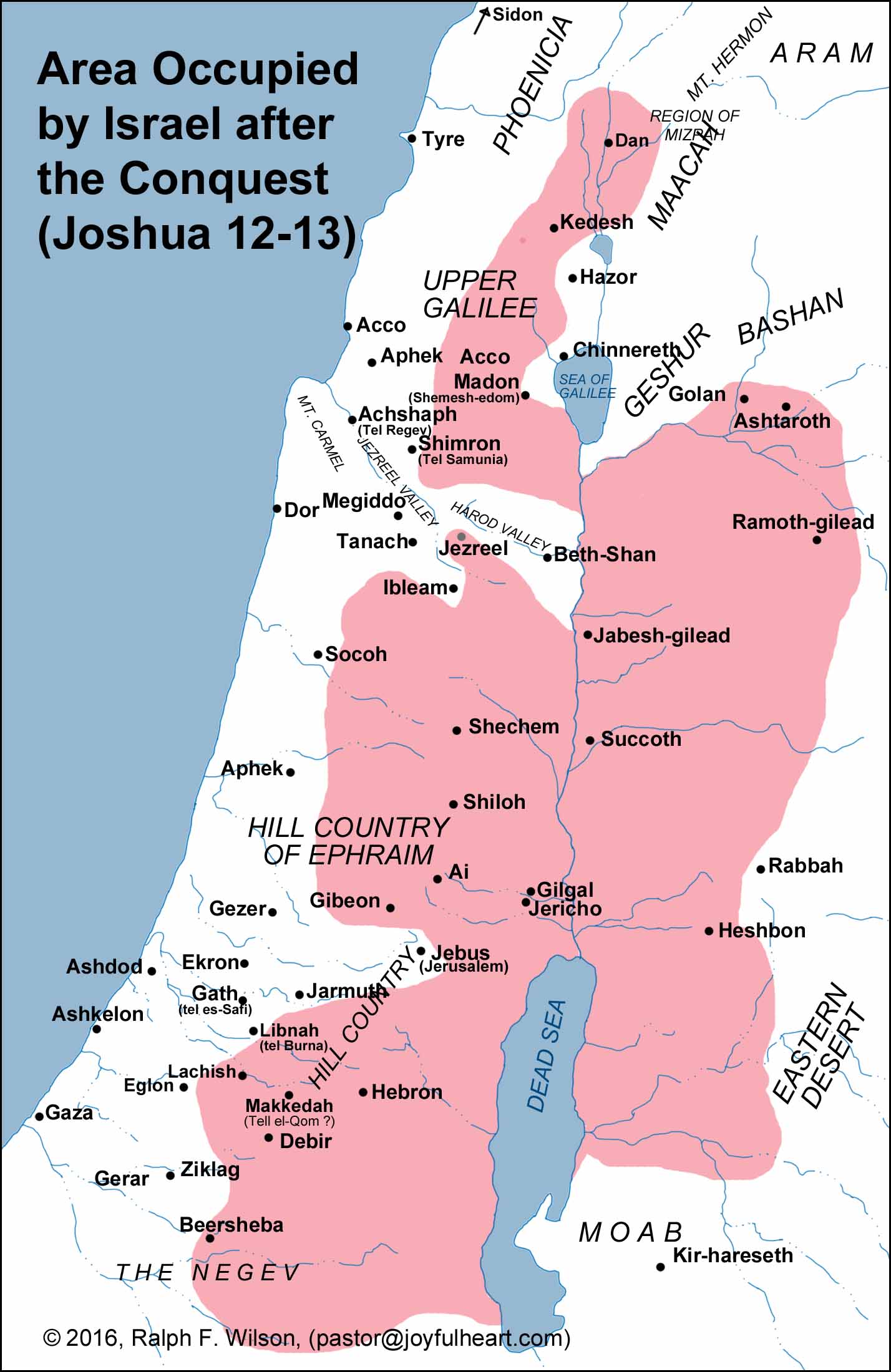
The land of Hebron became the inheritance of Caleb and the tribe of Judah to the day of Joshua's writing because he had wholly followed his Lord God and still had full faith in Him to that day.  I found this map at iBiblemaps.com that shows the division of the tribes' lands, including Caleb's (Judah):


(15) And the name of Hebron before was Kirjath Arba, a great man among the Anakims. And the land had rest from war.

Previously, the name of the main city of the land was Kirjath Arba, which meant City of Arba, who was a great man among the Anakim.  Caleb may have renamed it Hebron for his grandson as he had the same name (1 Chronicles 2:42).  The promised land of Canaan had rest from war.

In this chapter, the division of the inheritance west of the Jordan River had begun.  Caleb first made his request and was granted it.  Adam Clarke, in his Commentary on the Bible, wrote a beautiful epilogue to this chapter that deserves serious contemplation:

The Jewish economy furnishes, not only a history of God’s revelations to man, but also a history of his providence, and an ample, most luminous, and glorious comment on that providence. Is it possible that any man can seriously and considerately sit down to the reading even of this book, without rising up a wiser and a better man? This is the true history which everywhere exhibits God as the first mover and prime agent, and men only as subordinate actors. What a miracle of God’s power, wisdom, grace, justice, and providence are the people of Israel in every period of their history, and in every land of their dispersions! If their fall occasioned the salvation of the Gentile world, what shall their restoration produce! Their future inheritance is not left to what men would call the fortuitous decision of a lot; like Caleb’s possession it is confirmed by the oath of the Lord; and when the end shall be, this people shall stand in their lot at the end of the days, and shall again be great to the ends of the earth.

Sunday, February 2, 2025

The Inheritance East of the Jordan River

Continuing a chronological Bible study:

(Joshua 13:1) Now Joshua was old, stricken in years, and the Lord said to him, "You are old, stricken in years, and there remains yet very much land to be possessed."

Joshua and the Israelite army had conquered thirty-one kings and territories in the past seven years.  But Joshua was getting old, commentators think about a hundred years old.  It's amazing to think that a man in his nineties could have done what he had done in the past seven years!  But there was still much land to be conquered all around on the outskirts of the conquered area.  This map I found on Pinterest said to have come from jesuswalk.com clearly shows the conquered lands in relation to the whole:


I find it interesting to note that although Joshua had defeated their kings as noted in the last chapter, some of their territories remained outside of Israelite occupation (Gezer, Aphek, Dor, Megiddo, etc.).  It seems reasonable to assume that Joshua may have continued to try to conquer the rest of the lands, but God stopped him because of his advanced age.  Adam Clarke, in his Commentary on the Bible, had an interesting perspective.  As nothing God does is by accident, he suggested that God may have wanted some of the original inhabitants to remain in order to keep the oftentimes unfaithful Israel in check.  

(2) "This is the land that yet remains, all the borders of the Philistines, and all Geshuri,"

The Lord then detailed the lands that were still unconquered, undoubtedly so that Joshua and the Israelites would know what they had a right to claim.  There was the territory of the Philistines in the southwest of Canaan along the Mediterranean Sea, to Geshuri, which appears to be Geshur in the north.  This map borrowed from Big Springs Community Church shows the unconquered lands more clearly than the one above:


(3) "From Sihor before Egypt to the borders of Ekron northward, counted to the Canaanite, five lords of the Philistines, the Gazites, the Ashdodites, the Ashkelonites, the Gittites, and the Ekronites, also the Avites;"

God described in more detail the as of yet unconquered territories of the promised land.  Describing the land of the Philistines, He said it ranged from Sihor before Egypt in the south to Ekron in the north which can be seen in the first map, across from Jerusalem.  The land of Philistia was counted as belonging to the posterity of Canaan, but the Philistines had gotten possession of it.  Because it was counted as Canaanite land, it was part of the promised land.  There were five lords in Philistia rather than kings, and it contained the cities of Gaza, Ashdod, Ashkelon, Ekron, and their inhabitants, and to whatever cities the Gittites and Avites belonged.

(4) "From the south, all the land of the Canaanites and Mearah beside the Sidonians, to Aphek to the borders of the Amorites;"

As near as I can tell by these maps, God is describing all the land of the Canaanites that was not part of the Philistines, from the south upward to Aphek (note there are two Apheks, one in Upper Galilee) to Sidon.

(5) "And the land of the Gebalites, and all Lebanon, toward the sunrising, from Baal Gad under Mount Hermon to the entering into Hamath;"

Gebal was north of Sidon on the Mediterranean coast.  The land of the Gebalites was said to be that east of Tyre, Sidon, and Gebal, the land east of the Lebanon mountains in the north, from Mount Hermon to the entrance of Hamath, seen clearly in this map borrowed from The Biblical Zionist:


(6) "All the inhabitants of the hill country from Lebanon to Misrephoth Maim, all the Sidonians, them I will drive out from before the children of Israel; only divide it by lot to the Israelites for an inheritance as I have commanded you."

The Lord continued to describe the land that was yet unconquered that also included all the hill country from Lebanon to Misrephoth Maim which was south of Tyre, all the land of the Sidonians.  All that very much land yet to be possessed (v. 1) included all the lands described from verse 2 to the Sidonians in verse 6.  All those the Lord would drive out from before the children of Israel.  Even though they were not yet driven out, the Lord wanted Joshua to divide all the promised land by lot to the Israelites for their inheritance.  Most of the early commentators I study suggest that these people were not ever entirely driven out or their land completely possessed by the Israelites, that the promise was always part of a covenant that must be upheld by the Israelites, and they did not do their part.  However, I refer back to Exodus 23:30-31, when the Lord said:

"Little by little I will drive them out from before you, until you have increased, and you inherit the land. And I will set your bounds from the Red Sea to the sea of the Philistines, and from the desert to the river; for I will deliver the inhabitants of the land into your hand, and you shall drive them out before you."

God specifically said that it would be little by little, and indeed all the land was subdued under the reign of David.  Some say that still the people were not specifically driven out, only subdued.  However, throughout ancient and modern history, Israel's borders have changed, and indeed the future Millennial Israel will include all of the promised land.

(7) "Now therefore divide this land for an inheritance to the nine tribes and the half tribe of Manasseh," (8) With whom the Reubenites and the Gadites have received their inheritance which Moses gave them beyond Jordan eastward, as Moses the servant of the Lord gave them,

The Lord told Joshua to divide the land on their present side of the Jordan River for an inheritance to the nine and a half tribes that had not yet received their inheritance.  Reuben, Gad, and the other half tribe of Manasseh had already received their lots on the east side of the Jordan River, given them by Moses.

(9) From Aroer which is on the bank of the River Arnon, and the city that is in the midst of the river, and all the plain of Medeba to Dibon, (10) And all the cities of Sihon king of the Amorites who reigned in Heshbon, to the border of the children of Ammon;

Further describing the lands given to Reuben, Gad, and the half tribe of Manasseh, it was from Aroer in the middle of the Arnon River that separated the land of the Amorites from Moab, and all the plain and cities of Sihon king of the Amorites to the Jabbok River which was the border of the Ammonites.

(11) And Gilead, and the border of the Geshurites and Maachathites, and all Mount Hermon, and all Bashan to Salcah, (12) All the kingdom of Og in Bashan who reigned in Ashtaroth and in Edrei, who remained of the remnant of the giants; for these did Moses smite and cast them out.

They had also received all the kingdom of Og, which included Gilead, the border of the Geshurites and Maachathites, all Mount Hermon, and all Bashan to Salcah.  All that land of Og that had been taken by Moses had been given to Israel, but they had not taken possession of much of it.

(13) Nevertheless, the children of Israel did not expel the Geshurites, nor the Maachathites, but the Geshurites and the Maachathites dwell among the Israelites until this day.

Indeed, Joshua went on to write that the Israelites had not driven out the Geshurites and Maachathites, and they still dwelt with them at the time of his writing.

(14) Only to the tribe of Levi He gave no inheritance; the sacrifices of the Lord God of Israel made by fire are their inheritance, as He said to them.

The tribe of Levi received no land inheritance on either side of the Jordan River.  As they were God's priests, He was to be their inheritance; they were to live off the sacrifices to their Lord God (Deuteronomy 18:1).

(15) And Moses gave to the tribe of the children of Reuben according to their families. (16) And their coast was from Aroer which is on the bank of the river Arnon, the city in the midst of the river, and all the plain by Medeba;

Moses had given to the tribe of Reuben the land from Aroer in the southeast and all the plain of Medeba.

(17) Heshbon, and all her cities in the plain, Dibon, and Bamoth Baal, and Beth Baal Meon, (18) And Jahazah, and Kedemoth, and Mephaath, (19) And Kirjathaim, and Sibmah, and Zereth Shahar in the mount of the valley, (20) And Beth Peor, and Ashdoth Pisgah, and Beth Jeshimoth, (21) And all the cities of the plain, and all the kingdom of Sihon king of the Amorites, who reigned in Heshbon, whom Moses smote with the princes of Midian, Evi, and Rekem, and Zur, and Hur, and Reba, dukes of Sihon dwelling in the country.

Reuben's inheritance included all these cities in the former kingdom of Sihon.  It had been taken by Moses when he defeated the king of Sihon and all his princes.  I can't begin to try to locate all these cities, but I found this map at Psalms to God Podcast that shows a general view of all the tribes and their allotments:


(22) Balaam also, the son of Beor, the soothsayer, the children of Israel killed with the sword, among those who were killed by them. 

The Israelites had also killed Balaam, the soothsayer, at the same time as the princes (Numbers 31:8).

(23) And the border of the children of Reuben was Jordan and its border. This was the inheritance of the children of Reuben after their families, the cities and the villages.

The northwestern border of the land possessed by the descendants of Reuben was the Jordan River.  All the land, cities, and villages between the Jordan and Aroer in the southeast made up the inheritance of the children of Reuben.

(24) And Moses gave to the tribe of Gad, to the children of Gad according to their families. (25) And their coast was Jazer and all the cities of Gilead, and half the land of the children of Ammon, to Aroer before Rabbah; (26) And from Heshbon to Ramath Mizpah and Betonim, and from Mahanaim to the border of Debir; (27) And in the valley Beth Haram, and Beth Nimrah, and Succoth, and Zaphon, the rest of the kingdom of Sihon king of Heshbon, with the Jordan as border to the edge of the Sea of Chinnereth on the other side of the Jordan eastward. (28) This is the inheritance of the children of Gad after their families, the cities and their villages.

Moses gave as an inheritance to the children of Gad the land from Jazer in the south to Rabbah in the west, with the Jordan River as the western border.  The northern border was quite unique, and I will let the map show the general area that was allotted to Gad.  Once again trying to locate all those cities is quite a dizzying task.  The Aroer before Rabbah would have to be a different Aroer from the one at the middle of the Arnon River.  Also Debir would have to be a different Debir.  All the cities of Gilead would only pertain to those cities within the area of Gad, as half of Gilead was given to the half tribe of Manasseh.  The same would have to be said for all the kingdom of Sihon that was given to Reuben (v. 21), as it states here that there was the rest of the kingdom of Sihon that was given to Gad.  Half the land of the children of Ammon refers to that part that Sihon king of the Amorites took from the Ammonites.

(29) And Moses gave to the half tribe of Manasseh, and this was of the half tribe of the children of Manasseh by their families. (30) And their coast was from Mahanaim, all Bashan, all the kingdom of Og king of Bashan, and all the towns of Jair, which are in Bashan, sixty cities; (31) And half Gilead, and Ashtaroth, and Edrei, cities of the kingdom of Og in Bashan, to the children of Machir the son of Manasseh, to the one half of the children of Machir by their families.

To the half tribe of Manasseh, the land from Mahanaim, which must have been the southern border as Gad also had that border (v. 26), including all the land of Bashan that included sixty cities, half of Gilead, and the royal cities of Og, Ashtaroth and Edrei.  The land is said to have been given to half the children of Machir, who was Manasseh's son.

(32) These are what Moses had distributed for inheritance in the plains of Moab on the other side of the Jordan by Jericho eastward.

The lands described above from verse 9 to this verse were all the lands that had been distributed by Moses to the tribes of Reuben, Gad, and the half tribe of Manasseh, on the eastern side of the Jordan River, east of Jericho.

(33) But to the tribe of Levi Moses did not give inheritance; the Lord God of Israel was their inheritance, as He said to them.

Once again, Joshua points out that the tribe of Levi did not receive any land as their inheritance, because as priests, the Lord God was their inheritance.

As Joshua was now old, God had him rest from his battles, even though there was still much land to be conquered.  However, for now, He wanted Joshua to portion out the lots of inheritance, and it was to include all the land that had been promised, even those not yet conquered.  This chapter began with the allotments that had already been given to the tribes of Reuben, Gad, and the half tribe of Manasseh. 

Wednesday, January 29, 2025

Kings Defeated by Israel

Continuing a chronological Bible study:

(Joshua 12:1) Now these are the kings of the land whom the children of Israel smote and possessed their land on the other side of the Jordan toward the rising of the sun, from the River Arnon to Mount Hermon, and all the plain on the east:

In the last chapter and post, Joshua and his army had concluded their conquest of their promised land on the west side of the Jordan River.  Now began a summary and list of the kings whom Israel defeated in order that the Israelites could possess their land.  The list started with the kings Israel defeated on the east side of the Jordan River from the Arnon River in the south to Mount Hermon in the north and all the plains between the two.  

(2) Sihon king of the Amorites who dwelt in Heshbon and ruled from Aroer which is on the bank of the River Arnon, and from the middle of the river and from half Gilead even to the River Jabbok, the border of the children of Ammon, (3) And from the plain to the Sea of Chinneroth on the east and to the sea of the plain, the Salt Sea on the east, the way to Beth Jeshimoth, and from the south under Ashdoth Pisgah.

The first king the Israelites defeated in order to take possession of their land was Sihon king of the Amorites.  He dwelt in Heshbon and ruled half of Gilead from Aroer in the middle of the Arnon River, which was the boundary between the Amorites and the Moabites, to the Jabbok River which bordered the Ammonites, from the plain of Moab to the Sea of Chinneroth on the east and to the Salt Sea on the east, the way to Beth Jeshimoth, a place in the plains of Moab, and from the south under Ashdoth Pisgah, which meant literally the ravines of Pisgah, named for the springs of Pisgah which flowed from Mount Pisgah.  It is very difficult for me to grasp the exact locations of these territories, but I found a map on Pinterest said to be a map of the lands taken and kings defeated by Moses and Joshua from this chapter in Joshua.  The map was originally found at thesentone.files.wordpress.com:


(4) And the coast of Og king of Bashan of the remnant of the giants who dwelt at Ashtaroth and at Edrei, (5) And reigned in Mount Hermon, and in Salcah, and in all Bashan, to the border of the Geshurites and the Maachathites, and half Gilead, the border of Sihon king of Heshbon.

The Israelites also defeated Og king of Bashan who was of the remnant of giants, said to be the only one left in Deuteronomy 3:11.  Og dwelt at Ashtaroth and at Edrei and reigned over Mount Hermon and Salcah, and over all of Bashan, to the border of the Geshurites and the Maachathites, and half of Gilead to the border of Sihon king of Heshbon.

(6) Them did Moses the servant of the Lord and the children of Israel smite, and Moses the servant of the Lord gave it as a possession to the Reubenites, and the Gadites, and the half tribe of Manasseh.

Sihon and Og were the two kings who had been destroyed under the direction of Moses.  Moses gave those lands to the tribes of Reuben, Gad, and the half tribe of Manasseh (Deuteronomy 3:11-17).

(7) And these are the kings of the country which Joshua and the children of Israel smote on this side of the Jordan on the west, from Baal Gad in the valley of Lebanon even to the mount Halak that goes up to Seir, which Joshua gave to the tribes of Israel for a possession according to their divisions, (8) In the mountains, and in the valleys, and in the plains, and in the springs, and in the wilderness, and in the south country, the Hittites, the Amorites, and the Canaanites, the Perizzites, the Hivites, and the Jebusites:

Following in verse 9 begins a list of the kings defeated by Joshua and the Israelite army on the western side of the Jordan River, from Baal Gad in the valley of Lebanon in the north to Halak in Edom in the south, which Joshua would later divide among the tribes of Israel for their possession.  All the land contained in this area, all the mountains, valleys, plains, springs, the wilderness, and the south country, inhabited by the Hittites, the Amorites, the Canaanites, the Perizzites, the Hivites, and the Jebusites, Israel had conquered.

(9) The king of Jericho, one; the king of Ai, which is beside Bethel, one;

The list of kings defeated by Joshua begins with Jericho, one king, and next was the king of Ai, one king, which brings the tally to two kings.

(10) The king of Jerusalem, one; the king of Hebron, one; (11) The king of Jarmuth, one; the king of Lachish, one; (12) The king of Eglon, one; the king of Gezer, one;

The list continues with the kings of Jerusalem, Hebron, Jarmuth, Lachish, and Eglon, who were the five kings who had allied against Israel and were taken and hanged.  Next was Gezer who came to help Lachish.  That brings the number to eight kings.

(13) The king of Debir, one; the king of Geder, one; (14) The king of Hormah, one; the king of Arad, one; (15) The king of Libnah, one; the king of Adullam, one; 

Israel also defeated the kings of Debir, Geder, Hormah, Arad, Libnah, and Adullam, some of which were not mentioned among the major battles of chapters 10 and 11.  That brings the number of kings defeated to fourteen.

(16) The king of Makkedah, one; the king of Bethel, one; (17) The king of Tappuah, one; the king of Hepher, one; (18) The king of Aphek, one; the king of Lasharon, one; 

The kings of Makkedah, Bethel, Tappuah, Hepher, Aphek, and Lasharon, bring the total to twenty kings defeated.

(19) The king of Madon, one; the king of Hazor, one; (20) The king of Shimron Meron, one; the king of Achshaph, one; (21) The king of Taanach, one; the king of Megiddo, one;

The kings of Madon, Hazor, Shimron Meron, Achshaph, Taanach, and Megiddo, bring the total to twenty-six.

(22) The king of Kedesh, one; the king of Jokneam of Carmel, one; (23) The king of Dor in the coast of Dor, one; the king of the nations of Gilgal, one;

The kings of Kedesh, Jokneam, Dor, and Gilgal were defeated by the Israelites.  Many Bible commentators say that the Gilgal where the king was defeated is not the same place as the Gilgal where Joshua lodged at first on the western side of the Jordan River (Joshua 4:19).  However, the way it is written in the verse, "nations of Gilgal," suggests there were several smaller cities or perhaps even nomadic tribes under one rule, so the king of the nations of Gilgal would not necessarily have been in the Gilgal where Joshua lodged, but could have still been over it, the way I see it.  The number of kings defeated by Joshua comes to thirty.

(24) The king of Tirzah, one; all the kings, thirty-one.

Finally, the king of Tirzah was defeated, bringing the total number of kings defeated by Joshua to thirty-one.  Thus completes the list of all the kings defeated by Israel in order to take possession of their promised land.  There were two kings defeated on the east side of the Jordan River under the direction of Moses, and thirty-one kings defeated by Joshua on the west side of the Jordan.

Monday, January 27, 2025

Conclusion of Joshua's Conquest of Canaan

Continuing a chronological Bible study:

(Joshua 11:1) And it came to pass when Jabin king of Hazor had heard, that he sent to Jobab king of Madon, and to the king of Shimron, and to the king of Achshaph, 

In the last chapter and post, Joshua had continued his conquest and had destroyed the Canaanite cities of the south.  Jabin, the king of Hazor in the north, heard about Joshua's conquest of the south and was undoubtedly alarmed.  He sent word to kings who were in the north as well, although their exact locations are not known.

(2) And to the kings on the north of the mountains, and of the plains south of Chinneroth, and in the valley, and in the borders of Dor in the west, (3) To the Canaanites in the east and on the west, and the Amorite, and the Hittite, and the Perizzite, and the Jebusite in the mountains, and the Hivite under Hermon in the land of Mizpah.

Jabin sent word to other kings in the north as far south as the plains south of Chinneroth which Biblical commentators think are the plains of Jezreel, and to the west to the borders of Dor on the Mediterranean Sea.  He also sent word to kings in the northern mountainous region to Mount Hermon which was north of Dan.  The map used in the last post to show the southern conquest also identifies some of these places in the north:


(4) And they went out, they and all their armies with them, much people, even as the sand upon the seashore in multitude, with horses and chariots very many. (5) And when all these kings were met together, they came and pitched together at the waters of Merom to fight against Israel.

These kings went out from their cities with their huge armies, people so numerous as to be compared with the number of sand particles on the seashore, and with many horses and chariots.  The kings all met together and camped at a place called Merom, although that exact location is not known.  Their intention was to fight against Israel.

(6) And the Lord said to Joshua, "Do not be afraid because of them, for tomorrow about this time I will deliver them up all slain before Israel; you shall hock their horses and burn their chariots with fire."

Even though these armies were apparently much larger than any Joshua had encountered in Canaan thus far, the Lord told him not to fear, for He would deliver them into Israel's hand slain.  He said that Israel was to hamstring their horses rendering them useless and burn their chariots.  The Lord did not want them to fear their many horses and chariots, but it appears neither did He want the Israelites to keep the horses and chariots as they were not to put their trust in such things; it was only in their God who fought for them they should put their trust.

(7) So Joshua came, and all the people of war with him, against them by the waters of Merom suddenly, and they fell upon them.

Joshua and his army came upon the encamped kings and their armies at Merom suddenly and took them by surprise.

(8) And the Lord delivered them into the hand of Israel who killed them and chased them to great Sidon and to Misrephoth-Maim and to the Valley of Mizpah eastward, and they struck them until they left none remaining.

The Lord indeed delivered the great armies into the hand of Israel.  The Israelite army killed them and chased the rest into the valley eastward until there were none remaining.

(9) And Joshua did to them as the Lord bade him; he hocked their horses and burnt their chariots with fire.

Joshua did as the Lord commanded and hamstrung their horses and burned their chariots with fire.

(10) And Joshua at that time turned back and took Hazor and struck its king with the sword, for Hazor before was the head of all those kingdoms.

Having destroyed all the armies that had gathered against Israel, Joshua then went to Hazor and took the city and killed its king, for it was the royal city that had been the head of the northern regions that had come out against Israel.

(11) And they killed all the souls in it with the edge of the sword, utterly destroying them; there were not any left to breathe, and he burnt Hazor with fire.

Joshua and the Israelite army killed all the people in Hazor leaving not one alive, and they burnt the city with fire.

(12) And all the cities of those kings and all the kings of them, Joshua took and struck them with the edge of the sword, he utterly destroyed them as Moses the servant of the Lord commanded.

All those cities, Hazor, Madon, Shimron, and Achshaph, and all their kings, Joshua utterly destroyed and killed, as the Lord had commanded through Moses in Deuteronomy 7:2, "...you shall strike them and utterly destroy them," speaking of what they were to do with the inhabitants of the land when the Lord brought them into their promised land.

(13) But the cities that stood still in their strength, Israel burned none of them, except Hazor only which Joshua burned.

Although Joshua and the Israelite army had killed all the inhabitants and destroyed the cities of Madon, Shimron, and Achshaph, they did not burn them to the ground as they had done to Hazor.  Those cities still stood in their "strength," the original word being "tel" which meant literally "mound or heap."  Those cities probably stood on hills and were stronger because of their physical positions.  Joshua reserved them for use by the Israelites.

(14) And all the spoil of these cities and the cattle, the children of Israel took for a plunder to themselves, but every man they struck with the edge of the sword until they had destroyed them, they left none to breathe.

The gold, silver, and any goods that survived destruction of the cities, along with the cattle, the Israelites took as their spoil, but they killed every one of the inhabitants of the cities.

(15) As the Lord commanded Moses his servant, so did Moses command Joshua, and so Joshua did; he left nothing undone of all that the Lord commanded Moses.

As the Lord had commanded Moses regarding what the people were to do when they came into their promised land, Moses had in turn commanded his servant and successor Joshua, and Joshua did all that he had been commanded to do.

(16) So Joshua took all that land, the hills, all the south country, all the land of Goshen, the valley, the plain, the mountain of Israel, and its valley, (17) From Mount Halak that goes up to Seir, even to Baal Gad in the valley of Lebanon under Mount Hermon; and all their kings he took and struck them and killed them.

So Joshua had taken that whole land of Canaan including the hill country of Judea, all the south country, all the land of Goshen with its valley and plain, as described in Joshua 10:40-41, the mountain of Israel which may be Jerusalem, and its valley, from Mount Halak on the border of Edom in the south, to Baal Gad in the valley of Lebanon below Mount Hermon in the north.  He struck and killed all their kings.

(18) Joshua made war a long time with all those kings.

Although the conquests of this chapter are lumped together and appear to have taken place in rapid order, it took five to seven years for Joshua to completely subdue the rest of the land of Canaan.

(19) There was not a city that made peace with the children of Israel except the Hivites, the inhabitants of Gibeon. All the others they took in battle.

None of the cities of Canaan made peace with the Israelites except for the Gibeonites who had obtained peace, although through trickery.  The Israelites took all the other cities in battle.

(20) For it was of the Lord to harden their hearts that they should come against Israel in battle, that He might destroy them utterly, that they might have no favor, but that He might destroy them as the Lord commanded Moses.

The Lord Himself had hardened the hearts of all the Canaanite inhabitants against trying to make peace with the Israelites.  It had been His will to completely destroy them because of their abominable wickedness (Deuteronomy 9:4-5).  God's will was that the Israelites make no covenant with them or show them any mercy (Deuteronomy 7:2).  However, Israel had made a peace agreement with the Gibeonites, even though the Gibeonites had used trickery to get it.  The Lord did not want any other cities pulling similar stunts, so He hardened their hearts so that all would want to go against Israel in battle where the Lord would have Israel completely destroy them.

(21) And at that time Joshua came and cut off the Anakims from the mountains, from Hebron, from Debir, from Anab, and from all the mountains of Judah, and from all the mountains of Israel; Joshua utterly destroyed them with their cities.

Joshua and his army had destroyed all the cities, and they also at that time cut off the Anakims from the mountains.  The Anakims were a wild, barbarous, and gigantic people who inhabited the mountains in the country around Hebron, Debir, Anab, the hill country of Judah, and all the mountains of Israel.  Joshua had also destroyed the Anakims in the mountains and in the cities which they may have inhabited before, or perhaps had taken possession of after Joshua had destroyed those cities.

(22) None of the Anakims were left in the land of the children of Israel, only in Gaza, in Gath, and in Ashdod, there remained.

There were no Anakims left in the land of the children of Israel.  They were either destroyed or had fled to the southern coast of Canaan in what would become the land of the Philistines, in Gaza, Gath, and Ashdod.

(23) So Joshua took the whole land, according to all that the Lord said to Moses, and Joshua gave it for an inheritance to Israel according to their divisions by their tribes. And the land rested from war.

Thus Joshua had taken the land of Canaan as described in the past few chapters.  However, there were a few areas that were not yet subdued (Joshua 13:1-6).  Joshua had destroyed and driven out all the inhabitants of the land as had been declared by the Lord to Moses (Deuteronomy 7:2, 11:23).  It was the Lord who had given the land as an inheritance to Israel, but later Joshua would be instrumental in dividing it among the tribes.  I found this wonderfully detailed map of Joshua's conquest, as well as the sites of many historical events before and after the conquest at BibleAtlas.org:


The Joshua conquest could be seen as a symbol of the spiritual conquest that Christians must make.  When we put our faith in Jesus, He goes before us in spiritual battle and subdues all things to Himself, enemies from the outside and the strongholds of sin and lusts of the flesh from within us.  We then may rest from warring against those things when through His grace, we have conquered the flesh, the world, and the devil.  "...in all these things we are more than conquerors through Him who loved us." (Romans 8:37)

Sunday, January 12, 2025

Joshua's Conquest of Southern Canaan

In the last chapter and post, Israel had made a peace agreement with the Gibeonites who were of the Hivites, even though the Gibeonites had deceived Israel by pretending they had come from a far country beyond Canaan.  Still an agreement was reached for peace with the Gibeonites, but they would serve Israel as woodcutters and water carriers.  Continuing a chronological Bible study:

(Joshua 10:1) Now it came to pass, when Adoni-Zedek, king of Jerusalem, had heard how Joshua had taken Ai and had utterly destroyed it; as he had done to Jericho and her king, so he had done to Ai and her king; and how the inhabitants of Gibeon had made peace with Israel and were among them, (2) That they feared greatly because Gibeon was a great city, as one of the royal cities, and because it was greater than Ai and all its men were mighty.

In the last chapter, all the kings of Canaan planned to form an alliance to go against the Israelites.  Gibeon, part of the Hivites, had broken away and made a peace agreement with Israel.  Jerusalem at that time was a Jebusite city.  When its king, Adoni-Zedek, heard about how Israel had destroyed Ai and how Gibeon had made peace with Israel, he and his people greatly feared because Gibeon was a great royal city, greater than Ai, with mighty men, and it was now allied with Israel.

(3) Therefore Adoni-Zedek king of Jerusalem sent to Hoham king of Hebron, and to Piram king of Jarmuth, and to Japhia king of Lachish, and to Debir king of Eglon, saying, (4) "Come up to me and help me, that we might strike Gibeon, for it has made peace with Joshua and with the children of Israel."

The king of Jerusalem sent word to four other kings of Canaanite cities and asked them to come help him strike Gibeon because it had made peace with Israel.  That probably seemed a betrayal to him and was the reason he sought only to strike Gibeon and not Israel at that time.  Additionally, he probably considered Gibeon an easier target, especially with five armies attacking it.

(5) Therefore the five kings of the Amorites, the king of Jerusalem, the king of Hebron, the king of Jarmuth, the king of Lachish, and the king of Eglon, gathered themselves together and went up, they and all their hosts, and encamped before Gibeon and made war against it.

These five kings were called Amorites even though Jerusalem was a Jebusite city, and Hebron was a Hittite city.  The Canaanites as a whole were often called Amorites.  The Amorites were the most powerful people in the land and had dispersed throughout Canaan, and so Amorites became synonymous with Canaanites.  The five kings with their armies went and encamped before Gibeon and made war against it.

(6) And the men of Gibeon sent to Joshua to the camp to Gilgal, saying, "Do not slacken your hand from your servants; come up to us quickly, and save us, and help us, for all the kings of the Amorites who dwell in the mountains are gathered together against us."

The men of Gibeon sent word to Joshua and asked that he not delay in helping to save the Gibeonites from the Amorites who dwelt in the mountains who had gathered together to make war against them.

(7) So Joshua ascended from Gilgal, he and all the people of war with him, and all the mighty men of valor.

Indeed, Joshua and all his mighty men of war went up to Gibeon.

(8) And the Lord said to Joshua, "Do not fear them, for I have delivered them into your hand; there shall not a man of them stand before you."

The Lord told Joshua not to fear them, that He had delivered them into his hand, and that not one man would be able to stand before him.  What an incredible promise!  Five kings with five armies and not one man would be able to stand before Joshua!  

(9) Joshua therefore came to them suddenly and went up from Gilgal at night.

Joshua and his men came upon the kings and their armies suddenly in the night.

(10) And the Lord confounded them before Israel, and killed them with a great slaughter at Gibeon, and chased them along the way that goes up to Beth Horon and struck them to Azekah and to Makkedah.

The Lord confused the kings and their armies when they were taken by surprise in the night, and a great number of them were slaughtered at Gibeon.  Israel chased the rest of them out of the city and into other cities in the area.

(11) And it came to pass as they fled from before Israel and were going down to Beth Horon, that the Lord cast down great stones from heaven upon them to Azekah, and they died. More died with hailstones than the children of Israel killed with the sword.

And as the kings and their armies were fleeing into Azekah, the Lord sent great hailstones from heaven that killed them.  More people died from the hailstones than Israel's army killed.  Thus the Lord Himself killed the majority of them.

(12) Then Joshua spoke to the Lord in the day when the Lord delivered up the Amorites before the children of Israel, and he said in the sight of Israel, "Sun, stand still upon Gibeon, and moon, in the valley of Ajalon."

This was during the battle that Joshua prayed that the sun and moon might stand still over Gibeon until they were able to fully defeat the kings and their armies.  I believe the sense is that he prayed the sun not set and leave them in darkness before they had completely defeated their enemies.

(13) And the sun stood still, and the moon stayed, until the people had avenged themselves upon their enemies. Is this not written in the book of Jasher? So the sun stood still in the midst of heaven and did not hasten to go down about a whole day.

The sun and moon indeed stood still about a whole day until the people had defeated their enemies.  It is believed that the last part of verse 12 and the beginning of verse 13 may have been poetical prophecy from the lost book of Jasher:

Sun, stand still upon Gibeon,
And Moon, in the Valley of Ajalon.
And the sun stood still,
And the moon stayed
Until the people had avenged themselves
Upon their enemies.

Actually, it seems to me more likely that the first two lines were prayed by Joshua, and then perhaps the next four were prophesied in the book of Jasher.  Regardless, the sun and moon did in fact stand still in the sky for about a whole day.

(14) And there was no day like that before it or after it, that the Lord hearkened to the voice of a man, for the Lord fought for Israel.

I believe this verse proves that the first two lines above were in fact the prayer of Joshua.  Joshua wrote that never before or after, as far as he knew, had the Lord heeded the voice of man to do such a miraculous thing in the sky.  Joshua recognized that it was because the Lord fought for Israel.

(15) And Joshua returned, and all Israel with him, to the camp to Gilgal.

After they had completely defeated the kings and their armies, Joshua and all the people of Israel who had gone up with him, returned to their camp at Gilgal.

(16) But these five kings fled and hid themselves in a cave at Makkedah.

However, we find that the kings of the armies Israel had defeated, had fled on to Makkedah and hid themselves in a cave.

(17) And it was told Joshua, saying, "The five kings have been found hidden in a cave at Makkedah." (18) And Joshua said, "Roll great stones upon the mouth of the cave and set men by it to keep them."

Joshua learned that the kings had hidden in a cave at Makkedah.  He then ordered that large stones be rolled to the mouth of the cave to keep the kings from escaping and that men be set by it to guard them.

(19) "And do not stay but pursue after your enemies and strike the hindmost of them; do not allow them to enter into their cities, for the Lord your God has delivered them into your hand."

It seems that there must have been a band of soldiers who followed their kings to the cave.  Joshua ordered that the kings be closed in and a guard set, but that the rest of the Israelite soldiers were to pursue the kings' soldiers and strike them from behind and prevent them from entering into their cities.  Joshua encouraged his soldiers by telling them that the Lord had indeed delivered those soldiers into their hands just as He had the others they had conquered.

(20) And it came to pass when Joshua and the children of Israel had made an end of slaying them with a very great slaughter till they were consumed, that the rest who remained of them entered into fenced cities.

Joshua and the Israelites killed all the soldiers they had pursued who were along the way, but some of them had been able to escape into the fenced cities.

(21) And all the people returned to the camp to Joshua at Makkedah in peace; none moved his tongue against any of the children of Israel.

The Israelites returned to a camp they had pitched at Makkedah in peace, insinuating that none perished.  No one dared to speak ill of the Israelites for invading them; such was the fear of them.

(22) Then Joshua said, "Open the mouth of the cave and bring out those five kings to me out of the cave."

Then Joshua ordered that the five kings be brought to him from out of the cave where they had sought to hide.

(23) And they did so and brought forth those five kings to him out of the cave, the king of Jerusalem, the king of Hebron, the king of Jarmuth, the king of Lachish, and the king of Eglon.

They did as Joshua ordered and brought the five kings to him.

(24) And it came to pass when they brought out those kings to Joshua, that Joshua called for all the men of Israel, and said to the captains of the men of war who went with him, "Come near, put your feet on the necks of these kings." And they came near and put their feet upon the necks of them.

When they brought the kings to Joshua, he called for his men and told the captains of his army to put their feet on the necks of the kings, symbolizing their complete subjection to Israel.  The captains did as they were ordered and put their feet on the necks of the kings.

(25) And Joshua said to them, "Fear not, nor be dismayed; be strong and of good courage for thus shall the Lord do to all your enemies against whom you fight."

Joshua encouraged his soldiers to be strong and of good courage and not to fear, for their Lord would bring all their enemies under subjection as the kings under their feet.

(26) And afterward Joshua struck them and killed them and hanged them on five trees, and they were hanging on the trees until the evening.

Joshua then killed the kings and hanged them on five trees where they remained until the evening.

(27) And it came to pass at the going down of the sun, that Joshua commanded, and they took them down off the trees and cast them into the cave where they had been hidden and laid great stones in the cave's mouth until this very day.

When evening came and the sun was going down, Joshua ordered and his men obeyed, and they took the kings down from the trees and cast them into the cave where they had been hiding.  They laid large stones at the mouth of the cave, and that is where they still lay at the time of Joshua's writing.

(28) And that day Joshua took Makkedah and struck it with the edge of the sword, and its king he utterly destroyed, them and all the souls therein; he let none remain, and he did to the king of Makkedah as he did to the king of Jericho.

That day Joshua also took Makkedah, killing the king who had not been among the five kings, and all the people in his city, letting none remain.  He did to the king of Makkedah as he had done to the king of Jericho and killed him with the sword.

(29) Then Joshua passed from Makkedah, and all Israel with him, to Libnah, and fought against Libnah.

After they had destroyed Makkedah, Joshua and the Israelite army with him moved to the nearby city of Libnah and fought against it.

(30) And the Lord delivered it also and its king into the hand of Israel, and he struck it with the edge of the sword and all the souls that were in it; he let none remain in it but did to its king as he did to the king of Jericho.

The Lord also delivered Libnah and its king into the hand of Israel.  Joshua and the Israelites killed all the inhabitants of the city, along with its king.

(31) And Joshua passed from Libnah, and all Israel with him, to Lachish and encamped against it and fought against it.

Joshua and the Israelite army then moved from Libnah to Lachish.  Their king was one of the five kings who had come together to invade Gibeon.  The Israelite army encamped across from Lachish and fought against it.

(32) And the Lord delivered Lachish into the hand of Israel who took it on the second day and struck it with the edge of the sword, and all the souls in it, according to all that he had done to Libnah.

The Lord also delivered Lachish into the hand of Israel, but it took two days, which may be the reason the Israelites camped there.  They struck the city and killed all the people in it just as they had done in Libnah.

(33) Then Horam king of Gezer came up to help Lachish, and Joshua killed him and his people until he had left him none remaining.

Horam, the king of a neighboring city Gezer, came with his men to help the city of Lachish, but Joshua and the Israelite army also killed him and his people.

(34) And from Lachish Joshua passed to Eglon, and all Israel with him, and they encamped against it and fought against it.

Joshua and his army moved on to Eglon and camped across from it and fought against it.  Eglon's king was one of the five kings from above.

(35) And they took it on that day and struck it with the edge of the sword, and all the souls in it he utterly destroyed that day, according to all that he had done to Lachish.

Joshua and the Israelites took Eglon that same day, striking it with the sword and killing all the people in the city just as they had done to Lachish.

(36) And Joshua went up from Eglon, and all Israel with him, to Hebron and they fought against it.

Then Joshua and the Israelites moved from Eglon to Hebron and fought against it.  Hebron's king was one of the five kings Joshua hanged.

(37) And they took it and struck it with the edge of the sword, and its king and all its cities and all the souls in it; he left none remaining, according to all that he had done to Eglon, but destroyed it utterly and all the souls in it.

Israel then took Hebron.  It seems they had set another king over them, but he, all his people, and all the suburbs of Hebron, were destroyed by Joshua and the Israelite army.  They left no one but did to Hebron as they had done to Eglon.

(38) And Joshua returned and all Israel with him to Debir and fought against it.

Joshua and all the Israelite army turned back and went back to Debir which they had apparently passed over on the march to Hebron.  They then fought against it.  This Debir appears to be the name of a place and not the same as the king of Eglon whom Joshua had already killed.

(39) And he took it and its king and all its cities, and they struck them with the edge of the sword and utterly destroyed all the souls in it; he left none remaining; as he had done to Hebron, so he did to Debir and to its king, as he had done also to Libnah and to her king.

Joshua and the Israelites took Debir and killed the king and all its inhabitants in all its suburbs.  They left no one; as they had done to Hebron and Libnah they did to Debir and its king.

(40) So Joshua struck all the country of the hills, and of the south, and of the valley, and of the springs, and all their kings; he left none remaining, but utterly destroyed all that breathed as the Lord God of Israel commanded.

Joshua and his army struck all the country in that area which was the part of Canaan which lay southward, consisting of hills and valleys and springs.  They destroyed all their kings and all who breathed, which seems to suggest animals, too.  They could not have done what they did except that God willed it.  He had commanded that they utterly destroy the inhabitants of the land He was giving to His people (Deuteronomy 20:16-17).  Because of their many abominations (Leviticus 18) God had so judged the Canaanites.

(41) And Joshua struck them from Kadesh Barnea even to Gaza, and all the country of Goshen, even to Gibeon.

Joshua and his army had struck them from Kadesh Barnea which lay in the south of Canaan to Gaza which lay in the southwest.  The Goshen mentioned here is not the same as Goshen in Egypt, and its location has not been identified.  However, as the southern and southwestern boundaries are identified, as well as Gibeon in the north, the area of Joshua's conquest is pretty well identified.  I borrowed this map from Biblical Foundations for Freedom by Rev. Paul J. Bucknell:


Here is a map of all of Canaan that shows Joshua's conquest in relation to the whole.  I found this on Pinterest, and it was stated as coming from biblestudy.org, although I did not find this exact map there.


(42) And all these kings and their land did Joshua take at one time because the Lord God of Israel fought for Israel.

Joshua and Israel's army were able to take all these kings and their lands so quickly only because God willed it and fought for Israel.

(43) And Joshua returned, and all Israel with him, to the camp to Gilgal.

Joshua and the Israelite army then returned to their camp at Gilgal victorious.  Again it must be stressed that this amazing victory was only possible because God fought for Israel.  "If God be for us, who can be against us?" (Romans 8:31)

Sunday, January 5, 2025

The Gibeonites' Deceit to Obtain Peace with the Israelites

Continuing a chronological Bible study:

(Joshua 9:1) And it came to pass when all the kings on this side of the Jordan, in the hills, and in the valleys, and in all the coasts of the great sea toward Lebanon, the Hittite, and the Amorite, the Canaanite, the Perizzite, the Hivite, and the Jebusite, heard, (2) That they gathered themselves together to fight with Joshua and with Israel with one accord.

In the last chapter and post, Israel had completely destroyed Ai and its king.  When the kings on the side of the Jordan River that the Israelites were now on, the Hittite, Amorite, Canaanite, Perizzite, Hivite, and Jebusite kings, in the hills and valleys and coasts toward Lebanon, heard how they had destroyed Jericho and Ai, they gathered together and agreed to unite against Israel.

(3) And when the inhabitants of Gibeon heard what Joshua had done to Jericho and to Ai, (4) They worked craftily and went and made as if they had been ambassadors, and took old sacks on their donkeys, and wine bottles old and torn and bound up, (5) And old shoes and patched on their feet, and old garments on them, and all the bread of their provision was dry and moldy.

Gibeon was a large royal metropolitan city of the Hivites.  When its inhabitants heard about what Joshua had done in Jericho and Ai, it seems they took matters into their own hands and schemed.  They acted as if they were ambassadors from some faraway country.  They wore old worn out and patched clothing and shoes and took upon their donkeys old sacks, old torn and tied up wineskins, and moldy bread, to make it look as if they had traveled a long way.

(6) And they went to Joshua to the camp at Gilgal and said to him and to the men of Israel, "We have come from a far country; now therefore make a league with us."

They went to Joshua and the men of Israel to their camp at Gilgal and indeed told them they were from a faraway country, and they desired a league with Israel.

(7) And the men of Israel said to the Hivites, "Perhaps you dwell among us, so how shall we make a league with you?"

The men of Israel replied to the Gibeonites who were indeed part of the Hivites, although they did not know that for certain, that it might be that they dwelled among them so they could not possibly be in league with them, as they had come to destroy them.  Additionally, they were forbidden to make any covenant or show any mercy to the countries they had come to destroy (Deuteronomy 7:2).

(8) And they said to Joshua, "We are your servants." And Joshua said to them, "Who are you, and where do you come from?"

The Gibeonites declared themselves servants to Joshua, meaning in this agreement they would do whatever he wanted to make an alliance with him.  It seems Joshua was suspicious and demanded to know just who they were and where they came from.

(9) And they said to him, "From a very far country your servants have come because of the name of the Lord your God, for we have heard the fame of Him and all that He did in Egypt, (10) And all that He did to the two kings of the Amorites beyond Jordan, to Sihon king of Heshbon and to Og king of Bashan at Ashtaroth."

They did not tell Joshua what country they had come from but only said it was a very far country.  They said they had come because of the name of the Israelite God, and they had heard about what He had done in Egypt and to Sihon and Og, the Amorite kings on the other side of the Jordan River.  They didn't mention Jericho and Ai, but perhaps because they had supposedly come from so far away, they would not have heard about those yet.  That was probably part of their scheme to make them less suspicious to Joshua.  They made it sound as if they were awed by their Lord's great and glorious works and perhaps would embrace the Israelite religion.  I can't help but wonder why on earth they wouldn't truly want to after hearing of all those miraculous works, they and all the Canaanite nations!  

(11) "Therefore the elders and all the inhabitants of our country spoke to us, saying, 'Take victuals with you for the journey and go to meet them, and say to them, "We are your servants; now therefore, make a league with us."'"

The Gibeonites told Joshua that the elders and inhabitants of their country asked them to take provisions and make the long journey to the Israelites to meet them, perhaps the implication was before the Israelites had a chance to come hostilely into their country.  They were instructed to come to them and declare they were ready to make an agreement with them.  As their servants, they meant they were ready to do whatever was asked of the Israelites in order to make an alliance with them.

(12) "This our bread we took hot for our provision out of our houses on the day we came forth to go to you, but now, behold, it is dry and it is moldy."

The Gibeonites began to lay it on a bit thicker, saying that they had taken hot bread for provision when they departed on their journey, and now the bread was dry and moldy.  It seems to me a little suspicious that they would feel the need to show Joshua their bread to prove they had come a long way, so he would believe their story must be true.  A more natural and logical way may have been to merely ask for food as theirs had supposedly become dry and moldy.  But I suppose it's easy to Monday morning quarterback, and it appears their method worked for them.

(13) "And these bottles of wine which we filled were new, and behold, they are torn; and our garments and our shoes have become old because of the very long journey."

The Gibeonites continued trying to prove they had come a long way by telling Joshua their wineskins had been new, but were now torn, and their clothes and shoes had worn out.  

(14) And the men took of their victuals and did not ask counsel at the mouth of the Lord.

The men of Israel took the Gibeonites' provisions from them as they were showing them to them, and it seems they believed them.  However, they did not think to seek counsel from their Lord.  It looks to be another lesson so soon in their new land that they needed to seek to follow the Lord in all things.

(15) And Joshua made peace with them and made a league with them, to let them live, and the princes of the congregation swore to them.

Joshua himself did not seek counsel from the Lord, but made peace with the Gibeonites and made an agreement with them that they be allowed to live in peace.  The princes of Israel made an oath that they would keep the covenant they made with them.  

(16) And it came to pass at the end of three days after they had made a league with them, that they heard that they were their neighbors and that they dwelt among them.

Three days later, the Israelites discovered that the Gibeonites were their neighbors and dwelt among them in their promised land.

(17) And the children of Israel journeyed and came to their cities on the third day. Now their cities were Gibeon, and Chephirah, and Beeroth, and Kirjath Jearim.

On the third day after making league with the Gibeonites and now having discovered they were their neighbors, the Israelites went to their cities.  Gibeon was the metropolis with Chephirah, Beeroth, and Kirjath Jearim, being suburbs of it.

(18) And the children of Israel did not attack them because the princes of the congregation had sworn to them by the Lord God of Israel. And all the congregation murmured against the princes.

Israel did not attack Gibeon and its suburbs because the Israelite princes had sworn to them by their Lord God that they would let them live.  However, the congregation murmured against the princes, possibly fearing the wrath of the Lord because they did not completely destroy them as they were commanded to do to all the inhabitants of their promised land, or perhaps because they had a more selfish reason in that they would not be able to plunder their cities and inhabit them.

(19) But all the princes said to all the congregation, "We have sworn to them by the Lord God of Israel; now therefore, we may not touch them."

The princes told the murmuring congregation that they had sworn to the Gibeonites by their Lord God of Israel, so they would not break their oath and they would not touch them.  Interestingly, even though the Israelites had not sought God's counsel, God approved of their upholding their covenant with the Gibeonites, as evidenced much later when God avenged the wrong Saul did to the Gibeonites in violation of their covenant (2 Samuel 21:1).  It is a merciful loving God who blesses us even though we do not always follow exactly in His ways.  His ways are perfect, and if we always sought His counsel, our ways would be perfect as God desires the best for us.  But even when we mess up, He can make things work to the good if we love God and are called according to His purposes (Romans 8:28).  A perfect example is when God promised Abraham and Sarah a son, but Sarah grew impatient and decided to help God by giving Abraham her maidservant to birth a son, Ishmael, and it all caused troubles in the lives of all concerned.  God still blessed Abraham with his son Isaac, but things would have been much better and smoother had Sarah trusted in God's promise and had patience to wait on God's timing.

No doubt, things would have been better for Joshua had he asked God's counsel before making a covenant with the Gibeonites, but He honored Israel's oath.  Who knows?  God might have spared the Gibeonites anyway because they had come to Israel to make peace, but you can be sure His covenant would have been perfect and better for the Israelites than the one they struck without Him.

(20) "This we will do to them, we will even let them live, lest wrath be upon us because of the oath which we swore to them."

The princes went on to tell the congregation of Israel that they would let the Gibeonites live because they would not bring the wrath of God upon them because they had sworn by His name.

(21) And the princes said to them, "Let them live, but let them be hewers of wood and drawers of water to all the congregation, as the princes had promised them."

The princes continued telling the congregation to let the Gibeonites live as the princes had promised them.  However, they would be made to be woodcutters and water carriers for the entire congregation, which were thought of as low and demeaning types of work.

(22) And Joshua called for them, and he spoke to them, saying, "Why have you deceived us, saying, 'We are very far from you,' when you dwell among us?"

Joshua called for the Gibeonites and asked them why they had lied to the Israelites, telling them they had come from afar when they were actually their neighbors living among them.

(23) "Now therefore, you are cursed, and there shall none of you be freed from being bondmen and hewers of wood and drawers of water for the house of my God."

Although Israel would still honor their oath with the Gibeonites even though they had lied to them, Joshua declared they would all be servants, woodcutters and water carriers, specifically for the house of the Lord, which was for all the congregation (v. 21).  They became the servants of the Levites who were servants to the priests.  That actually became a fulfillment of a curse pronounced by Noah in Genesis 9:25, "Cursed be Canaan; a servant of servants he shall be to his brethren."

(24) And they answered Joshua and said, "Because it was certainly told your servants how that the Lord your God commanded His servant Moses to give you all the land and to destroy all the inhabitants of the land from before you, therefore we were very much afraid of our lives because of you and have done this thing."

The Gibeonites answered Joshua's question about why they had lied.  They had heard that their Lord God had commanded Moses to give the Israelites all the land of Canaan and that they were to destroy all the land's inhabitants.  They were very much afraid for their lives, so they deceived the Israelites the way they did to save their own lives.

(25) "And now, behold, we are in your hand; as it seems good and right to you to do to us, do."

The Gibeonites, realizing they were at Joshua's mercy because they had lied to him, told him they would do whatever he deemed good and right, in order to continue to live among them.

(26) And so he did to them and delivered them out of the hand of the children of Israel that they did not kill them.

Joshua did as he said and made the Gibeonites servants to them, but he allowed them to live among them.  In doing so, he had delivered them out of the hand of the Israelites who would have killed them if they had their way.

(27) And Joshua made them that day hewers of wood and drawers of water for the congregation and for the altar of the Lord, even to this day, in the place which He should choose.

That very day Joshua made the Gibeonites woodcutters and water bearers for the congregation and for the altar of the Lord.  Perhaps since the Lord had not yet chosen the place for His tabernacle, the Gibeonites actually did serve all the congregation, or maybe the meaning was that by serving the Levites who served the priests, they were doing their part for the entire congregation as their labor served the Lord's altar.  However they served in the beginning, they did come to serve the Levites when the tabernacle was placed in the place of the Lord's choosing.

Had the Israelites consulted God first before making an oath with the Gibeonites, things would have worked out better for them.  Additionally, things would have worked out better for the Gibeonites if they had been honest in the beginning.  If they had come truthfully and sincerely to Joshua seeking peace and renouncing their idolatry, they could have lived among the Israelites in freedom and in peace.  However, in this way, they barely escaped with their lives and were doomed to live as servants in menial labor.  God's way is always perfect.  If only we always sought His counsel and obeyed all His commandments, our lives could be perfect as He desires for us.

Wednesday, January 1, 2025

Israel Takes Ai and Joshua Renews Covenant

Continuing a chronological Bible study:

(Joshua 8:1) And the Lord said to Joshua, "Fear not, neither be dismayed; take all the people of war with you and arise, go up to Ai; see I have given into your hand the king of Ai, and his people, and his city, and his land."

In the last chapter and post, Israel had been defeated at Ai when thirty-six of her men had been killed and her people turned and fled from the men of Ai.  The Lord had not been with Israel because she had sinned against Him by stealing of the accursed things of Jericho.  The thief was found out and he and all that he had were removed from the Israelite camp and burned.  Now that the cursed things had been removed, God told Joshua not to fear nor be dismayed by what had happened.  He told him to take the men of war with him and go up into Ai and see that He had given into Israel's hand the king of Ai, his people, and all his land.

(2) "And you shall do to Ai and her king as you did to Jericho and her king, only its spoil and its cattle you shall take for plunder to yourselves; lay an ambush for the city behind it."

The Lord told Joshua he and the armed men of Israel would now be able to overcome and destroy Ai and its king the same way they were able to overcome and destroy Jericho.  However, this time the Lord would allow them to plunder the city of its goods and cattle for themselves.  They were instructed to lay an ambush for the city behind it.

(3) So Joshua arose and all the people of war to go up against Ai; and Joshua chose out thirty thousand men of valor and sent them away by night.

Joshua rose up along with all the men of war to go up against Ai.  He chose thirty thousand men out of all the men of war and sent them away in the night.  These were the ones sent for an ambush, and they moved at night so that they might get behind the city unnoticed.

(4) And he commanded them, saying, "Behold, you shall lie in wait against the city, behind the city; do not go very far from the city, but all of you be ready."

Joshua commanded the thirty thousand men to lie in wait behind the city, near to it, ready to go into it when its men went out to meet the soldiers of Israel.

(5) "And I and all the people with me will approach to the city, and it shall come to pass, when they come out against us as at the first, that we will flee before them."

Joshua with the rest of the army would approach the city, and when the men of Ai came out against them as they had done the first time, they would again flee from them which would draw the men of Ai out of the city.

(6) "For they will come out after us till we have drawn them from the city, for they will say, 'They flee before us as at the first.' Therefore we will flee before them."

Indeed, Joshua said that the men of Ai would come out after them because they were fleeing just as they had the first time.  That was their plan, to flee before them and draw them out.

(7) "Then you shall rise up from the ambush and seize upon the city, for the Lord your God will deliver it into your hand."

When the men of Ai had been drawn out of the city, the thirty thousand Israelite men who lay in wait, would rise up and seize the city as the Lord had delivered it into their hands.

(8) "And it shall be when you have taken the city, you shall set the city on fire; according to the commandment of the Lord you shall do. See, I have commanded you."

After the thirty thousand men had taken the city from behind and plundered it, they were to set the city on fire.  Joshua had given them the command of the Lord, and they were to do accordingly as He commanded.

(9) Joshua therefore sent them forth, and they went to lie in ambush and abode between Bethel and Ai on the west side of Ai, but Joshua lodged that night among the people.

Joshua sent the thirty thousand soldiers forth into Ai by night to lie in ambush, actually on the west side of Ai between Ai and Bethel.  Joshua remained with the rest of the army and the people that night.

(10) And Joshua rose up early in the morning and numbered the people and went up, he and the elders of Israel, before the people to Ai.

Joshua rose up early the next morning and made sure everyone was ready and accounted for, and then he and the elders of Israel went forth before the people to Ai.

(11) And all the people of war with him went up and drew near and came before the city and pitched on the north side of Ai; now a valley lay between them and Ai.

Joshua with all the men of war went forth and drew near to Ai.  They pitched a camp on the north side of the city, and there lay a valley between them and Ai.

(12) And he took about five thousand men and set them to lie in ambush between Bethel and Ai on the west side of the city.

It seems that Joshua took another five thousand men out of the men he was with and set them to also lie in ambush between Bethel and Ai on the west side of the city, perhaps a little closer to the city and to him to ensure no escape.

(13) And when they had set the people, all the host on the north of the city and their liers in wait on the west of the city, Joshua went that night into the midst of the valley.

When all the people had been set in place, Joshua and his army on the north of the city, and those who lay in ambush on the west of the city, Joshua then went that night, possibly with a small band of men, into the midst of the valley that lay between him and Ai.  It was probably his intention to have the king and men of Ai see him to draw them out before they had a chance to discover the men in the ambush.

(14) And it came to pass when the king of Ai saw, that they hasted and rose up early and the men of the city went out against Israel to battle, he and all his people, at a time appointed, before the plain, but he did not know that there were liers in ambush against him behind the city.

When the king of Ai saw movement on the north side of the city, he and his army went forth to battle against Israel at a time the king had apparently appointed, heading into the plain or valley that lay between his city and the Israelite camp.  Of course, he did not know that large numbers of Israelite men of war lay in ambush behind him.

(15) And Joshua and all Israel made as if they were beaten before them and fled by way of the wilderness.

Joshua and the army with him acted as though they were beaten by the army of Ai, and they fled from before them into the wilderness.

(16) And all the people in Ai were called together to pursue after them, and they pursued after Joshua and were drawn away from the city.

All the people of Ai were called together to pursue after Israel, and they pursued after Joshua and the Israelite army, drawing all the people out of the city of Ai.

(17) And there was not a man left in Ai or Bethel that did not go out after Israel, and they left the city open and pursued after Israel.

As all the people of Ai were called out to pursue after Israel, there was not one man left in the city or in Bethel.  Thus they left the city of Ai open as they pursued after Israel.

(18) And the Lord said to Joshua, "Stretch out the spear in your hand toward Ai for I will give it into your hand." And Joshua stretched out the spear in his hand toward the city.

The Lord told Joshua to stretch out his spear that was in his hand toward Ai as a sign that the Lord would deliver the city into his hand.  Joshua had to turn back toward the city to do as the Lord instructed, and he stretched out his spear toward the city of Ai.

(19) And the ambush arose quickly out of their place, and they ran as soon as he had stretched out his hand, and they entered into the city and took it and hasted and set the city on fire.

The stretching forth of the spear was a signal to the ambush to rise up and run toward the city and take it.  They easily took possession of it and hurried and set it on fire.

(20) And when the men of Ai looked behind them, they saw, and behold, the smoke of the city ascended up to heaven, and they had no power to flee this way or that way, and the people who fled to the wilderness turned back upon the pursuers.

When the men of Ai looked behind them, they saw the smoke of their city ascending toward heaven, and they had no power to flee ahead of them because Joshua and the Israelite army had turned toward them, neither could they flee back the way they came because the enemy was behind them.  Joshua and the people who had fled into the wilderness now turned back on the Ai pursuers.

(21) And when Joshua and all Israel saw that the ambush had taken the city and that the smoke of the city ascended, then they turned again and slew the men of Ai.

When Joshua and the Israelites with him also saw the smoke of the city ascending, and they knew that the ambush had taken the city, they turned back toward the city and killed the men of Ai who had come out after them.

(22) And the others came out of the city against them, so they were in the midst of Israel, some on this side and some on that side, and they struck them, so that they let none of them remain or escape.

The other Israelites who had been part of the ambush came through the city and after the men of Ai, so that the men of Ai were surrounded by the Israelites on all sides.  Israel struck them down and allowed none of them to remain or escape.

(23) And the king of Ai they took alive and brought him to Joshua.

However, the Israelite army did not kill the king of Ai but brought him to Joshua.

(24) And it came to pass, when Israel had made an end of slaying all the inhabitants of Ai in the field, in the wilderness wherein they chased them, and when they were all fallen on the edge of the sword until they were consumed, that all the Israelites returned to Ai and struck it with the edge of the sword.

When Israel had killed all the inhabitants of Ai who had come out of the city after them, they all returned to Ai and struck down all the people who remained there, those who had been unfit for war.

(25) And so it was, all who fell that day both of men and women, were twelve thousand, all the people of Ai.

In the end, Israel had killed twelve thousand inhabitants of Ai, both men and women.  Indeed it was a small city as the spies had told Joshua in Joshua 7:3.

(26) For Joshua did not draw his hand back, with which he stretched out the spear, until he had utterly destroyed all the inhabitants of Ai.

It seems that Joshua continued to stretch out his spear and did not let up pursuit until all the inhabitants of Ai had been killed.  It was quite reminiscent of the time Joshua fought against Amalek in Exodus 17:10-12, when Israel prevailed as long as Moses's hand was held up, but Amalek prevailed when Moses let down his hand, and so Aaron and Hur held up Moses's hand when he wearied.  

(27) Only the cattle and the spoil of that city Israel took for plunder to themselves, according to the word of the Lord which He commanded Joshua.

This time, unlike in Jericho, the Lord allowed Israel to take the cattle and the substance of the city's inhabitants as plunder, which they did.

(28) And Joshua burnt Ai and made it a heap forever, a desolation to this day.

Joshua and the Israelite army burned Ai, leaving it in a pile of rubble that existed to the day Joshua wrote his account.

(29) And the king of Ai he hanged on a tree until evening; and as soon as the sun was down, Joshua commanded that they should take his carcass down from the tree and cast it at the entrance of the gate of the city and raise on it a great heap of stones to this day.

Joshua hanged the king of Ai on a tree until the evening.  Then, as per the law in Deuteronomy 21:23, he ordered his body be taken down so that the land not be defiled.  His body was buried under a heap of stones at the entrance gate of the city, surely meant to be a warning to other kings against going against Israel.

(30) Then Joshua built an altar to the Lord God of Israel in Mount Ebal, (31) As Moses the servant of the Lord commanded the children of Israel as it is written in the book of the law of Moses, an altar of whole stones, over which no man has lifted up iron; and they offered on it burnt offerings to the Lord and sacrificed peace offerings.

Then Joshua built an altar to the Lord on Mount Ebal, as Moses had commanded in Deuteronomy 27:5 that they do in Mount Ebal after they had gone over the Jordan.  As commanded, Joshua built the altar of whole stones that had not been altered by any iron tools.  The people offered burnt offerings and sacrificed peace offerings on the altar.

(32) And he wrote there upon the stones a copy of the law of Moses, which he wrote in the presence of the children of Israel.

Joshua also wrote a copy of the law of Moses upon stones which according to Deuteronomy 27:4 would have been a separate set of stones that were plastered over with plaster.  He wrote the law in the presence of the children of Israel.

(33) And all Israel, and their elders, and officers, and their judges, stood on this side of the ark and on that side before the priests the Levites, who bore the ark of the covenant of the Lord, as well the stranger as he who was born among them, half of them over against Mount Gerizim and half of them over against Mount Ebal, as Moses the servant of the Lord had commanded before, that they should bless the people of Israel.

Also as commanded by Moses in Deuteronomy 27:12-13, all of Israel, including elders and officers, men and women, proselytes and native-born Israelites alike, were to stand half on one side of the ark of the covenant at Mount Gerizim and the other half at Mount Ebal.  Specifically, the tribes of Simeon, Levi, Judah, Issachar, Joseph, and Benjamin, were to stand on Mount Gerizim to bless the people, and the tribes of Reuben, Gad, Asher, Zebulun, Dan, and Naphtali, were to stand on Mount Ebal to curse. 

(34) And afterward he read all the words of the law, the blessings and cursings, according to all that is written in the book of the law.

After Joshua had written the law, he read all the words of the law, and the blessings and the cursings were probably read by the Levites according to the law written in Deuteronomy 27.

(35) There was not a word of all that Moses commanded which Joshua did not read before all the congregation of Israel, with the women, and the little ones, and the strangers who walked among them.

Joshua did everything just as Moses had commanded in Deuteronomy 27 before the entire congregation of Israel, including women, children, and proselytes who lived among them.

With the sin removed from the camp, God gave Israel victory over Ai.  In honor and thanksgiving, Joshua built an altar at Mount Ebal.  He then wrote the law on plastered stones and directed a solemn ceremony in which blessings and cursings were pronounced, all according to what Moses directed in Deuteronomy 27.  Israel had finally come into their promised land and had begun to take possession of it.  It was time for a solemn writing and reading of the law before all the congregation in a renewal of their covenant with God as He had fulfilled His promise to give them this land flowing with milk and honey.  It was a reminder that they must adhere to their obligations in the covenant if they wanted God to continue to lead them to victory in conquering the rest of their promised land.