Showing posts with label 2 Samuel 5. Show all posts

Tuesday, June 30, 2026

David Takes Zion and Makes It the City of David

Continuing a chronological Bible study:

(2 Samuel 5:6) And the king and his men went to Jerusalem to the Jebusites, the inhabitants of the land, who spoke to David, saying, "Except you take away the blind and the lame, you shall not come in here," thinking, "David cannot come in here." 

David had just been made king over all of Israel, and it appears he and his men immediately went to Jerusalem which was still ruled by the Jebusites.  I believe the sense of what the Jebusites said to him was that even the blind and the lame of them would prevent David and his men from entering their city.  From what follows, it may be that the lame and the blind were placed at the walls to guard them.  The Jebusites were so confident in the strength of their fortifications that even the blind and the lame would prevent David from entering their city.

(7) Nevertheless David took the stronghold of Zion, the same the City of David. 

However, David took the stronghold of Zion outside the city which would later be called the City of David.  The taking of it probably facilitated the taking of the city.

(8) And David said on that day, "Whoever gets up to the gutter and strikes the Jebusites and the lame and the blind, hated of David's soul, shall be chief and captain." Therefore they say, "The blind and the lame shall not come into the house."

This is a rather difficult verse to interpret.  The words "shall be chief and captain" aren't in the original but were supplied by the KJV translators because that is what it said in the Chronicles version of this incident.  David was obviously calling for someone to get up to the gutter and strike the Jebusites, and the text adds "and the lame and the blind" (emphasis on "and" mine) who were hated by David.  It seems that the lame and the blind would have been Jebusites.  Perhaps the better interpretation never included "and" but just meant for someone to get up to the gutter and strike those blind and lame Jebusites on the wall.  Why it became a saying that the blind and lame should not come into the house, I'm not sure.  Because they were hated by David as being the wicked pagan inhabitants who still inhabited part of the promised land, maybe it became a reference to anyone hated or despised.

Some commentators believe that the lame and the blind referred to idols and images, which had eyes but did not see and feet but did not walk.  In many ways that makes sense.  The Jebusites might have had their gods on the walls thinking they would protect their city.  David would have greatly despised those false idols, and they never would have been allowed back into the house.  However, what does not make sense is that the Jebusites themselves would not have called their gods "the blind and the lame" (verse 6), but I suppose whoever wrote this account might have.

(9) So David dwelt in the fort and called it the City of David. And David built round about from Millo and inward.

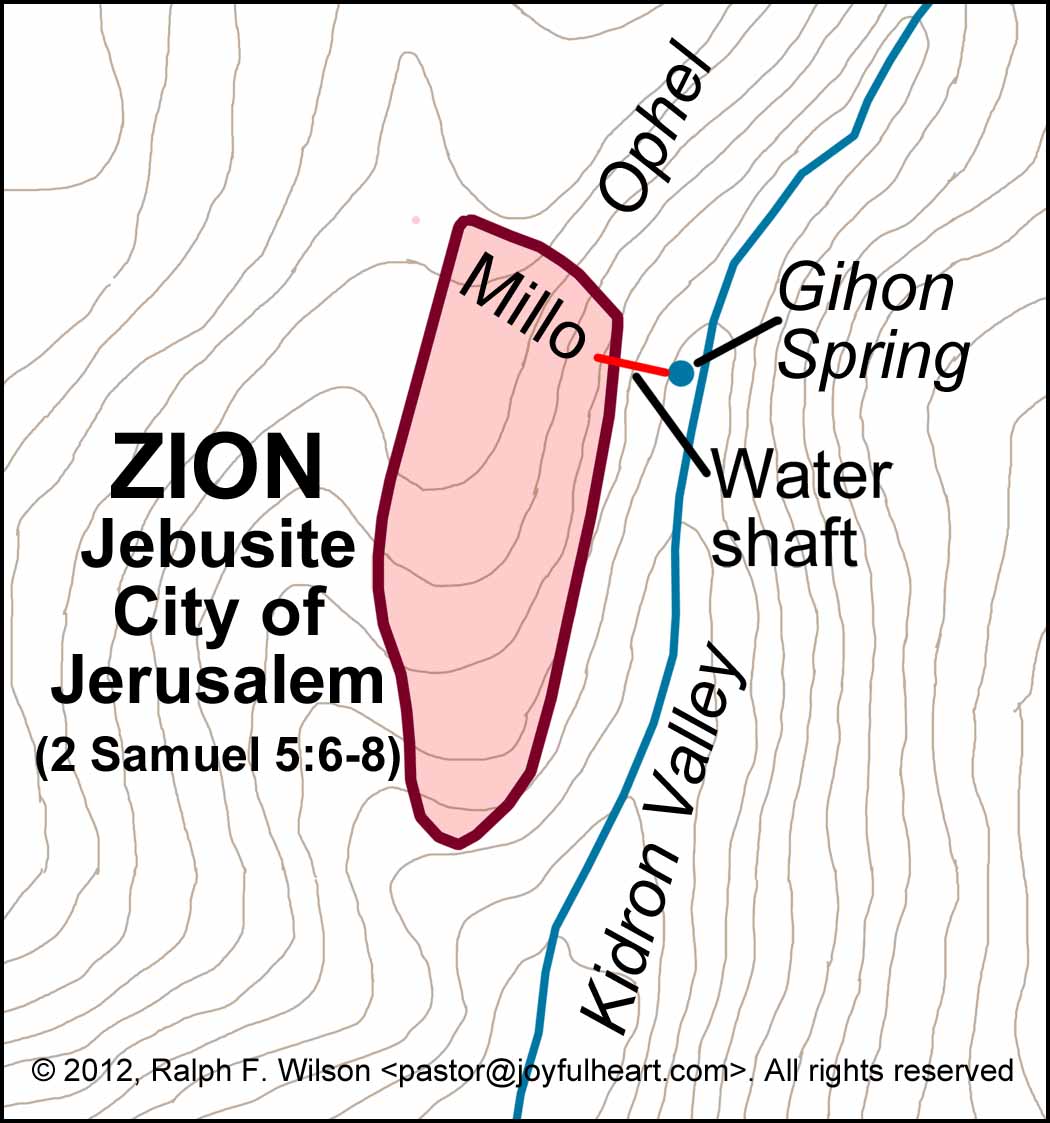
David dwelt in that stronghold he had taken from the Jebusites and called it the City of David.  He built round about his fort from Millo in the north inward to the city.  See this map borrowed from JesusWalk:


The map shows the water shaft which was probably the gutter David spoke about accessing (verse 8).

(10) And David went on and grew great, and the Lord God of hosts was with him.

David continued on and grew great, enlarging his dominion, with His Lord with him.

(1 Chronicles 11:4) And David and all Israel went to Jerusalem, which is Jebus, where the Jebusites were, the inhabitants of the land.

1 Chronicles 11 also tells of David and his men going to Jerusalem which was originally called Jebus, and its inhabitants were called Jebusites.

(5) And the inhabitants of Jebus said to David, "You shall not come here." Nevertheless David took the castle of Zion, which is the City of David.

The Jebusites told David he would not be allowed to come into their city, but he took the stronghold of Zion, called a castle here, and made that his home, becoming known as the City of David.

(6) And David said, "Whoever strikes the Jebusites first shall be chief and captain." So Joab the son of Zeruiah went up first and was chief.

David said that whoever struck the Jebusites first would be chief and captain.  Joab, the son of David's sister Zeruiah, went up first and was made chief.

(7) And David dwelt in the castle; therefore they called it the City of David. (8) And he built the city round about, even from Millo round about, and Joab repaired the rest of the city. (9) So David waxed greater and greater for the Lord of hosts was with him.

David dwelt in the castle Zion, so it became known as the City of David.  He built up the city all around Millo, and Joab repaired the rest of the city.  David grew greater and greater because the Lord was with him.

I'll end this short post here as my chronological study takes me next to a psalm of David.

Sunday, June 14, 2026

David Anointed King Over All of Israel

Continuing a chronological Bible study:

(2 Samuel 5:1) Then came all the tribes of Israel to David to Hebron, and spoke, saying, "Behold we, your bone and your flesh."

In the last chapter and post, Ishbosheth, the acting king of all Israel except for Judah where David was king, had been murdered, and David had the murderers executed for their crime.  Now representatives of all the tribes of Israel came to David.  They spoke to David and began by telling him they acknowledged that they were all part of the family of Israel.

(2) "Also in time past, when Saul was king over us, you were he who led out and brought in Israel, and the Lord said to you, 'You shall feed My people Israel, and you shall be a captain over Israel.'"

The reps told David that they realized that when Saul was king of all Israel, it had been David who led out the armies of Israel to fight against their enemies, obtained victories, and brought them home again.  They also acknowledged that the Lord had said that David was to tend His flock, His people Israel, and that He was to reign over them.  Once again, as in 2 Samuel 3:18, we have words quoted as the Lord's words of which we don't find in the Bible.  The Lord probably did say those words at some point, and they had become known by the people.

(3) So all the elders of Israel came to the king to Hebron, and King David made a league with them in Hebron before the Lord, and they anointed David king over Israel.

Then all the elders of Israel came to David at Hebron, and David made an agreement with them, surely promising to rule over all of Israel justly and righteously, and this he did before the Lord and in His name, I'm sure.  So the elders anointed David king over all of Israel. 

(1 Chronicles 11:1) Then all Israel gathered themselves to David to Hebron, saying, "Behold we, your bone and your flesh."

This same incident is recorded in 1 Chronicles 11.  Representatives of all Israel, as all the people of Israel could not have all come, came to David acknowledging that they were all of one family of Israel.

(2) "And moreover in time past, even when Saul was king, you were he who led out and brought in Israel, and the Lord your God said to you, 'You shall feed My people Israel, and you shall be ruler over My people Israel." (3) Therefore came all the elders of Israel to the king to Hebron, and David made a covenant with them in Hebron before the Lord, and they anointed David king over Israel, according to the word of the Lord by Samuel.

As stated before, the reps acknowledged that even when Saul was king, it was David who had led the troops to victories and brought them home again.  They also knew that the Lord had told David he was to rule over Israel.  So the elders of Israel came to David, and David made a covenant with all Israel, and they anointed him king of all Israel as the Lord had determined when He spoke to the prophet Samuel (1 Samuel 16:1).

(1 Chronicles 12:23) And these are the numbers of the bands ready armed for war who came to David to Hebron to turn the kingdom of Saul to him, according to the word of the Lord.

1 Chronicles 12 numbers the men who were able men of war who came to David in Hebron to make him king over all of Israel in the following verses.

(24) The children of Judah who bore shield and spear, six thousand and eight hundred, ready armed for war.

From the tribe of Judah that had already made David their king, 6800 armed men ready for war came to David.

(25) Of the children of Simeon, mighty men of valor for war, seven thousand and one hundred. (26) Of the children of Levi, four thousand and six hundred.

From the tribe of Simeon, 7100 valiant men of war came to David.  Even from the tribe of Levi, who were the priests and their attendants, 4600 men came to David.

(27) And Jehoiada was the leader of the Aaronites, and with him, three thousand and seven hundred; (28) And Zadok, a young man mighty of valor, and of his father's house, twenty-two captains.

The Aaronites were Levites, but these would have been direct descendants of Aaron.  Jehoiada was captain over that family, and he alone brought 3700 men with him.  Also from the tribe of Levi came Zadok, a young man of valor, and 22 captains from his father's house.

(29) And of the children of Benjamin, the kindred of Saul, three thousand (for until then the greatest part of them had kept the ward of the house of Saul).

Only 3000 men came from the tribe of Benjamin, as it seems being of the family of Saul, most men maintained their allegiance to the house of Saul up to that point.

(30) And of the children of Ephraim, twenty thousand and eight hundred mighty men of valor, famous throughout the house of their fathers. 

From the tribe of Ephraim, a whopping 20,800 famous men of valor came to David in Hebron.

(31) And of the half tribe of Manasseh, eighteen thousand who were expressed by name to come and make David king.

From the half tribe of Manasseh that was on the same side of the Jordan River, 18,000 men who were expressly named, either specifically called by name for the purpose, or by volunteering by name, came to David to make him king.

(32) And of the children of Issachar who had understanding of the times to know what Israel ought to do, the heads of them were two hundred, and all their brethren were at their command.

The men of the tribe of Issachar it seems had a unique understanding of the times to know what Israel should do.  There were two hundred heads, and the rest were at their command, apparently having full confidence in their leaders' direction.  Perhaps this meant only 200 went to David to make him king, but all the tribe would have been in agreement that he should be made king.

(33) Of Zebulun, such as went forth to battle, expert in war, with all instruments of war, fifty thousand who could keep rank, not of double heart.

The tribe of Zebulun sent 50,000 men of war who were experts in all instruments of war and ready to organize and go to war if necessary.  These men were steadfast in their loyalty to David.

(34) And of Naphtali, a thousand captains, and with them with shield and spear, thirty-seven thousand.

The tribe of Naphtali sent 1000 captains and 37,000 armed men with them.

(35) And of the Danites, expert in war, twenty-eight thousand and six hundred. (36) And of Asher, such as went forth to battle, expert in war, forty thousand.

From the tribe of Dan came 28,600, and from Asher, 40,000, all men expert in war.

(37) And on the other side of Jordan, of the Reubenites, and the Gadites, and of the half tribe of Manasseh, with all manner of instruments of war for the battle, a hundred and twenty thousand.

From the eastern side of the Jordan River came 120,000 men from the tribes of Reuben, Gad, and the other half tribe of Manasseh, with all manner of instruments of war with them.

(38) All these men of war who could keep rank, came with a perfect heart to Hebron to make David king over all Israel, and all the rest also of Israel were of one heart to make David king.

All these mighty men of valor, well-disciplined and well able to organize for war, if necessary, came with a perfect heart and one mind to make David king over all of Israel.  And it seems that by that time, all of Israel was unanimous in making David king, even the tribe of Benjamin, Saul's tribe.

(39) And there they were with David three days, eating and drinking, for their brethren had prepared for them. (40) Moreover, they who were near them, even to Issachar and Zebulun and Naphtali, brought bread on asses, and on camels, and on mules, and on oxen, meat, meal, cakes of figs, and bunches of raisins, and wine, and oil, and oxen, and sheep abundantly, for there was joy in Israel.

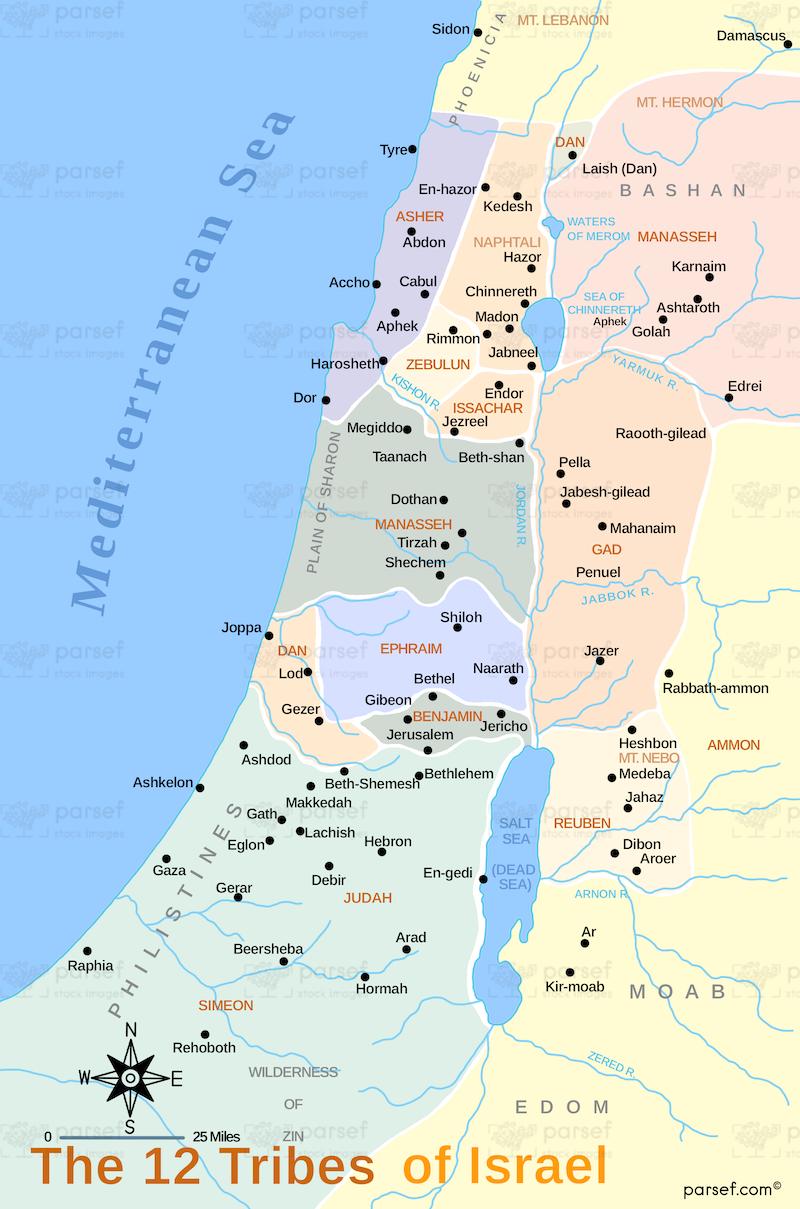
All these tens of thousands of men were with David for three days, celebrating, eating, and drinking, for their brethren who were near enough to them, even as far as the tribes of Issachar, Zebulun, and Naphtali, brought huge amounts of food and wine on all animals that could carry it.  There was great joy in Israel for the people were united again as one people Israel under King David.  This map borrowed from Maps of the World shows the twelve tribes at this time:

(1 Chronicles 29:26) Thus David the son of Jesse reigned over all Israel.

From that point onward, David reigned over all of Israel.

(2 Samuel 5:5) In Hebron he reigned over Judah seven years and six months, and in Jerusalem he reigned thirty-three years over all Israel and Judah.

David had reigned over Judah in Hebron for seven years and six months.  He was about to begin his reign over all of Israel which would last thirty-three years.

Friday, May 22, 2026

David Made King Over Judah and Ishbosheth Made King Over Israel

Continuing a chronological Bible study:

(2 Samuel 5:4) David was thirty years old when he began to reign; he reigned forty years.

King Saul had been killed, and now David began his reign at thirty years of age.  He reigned as king for forty years.

(1 Chronicles 29:27) And the time that he reigned over Israel was forty years; seven years he reigned in Hebron, and thirty-three years he reigned in Jerusalem.

This scripture also spoke of David having reigned over Israel forty years.  Here it was added that he reigned in Hebron for seven of those years and in Jerusalem for 33 years.  It is interesting to note that Jesus began his ministry at age 30.  Also Hebron was the city of priests (Joshua 21:28), and Jerusalem was the city of the kings, of the law.  David's reign was a perfect foreshadowing of the gospel state that would come with Jesus.

(2 Samuel 2:1) And it came to pass after this, that David enquired of the Lord, saying, "Shall I go up into any of the cities of Judah?" And the Lord said to him, "Go up." And David said, "Where shall I go up?" And He said, "To Hebron."

David had been living in Ziklag in the land of the Philistines while he was hiding out from Saul.  Now that Saul was dead, he asked the Lord if he should go back to Judah, and if so, where?  The Lord told him to go to Hebron, a city of priests and a city of refuge (Joshua 21:13).

(2) So David went up there, and his two wives also, Ahinoam the Jezreelitess, and Abigail, Nabal's wife, the Carmelite.

So David did as the Lord told him and went from Ziklag to Hebron, taking his wives, Ahinoam and Abigail.

(3) And his men who were with him David brought up, every man with his household, and they dwelt in the cities of Hebron.

The men who were with David also went to Hebron with their households and dwelt in the towns and villages around Hebron.

(4) And the men of Judah came, and there they anointed David king over the house of Judah. And they told David, saying, "The men of Jabesh Gilead were the ones who buried Saul."

The men of Judah came to David in Hebron and anointed him king over their tribe, Judah.  They did not take it upon themselves to make him the king of all Israel even though that was God's plan.  They seemed to have thought like David, not to force him upon all of Israel at once, but the Lord would provide the way in His timing.  The men of Judah told David that Saul had been buried by the men of Jabesh Gilead.

(5) And David sent messengers to the men of Jabesh Gilead, and said to them, "Blessed you of the Lord, that you have showed this kindness to your lord, to Saul, and have buried him. (6) And now the Lord show kindness and truth to you, and I also will requite you this kindness because you have done this thing. (7) Therefore now, let your hands be strengthened and be valiant, for your master Saul is dead, and also the house of Judah has anointed me king over them."

David sent word to the men of Jabesh Gilead to offer blessings to them for their kindness in burying Saul.  David told them that the Lord would bless them for their kind deed and that he would also repay them for their kindness.  He told them to be strong and valiant, probably meaning not to be afraid of the Philistines who had killed Saul, that although their king was dead, the house of Judah had made him their king, implying that he would now be their protector.

(8) But Abner, the son of Ner, captain of Saul's host, took Ishbosheth the son of Saul and brought him over to Mahanaim, (9) And made him king over Gilead, and over the Ashurites, and over Jezreel, and over Ephraim, and over Benjamin, and over all Israel.

Abner, Saul's first cousin, had been the captain of his army.  Perhaps he felt a fierce loyalty to Saul, and against David, or maybe it was for his own power and position, but he felt that Saul's only living heir should be made king over Israel.  That was Ishbosheth, or Eshbaal as in 1 Chronicles 8:33.  Dr. John Gill, in his Exposition of the Bible, expounded further than I have seen on the reasoning for the change of names.  Ish/Esh are essentially the same.  Baal was the name of a despicable and shameful false idol.  Bosheth meant "shame."  Perhaps rather than saying the name of a shameful idol, a word that meant the same was substituted, so Esh-baal became Ish-bosheth, as Jerub-baal, as Gideon became known (Judges 6:32), became Jerub-besheth in 2 Samuel 11:21.  Merib-baal became Mephi-bosheth, although there was a slight change to the first part of the name, as well.

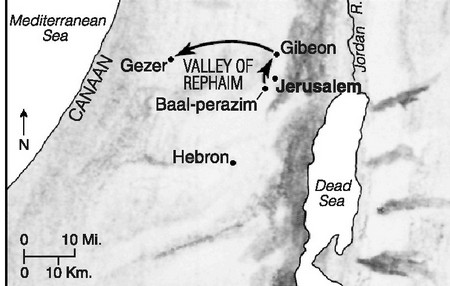
Abner took Ishbosheth to Mahanaim which was in Gad on the other side of the Jordan, perhaps because it was close to Jabesh Gilead where Saul was buried, and maybe because it was away from David at Hebron, as seen on this map borrowed from Free Bible:


Abner apparently had the power, or at least he took it upon himself, to make Ishbosheth king of all Israel with the exception of Judah where David had been made king.

(10) Ishbosheth Saul's son was forty years old when he began to reign over Israel and reigned two years. But the house of Judah followed David. (11) And the time that David was king in Hebron over the house of Judah was seven years and six months.

Ishbosheth was forty years old when he began to reign over Israel, and he reigned for two years.  The tribe of Judah considered David their king, and he reigned over Judah for seven years and six months.  Evidently, it was a common belief that Ishbosheth reigned over Israel the whole time that David reigned over Judah, so perhaps the meaning is that Ishbosheth reigned two years before the following took place:

(12) And Abner the son of Ner and the servants of Ishbosheth the son of Saul went out from Mahanaim to Gibeon. (13) And Joab the son of Zeruiah and the servants of David went out and met together at the pool of Gibeon, and they sat down, the one on the one side of the pool and the other on the other side of the pool.

Abner, now the commander of Ishbosheth's army, along with the servants of Ishbosheth, went out from Mahanaim to the other side of the Jordan to Gibeon.  Zeruiah was David's sister, and it appears that Joab her son was the captain of David's army.  Joab and the servants of David went to the pool of Gibeon where Abner's army was, and they sat by the pool on one side across from Abner and his army.

(14) And Abner said to Joab, "Let the young men now arise and play before us." And Joab said, "Let them arise."

Abner told Joab to let the young men arise and "play," as gladiators or duelers might, to see who was the most skilled in the use of the sword.  Joab agreed to let his men arise and play.

(15) And then there arose and went over by number twelve of Benjamin of Ishbosheth the son of Saul, and twelve of the servants of David.

Twelve men from Ishbosheth's army went over the pool to meet twelve men of David's army.

(16) And they caught every one his fellow by the head and thrust his sword into his fellow's side so they fell down together; therefore that place was called Helkathhazzurim, which is in Gibeon.

The twelve of David's men each caught their opponent by the head and thrust his sword into his opponent's side so that all twelve of Abner's men fell down together.  They called that place Helkathhazzurim, which literally meant "Field of Swords" in Gibeon.

(17) And there was a very sore battle that day, and Abner was beaten and the men of Israel, before the servants of David. 

There was a very severe battle that day, and in the end, David's men won the "game" defeating Abner's men.

(18) And there were three sons of Zeruiah there, Joab, and Abishai, and Asahel; and Asahel was as light of foot as a wild roe.

There were actually three sons of David's sister there, Joab, Abishai, and Asahel.  Asahel was said to be as swift of foot as a wild deer.

(19) And Asahel pursued after Abner, and in going he turned not to the right hand nor to the left from following Abner.

Asahel pursued after Abner, straight after him, not turning his attention to the right or the left.

(20) Then Abner looked behind him, and said, "Are you Asahel?" And he answered, "I am." (21) And Abner said to him, "Turn aside to your right hand or to your left, and lay hold of one of the young men, and take his armor." But Asahel would not turn aside from following him.

Abner looked behind him and saw Asahel, and Asahel confirmed that it was indeed him.  Abner told him to turn aside to the left or right and take hold of one of his soldiers and take his armor, rather than pursuing him, but Asahel would not turn aside from following Abner.

(22) And Abner said again to Asahel, "Turn aside from following me, for why should I strike you to the ground? How then should I hold up my face to Joab your brother?"

Abner warned Asahel to turn from following him or else he would be forced to strike him, which he apparently did not really want to do.  After all, neither he nor Joab had been "playing," and he did not want to have to face Joab if he struck Asahel.

(23) However, Asahel refused to turn aside; therefore Abner with the hinder end of the spear struck him under the fifth rib that the spear came out behind him, and he fell down there and died in the same place; and it came to pass, as many as came to the place where Asahel fell down and died, stood still.

Asahel refused to turn aside, and he, being swift as a wild deer, was surely gaining on Abner, and Abner felt he must strike or be killed himself.  It seems as if Abner's spear had a pointed head on both ends, and he struck Asahel behind him by thrusting his spear backwards at him.  He struck Asahel under the fifth rib, and the spear went all the way through him, coming out his back, and he fell down and died.  All who came up to the place where he died were dumbfounded and just stood there, not pursuing Abner or any of his men.

(24) Joab also and Abishai pursued after Abner, and the sun went down when they had come to the hill of Ammah that lies before Giah by the way of the wilderness of Gibeon.

However, it seems that Joab and Abishai, Asahel's brothers, had been pursuing after Abner behind Asahel, and they continued pursuing him.  The sun had gone down when they reached the hill of Ammah before Giah by the road of the wilderness of Gibeon.  The exact locations of these places are unknown, but they must have been near to Gibeon.

(25) And the children of Benjamin gathered themselves together after Abner and became one troop and stood on the top of a hill.

Men from the tribe of Benjamin came out behind Abner and formed a troop at the top of a hill against Joab and Abishai and their men.

(26) Then Abner called to Joab, and said, "Shall the sword devour forever? Don't you know that it will be bitterness in the latter end? How long shall it be then until you bid the people return from following their brethren?"

Abner called out to Joab asking if they should continue the battle of the swords forever until it resulted in a bitter end, with the killing of a great number more men and perhaps even him and Joab themselves.  He asked how long it would be before Joab called off his men from following their brethren.  He now called the men of Israel and the men of Judah brethren, but that didn't seem to bother him when he first suggested the brethren "play."

(27) And Joab said, "As God lives, unless you had spoken, surely then in the morning the people would have gone up every one from following his brother."

Joab answered, and I believe the sense is that had Abner not spoken as he had, Joab's army would have pursued all night and not quit until the morning.  Or perhaps he meant that had Abner not spoken in the first place to have the men "play," Joab's men would never have pursued them that morning or day.

(28) So Joab blew a trumpet, and all the people stood still, and pursued after Israel no more, neither did they fight anymore.

So Joab blew a trumpet which signaled his men to stop from pursuing and fighting with the men of Israel.

(29) And Abner and his men walked all that night through the plain and passed over Jordan and went through all Bithron, and they came to Mahanaim.

So Abner and his men walked all night through the plain and across the Jordan River, back to their place in Mahanaim.

(30) And Joab returned from following Abner, and when he had gathered all the people together, there lacked of David's servants nineteen men and Asahel. (31) But the servants of David had struck of Benjamin and of Abner's men, three hundred and sixty men who died.

Joab returned from following Abner, and when he gathered all his men together, he found that nineteen men plus Asahel had been killed.  However, they had killed 360 of Abner's men and the men of Benjamin.

(32) And they took up Asahel and buried him in the sepulchre of his father which was in Bethlehem. And Joab and his men went all night, and they came to Hebron at break of day.  

Joab and his men took the body of Asahel and buried him in the sepulcher of his father, Zeruiah's husband, which was in Bethlehem.  Then they walked all night and came back to Hebron at daybreak the next morning.

The Lord had rejected Saul and now he was dead, but David, the Lord's choice for king, the man after His own heart, still was not made king over all Israel.  In fact, it seems a civil war was brewing between Judah and Israel.  Abner, probably more for his own benefit and power, set up Saul's son Ishbosheth as king of Israel.  God allowed this testing and refining time for David.  After all, David had been just a shepherd boy.  He had a heart for the Lord, but he needed time to mature and develop the leadership qualities to be king.  After all, he was to become Israel's greatest king and from his line of descendants would come the Messiah.  God was preparing David for his awesome role in Biblical history.