Continuing a chronological Bible study:
(Judges 1:1) Now after the death of Joshua, it came to pass that the children of Israel asked the Lord, saying, "Who shall go up for us against the Canaanites first, to fight against them?"
Joshua had died in the last chapter and post. As he left no successor, no commander in chief, the people inquired of the Lord, either by prayer or the Urim and Thummim, which were some sort of objects worn by the high priest that were used to determine God's will, about who would go first to fight the Canaanites that remained in their land.
(2) And the Lord said, "Judah shall go up; behold, I have delivered the land into his hand."
The Lord said that the tribe of Judah should go first against the Canaanites that remained in their land. He said He had already delivered that Canaanite land into their hand.
(3) And Judah said to Simeon his brother, "Come up with me into my lot that we may fight against the Canaanites, and I likewise will go with you into your lot." So Simeon went with him.
As the tribe of Simeon lay in the middle of the tribe of Judah, Judah's tribe asked the tribe of Simeon to go with them to fight the Canaanites, and in turn, Judah would go with Simeon when they were called to fight. The tribe of Simeon agreed and went with the tribe of Judah.
(4) And Judah went up, and the Lord delivered the Canaanites and the Perizzites into their hand, and they slew of them in Bezek ten thousand men.
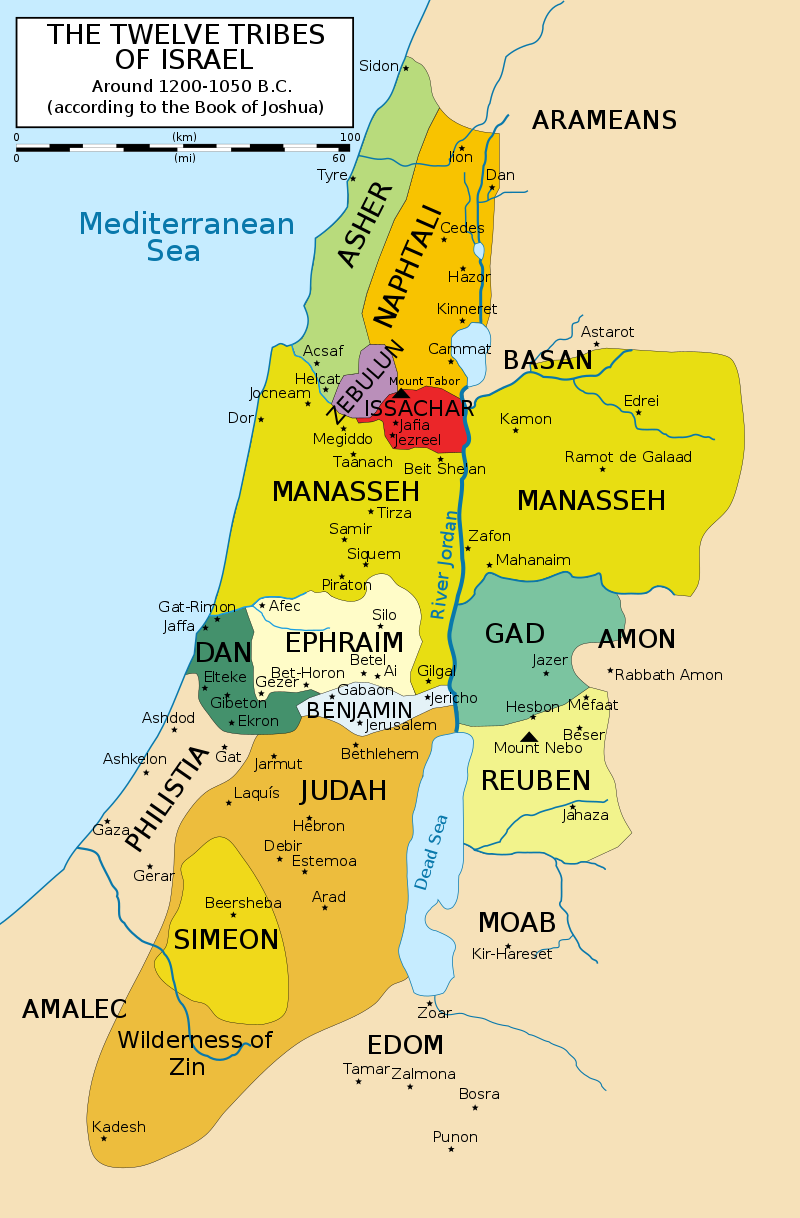
Judah with Simeon went up against the Canaanites and the Perizzites. The term "Canaanites" often referred to the seven nations that occupied Canaan as a whole, but there was one nation of Canaanites, and it, as well as the nation of Perizzites, were delivered into Israel's hand by the Lord. The Israelites killed ten thousand men in and around the area of Bezek which was just west of Jerusalem. This section of a map borrowed from Psalms to God shows the tribes of Judah and Simeon and where they went up to fight in the northeastern part of Judah:
(5) And they found Adoni-Bezek in Bezek, and they fought against him, and they slew the Canaanites and the Perizzites. (6) But Adoni-Bezek fled, and they pursued after him and caught him and cut off his thumbs and his big toes.
The Israelites found the king of Bezek there and fought against him. They slew the Canaanites and the Perizzites, but King Adoni-Bezek fled from them. They pursued him and eventually caught him, and they cut off his thumbs and his big toes. This would have disabled him from fighting as he would not be able to hold a weapon, and he would no longer be able to run. It was unusual for the Israelites to inflict such torture and punishment, but it may have been God's will as the king himself recognized:
(7) And Adoni-Bezek said, "Seventy kings with their thumbs and big toes cut off gathered scraps under my table; as I have done, so God has requited me." And they brought him to Jerusalem, and there he died.
The king confessed that he had cut off the thumbs and big toes of seventy kings who were then left to gather scraps from under his table. He said that as he had done so cruelly to others, God had repaid him by doing the same to him. It's interesting that a pagan king would realize that God had done that to him, so it may be that he spoke under the influence of God's Holy Spirit. The Israelites brought him to Jerusalem where he died.
(8) Now the children of Judah had fought against Jerusalem and had taken it and struck it with the edge of the sword and set the city on fire.
Judah had previously conquered Jerusalem which was how they were able to take the king there. During the time of Joshua, the Israelites had not yet been able to drive the Jebusites out of Jerusalem (Joshua 15:63), but apparently Judah had been able to do it.
(9) And afterward the children of Judah went down to fight against the Canaanites who dwelt in the mountains, and in the south, and in the valley.
After the death of King Adoni-Bezek, the Israelites went southward to fight against the Canaanites who still dwelt in other areas of Judah, in the mountains, in the valley, and in the southern part of Judah.
(10) And Judah went against the Canaanites who dwelt in Hebron (now the name of Hebron before was Kirjath Arba), and they killed Sheshai, and Ahiman, and Talmai.
The tribe of Judah went against the Canaanites who still dwelt in Hebron. The city of Hebron was before named Kirjath Arba for Arba, a chief among the Anakims who were giants in the city. Caleb had previously driven out the giants, Sheshai, Ahiman, and Talmai (Joshua 15:14), but it seems they must have regained at least parts of the city. This time the tribe of Judah killed the three giants.
(11) And from there he went against the inhabitants of Debir, and the name of Debir before was Kirjath Sepher.
This and what follows in the next few verses appears to be a retelling of Joshua 15:15-19. It couldn't have happened after Joshua died because Joshua wrote about it. Since Jewish tradition considers the prophet Samuel to be the author of Judges, and he would have written this about 300 years after the fact, it may be reasonable to believe he might not have gotten the chronology exactly right. However, here Samuel was writing about the lands that were conquered after Joshua's initial conquest, and the conquest of Hebron did happen after that. It was after the tribe of Judah had been given their allotment that Caleb (of Judah) went against the inhabitants of Debir. Before it was renamed Debir the city was called Kirjath Sepher.
(12) And Caleb said, "He who strikes Kirjath Sepher and takes it, to him I will give Achsah my daughter to wife."
Caleb had said at the time that whoever was able to take Kirjath Sepher would be given his daughter Achsah in marriage (Joshua 15:16).
(13) And Othniel the son of Kenaz, Caleb's younger brother, took it, and he gave him Achsah his daughter to wife.
It was Caleb's nephew Othniel, the son of Kenaz who was Caleb's younger brother, who took Kirjath Sepher, and Caleb indeed gave him his daughter Achsah in marriage.
(14) And it came to pass when she came, that she moved him to ask of her father a field, and she dismounted, and Caleb said to her, "What do you want?" (15) And she said to him, "Give me a blessing, for you have given me a south land; give me also springs of water." And Caleb gave her the upper springs and the lower springs.
When Achsah came to Othniel on her donkey, she persuaded him to ask for a field from her father. She dismounted her donkey, and Caleb asked her what she wanted. She asked for an extra blessing. He had already given her a south land, which might indicate a dry land, so she now asked for springs of water. Caleb gave her upper springs and lower springs.
The fact that this account was written twice made me look harder at the reason why it was so important. I read many commentaries and understood what others had found. It was an illustration of how we can boldly approach our Father in heaven with our requests. Imagine that! The holy God of the universe wants to have a father/child relationship with us sinful creatures, and He urges us to come to Him with our petitions. However, we must remember that the only way we unclean sinners are able to approach Him is because of the blood sacrifice of Jesus Christ that purifies us when we accept His gift. Jesus said in Matthew 7:11, “If you then, being evil, know how to give good gifts to your children, how much more will your Father who is in heaven give good things to those who ask Him?" However, we are to use wisdom and discernment as Achsah did. She didn't ask for a gold-plated castle, but for springs for her dry land to make it more fruitful for her family. James said in James 4:3, "You ask and do not receive, because you ask amiss, that you may spend it on your pleasures." Our Father in heaven wants to bless us with the things that will help us grow and be more effective servants for His church, not with worthless trinkets. He knows what is best for us, but He invites us to come confidently to Him with our requests, having faith that He will give us what we need, but perhaps not always what we want.
(16) And the children of the Kenite, Moses's father-in-law, went up out of the city of palm trees with the children of Judah into the wilderness of Judah, which is in the south of Arad, and they went and dwelt among the people.
Moses's father-in-law was Jethro, a Kenite. There is no consensus for whom the Kenites were named, but they were an ancient people living in Canaan in the time of Abraham (Genesis 15:19). They were among ten tribes whose land God said He was giving to Abram. However, during the time of Moses and Joshua, only seven nations were named as occupying Canaan. The Kenites, the Kenizzites, and the Kadmonites, had either become extinct, moved out of Canaan, or mixed with other nations. Jethro's daughter Zipporah married Moses. Jethro and his son Hobab had joined with Moses, and Hobab's descendants lived among the Israelites in the land of Canaan; they were the Kenites. The city of palm trees was Jericho (Deuteronomy 34:3). The Kenites had apparently resided in Jericho, but they now left it to go with the tribe of Judah and settled in the wilderness of Judah which was south of Arad, which would put them east of the tribe of Simeon according to the map above. According to Albert Barnes in his Notes on the Bible, the rabbinical story was that Jericho had been given to Hobab. Joshua had cursed that city and any person who rose up to rebuild it (Joshua 6:26), so apparently the descendants of Hobab had determined to leave that cursed city and dwell among the tribe of Judah in the wilderness.
(17) And Judah went with Simeon his brother, and they slew the Canaanites that inhabited Zephath and utterly destroyed it. And the name of the city was called Hormah.
As the tribe of Judah had promised, they went with the tribe of Simeon and killed the Canaanites who inhabited a city called Zephath in eastern Simeon, and they renamed it Hormah.
(18) Also Judah took Gaza with its territory, and Ashkelon with its territory, and Ekron with its territory.
Judah also took Gaza and Ashkelon on the Mediterranean coast and Ekron in the north. The Biblical scholars I study wrote that the cities were later retaken and possessed by the Philistines. John Wesley in his Notes on the Bible, observed that the scripture did not say they slew the people as it did in the verse before it. The people, being spared, regained their control of the cities.
(19) And the Lord was with Judah, and he drove out the mountaineers, but could not drive out the inhabitants of the valley because they had chariots of iron.
The Lord was with Judah, and the tribe was able to drive out the inhabitants of the mountainous region of Judah. However, it appears their faith failed when they feared the chariots of iron, and they were unable to drive out the inhabitants of the valley. The Lord was with them, and there was no reason to believe that He wouldn't be with them to drive out those people, but it appears they didn't even try because of their fear.
(20) And they gave Hebron to Caleb, as Moses said, and he expelled from there the three sons of Anak.
Once again, the author of this book wrote in this chapter about the areas that had been left unconquered after Joshua's conquest. He referred again to Hebron which had been given to Caleb. Caleb had driven out the three giants, Sheshai, Ahiman, and Talmai, whom Judah later killed (v.10).
(21) And the children of Benjamin did not drive out the Jebusites that inhabited Jerusalem, but the Jebusites dwell with the children of Benjamin in Jerusalem to this day.
The tribe of Benjamin did not drive out the Jebusites that inhabited Jerusalem. Although the tribe of Judah had previously taken the city (v. 8), it appears it was reinhabited by the Jebusites. They remained dwelling with the tribe of Benjamin to the day the author, probably Samuel, wrote this. John Gill, in his Exposition of the Bible, wrote that Samuel wrote the book of Judges before the reign of David who would dispossess the Jebusites.
(22) And the house of Joseph, they also went up against Bethel, and the Lord was with them.
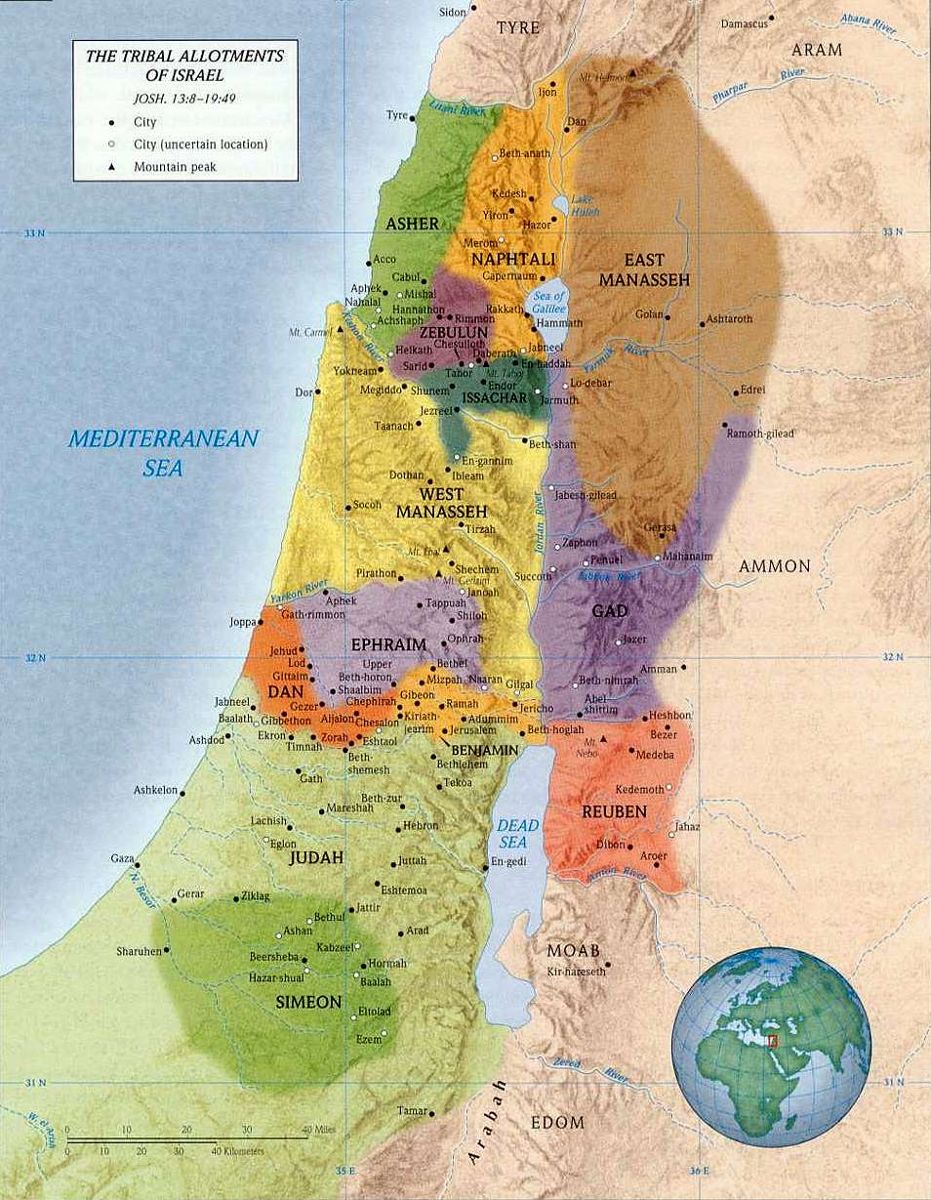
The house of Joseph, Ephraim and Manasseh, went up against Bethel in the southern portion of Ephraim. The inhabitants of Bethel had been driven away from the city by Joshua (Joshua 8:17), but apparently the city had become reinhabited by the Canaanites. The Lord was with Ephraim and Manasseh as they went against the inhabitants of Bethel. This map borrowed from
Precept Austin, shows all of the tribes, and Bethel is seen in southern Ephraim:
(23) And the house of Joseph sent to descry Bethel. (Now the name of the city before was Luz.)
The tribes of Ephraim and Manasseh sent spies into Bethel to examine the conditions. The name of Bethel was formerly Luz.
(24) And the spies saw a man come forth out of the city, and they said to him, "Show us, we pray you, the entrance into the city, and we will show you mercy."
The spies saw a man coming out of Bethel. They asked him to tell them how to get into the city, and they in turn would show him mercy.
(25) And when he showed them the entrance into the city, they struck the city with the edge of the sword, but they let the man and all of his family go.
The man showed the spies a way into the city, and the tribes of Joseph struck the city and killed its inhabitants, but they let the man and his entire family go free.
(26) And the man went into the land of the Hittites and built a city and called its name Luz, which is its name to this day.
The man and his family went into the land of the Hittites where the Hittites apparently dwelt after being expelled from Canaan. He built a city and called it Luz after the city he had been forced to leave. Luz was still there at the writing of this book, although it was no longer there at the writing of the Biblical scholars I study, as they didn't know where this city of Luz would have been.
(27) Neither did Manasseh drive out Beth Shean and her towns, nor Taanach and her towns, nor the inhabitants of Dor and her towns, nor the inhabitants of Ibleam and her towns, nor the inhabitants of Megiddo and her towns, but the Canaanites would dwell in that land.
Beth Shean, Taanach, Ibleam, Dor, and Megiddo, were cities given to the half tribe of Manasseh west of the Jordan River out of the lots of Issachar and Asher (Joshua 17:11). Apparently, they never made any attempt to drive out the inhabitants of the cities and inhabit them as their cities, so the Canaanites dwelt in their land. The map above shows most of these cities in northern West Manasseh.
(28) And it came to pass, when Israel was strong, that they put the Canaanites to tribute and did not utterly drive them out.
When Israel became strong, they still did not drive out the Canaanites but made them tributaries under them.
(29) Neither did Ephraim drive out the Canaanites that dwelt in Gezer, but the Canaanites dwelt in Gezer among them.
Neither did Ephraim, the other son of Joseph, drive out Canaanites in his land, specifically Gezer, and the Canaanites lived in Gezer among them.
(30) Neither did Zebulun drive out the inhabitants of Kitron nor the inhabitants of Nahalol, but the Canaanites dwelt among them and became tributaries.
Zebulun did not drive out the inhabitants of Kitron or Nahalol, and the Canaanites there became tributaries.
(31) Neither did Asher drive out the inhabitants of Accho, nor the inhabitants of Zidon, nor of Ahlab, nor of Achzib, nor of Helbah, nor of Aphik, nor of Rehob, (32) But the Asherites dwelt among the Canaanites, the inhabitants of the land, for they did not drive them out.
The tribe of Asher appears especially slothful in driving the Canaanites out of their land as God had instructed. Out of 22 cities they had been given (Joshua 19:30), they failed to drive the enemy out of seven of them, about one third of their allotted cities.
(33) Neither did Naphtali drive out the inhabitants of Beth Shemesh nor the inhabitants of Beth Anath, but he dwelt among the Canaanites, the inhabitants of the land; nevertheless, the inhabitants of Beth Shemesh and Beth Anath became tributaries to them.
The tribe of Naphtali failed to drive out the Canaanites from Beth Shemesh and Beth Anath, so they dwelt among the Canaanites, but they did make the Canaanites in those cities tributaries to them.
(34) And the Amorites forced the children of Dan into the mountain, for they would not allow them to come down to the valley.
The Amorites in the tribe of Dan's territory forced their tribe into the mountains and would not allow them to go down to the valley. There must have been a serious lack of faith in God to drive out their enemies that their enemies were able to drive them from their land.
(35) But the Amorites would dwell in Mount Heres in Aijalon, and in Shaalbim, yet the hand of the house of Joseph prevailed so that they became tributaries.
It appears that the Amorites even dwelt among Dan in the mountains. However, the house of Joseph helped its brother tribe, as Ephraim and Manasseh bordered Dan. They at least made the Amorites tributaries in Mount Heres in Aijalon and in Shaalbim, however it doesn't appear that they were ever able to make tributaries of the Amorites in the valley.
(36) And the coast of the Amorites was from the going up to Akrabbim, from the rock and upward.
Akrabbim means "scorpion," so this is believed to be the Scorpion Pass, a pass between the south end of the Dead Sea and Zin. "The rock" is believed to be Petra which was located east of that region on the east side of the Dead Sea. Looking at the map above, I believe the territory of the Amorites at this time was from the eastern edge of the Wilderness of Zin, eastward below the Dead Sea, and upward on the east side of the Dead Sea, the regions of Edom and Moab. The Amorites were said to be the most powerful people among the Canaanites and would prove to be very troublesome to Israel.
The Israelites were very careless with their duty to drive out all the Canaanites from their land. Whether it was laziness or fear and a lack of faith, they did not do as their Lord God had told them to do. Some of the cities where the Israelites failed to remove the Canaanites were cities that had been given to the Levites, including Taanach, Gezer, Nahalal, and Rehob, which may have been the reason they were lax in driving out the Canaanites. However, you would think they would take better care of their priests and ministers who served their Lord God. There may have been some covetousness on Israel's part as well, as they decided making the Canaanites pay tribute was more advantageous to them than driving them out. However, God's way is always the best way, and by disobeying Him in their total conquest of Canaan, they brought troubles on themselves. However, this may have been by divine design. The Israelites had proved to be a people lacking faith and easily drawn away from their Lord. Perhaps they needed adversity to keep them in check. It's most often in adversity that people turn toward God. It's not that God purposely designed things the way they were in order to punish His people. He just allowed them to do or not do according to their own desires, letting them learn great lessons as He brought them through their adversities.