Showing posts with label Evi. Show all posts

Sunday, February 2, 2025

The Inheritance East of the Jordan River

Continuing a chronological Bible study:

(Joshua 13:1) Now Joshua was old, stricken in years, and the Lord said to him, "You are old, stricken in years, and there remains yet very much land to be possessed."

Joshua and the Israelite army had conquered thirty-one kings and territories in the past seven years.  But Joshua was getting old, commentators think about a hundred years old.  It's amazing to think that a man in his nineties could have done what he had done in the past seven years!  But there was still much land to be conquered all around on the outskirts of the conquered area.  This map I found on Pinterest said to have come from jesuswalk.com clearly shows the conquered lands in relation to the whole:
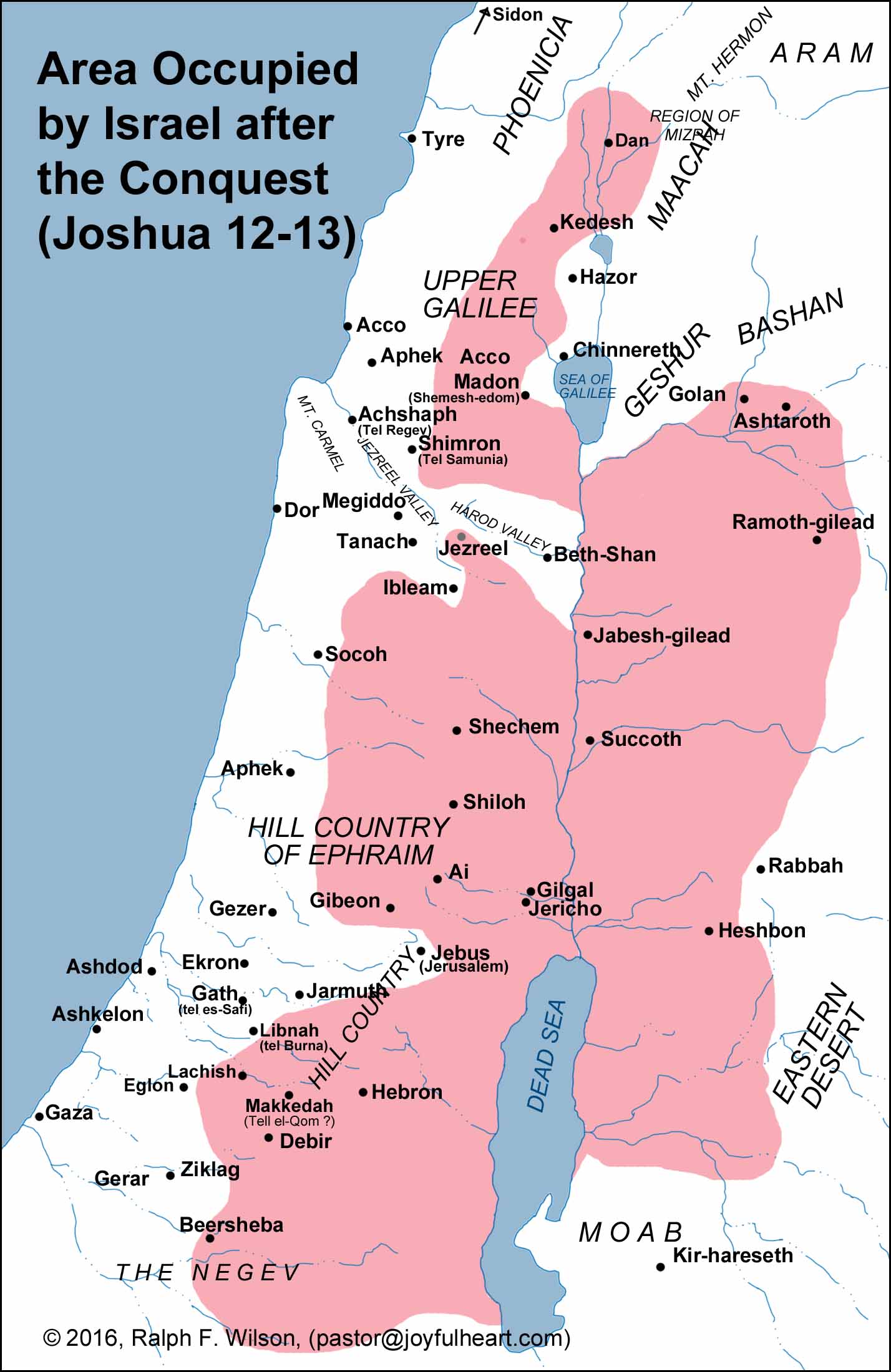

I find it interesting to note that although Joshua had defeated their kings as noted in the last chapter, some of their territories remained outside of Israelite occupation (Gezer, Aphek, Dor, Megiddo, etc.).  It seems reasonable to assume that Joshua may have continued to try to conquer the rest of the lands, but God stopped him because of his advanced age.  Adam Clarke, in his Commentary on the Bible, had an interesting perspective.  As nothing God does is by accident, he suggested that God may have wanted some of the original inhabitants to remain in order to keep the oftentimes unfaithful Israel in check.  

(2) "This is the land that yet remains, all the borders of the Philistines, and all Geshuri,"

The Lord then detailed the lands that were still unconquered, undoubtedly so that Joshua and the Israelites would know what they had a right to claim.  There was the territory of the Philistines in the southwest of Canaan along the Mediterranean Sea, to Geshuri, which appears to be Geshur in the north.  This map borrowed from Big Springs Community Church shows the unconquered lands more clearly than the one above:


(3) "From Sihor before Egypt to the borders of Ekron northward, counted to the Canaanite, five lords of the Philistines, the Gazites, the Ashdodites, the Ashkelonites, the Gittites, and the Ekronites, also the Avites;"

God described in more detail the as of yet unconquered territories of the promised land.  Describing the land of the Philistines, He said it ranged from Sihor before Egypt in the south to Ekron in the north which can be seen in the first map, across from Jerusalem.  The land of Philistia was counted as belonging to the posterity of Canaan, but the Philistines had gotten possession of it.  Because it was counted as Canaanite land, it was part of the promised land.  There were five lords in Philistia rather than kings, and it contained the cities of Gaza, Ashdod, Ashkelon, Ekron, and their inhabitants, and to whatever cities the Gittites and Avites belonged.

(4) "From the south, all the land of the Canaanites and Mearah beside the Sidonians, to Aphek to the borders of the Amorites;"

As near as I can tell by these maps, God is describing all the land of the Canaanites that was not part of the Philistines, from the south upward to Aphek (note there are two Apheks, one in Upper Galilee) to Sidon.

(5) "And the land of the Gebalites, and all Lebanon, toward the sunrising, from Baal Gad under Mount Hermon to the entering into Hamath;"

Gebal was north of Sidon on the Mediterranean coast.  The land of the Gebalites was said to be that east of Tyre, Sidon, and Gebal, the land east of the Lebanon mountains in the north, from Mount Hermon to the entrance of Hamath, seen clearly in this map borrowed from The Biblical Zionist:


(6) "All the inhabitants of the hill country from Lebanon to Misrephoth Maim, all the Sidonians, them I will drive out from before the children of Israel; only divide it by lot to the Israelites for an inheritance as I have commanded you."

The Lord continued to describe the land that was yet unconquered that also included all the hill country from Lebanon to Misrephoth Maim which was south of Tyre, all the land of the Sidonians.  All that very much land yet to be possessed (v. 1) included all the lands described from verse 2 to the Sidonians in verse 6.  All those the Lord would drive out from before the children of Israel.  Even though they were not yet driven out, the Lord wanted Joshua to divide all the promised land by lot to the Israelites for their inheritance.  Most of the early commentators I study suggest that these people were not ever entirely driven out or their land completely possessed by the Israelites, that the promise was always part of a covenant that must be upheld by the Israelites, and they did not do their part.  However, I refer back to Exodus 23:30-31, when the Lord said:

"Little by little I will drive them out from before you, until you have increased, and you inherit the land. And I will set your bounds from the Red Sea to the sea of the Philistines, and from the desert to the river; for I will deliver the inhabitants of the land into your hand, and you shall drive them out before you."

God specifically said that it would be little by little, and indeed all the land was subdued under the reign of David.  Some say that still the people were not specifically driven out, only subdued.  However, throughout ancient and modern history, Israel's borders have changed, and indeed the future Millennial Israel will include all of the promised land.

(7) "Now therefore divide this land for an inheritance to the nine tribes and the half tribe of Manasseh," (8) With whom the Reubenites and the Gadites have received their inheritance which Moses gave them beyond Jordan eastward, as Moses the servant of the Lord gave them,

The Lord told Joshua to divide the land on their present side of the Jordan River for an inheritance to the nine and a half tribes that had not yet received their inheritance.  Reuben, Gad, and the other half tribe of Manasseh had already received their lots on the east side of the Jordan River, given them by Moses.

(9) From Aroer which is on the bank of the River Arnon, and the city that is in the midst of the river, and all the plain of Medeba to Dibon, (10) And all the cities of Sihon king of the Amorites who reigned in Heshbon, to the border of the children of Ammon;

Further describing the lands given to Reuben, Gad, and the half tribe of Manasseh, it was from Aroer in the middle of the Arnon River that separated the land of the Amorites from Moab, and all the plain and cities of Sihon king of the Amorites to the Jabbok River which was the border of the Ammonites.

(11) And Gilead, and the border of the Geshurites and Maachathites, and all Mount Hermon, and all Bashan to Salcah, (12) All the kingdom of Og in Bashan who reigned in Ashtaroth and in Edrei, who remained of the remnant of the giants; for these did Moses smite and cast them out.

They had also received all the kingdom of Og, which included Gilead, the border of the Geshurites and Maachathites, all Mount Hermon, and all Bashan to Salcah.  All that land of Og that had been taken by Moses had been given to Israel, but they had not taken possession of much of it.

(13) Nevertheless, the children of Israel did not expel the Geshurites, nor the Maachathites, but the Geshurites and the Maachathites dwell among the Israelites until this day.

Indeed, Joshua went on to write that the Israelites had not driven out the Geshurites and Maachathites, and they still dwelt with them at the time of his writing.

(14) Only to the tribe of Levi He gave no inheritance; the sacrifices of the Lord God of Israel made by fire are their inheritance, as He said to them.

The tribe of Levi received no land inheritance on either side of the Jordan River.  As they were God's priests, He was to be their inheritance; they were to live off the sacrifices to their Lord God (Deuteronomy 18:1).

(15) And Moses gave to the tribe of the children of Reuben according to their families. (16) And their coast was from Aroer which is on the bank of the river Arnon, the city in the midst of the river, and all the plain by Medeba;

Moses had given to the tribe of Reuben the land from Aroer in the southeast and all the plain of Medeba.

(17) Heshbon, and all her cities in the plain, Dibon, and Bamoth Baal, and Beth Baal Meon, (18) And Jahazah, and Kedemoth, and Mephaath, (19) And Kirjathaim, and Sibmah, and Zereth Shahar in the mount of the valley, (20) And Beth Peor, and Ashdoth Pisgah, and Beth Jeshimoth, (21) And all the cities of the plain, and all the kingdom of Sihon king of the Amorites, who reigned in Heshbon, whom Moses smote with the princes of Midian, Evi, and Rekem, and Zur, and Hur, and Reba, dukes of Sihon dwelling in the country.

Reuben's inheritance included all these cities in the former kingdom of Sihon.  It had been taken by Moses when he defeated the king of Sihon and all his princes.  I can't begin to try to locate all these cities, but I found this map at Psalms to God Podcast that shows a general view of all the tribes and their allotments:


(22) Balaam also, the son of Beor, the soothsayer, the children of Israel killed with the sword, among those who were killed by them. 

The Israelites had also killed Balaam, the soothsayer, at the same time as the princes (Numbers 31:8).

(23) And the border of the children of Reuben was Jordan and its border. This was the inheritance of the children of Reuben after their families, the cities and the villages.

The northwestern border of the land possessed by the descendants of Reuben was the Jordan River.  All the land, cities, and villages between the Jordan and Aroer in the southeast made up the inheritance of the children of Reuben.

(24) And Moses gave to the tribe of Gad, to the children of Gad according to their families. (25) And their coast was Jazer and all the cities of Gilead, and half the land of the children of Ammon, to Aroer before Rabbah; (26) And from Heshbon to Ramath Mizpah and Betonim, and from Mahanaim to the border of Debir; (27) And in the valley Beth Haram, and Beth Nimrah, and Succoth, and Zaphon, the rest of the kingdom of Sihon king of Heshbon, with the Jordan as border to the edge of the Sea of Chinnereth on the other side of the Jordan eastward. (28) This is the inheritance of the children of Gad after their families, the cities and their villages.

Moses gave as an inheritance to the children of Gad the land from Jazer in the south to Rabbah in the west, with the Jordan River as the western border.  The northern border was quite unique, and I will let the map show the general area that was allotted to Gad.  Once again trying to locate all those cities is quite a dizzying task.  The Aroer before Rabbah would have to be a different Aroer from the one at the middle of the Arnon River.  Also Debir would have to be a different Debir.  All the cities of Gilead would only pertain to those cities within the area of Gad, as half of Gilead was given to the half tribe of Manasseh.  The same would have to be said for all the kingdom of Sihon that was given to Reuben (v. 21), as it states here that there was the rest of the kingdom of Sihon that was given to Gad.  Half the land of the children of Ammon refers to that part that Sihon king of the Amorites took from the Ammonites.

(29) And Moses gave to the half tribe of Manasseh, and this was of the half tribe of the children of Manasseh by their families. (30) And their coast was from Mahanaim, all Bashan, all the kingdom of Og king of Bashan, and all the towns of Jair, which are in Bashan, sixty cities; (31) And half Gilead, and Ashtaroth, and Edrei, cities of the kingdom of Og in Bashan, to the children of Machir the son of Manasseh, to the one half of the children of Machir by their families.

To the half tribe of Manasseh, the land from Mahanaim, which must have been the southern border as Gad also had that border (v. 26), including all the land of Bashan that included sixty cities, half of Gilead, and the royal cities of Og, Ashtaroth and Edrei.  The land is said to have been given to half the children of Machir, who was Manasseh's son.

(32) These are what Moses had distributed for inheritance in the plains of Moab on the other side of the Jordan by Jericho eastward.

The lands described above from verse 9 to this verse were all the lands that had been distributed by Moses to the tribes of Reuben, Gad, and the half tribe of Manasseh, on the eastern side of the Jordan River, east of Jericho.

(33) But to the tribe of Levi Moses did not give inheritance; the Lord God of Israel was their inheritance, as He said to them.

Once again, Joshua points out that the tribe of Levi did not receive any land as their inheritance, because as priests, the Lord God was their inheritance.

As Joshua was now old, God had him rest from his battles, even though there was still much land to be conquered.  However, for now, He wanted Joshua to portion out the lots of inheritance, and it was to include all the land that had been promised, even those not yet conquered.  This chapter began with the allotments that had already been given to the tribes of Reuben, Gad, and the half tribe of Manasseh. 

Sunday, October 6, 2019

The Israelites' Holy War With Midian

Continuing a chronological Bible study:

(Numbers 31:1) And the LORD spoke to Moses, saying, (2) "Avenge the children of Israel on the Midianites; afterward you shall be gathered to your people.”

The events of chapter 31 follow those of chapter 27, after an interruption where the Lord reviewed the law of sacrifices and the law of vows in the previous three chapters.  In Numbers 27:13 the Lord had told Moses that once he had been permitted to see the promised land, he would die, and would not be allowed to enter the land of Canaan because he had rebelled against the commandment of the Lord (Numbers 20:12).

Now the Lord told Moses that he was first to make war upon the Midianites to avenge the children of Israel for the injury they had done to them by sending their daughters among them to entice them to adultery and idolatry.  After that, he would be gathered to his people, meaning he would die as all his people before him.

(3) And Moses spoke to the people, saying, “Arm some of yourselves for war, and let them go against the Midianites, and avenge the LORD on Midian."

Moses then told the people to arm some of their able-bodied men of war and let them go against the Midianites to avenge the LORD.  Note the Lord had said in verse 2 to avenge the children of Israel, but Moses now called it vengeance for the Lord.  The Israelites had indeed suffered and lost 24,000 people due to the iniquity they were drawn into by the Midianites, but Moses recognized this had been an affront to their Lord and called the people to avenge His name and honor which had been dishonored by their sins of lewdness and idolatry.

(4) "Of every tribe a thousand, throughout all the tribes of Israel, shall you send to the war."

Each tribe was to send 1000 men to war.

(5) So there were delivered out of the thousands of Israel, a thousand of every tribe, twelve thousand armed for war.

The people did as Moses had instructed, and delivered out of each tribe 1000 men armed for war, for a total of 12,000 men from the tribes of Reuben, Simeon, Judah, Issachar, Zebulun, Dan, Naphtali, Gad, Asher, Ephraim, Manasseh, and Benjamin.  The tribe of Levi, as priests and caretakers of the tabernacle, would not have sent men to war.

(6) And Moses sent them to the war, a thousand of every tribe, them and Phinehas the son of Eleazar the priest, to the war, with the holy instruments and the trumpets to blow in his hand.

Moses sent the thousand men from each tribe to war.  We see that the tribe of Levi did participate; Phinehas the son of Eleazar the priest, went to war with holy articles from the sanctuary and trumpets to blow, signifying this was the Lord's battle.

(7) And they warred against the Midianites, as the LORD commanded Moses; and they killed all the males.

The 12,000 Israelite soldiers warred against the Midianites as the Lord had commanded Moses they do, and they killed all the males.  This means all the males who warred against them, or the ones who did not escape; it cannot mean every last Midianite male, as the Midianites would later raise their war heads again.

(8) And they killed the kings of Midian, besides the rest of them who were slain, namely, Evi, Rekem, Zur, Hur, and Reba, five kings of Midian; Balaam also, the son of Beor, they slew with the sword.

They also killed the kings of Midian, in addition to every other male who was killed.  The five kings of Midian who were killed were Evi, Rekem, Zur, Hur, and Reba.  They also killed Balaam, who was either still in Midian on his way back to his home, or had returned to Midian, as we were told in Numbers 24:25 he "returned to his place" after his meeting with Balak that had been intended, but failed, to curse Israel.

(9) And the children of Israel took the women of Midian captive, and their little ones, and took as spoil all their cattle, all their flocks, and all their goods.

The Israelites took the women and their children captive, and took as spoil all their cattle, flocks, and goods.  Once again it must be understood that not all the women were taken captive, just as not all the men were killed, because the Midianites would come against Israel again; but all who came against them and did not escape were killed and their women and children taken captive.

(10) And they burnt all their cities wherein they dwelt, and all their goodly castles, with fire.

The Israelites burned all the cities where the people mentioned in the above verses dwelt.  They also burned the castles which probably belonged to the kings they had killed.

(11) And they took all the spoil, and all the prey, of men and of beasts.

The Israelites took all the spoil of the goods, and all the prey of men and livestock.

(12) And they brought the captives, the prey, and the spoil, to Moses, and Eleazar the priest, and to the congregation of the children of Israel, to the camp at the plains of Moab by Jordan near Jericho.

The Israelite soldiers brought the captives and their large booty to Moses and Eleazar the priest, and to the congregation at their camp in the plains of Moab by the Jordan River across from Jericho.

(13) And Moses, Eleazar the priest, and all the leaders of the congregation, went to meet them outside the camp.

Moses, Eleazar, and all the leaders of the congregation, actually went out of the camp to meet the returning Israelites outside the camp.

(14) And Moses was angry with the officers of the army, the captains over thousands and captains over hundreds, who had come from the battle.

Moses turned out to be very angry with the officers of the Israelite army, those captains over thousands and captains over hundreds, who had come back from the battle with their captives and their rich booty.

(15) And Moses said to them, “Have you saved all the women alive? (16) Behold, these caused the children of Israel, through the counsel of Balaam, to commit trespass against the LORD in the matter of Peor, and there was a plague among the congregation of the LORD."

Moses was angry they had kept all the women alive.  After all, they were the main ones who first caused the Israelites to sin against their Lord, when they, apparently at the counsel of Balaam, went among the Israelites and enticed them into lewdness and eventually idolatry; and because of that, there had been a plague among the congregation of Israel.

(17) “Now therefore, kill every male among the little ones, and kill every woman who has known a man intimately."

Moses instructed the Israelite army to kill every male child and every woman who had known a man intimately.  Only the female children were spared.  Usually women and children were spared in these situations, as they were usually unable to resist.  However in this case, the women were the most guilty of wrongdoing against the Israelites, and the male children would later have become men and warriors against them.  Besides, the Lord God, the author, creator, and supporter of life, has every right to dispose of it when He sees proper; and as righteous and just, He cannot do anything but what is right and just.  Knowing all that is and what will be, He knows what each life would have done.  Also just because someone is taken away from this physical life doesn't always mean the end; God also takes people to save them from the evil to come (Isaiah 57:1), which could very well describe the future existence of these particular children.  Taking the children away to be with Him would be a most loving and merciful act.

(18) "But all the women children, who have not known a man intimately, keep alive for yourselves."

The female children were spared and could be taken by the Israelites.  They could be maidservants, or they could even become wives of Israelite men if they embraced the Israelite religion.

(19) "And you do abide outside the camp seven days; whoever has killed any person, and whoever has touched any slain, purify yourselves and your captives on the third day and on the seventh day.

Even though the Israelite soldiers had acted as the Lord had commanded them, they had become unclean and defiled by touching the dead, and had to go through the prescribed purification process.  Anyone who had killed or had come in contact with any slain, were to purify themselves and their captives (the female children) on the third and on the seventh day of the seven days they remained outside the camp.

(20) "And purify all clothing, and all that is made of skins, and all work of goats' hair, and all things made of wood."

They were to purify all their spoils.  All clothing, skins, works of goats' hair, such as coverings of tents were made from, and all things made of wood, were to be purified by washing them.

(21) And Eleazar the priest said to the men of war who had gone to the battle, “This is the ordinance of the law which the LORD commanded Moses: (22) Only the gold, the silver, the brass, the iron, the tin, and the lead, (23) Everything that may abide the fire, you shall put through the fire, and it shall be clean; nevertheless it shall be purified with the water of purification; all that cannot endure fire you shall put through the water."

Eleazar the priest told the men who had gone to battle about the law of purification of unclean people and things, according to what Moses had said as received from the Lord.  Items made of gold, silver, brass, and the like, that could withstand fire, were to be put through the fire and would be cleaned that way.  However, they were also to be purified with the water of purification, water mixed with the ashes of the burnt red heifer (Numbers 19:17).  All items that could not endure fire were to be washed with water.

(24) “And you shall wash your clothes on the seventh day and be clean, and afterward you may come into the camp.”

After cleansing and purifying everything else, on the seventh day they were to wash their own clothes, and then they were allowed to come into the camp.

(25) And the LORD spoke to Moses, saying, (26) "Take the sum of the prey that was taken, of man and of beast, you and Eleazar the priest and the chief fathers of the congregation."

The Lord then told Moses to make a count of all the plunder that was taken, both of man and beast.  Moses, Eleazar the priest, and the chiefs of the congregation were to do this.

(27) "And divide the prey into two parts, between them who took part in the war, who went out to battle, and all the congregation."

The plunder was to be divided into two equal parts between those who had gone into battle and all those others of the congregation.  Because all the Israelites were harmed by the Midianites, they all were to share in the plunder.  However, since there were just 12,000 men of war who had gone to battle, they had a far greater share of the plunder, as well they should, since they had been the ones who faced the dangers of war.

(28) "And levy a tribute for the LORD on the men of war who went out to battle, one of every five hundred of the persons, the cattle, the donkeys, and the sheep; (29) Take it of their half, and give it to Eleazar the priest, for a heave offering to the LORD."

There was to be a tribute or tax on the men who had gone to battle to be given to their Lord.  One out of every 500 of the people (the female children), and one of every 500 of the cattle, and likewise of the donkeys and the sheep, was to be taken from the soldiers' half of the plunder, and was to be given to Eleazar for a heave offering to the Lord, as a way to thank or give a tithe of sorts to the Lord for their success and victory and for all the plunder they had taken.

(30) “And from the children of Israel’s half you shall take one of every fifty, of the persons, of the cattle, the donkeys, and the flocks, of all manner of beasts, and give them to the Levites, who keep the charge of the tabernacle of the LORD.”

From the congregation's half of the plunder, they were to take one of every fifty of the people, of the cattle, and of every kind of livestock or animals taken, and those were to be given to the Levites who were employed in the service of the tabernacle.

(31) And Moses and Eleazar the priest did as the LORD commanded Moses.

Moses and Eleazar did just as the Lord had commanded to Moses they do.

(32) And the booty, being the rest of the prey which the men of war had caught, was six hundred and seventy-five thousand sheep, (33) And seventy-two thousand cattle, (34) And sixty-one thousand donkeys, (35) And thirty-two thousand persons in all, of women who had not known a man intimately.

These verses seem to reference the total booty, or the live prey of the booty.  I'm not sure what is meant by the "rest of the prey", unless perhaps it was what remained after the soldiers' seven days outside the camp, before it was counted.  The original word translated as "rest" was "yether" and it means "overhanging (by implication) an excess, remainder".  However, it can also mean "abundance, affluence, superiority, excellency", so perhaps the meaning was that the abundance of the total prey numbered 675,000 sheep, 72,000 cattle, 61,000 donkeys, and 32,000 young woman or girls who had never known a man intimately.

(36) And the half, the portion of them who went out to war, was in number three hundred and thirty-seven thousand five hundred sheep, (37) And the LORD'S tribute of the sheep was six hundred and seventy-five. (38) And the cattle were thirty-six thousand, of which the LORD’s tribute was seventy-two. (39) And the donkeys were thirty thousand five hundred, of which the LORD’s tribute was sixty-one. (40) And the persons were sixteen thousand, of which the LORD’s tribute was thirty-two persons.

The half portion of that total prey that went to the men who went out to war numbered 337,500 sheep, 36,000 cattle, 30,500 donkeys, and 16,000 virgins.  The Lord's tribute of these numbered 675 sheep, 72 cattle, 61 donkeys, and 32 virgins.

(41) And Moses gave the tribute, the LORD'S heave offering, to Eleazar the priest, as the LORD commanded Moses.

Moses gave the tribute of 675 sheep, 72 cattle, 61 donkeys, and 32 virgins, to Eleazar the priest, for a heave offering, as the Lord had commanded to Moses.  People given as an offering to the Lord cannot be understood as being sacrificed, but with this heave offering they were presented, or perhaps even ceremonially raised and lowered, in dedication to God and afterward would have been reserved for the priests' use.

(42) And of the children of Israel's half, which Moses divided from the men that warred, (43) Now the half belonging to the congregation was three hundred and thirty-seven thousand five hundred sheep, (44) And thirty-six thousand cattle, (45) And thirty thousand five hundred donkeys, (46) And sixteen thousand persons.

The children of Israel's half of the prey which Moses had divided out of the total prey, totaled 337,500 sheep, 36,000 cattle, 30,500 donkeys, and 16,000 virgins.

(47) Of the children of Israel's half, Moses took one portion of fifty, of man and of beast, and gave them to the Levites, who kept the charge of the tabernacle of the LORD, as the LORD commanded Moses.

Of the children of Israel's half, Moses took one of each fifty, of the virgins, and of each species of animal, and gave them to the Levites who kept charge of the tabernacle, just as the Lord had commanded he do.  Although the numbers given to the Levites was not recorded here, it can be easily calculated.  The children of Israel, being required to give one in fifty, gave ten times more than the soldiers who gave one in 500; therefore their numbers were 6750 sheep, 720 cattle, 610 donkeys, and 320 virgins.

(48) And the officers who were over thousands of the army, the captains of thousands and captains of hundreds, came near to Moses; (49) And they said to Moses, “Your servants have taken a count of the men of war who are under our command, and not a man of us is missing."

The officers of the army of Israelites came to Moses and reported to him that after waging war with a whole nation, killing all the males and the kings, burning their cities, taking so many captives and such a large booty, miraculously not a single one of the 12,000 soldiers was killed or missing.

(50) "We have therefore brought an oblation for the LORD, what every man has gotten, of jewels of gold, chains, and bracelets, rings, earrings, and necklaces, to make an atonement for our souls before the LORD."

In thanksgiving for success and sparing all their lives, the officers brought a freewill offering over and above the tribute that was levied upon them.  It seems to read that they brought to the Lord all the gold jewels and jewelry that the soldiers had taken as plunder.  They said it was to make atonement for their souls before the Lord, perhaps for their error in judgment in sparing all the women.

(51) And Moses and Eleazar the priest took the gold from them, even all the crafted jewels.

Moses and Eleazar received all the gold and fashioned jewelry from them.

(52) And all the gold of the offering that they offered up to the LORD, from the captains of thousands, and from the captains of hundreds, was sixteen thousand seven hundred and fifty shekels. (53) (The men of war had taken spoil, every man for himself.)

The value of all the gold the officers had offered to the Lord was 16,750 shekels.  The opinion on what a shekel of gold was worth in those times varies, but with one conversion chart I used at Convert-me.com it calculated it was equal to 0.4 ounce.  16,750 shekels would equal 6700 ounces of gold.  At the current US value of over $1500 an ounce, that would make it worth well over $10,000,000.  With this large amount, I have to believe the meaning of the parenthetical 53rd verse was that the amount was so large because every man of war had taken some gold for himself which he now offered to the Lord.  However, there are some who believe that the meaning was that some men held back the gold they took for themselves and it was not part of the offering.  That would seem to imply the meaning of the parenthetical remark was that the amount was so small because the men held back, and that just doesn't seem to be the logical meaning to me.  Whether they gave all their gold or they gave of their gold, it was still quite a large freewill offering they gave to their Lord over and above the tribute they were required to give Him.

(54) And Moses and Eleazar the priest took the gold from the captains of thousands and of hundreds, and brought it into the tabernacle of the congregation, for a memorial for the children of Israel before the LORD.

Moses and Eleazar took the gold from the officers and brought it into the tabernacle, probably laying it up in some chamber there, in remembrance of the victory the Israelites had obtained because of their Lord's goodness and protection, that they would remember this victory and trust Him in all future endeavors.  That's the way I took the meaning to be, but some Biblical scholars suggest it was laid up in the tabernacle to remind the Lord that they had given it to Him.  I really don't like that suggestion and wouldn't think it would be acceptable to the Lord if it was a bribe for purely selfish reasons.  However, Matthew Henry, in his Commentary on the Whole Bible, put it a little more softly:  "...that he (God), being well pleased with this thankful acknowledgment of favours bestowed, might continue and repeat his mercies to them."

I rather think the moral of this story, or rather historical incident, is that the people obeyed the Lord in avenging the children of Israel, thus avenging the Lord because their lewdness and idolatry had greatly dishonored Him.  Being imperfect as all men are, they erred in their judgment in keeping all the women alive, but did as Moses instructed they do when this was brought to their attention.  Their success in war was remarkable that so small an army could overcome such multitudes, and still more miraculous that not one soldier was killed or missing.  Again quoting Matthew Henry, this time in his Concise Commentary on the Whole Bible, the army then "...presented the gold they found among the spoils, as an offering to the Lord. Thus they confessed, that instead of claiming a reward for their service, they needed forgiveness of much that had been amiss, and desired to be thankful for the preservation of their lives, which might justly have been taken away."