Showing posts with label 2 Samuel 23. Show all posts

Friday, October 16, 2026

The Rest of David's Mighty Men

These are some of David's most mighty men, a list started in previous posts.  Because Blogger only allows 20 labels per post, these names have been placed on a separate page:

(2 Samuel 23:33) Shammah the Hararite, Ahiam the son of Sharar the Hararite, (34) Eliphelet the son of Ahasbai, the son of the Maachathite, Eliam the son of Ahithophel the Gilonite, (35) Hezrai the Carmelite, Paarai the Arbite, (36) Igal the son of Nathan of Zobah, Bani the Gadite, (37) Zelek the Ammonite, Naharai the Beerothite, armourbearer to Joab the son of Zeruiah, (38) Ira an Ithrite, Gareb an Ithrite, (39) Uriah the Hittite, thirty-seven in all.

Only 36 mighty men were listed, but their general was Joab, who most certainly would have been counted as one of David's most mighty men, and would bring the number to 37, two groups of three, then thirty, and Joab their general.

Go back to the previous post, David's Mightiest Men

David's Mightiest Men

Continuing a chronological Bible study: 

In the last post began a list of David's most mighty men under his general Joab which had included Adino, Eleazar, Shammah, Abishai, Benaiah, Asahel, Elhanan, Shammoth, and Elika.  The list continued with:

(2 Samuel 23:26) Helez the Paltite, Ira the son of Ikkesh the Tekoite, (27) Abiezer the Anethothite, Mebunnai the Hushathite, (28) Zalmon the Ahohite, Maharai the Netophathite, (29) Heleb the son of Baanah, a Netophathite, Ittai the son of Ribai out of Gibeah of the children of Benjamin, (30) Benaiah the Pirathonite, Hiddai of the brooks of Gaash, (31) Abialbon the Arbathite, Azmaveth the Barhumite, (32) Eliahba the Shaalbonite, of the sons of Jashen, Jonathan, 

Because Blogger only allows twenty labels per post, the list had to be continued on another post:

And The Rest of David's Mighty Men

(1 Chronicles 11:10) These also are the chief of the mighty men whom David had, who strengthened themselves with him in his kingdom, with all Israel, to make him king, according to the word of the Lord concerning Israel.

1 Chronicles 11 also listed the chief of the mighty men of David, especially those who had exerted themselves with all Israel to make him king, according to the Lord's word and will.

(11) And this is the number of the mighty men whom David had, Jashobeam, an Hachmonite, the chief of the captains; he lifted up his spear against three hundred killed at one time.

This list named Jashobeam first, rather than Adino as in the list in 2 Samuel 23.  Jashobeam is probably his actual name, as Adino the Eznite was probably a nickname of sorts given to him because he was good with a spear as "Adino" and "Eznite" both referred to a spear.  In the previous account he was said to have killed eight hundred men at one time; here it states three hundred.  Perhaps he fought against eight hundred and personally killed three hundred; I don't really know the reason for the discrepancy.

(12) And after him was Eleazar the son of Dodo, the Ahohite, who was one of the three mighties. (13) He was with David at Pasdammim, and there the Philistines were gathered together to battle, where was a parcel of ground full of barley; and the people fled from before the Philistines. (14) And they set themselves in the midst of that parcel, and delivered it, and slew the Philistines; and the LORD saved them by a great deliverance.

The account in 2 Samuel 23 spoke of Eleazar clinging to a sword although his hand was weary striking Philistines, and that it was Shammah who had defended a parcel of lentils, said to be barley here.  Adam Clarke, in his Commentary on the Bible, quoted Hebrew scholar Dr. Benjamin Kennicott who said that, "...thirty-four Hebrew words have been lost out of this part of the passage in Chronicles, which are happily preserved in Samuel."  That would account for the discrepancy.

(15) Now three of the thirty captains went down to the rock to David, into the cave of Adullam; and the host of the Philistines encamped in the valley of Rephaim. (16) And David was then in the hold, and the Philistines' garrison was then at Bethlehem. (17) And David longed, and said, "Oh, that one would give me drink of the water of the well of Bethlehem, that is at the gate!" (18) And the three broke through the host of the Philistines, and drew water out of the well of Bethlehem that was by the gate, and took it, and brought it to David, but David would not drink of it, but poured it out to the Lord, (19) And said, "My God forbid it me, that I should do this thing; shall I drink the blood of these men who have put their lives in jeopardy? For with the jeopardy of their lives they brought it." Therefore he would not drink it. These things did these three mightiest.

This same account was recorded in 2 Samuel 23.

(20) And Abishai the brother of Joab, he was chief of the three, for lifting up his spear against three hundred, he killed them and had a name among the three. (21) Of the three, he was more honorable than the two, for he was their captain; however he did not attain to the first three.

Although verse 20 seemed to place Abishai among the aforementioned three, it becomes clear in verse 21 that he was captain over the second set of three as recorded in 2 Samuel 23.

(22) Benaiah the son of Jehoiada, the son of a valiant man of Kabzeel, who had done many acts; he killed two lionlike men of Moab; also he went down and slew a lion in a pit in a snowy day. (23) And he killed an Egyptian, a man of great stature, five cubits high, and in the Egyptian's hand was a spear like a weaver's beam, and he went down to him with a staff, and plucked the spear out of the Egyptian's hand, and killed him with his own spear. (24) These things did Benaiah the son of Jehoiada and had the name among the three mighties. (25) Behold, he was honorable among the thirty but did not attain to the first three, and David set him over his guard.

The exploits of Benaiah were repeated from 2 Samuel 23 with a little more detail about the Egyptian he killed.  The man was five cubits high which is about seven and a half feet tall, and his spear was as large as a weaver's beam, but Benaiah wrenched the spear out of the Egyptian's hand and killed him with his own spear.

(26) Also the valiant men of the armies were, Asahel the brother of Joab, Elhanan the son of Dodo of Bethlehem, (27) Shammoth the Harorite, Helez the Pelonite, (28) Ira the son of Ikkesh the Tekoite, Abiezer the Antothite, (29) Sibbecai the Hushathite, Ilai the Ahohite,

Elika (2 Samuel 23:25) was left out of this list, and Sibbecai and Ilai are named instead of Mebunnai and Zalmon.  However, in the case of Mebunnai/Sibbecai and Zalmon/Ilai, they are said to be from the same tribes, Hushthites and Ahohites, so either they were also called by other names, or perhaps the formers died early and were replaced with others from their tribes.

(30) Maharai the Netophathite, Heled the son of Baanah the Netophathite, (31) Ithai the son of Ribai of Gibeah, of the children of Benjamin, Benaiah the Pirathonite, (32) Hurai of the brooks of Gaash, Abiel the Arbathite, (33) Azmaveth the Baharumite, Eliahba the Shaalbonite, (34) The sons of Hashem the Gizonite, Jonathan the son of Shage the Hararite,

The list continued with pretty much the same names as in 2 Samuel 23 except for variance in spelling.  However, verse 34 is a bit difficult to discern.  The account in Samuel named Jonathan "of the sons of Jashen."  Since it didn't specifically say he was the son of Jashen, but was of the sons of Jashen, the family of Jashen, then he could have had a father named Shage of the same family, and the two accounts are reconciled.  As with the former list, Blogger only allows twenty labels per post, so the rest of the mighty men will be named on a separate post:

The List of David's Mighty Men Continues

David's Mighty Men

Continuing a chronological Bible study:

(1 Kings 11:15) For it came to pass, when David was in Edom, and Joab the captain of the host had gone up to bury the slain, after he had killed every male in Edom, 

Even though this was written at a much later chronological time, it fills in a little bit of detail about when David, with Joab and Abishai, killed the Edomites (2 Samuel 8:13, Psalm 60:1, 1 Chronicles 18:12).  After his victory over the Edomites, David was in Edom, and Joab the captain of his army, had gone to bury the slain of Israel.

(16) (For six months Joab did remain there with all Israel, until he had cut off every male in Edom), (17) That Hadad fled, he and certain Edomites of his father's servants with him, to go into Egypt, Hadad yet a little child.

Joab and his army had been in Edom for six months until they killed every male in Edom.  However, Hadad, a child of the royal family (1 Kings 11:14), fled into Egypt with his father's servants.

(18) And they arose out of Midian and came to Paran, and they took men with them out of Paran, and they came to Egypt, to Pharaoh king of Egypt, who gave him a house and appointed him victuals and gave him land.

Hadad and his father's servants went to Egypt through Midian and Paran, where they gathered an entourage, and then came to Pharaoh king of Egypt.  Pharaoh gave Hadad provisions and a house and land.

(19) And Hadad found great favor in the sight of Pharaoh so that he gave him as wife the sister of his own wife, the sister of Tahpenes the queen.

As he grew up, Hadad found great favor with Pharaoh, so much so that he gave Hadad the sister of his wife, Queen Tahpenes, to be his wife.

(20) Then the sister of Tahpenes bore him Genubath his son, whom Tahpenes weaned in Pharaoh’s house; and Genubath was in Pharaoh’s household among the sons of Pharaoh.

Hadad's wife bore him a son, Genubath.  It seems he grew up in Pharaoh's household among the sons of Pharaoh.  

(2 Samuel 23:8) These are the names of the mighty men whom David had: the Tachmonite who sat in the seat, chief among the captains; the same was Adino the Eznite, who slew eight hundred at one time.

Here follows a list of the mighty men who fought under David, under his general, Joab.  First was Adino the Eznite, a name that meant something to the effect of a sharp, strong spear, given because he had killed 800 men at one time with a spear.  He was called a Tachmonite, which meant wise.  He was called chief among the captains, but it seems there were three chief captains, of which he was one (2 Samuel 23:18, 1 Chronicles 12:18).

(9) And after him was Eleazar the son of Dodo the Ahohite, one of the three mighty men with David, when they defied the Philistines who were there gathered together to battle, and the men of Israel had gone away. (10) He arose and struck the Philistines until his hand was weary, and his hand clung to the sword; and the Lord wrought a great victory that day, and the people returned after him only to spoil.

Next was Eleazar, one of three mighty men with David, who alone defied the Philistines who had gathered together to battle Israel when the men of Israel had fled.  It seems he struck the Philistines until his hand was weary, but he clung to his sword, regardless, and the Lord gave them a great victory that day.  The people returned only afterward to plunder.  

(11) And after him was Shammah the son of Agee the Hararite. And the Philistines were gathered together into a troop where was a piece of ground full of lentils, and the people fled from the Philistines. (12) But he stood in the midst of the ground and defended it and killed the Philistines, and the Lord wrought a great victory.

Third there was Shammah who defended a piece of ground full of lentils against the Philistines.  The people had fled, but he stood his ground, defending it, and killing the Philistines.  The Lord wrought a great victory that time, as well.

(13) And three of the thirty chief went down and came to David in the harvest time to the cave of Adullam, and the troop of the Philistines pitched in the valley of Rephaim. (14) And David was then in a hold, and the garrison of the Philistines was then in Bethlehem.

This event that continues following occurred right after David had been anointed king over all of Israel, and the Philistines came up to seek David, and David heard and went down to the hold (2 Samuel 5:17).  Three of David's thirty chief men went to him in the cave of Adullam where he had apparently gone; they were likely the three who were named above, Adino, Eleazar, and Shammah.  The Philistines were then in Bethlehem.

(15) And David longed, and said, "Oh that one would give me drink of the water of the well of Bethlehem which is by the gate."

David longingly said he wished he could have a drink of the water from the well of Bethlehem which was said to be about three-quarters of a mile to the north of Bethlehem.

(16) And the three mighty men broke through the host of the Philistines and drew water out of the well of Bethlehem that was by the gate and took it and brought it to David. Nevertheless he would not drink of it but poured it out to the Lord.

The three mighty men took it upon themselves to break through the army of the Philistines to go to the well of Bethlehem and bring water back to David.  However, David did not drink it but poured it out before the Lord.

(17) And he said, "Be it far from me, O Lord, that I should do this. Is this not the blood of the men who went in jeopardy of their lives?" Therefore he would not drink it. These things did these three mighty men.

Evidently David had not expected anyone to actually go get him water from the well.  He had just meant to express that it would have been welcome at that time.  He felt he could not drink the water because it represented the blood of the men who had risked their lives just to bring him water.  This was another one of the exploits of those three mighty men.  

(18) And Abishai, the brother of Joab, the son of Zeruiah, was chief among three. And he lifted up his spear against three hundred, killed them, and had the name among three. (19) Was he not most honorable of three? Therefore he was their captain, however, he did not attain to the first three.

Joab's brother Abishai, son of David's sister Zeruiah, was chief among what would appear to be the next group of three of David's mightiest men.  He had killed three hundred men with his spear and had his name among three mighty men.  He was the most honorable of the second set of three named mighty men, so he was their captain.  However, it would seem he came in as David's fourth most mighty man.

(20) And Benaiah the son of Jehoiada, the son of a valiant man, of Kabzeel, who had done many acts; he killed two lionlike men of Moab; he went down also and killed a lion in the midst of a pit in time of snow.

Benaiah appears to have been in the second group of three of the mightiest men of David.  He had killed a lion and two lion-like men of Moab.  

(21) And he killed an Egyptian, a goodly man; and the Egyptian had a spear in his hand. But he went down to him with a staff and plucked the spear out of the Egyptian's hand and killed him with his own spear.

The "goodly" Egyptian did not mean he was a good and moral man, but that he was of a goodly size and stature.  He had a spear in his hand, but Benaiah wrenched the spear from his hand and killed him with his own spear.

(22) These things Benaiah, the son of Jehoida, did, and had a name among three mighty men. (23) He was more honorable than the thirty, but he did not attain to the first three. And David set him over his guard.

Because of the things he had done, Benaiah had a name among the second grouping of three mighty men, but he did not attain to the first three.  However, he was more honorable than the next thirty named mighty men, so David set him over his guard, probably a bodyguard.

(24) Asahel the brother of Joab was one of the thirty, Elhanan the son of Dodo of Bethlehem, (25) Shammah the Harodite, Elika the Harodite, 

The list of the next thirty mightiest men began with Asahel, Joab's brother, who was killed by Abner (2 Samuel 2:23).  31 men are actually named in these and the following verses.  Because Asahel was killed so early, he was probably replaced by another but deserved his name among the thirty.  Elhanan, a townsman of David, was also among the thirty.  Shammah the Harodite does not appear to be the same Shammah who was in the first group of three mighty men.  When he was mentioned in 1 Chronicles 11:27, he was called Shammoth.  Another man of Harod, Elika, was named among the thirty.

Because Blogger only allows me twenty labels, I will continue this list of David's most mighty men in the next post:

David's Mightiest Men

Monday, July 13, 2026

David Defeats the Philistines

Continuing a chronological Bible study:

(1 Chronicles 12:8) And of the Gadites there separated themselves to David into the hold to the wilderness men of might, men of war fit for the battle, who could handle shield and buckler, whose faces the faces of lions and as swift as the roes on the mountains.

David had overtaken Jerusalem.  The Philistines heard that David had been made king over all of Israel and came looking for him.  This passage in 1 Chronicles 12 does not belong here chronologically.  I have been following a chronological study created by Skip Andrews and can't change now or I would surely miss something.  This passage refers to a time when David was still hiding out from Saul long before he was king and residing in Jerusalem.  It was obviously missed earlier and perhaps placed here to name the men who had previously joined David.  Men from the tribe of Gad on the other side of the Jordan River had joined with David.  They were valiant and courageous men of war, who were skilled in the instruments of war, and whose faces were like the faces of lions, bold, stern, and fierce.  Additionally, they were very swift.

(9) Ezer the first, Obadiah the second, Eliab the third, (10) Mishmannah the fourth, Jeremiah the fifth, (11) Attai the sixth, Eliel the seventh, (12) Johanan the eighth, Elzabad the ninth, (13) Jeremiah the tenth, Machbanai the eleventh.

Those eleven warriors named above from the tribe of Gad joined with David.  

(14) These were the sons of Gad, captains of the host, one of the least over a hundred and the greatest over a thousand.

Those Gadites who joined David were captains of large numbers of men in their own tribe, or perhaps the meaning is that David made them captains.

(15) These are they who went over Jordan in the first month when it had overflowed all its banks, and they put to flight all in the valleys, toward the east and toward the west.

These men had come over to David at a time when the Jordan River had overflowed its banks, at a time when it was probably so deep they had to swim over it, another sign of their fearless boldness.  It seems this band of warriors had put to flight all in the valleys on their way over.

(2 Samuel 5:18) The Philistines also came and spread themselves in the valley of Rephaim.  (1 Chronicles 14:9) And the Philistines came and spread themselves in the valley of Rephaim.

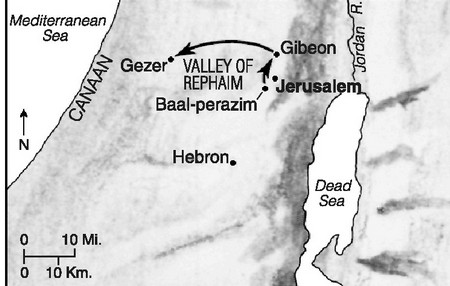
Meanwhile, back to David and the Philistines at Jerusalem, the Philistines came and spread themselves out in the Valley of Rephaim, which this map borrowed from Precept Austin shows to be just west of Jerusalem.


(2 Samuel 23:13) And three of the thirty chief went down and came to David in the harvest time to the cave of Adullam, and the troop of the Philistines pitched in the valley of Rephaim.

Three of David's chief men went to him in the cave of Adullam where he had apparently gone when the Philistines came and pitched in the Valley of Rephaim.

(14) And David was then in a hold, and the garrison of the Philistines was then in Bethlehem.

This map borrowed from BibleWalks shows in more detail the Valley of Rephaim in the upper right quadrant of the map with Jerusalem in the far right and Bethlehem about six miles south which is where the Philistines were then while David was in the cave of Adullam in the lower left quadrant of the map:


(15) And David longed, and said, "Oh that one would give me drink of the water of the well of Bethlehem which is by the gate."

David longingly said he wished he could have a drink of the water from the well of Bethlehem which is said to be about three-quarters of a mile to the north of Bethlehem, subsequently called David's well.

(16) And the three mighty men broke through the host of the Philistines and drew water out of the well of Bethlehem that was by the gate and took it and brought it to David. Nevertheless he would not drink of it but poured it out to the Lord.

The three mighty men took it upon themselves to break through the army of the Philistines to go to the well of Bethlehem and bring water back to David.  However, David did not drink it but poured it out before the Lord.

(17) And he said, "Be it far from me, O Lord, that I should do this. Is this not the blood of the men who went in jeopardy of their lives?" Therefore he would not drink it. These things did these three mighty men.

Evidently David had not expected anyone to actually go get him water from the well.  He had just meant to express that it would have been welcome at that time.  He felt he could not drink the water because it represented the blood of the men who had risked their lives just to bring him water.  This was one of the exploits of those three mighty men.  

(1 Chronicles 11:15) Now three of the thirty captains went down to the rock to David, into the cave of Adullam; and the host of the Philistines encamped in the valley of Rephaim. (16) And David was then in the hold, and the Philistines' garrison was then at Bethlehem. (17) And David longed, and said, "Oh that one would give me drink of the water of the well of Bethlehem, that is at the gate!" (18) And the three broke through the host of the Philistines, and drew water out of the well of Bethlehem, that was by the gate, and took it, and brought it to David, but David would not drink of it, but poured it out to the LORD, (19) And said, "My God forbid it me, that I should do this thing. Shall I drink the blood of these men who have put their lives in jeopardy? For with the jeopardy of their lives they brought it." Therefore he would not drink it. These things did these three mightiest.

1 Chronicles 11 told of the same incident, almost verbatim.

(2 Samuel 5:19) And David enquired of the Lord, saying, "Shall I go up to the Philistines? Will You deliver them into my hand?" And the Lord said to David, "Go up, for I will doubtless deliver the Philistines into your hand."

Then David asked the Lord if he should go out to the Philistines and if He would deliver them into his hands.  The Lord answered David that he should go forth for He would certainly deliver them into his hands.

(20) And David came to Baal Perazim, and David struck them there, and said, "The Lord has broken forth upon my enemies before me as the breach of waters." Therefore he called the name of that place Baal Perazim.

It seems the Philistines, at least some of them, had moved to a place later called Baal Perazim which was said to be in between Bethlehem and Jerusalem.  David struck them there, and said that the Lord had broken forth on the Philistines as floods or rivers of waters overflow a land and overturn all that stands in their way.  He called the place Baal Perazim which literally meant "possessor of breaches" or "lord of the breaks."

(21) And there they left their images, and David and his men burned them.

The Philistines had left their images, their false gods, which they had no doubt brought with them to protect and defend them and give them victory over the Israelites.  David and his men burned all their images.

(1 Chronicles 14:10) And David enquired of God, saying, "Shall I go up against the Philistines? And will You deliver them into my hand?" And the LORD said to him, "Go up, for I will deliver them into your hand." (11) So they came up to Baal Perazim; and David struck them there. Then David said, "God has broken in on my enemies by my hand like the breaking forth of waters." Therefore they called the name of that place Baal Perazim. (12) And when they had left their gods there, David gave a commandment, and they were burned with fire.

1 Chronicles 14 told of the same incident with only a little added detail that David commanded the pagan gods to be burned which they then were.

(2 Samuel 5:22) And the Philistines came up yet again and spread themselves in the valley of Rephaim.

More Philistines came forth and spread themselves in the valley of Rephaim.

(23) And when David enquired of the Lord, He said, "You shall not go up, but circle around behind them and come upon them over against the mulberry trees."

David wisely consulted his Lord before each of his advances, for the Lord told him this time not to go forth against the Philistines, but to encircle them from behind specifically in an area across from mulberry trees.

(24) "And let it be when you hear the sound of a going in the tops of the mulberry trees, then you shall stir yourself, for then shall the Lord go out before you to strike the host of the Philistines."

The Lord went on to instruct David that when he heard the rustling of the trees indicating the advancement of the Philistines, he was then to move toward the Philistines for the Lord would go out before him to strike them.  The Lord purposely used different methods to keep David dependent on Him.  If He struck His enemies the same way every time, David could become complacent and believe it was of himself that his enemies were overcome.

(25) And David did so as the Lord had commanded him and struck the Philistines from Gibeon until you come to Gezer.

David did as the Lord instructed and struck the Philistines all across the valley of Rephaim from Gibeon to Gezer, as seen on the first map above.

(1 Chronicles 14:13) And the Philistines yet again spread themselves abroad in the valley. (14) Therefore David enquired again of God, and God said to him, "Go not up after them; turn away from them, and come upon them over against the mulberry trees. (15) And it shall be, when you shall hear a sound of going in the tops of the mulberry trees, then you shall go out to battle, for God is gone forth before you to strike the host of the Philistines." (16) David therefore did as God commanded him, and they struck the host of the Philistines from Gibeon even to Gezer.

1 Chronicles 14 told of the same incident.

(17) And the fame of David went out into all lands, and the Lord brought the fear of him upon all nations.

Because of his exploits, David became famous throughout the surrounding lands, and the Lord caused the nations to fear him.

(1 Chronicles 13:1) And David consulted with the captains of thousands and hundreds, with every leader.

Then David consulted with all the captains of his troops of varying numbers.

(2) And David said to all the congregation of Israel, "If it seems good to you and of the Lord our God, let us send abroad to our brethren everywhere left in all the land of Israel and with them to the priests and Levites in their cities and suburbs, that they may gather themselves to us."

David spoke to the representatives of all the congregation of Israel and suggested that if it seemed good to them and was in accord with the will of God, they should send word to all their brethren left in Israel who had not yet come there and to all the priests and Levites, that they all might gather there to them.

(3) "And let us bring again the ark of our God to us for we did not enquire at it in the days of Saul.

David proposed that they should bring the ark of the Lord, that symbol of God's divine presence, to the royal city, for they had not enquired of it in the days of Saul, him being rather indifferent to it.

(4) And all the congregation said that they would do so, for the thing was right in the eyes of all the people.

All the congregation of Israel agreed that was what they should do as it seemed right to all of them.  One of David's first concerns as king was to restore religion which had been corrupted and neglected in the days of Saul.