Showing posts with label Machir. Show all posts

Saturday, May 17, 2025

Song of Deborah

Continuing a chronological Bible study:

(Judges 5:1) Then sang Deborah and Barak the son of Abinoam on that day, saying,

In the last chapter, Deborah and Barak had just defeated the king of Canaan and his army and its captain, Sisera, by the hand of the Lord who delivered their enemy to them.  Deborah wrote a song of praise that was sung by both her and Barak:

(2) "Praise you, the Lord, for the avenging of Israel, when the people willingly offered themselves."

Deborah began by praising the Lord for taking vengeance on Jabin king of Canaan, when, led by the Lord, the children of Israel willingly went to fight against their enemies for Israel.

(3) "Hear, O you kings! Give ear, O you princes! I, even I, will sing to the Lord; I will sing praise to the Lord God of Israel."

Deborah desired that all kings and princes hear her song of praise, that all might know the wonderful works of the Lord God of Israel.

(4) "Lord, when You went out of Seir, when You marched out of the field of Edom, the earth trembled, and the heavens dropped; the clouds also dropped water."

Seir and Edom are the same place, and Deborah here acknowledged that the Lord had led His people from there to their land in Canaan.  All the way, He struck dread in the hearts of their enemies with earthquakes and rain and hail storms.

(5) "The mountains melted from before the Lord, that Sinai from before the Lord God of Israel."

Even the mountains trembled and melted before the Lord, just as Mount Sinai had trembled and quaked at the presence of God on it.

(6) "In the days of Shamgar the son of Anath, in the days of Jael, the highways were unoccupied, and the travelers walked through byways."

Shamgar succeeded Ehud as judge, but did not appear to rule long or accomplish much (Judges 3:31), or at least not a perfect and complete deliverance of Israel.  But during his time and that of Jael, the wife of Heber (Judges 4:17), the highways were unoccupied by the Israelites because they were dangerous, occupied by their enemies who wished to do them harm.  They were forced to travel by less frequented paths.

(7) "The villages ceased; they ceased in Israel until that I, Deborah, arose, that I arose a mother in Israel."

Life in their villages as it once was ceased because the Israelites were so oppressed by their enemy.  That is, until Deborah rose up; being raised up by God, she was as a mother to the children of Israel, instructing, ruling, and protecting them.  

(8) "They chose new gods, then was war in the gates; was there a shield or spear seen among forty thousand in Israel?"

The children of Israel chose the false gods of the enemy, called new gods because they were new and previously unknown to them.  It's not as if they simply submitted to worshiping them when their enemy forced them, but it seems they willingly chose them.  There was war within the gates of their cities for they were completely taken over by their enemy.  Apparently, their enemy had totally disarmed the Israelites, as well.

(9) "My heart is toward the governors of Israel who offered themselves willingly among the people. Bless you the Lord!"

Deborah had a heart for the rulers of Israel who had offered themselves willingly to do the work of their Lord.  The original word "chaqaq" that was translated as "governors" came from a root that meant "engrave."  So she might have meant that she had a heart for the wise men and scribes who willingly taught the word of God and His commandments.  She blessed the Lord for giving those "governors" hearts to willingly engage in service to Him, whatever it might be.

(10) "Speak, you who ride on white donkeys, you who sit in judgment and walk by the way."

Deborah called for nobles and magistrates, or perhaps it was the wise men and scribes, who rode on white donkeys to speak out.  The original word that was translated as "judgment" was "mad," and it most often referred to garments or clothing.  I believe what is meant here is that Deborah called for the upper class of nobles and leaders, described as having white donkeys and fine raiment, who walked among the common people, to tell of God's great works.

(11) "From the noise of archers in the places of drawing water, there shall they rehearse the righteous acts of the Lord, the righteous acts of His villages in Israel; then shall the people of the Lord go down to the gates."

I'm not sure whether this means the places of drawing water were free from the noise of the archers who attacked the people, and there the nobles could celebrate the righteous acts of the Lord, or if even in spite of the noise of the attacks of their enemies, they were to celebrate the Lord.  "Celebrate" is a better translation of the original word "tanah" that was translated as "rehearse."  Most of the Biblical commentators I study see this as celebration after the Lord delivered them, but as the next verse calls on Deborah and Barak to rise up, I see this as happening before they were delivered.  Deborah had called on the nobles to speak out even in the people's oppression.  This they did, and the people cried out to the Lord (Judges 4:3).  Then they would be able to go in and out of the gates when the Lord delivered them.

(12) "Awake, awake, Deborah! Awake, awake, utter a song. Arise, Barak, and lead your captivity captive, you son of Abinoam."

Once again, I disagree with the commentators I study about the meaning of this verse.  They believe Deborah is stirring herself to more zeal and enthusiasm in her song after the Lord had delivered Israel.  Why then would the verse continue with raising up Barak against the enemy if that had already been done?  The commentators admit that there are some difficulties in the text of the song which probably lost something in translation.  However, I see this as Deborah relating the chronological order of things in her song.  She was called to rise up, and yes, she would eventually utter a song upon victory, but I believe it's also possible this was a call for her to prophesy when she was raised up.  Then she called on Barak to rise up and make those who held the children of Israel captive, themselves captive.

(13) "Then He made him who remained have dominion over the nobles among the people; the Lord made me have dominion over the mighty."

Then the Lord made those who remained of the Israelites after the oppression of the Canaanites to have dominion over the nobles and officers of the enemy among them.  The Lord had raised up Deborah to have dominion over their mighty enemy.

(14) "Out of Ephraim a root of them against Amalek; after you, Benjamin, among your people; out of Machir came down governors, and out of Zebulun they who handle the pen of the writer."

Out of the tribe of Ephraim, of which Deborah was a member, came the root and foundation of the campaign against the Amalekites, chief enemies of Israel among the Canaanites.  Then the tribe of Benjamin joined forces with the tribe of Ephraim against their enemy.  Machir, the son of Manasseh, represented his tribe on the west of the Jordan, and they sent leaders, probably meaning military leaders, to aid in the campaign against the Canaanites.  Even the tribe of Zebulun where normally clerks and scribes and those mighty with the pen dwelled, sent troops to aid Barak in his campaign against Jabin king of Canaan.

(15) "And the princes of Issachar were with Deborah, even Issachar, and also Barak, he was sent on foot into the valley. For the divisions of Reuben, great thoughts of heart."

The leaders of Issachar, as well as Issachar in general, were with Deborah in her campaign.  Barak of the tribe of Naphtali, which I believe means to include the whole tribe of Naphtali, were an integral part of the campaign, and they were sent forth into the valley of the river of Kishon where the Lord would draw Sisera of King Jabin's army to them (Judges 4:7).  Among the clans of Reuben, it appears there were many conflicting thoughts about the campaign, and they did not join their brothers on the western side of the Jordan against Sisera.

(16) "Why did you abide among the sheepfolds to hear the bleating of the flocks? For the divisions of Reuben, great searchings of heart."

Deborah chided the tribe of Reuben, asking why they would sit there with their flocks of sheep and not go to help their brethren.  Again, she mentions the great searchings of heart.  Either she was disappointed that they couldn't agree to accompany her, or perhaps she and Barak and the other tribes with them were the ones having to search their hearts for what they felt about their brethren who would not help them.

(17) "Gilead abode beyond Jordan, and why did Dan remain in ships? Asher continued on the seashore and abode in his breaches."

The land of Gilead belonged to Gad and the half tribe of Manasseh on the east side of the Jordan River.  Deborah was proclaiming that those tribes stayed put and did not join the campaign.  Neither did the tribes of Dan or Asher.  The tribe of Dan continued in its work in ships on the Mediterranean Sea, as did Asher tend to its business on the shore of the sea.  They abode in their breaks in the shore and ignored their brothers fighting against Canaan.

(18) "Zebulun and Naphtali, a people who jeopardized their lives to the death in the high places of the field."

Deborah commended the tribes of Zebulun and Naphtali who were the chief fighters in the war against Sisera, the 10,000 soldiers initially called by Deborah and Barak (Judges 4:6).  They jeopardized their lives in the height of battle in the battlefield while some of their brethren dwelt in safety within their tribes.

(19) "The kings came and fought, then fought the kings of Canaan in Taanach by the waters of Megiddo; they took no gain of money."

I believe both mentions of the kings refer to the kings of Canaan who came from diverse places within Canaan to fight Israel in Taanach not far from the Kishon River.  They were unable to win any spoils; they lost it all.

(20) "They fought from heaven; the stars in their courses fought against Sisera."

The Lord fought for Israel from heaven when what Deborah described as the stars themselves fought against Sisera.  I believe this lends credence to Josephus's assertion that Sisera's army was hit with rain and hail from heaven (see Judges 4:15).

(21) "The river of Kishon swept them away, that ancient river, the river Kishon. O my soul, you have trodden down strength."

The Kishon River may have swept away some dead bodies of the enemy, but I rather think this was a somewhat poetic way of saying that the enemy was conquered there because that is where the Lord drew them for battle (Judges 4:7).  An ancient river, although not a necessarily great one, that is where a strong and mighty army was totally trodden down and crushed.

(22) "Then were horse hooves broken by the means of the galloping, the galloping of their mighty ones."

The enemy's horses' hooves were broken because of their violent galloping, the violent galloping of their strong and mighty horses.  Or perhaps the second part meant they were broken because of the violent galloping through the rain and hail, driven hard by their mighty soldiers.

(23) "'Curse you, Meroz,' said the angel of the Lord, 'Curse you bitterly its inhabitants because they did not come to the help of the Lord against the mighty.'"

Meroz was apparently a city close to where they fought, but none of the Bible commentators I study know where exactly it was.  John Wesley, in his Notes on the Bible, suggested that it may have been part of the curse that there should be no remembrance of it left.  The angel of the Lord called it to be cursed, which was either Deborah's way of describing what the Spirit of the Lord had said to her, or perhaps Barak was called the angel of the Lord because he had been called by Him to deliver His people.  Meroz was cursed because they did not come to the aid of God's people against Sisera even though they had surely been called by the Lord.

(24) "Blessed above women shall Jael the wife of Heber the Kenite be, blessed shall she be above women in the tents."

However, Jael was blessed because she had helped Israel, even though she had not been initially called.  She was blessed above women in tents, women whose jobs were to take care of their homes, not to be as soldiers.

(25) "He asked water, she gave milk; she brought forth butter in a lordly dish."

Sisera had asked Jael for water, and she gave him milk.  It seems it was a very rich milk, cream, that she brought to him in a nice dish, rather than just a drink of water from a ladle or simple cup.  It was probably just meant to be a kind act on her part, but as God was about to direct her to do otherwise, the rich milk probably helped to make him sleepy.

(26) "She put her hand to the nail, and her right hand to the workmen's hammer, and with the hammer she struck Sisera; she smote off his head when she had pierced and stricken through his temples."

Jael had taken a tent spike and a hammer and struck the spike into Sisera's temple which went through and out the other temple, pinning him to the floor.  In that way she crushed his head, which is actually a better translation of the original word "machaq" which was translated as "smote off" by the King James translators.

(27) "At her feet he bowed, he fell, he lay down; at her feet he bowed, he fell; where he bowed, there he fell down dead."

After Jael had struck him, it was as if Sisera bowed before her feet.  Bible commentators struggled to explain how he must had stood up to bow down and fall.  However, again, I think Deborah is just being poetic in song.  Jael could not have stricken Sisera through the temples and pinned him to the floor (Judges 4:21) unless he was lying down.  Sisera fell dead at Jael's feet.

(28) "The mother of Sisera looked out at a window and cried through the lattice, 'Why is his chariot long in coming? Why do the wheels of his chariots tarry?'"

Deborah imagined Sisera's mother looking out a window and crying through the lattice that covered it, wondering why Sisera was so long in returning.  She wondered why she did not hear the clatter of the wheels of his nine hundred chariots returning.

(29) "Her wise ladies answered her, 'Yes,' she returned answer to herself, (30) 'Have they not sped, have they divided the prey, to every man a damsel or two, to Sisera a prey of diverse colors, a prey of diverse colors of needlework, of diverse colors of needlework on both sides for the necks of the spoilers?'"

Deborah imagined that Sisera's mother's wise maidens or women attending her would answer, and she answered herself that yes, Sisera and his army had surely sped through to victory and were still dividing the spoils.  The soldiers were probably taking the women, and Sisera was taking fine, beautiful, and colorful linens and garments either to be worn on his neck, but probably more likely to be carried on the necks or backs of the soldiers.

(31) "So let all of Your enemies perish, O Lord, but those who love Him as the sun when it goes forth in its might." And the land had rest for forty years.

Deborah ended her song with her desire that all the Lord's enemies perish as Sisera and his army had.  And she wished that all those who loved the Lord be as the sun at its brightest and hottest, with intense love and as a bright light to the world.  And then the land had rest from their enemies for forty years.

Monday, March 3, 2025

The Inheritance of Manasseh West of the Jordan

Continuing a chronological Bible study:

The past few and future chapters of Joshua described the lots of inheritance that fell to the twelve tribes of Israel.  This same map from iBiblemaps.com shows the general division of the tribes:


(Joshua 17:1) There was also a lot for the tribe of Manasseh for he, the firstborn of Joseph, for Machir the firstborn of Manasseh, the father of Gilead; because he was a man of war, therefore he had Gilead and Bashan. 

The last chapter spoke of the lots that fell to the children of Joseph but only described the one that fell to Ephraim.  This chapter described the lot that went to the other son of Joseph, Manasseh, half already having been given on the east of the Jordan River.  The lot of Manasseh described in verse 1 was allotted to Machir the son of Manasseh and through his son Gilead.  It seems Machir was known as a man of war.  I suppose the sense was that because he was a valiant warrior, he had been given the land on the east of the Jordan that he or his descendants had conquered (Bashan, the kingdom of Og), and he received part of Gilead, and he was also to be given a portion on the west of the Jordan.

(2) There was also a lot for the rest of the children of Manasseh by their families, for the children of Abiezer, and for the children of Helek, and for the children of Asriel, and for the children of Shechem, and for the children of Hepher, and for the children of Shemida; these were the male children of Manasseh the son of Joseph by their families.

There was also a lot given to the other half of the tribe of Manasseh on the west side of the Jordan River.  It was said to be for the children of Abiezer, also called Jeezer (Numbers 26:30), a son of Gilead who was the son of Machir.  It was also for the children of the other sons of Gilead, Helek, Asriel, Shechem, Hepher, and Shemida (Numbers 26:30-32).  These were the male children or descendants of Manasseh.

(3) But Zelophehad, the son of Hepher, the son of Gilead, the son of Machir, the son of Manasseh, had no sons, but daughters, and these are the names of his daughters, Mahlah, and Noah, Hoglah, Milcah, and Tirzah.

Normally only the males inherited, but Zelophehad, the son of Hepher, had no sons, only daughters, Mahlah, Noah, Hoglah, Milcah, and Tirzah.  His daughters had requested and were granted their father's inheritance (Numbers 27:7).

(4) And they came near before Eleazar the priest and before Joshua the son of Nun and before the princes, saying, "The Lord commanded Moses to give us an inheritance among our brethren." Therefore, according to the commandment of the Lord, he gave them an inheritance among the brethren of their father.

Indeed, the daughters of Zelophehad, the son of Hepher, came before the priest, and Joshua, and the ten princes who were appointed along with Eleazar and Joshua to divide the land (Numbers 34:17), and claimed their inheritance according to the commandment of the Lord to Moses (Numbers 27:7), and it was given to them.

(5) And there fell ten portions to Manasseh, besides the land of Gilead and Bashan on the other side of the Jordan, (6) Because the daughters of Manasseh had an inheritance among his sons, and the rest of Manasseh's sons had the land of Gilead.

The lot on the west side of the Jordan that fell to the half tribe of Manasseh was divided into ten portions, for the five sons of Gilead who had male descendants and for the five daughters of Zelophehad, the son of Hepher.  Apparently, Hepher had only the one son, Zelophehad, who had only daughters, so there were no males among Hepher's descendants to receive an inheritance.  The rest of Manasseh's sons, the sons of Machir, had the land of Gilead and Bashan on the east side of the Jordan.

(7) And the coast of Manasseh was from Asher to Michmethah that lies before Shechem, and the border went along on the right hand to the inhabitants of En Tappuah.  

The boundary of West Manasseh went from the border of Asher in the northwest corner to Michmethah in the south.  Or perhaps there was a city of Asher, not the tribe of Asher, in the southwest corner of West Manasseh that went across to Michmethah, which was said to be before Shechem, to En Tappuah.  The map at the beginning of this post shows the tribe of Asher in relation to West Manasseh, and this map borrowed from Precept Austin shows the southern cities of Michmethah and Shechem.


(8) Manasseh had the land of Tappuah, but Tappuah on the border of Manasseh belonged to the children of Ephraim.

West Manasseh had the territory of Tappuah, but Ephraim had the city of Tappuah, one of those cities within West Manasseh that were given to Ephraim, according to Joshua 16:9.

(9) And the coast descended to the river Kanah, southward of the river; these cities of Ephraim are among the cities of Manasseh; the coast of Manasseh also was on the north side of the river, and the outgoings of it were at the sea.

I believe the meaning is that from the city of Tappuah that belonged to the children of Ephraim, the border continued west along the Kanah River and eventually reached the Mediterranean Sea.  The cities southward of the river were among the cities in West Manasseh that belonged to Ephraim.  North of the river belonged to Manasseh.

(10) Southward was Ephraim's and northward Manasseh's, and the sea is its border, and they met together in Asher on the north and in Issachar on the east.

The land south of the river belonged to Ephraim and north of it was Manasseh's, and the Mediterranean Sea was West Manasseh's western border.  The western border met the northern border at the border of Asher's lot and went eastward to Issachar's in the northeast.

(11) And Manasseh had in Issachar and in Asher Beth Shean and her towns and Ibleam and her towns and the inhabitants of Dor and her towns and the inhabitants of En Dor and her towns and the inhabitants of Taanach and her towns and the inhabitants of Megiddo and her towns, three countries.

As Ephraim had cities within the tribe of Manasseh, it seems that Manasseh had cities within Asher and Issachar.  It seems to me that everyone's borders should have been pushed northward a little, but I imagine that the lots were determined before they knew who would get which lot, and as some tribes were much larger than others and required more land than perhaps had been allotted to them, adjustments were made to accommodate them.  The cities of Beth Shean, Ibleam, Dor, Taanach, and Megiddo all appear to be completely within West Manasseh in the map above, so perhaps the border was adjusted from what was previously intended to be Asher's and Issachar's lots.  I believe the sense of the three countries is that all these cities were in three regions in the north that became part of West Manasseh, perhaps the northwest region around Dor from Asher, the north central region around Megiddo and other cities in the north central from Issachar, and the northeast region around Beth Shean, also from Issachar.

(12) Yet the children of Manasseh could not drive out those cities, but the Canaanites would dwell in that land.

The tribe of Manasseh did not entirely drive out the Canaanites from those cities, so those Canaanites continued to dwell in the land.

(13) Yet it came to pass, when the children of Israel grew strong, that they put the Canaanites to tribute, but did not utterly drive them out.

When the Israelites grew stronger, perhaps meaning they grew greater in number, they made the Canaanites pay tribute to them and allowed them to stay.  It seems that if they were strong enough to force them to pay tribute, they would have been strong enough to drive them out as God had commanded they do, but they didn't, perhaps for some selfish gain.

(14) And the children of Joseph spoke to Joshua, saying, "Why have you given me one lot and one portion to inherit, seeing I am a great people, for as much as the Lord has blessed me till now?"

The children of Joseph were Ephraim and Manasseh.  It seems they thought they should have more than one lot each seeing that they were a great people, most likely meaning great in number as the Lord had blessed them up to that point, but perhaps they also looked forward to the future as Jacob had blessed them, his grandsons, as his sons (Genesis 48:19), and said they would be great, especially Ephraim whose descendants would become a multitude of nations.  

(15) And Joshua answered them, "If you are a great people, get up to the forest and cut down for yourself there in the land of the Perizzites and of the giants, if mount Ephraim is too narrow for you."

However, Joshua said that if they were indeed a great people, then they should get themselves into the wood country and clear more land for them in the land of the Perizzites and the Rephaim, the giants, if what they now occupied was too small for them.  This map borrowed from Big Springs Community Church clearly shows much land west of Megiddo, Beth Shean, and Shechem, that they did not occupy: 


(16) And the children of Joseph said, "The hill is not enough for us, and all the Canaanites that dwell in the land of the valley have chariots of iron, they of Beth Shean and her towns and they of the valley of Jezreel."

The children of Joseph said that that hill country was not enough for them, and all the Canaanites that dwelt in Beth Shean and all the valley of Jezreel were too much for them.  Most all the commentaries I study suggest that chariots of iron did not mean they were made of iron, but rather they were armed with scythes and dangerous.  This response of the children of Joseph hearkens back to the time the first spies came back with the report that the Canaanites were giants and too strong for them, and they were punished for having no faith in God to give them the land as He had said.

(17) And Joshua spoke to the house of Joseph, to Ephraim and to Manasseh, saying, "You are a great people and have great power; you shall not have one lot, (18) But the mountain shall be yours, for it is a wood and you shall cut it down, and the outgoings of it shall be yours, for you shall drive out the Canaanites, though they have chariots, though they be strong."

I have to hand it to Joshua; even though he was from the tribe of Ephraim, he did not back down and give in to give them more land.  I also can't help but think of Jacob who loved Joseph so much and made his sons his own.  He might have been disappointed to learn that they were acting so weak and faithless.  Joshua told Ephraim and the half tribe of Manasseh that they were indeed a great and powerful people, and they would not have only the one lot they occupied, but they would have almost twice as much land if they went in and cut down the woods and even the outgoings of that region to the Mediterranean Sea would be theirs because they would drive out the Canaanites, even though they were strong.  After all, their Lord was stronger and had promised them all that territory.

There is a great lesson in this.  God never promised us a rose garden.  He said we will be saved, and we will overcome, but we will be persecuted.  Life will be hard; we lost the Garden of Eden long ago.  God will make a way if we rely on Him, but we must have that whole armor of God, truth, righteousness, the gospel of peace, faith, salvation, and the word of God (Ephesians 6:13-17), and we must endure till the end (Matthew 24:13).  But be of good courage, Paul told us in 1 Corinthians 3:15, that even in weaknesses, such as slothfulness, which might be said of the children of Joseph at this point, we will suffer loss but we ourselves will still be saved as one barely escaping a fire.  However, God desires the best for us, and if we will trust in Him to lead us, we can live that best life.

Sunday, February 2, 2025

The Inheritance East of the Jordan River

Continuing a chronological Bible study:

(Joshua 13:1) Now Joshua was old, stricken in years, and the Lord said to him, "You are old, stricken in years, and there remains yet very much land to be possessed."

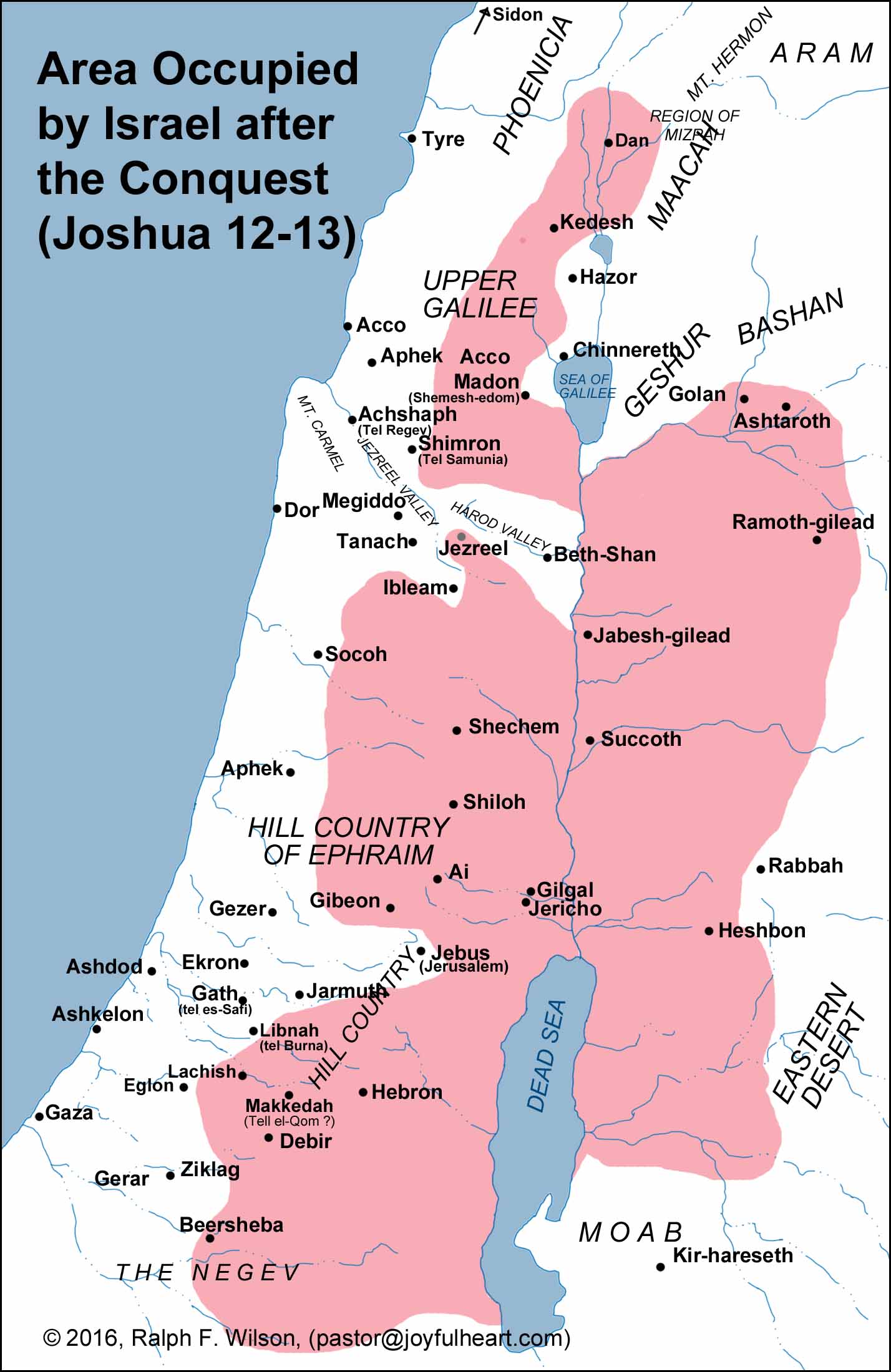
Joshua and the Israelite army had conquered thirty-one kings and territories in the past seven years.  But Joshua was getting old, commentators think about a hundred years old.  It's amazing to think that a man in his nineties could have done what he had done in the past seven years!  But there was still much land to be conquered all around on the outskirts of the conquered area.  This map I found on Pinterest said to have come from jesuswalk.com clearly shows the conquered lands in relation to the whole:


I find it interesting to note that although Joshua had defeated their kings as noted in the last chapter, some of their territories remained outside of Israelite occupation (Gezer, Aphek, Dor, Megiddo, etc.).  It seems reasonable to assume that Joshua may have continued to try to conquer the rest of the lands, but God stopped him because of his advanced age.  Adam Clarke, in his Commentary on the Bible, had an interesting perspective.  As nothing God does is by accident, he suggested that God may have wanted some of the original inhabitants to remain in order to keep the oftentimes unfaithful Israel in check.  

(2) "This is the land that yet remains, all the borders of the Philistines, and all Geshuri,"

The Lord then detailed the lands that were still unconquered, undoubtedly so that Joshua and the Israelites would know what they had a right to claim.  There was the territory of the Philistines in the southwest of Canaan along the Mediterranean Sea, to Geshuri, which appears to be Geshur in the north.  This map borrowed from Big Springs Community Church shows the unconquered lands more clearly than the one above:


(3) "From Sihor before Egypt to the borders of Ekron northward, counted to the Canaanite, five lords of the Philistines, the Gazites, the Ashdodites, the Ashkelonites, the Gittites, and the Ekronites, also the Avites;"

God described in more detail the as of yet unconquered territories of the promised land.  Describing the land of the Philistines, He said it ranged from Sihor before Egypt in the south to Ekron in the north which can be seen in the first map, across from Jerusalem.  The land of Philistia was counted as belonging to the posterity of Canaan, but the Philistines had gotten possession of it.  Because it was counted as Canaanite land, it was part of the promised land.  There were five lords in Philistia rather than kings, and it contained the cities of Gaza, Ashdod, Ashkelon, Ekron, and their inhabitants, and to whatever cities the Gittites and Avites belonged.

(4) "From the south, all the land of the Canaanites and Mearah beside the Sidonians, to Aphek to the borders of the Amorites;"

As near as I can tell by these maps, God is describing all the land of the Canaanites that was not part of the Philistines, from the south upward to Aphek (note there are two Apheks, one in Upper Galilee) to Sidon.

(5) "And the land of the Gebalites, and all Lebanon, toward the sunrising, from Baal Gad under Mount Hermon to the entering into Hamath;"

Gebal was north of Sidon on the Mediterranean coast.  The land of the Gebalites was said to be that east of Tyre, Sidon, and Gebal, the land east of the Lebanon mountains in the north, from Mount Hermon to the entrance of Hamath, seen clearly in this map borrowed from The Biblical Zionist:


(6) "All the inhabitants of the hill country from Lebanon to Misrephoth Maim, all the Sidonians, them I will drive out from before the children of Israel; only divide it by lot to the Israelites for an inheritance as I have commanded you."

The Lord continued to describe the land that was yet unconquered that also included all the hill country from Lebanon to Misrephoth Maim which was south of Tyre, all the land of the Sidonians.  All that very much land yet to be possessed (v. 1) included all the lands described from verse 2 to the Sidonians in verse 6.  All those the Lord would drive out from before the children of Israel.  Even though they were not yet driven out, the Lord wanted Joshua to divide all the promised land by lot to the Israelites for their inheritance.  Most of the early commentators I study suggest that these people were not ever entirely driven out or their land completely possessed by the Israelites, that the promise was always part of a covenant that must be upheld by the Israelites, and they did not do their part.  However, I refer back to Exodus 23:30-31, when the Lord said:

"Little by little I will drive them out from before you, until you have increased, and you inherit the land. And I will set your bounds from the Red Sea to the sea of the Philistines, and from the desert to the river; for I will deliver the inhabitants of the land into your hand, and you shall drive them out before you."

God specifically said that it would be little by little, and indeed all the land was subdued under the reign of David.  Some say that still the people were not specifically driven out, only subdued.  However, throughout ancient and modern history, Israel's borders have changed, and indeed the future Millennial Israel will include all of the promised land.

(7) "Now therefore divide this land for an inheritance to the nine tribes and the half tribe of Manasseh," (8) With whom the Reubenites and the Gadites have received their inheritance which Moses gave them beyond Jordan eastward, as Moses the servant of the Lord gave them,

The Lord told Joshua to divide the land on their present side of the Jordan River for an inheritance to the nine and a half tribes that had not yet received their inheritance.  Reuben, Gad, and the other half tribe of Manasseh had already received their lots on the east side of the Jordan River, given them by Moses.

(9) From Aroer which is on the bank of the River Arnon, and the city that is in the midst of the river, and all the plain of Medeba to Dibon, (10) And all the cities of Sihon king of the Amorites who reigned in Heshbon, to the border of the children of Ammon;

Further describing the lands given to Reuben, Gad, and the half tribe of Manasseh, it was from Aroer in the middle of the Arnon River that separated the land of the Amorites from Moab, and all the plain and cities of Sihon king of the Amorites to the Jabbok River which was the border of the Ammonites.

(11) And Gilead, and the border of the Geshurites and Maachathites, and all Mount Hermon, and all Bashan to Salcah, (12) All the kingdom of Og in Bashan who reigned in Ashtaroth and in Edrei, who remained of the remnant of the giants; for these did Moses smite and cast them out.

They had also received all the kingdom of Og, which included Gilead, the border of the Geshurites and Maachathites, all Mount Hermon, and all Bashan to Salcah.  All that land of Og that had been taken by Moses had been given to Israel, but they had not taken possession of much of it.

(13) Nevertheless, the children of Israel did not expel the Geshurites, nor the Maachathites, but the Geshurites and the Maachathites dwell among the Israelites until this day.

Indeed, Joshua went on to write that the Israelites had not driven out the Geshurites and Maachathites, and they still dwelt with them at the time of his writing.

(14) Only to the tribe of Levi He gave no inheritance; the sacrifices of the Lord God of Israel made by fire are their inheritance, as He said to them.

The tribe of Levi received no land inheritance on either side of the Jordan River.  As they were God's priests, He was to be their inheritance; they were to live off the sacrifices to their Lord God (Deuteronomy 18:1).

(15) And Moses gave to the tribe of the children of Reuben according to their families. (16) And their coast was from Aroer which is on the bank of the river Arnon, the city in the midst of the river, and all the plain by Medeba;

Moses had given to the tribe of Reuben the land from Aroer in the southeast and all the plain of Medeba.

(17) Heshbon, and all her cities in the plain, Dibon, and Bamoth Baal, and Beth Baal Meon, (18) And Jahazah, and Kedemoth, and Mephaath, (19) And Kirjathaim, and Sibmah, and Zereth Shahar in the mount of the valley, (20) And Beth Peor, and Ashdoth Pisgah, and Beth Jeshimoth, (21) And all the cities of the plain, and all the kingdom of Sihon king of the Amorites, who reigned in Heshbon, whom Moses smote with the princes of Midian, Evi, and Rekem, and Zur, and Hur, and Reba, dukes of Sihon dwelling in the country.

Reuben's inheritance included all these cities in the former kingdom of Sihon.  It had been taken by Moses when he defeated the king of Sihon and all his princes.  I can't begin to try to locate all these cities, but I found this map at Psalms to God Podcast that shows a general view of all the tribes and their allotments:


(22) Balaam also, the son of Beor, the soothsayer, the children of Israel killed with the sword, among those who were killed by them. 

The Israelites had also killed Balaam, the soothsayer, at the same time as the princes (Numbers 31:8).

(23) And the border of the children of Reuben was Jordan and its border. This was the inheritance of the children of Reuben after their families, the cities and the villages.

The northwestern border of the land possessed by the descendants of Reuben was the Jordan River.  All the land, cities, and villages between the Jordan and Aroer in the southeast made up the inheritance of the children of Reuben.

(24) And Moses gave to the tribe of Gad, to the children of Gad according to their families. (25) And their coast was Jazer and all the cities of Gilead, and half the land of the children of Ammon, to Aroer before Rabbah; (26) And from Heshbon to Ramath Mizpah and Betonim, and from Mahanaim to the border of Debir; (27) And in the valley Beth Haram, and Beth Nimrah, and Succoth, and Zaphon, the rest of the kingdom of Sihon king of Heshbon, with the Jordan as border to the edge of the Sea of Chinnereth on the other side of the Jordan eastward. (28) This is the inheritance of the children of Gad after their families, the cities and their villages.

Moses gave as an inheritance to the children of Gad the land from Jazer in the south to Rabbah in the west, with the Jordan River as the western border.  The northern border was quite unique, and I will let the map show the general area that was allotted to Gad.  Once again trying to locate all those cities is quite a dizzying task.  The Aroer before Rabbah would have to be a different Aroer from the one at the middle of the Arnon River.  Also Debir would have to be a different Debir.  All the cities of Gilead would only pertain to those cities within the area of Gad, as half of Gilead was given to the half tribe of Manasseh.  The same would have to be said for all the kingdom of Sihon that was given to Reuben (v. 21), as it states here that there was the rest of the kingdom of Sihon that was given to Gad.  Half the land of the children of Ammon refers to that part that Sihon king of the Amorites took from the Ammonites.

(29) And Moses gave to the half tribe of Manasseh, and this was of the half tribe of the children of Manasseh by their families. (30) And their coast was from Mahanaim, all Bashan, all the kingdom of Og king of Bashan, and all the towns of Jair, which are in Bashan, sixty cities; (31) And half Gilead, and Ashtaroth, and Edrei, cities of the kingdom of Og in Bashan, to the children of Machir the son of Manasseh, to the one half of the children of Machir by their families.

To the half tribe of Manasseh, the land from Mahanaim, which must have been the southern border as Gad also had that border (v. 26), including all the land of Bashan that included sixty cities, half of Gilead, and the royal cities of Og, Ashtaroth and Edrei.  The land is said to have been given to half the children of Machir, who was Manasseh's son.

(32) These are what Moses had distributed for inheritance in the plains of Moab on the other side of the Jordan by Jericho eastward.

The lands described above from verse 9 to this verse were all the lands that had been distributed by Moses to the tribes of Reuben, Gad, and the half tribe of Manasseh, on the eastern side of the Jordan River, east of Jericho.

(33) But to the tribe of Levi Moses did not give inheritance; the Lord God of Israel was their inheritance, as He said to them.

Once again, Joshua points out that the tribe of Levi did not receive any land as their inheritance, because as priests, the Lord God was their inheritance.

As Joshua was now old, God had him rest from his battles, even though there was still much land to be conquered.  However, for now, He wanted Joshua to portion out the lots of inheritance, and it was to include all the land that had been promised, even those not yet conquered.  This chapter began with the allotments that had already been given to the tribes of Reuben, Gad, and the half tribe of Manasseh. 

Wednesday, March 18, 2020

Review of Conquest of Og and Distribution of the Conquered Land

Continuing a chronological Bible study:

(Deuteronomy 3:1) “Then we turned and went up the way to Bashan; and Og the king of Bashan came out against us, he and all his people, to battle at Edrei."

In the past couple of chapters and posts, Moses has been relating the history of the Israelites in the wilderness that had brought them to this point.  At the end of the last chapter he had spoken about how they had conquered Sihon.  Now he began the retelling of the events leading to the conquest of Og.  They turned from the kingdom of Sihon and went toward Bashan.  Og the king of Bashan and all his people came out against the Israelites to battle at Edrei, a city in his kingdom.  Following is a map of the kingdoms of Sihon and Og found here in Wikipedia:


(2) “And the LORD said to me, ‘Do not fear him, for I will deliver him, and all his people, and his land, into your hand; and you shall do to him as you did to Sihon king of the Amorites, who dwelt at Heshbon.’"

The Lord told Moses at the time not to fear Og who had come out against Israel, for He would deliver Og, his people, and his land into the hands of the children of Israel.  The Israelites would defeat Og just as they had defeated Sihon king of the Amorites.

(3) “So the LORD our God also delivered into our hands Og king of Bashan, and all his people, and we struck him until none was left remaining to him."

The Lord indeed delivered Og and all his people into their hands.  The Israelites killed them all so that none remained alive; see Numbers 21:35.

(4) “And we took all his cities at that time; there was not a city which we did not take from them, sixty cities, all the region of Argob, the kingdom of Og in Bashan."

The Israelites took all the cities in the kingdom of Og, sixty cities in all, all the region of Argob, which was a district in Bashan; there was not a single city that they did not seize from Og.

(5) “All these cities were fenced with high walls, gates, and bars, besides a great many unwalled towns."

All the cities of Bashan that the Israelites took were cities well fortified with high walls, gates, and bars.  These were besides the small towns and villages in the land.

(6) “And we utterly destroyed them, as we did to Sihon king of Heshbon, utterly destroying the men, women, and children of every city."

Moses related that the children of Israel had utterly destroyed Og and his people, just as they had destroyed Sihon, utterly destroying all the men, women, and children, of every city.

(7) "But all the cattle, and the spoil of the cities, we took for a prey to ourselves."

However, they did not destroy the livestock, but kept them for themselves, as well as the spoil of the cities.

(8) “And at that time we took the land from the hand of the two kings of the Amorites who were on this side of the Jordan, from the river of Arnon to Mount Hermon, (9) (Which Hermon the Sidonians call Sirion; and the Amorites call it Shenir); (10) All the cities of the plain, all Gilead, and all Bashan, to Salchah and Edrei, cities of the kingdom of Og in Bashan."

Moses related that at that time they had taken the land from two kings of the Amorites, Sihon and Og, that were on their current side of the Jordan River, from the Arnon River, the southern border of the land of Sihon, to Mount Hermon in the north.  Verse 9 is a parenthetical statement that tells that Hermon was also called Sirion by the Sidonians, and called Shenir by the Amorites.  They took all the cities in the plain, the cities surrounding Mount Gilead, and all of Bashan, to Salchah in the east, and Edrei and beyond, as seen in the map above.

(11) “For only Og king of Bashan remained of the remnant of giants; behold, his bedstead was a bedstead of iron; is it not in Rabbath of the children of Ammon? Nine cubits was its length and four cubits its breadth, after the standard cubit of a man."

A sort of parenthetical statement is made about Og.  He had been the last of the giants that were mentioned in the previous chapter, the Emim and Zamzummim, who had once possessed the land of the Moabites and Ammonites.  In explanation of how big he was, Moses remarked he had an iron bed, apparently needed to hold his massive frame.  It was in Rabbath, in Ammonite territory, apparently carried there either to save it or perhaps as a trophy.  It was 13.5 feet long and six feet wide, according to the standard cubit of a man; apparently a "king's cubit" was longer.

(12) “And this land, which we possessed at that time, from Aroer, which is by the River Arnon, and half the mountains of Gilead and its cities, I gave to the Reubenites and the Gadites."

The land that the Israelites took possession of at that time extended from Aroer by the Arnon River on the border of Moab, land taken from Sihon, to Mount Gilead and its cities which were taken from Og.  Moses gave the land taken from Sihon and half the mountain and cities of Gilead to the Reubenites and the Gadites, per their request in Numbers 32.

(13) "And the rest of Gilead, and all Bashan, the kingdom of Og, I gave to half the tribe of Manasseh, all the region of Argob, with all Bashan, which was called the land of giants."

The other half of Mount Gilead with its cities, which included all the region of Argob (v. 4), with all Bashan, which had been called the land of giants (Og apparently being the last), Moses gave to the half tribe of Manasseh.  Below is a map found at FreeBibleImages.org, specifically at http://www.freebibleimages.org/illustrations/joshua-altar/, that shows the land of the Reubenites, Gadites, and the half tribe of Manasseh, east of the Jordan River:


(14) “Jair the son of Manasseh took all the country of Argob to the coasts of Geshuri and Maachathi; and called them after his own name, Bashan Havoth Jair, to this day."

Jair, the son of Manasseh, took all the country of Argob to the coasts of Geshur and Maachah, shown in the first map above.  He called it Bashan Havoth Jair, which literally meant "Bashan, villages of Jair".  At first I wondered which map was imprecise, as the western border of Jair's land in the map immediately above doesn't exactly match the territory of Og in the first map.  Then I read that the exact position of Maachah and of Geshur cannot be ascertained.

(15) "And I gave Gilead to Machir."

Moses gave Gilead to Machir, another son of Manasseh, or perhaps more precisely to the Machirites, his descendants.  This map which I cut from a larger map found here at BibleQ, shows Gilead to be the southern portion of the half tribe Manasseh that settled on the eastern side of the Jordan.


(16) “And to the Reubenites and the Gadites I gave from Gilead to the river Arnon half the valley, and the border to the river Jabbok, which is the border of the children of Ammon; (17) The plain also, and Jordan, and its coast, from Chinnereth even to the sea of the plain, even the salt sea, under Ashdoth Pisgah eastward."

To the tribes of Reuben and Gad Moses stated he gave land from Gilead to half the valley of the Arnon River.  The original word "nachlah" translated as "valley" usually more often means "stream or river" or the like.  A valley is the middle of a river, but in this case, most Biblical scholars agree that the middle (or half) meant in the length of the river.  Their land extended from the Arnon River (half of it) northward to the Jabbok River which bordered the Ammonites.  This area is better illustrated on the map earlier that showed the kingdoms of Sihon and Og.  All the plain and the coastland along the Jordan River from Chinnereth to the Salt Sea (or Dead Sea) was included.  Ashdoth Pisgah actually translates "slopes" or "springs" of Pisgah.  Their land went eastward from the Jordan and Salt Sea to the eastern slopes and springs of Mount Pisgah.  This portion of a map shows Mount Pisgah in relation to Heshbon and Nebo seen on the map above this one:


(18) "And I commanded you at that time, saying, ‘The LORD your God has given you this land to possess; you shall pass over armed before your brethren the children of Israel, all who are meet for the war.'"

Part of the agreement that Moses made with the tribes of Reuben and Gad for the land they requested east of the Jordan, was that they would pass over the Jordan with the rest of the tribes, all who were able being armed to assist them in the conquest of Canaan (Numbers 32:29).

(19) "‘But your wives, your little ones, and your cattle, (for I know that you have much cattle,) shall abide in your cities which I have given you, (20) Until the LORD has given rest to your brethren, as well as to you, and until they also possess the land which the LORD your God has given them beyond Jordan; and then shall you return every man to his possession, which I have given you.'"

When the tribes east of the Jordan went over to fight with their brothers to gain possession of the promised land west of the Jordan, they were to leave their wives and children and livestock in the cities they had been given.  Once the Lord brought victory and gave peace to the children of Israel in their promised land, then the two and a half tribes could return to their possessions east of Jordan.

(21) “And I commanded Joshua at that time, saying, ‘Your eyes have seen all that the LORD your God has done to these two kings; so will the LORD do to all the kingdoms through which you pass. (22) You shall not fear them, for the LORD your God Himself shall fight for you.'"

Moses related what he had told Joshua at the time.  After the victories over Sihon and Og, and the assignment of territories to the two and a half tribes east of Jordan, and Moses knowing that he would soon die, he gave charge to Joshua his successor.  He told him that he had seen all that the Lord had done to deliver victories over Sihon and Og, and that the Lord would continue to do just that to all the kingdoms they would pass through to possess their promised land.  There was no need to fear any of the peoples because the Lord Himself would fight for the children of Israel.

(23) "And I besought the LORD at that time, saying, (24) ‘O Lord GOD, You have begun to show Your servant Your greatness and Your mighty hand, for what god in heaven or on earth can do according to your works and according to your might?'"

Moses reflected that he had pleaded with the Lord at that time, first showing that he recognized how great and mighty his Lord was, that no other false god or idol could do what He had done.

(25) "‘I pray, let me cross over and see the good land beyond the Jordan, that pleasant mountain, and Lebanon.’"

The subject of Moses's plea was that he be allowed to cross over the Jordan River to see the promised land.

(26) “But the LORD was angry with me for your sakes, and would not hear me; and the LORD said to me, 'Let it suffice; speak no more to me of this matter.'"

Moses related that the Lord had been angry with him and would not listen to his plea.  Moses said what the Lord had been angry with him about was for the sake of the people.  It was the time at the rock at Meribah, when he spoke for the sake of the people, but spoke ill-advisedly and did not act in the way the Lord had commanded him, and he did not sanctify the Lord in the eyes of the children of Israel.  Apparently the Lord had answered Moses's prayer and plea by telling him not to speak of it anymore.  The Lord had already spoken to Moses on the matter, and more pleas would not change His mind.

(27) "‘Go up to the top of Pisgah, and lift your eyes toward the west, the north, the south, and the east, and behold it with your eyes, for you shall not cross over this Jordan.'"

The Lord continued to tell Moses at the time that he would be allowed to go to the top of Mount Pisgah and look all around him, and he would be allowed to see the promised land, but he would not be allowed to cross over the Jordan into it.

(28) "'But charge Joshua, encourage him, and strengthen him, for he shall go over before this people, and he shall cause them to inherit the land which you shall see.’"

The Lord continued instructing Moses that because he would not be able to cross over Jordan, he was to charge Joshua as his successor, encouraging and strengthening him because he would be the one to lead the people to inherit the promised land that Moses would be allowed to see.

(29) "So we abode in the valley opposite Beth Peor."

This chapter ended with Moses stating the people abode in the valley, the plains of Moab, opposite Beth Peor, which literally meant "house of Peor", probably named for a temple of the god Peor who was worshiped there.

Adam Clarke, in his Commentary on the Bible, made an interesting observation.  He wrote that the promised land was symbolic of heaven, and Moses represented the law.  The law itself could not bring the people to possession of their kingdom of heaven.  Moses was a great leader, and as good a man as there was at his time, but no one is good enough under the law to enter the kingdom of heaven.  Joshua, whose name is the same as Jesus, Yehoshua, the name meaning "salvation", was appointed to bring the people into the rest God had provided for them.  I love how we can find the promise of Jesus in every book of the Old Testament!

Friday, November 29, 2019

Law Governing Marriage of the Daughters of Zelophehad

Continuing a chronological Bible study:

(Numbers 36:1) And the chief fathers of the families of the children of Gilead, the son of Machir, the son of Manasseh, of the families of the sons of Joseph, came near, and spoke before Moses and before the princes, the chief fathers of the children of Israel.

The Israelites were in their last station in the plains of Moab before going over the Jordan River to take possession of their promised land.  In the past couple of chapters and posts, God had been laying out some instructions through Moses about their boundaries and the makeup of their cities.  At this point, the chief fathers of the children of Gilead, the son of Machir, the son of Manasseh, came forward to speak before Moses and the chief fathers of the children of Israel.  Machir made up the half tribe of Manasseh that took its inheritance on their current side of the Jordan River.

(2) And they said, "The LORD commanded my lord to give the land for an inheritance by lot to the children of Israel; and my lord was commanded by the LORD to give the inheritance of our brother Zelophehad to his daughters."

The chief fathers of the families of Gilead, the son of Machir, the half tribe of Manasseh on the east side of the Jordan, began by referencing the fact that Moses had been commanded by the Lord to give the inheritance of Zelophehad to his daughters.  Zelophehad, we were told in Numbers 27:1, was the son of Hepher who was the son of Gilead, and therefore had also been a chief father of the family of Gilead.  Now his inheritance belonged to his daughters.

(3) "And if they be married to any of the sons of the other tribes of the children of Israel, then shall their inheritance be taken from the inheritance of our fathers, and shall be put to the inheritance of the tribe in which they are received; so it shall be taken from the lot of our inheritance."

The chief fathers of the families of Gilead brought up the supposition that the daughters of Zelophehad might well marry a man from another tribe, and land from their tribe's inheritance would be taken away and added to the tribe into which each daughter of Zelophehad married.

(4) “And when the Jubilee of the children of Israel comes, then their inheritance will be added to the inheritance of the tribe into which they are received; so shall their inheritance be taken away from the inheritance of the tribe of our fathers."

Normally, in the Year of Jubilee inheritances were to be restored to the original owners of them, but this would not be the case for the inheritances of the daughters of Zelophehad; theirs would remain with the tribe into which they had married, and would thus be taken away from the inheritance of the tribe of the fathers of the families of Gilead, that is Machir, that half tribe of Manasseh that had its inheritance on the eastern side of the Jordan River.

(5) And Moses commanded the children of Israel according to the word of the LORD, saying, "The tribe of the sons of Joseph has spoken well."

Moses then told the children of Israel that the Lord had said that what the fathers of the families of Gilead (the son of Machir, the son of Manasseh, who was the son of Joseph) had said was right and reasonable.

(6) "This is the thing which the LORD commands concerning the daughters of Zelophehad, saying, ‘Let them marry whom they think best, but only to the family of the tribe of their father shall they marry.'"

The Lord commanded that the daughters of Zelophehad marry only within the family of their father's, and theirs themselves, own tribe.  There was to be no forced or arranged marriage; they could marry whomever they wished, but it had to be within their own tribe.  Some Bible commentators say that the verse meant they could only marry within their father's family within the tribe, meaning the family of the Hepherites, Hepher being the father of Zelophehad.  At this point, I don't see it that way.  I believe it means they could marry into the family of their father's tribe, which would be the half tribe of Manasseh that was to dwell on the eastern side of the Jordan.  This seems a very wise and reasonable command.  For one thing, if God is the one directing whom they should marry, then how could the marriage fail?  Even now isn't it God's best for Christians that they not be unequally yoked with unbelievers (2 Corinthians 6:14)?

(7) “So the inheritance of the children of Israel shall not move from tribe to tribe; for every one of the children of Israel shall keep to himself the inheritance of the tribe of his fathers."

Doing as God commanded, Moses said, would allow each of the children of Israel to keep his inheritance of the tribe of his fathers, and ownership would not move from tribe to tribe. 

(8) “And every daughter who possesses an inheritance in any tribe of the children of Israel shall be the wife of one of the family of her father’s tribe, so that the children of Israel each may enjoy the inheritance of his fathers. (9) Neither shall the inheritance move from one tribe to another tribe; but every one of the tribes of the children of Israel shall keep its own inheritance.”

Dr. John Gill pointed out, in his Exposition of the Entire Bible, that the tribes were not strictly obliged to marry within their own tribes.  The inheritances were given to the heads of each tribe, and wives who married into the families of a tribe became one of that tribe, and likewise the children they bore.  It was only in the case of the daughters who possessed an inheritance, that they would have to marry within their tribe so that their inheritance would not go to another tribe.  With this law, all tribes retained their inheritances.

I recall something that illustrates this point.  I am a genealogist, and in researching my son's family tree, I found this case of his great-great grandfather.  He married a young woman of some means, and her parents gave her a good bit of land when they got married.  She died in childbirth with their first child, a daughter.  The land then went to the daughter.  However, the baby daughter died, and then the land went to her father.  Her father remarried and they had a child.  At that point, the child who was completely unrelated to the parents who had initially given the land, was the heir to the land.  Those parents were upset about it and even sued the husband of their daughter, but to no avail.  If it had been Biblical times, and their daughter had married someone within the tribe of her parents, the land would have stayed in the family, because her husband was within their tribe, and there would have been no hostile feelings and lawsuits.  God makes such wise laws!

(10) Just as the LORD commanded Moses, so did the daughters of Zelophehad; (11) For Mahlah, Tirzah, Hoglah, Milcah, and Noah, the daughters of Zelophehad, were married to the sons of their father’s brothers. (12) They were married into the families of the sons of Manasseh the son of Joseph, and their inheritance remained in the tribe of the family of their father.

The daughters of Zelophehad did just as the Lord had commanded to Moses that they do.  They married into the families of their father's brothers, and therefore were married into the families of their half tribe of Manasseh, and thus their inheritances remained in the tribe of their father.

(13) These are the commandments and the judgments which the LORD commanded the children of Israel by the hand of Moses in the plains of Moab by the Jordan, across from Jericho.

With this verse the book of Numbers ends with a summary statement that the preceding had been the commandments and judgments of the Lord, concerning their inheritances in the promised land, regarding the division of it, cities of refuge, and the case of inheritances in it.  These commandments the Lord gave at the Israelites' last station in the plains of Moab by the Jordan River across from Jericho where they would enter their promised land.

The moral of the 36th chapter of Numbers is that the people of God are taught to hold fast to their inheritances in His promises and their right in Christ.  They are not to be unequally yoked as to have union with pagans that would make them partakers in paganism and idolatry, and thus pull them away from their God.  We should not join in friendships with wicked men and unbelievers.  Though we can't completely avoid being around such people, we shouldn't choose those people for our closest friends.  We must not defile ourselves by closely sharing with those who defile themselves with sin.  Of course, that is not to say we shouldn't have any contact with unbelievers and sinners.  How can an unbelieving world learn about Christ if it can't see the light?  However, we have to avoid those close associations that would necessarily make us compromise God's laws.

Saturday, October 26, 2019

Assignment of Conquered Lands to Reuben, Gad, and the Half Tribe of Manasseh

Continuing a chronological Bible study:

(Numbers 32:1) Now the children of Reuben and the children of Gad had a very great multitude of cattle; and when they saw the land of Jazer and the land of Gilead, that, behold, the place was a place for cattle, (2) The children of Gad and the children of Reuben came and spoke to Moses, and to Eleazar the priest, and to the princes of the congregation, saying, (3) “Ataroth, Dibon, Jazer, Nimrah, Heshbon, Elealeh, Shebam, Nebo, and Beon, (4) The country which the LORD smote before the congregation of Israel, is a land for cattle, and your servants have cattle." (5) Therefore they said, “If we have found grace in your sight, let this land be given to your servants for a possession, and do not bring us over Jordan."

Israel was still camped in the plains of Moab.  In the last chapter and post, the Israelites had warred with the Midianites to avenge themselves and their Lord.  They had not even yet crossed over into their promised land, but had acquired land and more livestock as a result of their victorious wars thus far.  The tribes of Reuben and Gad apparently had herds of cattle that had grown very large, and they liked the place where they were, thinking it was a good place for their cattle.  They came to Moses, Eleazar, and the princes of the congregation, naming the places they had conquered, giving glory to God that He had been the conqueror.  They reasoned to them that these lands were great places for cattle, and since they had cattle, they asked that they be allowed to have these lands for their possession, and not have them go over the Jordan River to the promised land with the rest of the tribes.

Imagine that!  Forty years had been spent wandering the wilderness until the time when they finally reached their promised land flowing with milk and honey, that marvelous gift of God that had been anticipated since Abraham, and they were content to just stay where they were.  They did not have the proper respect and honor for Israel as a whole and for the promise of their Lord.  They seemed to have a more selfish regard for themselves and for what served their own purposes.  Cyrus Ingerson Scofield, in the Scofield Reference Notes, called them "world-borderers, carnal Christians".  The apostle Paul spoke in Philippians 2:21 of men seeking their own things and not the things of Jesus Christ.  These tribes were more interested in their own worldly interests than in the heavenly Canaan.  Is that not a perfect example for us today?  How often do we settle for what satisfies us immediately and miss out on the greater plan of God?

(6) And Moses said to the children of Gad and to the children of Reuben, “Shall your brethren go to war, and shall you sit here?"

Moses was not at all happy with their request.  He asked them if they intended to sit there in peace and quiet in their fruitful land while their brothers went to war to dispossess their enemies of their land before they could settle in it.  It probably seemed to Moses that this was a selfish and cowardly request.  It showed disrespect for God's promised land and perhaps even a lack of faith in the power of God to displace the Canaanites.  It showed dishonor and neglect for their brethren, as well.

(7) "And therefore you discourage the heart of the children of Israel from going over into the land which the LORD has given them?"

Moses argued that this act of theirs might discourage the other tribes in that they would have less assistance in fighting to conquer the lands, and in the possibility that they might begin to question whether they too should take what was known rather than trusting in what they saw as unknown, encouraging a lack of faith.

(8) “Thus your fathers did when I sent them away from Kadesh Barnea to see the land. (9) For when they went up to the Valley of Eshcol and saw the land, they discouraged the heart of the children of Israel, that they should not go into the land which the LORD had given them."

Moses continued to rebuke these two tribes, saying this request of theirs would discourage the rest of the children of Israel just as their previous generation had discouraged the people with their spies' ill report, telling them that there were giants in the land, and that the people were strong, and their cities walled, and that the children of Israel were not able to go up against them and overcome them.

(10) "And the LORD'S anger was kindled the same time, and He swore, saying, (11) 'Surely none of the men who came up out of Egypt, from twenty years old and upward, shall see the land which I swore to Abraham, to Isaac, and to Jacob, because they have not wholly followed Me.'"

Moses reminded them that the Lord's anger had been roused at the same time as the spies returned with their bad report.  At that time the Lord said that none of the men who came out of Egypt from twenty years and upward (except Caleb and Joshua) would see the promised land because they had not trusted and followed Him when He told them to go possess the land.

(12) "'Except Caleb the son of Jephunneh, the Kenizzite, and Joshua the son of Nun, for they have wholly followed the LORD.’"

The Lord had indeed made it a point to make an exception for Caleb and Joshua because they were men who had wholly followed Him, trusting that what He had told them to do, they would definitely be able to do.  That reminds me of Romans 4:20-22 that spoke of the great faith of Abraham, that he was "fully persuaded that, what He had promised, He was able also to perform."  What a wonderful reminder for us all!  No matter how things look, we must trust God!  Also in the same passage in Romans that spoke of Abraham's great faith, Romans 4:17 spoke of God as calling "things which be not as though they were."  Abraham didn't look at the way things appeared to be, but trusted in what God said they would be, and that's what Caleb and Joshua had done.  They didn't look at the "giants" and walled cities and decide they could not overcome them, but trusted God who had said "go up and possess it", and believed that if God told them to do it, He would make it happen.

(13) "And the LORD'S anger was kindled against Israel, and He made them wander in the wilderness forty years, until all the generation that had done evil in the sight of the LORD, was consumed."

Moses continued speaking about the time the spies had come back with the bad report, saying that the Lord's anger was so aroused by their lack of faith that He made them wander in the wilderness forty years until the generation of people who had not trusted Him were gone (except for Caleb and Joshua).

(14) "And, behold, you have risen in your fathers’ place, a brood of sinful men, to increase still more the fierce anger of the LORD toward Israel."

Moses returned to the subject of the current situation, that he saw the request of the children of Gad and the children of Reuben as distrust of their Lord to bring them fully to their promised land.  They, the next generation of men that the Lord promised to bring into the promised land, were just as their fathers were, and would rouse the anger of the Lord even more against Israel.

(15) “For if you turn away from following Him, He will yet again leave them in the wilderness, and you will destroy all these people.”

Moses reasoned that if they turned away from following the Lord into the promised land, they would discourage all the children of Israel from going forth into it, and the Lord would again leave them in the wilderness till that current generation of people was destroyed.

(16) And they came near to him, and said, "We will build sheepfolds here for our cattle, and cities for our little ones, (17) But we ourselves will go ready armed before the children of Israel, until we have brought them to their place; and our little ones will dwell in the fenced cities because of the inhabitants of the land."

The children of Gad and the children of Reuben came near to Moses and told him they would build enclosures for their livestock and fortified cities for their families, but the men themselves would be ready and armed to go before the children of Israel to bring them into their promised land.  They wanted their families and livestock first protected from the inhabitants of the land, and then they would be happy to go forth with their brethren into the promised land, showing they had no cowardice nor lack of faith which might discourage the rest of the children of Israel.

(18) “We will not return to our homes until every one of the children of Israel has received his inheritance. (19) For we will not inherit with them on the other side of the Jordan and beyond, because our inheritance has fallen to us on this eastern side of the Jordan.”

The tribes of Gad and Reuben vowed to not return to their homes until every one of the children of Israel had received his inheritance.  They themselves would not inherit land on the other side of the Jordan River and beyond, because they had accepted that eastern side of the Jordan as their inheritance.

(20) And Moses said to them, “If you do this thing, if you go armed before the LORD to war, (21) And will go all of you armed over Jordan before the LORD, until He has driven out His enemies from before Him, (22) And the land is subdued before the LORD, then afterward you shall return and be guiltless before the LORD and before Israel; and this land shall be your possession before the LORD."

Moses, apparently being more satisfied with the reasonableness of their request, then said to them if they would do what they said and go armed before the Lord over the Jordan until He drove out the enemies before Him, and the land was subdued before Him and the Israelites, then they could return to what they wished to be considered their homes, and they would be considered blameless before the Lord, and that land would indeed be their possession before the Lord.

(23) "But if you do not do so, behold, you have sinned against the LORD, and be sure your sin will find you out."

However, Moses told them, if they did not do as they said they would do, that would be considered a sin against the Lord, and their sin would surely catch up with them, implying that their sin would eventually bring punishment.

(24) “Build cities for your little ones and folds for your sheep, and do what has proceeded out of your mouth.”

Moses agreed and told them to go ahead and build their cities for their families and enclosures for their livestock, and do what they said they would do.

(25) And the children of Gad and the children of Reuben spoke to Moses, saying, “Your servants will do as my lord commands."

The tribes of Gad and Reuben told Moses they would do as he had agreed to have them do.  Showing respect for Moses, they proclaimed they would do according to his command regarding their march before the Lord to battle, and with respect to their provision for their families and livestock.

(26) "Our little ones, our wives, our flocks, and all our cattle, shall be there in the cities of Gilead; (27) But your servants will cross over, every man armed for war, before the LORD to battle, just as my lord says.”

Indeed, they specified exactly what they intended to do.  Their wives and children, and all their livestock, would be there in the cities of Gilead, but the men themselves, all armed for war, would cross over the Jordan to go before the Lord to battle, just as Moses had agreed they do.

(28) So Moses gave command concerning them to Eleazar the priest, to Joshua the son of Nun, and to the chief fathers of the tribes of the children of Israel.

Moses then proceeded to command Eleazar the priest, Joshua, and the chief fathers of the rest of the tribes of Israel concerning what had been decided regarding the tribes of Gad and Reuben.

(29) And Moses said to them, “If the children of Gad and the children of Reuben cross over the Jordan with you, every man armed for battle before the LORD, and the land is subdued before you, then you shall give them the land of Gilead for a possession."

He explained to them that it had been decided that if the children of Gad and the children of Reuben crossed over the Jordan River, armed for battle, and the land became subdued for them all, then they were to agree to give them the land of Gilead for their inheritance and possession.

(30) “But if they do not cross over armed with you, they shall have possessions among you in the land of Canaan.”

However, Moses continued, if they did not go with them across the Jordan armed for battle, then they must accept their inheritance in the land of Canaan, and would not be allowed to keep Gilead for themselves.

(31) And the children of Gad and the children of Reuben answered, saying, “As the LORD has said to your servants, so we will do. (32) We will cross over armed before the LORD into the land of Canaan, that the possession of our inheritance on this side of Jordan may be ours."

The children of Gad and of Reuben answered Moses's statement with their own vow that what Moses had said, being as from the Lord, they would indeed do accordingly.  They would cross over the Jordan armed with their brethren so that the possession they desired on the current side of the Jordan would be declared theirs.

(33) And Moses gave to the children of Gad, to the children of Reuben, and to half the tribe of Manasseh the son of Joseph, the kingdom of Sihon king of the Amorites and the kingdom of Og king of Bashan, the land with its cities within the borders, the cities of the surrounding country.

Therefore Moses gave to the children of Gad and the children of Reuben the lands with the cities within its borders, that had previously belonged to Sihon and Og, but had been conquered by Israel.  He also gave a portion of it to half of the tribe of Manasseh, the son of Joseph.  No mention was made of half of the tribe of Manasseh wanting to join the tribes of Gad and Reuben in possessing the land of Gilead.  Later in this chapter, and even later in Joshua, when the land was divided among the tribes, we learn that the Machirites, named for the firstborn son of Manasseh, had been key in dispossessing the Amorites from the region of Gilead, and were thus given part of it as an inheritance.

(34) And the children of Gad built Dibon, Ataroth, and Aroer, (35) And Atroth-Shophan, Jaazer, and Jogbehah, (36) And Beth Nimrah and Beth Haran, fenced cities, and folds for sheep.

The children of Gad rebuilt the cities named above that had been demolished in the wars with Sihon and Og.  They restored them to fortified cities for their families and built enclosures for their livestock.

(37) And the children of Reuben built Heshbon, Elealeh, and Kirjathaim, (38) And Nebo and Baal Meon (their names being changed), and Shibmah; and gave other names to the cities which they built.

The children of Reuben rebuilt the cities of Heshbon, Elealeh, and Kirjathaim.  They also rebuilt the cities of Nebo, Baal Meon, and Shibmah, but gave new names to some of the cities they rebuilt.  In the case of Nebo, that was the name of an idol; and Baal Meon literally meant "Baal's habitation".  They rebuilt existing cities but some were given different names, although we are not told here what they were called.

(39) And the children of Machir the son of Manasseh went to Gilead and took it, and dispossessed the Amorites who were in it. (40) And Moses gave Gilead to Machir the son of Manasseh, and he dwelt in it.

It appears by this statement that the Reubenites and Gadites had been given the already conquered parts of Gilead that they desired; and that the Machirites, that half tribe of Manasseh, went and dispossessed the Amorites who were still in the remaining parts of Gilead.  Albert Barnes, in his Notes on the Bible, wrote that this was northern Gilead.  He also stated that the phrase "went to Gilead and took it" should have more properly read "had gone to Gilead and had taken it".  Thus they were given that part of Gilead as a reward for something they had done previously.  I'm not sure that has to be the case.  After all, up until this time, all the tribes were expected to have their inheritances across the Jordan.  It wasn't until the tribes of Reuben and Gad decided they were content with what had already been conquered, that there was any thought to giving lands on the current side of the Jordan.  I don't believe that would have been a reward.  It seems the better reward would be to be given the best God had to offer which was His promised land on the other side of the Jordan River.  I tend to believe the half tribe of Manasseh drove the Amorites out of the rest of Gilead after, or at the same time, that Moses had agreed to give Gad and Reuben their possessions and they were rebuilding.  Therefore, Moses then gave that region to the half tribe of Manasseh and they dwelt there.

(41) And Jair the son of Manasseh went and took its small towns, and called them Havoth Jair.

Dr. John Gill, in his Exposition of the Entire Bible, wrote that Jair of the tribe of Manasseh, was actually the son of Segub, who was the son of Hezron of the tribe of Judah, but that Hezron had married a daughter of Machir, the son of Manasseh.  This is confirmed in 1 Chronicles 2:21.  Apparently Jair identified with his mother's tribe and took the smaller towns of that part of Gilead that was given to the Machirites and named them for himself.  Havoth Jair literally meant the "villages of Jair".

(42) And Nobah went and took Kenath and its villages, and he called it Nobah, after his own name.

Nobah, evidently a descendant of Manasseh, took the town of Kenath and its surrounding villages, and called it Nobah after his own name.

Once again, I can't help but think about how these tribes settled for less than what God had planned for them.  Moses agreed to let them have what they desired, just as God does allow us to get what we want at times, although it is not what is His best plan for us.  Events will play out in future chapters that demonstrate how this indeed was not the best choice for their possessions, but for this time, they got what they desired.

Sunday, July 28, 2019

Census of Israel in the Plains of Moab, Part 4

Continuing a chronological Bible study, started in the previous three posts:

Census of Israel in the Plains of Moab, Part 1

Census of Israel in the Plains of Moab, Part 2

Census of Israel in the Plains of Moab, Part 3

Chapter 26 of Numbers has had to be chopped up into many short posts because Blogger limits the number of labels each post can have.  There is an all-important census going on in this chapter, and all the names should be noted.  Continuing:

(Numbers 26:28) The sons of Joseph after their families were Manasseh and Ephraim.

The sons of Joseph were Manasseh and Ephraim, and they became two of the twelve tribes of Israel.

(29) Of the sons of Manasseh: of Machir, the family of the Machirites; and Machir begat Gilead: of Gilead come the family of the Gileadites. (30) These are the sons of Gilead: Jeezer, the family of the Jeezerites; of Helek, the family of the Helekites. (31) And of Asriel, the family of the Asrielites: and Shechem, the family of the Shechemites; (32) And Shemida, the family of the Shemidaites; and Hepher, the family of the Hepherites.

From Machir, the son of Manasseh, came the family of the Machirites.  Machir's son was Gilead, and the Gileadites were separated into six families after his sons, Jeezer, Helek, Asriel, Shechem, Shemida, and Hepher.

(33) And Zelophehad the son of Hepher had no sons, but daughters: and the names of the daughters of Zelophehad were Mahlah, Noah, Hoglah, Milcah, and Tirzah.

It appears that Hepher, the son of Gilead, had only one son, Zelophehad, who had no sons, only five daughters, but they were important enough to be named here, even though they would not be counted as able to go to war.  They were Mahlah, Noah, Hoglah, Milcah, and Tirzah.

(34) These are the families of Manasseh; and those who were numbered of them were fifty-two thousand seven hundred.

The families of the tribe of Manasseh were numbered at 52,700 able-bodied men of war twenty years and older.  Their numbers had increased by 20,500 since the census 38 years prior to this one.  Indeed Manasseh's numbers had increased more than those of any other tribe.

Once again, I have to end a short post and continue in the next because Blogger limits the number of labels I can have in each post.  To continue the census:

Census of Israel in the Plains of Moab, Part 5

Thursday, January 9, 2014

From the Death of Jacob to the Death of Joseph

Continuing a chronological Bible study:

(Genesis 50:1) And Joseph fell upon his father's face, and wept upon him, and kissed him.

In the last verse of the last chapter, Jacob had died, and it appears that Joseph immediately fell upon his father's face and kissed him and wept over him.

(2) And Joseph commanded his servants the physicians to embalm his father; and the physicians embalmed Israel.

As they were still in Egypt, and Joseph was second in command only to Pharaoh, the physicians were seen as Joseph's servants, and he commanded them to embalm his father, which they did.  Embalming was a common practice in Egypt, and it was very necessary in Jacob's case if his body was to be taken back to Canaan which would take some time.

(3) And forty days were fulfilled for him, for so are fulfilled the days of those which are embalmed; and the Egyptians mourned for him seventy days.

It apparently took forty days for the embalming process to be completed, and Jacob's body lay in state another thirty days, where it is said, even the Egyptians mourned the loss of Jacob.

(4) And when the days of his mourning were past, Joseph spoke to the household of Pharaoh, saying, “If now I have found favor in your eyes, please speak in the hearing of Pharaoh, saying, (5) ‘My father made me swear, saying, “Behold, I am dying; in my grave which I dug for myself in the land of Canaan, there you shall bury me.” Now therefore, please let me go up and bury my father, and I will come back.’”

Joseph asked the principle men of Pharaoh's court to speak to Pharaoh for him, probably because he was still in mourning for his father.  The verse said that the days of mourning had passed, but Joseph was probably still in mourning attire, and it was said that no man could appear before the king in such a fashion.  He asked the men to relay to Pharaoh for him that his father had made him swear to bury him back in the land of Canaan.  He requested to be able to do that and he promised he would come back.

(6) And Pharaoh said, “Go up and bury your father, as he made you swear.” (7) And Joseph went up to bury his father; and with him went up all the servants of Pharaoh, the elders of his house, and all the elders of the land of Egypt, (8) And all the house of Joseph, and his brothers, and his father’s house; only their little ones, their flocks, and their herds they left in the land of Goshen.

Pharaoh agreed and fully encouraged Joseph to go bury his father as his father had asked him.  Not only all of Joseph's household and his father's household (except the little ones) went with Joseph to bury his father, but so did the servants of Pharaoh, all the elders of Pharaoh in the land of Egypt.  They must have had great honor and respect for Joseph.

(9) And there went up with him both chariots and horsemen, and it was a very great company. (10) And they came to the threshing floor of Atad, which is beyond the Jordan, and there they mourned with a great and very grievous lamentation; and he made a mourning for his father seven days.

What is surely described is a huge funeral procession, and then the funeral.  "Atad" meant "bramble, thorn, or buckthorn", so this place was either called Atad because of the thorns or was owned by a person so named because he was a great farmer in this area of thorns.  The threshing floor would have been a smoothed out or open area among the thorny brambles.  This place was said to have been "beyond the Jordan".  Coming from Egypt, it would seem as if the procession had made it through Canaan and was now on the east side of the Jordan.  However, I have read that Moses in his writings of the first five books of the Bible, used the term "beyond the Jordan" to mean "westward of Jordan".  "They", the members of the funeral procession, mourned with a great and grievous lamentation, but "he", Joseph, made a mourning for his father for seven days.  Since it appears that there are two distinct descriptions of mourning, it has been said that perhaps the louder mourning might have been made by the Egyptians when they first arrived, so that the inhabitants of the country would know why they came, to peacefully bury their dead, and not to invade or make war on the inhabitants.  Joseph mourned for his father for seven days, which was the time of mourning afterwards observed by the Jews.

(11) And when the inhabitants of the land, the Canaanites, saw the mourning in the floor of Atad, they said, “This is a grievous mourning to the Egyptians"; therefore the name of it was called Abel Mizraim, which is beyond the Jordan.

Indeed the inhabitants of Canaan did see the funeral of Jacob in the threshing floor of Atad, and recognized it as a very grievous occasion.  They even gave the place a name, which literally meant "meadow of Egypt", to commemorate the time the Egyptians came into Canaan for that funeral.

(12) And his sons did to him according as he commanded them. (13) For his sons carried him into the land of Canaan, and buried him in the cave of the field of Machpelah, which Abraham bought with the field from Ephron the Hittite as a possession for a burial place.

Jacob's sons did as he had asked them to and indeed took him back to Canaan and buried him where he had asked to be buried, where his fathers before him had been buried in the cave of Machpelah that Abraham had purchased as a burial place for Sarah.

(14) And Joseph returned to Egypt, he and his brothers and all who went up with him to bury his father, after he had buried his father. (15) And when Joseph's brothers saw that their father was dead, they said, “Perhaps Joseph will hate us, and will certainly repay us for all the evil which we did to him.”

After they buried their father, Joseph and his brothers and all who went with him to bury his father, went back to Egypt.  Now that their father was gone, Joseph's brothers were afraid that he might retaliate against them for what they had done to him.  It's interesting that his former words to them about this matter seemed to have been forgotten; such is a guilty conscience, I suppose, never at rest.

(16) And they sent a messenger to Joseph, saying, “Before your father died he commanded, saying, (17) 'So shall you say to Joseph, “I pray you, please forgive the trespass of your brothers and their sin, for they did evil to you"', and now, we pray you, forgive the trespass of the servants of the God of your father.” And Joseph wept when they spoke to him.

The brothers sent a messenger to Joseph which included a supposed message from their father.  If that conversation did happen between Jacob and Joseph's brothers, it was not made known in scripture, but I suppose it could have happened.  It seems a little suspicious, but Jacob may have indeed encouraged his sons to humbly ask Joseph's forgiveness.  The brothers didn't tell Joseph that their father commanded that he, Joseph, should forgive his brothers, but rather their father commanded them, the brothers, to beg forgiveness, and that seems reasonable enough to be truthful.  The brothers took it a step further and asked for forgiveness themselves as servants of the God of his father.  Not only did they appeal to him as all sons of their father, but as all servants of a gracious and forgiving God.  Joseph wept, probably partly because they still felt so guilty, but possibly at the thought of his father also begging for their mercy.  He was obviously very touched by their words.

(18) And his brothers also went and fell down before his face, and they said, “Behold, we are your servants.”

The brothers had previously sent a messenger to Joseph with their words.  They now went to him themselves and fell down in submission before him declaring themselves servants to him, thus fulfilling Joseph's dream of the eleven stars making obeisance to him.

(19) And Joseph said to them, “Do not be afraid, for am I in the place of God? (20) But as for you, you thought evil against me, but God meant it for good, to bring to pass, as it is this day, to save many people alive. (21) Now therefore, do not be afraid; I will nourish you and your little ones.” And he comforted them and spoke kindly to them.

Joseph's question about being in the place of God could be taken two ways, and maybe both were meant.  First of all, it was not up to him to judge their previous actions.  He had forgiven them and he certainly wouldn't take it upon himself to judge them further.  He went on to tell them that what they might have intended for evil, God intended for good to save many people from starvation, so the implied question would be how could he question God and do anything differently.  Joseph may have also meant that his brothers should not bow before him, a man, but that glory should belong to God alone.  He comforted his brothers and told them that he would continue to provide for them and their children.

(22) And Joseph dwelt in Egypt, he and his father’s household; and Joseph lived one hundred and ten years. (23) And Joseph saw Ephraim's children of the third generation; the children also of Machir the son of Manasseh were brought up on Joseph’s knees.

Joseph and his family, including his father's household, remained in Egypt, and Joseph lived to 110 years of age.  He lived to see the third generation of Ephraim's children, which I would assume would be his great-great-grandchildren.  The second generation of Manasseh's children, or at least the children of Manasseh's son Machir, were also brought up under Joseph's guidance.

(24) And Joseph said to his brothers, “I am dying; but God will surely visit you, and bring you out of this land to the land of which He swore to Abraham, to Isaac, and to Jacob." (25) And Joseph took an oath of the children of Israel, saying, “God will surely visit you, and you shall carry up my bones from here.”

Surely some of Joseph's older brothers had gone before them, but to those who remained and maybe to some of their sons who stood in their stead, Joseph comforted them with the same assurance his father had given him, that God would be with them and bring them back to the promised land.  Perhaps Joseph spoke first to his brothers and then to the broader group of all the children of Israel, which would have been the descendants of Jacob.  He "took an oath", showing unwavering confidence about the return of the sons of Israel to the promised land.  It is interesting to note that Joseph was so sure of this fact even though he had not seen it in his lifetime, and that is probably because he spoke under the spirit of prophecy through faith in God's promise.  As a matter of fact, Joseph is one of the "heroes of faith" later mentioned in Hebrews, specifically Hebrews 11:22, "By faith Joseph, when he died, made mention of the departing of the children of Israel; and gave commandment concerning his bones."

(26) So Joseph died, being one hundred and ten years old; and they embalmed him, and he was put in a coffin in Egypt.

Joseph did die at the age of 110, and his body was embalmed and put in a coffin, but apparently not buried until the children of Israel had received their inheritance in Canaan:

"And the bones of Joseph, which the children of Israel brought up out of Egypt, they buried at Shechem, in a parcel of ground which Jacob had bought from the sons of Hamor the father of Shechem for one hundred pieces of silver, and which had become an inheritance of the children of Joseph." - Joshua 24:32