Continuing my chronological Bible study:
(Genesis 28:1) And Isaac called Jacob and blessed him, and charged him, and said to him, "You shall not take a wife of the daughters of Canaan."
At the end of the last chapter, Rebekah had thought of a way to send Jacob away so that Esau would not kill him because of Jacob's deceit and trickery in stealing his blessing. She told Isaac she just could not bear it if Jacob married a Canaanite woman. Isaac therefore called Jacob and it appears that he willingly confirmed his blessing upon him, and told him that he was not to take a wife from among the Canaanite women.
(2) "Arise, go to Padan Aram, to the house of Bethuel your mother's father; and take you a wife from there of the daughters of Laban your mother's brother. (3) And God Almighty bless you, and make you fruitful and multiply you, that you may be a multitude of people; (4) And give you the blessing of Abraham, to you and to your descendants with you, that you may inherit the land in which you are a stranger, which God gave to Abraham." (5) And Isaac sent Jacob away, and he went to Padan Aram to Laban, son of Bethuel the Syrian, the brother of Rebekah, Jacob's and Esau's mother.
Isaac told Jacob to go to Padan Aram to Laban in the house of Bethuel, Rebekah's father, and marry one of the daughters of Rebekah's brother, Laban. Isaac blessed his son Jacob with the Abrahamic promise that had been passed from Abraham to Isaac and now to Jacob, that he would be fruitful and his descendants would be many, and that they would ultimately inherit the land of Canaan, the land in which they were only sojourners then. Then Isaac did indeed send Jacob away to Padan Aram.
(6) When Esau saw that Isaac had blessed Jacob and sent him away to Padan Aram to take himself a wife from there, and that as he blessed him he gave him a charge, saying, "You shall not take a wife from the daughters of Canaan," (7) And that Jacob obeyed his father and his mother and had gone to Padan Aram, (8) And Esau seeing that the daughters of Canaan did not please his father Isaac, (9) Then Esau went to Ishmael and took Mahalath the daughter of Ishmael, Abraham's son, the sister of Nebajoth, to be his wife in addition to the wives he had.
Esau saw that his father had blessed Jacob and that he had sent him away to find a wife in order that he not take a wife from among the Canaanite women. With that he realized that his father was not pleased with the Canaanite women as wives for his sons, as Esau had previously taken, so he took another wife. This time he married the daughter of his father's brother, Ishmael. Ishmael was now dead, so when Esau "went to Ishmael", it was as Jacob going to the house of Bethuel. Esau went to the house of Ishmael, probably directly to Nebajoth, who was Ishamel's oldest son, and took Mahalath, Nebajoth's sister, to be his wife. Esau may have been trying to please his father, but daughters of Ishmael would not have been the most favorable as Ishmael had been separated from the house of Abraham and was not included in the Abrahamic promise, another indication that Esau just didn't understand the spiritual importance of his birthright and the blessing of the firstborn in the line of Abraham.
(10) And Jacob went out from Beersheba and went toward Haran. (11) And he lighted upon a certain place and tarried there all night because the sun was set; and he took of the stones of that place, and put it for his pillows, and lay down in that place to sleep.
Jacob left Beersheba and went toward Haran. He apparently couldn't make it in one day, and happened upon a certain place casually, and not necessarily intentionally, and decided to stay there for the night as the sun was setting. He took a stone for a pillow as he evidently didn't have other provisions.
(12) And he dreamed, and behold, a ladder was set up on the earth, and the top of it reached to heaven; and behold the angels of God were ascending and descending on it. (13) And behold, the LORD stood above it and said, "I am the LORD God of Abraham your father and the God of Isaac; the land on which you lie I will give to you and your descendants. (14) And your descendants shall be as the dust of the earth, and you will spread abroad to the west and to the east, and to the north and to the south; and in you and in your seed all the families of the earth will be blessed. (15) And, behold, I am with you and will keep you in all places wherever you go, and will bring you again to this land, for I will not leave you until I have done that of which I have spoken to you."
Jacob dreamed of a ladder that was set up on earth and reached to heaven with angels going up and down it. The Lord stood above it and spoke to Jacob. He confirmed His promise to Abraham now to Jacob. The land on which Jacob lay that may have been accidental for him, was providential in that the Lord told him this very land would be given to him and his descendants. As God had told Abraham, Jacob's descendants would be as the dust of the earth, too numerous to count, and they would spread in all directions. As He had told Abraham, God told Jacob that through him and his descendants would all the families of the earth be blessed, which is a reference to the Messiah who would come from this line and in Whom all may be saved. The Lord told Jacob He was with him and would be with him wherever he went, and that He would bring him back to this land. The line of angels going up and down the ladder in Jacob's dream was a picture of the constant ministering spirits and line of communication that would always be between God and Jacob. More than that, it is a picture of Jesus Christ Who would become the direct line from us to God.
(16) And Jacob awoke out of his sleep and said, "Surely the LORD is in this place, and I did not know it." (17) And he was afraid and said, "How dreadful is this place! This is none other than the house of God, and this is the gate of heaven."
Once again what was a casual nondescript place in Jacob's mind was a place where the Lord showed Himself to Jacob unexpectedly. He realized that the Lord was certainly in that place and that apparently surprised him. I left the original KJV words "afraid" and "dreadful" in my study. Although I usually don't think of them as "fright" and "awful" as we have come to interpret those words, sometimes I think our modern translations diminish the intended meaning of the original words. Jacob was afraid; he had fear. Yes, I agree with the common idea that it was a reverential fear, but it was more than that. I don't think we today quite understand that awestruck fear of knowing that you have just come in contact with the One who literally holds your life in His Hands. How could we when we so flippantly disregard all the things He told us in His Word? We keep Him only in church and bring Him out only when we really need something; we pretend that He shouldn't be a part of our daily public lives and decisions. How preposterous! Just think of how far our country has gone in rejecting God. We've come to accept the idea that He doesn't belong in schools or in the public square because someone might be offended. Would we care if we really feared God and saw Him as the Master of the Universe? We actually kill millions of babies and call it a RIGHT! Does anyone really think that God would approve of killing the most innocent because it is not convenient to let that child be born right now? Does anyone think that God is going to bless a country that promotes and celebrates same-sex "marriage" as equality and a RIGHT even though He called it an abomination? Do we think a country can survive without God's blessing? Do we think God understands that the times have changed and we are such a wiser people now? Suppose you had to confront God and ask Him face to face if it was okay to kill your baby and "marry" your lesbian lover. Does that strike fear in your heart? If it doesn't, it should! I have to wonder if some of the people out there cheering on these horrible Godless acts ever really think about what God would say, or do they just try to ignore that. Or have they really reached a point where they don't care? Oh, they would care if God presented Himself as the awesome terror that He is! He IS Someone to be dreaded! He does hold your life in His hand; He holds our country in His hand; He holds the entire planet in His hand! And God will not be mocked! Oh, He is patient, oh-so patient that people forget that the things of God matter, but they do! And there will come a time when EVERYONE will know that!
For it is written, "As I live, says the LORD, every knee shall bow to Me, and every tongue shall confess to God." So then every one of us shall give account of himself to God. - Romans 14:11-12
And that is a reference to Isaiah 45:23 which says:
"I have sworn by Myself, the word has gone out of my mouth in righteousness, and shall not return, that unto Me every knee shall bow, every tongue shall swear."
Can you imagine that? Just by the sheer force of His majesty, everyone will be on his knees before the Lord. EVERYONE, not just believers, not just Christians, EVERYONE! And everyone will give an account of just why they did what they did. That ought to strike fear in us to our very cores. But surely God will understand a changing culture. Surely God will understand taking a baby's life until a time when it is more convenient. After all you don't have time to properly love that child now. Surely God will understand that there had to be separation of church and state and that is why we fought to keep prayer out of schools and references to Him out of the public square! Surely God understands that it is because you are so loving and tolerant that you believe you should fight for same-sex marriage even though He called it an abomination. I'm not suggesting that any of these things can't be forgiven by God, and He did give us Jesus as our Mediator so that our sinful selves can come into His presence. But He is still the same God and we have to realize when we are sinning against Him and repent, which means change! Yes, Jesus gives us grace so that we don't have to fear God, but only when we see our sin, see our need for Him to cover our sin, and REPENT! A repentant heart is one that is truly sorry and seeks to change. We know what is right. Isaiah 45:24 goes on to say that after we all bow before the Lord, "and all that are incensed against Him shall be ashamed". We will know He is God; we will bow before Him; and we will be ashamed. I'm just imagining how we would act in this country if we had to be on our knees in the presence of God before every decision we made. Or maybe just every night to explain why we did what we did. Do you think we'd act a lot differently? God gives us free will; it's true. But that doesn't change what is right and true. And if we truly had the fear of God as we should, we wouldn't dare do what we do in this day and age.
(18) And Jacob rose up early in the morning, and took the stone that he had put for his pillows, and set it up for a pillar, and poured oil on the top of it. (19) And he called the name of that place Bethel, but the name of that city was called Luz at first.
Jacob took the stone he had used for a pillow and turned it into an upright erect position as a monument to God or as a reminder to him of the greatness of God and of his vision. He called the place Bethel, which literally meant "house of God". It had previously been called Luz, which was the word for a kind of nut, an almond or a hazel nut, which probably grew there.
(20) And Jacob made a vow, saying, "If God will be with me, and will keep me in this way that I am going, and will give me bread to eat and clothing to put on, (21) So that I come again to my father's house in peace, then the LORD shall be my God. (22) And this stone which I have set as a pillar shall be God's house, and of all that You give me I will surely give a tenth to You."
The wording of Jacob's vow sounds like he is making it a condition that IF God will be with him, then he Jacob will do... I don't think that was Jacob's intention. He has just heard from God and God has promised to be with him and keep him and bring him to this place again, so that was Jacob's way of saying that because the Lord was going to be with him, etc., so that he would come again, that the Lord was his God. The little word translated as "if" by the KJV translators actually does also mean "when", "lo", or "verily", words all meaning Jacob was sure that God would do what He said in his vision. This was more of a demonstrative statement rather than a conditional one. The stone Jacob had set up would be God's house. He may have meant that in the future he would make it God's house as later in scripture, it is said that he went to Bethel and made an altar to God (Gen. 35:3), but he may have meant that it would forever be a place where God had appeared to him and therefore was God's house, because everywhere that God is, is His house.
Jacob did vow to give a tithe of 10% of all that the Lord gave him. All blessings come from the Lord. Ten represents the whole and 1/10 is given in acknowledgment of the Lord and His sovereign right to it all. It is given in gratitude to Him and is used for the support of worship to Him, as in building an altar or church, or in providing a sacrifice, or in giving to the poor or needy, or for any need or service in which God may be glorified. I personally believe the tithe is still relevant today, although the Apostle Paul said in the New Testament that it should be given according to how God has prospered, and as one feels led in his heart, so that he does not give begrudgingly, but cheerfully. There is a lot of discussion today about whether or not the tithe is still required or if it is an Old Testament law that is not necessary today. Today the law is written on our hearts, and I believe that is what Paul was saying in 1 Corinthians 16:2 and 2 Corinthians 9:7. Since the tithe is only given as the Lord has given us, and not as a regular bill that is due whether or not we get paid, it is easy to give back. It is all God's anyway, and by giving 1/10 back in acknowledgment and thanksgiving, I believe we are saying that we trust God with all of it. I can say from personal experience that God can do amazing things with very little when I trust Him! Can you imagine the good that would be done in the world today if everyone tithed only 10% to God instead of giving 20-30% to a corrupt government that forces people to give for ungodly things like abortions for the poor?

Showing posts with label Rebekah. Show all posts
Showing posts with label Rebekah. Show all posts
Saturday, April 6, 2013

Friday, March 29, 2013
The Prophetic Blessings of Isaac's Sons, Ongoing Tension Still Seen Today
Continuing a chronological Bible study:
(Genesis 27:1) And it came to pass that when Isaac was old and his eyes were dim, so that he could not see, he called Esau his oldest son and said to him, "My son", and he said to him, "Here I am."
Isaac had grown old and his eyes were blind. By this time, Esau had probably been married to the Hittite women for some time, marriages which were grievous to Isaac and Rebekah, so I don't believe they would be living in Isaac's household. They may have lived close by, but regardless, Isaac called for Esau, his oldest son.
(2) And he said, "Behold now, I am old; I do not know the day of my death. (3) Now therefore, please take your weapons, your quiver and your bow, and go out to the field and take me venison. (4) And make me savory meat, such as I love, and bring it to me that I may eat, that my soul may bless you before I die."
Isaac told Esau that he was old and didn't know when he might die. He asked Esau to go hunting and bring back and prepare the meat, as Isaac loved. Isaac had already stated that he didn't know how much longer he would live, so the real purpose in this was to bless his oldest son, but he would enjoy doing it after a meal like he had always enjoyed from his son, the hunter. In Biblical times, the parental blessing bestowed on their children near the parents' time of death was an important one, and godly men often did it under a spirit of prophecy, declaring their children's future.
(5) And Rebekah heard when Isaac spoke to Esau his son. And Esau went to the field to hunt venison and to bring it. (6) And Rebekah spoke to Jacob her son, saying, "Behold, I heard your father speak to Esau your brother, saying, (7) 'Bring me venison and make me savory meat that I may eat, and bless you before the LORD before my death.'"
Rebekah overheard when Isaac spoke to Esau. It was more than likely by design, rather than by accident, and she eavesdropped. She may have seen Issac calling for his oldest son and made it a point to hear what he wanted. She called Jacob and told him what she had overheard.
(8) "Now therefore, my son, obey my voice according to that which I command you. (9) Go now to the flock and bring me from there two good kids of the goats, and I will make them savory meat for your father, such as he loves. (10) And you will bring it to your father, that he may eat, and that he may bless you before his death."
After telling Jacob what she overheard his father say to Esau, Rebekah instructed him on what she wanted him to do. She presented it as a command and told him to obey her. She told him to go to the flock and get two kid goats, as that would be faster than Esau could hunt down game. She would then prepare the meat as Isaac loved and Jacob would take it to his father and receive his father's blessing. This cannot be condoned as righteous behavior. It had been prophesied to Rebekah that her oldest son would serve her younger, but once again, we have a case of people feeling they have to help God bring the prophecy to fulfillment. Prophecy of future events tells us what will happen, good or bad. It cannot be said that God willed it to happen by deceit. God saw future events and foretold them. If, as in the case of the birth of a son to Abraham, it was God's will, then God was perfectly able to perform what He had promised.
(11) And Jacob said to Rebekah his mother, "Look, Esau my brother is a hairy man, and I am a smooth man. (12) My father perhaps will feel me, and I shall seem to him as a deceiver; and I shall bring a curse upon me and not a blessing."
Jacob objected to his mother's commandment. Whether it was out of conscience or fear, he told his mother he didn't think her plan would work. Maybe Isaac couldn't see, but he would certainly be able to tell by feeling that Jacob was not Esau. I thought the wording "I shall seem...as a deceiver" was funny; he IS a deceiver if he follows through with this plan. But the point is that his father would see him as the deceiver he was and, as we'll see written in the laws later, a man who purposely led a blind man astray was to be cursed (Deut. 27:18)
(13) And his mother said to him, "Let your curse be on me, my son; only obey my voice, and go fetch them for me."
Rebekah insisted that Jacob obey her and told him she would bear all responsibility and punishment. It may be that she felt very secure in the prophesy that she had received that Esau would serve Jacob, that she did not at all fear a curse, but I am quite sure that God did not instruct her in this deception. This she did of herself.
(14) And he went and fetched and brought them to his mother, and his mother made savory meat, such as his father loved. (15) And Rebekah took choice clothes of her oldest son Esau, which were with her in the house, and put them on Jacob her younger son. (16) And she put the skins of the kids of the goats on his hands and on the smooth part of his neck. (17) And she gave the savory meat and the bread, which she had prepared, into the hand of her son Jacob.
Jacob went and brought the two kids from the flock and his mother prepared them the way Isaac loved. To complete the deception, she took some of Esau's clothes that she had in her possession and the skins of the kids and put them on Jacob to make him feel and perhaps smell like Esau. She gave him the meal she had prepared.
(18) And he came to his father and said, "My father", and he said, "Here I am; who are you, my son?"
Perhaps Isaac was expecting Esau and since it didn't sound like Esau, he asked who it was. I have to believe his sons must have sounded a little alike, or else he surely would have known right away it was his son Jacob.
(19) And Jacob said to his father, "I am Esau your firstborn; I have done accordingly as you told me; please arise, sit and eat of my venison, that your soul may bless me." (20) And Isaac said to his son, "How is it that you have found it so quickly, my son?" And he said, "Because the LORD your God brought it to me."
Even though his mother insisted Jacob play in this deception, he can in no way be excused from lying. He didn't merely play the part; he outright lied to his father when he told him he was Esau. When Isaac wondered how he could have found his game so quickly, Jacob even said the Lord brought it to him! How could a righteous man bring the name of the Lord into his deliberate lie? The only way I can resolve that is to think that he must have truly believed, as did his mother, that it was God's will that he become the heir to his father's blessing. That is not to condone his behavior in any way! God did not need his help in this and God certainly would never condone lying, but maybe in Jacob's heart, he did not see it as blatantly evil as it could be interpreted to one reading about the deceptive trickery to a blind man. Thankfully, the Lord judges our hearts in our actions as we humans often screw up! That doesn't mean there won't be consequences to our wrong actions, but God graciously judges our hearts and motives. Of course, that means He judges our motives when we do something good, as well, to see if there was truly good in our hearts, or if we are doing it to bring glory to ourselves.
(21) And Isaac said to Jacob, "Please come near, that I may feel you, my son, whether you are my very son Esau or not."
I always found this scripture a bit odd. The way it is worded, it's as if Isaac suspects trickery. I always wondered why he would suspect he was being deceived. He's already asked who it was and received an answer that confirmed something that he had said to Esau, something he would have thought no one else would have heard, but he was still not sure it was really Esau and wanted to feel him to be certain. Was there so much trickery in and around this household that he suspected it now? Maybe there was a constant tension between his sons as Jacob strove to be first. Esau may have felt tricked over selling his birthright and may have made that known. Or maybe it's simply that even though the man said he was Esau, it just didn't sound like him, and being unable to see, Isaac would feel more comfortable having his son close to him so that he might touch him and feel confident.
(22) And Jacob went near to Isaac his father, and he felt him and said, "The voice is Jacob's voice, but the hands are the hands of Esau."
So it seems Isaac did suspect it was Jacob, even though Jacob had said he was Esau. Does that mean he would have suspected Jacob of lying to him? Maybe he didn't give it that much thought. Perhaps he was just confused because the man sounded like Jacob, and he just wanted confirmation that it really was Esau.
(23) And he did not recognize him, because his hands were hairy like his brother Esau's hands; so he blessed him.
Thus Isaac did not recognize that this was Jacob. If he had been confused, feeling the hairy hands confirmed it for him that this must be Esau. It was more rational to believe that Esau's voice was a bit altered for whatever reason than to believe that Jacob had suddenly grown hair. So he blessed Jacob, as detailed in the next few verses.
(24) And he said, "Are you my very son Esau?" And he said, "I am."
Was Isaac still not 100% sure? You would think he would not bless Jacob if he suspected trickery, but perhaps this was just a sort of rhetorical question meant to be confirmation after he had felt his son.
(25) And he said, "Bring it near to me, and I will eat of my son's venison, so that my soul may bless you." And he brought it near to him, and he ate; and he brought him wine, and he drank. (26) And his father Isaac said to him, "Come near now and kiss me, my son." (27) And he came near and kissed him, and he smelled the smell of his clothing and blessed him and said, "See, the smell of my son is as the smell of a field which the LORD has blessed."
Isaac ate his son's meal, and then asked his son to come near and kiss him. When he felt him earlier, Jacob apparently did not come close enough for his father to really smell of his clothing; perhaps he had just reached out his hairy hands. But now Isaac smelled the clothes of his son the hunter and began his blessing.
(28) "Therefore God give you of the dew of heaven, and the fatness of the earth, and plenty of corn and wine. (29) Let people serve you, and nations bow down to you; be lord over your brethren, and let your mother's sons bow down to you; cursed be everyone who curses you, and blessed be he who blesses you."
Isaac continued his blessing. The dew of heaven would represent blessings from heaven or blessings from God. Jacob would be blessed by God and blessed with plenty from the earth. People and nations of people would serve Jacob. He would have dominion over his brethren, plural, probably meaning Esau and his posterity and his mother's sons being his mother's people, perhaps sons of her brother Laban. More than power to Jacob, this blessing is a prophecy of the coming Messiah before whom all kings will fall down and all nations will serve (Psalm 72:11). Blessing those who bless him, and cursing those who curse him, is a reiteration of the promise made to Abraham in Genesis 12:3, "And I will bless them who bless you, and curse him who curses you, and in you will all families of the earth be blessed".
(30) And it came to pass, as soon as Isaac had made an end of blessing Jacob, and Jacob had scarcely gone out from the presence of Isaac his father, that Esau his brother came in from his hunting. (31) And he also had made savory meat, and brought it to his father, and said to his father, "Let my father arise and eat of his son's venison, that your soul may bless me."
Jacob had received his blessing, the blessing Isaac meant for his firstborn, Esau, and he had left. Then the real Esau came in from hunting and presented the meal his father had requested of him.
(32) And Isaac his father said to him, "Who are you?" And he said, "I am your son, your firstborn, Esau."
No doubt this greatly surprised Isaac. He had finally been satisfied that he had previously been with Esau, and then here came someone who surely sounded more like him.
(33) And Isaac trembled very exceedingly and said, "Who? Where is he who has taken venison and brought it to me? And I have eaten all of it before you came, and I have blessed him, and indeed he shall be blessed."
Isaac trembled exceedingly, obviously very distraught over what he at that point realized must have happened. He quickly spurted out questions about who and where was the person he had just blessed, although he probably knew that it was Jacob. Isaac obviously knew the blessing he had pronounced upon Jacob had come from the Holy Spirit when he said, "...indeed he shall be blessed". Otherwise, he could have changed his blessing.
(34) And when Esau heard the words of his father, he cried with a great and exceeding bitter cry, and said to his father, "Bless me, me also, O my father!"
The original words for "cried" and "cry" used here literally mean "shriek". Esau screamed in bitter anger upon hearing the words of his father that someone else had received the blessing meant for him. He asked his father to bless him also.
(35) And he said, "Your brother came with deceit and has taken away your blessing."
Isaac undoubtedly was moved by the great disappointment of Esau at having lost his blessing. He explained that it was Jacob's fault, that he had deceived Isaac and had taken away his blessing.
(36) And he said, "Is he not rightly named Jacob? For he has supplanted me these two times; he took away my birthright, and now look, he has taken away my blessing." And he said, "Have you not reserved a blessing for me?"
This scripture shows that Esau indeed still felt some hostility over being robbed of his birthright, although in that case, there was no deceit, and Esau gave up his birthright willingly; but it is true that Jacob used Esau's hunger and weakened state to his advantage. Esau asked if Jacob was not rightly named, as "Jacob" means "supplanter". To "supplant" another is to put a foot under the heel of the other in order to trip him up, or in a figural sense, to trip him up by fraud or trickery. Now Esau felt that Jacob had robbed him twice, and he asked his father if there wasn't any blessing left for him.
(37) And Isaac answered and said to Esau, "Indeed I have made him your lord, and all his brethren I have given to him for servants; and with corn and wine have I sustained him; and what shall I do now for you, my son?"
The language Isaac used to tell Esau of the blessing he had bestowed on Jacob shows that he had surely been speaking prophetically by the power of the Holy Spirit. Otherwise Isaac's words alone would not have been enough to will anything to happen. But now that these prophetic words have been spoken and bestowed upon Jacob, Isaac can't see anything left for Esau. Jacob will have dominion over others, even nations, and over Esau himself and his posterity; and he will be rich in heavenly and earthly blessings; what else is there, Isaac wondered.
(38) And Esau said to his father, "Have you but one blessing, my father? Bless me, me also, O my father!" And Esau lifted up his voice and wept.
Esau openly wept to his father, and one might think he was genuine in his disappointment over not receiving his father's blessing. Perhaps on one level he was genuinely sorrowful, but not for the right reasons. We must remember that it was Esau who willingly gave up his birthright when things got a little tough. In the New Testament, that episode is recounted in Hebrews 12:16-17:
"Lest there be any fornicator, or profane person, as Esau, who for one morsel of meat sold his birthright. For you know that afterward, when he would have inherited the blessing, he was rejected, for he found no place of repentance, though he sought it carefully with tears."
Esau probably cried real tears over losing his father's blessing, but it was probably more for selfish reasons over the loss of something he would have received, rather than repentance for something he had done wrong in rejecting his birthright which led up to this current event.
(39) And Isaac his father answered and said to him: "Behold, your dwelling shall be the fatness of the earth, and of the dew of heaven from above. (40) And by your sword you will live, and will serve your brother; and it shall come to pass when you will have the dominion, that you will break his yoke from off your neck."
Isaac did find a blessing for Esau, and once again, we can assume it was given by the Holy Spirit of God, because if it was a spoken wish of a loving father, I'm sure he could have come up with something more pleasant sounding. Isaac told Esau that he would dwell in the plenty of the earth and where blessings come from heaven, but as God would send these blessings of plenty to Jacob, Esau would receive them only because he dwelt in the area of the blessings given to Jacob. Esau would live by the sword, which may mean that he would live in violence and war, but it may have also referred to the fact he was a hunter and lived by killing his prey. And he would serve his brother, but there would come a time when his people would have some dominion and power in the world, and then they would revolt from the posterity of Jacob and would break that yoke of bondage. Albert Barnes wrote succinctly about this in his Notes on the Bible:
"The history of Edom was a perpetual struggle against the supremacy of Israel. Conquered by Saul, subdued by David, repressed by Solomon, restrained after a revolt by Amaziah, they recovered their independence in the time of Ahab."
Actually, the struggles between the descendants of Jacob and the descendants of Esau continue to this day. There are differing opinions about exactly whom each are in our present day, but no one can deny the constant Middle East unrest that always centers around tiny Israel! And just think how the actions of Abraham and Sarah, and Isaac and Rebekah (and Jacob), being impatient with God, may have created all the unrest of today!
(41) And Esau hated Jacob because of the blessing with which his father blessed him, and Esau said in his heart, "The days of mourning for my father are at hand; then I will slay my brother Jacob."
Esau hated Jacob because of the blessings each had received. Hatred is not the stuff of repentant hearts, so this does show the nature of Esau. It also shows what happens when we seek to do things our own way instead of God's way. Because of the way Jacob did things in deceiving Esau, Esau now wanted to kill him. He wouldn't do it while Isaac was still alive, but he knew his father's days were not long for the world, and he would wait till then.
(42) And these words of Esau her older son were told to Rebekah; and she sent and called Jacob her younger son and said to him, "Behold, your brother Esau comforts himself concerning you by purposing to kill you."
The scripture before this one had said that Esau said these things in his heart, but he must have voiced them to someone or at least in earshot of someone who told his intentions to Rebekah. She told Jacob of his brother's plans. If this is a true report of Esau's thoughts and intentions, then we once again see the nature of Esau, in that he would not gain anything in the death of Jacob, but he comforted himself with his thoughts of revenge against him.
(43) "Now therefore, my son, obey my voice, and arise, flee to my brother Laban in Haran. (44) And stay with him a few days, until your brother's fury turns away, (45) Until your brother's anger turns away from you, and he forgets what you have done to him; then I will send and fetch you from there; why should I be deprived also of you both in one day?"
Rebekah told Jacob to obey her again and run to her brother Laban in Haran and stay with him a few days until Esau's anger subsided, until he forgot what "you" have done. Of course, it was Jacob who ultimately deceived his father into giving him the blessing Isaac intended for Esau, but it was Rebekah's idea and she insisted Jacob obey her then, too. And now her son had to flee for his life because of it. It was always a prophetic fact that Jacob would receive the spiritual Abrahamic blessing of the coming Messiah, and Rebekah probably felt that strongly within her heart, but like in the actions of Sarah with Hagar, when we don't wait upon the Lord, we can make matters worse than they had to be. Rebekah would be deprived of both her sons if one killed the other and the first was put to death for murder.
(46) And Rebekah said to Isaac, "I am weary of my life because of the daughters of Heth; if Jacob takes a wife of the daughters of Heth, such as these who are of the daughters of the land, what good will my life do me?"
This is the set-up of Rebekah's plan to get Jacob away from there. She told Isaac she could not take it if Jacob married a daughter of Heth as his brother had done. There was probably some truth to this as the end of the last chapter had said that Isaac and Rebekah were both grieved because Esau had married Hittite women, so now was as good a time as any to get Jacob out of there.
(Genesis 27:1) And it came to pass that when Isaac was old and his eyes were dim, so that he could not see, he called Esau his oldest son and said to him, "My son", and he said to him, "Here I am."
Isaac had grown old and his eyes were blind. By this time, Esau had probably been married to the Hittite women for some time, marriages which were grievous to Isaac and Rebekah, so I don't believe they would be living in Isaac's household. They may have lived close by, but regardless, Isaac called for Esau, his oldest son.
(2) And he said, "Behold now, I am old; I do not know the day of my death. (3) Now therefore, please take your weapons, your quiver and your bow, and go out to the field and take me venison. (4) And make me savory meat, such as I love, and bring it to me that I may eat, that my soul may bless you before I die."
Isaac told Esau that he was old and didn't know when he might die. He asked Esau to go hunting and bring back and prepare the meat, as Isaac loved. Isaac had already stated that he didn't know how much longer he would live, so the real purpose in this was to bless his oldest son, but he would enjoy doing it after a meal like he had always enjoyed from his son, the hunter. In Biblical times, the parental blessing bestowed on their children near the parents' time of death was an important one, and godly men often did it under a spirit of prophecy, declaring their children's future.
(5) And Rebekah heard when Isaac spoke to Esau his son. And Esau went to the field to hunt venison and to bring it. (6) And Rebekah spoke to Jacob her son, saying, "Behold, I heard your father speak to Esau your brother, saying, (7) 'Bring me venison and make me savory meat that I may eat, and bless you before the LORD before my death.'"
Rebekah overheard when Isaac spoke to Esau. It was more than likely by design, rather than by accident, and she eavesdropped. She may have seen Issac calling for his oldest son and made it a point to hear what he wanted. She called Jacob and told him what she had overheard.
(8) "Now therefore, my son, obey my voice according to that which I command you. (9) Go now to the flock and bring me from there two good kids of the goats, and I will make them savory meat for your father, such as he loves. (10) And you will bring it to your father, that he may eat, and that he may bless you before his death."
After telling Jacob what she overheard his father say to Esau, Rebekah instructed him on what she wanted him to do. She presented it as a command and told him to obey her. She told him to go to the flock and get two kid goats, as that would be faster than Esau could hunt down game. She would then prepare the meat as Isaac loved and Jacob would take it to his father and receive his father's blessing. This cannot be condoned as righteous behavior. It had been prophesied to Rebekah that her oldest son would serve her younger, but once again, we have a case of people feeling they have to help God bring the prophecy to fulfillment. Prophecy of future events tells us what will happen, good or bad. It cannot be said that God willed it to happen by deceit. God saw future events and foretold them. If, as in the case of the birth of a son to Abraham, it was God's will, then God was perfectly able to perform what He had promised.
(11) And Jacob said to Rebekah his mother, "Look, Esau my brother is a hairy man, and I am a smooth man. (12) My father perhaps will feel me, and I shall seem to him as a deceiver; and I shall bring a curse upon me and not a blessing."
Jacob objected to his mother's commandment. Whether it was out of conscience or fear, he told his mother he didn't think her plan would work. Maybe Isaac couldn't see, but he would certainly be able to tell by feeling that Jacob was not Esau. I thought the wording "I shall seem...as a deceiver" was funny; he IS a deceiver if he follows through with this plan. But the point is that his father would see him as the deceiver he was and, as we'll see written in the laws later, a man who purposely led a blind man astray was to be cursed (Deut. 27:18)
(13) And his mother said to him, "Let your curse be on me, my son; only obey my voice, and go fetch them for me."
Rebekah insisted that Jacob obey her and told him she would bear all responsibility and punishment. It may be that she felt very secure in the prophesy that she had received that Esau would serve Jacob, that she did not at all fear a curse, but I am quite sure that God did not instruct her in this deception. This she did of herself.
(14) And he went and fetched and brought them to his mother, and his mother made savory meat, such as his father loved. (15) And Rebekah took choice clothes of her oldest son Esau, which were with her in the house, and put them on Jacob her younger son. (16) And she put the skins of the kids of the goats on his hands and on the smooth part of his neck. (17) And she gave the savory meat and the bread, which she had prepared, into the hand of her son Jacob.
Jacob went and brought the two kids from the flock and his mother prepared them the way Isaac loved. To complete the deception, she took some of Esau's clothes that she had in her possession and the skins of the kids and put them on Jacob to make him feel and perhaps smell like Esau. She gave him the meal she had prepared.
(18) And he came to his father and said, "My father", and he said, "Here I am; who are you, my son?"
Perhaps Isaac was expecting Esau and since it didn't sound like Esau, he asked who it was. I have to believe his sons must have sounded a little alike, or else he surely would have known right away it was his son Jacob.
(19) And Jacob said to his father, "I am Esau your firstborn; I have done accordingly as you told me; please arise, sit and eat of my venison, that your soul may bless me." (20) And Isaac said to his son, "How is it that you have found it so quickly, my son?" And he said, "Because the LORD your God brought it to me."
Even though his mother insisted Jacob play in this deception, he can in no way be excused from lying. He didn't merely play the part; he outright lied to his father when he told him he was Esau. When Isaac wondered how he could have found his game so quickly, Jacob even said the Lord brought it to him! How could a righteous man bring the name of the Lord into his deliberate lie? The only way I can resolve that is to think that he must have truly believed, as did his mother, that it was God's will that he become the heir to his father's blessing. That is not to condone his behavior in any way! God did not need his help in this and God certainly would never condone lying, but maybe in Jacob's heart, he did not see it as blatantly evil as it could be interpreted to one reading about the deceptive trickery to a blind man. Thankfully, the Lord judges our hearts in our actions as we humans often screw up! That doesn't mean there won't be consequences to our wrong actions, but God graciously judges our hearts and motives. Of course, that means He judges our motives when we do something good, as well, to see if there was truly good in our hearts, or if we are doing it to bring glory to ourselves.
(21) And Isaac said to Jacob, "Please come near, that I may feel you, my son, whether you are my very son Esau or not."
I always found this scripture a bit odd. The way it is worded, it's as if Isaac suspects trickery. I always wondered why he would suspect he was being deceived. He's already asked who it was and received an answer that confirmed something that he had said to Esau, something he would have thought no one else would have heard, but he was still not sure it was really Esau and wanted to feel him to be certain. Was there so much trickery in and around this household that he suspected it now? Maybe there was a constant tension between his sons as Jacob strove to be first. Esau may have felt tricked over selling his birthright and may have made that known. Or maybe it's simply that even though the man said he was Esau, it just didn't sound like him, and being unable to see, Isaac would feel more comfortable having his son close to him so that he might touch him and feel confident.
(22) And Jacob went near to Isaac his father, and he felt him and said, "The voice is Jacob's voice, but the hands are the hands of Esau."
So it seems Isaac did suspect it was Jacob, even though Jacob had said he was Esau. Does that mean he would have suspected Jacob of lying to him? Maybe he didn't give it that much thought. Perhaps he was just confused because the man sounded like Jacob, and he just wanted confirmation that it really was Esau.
(23) And he did not recognize him, because his hands were hairy like his brother Esau's hands; so he blessed him.
Thus Isaac did not recognize that this was Jacob. If he had been confused, feeling the hairy hands confirmed it for him that this must be Esau. It was more rational to believe that Esau's voice was a bit altered for whatever reason than to believe that Jacob had suddenly grown hair. So he blessed Jacob, as detailed in the next few verses.
(24) And he said, "Are you my very son Esau?" And he said, "I am."
Was Isaac still not 100% sure? You would think he would not bless Jacob if he suspected trickery, but perhaps this was just a sort of rhetorical question meant to be confirmation after he had felt his son.
(25) And he said, "Bring it near to me, and I will eat of my son's venison, so that my soul may bless you." And he brought it near to him, and he ate; and he brought him wine, and he drank. (26) And his father Isaac said to him, "Come near now and kiss me, my son." (27) And he came near and kissed him, and he smelled the smell of his clothing and blessed him and said, "See, the smell of my son is as the smell of a field which the LORD has blessed."
Isaac ate his son's meal, and then asked his son to come near and kiss him. When he felt him earlier, Jacob apparently did not come close enough for his father to really smell of his clothing; perhaps he had just reached out his hairy hands. But now Isaac smelled the clothes of his son the hunter and began his blessing.
(28) "Therefore God give you of the dew of heaven, and the fatness of the earth, and plenty of corn and wine. (29) Let people serve you, and nations bow down to you; be lord over your brethren, and let your mother's sons bow down to you; cursed be everyone who curses you, and blessed be he who blesses you."
Isaac continued his blessing. The dew of heaven would represent blessings from heaven or blessings from God. Jacob would be blessed by God and blessed with plenty from the earth. People and nations of people would serve Jacob. He would have dominion over his brethren, plural, probably meaning Esau and his posterity and his mother's sons being his mother's people, perhaps sons of her brother Laban. More than power to Jacob, this blessing is a prophecy of the coming Messiah before whom all kings will fall down and all nations will serve (Psalm 72:11). Blessing those who bless him, and cursing those who curse him, is a reiteration of the promise made to Abraham in Genesis 12:3, "And I will bless them who bless you, and curse him who curses you, and in you will all families of the earth be blessed".
(30) And it came to pass, as soon as Isaac had made an end of blessing Jacob, and Jacob had scarcely gone out from the presence of Isaac his father, that Esau his brother came in from his hunting. (31) And he also had made savory meat, and brought it to his father, and said to his father, "Let my father arise and eat of his son's venison, that your soul may bless me."
Jacob had received his blessing, the blessing Isaac meant for his firstborn, Esau, and he had left. Then the real Esau came in from hunting and presented the meal his father had requested of him.
(32) And Isaac his father said to him, "Who are you?" And he said, "I am your son, your firstborn, Esau."
No doubt this greatly surprised Isaac. He had finally been satisfied that he had previously been with Esau, and then here came someone who surely sounded more like him.
(33) And Isaac trembled very exceedingly and said, "Who? Where is he who has taken venison and brought it to me? And I have eaten all of it before you came, and I have blessed him, and indeed he shall be blessed."
Isaac trembled exceedingly, obviously very distraught over what he at that point realized must have happened. He quickly spurted out questions about who and where was the person he had just blessed, although he probably knew that it was Jacob. Isaac obviously knew the blessing he had pronounced upon Jacob had come from the Holy Spirit when he said, "...indeed he shall be blessed". Otherwise, he could have changed his blessing.
(34) And when Esau heard the words of his father, he cried with a great and exceeding bitter cry, and said to his father, "Bless me, me also, O my father!"
The original words for "cried" and "cry" used here literally mean "shriek". Esau screamed in bitter anger upon hearing the words of his father that someone else had received the blessing meant for him. He asked his father to bless him also.
(35) And he said, "Your brother came with deceit and has taken away your blessing."
Isaac undoubtedly was moved by the great disappointment of Esau at having lost his blessing. He explained that it was Jacob's fault, that he had deceived Isaac and had taken away his blessing.
(36) And he said, "Is he not rightly named Jacob? For he has supplanted me these two times; he took away my birthright, and now look, he has taken away my blessing." And he said, "Have you not reserved a blessing for me?"
This scripture shows that Esau indeed still felt some hostility over being robbed of his birthright, although in that case, there was no deceit, and Esau gave up his birthright willingly; but it is true that Jacob used Esau's hunger and weakened state to his advantage. Esau asked if Jacob was not rightly named, as "Jacob" means "supplanter". To "supplant" another is to put a foot under the heel of the other in order to trip him up, or in a figural sense, to trip him up by fraud or trickery. Now Esau felt that Jacob had robbed him twice, and he asked his father if there wasn't any blessing left for him.
(37) And Isaac answered and said to Esau, "Indeed I have made him your lord, and all his brethren I have given to him for servants; and with corn and wine have I sustained him; and what shall I do now for you, my son?"
The language Isaac used to tell Esau of the blessing he had bestowed on Jacob shows that he had surely been speaking prophetically by the power of the Holy Spirit. Otherwise Isaac's words alone would not have been enough to will anything to happen. But now that these prophetic words have been spoken and bestowed upon Jacob, Isaac can't see anything left for Esau. Jacob will have dominion over others, even nations, and over Esau himself and his posterity; and he will be rich in heavenly and earthly blessings; what else is there, Isaac wondered.
(38) And Esau said to his father, "Have you but one blessing, my father? Bless me, me also, O my father!" And Esau lifted up his voice and wept.
Esau openly wept to his father, and one might think he was genuine in his disappointment over not receiving his father's blessing. Perhaps on one level he was genuinely sorrowful, but not for the right reasons. We must remember that it was Esau who willingly gave up his birthright when things got a little tough. In the New Testament, that episode is recounted in Hebrews 12:16-17:
"Lest there be any fornicator, or profane person, as Esau, who for one morsel of meat sold his birthright. For you know that afterward, when he would have inherited the blessing, he was rejected, for he found no place of repentance, though he sought it carefully with tears."
Esau probably cried real tears over losing his father's blessing, but it was probably more for selfish reasons over the loss of something he would have received, rather than repentance for something he had done wrong in rejecting his birthright which led up to this current event.
(39) And Isaac his father answered and said to him: "Behold, your dwelling shall be the fatness of the earth, and of the dew of heaven from above. (40) And by your sword you will live, and will serve your brother; and it shall come to pass when you will have the dominion, that you will break his yoke from off your neck."
Isaac did find a blessing for Esau, and once again, we can assume it was given by the Holy Spirit of God, because if it was a spoken wish of a loving father, I'm sure he could have come up with something more pleasant sounding. Isaac told Esau that he would dwell in the plenty of the earth and where blessings come from heaven, but as God would send these blessings of plenty to Jacob, Esau would receive them only because he dwelt in the area of the blessings given to Jacob. Esau would live by the sword, which may mean that he would live in violence and war, but it may have also referred to the fact he was a hunter and lived by killing his prey. And he would serve his brother, but there would come a time when his people would have some dominion and power in the world, and then they would revolt from the posterity of Jacob and would break that yoke of bondage. Albert Barnes wrote succinctly about this in his Notes on the Bible:
"The history of Edom was a perpetual struggle against the supremacy of Israel. Conquered by Saul, subdued by David, repressed by Solomon, restrained after a revolt by Amaziah, they recovered their independence in the time of Ahab."
Actually, the struggles between the descendants of Jacob and the descendants of Esau continue to this day. There are differing opinions about exactly whom each are in our present day, but no one can deny the constant Middle East unrest that always centers around tiny Israel! And just think how the actions of Abraham and Sarah, and Isaac and Rebekah (and Jacob), being impatient with God, may have created all the unrest of today!
(41) And Esau hated Jacob because of the blessing with which his father blessed him, and Esau said in his heart, "The days of mourning for my father are at hand; then I will slay my brother Jacob."
Esau hated Jacob because of the blessings each had received. Hatred is not the stuff of repentant hearts, so this does show the nature of Esau. It also shows what happens when we seek to do things our own way instead of God's way. Because of the way Jacob did things in deceiving Esau, Esau now wanted to kill him. He wouldn't do it while Isaac was still alive, but he knew his father's days were not long for the world, and he would wait till then.
(42) And these words of Esau her older son were told to Rebekah; and she sent and called Jacob her younger son and said to him, "Behold, your brother Esau comforts himself concerning you by purposing to kill you."
The scripture before this one had said that Esau said these things in his heart, but he must have voiced them to someone or at least in earshot of someone who told his intentions to Rebekah. She told Jacob of his brother's plans. If this is a true report of Esau's thoughts and intentions, then we once again see the nature of Esau, in that he would not gain anything in the death of Jacob, but he comforted himself with his thoughts of revenge against him.
(43) "Now therefore, my son, obey my voice, and arise, flee to my brother Laban in Haran. (44) And stay with him a few days, until your brother's fury turns away, (45) Until your brother's anger turns away from you, and he forgets what you have done to him; then I will send and fetch you from there; why should I be deprived also of you both in one day?"
Rebekah told Jacob to obey her again and run to her brother Laban in Haran and stay with him a few days until Esau's anger subsided, until he forgot what "you" have done. Of course, it was Jacob who ultimately deceived his father into giving him the blessing Isaac intended for Esau, but it was Rebekah's idea and she insisted Jacob obey her then, too. And now her son had to flee for his life because of it. It was always a prophetic fact that Jacob would receive the spiritual Abrahamic blessing of the coming Messiah, and Rebekah probably felt that strongly within her heart, but like in the actions of Sarah with Hagar, when we don't wait upon the Lord, we can make matters worse than they had to be. Rebekah would be deprived of both her sons if one killed the other and the first was put to death for murder.
(46) And Rebekah said to Isaac, "I am weary of my life because of the daughters of Heth; if Jacob takes a wife of the daughters of Heth, such as these who are of the daughters of the land, what good will my life do me?"
This is the set-up of Rebekah's plan to get Jacob away from there. She told Isaac she could not take it if Jacob married a daughter of Heth as his brother had done. There was probably some truth to this as the end of the last chapter had said that Isaac and Rebekah were both grieved because Esau had married Hittite women, so now was as good a time as any to get Jacob out of there.
Wednesday, March 20, 2013
Now Isaac is Heir to the Promise
Continuing a chronological Bible study:
(Genesis 26:1) And there was a famine in the land, besides the first famine that was in the days of Abraham. And Isaac went to Abimelech king of the Philistines, to Gerar. (2) And the LORD appeared to him and said, "Do not go down into Egypt; dwell in the land of which I shall tell you."
The first famine referred to here is from Genesis 12:10, when Abraham was still Abram, and he "went down to Egypt to sojourn there, for the famine was grievous in the land." However, God told Isaac not to go to Egypt, so we might assume he was on his way there, as his father had gone. It appears he had gone as far as Gerar when God told him not to go to Egypt. This Abimelech was probably a son of the Abimelech who was king during Abraham's time.
(3) "Dwell in this land, and I will be with you and bless you; for to you and to your seed I will give all these countries, and I will perform the oath which I swore to Abraham your father. (4) And I will make your seed multiply as the stars of heaven, and will give to your seed all these countries; and in your seed shall all the nations of the earth be blessed; (5) Because Abraham obeyed My voice and kept My charge, My commandments, My statutes, and My laws."
God told Isaac to dwell in this land, the land of Canaan, of which Gerar was a part, and repeated His promise to Abraham now to Isaac, that He would give him all these countries, inhabited at that time by the Canaanites and the Philistines. God told Isaac as He had told Abraham before him that He would multiply his descendants as the stars in heaven, and through his descendants ALL the nations of the earth would be blessed, which is most assuredly a reference to the Messiah who would come from his descendants. This promise is for Isaac, too, because his father Abraham had first obeyed the Lord and kept His charge, or whatever he was given to be in charge of or observe. It's interesting that God mentioned three different things that sound and seem essentially the same. A commandment is a law or ordinance that was commanded, and Strong's defines the original word used here for "law" as "precept" or "statute", which brings us to "statute", the original meaning of the word being "ordinance" or "appointment", but also "custom" or "manner". It is the way of God to repeat things two or three times because that is how a thing is firmly established, but it may be that these words had slightly different significances. There were natural laws of God, as laws of nature, that just were and are; there were customs; there were those things which were commanded outright; and Abraham was obedient in all, and therefore the promise was being passed down to Isaac.
(6) And Isaac dwelt in Gerar; (7) And the men of the place asked about his wife; and he said, "She is my sister"; for he feared to say, "She is my wife", lest, said he, "the men of the place should kill me for Rebekah, because she was fair to look upon."
It's almost unbelievable that Isaac should do exactly the same thing as his father in the same place! Isaac, as his father before him, feared, rather than trusting in the Lord who told him to stay there. In their fear, they even exposed their wives to harm and shame. It seems like an odd thing to be duplicated, so I suppose this could be an illustration of how we can inherit bad traits and habits. We are certainly born into sin and our natures are sinful. The Bible is full of messy sinful people who, despite their natures, circumstances, and surroundings, followed God. It should be very encouraging to us when we read of the flawed people God loved and blessed.
(8) And it came to pass, when he had been there a long time, that Abimelech king of the Philistines looked out at a window, and saw, and behold, Isaac was sporting with Rebekah his wife. (9) And Abimelech called Isaac, and said, "Behold, surely she is your wife; so how could you say, 'She is my sister'?" Isaac said to him, "Because I said, 'Lest I die for her.'"
As always, our lies catch up with us, and Abimelech accidentally saw Isaac laughing and playing with Rebekah, obviously a little too familiarly to be brother and sister. He called Isaac and asked why he would lie about his relationship with Rebekah. Unlike his father who could claim that his wife really was a sister, Isaac had to admit to lying and explained why. He was afraid that someone would kill him to have Rebekah!
(10) And Abimelech said, "What is this you have done to us? One of the people might soon have lain with your wife, and you would have brought guiltiness on us."
This question of this Abimelech echoes the one asked by the first Abimelech of Abraham. Why would Isaac do such a thing to them? Either because he recognized God's blessing on Isaac, or because he himself recognized adultery as sinful, or maybe a little of both, Abimelech knew Isaac's lie made it easier for his men to sin against God unknowingly.
(11) And Abimelech charged all his people, saying, "He who touches this man or his wife shall surely be put to death."
As soon as Abimelech discovered that Rebekah was Isaac's wife, he ordered the people of his kingdom not to touch Isaac or Rebekah, either one, or else pay by penalty of death.
(12) Then Isaac sowed in that land, and received in the same year a hundredfold; and the LORD blessed him. (13) And the man became great, and went forward and grew until he became very great; (14) For he had possession of flocks and possession of herds and a great number of servants; and the Philistines envied him.
So Isaac stayed there at Gerar and sowed in that land, and being blessed by God, reaped 100 times what he sowed. Isaac had already been given all that his father Abraham had and continued to grow and became very great and propserous, and the Philistines envied him.
(15) For all the wells which his father's servants had dug in the days of Abraham his father, the Philistines had stopped them and filled them with earth.
This may mean the Philistines stopped up all the wells Abraham had previously dug because they were envious and wanted to cause harm to Isaac. However, it had occurred during the time of Abraham as well (Genesis 21:25), so it appears the envy and retaliation was an ongoing problem.
(16) And Abimelech said to Isaac, "Go from us, for you are much mightier than we."
Whether it was a mere suggestion because of the Philistines' envy and as a solution to the problem of the jealous people stopping up his wells, or a banishment command because Isaac had grown so large that there was reason to fear him, Isaac was sent away from there. Perhaps it was a little of both. Perhaps because Isaac had become so great, Abimelech feared what would happen if Isaac decided to retaliate against the jealous Philistines.
(17) And Isaac departed from there and pitched his tent in the valley of Gerar, and dwelt there.
Isaac left Gerar and dwelt in the valley of Gerar, so he may have left the city of Gerar and dwelt in the valley. However, with so many flocks and herds, I can't imagine him in the midst of the city. I believe that the word "nachal" translated as "valley" here, may be better defined as a "stream or river" in this case. Indeed that translation is used elsewhere in scripture, maybe even more often than as "valley". So as a river named for a city often travels well out of the city and sometimes even into another country, I think it can be assumed Isaac moved well away from where he had been.
(18) And Isaac dug again the wells of water which they had dug in the days of Abraham his father, for the Philistines had stopped them up after the death of Abraham; and he called their names after the names by which his father had called them.
These appear to be the same wells mentioned in verse 15 that Abraham's servants had dug and that the Philistines had stopped. Isaac again dug the wells and called them by the names his father had called them.
(19) And Isaac's servants dug in the valley, and found there a well of running water. (20) And the herdsmen of Gerar strove with Isaac's herdsmen, saying, "The water is ours", and he called the name of the well Esek, because they strove with him.
Then it appears Isaac dug another well and found running water, but the herdsmen of Gerar claimed it was theirs, striving, that is, probably arguing with words, rather than striving physically. I say that because if Isaac were truly mightier than them all, I wouldn't think they would pick physical fights. Therefore Isaac called the name of the well "Esek", which literally means "strife" or "contention".
(21) And they dug another well, and strove for that also; and he called the name of it Sitnah.
Isaac dug another well and had to strive over that one, as well. He named that one "Sitnah", which literally means "strife" from what I see in Strong's and Brown-Driver-Briggs; however, some of the scholars of old wrote that it actually meant "hatred". Dr. John Gill wrote that "sitnah" comes from the root word, "satan", which means "attack" or "accuse", and of course, it's from that word that Satan got his name.
(22) And he moved from there and dug another well, and for that they did not strive, and he called the name of it Rehoboth; and he said, "For now the LORD has made room for us, and we shall be fruitful in the land."
It does seems that Isaac was of a peaceful sort. When he dug a well that was in controversy, he named it so, and moved on. He finally dug a well we can assume in a place far enough away that it was not in contention, and he named that one "Rehoboth", which literally means "wide places or streets" or "spaciousness". Here he proclaimed that the Lord had made room for him and his family, and his flocks and herds, and that they would increase and be prosperous.
(23) And he went up from there to Beersheba. (24) And the LORD appeared to him the same night and said, "I am the God of Abraham your father; do not fear, for I am with you and will bless you and multiply your seed for My servant Abraham's sake."
Then Isaac went or returned to Beersheba, as that was the place of his father, named by Abraham meaning "well of an oath", where he had dug the well and made the agreement with Abimelech that this was indeed his well (Genesis 21). Immediately upon returning, God appeared to Isaac and reassured him that he was with him and reiterated his promise to Abraham and to him.
(25) And he built an altar there and called on the name of the LORD, and pitched his tent there, and there Isaac's servants dug a well.
So it appears that Isaac planned to stay there after receiving confirmation and reassurance from the Lord. He pitched his tent and his servants dug a well. He also built an altar and prayed to the Lord, undoubtedly in thanksgiving to Him.
(26) Then Abimelech went to him from Gerar, and Ahuzzath, one of his friends, and Phichol the chief captain of his army.
Interestingly, here came the next generation of Abimelech, at least I am assuming the son of the Abimelech who first swore the oath to Abraham there at Beersheba. With him came his friend, and also Phichol, the chief captain of his army. It was said Phichol was also the first Abimelech's chief captain, so is this the same Phichol some hundred years later, or also a son named after his father? Actually, as "Phichol" means "mouth of all", perhaps that was the name of his position rather than his given name, as he was perhaps a spokesman for all the people to the king.
(27) And Isaac said to them, "Why do you come to me, seeing you hate me and have sent me away from you?"
Isaac wondered why they had come to him, citing specifically that they hate him, giving credence to the opinion of ancient scholars that the name of the afore-mentioned well, "Sitnah", did indeed mean "hatred".
(28) And they said, "We saw certainly that the LORD was with you, and we said, 'Let there now be an oath between us, between us and you; and let us make a covenant with you, (29) That you will do us no harm, as we have not touched you, and as we have done nothing to you but good and have sent you away in peace; you are now the blessed of the LORD.'"
They responded that they could plainly see that the Lord was with Isaac and had greatly blessed him, and they didn't want to be at odds with him. So this Abimelech, as his father before him with Abraham, also requested a covenant between his people and Isaac's. Abimelech and his men admitted they may have sent him away, but they wanted to stress that it was in peace; no harm was done to Isaac personally. Abimelech wanted an oath from Isaac that he, in turn, would not harm them.
(30) And he made them a feast, and they did eat and drink. (31) And they rose up early in the morning and swore one to the other; and Isaac sent them away, and they departed from him in peace.
After eating and drinking and sleeping on it, they did indeed swear an oath to have peace among them, and Isaac sent them on their way.
(32) And it came to pass the same day that Isaac's servants came and told him concerning the well which they had dug, and said to him, "We have found water." (33) And he called it Shebah; therefore the name of the city is Beersheba to this day.
Apparently, this is the well that the servants dug in verse 25. "Shebah" means "oath" or "seven", the "sacred full one", which gave the sense of fullness or completeness. Therefore the city was called Beersheba "to this day" because Isaac renewed the "well of the oath" that Abraham had so named a hundred years earlier. The oath was renewed and confirmed.
(34) And Esau was forty years old when he took as wives Judith the daughter of Beeri the Hittite, and Bashemath the daughter of Elon the Hittite, (35) Which were a grief of mind to Isaac and Rebekah.
Esau married Canaanite women, troubling to Isaac and Rebekah, because they would not have wanted either of their sons to marry the pagan women of the land, but would have wished for God's people, as when Abraham sent his servant to look for a wife for Isaac.
(Genesis 26:1) And there was a famine in the land, besides the first famine that was in the days of Abraham. And Isaac went to Abimelech king of the Philistines, to Gerar. (2) And the LORD appeared to him and said, "Do not go down into Egypt; dwell in the land of which I shall tell you."
The first famine referred to here is from Genesis 12:10, when Abraham was still Abram, and he "went down to Egypt to sojourn there, for the famine was grievous in the land." However, God told Isaac not to go to Egypt, so we might assume he was on his way there, as his father had gone. It appears he had gone as far as Gerar when God told him not to go to Egypt. This Abimelech was probably a son of the Abimelech who was king during Abraham's time.
(3) "Dwell in this land, and I will be with you and bless you; for to you and to your seed I will give all these countries, and I will perform the oath which I swore to Abraham your father. (4) And I will make your seed multiply as the stars of heaven, and will give to your seed all these countries; and in your seed shall all the nations of the earth be blessed; (5) Because Abraham obeyed My voice and kept My charge, My commandments, My statutes, and My laws."
God told Isaac to dwell in this land, the land of Canaan, of which Gerar was a part, and repeated His promise to Abraham now to Isaac, that He would give him all these countries, inhabited at that time by the Canaanites and the Philistines. God told Isaac as He had told Abraham before him that He would multiply his descendants as the stars in heaven, and through his descendants ALL the nations of the earth would be blessed, which is most assuredly a reference to the Messiah who would come from his descendants. This promise is for Isaac, too, because his father Abraham had first obeyed the Lord and kept His charge, or whatever he was given to be in charge of or observe. It's interesting that God mentioned three different things that sound and seem essentially the same. A commandment is a law or ordinance that was commanded, and Strong's defines the original word used here for "law" as "precept" or "statute", which brings us to "statute", the original meaning of the word being "ordinance" or "appointment", but also "custom" or "manner". It is the way of God to repeat things two or three times because that is how a thing is firmly established, but it may be that these words had slightly different significances. There were natural laws of God, as laws of nature, that just were and are; there were customs; there were those things which were commanded outright; and Abraham was obedient in all, and therefore the promise was being passed down to Isaac.
(6) And Isaac dwelt in Gerar; (7) And the men of the place asked about his wife; and he said, "She is my sister"; for he feared to say, "She is my wife", lest, said he, "the men of the place should kill me for Rebekah, because she was fair to look upon."
It's almost unbelievable that Isaac should do exactly the same thing as his father in the same place! Isaac, as his father before him, feared, rather than trusting in the Lord who told him to stay there. In their fear, they even exposed their wives to harm and shame. It seems like an odd thing to be duplicated, so I suppose this could be an illustration of how we can inherit bad traits and habits. We are certainly born into sin and our natures are sinful. The Bible is full of messy sinful people who, despite their natures, circumstances, and surroundings, followed God. It should be very encouraging to us when we read of the flawed people God loved and blessed.
(8) And it came to pass, when he had been there a long time, that Abimelech king of the Philistines looked out at a window, and saw, and behold, Isaac was sporting with Rebekah his wife. (9) And Abimelech called Isaac, and said, "Behold, surely she is your wife; so how could you say, 'She is my sister'?" Isaac said to him, "Because I said, 'Lest I die for her.'"
As always, our lies catch up with us, and Abimelech accidentally saw Isaac laughing and playing with Rebekah, obviously a little too familiarly to be brother and sister. He called Isaac and asked why he would lie about his relationship with Rebekah. Unlike his father who could claim that his wife really was a sister, Isaac had to admit to lying and explained why. He was afraid that someone would kill him to have Rebekah!
(10) And Abimelech said, "What is this you have done to us? One of the people might soon have lain with your wife, and you would have brought guiltiness on us."
This question of this Abimelech echoes the one asked by the first Abimelech of Abraham. Why would Isaac do such a thing to them? Either because he recognized God's blessing on Isaac, or because he himself recognized adultery as sinful, or maybe a little of both, Abimelech knew Isaac's lie made it easier for his men to sin against God unknowingly.
(11) And Abimelech charged all his people, saying, "He who touches this man or his wife shall surely be put to death."
As soon as Abimelech discovered that Rebekah was Isaac's wife, he ordered the people of his kingdom not to touch Isaac or Rebekah, either one, or else pay by penalty of death.
(12) Then Isaac sowed in that land, and received in the same year a hundredfold; and the LORD blessed him. (13) And the man became great, and went forward and grew until he became very great; (14) For he had possession of flocks and possession of herds and a great number of servants; and the Philistines envied him.
So Isaac stayed there at Gerar and sowed in that land, and being blessed by God, reaped 100 times what he sowed. Isaac had already been given all that his father Abraham had and continued to grow and became very great and propserous, and the Philistines envied him.
(15) For all the wells which his father's servants had dug in the days of Abraham his father, the Philistines had stopped them and filled them with earth.
This may mean the Philistines stopped up all the wells Abraham had previously dug because they were envious and wanted to cause harm to Isaac. However, it had occurred during the time of Abraham as well (Genesis 21:25), so it appears the envy and retaliation was an ongoing problem.
(16) And Abimelech said to Isaac, "Go from us, for you are much mightier than we."
Whether it was a mere suggestion because of the Philistines' envy and as a solution to the problem of the jealous people stopping up his wells, or a banishment command because Isaac had grown so large that there was reason to fear him, Isaac was sent away from there. Perhaps it was a little of both. Perhaps because Isaac had become so great, Abimelech feared what would happen if Isaac decided to retaliate against the jealous Philistines.
(17) And Isaac departed from there and pitched his tent in the valley of Gerar, and dwelt there.
Isaac left Gerar and dwelt in the valley of Gerar, so he may have left the city of Gerar and dwelt in the valley. However, with so many flocks and herds, I can't imagine him in the midst of the city. I believe that the word "nachal" translated as "valley" here, may be better defined as a "stream or river" in this case. Indeed that translation is used elsewhere in scripture, maybe even more often than as "valley". So as a river named for a city often travels well out of the city and sometimes even into another country, I think it can be assumed Isaac moved well away from where he had been.
(18) And Isaac dug again the wells of water which they had dug in the days of Abraham his father, for the Philistines had stopped them up after the death of Abraham; and he called their names after the names by which his father had called them.
These appear to be the same wells mentioned in verse 15 that Abraham's servants had dug and that the Philistines had stopped. Isaac again dug the wells and called them by the names his father had called them.
(19) And Isaac's servants dug in the valley, and found there a well of running water. (20) And the herdsmen of Gerar strove with Isaac's herdsmen, saying, "The water is ours", and he called the name of the well Esek, because they strove with him.
Then it appears Isaac dug another well and found running water, but the herdsmen of Gerar claimed it was theirs, striving, that is, probably arguing with words, rather than striving physically. I say that because if Isaac were truly mightier than them all, I wouldn't think they would pick physical fights. Therefore Isaac called the name of the well "Esek", which literally means "strife" or "contention".
(21) And they dug another well, and strove for that also; and he called the name of it Sitnah.
Isaac dug another well and had to strive over that one, as well. He named that one "Sitnah", which literally means "strife" from what I see in Strong's and Brown-Driver-Briggs; however, some of the scholars of old wrote that it actually meant "hatred". Dr. John Gill wrote that "sitnah" comes from the root word, "satan", which means "attack" or "accuse", and of course, it's from that word that Satan got his name.
(22) And he moved from there and dug another well, and for that they did not strive, and he called the name of it Rehoboth; and he said, "For now the LORD has made room for us, and we shall be fruitful in the land."
It does seems that Isaac was of a peaceful sort. When he dug a well that was in controversy, he named it so, and moved on. He finally dug a well we can assume in a place far enough away that it was not in contention, and he named that one "Rehoboth", which literally means "wide places or streets" or "spaciousness". Here he proclaimed that the Lord had made room for him and his family, and his flocks and herds, and that they would increase and be prosperous.
(23) And he went up from there to Beersheba. (24) And the LORD appeared to him the same night and said, "I am the God of Abraham your father; do not fear, for I am with you and will bless you and multiply your seed for My servant Abraham's sake."
Then Isaac went or returned to Beersheba, as that was the place of his father, named by Abraham meaning "well of an oath", where he had dug the well and made the agreement with Abimelech that this was indeed his well (Genesis 21). Immediately upon returning, God appeared to Isaac and reassured him that he was with him and reiterated his promise to Abraham and to him.
(25) And he built an altar there and called on the name of the LORD, and pitched his tent there, and there Isaac's servants dug a well.
So it appears that Isaac planned to stay there after receiving confirmation and reassurance from the Lord. He pitched his tent and his servants dug a well. He also built an altar and prayed to the Lord, undoubtedly in thanksgiving to Him.
(26) Then Abimelech went to him from Gerar, and Ahuzzath, one of his friends, and Phichol the chief captain of his army.
Interestingly, here came the next generation of Abimelech, at least I am assuming the son of the Abimelech who first swore the oath to Abraham there at Beersheba. With him came his friend, and also Phichol, the chief captain of his army. It was said Phichol was also the first Abimelech's chief captain, so is this the same Phichol some hundred years later, or also a son named after his father? Actually, as "Phichol" means "mouth of all", perhaps that was the name of his position rather than his given name, as he was perhaps a spokesman for all the people to the king.
(27) And Isaac said to them, "Why do you come to me, seeing you hate me and have sent me away from you?"
Isaac wondered why they had come to him, citing specifically that they hate him, giving credence to the opinion of ancient scholars that the name of the afore-mentioned well, "Sitnah", did indeed mean "hatred".
(28) And they said, "We saw certainly that the LORD was with you, and we said, 'Let there now be an oath between us, between us and you; and let us make a covenant with you, (29) That you will do us no harm, as we have not touched you, and as we have done nothing to you but good and have sent you away in peace; you are now the blessed of the LORD.'"
They responded that they could plainly see that the Lord was with Isaac and had greatly blessed him, and they didn't want to be at odds with him. So this Abimelech, as his father before him with Abraham, also requested a covenant between his people and Isaac's. Abimelech and his men admitted they may have sent him away, but they wanted to stress that it was in peace; no harm was done to Isaac personally. Abimelech wanted an oath from Isaac that he, in turn, would not harm them.
(30) And he made them a feast, and they did eat and drink. (31) And they rose up early in the morning and swore one to the other; and Isaac sent them away, and they departed from him in peace.
After eating and drinking and sleeping on it, they did indeed swear an oath to have peace among them, and Isaac sent them on their way.
(32) And it came to pass the same day that Isaac's servants came and told him concerning the well which they had dug, and said to him, "We have found water." (33) And he called it Shebah; therefore the name of the city is Beersheba to this day.
Apparently, this is the well that the servants dug in verse 25. "Shebah" means "oath" or "seven", the "sacred full one", which gave the sense of fullness or completeness. Therefore the city was called Beersheba "to this day" because Isaac renewed the "well of the oath" that Abraham had so named a hundred years earlier. The oath was renewed and confirmed.
(34) And Esau was forty years old when he took as wives Judith the daughter of Beeri the Hittite, and Bashemath the daughter of Elon the Hittite, (35) Which were a grief of mind to Isaac and Rebekah.
Esau married Canaanite women, troubling to Isaac and Rebekah, because they would not have wanted either of their sons to marry the pagan women of the land, but would have wished for God's people, as when Abraham sent his servant to look for a wife for Isaac.
Sunday, March 3, 2013
Genesis 25: Priorities and Choices and How You Can Overcome Your Lot in Life (or Reject It!)
Continuing a chronological Bible study:
(Genesis 25:1) Then again Abraham took a wife, and her name was Keturah. (2) And she bore him Zimran, Jokshan, Medan, Midian, Ishbak, and Shuah. (3) And Jokshan begat Sheba and Dedan. And the sons of Dedan were Asshurim, Letushim, and Leummim. (4) And the sons of Midian were Ephah, Epher, Hanoch, Abidah, and Eldaah. All these were the children of Keturah.
"THEN" Abraham took a wife, obviously after the death of Sarah and probably after the marriage of Isaac, as well. Keturah gave Abraham six more sons in his very old age, it would seem at first glance. Obviously, she could have been much younger than Abraham, but we were told earlier in scripture that Abraham's body was dead when Sarah conceived Isaac, and that he was very old and well stricken with age when his servant went to find a wife for Isaac. I have to believe as some of the old Bible scholars suggest that Keturah was a concubine and bore children much earlier in life, while Sarah was alive, and she became Abraham's wife after the death of Sarah. Later in scripture, in 1 Chronicles 1:32, Keturah is called his concubine. She was a concubine who probably gave him these children earlier, and became his wife at this time after the death of Sarah.
(5) And Abraham gave all that he had to Isaac.
Isaac was Abraham's only begotten son of his wife, Sarah, and the heir to the promise, and Abraham had given him all he had, especially his right to the land of Canaan, and his "flocks, herds, silver, gold, menservants, maidservants, camels, and donkeys", as had been reported by his servant to Rebekah's family. However, Abraham must have reserved some for himself, as he gave gifts to the sons of his concubines:
(6) But Abraham gave gifts to the sons of the concubines which Abraham had; and while he yet lived, sent them away from Isaac his son, eastward to the east country.
Abraham remembered his other sons, these sons of Keturah above mentioned, as well as Hagar's son Ishmael. While he was still living, to avoid disputes after his death, he gave his sons their inherited gifts and sent all his other sons eastward away from his son, Isaac. The land of promise was to be only Isaac's.
(7) And these are the days of the years of Abraham's life which he lived, one hundred and seventy-five years. (8) Then Abraham gave up the ghost and died in a good old age, an old man and full of years, and was gathered to his people.
Abraham gave up the ghost, or breathed his last breath and died at 175 years of age, "in a good old age". While that seems quite old in our day and age, Adam Clarke in his "Commentary on the Bible", points out that Abraham died at the youngest age of all the patriarchs. That word "good" is not to be interpreted to mean that Abraham lived to an extremely old age, but that it was a good and full age. His life had been full and satisfying and he was ready to depart this world. He died at a good age, not having to endure a total decrepitness of mind and body. Being gathered to one's people was probably a way of saying that he joined those ancestors who went before him in death. There was much discussion in the old commentaries about the exact meaning of the phrase because surely Abraham wasn't literally gathered to his ancestors who were buried in Chaldea and not in Canaan, nor did it mean he was gathered to Sarah who was alone in a cave. Some said it meant he was "gathered to the spirits of just men made perfect". More recent scholars really make a big deal of the wording "was gathered" as opposed to other places where a person "shall be gathered" as if to say this proves whether we go to heaven when we die or wait to be resurrected at the end. I have to believe this was just a saying and it meant Abraham went the way of death as all his people before him went.
(9) And his sons Isaac and Ishmael buried him in the cave of Machpelah, in the field of Ephron the son of Zohar the Hittite, which is before Mamre, (10) The field which Abraham purchased from the sons of Heth; there Abraham was buried, and Sarah his wife.
Even though Ishmael and his mother had been sent away from Abraham's family, the brothers came together at this time to bury their father in the cave in the field Abraham had previously purchased when he needed a place to bury Sarah.
(11) And it came to pass, after the death of Abraham, that God blessed his son Isaac; and Isaac dwelt by the well Lahai Roi.
God blessed Abraham's son Isaac, the heir to the promise of God. Isaac lived by the well Lahai Roi, which was the same as Beer Lahai Roi, the place where the angel of the Lord came to Hagar and told her about the son she was carrying.
(12) Now these are the generations of Ishmael, Abraham's son, whom Hagar the Egyptian, Sarah's handmaid, bore to Abraham: (13) And these are the names of the sons of Ishmael, by their names, according to their generations: The firstborn of Ishmael, Nebajoth; and Kedar, Adbeel, Mibsam, (14) And Mishma, Dumah, and Massa, (15) Hadar, Tema, Jetur, Naphish, and Kedemah. (16) These are the sons of Ishmael, and these are their names, by their towns and by their castles, twelve princes according to their nations.
Ishmael had twelve sons, heads of twelve tribes of the Arab nation. God had promised Hagar that He would bless Ishmael and make him fruitful, and that he would beget twelve princes and become a great nation (Genesis 17:20), and so it was. Many of these sons, or princes, will be mentioned later in the Bible. Nebajoth and Kedar are mentioned in Isaiah. I have read that in old Jewish writings, the Arabic language is most frequently called the language of Kedar. Dumah is a place mentioned in Isaiah and was probably named after Ishmael's son. Interestingly, Tema and Temanites were mentioned in Job, meaning that, chronologically, I should have been studying Abraham before Job! Jetur and Naphish are mentioned in 1 Chronicles as part of the Hagarites who warred against the Israelites. The descendants of Kedemah may have lived at Kedemoth, a place mentioned in Deuteronomy.
(17) And these are the years of the life of Ishmael, one hundred and thirty-seven years, and he gave up the ghost and died, and was gathered to his people. (18) And they dwelt from Havilah to Shur, that is before Egypt as you go toward Assyria; and he died in the presence of all his brethren.
Ishmael lived to 137 years of age, and also gave up the ghost and was gathered to his people, as was Abraham. I believe these have to be merely expressions that were used in the day and were not meant to have a significant meaning as to the kind of life each man lived. I am picturing "giving up the ghost" as giving up the spirit of life or breath, breathing one's last breath. As was discussed above, I believe that being gathered to one's people must just mean to go the way of death as his ancestors before him. "They" in verse 18 would have to be the descendants of Ishmael and not his people before him. The Ishmaelites lived in the country that extended from east to west from Havilah to Shur. From what I have read and viewed on a map, this looks to be the northern region between Havilah arcing northward (as you go toward Assyria) to Shur next to Egypt. I found an excellent map at http://www.bible.ca/archeology/bible-archeology-exodus-route-wilderness-of-shur-ishmaelites-midianites-amalekites.htm with references to other scriptures which shows where this region must have been:
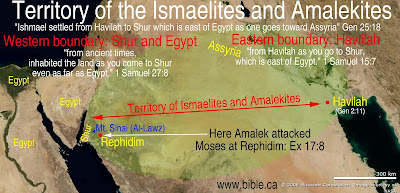
Ishmael died in the presence of all his brethren. This is a fulfillment of prophecy from Genesis 16:12 when the angel of the Lord told Hagar that Ishmael would "be a wild man; his hand will be against every man, and every man's hand against him; and he shall dwell in the presence of all his brethren." Among "all" his brethren probably means that he lived his wild and turbulent life and held his own in an area among Abraham's other children. He died as he lived, in the presence of or amongst all his brethren. Many of the old commentaries suggest that the pronoun "he" from verse 18 should have been read "it" and it meant that his lot fell among all his brethren. They believe this because although verse 17 speaks of Ishmael, verse 18 speaks of the place where the Ishmaelites dwelt. Additionally, the same word "naphal" that is translated as "died" here also means to divide by lot, and was used that way in another verse in the Bible; Joshua 23:4 states, "Behold, I have divided to you by lot these nations that remain, to be an inheritance for your tribes, from the Jordan, with all the nations that I have cut off, even to the great sea westward." So perhaps the true meaning of verse 18b is that his lot or inheritance was assigned him by God to be in the midst of all Abraham's other children. It is true that even though Ishmael was not the promised seed, God blessed him and made of him a great nation that lives today. Indeed Ishmael is the father of the Arab nation!
(19) And these are the generations of Isaac, Abraham's son: Abraham begat Isaac; (20) And Isaac was forty years old when he took Rebekah to be his wife, the daughter of Bethuel the Syrian of Padan Aram, the sister of Laban the Syrian.
We had a genealogy of Abraham's son Ishmael, and now begins one of Isaac. We have a brief genealogical synopsis of what we have read of Isaac to this point.
(21) And Isaac entreated the LORD for his wife, because she was barren; and the LORD was entreated for him, and Rebekah his wife conceived.
Now we pick up the story of Isaac's family after he and Rebekah were married. Apparently they lived 20 years together as man and wife before having a child. We were told that Isaac was 40 when he married Rebekah, and later in scripture we are told that he was 60 when his sons were born (verse 26). Isaac earnestly prayed to the Lord for Rebekah to have a child and the Lord granted his request and she conceived.
(22) And the children struggled together within her; and she said, "If it be well, why am I this way?" And she went to inquire of the LORD. (23) And the LORD said to her, "Two nations are in your womb, and two manner of people shall be separated from your body; and the one people shall be stronger than the other people; and the older shall serve the younger."
Apparently Rebekah felt a commotion inside her that did not feel normal, so she asked the Lord if everything was okay. The Lord told her there were two babies in her womb, two different babies, not identical twins. They would be different in appearance and in manner of life. More than just twins, God was prophesying that from the babies would spring two different nations. Two babies struggling in the womb would become two nations struggling with each other, one stronger than the other in physical strength, but the older would come to serve the younger.
24) And when her days to be delivered were fulfilled, behold, there were twins in her womb. (25) And the first came out red, like a hairy garment all over; and they called his name Esau.
Sure enough, Rebekah delivered twins. The first baby was red and hairy all over, and they called him "Esau", which literally means "rough" or "hairy".
(26) And after that his brother came out, and his hand took hold of Esau's heel, and his name was called Jacob; and Isaac was sixty years old when she bore them.
The second baby came out with his hand grabbing hold of the first baby's heel, the perfect picture of Jacob trying to pull back his older brother so that he might be the first, which was of course, a prophetic picture of what was to happen. Even Jacob's name was prophetic; it literally means "supplanter". To supplant is to overthrow by tripping up or to take the place of another by scheming or strategy. His parents may have named him Jacob only because of the way he grabbed his brother's heel and it just looked like he was trying to pull his brother back to be first, sort of like parents today might say, "Oh, isn't that cute; he wants to supplant his brother". However, God had told Rebekah that two nations struggled within her womb and that the older would serve the younger, so she may have seen the action of baby Jacob as prophecy fulfillment in the making and named him accordingly.
(27) And the boys grew; and Esau was a cunning hunter, a man of the field, and Jacob was a plain man, dwelling in tents.
I was tempted to use "better" adjectives for my study, but since the original words can mean a variety of things, I decided to leave them as the KJV translators translated them and I would explore all the meanings of the original words. Esau was a cunning hunter. The original word for "cunning" is "yada", which has a huge variety of meanings, but they all stem from the root word "to know". So he really knew about hunting; he was a skillful and experienced hunter. He was a man of the field, an outdoorsman. Jacob was a "plain" man. It is very interesting that the KJV translators used the word "plain" to define the original "tam", as it doesn't seem to begin to define the word completely. They were probably striving for the sense of "gentle" or "mild", which would be considered in contrast to the skillful hunter and outdoorsman, but they are considered secondary meanings of the word. "Tam" is most often used in other scriptures as "perfect and complete".
(28) And Isaac loved Esau, because he ate of his venison, but Rebekah loved Jacob.
This scripture always bothered me. How could a parent love one child over another? But when you consider what we have already learned about the boys, it may make sense that each parent was more attached to one son more than the other. Esau was Isaac's firstborn and he brought him good venison to eat. Isaac evidently really enjoyed that and Esau probably sought to please his father in this way. On the other hand, Jacob was probably more at home with his mother and of a milder and gentler disposition. It may have been natural for the parents to be a little more attached to one child over the other, but there may have been more to this, and there are different ways to look at it. Rebekah had received the prophetic word from God that the older son would eventually serve the younger son. Perhaps she saw Jacob as blessed by God and she loved and sought to nurture the son chosen by God. However, Adam Clarke wrote an interesting spin on this: "This is an early proof of unwarrantable parental attachment to one child in preference to another. Isaac loved Esau, and Rebekah loved Jacob; and in consequence of this the interests of the family were divided, and the house set in opposition to itself. The fruits of this unreasonable and foolish attachment were afterwards seen in a long catalogue of both natural and moral evils among the descendants of both families." Perhaps the moral lesson in this is that the parents should not have loved one over the other, but as God gives prophecy as events will happen and not necessarily as they should happen, and also because He makes things work to the good for those who love and follow Him, the blessings will follow Jacob, but there will be much strife.
(29) And Jacob made a stew, and Esau came from the field, and he was faint. (30) And Esau said to Jacob, "Please feed me with that same red stew, for I am faint." Therefore his name was called Edom.
Jacob, perhaps being the homebody that he was or maybe for some other reason, but certainly by Godly design, had made a stew. Esau came in from the field, having toiled but obviously having nothing to eat, and he was faint, we can assume from hunger. We are told that he was called "Edom" which literally means "red" because of this red stew. We were previously told that he was born red and hairy. Esau was the name for "hairy", and Edom was the name for "red".
(31) And Jacob said, "Sell me this day your birthright." (32) And Esau said, "Look, I am at the point of dying, so what profit will this birthright do to me?" (33) And Jacob said, "Swear to me this day." And he swore to him, and he sold his birthright to Jacob. (34) Then Jacob gave Esau bread and stew of lentils, and he ate and drank, and rose up, and went his way; thus Esau despised his birthright.
Jacob obviously took advantage of the fact that Esau was starving to death, as he had put it, and it can be argued that he did not act righteously. However, it must be noted that Esau had the choice to accept or decline Jacob's proposal. Could he have not said, "Are you crazy, giving up my birthright for a meal?" and grabbed some bread or a fruit from the field to alleviate his hunger? Jacob didn't force Esau to sell his birthright, but perhaps pressured him to decide just how important it really was. Maybe as Isaac's favorite, Esau didn't consider the "birthright" as necessary, but it was very important to Jacob. The birthright generally meant a double portion of inheritance, authority over the rest of the family, and his father's blessing. If that was all there was to it, perhaps Esau was right from a worldly and temporal point of view. What worldly things in this life really are that important, especially if Esau really thought he was starving to death? But there were also spiritual blessings. Exodus 13:2 and 22:29 show that the firstborn children were consecrated to God. When you really think about how God determined where and when we would be born, and that He determined who would be the firstborn in each family, how could we just throw that away? The parental blessing in this birthright was especially important with the promises of the Messiah and the inheritance of the land of Canaan. Rebekah knew that these things were designed for Jacob; she knew that the older son would serve the younger, and she had probably told Jacob of it, as well. Jacob seized this opportunity to get the birthright, and it was obviously not as important to Esau, who "despised" his birthright. Furthermore, he is called a profane person in Hebrews 12:16 because he sold his birthright "for one morsel of meat". Other meanings of the original word translated as "profane" here are "heathenish", "wicked", and "ungodly". Esau totally dismissed the spiritual things of God, as would a heathen.
Although God decides our birth order, it is obvious that He still gives us the choice to do with it what we will. Esau saw no value in it, and Jacob sought it and fought for it all his life, as we will see in coming scriptures. It must also be pointed out that God Himself may choose whomever He pleases to do His will as in the case of David, the youngest of several brothers. As a matter of fact, God often uses the weakest things to confound the mighty (1 Corinthians 1:27). So while we should never look upon the position God gave us in this world lightly, we must never consider it a hopeless lot in life. Acts 17:26 states, "And He has made from one blood every nation of men to dwell on all the face of the earth, and has determined their preappointed times and the boundaries of their habitation." Therefore, as I always like to say, "You were born for such a time as this!" That, of course, is from the story of Esther, but how true that is for each and every one of us. God chose this time for us, so when you think of all that is going on in the world today, remember that God purposed that each one of us would be here now at this particular time in all of history, and in our particular place in the world. How awesome is that to contemplate His purpose for us at this time?
The more I have studied and thought about this, the more instances I have found where the younger sibling seemed to rise above the firstborn. You could go all the way back to Cain and Abel! Then there's Ishmael and Isaac, and Esau and Jacob, and still to come in scripture, you might consider Leah and Rachel in this category. It was interesting to read some of the different takes on this, especially from some sites that were more sympathetic toward Islam. It was insinuated that the entire book of Genesis was about the reversal of the birth order law through some devious sort of predestination and that the poor firstborn were losers through no fault of their own. I believe the lesson in all these cases is that while some are born with special blessings of God, as in being the firstborn, or being one of God's chosen people, it is still our choice whether we desire the things of God or worldly things. Just because one might be firstborn and a blessed child of God's chosen people does not automatically guarantee him a place of honor with God. In the New Testament the Pharisees argued that they were children of Abraham and they didn't see the need for Jesus to make them free. Jesus in John 8:37 agreed that they were indeed the seed of Abraham, yet He told them their father was the devil! When John the Baptist preached about the coming of Christ (Matthew 3 and Luke 3), he told them they could not rely on the fact that Abraham was their father, but that they must repent of their sins. Additionally, even if one is born without certain apparent blessings of God, he may still come to God through salvation in Christ; that is the Good News that fills the New Testament! It is always amazing to me to see God's love and His plan from the beginning, that is, Jesus and salvation in Christ, in the Old Testament! Indeed God has never changed!
(Genesis 25:1) Then again Abraham took a wife, and her name was Keturah. (2) And she bore him Zimran, Jokshan, Medan, Midian, Ishbak, and Shuah. (3) And Jokshan begat Sheba and Dedan. And the sons of Dedan were Asshurim, Letushim, and Leummim. (4) And the sons of Midian were Ephah, Epher, Hanoch, Abidah, and Eldaah. All these were the children of Keturah.
"THEN" Abraham took a wife, obviously after the death of Sarah and probably after the marriage of Isaac, as well. Keturah gave Abraham six more sons in his very old age, it would seem at first glance. Obviously, she could have been much younger than Abraham, but we were told earlier in scripture that Abraham's body was dead when Sarah conceived Isaac, and that he was very old and well stricken with age when his servant went to find a wife for Isaac. I have to believe as some of the old Bible scholars suggest that Keturah was a concubine and bore children much earlier in life, while Sarah was alive, and she became Abraham's wife after the death of Sarah. Later in scripture, in 1 Chronicles 1:32, Keturah is called his concubine. She was a concubine who probably gave him these children earlier, and became his wife at this time after the death of Sarah.
(5) And Abraham gave all that he had to Isaac.
Isaac was Abraham's only begotten son of his wife, Sarah, and the heir to the promise, and Abraham had given him all he had, especially his right to the land of Canaan, and his "flocks, herds, silver, gold, menservants, maidservants, camels, and donkeys", as had been reported by his servant to Rebekah's family. However, Abraham must have reserved some for himself, as he gave gifts to the sons of his concubines:
(6) But Abraham gave gifts to the sons of the concubines which Abraham had; and while he yet lived, sent them away from Isaac his son, eastward to the east country.
Abraham remembered his other sons, these sons of Keturah above mentioned, as well as Hagar's son Ishmael. While he was still living, to avoid disputes after his death, he gave his sons their inherited gifts and sent all his other sons eastward away from his son, Isaac. The land of promise was to be only Isaac's.
(7) And these are the days of the years of Abraham's life which he lived, one hundred and seventy-five years. (8) Then Abraham gave up the ghost and died in a good old age, an old man and full of years, and was gathered to his people.
Abraham gave up the ghost, or breathed his last breath and died at 175 years of age, "in a good old age". While that seems quite old in our day and age, Adam Clarke in his "Commentary on the Bible", points out that Abraham died at the youngest age of all the patriarchs. That word "good" is not to be interpreted to mean that Abraham lived to an extremely old age, but that it was a good and full age. His life had been full and satisfying and he was ready to depart this world. He died at a good age, not having to endure a total decrepitness of mind and body. Being gathered to one's people was probably a way of saying that he joined those ancestors who went before him in death. There was much discussion in the old commentaries about the exact meaning of the phrase because surely Abraham wasn't literally gathered to his ancestors who were buried in Chaldea and not in Canaan, nor did it mean he was gathered to Sarah who was alone in a cave. Some said it meant he was "gathered to the spirits of just men made perfect". More recent scholars really make a big deal of the wording "was gathered" as opposed to other places where a person "shall be gathered" as if to say this proves whether we go to heaven when we die or wait to be resurrected at the end. I have to believe this was just a saying and it meant Abraham went the way of death as all his people before him went.
(9) And his sons Isaac and Ishmael buried him in the cave of Machpelah, in the field of Ephron the son of Zohar the Hittite, which is before Mamre, (10) The field which Abraham purchased from the sons of Heth; there Abraham was buried, and Sarah his wife.
Even though Ishmael and his mother had been sent away from Abraham's family, the brothers came together at this time to bury their father in the cave in the field Abraham had previously purchased when he needed a place to bury Sarah.
(11) And it came to pass, after the death of Abraham, that God blessed his son Isaac; and Isaac dwelt by the well Lahai Roi.
God blessed Abraham's son Isaac, the heir to the promise of God. Isaac lived by the well Lahai Roi, which was the same as Beer Lahai Roi, the place where the angel of the Lord came to Hagar and told her about the son she was carrying.
(12) Now these are the generations of Ishmael, Abraham's son, whom Hagar the Egyptian, Sarah's handmaid, bore to Abraham: (13) And these are the names of the sons of Ishmael, by their names, according to their generations: The firstborn of Ishmael, Nebajoth; and Kedar, Adbeel, Mibsam, (14) And Mishma, Dumah, and Massa, (15) Hadar, Tema, Jetur, Naphish, and Kedemah. (16) These are the sons of Ishmael, and these are their names, by their towns and by their castles, twelve princes according to their nations.
Ishmael had twelve sons, heads of twelve tribes of the Arab nation. God had promised Hagar that He would bless Ishmael and make him fruitful, and that he would beget twelve princes and become a great nation (Genesis 17:20), and so it was. Many of these sons, or princes, will be mentioned later in the Bible. Nebajoth and Kedar are mentioned in Isaiah. I have read that in old Jewish writings, the Arabic language is most frequently called the language of Kedar. Dumah is a place mentioned in Isaiah and was probably named after Ishmael's son. Interestingly, Tema and Temanites were mentioned in Job, meaning that, chronologically, I should have been studying Abraham before Job! Jetur and Naphish are mentioned in 1 Chronicles as part of the Hagarites who warred against the Israelites. The descendants of Kedemah may have lived at Kedemoth, a place mentioned in Deuteronomy.
(17) And these are the years of the life of Ishmael, one hundred and thirty-seven years, and he gave up the ghost and died, and was gathered to his people. (18) And they dwelt from Havilah to Shur, that is before Egypt as you go toward Assyria; and he died in the presence of all his brethren.
Ishmael lived to 137 years of age, and also gave up the ghost and was gathered to his people, as was Abraham. I believe these have to be merely expressions that were used in the day and were not meant to have a significant meaning as to the kind of life each man lived. I am picturing "giving up the ghost" as giving up the spirit of life or breath, breathing one's last breath. As was discussed above, I believe that being gathered to one's people must just mean to go the way of death as his ancestors before him. "They" in verse 18 would have to be the descendants of Ishmael and not his people before him. The Ishmaelites lived in the country that extended from east to west from Havilah to Shur. From what I have read and viewed on a map, this looks to be the northern region between Havilah arcing northward (as you go toward Assyria) to Shur next to Egypt. I found an excellent map at http://www.bible.ca/archeology/bible-archeology-exodus-route-wilderness-of-shur-ishmaelites-midianites-amalekites.htm with references to other scriptures which shows where this region must have been:
Ishmael died in the presence of all his brethren. This is a fulfillment of prophecy from Genesis 16:12 when the angel of the Lord told Hagar that Ishmael would "be a wild man; his hand will be against every man, and every man's hand against him; and he shall dwell in the presence of all his brethren." Among "all" his brethren probably means that he lived his wild and turbulent life and held his own in an area among Abraham's other children. He died as he lived, in the presence of or amongst all his brethren. Many of the old commentaries suggest that the pronoun "he" from verse 18 should have been read "it" and it meant that his lot fell among all his brethren. They believe this because although verse 17 speaks of Ishmael, verse 18 speaks of the place where the Ishmaelites dwelt. Additionally, the same word "naphal" that is translated as "died" here also means to divide by lot, and was used that way in another verse in the Bible; Joshua 23:4 states, "Behold, I have divided to you by lot these nations that remain, to be an inheritance for your tribes, from the Jordan, with all the nations that I have cut off, even to the great sea westward." So perhaps the true meaning of verse 18b is that his lot or inheritance was assigned him by God to be in the midst of all Abraham's other children. It is true that even though Ishmael was not the promised seed, God blessed him and made of him a great nation that lives today. Indeed Ishmael is the father of the Arab nation!
(19) And these are the generations of Isaac, Abraham's son: Abraham begat Isaac; (20) And Isaac was forty years old when he took Rebekah to be his wife, the daughter of Bethuel the Syrian of Padan Aram, the sister of Laban the Syrian.
We had a genealogy of Abraham's son Ishmael, and now begins one of Isaac. We have a brief genealogical synopsis of what we have read of Isaac to this point.
(21) And Isaac entreated the LORD for his wife, because she was barren; and the LORD was entreated for him, and Rebekah his wife conceived.
Now we pick up the story of Isaac's family after he and Rebekah were married. Apparently they lived 20 years together as man and wife before having a child. We were told that Isaac was 40 when he married Rebekah, and later in scripture we are told that he was 60 when his sons were born (verse 26). Isaac earnestly prayed to the Lord for Rebekah to have a child and the Lord granted his request and she conceived.
(22) And the children struggled together within her; and she said, "If it be well, why am I this way?" And she went to inquire of the LORD. (23) And the LORD said to her, "Two nations are in your womb, and two manner of people shall be separated from your body; and the one people shall be stronger than the other people; and the older shall serve the younger."
Apparently Rebekah felt a commotion inside her that did not feel normal, so she asked the Lord if everything was okay. The Lord told her there were two babies in her womb, two different babies, not identical twins. They would be different in appearance and in manner of life. More than just twins, God was prophesying that from the babies would spring two different nations. Two babies struggling in the womb would become two nations struggling with each other, one stronger than the other in physical strength, but the older would come to serve the younger.
24) And when her days to be delivered were fulfilled, behold, there were twins in her womb. (25) And the first came out red, like a hairy garment all over; and they called his name Esau.
Sure enough, Rebekah delivered twins. The first baby was red and hairy all over, and they called him "Esau", which literally means "rough" or "hairy".
(26) And after that his brother came out, and his hand took hold of Esau's heel, and his name was called Jacob; and Isaac was sixty years old when she bore them.
The second baby came out with his hand grabbing hold of the first baby's heel, the perfect picture of Jacob trying to pull back his older brother so that he might be the first, which was of course, a prophetic picture of what was to happen. Even Jacob's name was prophetic; it literally means "supplanter". To supplant is to overthrow by tripping up or to take the place of another by scheming or strategy. His parents may have named him Jacob only because of the way he grabbed his brother's heel and it just looked like he was trying to pull his brother back to be first, sort of like parents today might say, "Oh, isn't that cute; he wants to supplant his brother". However, God had told Rebekah that two nations struggled within her womb and that the older would serve the younger, so she may have seen the action of baby Jacob as prophecy fulfillment in the making and named him accordingly.
(27) And the boys grew; and Esau was a cunning hunter, a man of the field, and Jacob was a plain man, dwelling in tents.
I was tempted to use "better" adjectives for my study, but since the original words can mean a variety of things, I decided to leave them as the KJV translators translated them and I would explore all the meanings of the original words. Esau was a cunning hunter. The original word for "cunning" is "yada", which has a huge variety of meanings, but they all stem from the root word "to know". So he really knew about hunting; he was a skillful and experienced hunter. He was a man of the field, an outdoorsman. Jacob was a "plain" man. It is very interesting that the KJV translators used the word "plain" to define the original "tam", as it doesn't seem to begin to define the word completely. They were probably striving for the sense of "gentle" or "mild", which would be considered in contrast to the skillful hunter and outdoorsman, but they are considered secondary meanings of the word. "Tam" is most often used in other scriptures as "perfect and complete".
(28) And Isaac loved Esau, because he ate of his venison, but Rebekah loved Jacob.
This scripture always bothered me. How could a parent love one child over another? But when you consider what we have already learned about the boys, it may make sense that each parent was more attached to one son more than the other. Esau was Isaac's firstborn and he brought him good venison to eat. Isaac evidently really enjoyed that and Esau probably sought to please his father in this way. On the other hand, Jacob was probably more at home with his mother and of a milder and gentler disposition. It may have been natural for the parents to be a little more attached to one child over the other, but there may have been more to this, and there are different ways to look at it. Rebekah had received the prophetic word from God that the older son would eventually serve the younger son. Perhaps she saw Jacob as blessed by God and she loved and sought to nurture the son chosen by God. However, Adam Clarke wrote an interesting spin on this: "This is an early proof of unwarrantable parental attachment to one child in preference to another. Isaac loved Esau, and Rebekah loved Jacob; and in consequence of this the interests of the family were divided, and the house set in opposition to itself. The fruits of this unreasonable and foolish attachment were afterwards seen in a long catalogue of both natural and moral evils among the descendants of both families." Perhaps the moral lesson in this is that the parents should not have loved one over the other, but as God gives prophecy as events will happen and not necessarily as they should happen, and also because He makes things work to the good for those who love and follow Him, the blessings will follow Jacob, but there will be much strife.
(29) And Jacob made a stew, and Esau came from the field, and he was faint. (30) And Esau said to Jacob, "Please feed me with that same red stew, for I am faint." Therefore his name was called Edom.
Jacob, perhaps being the homebody that he was or maybe for some other reason, but certainly by Godly design, had made a stew. Esau came in from the field, having toiled but obviously having nothing to eat, and he was faint, we can assume from hunger. We are told that he was called "Edom" which literally means "red" because of this red stew. We were previously told that he was born red and hairy. Esau was the name for "hairy", and Edom was the name for "red".
(31) And Jacob said, "Sell me this day your birthright." (32) And Esau said, "Look, I am at the point of dying, so what profit will this birthright do to me?" (33) And Jacob said, "Swear to me this day." And he swore to him, and he sold his birthright to Jacob. (34) Then Jacob gave Esau bread and stew of lentils, and he ate and drank, and rose up, and went his way; thus Esau despised his birthright.
Jacob obviously took advantage of the fact that Esau was starving to death, as he had put it, and it can be argued that he did not act righteously. However, it must be noted that Esau had the choice to accept or decline Jacob's proposal. Could he have not said, "Are you crazy, giving up my birthright for a meal?" and grabbed some bread or a fruit from the field to alleviate his hunger? Jacob didn't force Esau to sell his birthright, but perhaps pressured him to decide just how important it really was. Maybe as Isaac's favorite, Esau didn't consider the "birthright" as necessary, but it was very important to Jacob. The birthright generally meant a double portion of inheritance, authority over the rest of the family, and his father's blessing. If that was all there was to it, perhaps Esau was right from a worldly and temporal point of view. What worldly things in this life really are that important, especially if Esau really thought he was starving to death? But there were also spiritual blessings. Exodus 13:2 and 22:29 show that the firstborn children were consecrated to God. When you really think about how God determined where and when we would be born, and that He determined who would be the firstborn in each family, how could we just throw that away? The parental blessing in this birthright was especially important with the promises of the Messiah and the inheritance of the land of Canaan. Rebekah knew that these things were designed for Jacob; she knew that the older son would serve the younger, and she had probably told Jacob of it, as well. Jacob seized this opportunity to get the birthright, and it was obviously not as important to Esau, who "despised" his birthright. Furthermore, he is called a profane person in Hebrews 12:16 because he sold his birthright "for one morsel of meat". Other meanings of the original word translated as "profane" here are "heathenish", "wicked", and "ungodly". Esau totally dismissed the spiritual things of God, as would a heathen.
Although God decides our birth order, it is obvious that He still gives us the choice to do with it what we will. Esau saw no value in it, and Jacob sought it and fought for it all his life, as we will see in coming scriptures. It must also be pointed out that God Himself may choose whomever He pleases to do His will as in the case of David, the youngest of several brothers. As a matter of fact, God often uses the weakest things to confound the mighty (1 Corinthians 1:27). So while we should never look upon the position God gave us in this world lightly, we must never consider it a hopeless lot in life. Acts 17:26 states, "And He has made from one blood every nation of men to dwell on all the face of the earth, and has determined their preappointed times and the boundaries of their habitation." Therefore, as I always like to say, "You were born for such a time as this!" That, of course, is from the story of Esther, but how true that is for each and every one of us. God chose this time for us, so when you think of all that is going on in the world today, remember that God purposed that each one of us would be here now at this particular time in all of history, and in our particular place in the world. How awesome is that to contemplate His purpose for us at this time?
The more I have studied and thought about this, the more instances I have found where the younger sibling seemed to rise above the firstborn. You could go all the way back to Cain and Abel! Then there's Ishmael and Isaac, and Esau and Jacob, and still to come in scripture, you might consider Leah and Rachel in this category. It was interesting to read some of the different takes on this, especially from some sites that were more sympathetic toward Islam. It was insinuated that the entire book of Genesis was about the reversal of the birth order law through some devious sort of predestination and that the poor firstborn were losers through no fault of their own. I believe the lesson in all these cases is that while some are born with special blessings of God, as in being the firstborn, or being one of God's chosen people, it is still our choice whether we desire the things of God or worldly things. Just because one might be firstborn and a blessed child of God's chosen people does not automatically guarantee him a place of honor with God. In the New Testament the Pharisees argued that they were children of Abraham and they didn't see the need for Jesus to make them free. Jesus in John 8:37 agreed that they were indeed the seed of Abraham, yet He told them their father was the devil! When John the Baptist preached about the coming of Christ (Matthew 3 and Luke 3), he told them they could not rely on the fact that Abraham was their father, but that they must repent of their sins. Additionally, even if one is born without certain apparent blessings of God, he may still come to God through salvation in Christ; that is the Good News that fills the New Testament! It is always amazing to me to see God's love and His plan from the beginning, that is, Jesus and salvation in Christ, in the Old Testament! Indeed God has never changed!
Sunday, February 3, 2013
A Beautiful Example of How God Can Find the Perfect Wife
Continuing a chronological Bible study:
(Genesis 24:1) And Abraham was old, well stricken in age; and the LORD had blessed Abraham in all things.
Abraham was 140 years old at this time, so three years have passed since the death of Sarah. We know this because we were told previously that he was ten years older than Sarah, and because of a scripture still to come that will tell us Isaac is 40 about this time--Genesis 25:20.
(2) And Abraham said to his oldest servant of his house, who ruled over all that he had, "Please, put your hand under my thigh, (3) And I will make you swear by the LORD, the God of heaven and the God of the earth, that you will not take a wife for my son from the daughters of the Canaanites, among whom I dwell; (4) But you will go to my country and to my family, and take a wife for my son Isaac."
Putting one's hand under another's thigh appears to have been a method of swearing an oath; it was a way of binding by oath the two parties. The person binding himself put his hand under the thigh of the person to whom he was to be bound. The reason the thigh area was chosen likely may have been because that is the part of the body that bore the mark of circumcision, the sign of God’s covenant. The person, in essence, is swearing by God, or in the presence of God, much like one today might put his hand on the Bible. Abraham told his servant what he planned to have him swear, that he would not take a wife for his son Isaac from the Canaanites, his neighbors. The original word for "take" doesn't always mean to actively take, but also means "receive" or "accept". At 40 years of age by this time, Isaac would have been well able to choose his own wife, so whether it was a custom for it to be prearranged or because Isaac would have had great respect for the opinion of the oldest servant of his father's house, either way, Abraham wanted his servant to be pro-active in steering Isaac away from the idolatrous and wicked Canaanites and finding him a wife from his own people.
(5) And the servant said to him, "Suppose the woman will not be willing to follow me to this land; must I take your son back to the land from which you came?"
It certainly appears that the servant is taking this oath seriously as he seems to be carefully considering all angles before he swears. Suppose he finds the right woman, but she will not leave her homeland. Should the servant bring Isaac to her?
(6) And Abraham said to him, "Beware that you do not take my son back there. (7) The LORD God of heaven, who took me from my father's house and from the land of my family, and who spoke to me and swore to me, saying, 'To your descendants will I give this land,' He will send His angel before you, and you will take a wife for my son from there. (8) And if the woman is not willing to follow you, then you will be clear from this oath; only do not take my son back there."
Abraham made it clear that the servant was not to take Isaac away from this land. God took Abraham from his homeland to this land, and told him He would give this new land to his descendants. Abraham is very certain that this is where Isaac must stay. He is so certain that he has faith that God Himself will guide the servant in finding the wife. However, for the servant's benefit, so that he may feel comfortable in swearing this oath, he told the servant that if he could not convince the woman to come back to this land, then the servant would be released from the oath.
(9) And the servant put his hand under the thigh of Abraham his master, and swore to him concerning that matter.
Once the servant had asked his questions and had a complete understanding of what he was being asked to swear to and do, he put his hand under Abraham's thigh and swore to him concerning the matter of finding a wife for Isaac.
(10) And the servant took ten of his master's camels and departed, for all his master's goods were in his hand; and he arose and went to Mesopotamia, to the city of Nahor. (11) And he made his camels kneel down outside the city by a well of water at evening time, the time that women go out to draw water.
I believe the sense of verse 10 is that as steward of Abraham's house, the servant had access to all of Abraham's goods, and therefore he was free to take ten camels, and it was his own decision to take them, and he then departed for the city of Nahor, Abraham's brother. When he reached his destination, he made his camels lie down beside a well outside the city. Whether at this point it was by design or not, it was in the evening at the time that women came to draw water.
(12) And he said, "O LORD God of my master Abraham, please send me good speed this day, and show kindness to my master Abraham."
The servant prayed to God for favor in his endeavor, and was asking this for his master Abraham's benefit. The words translated as "good speed" are not translated that way anywhere else in the Bible, so I had difficulty determining their exact meaning, but obviously he asked for success in his mission, or asked that it happen quickly and decisively. Perhaps "Godspeed" is the better translation; he asked that God prosper or bring him good fortune that day, but again, it was Abraham's good fortune for which he prayed.
(13) "Behold, I stand by the well of water, and the daughters of the men of the city come out to draw water. (14) And let it come to pass, that the damsel to whom I shall say, 'Please let down your pitcher that I may drink,' and she shall say, 'Drink, and I will give your camels drink also', let her be the one You have appointed for Your servant Isaac; and thereby shall I know that You have shown kindness to my master."
I have to wonder if this prayer and request for a sign from God was totally the servant's, or if Abraham had had any part of it, recalling that it was Abraham who first assured the servant that God would send His angel before the servant to find a wife for Isaac. Regardless the servant does appear to be a God-fearing man who is looking for assurance from God that he has found the right wife for his master's son.
(15) And it came to pass, before he had done speaking, that behold, Rebekah, who was born to Bethuel, son of Milcah, the wife of Nahor, Abraham's brother, came out with her pitcher on her shoulder. (16) And the damsel was very fair to look upon, a virgin, no man had known her; and she went down to the well, and filled her pitcher, and came up.
How awesome that God began to answer the servant's prayer before he had even completed it! There is a scripture in Isaiah, specifically, Isaiah 65:24, which says, "And it shall come to pass, that before they call, I will answer; and while they are yet speaking, I will hear." How wonderful is that? We are given a brief genealogy of Rebekah to show that she was indeed of Abraham's brother's family, and she was a fair unattached maiden. Rebekah came to the well and filled her pitcher, and was apparently coming back from the well.
(17) And the servant ran to meet her and said, "Please let me drink a little water from your pitcher." (18) And she said, "Drink, my lord", and she hurried and let down her pitcher to her hand, and gave him a drink. (19) And when she had done giving him a drink, she said, "I will draw water for your camels also, until they have done drinking."
The servant apparently watched Rebekah fill her pitcher and as she was leaving the well, then ran to meet her. The sign for which he had prayed could not have been fulfilled until she had water in her pitcher. Rebekah was beautiful to look upon and turned out to be most gracious and considerate, and began to fulfill the requested sign perfectly.
(20) And she hurried and emptied her pitcher into the trough, and ran again to the well to draw water, and drew for all his camels. (21) And the man, wondering at her, held his peace so as to know whether the LORD had made his journey prosperous or not.
Rebekah indeed did what she said, and also drew water for the camels. My first thought as I read this scripture was that of course, God had made his journey prosperous! Wouldn't he have known that when the maiden first opened her mouth and said she would water the camels? However, I believe the sense of this scripture is that the servant is in incredulous wonder that things played out exactly as he had asked. He watched until the entire incident was over, and marvelled at how God had worked in this gracious young woman. When you think about it, she could have found it very condescending of this man to ask for water when he was perfectly capable of getting water himself, as he was also at the well. But to be so generous to offer even more than the man had asked was certainly something at which to marvel!
(22) And it came to pass, as the camels had done drinking, that the man took a golden earring of half a shekel weight, and two bracelets for her hands of ten shekels weight of gold; (23) And said, "Whose daughter are you? Tell me, please, is there room in your father's house for us to lodge?"
Of course, it makes sense to me now that the servant could still be wondering if this was truly God's sign that this was the wife for Isaac. He did not yet know if she was of Abraham's family (only we knew that, at this point). The servant took out the gold jewelry, but the scripture doesn't say that he gave it to Rebekah yet. With what he has witnessed, he was probably pretty sure this maiden was "the one", but he may have wanted to be certain first before he gave her the jewels. Then again, the jewels may have been a "thank you" for her gracious generosity thus far, even if she wasn't "the one".
(24) And she said to him, "I am the daughter of Bethuel, the son of Milcah, whom she bore to Nahor." (25) Moreover she said to him, "We have both straw and feed enough, and room to lodge in."
Rebekah confirmed that she was indeed of Abraham's family, and she answered the servant's question about whether or not there was room in her father's house for the servant and his entourage to lodge.
(26) And the man bowed down his head, and worshipped the LORD. (27) And he said, "Blessed be the LORD God of my master Abraham, who has not forsaken my master of His mercy and His truth; I, being in the way, the LORD led me to the house of my master's brethren."
The man bowed and prayed and thanked the Lord for His mercy for Abraham and for putting him, the servant, in the right path of the maiden God had chosen for Isaac.
(28) And the damsel ran and told her mother's household these things.
At this point, Rebekah may only be telling her family that she has invited this man to lodge with them. The fact that she told her mother's household, and not her father's, might be because her father is dead at this time. While wives often had their own tents, and the fact that Bethuel is mentioned later in scripture, might mean her father is still alive, the fact that her brother appears to be the one making decisions, it may be that the Bethuel mentioned later is another brother, named after his father.
(29) And Rebekah had a brother and his name was Laban, and Laban ran out to the man to the well.
Apparently, Rebekah left the servant at the well while she ran home to prepare her family for their guest, as Rebekah's brother, Laban, went back to the well to meet the servant.
(30) And it came to pass, when he saw the earring and bracelets upon his sister's hands, and when he heard the words of Rebekah his sister, saying, "Thus the man spoke to me," that he came to the man; and there he stood by the camels at the well.
Rebekah had told her family what the man had said to her, and seeing the gold jewels, her brother Laban went out to meet the man at the well.
(31) And he said, "Come in, you blessed of the LORD; why do you stand outside? For I have prepared the house, and room for the camels."
Laban saw the servant as blessed by the Lord. It could be just because he appeared wealthy because of his gifts to Rebekah, and because of the number of attendants and camels he had, but it may be that Rebekah heard the thankful prayer the servant made to God and she relayed that to her brother and the rest of her family. Laban asked the question about why he stayed behind outside, probably just as a courteous invitation to delay no further and come on in, for they were prepared for him and his camels to stay.
(32) And the man came into the house; and he ungirded his camels, and gave straw and feed for the camels, and water to wash his feet and the feet of the men who were with him.
The servant went into the house, but the "he" who gave straw and feed and water to wash the feet of the men must be interpreted to be said of Laban, unless it was "he", the servant, acting on instructions and with provisions given by Laban.
(33) And there was set food before him to eat, but he said, "I will not eat until I have told about my errand." And he said, "Speak on."
Food was set before the servant, but he wanted to first make clear his purpose in being there. Laban told him to go ahead and tell them.
(34) And he said, "I am Abraham's servant. (35) And the LORD has blessed my master greatly, and he has become great; and He has given him flocks and herds, silver and gold, and menservants and maidservants, and camels and donkeys. (36) And Sarah my master's wife bore a son to my master when she was old; and to him he has given all that he has."
The servant began by telling who he was, and of the great blessings the Lord had given his master, Abraham, and of the son that was born to Abraham, who now owned all that his father had been given of God.
(37) "And my master made me swear, saying, 'You shall not take a wife for my son from the daughters of the Canaanites, in whose land I dwell; (38) But you shall go to my father's house and to my kindred, and take a wife for my son.' (39) And I said to my master, 'Perhaps the woman will not follow me.' (40) And he said to me, 'The LORD, before whom I walk, will send His angel with you and prosper your way; and you shall take a wife for my son from my kindred and from my father's house. (41) Then you shall be clear from this oath when you come to my kindred, and if they will not give her to you, you shall be clear from my oath.'"
The servant told Rebekah's family of Abraham's desire for a wife for Isaac from his family, and retold in detail the oath.
(42) "And I came this day to the well and said, 'O LORD God of my master Abraham, if now You do prosper my way in which I go, (43) Behold, I stand by the well of water; and it shall come to pass that when the virgin comes forth to draw water, and I say to her, "Please give me a little water from your pitcher to drink," (44) And she says to me, "You both drink, and I will also draw for your camels", let her be the woman whom the LORD has appointed for my master's son.' (45) And before I had done speaking in my heart, behold, Rebekah came forth with her pitcher on her shoulder, and she went down to the well and drew water; and I said to her, 'Let me drink, please.' (46) And she made haste and let down her pitcher from her shoulder, and said, 'Drink, and I will give your camels drink also.' So I drank, and she made the camels drink also."
The servant told Rebekah's family about his prayer for the sign that he had found the right woman for Isaac. Note that he told them that he had said the prayer silently, or in his heart, so it was not possible that Rebekah heard his prayer and decided to play along. He told them how she indeed did do what he had asked in his prayer.
(47) "And I asked her, and said, 'Whose daughter are you?' And she said, 'The daughter of Bethuel, Nahor's son, whom Milcah bore to him', and I put the earring upon her face, and the bracelets upon her hands."
The earring that the servant gave Rebekah might not have been the same kind of earring that we think of today. For one thing, there was only one. While it might have been only one for one ear, since the servant said he put it on her face, it might have been the type of ornament that hung from a lace tied around the head above the ears and centered down the forehead between the eyes and down the ridge of the nose. It could have also been a nosering.
(48) "And I bowed my head and worshiped the LORD, and blessed the LORD God of my master Abraham, who had led me in the right way to take my master's brother's daughter for his son. (49) And now if you will deal kindly and truly with my master, tell me; and if not, tell me, that I may turn to the right hand, or to the left."
The servant told Rebekah's family how he had thanked the Lord for fulfilling the sign and finding the woman for Isaac, and asked whether or not they would do this kindness for his master (in giving Rebekah in marriage to Isaac) or if he would have to look elsewhere.
(50) Then Laban and Bethuel answered and said, "The thing comes from the LORD; we cannot speak to you either bad or good. (51) Behold, Rebekah is before you; take her and go, and let her be your master's son's wife, as the LORD has spoken."
Here is the first time we actually hear from Bethuel in this whole episode. Dr. John Gill points out in his Exposition of the Entire Bible, that the order of the words in the original text is "then answered Laban and Bethuel", and that the word for "answered" is in the singular form, so it may be concluded that Laban gave the answer in the name of Bethuel, who might be an old man who left the management of his family affairs to his son. I would think he might also be dead by this time, and Laban could still be answering in the name of his father, as he was now head of his father's household. As mentioned before, this Bethuel might also be a younger brother named after his father. A few verses later these men seem to be mentioned again as sending "their sister" away, indicating they are her brothers, or if this Bethuel is not a brother and Laban was speaking in his father's name, it does seem that Bethuel the father is gone, and that only sons (brothers to Rebekah) remain in the household.
Regardless of who the men were, brother and father, or both brothers, they realize this thing was entirely the Lord's doing. They couldn't comment for or against, because they saw it as entirely the work of God, so they just told the servant Rebekah was before him (as God had planned) and that he should take her to be Isaac's wife.
(52) And it came to pass, that when Abraham's servant heard their words, he worshiped the LORD, bowing himself to the earth. (53) And the servant brought forth jewels of silver, and jewels of gold, and clothing, and gave them to Rebekah; he also gave precious things to her brother and to her mother.
When the servant realized that his mission was to be accomplished, he bowed himself to the ground and thanked and worshiped the Lord. He then gave Rebekah more jewels and clothing, and he also gave precious things, or presents, as the word is also translated, to Rebekah's brother and mother. Once again, we read no mention of Rebekah's father, so I have to finally conclude that her father is dead, and the gifts are being given to Laban, as head of the household.
(54) And they did eat and drink, he and the men who were with him, and stayed all night; and they rose up in the morning, and he said, "Send me away to my master." (55) And her brother and her mother said, "Let the damsel stay with us a few days, at least ten; after that she shall go." (56) And he said to them, "Do not hinder me, since the LORD has prospered my way; send me away so that I may go to my master."
The servant and the men who were with him ate and drank and spent the night with Rebekah's family. The next morning the servant was ready to depart with Rebekah and return to Abraham and Isaac. Rebekah's brother and mother wanted to spend a few more days with Rebekah before she left, but the servant asked to be hindered no longer as they were all in agreement that this was the work of the Lord.
(57) And they said, "We will call the damsel, and ask her." (58) And they called Rebekah, and said to her, "Will you go with this man?" And she said, "I will go."
I'm sure the family would have liked to spend a little more time with Rebekah as this marriage arrangement came about suddenly, but their delay may have been partly to be able to talk to Rebekah and be sure that she also wanted this marriage. Although marriages were often arranged by the parents in these times, it seems that the parties to be married had a say, as well. If they couldn't spend time with Rebekah to find out how she felt about all this, then they would ask her directly now. She said that she would go with the servant to be married to Isaac.
(59) And they sent away Rebekah their sister, and her nurse, and Abraham's servant and his men. (60) And they blessed Rebekah, and said to her, "You are our sister, you be the mother of thousands of millions, and let your descendants possess the gates of those who hate them."
Rebekah's family then sent her on her way with their blessing. I suppose it is a blessing that any family would want for their own, that they have many children and grandchildren, and that those descendants be successful and powerful and victorious, which was what they were, in essence, saying. Possessing the gate of those who hate them is to have power over them. This may have been a common blessing, but it certainly sounds prophetic. Perhaps they knew of God's promise to Abraham; maybe the servant had told them. Whether it was their unknowing prophetic wish and blessing for Rebekeh, or whether they knew God's full plan and in agreement sent Rebekah with their blessing, the end result was the same. Rebekah left her home to go with the servant back to Abraham and Isaac, to be Isaac's wife.
(61) And Rebekah arose, and her maidens, and they rode on the camels and followed the man; and the servant took Rebekah and went his way. (62) And Isaac came from the way of the well Lahai Roi, for he dwelt in the south country. (63) And Isaac went out to meditate in the field in the evening, and he lifted up his eyes and saw, and behold, the camels were coming.
Lahai Roi is the same place as Beer Lahai Roi, which was where the well was at which the angel met with Hagar when she fled from Sarah. As the camel caravan bringing Rebekah came back home, Isaac had gone out in a field to meditate or perhaps to pray, and saw the camels coming.
(64) And Rebekah lifted up her eyes, and when she saw Isaac, she got off the camel; (65) For she had said to the servant, "Who is this man who walks in the field to meet us?" And the servant had said, "It is my master." Therefore she took a veil and covered herself.
Apparently when Isaac saw the camels, he started toward them. When Rebekah saw Isaac coming toward them, she asked the servant who he was and the servant replied that it was his master, Isaac. It was after she knew who he was that Rebekah got off her camel, and she covered herself with a veil out of modesty and respect and subjection, as was the custom in those days when a woman met a man.
(66) And the servant told Isaac all the things that he had done. (67) And Isaac brought her into his mother Sarah's tent, and took Rebekah, and she became his wife, and he loved her; and Isaac was comforted after his mother's death.
I'm sure the servant told Isaac the entire story explaining how he knew this was the wife for Isaac. Isaac brought Rebekah to Sarah's tent, which would now be hers, as wives often had separate tents from their husbands. Rebekah became Isaac's wife, and the scripture points out that he really loved her. As a single man, he apparently still suffered from the loss of his mother, but Rebekah was a real comfort to him, just as God intended a marriage partner to be.
So ought men to love their wives as their own bodies; he who loves his wife loves himself. - Ephesians 5:28
And the LORD God said, "It is not good that the man should be alone; I will make a help meet for him." - Genesis 2:18
Therefore shall a man leave his father and his mother, and shall cleave to his wife: and they shall be one flesh. - Genesis 2:24
(Genesis 24:1) And Abraham was old, well stricken in age; and the LORD had blessed Abraham in all things.
Abraham was 140 years old at this time, so three years have passed since the death of Sarah. We know this because we were told previously that he was ten years older than Sarah, and because of a scripture still to come that will tell us Isaac is 40 about this time--Genesis 25:20.
(2) And Abraham said to his oldest servant of his house, who ruled over all that he had, "Please, put your hand under my thigh, (3) And I will make you swear by the LORD, the God of heaven and the God of the earth, that you will not take a wife for my son from the daughters of the Canaanites, among whom I dwell; (4) But you will go to my country and to my family, and take a wife for my son Isaac."
Putting one's hand under another's thigh appears to have been a method of swearing an oath; it was a way of binding by oath the two parties. The person binding himself put his hand under the thigh of the person to whom he was to be bound. The reason the thigh area was chosen likely may have been because that is the part of the body that bore the mark of circumcision, the sign of God’s covenant. The person, in essence, is swearing by God, or in the presence of God, much like one today might put his hand on the Bible. Abraham told his servant what he planned to have him swear, that he would not take a wife for his son Isaac from the Canaanites, his neighbors. The original word for "take" doesn't always mean to actively take, but also means "receive" or "accept". At 40 years of age by this time, Isaac would have been well able to choose his own wife, so whether it was a custom for it to be prearranged or because Isaac would have had great respect for the opinion of the oldest servant of his father's house, either way, Abraham wanted his servant to be pro-active in steering Isaac away from the idolatrous and wicked Canaanites and finding him a wife from his own people.
(5) And the servant said to him, "Suppose the woman will not be willing to follow me to this land; must I take your son back to the land from which you came?"
It certainly appears that the servant is taking this oath seriously as he seems to be carefully considering all angles before he swears. Suppose he finds the right woman, but she will not leave her homeland. Should the servant bring Isaac to her?
(6) And Abraham said to him, "Beware that you do not take my son back there. (7) The LORD God of heaven, who took me from my father's house and from the land of my family, and who spoke to me and swore to me, saying, 'To your descendants will I give this land,' He will send His angel before you, and you will take a wife for my son from there. (8) And if the woman is not willing to follow you, then you will be clear from this oath; only do not take my son back there."
Abraham made it clear that the servant was not to take Isaac away from this land. God took Abraham from his homeland to this land, and told him He would give this new land to his descendants. Abraham is very certain that this is where Isaac must stay. He is so certain that he has faith that God Himself will guide the servant in finding the wife. However, for the servant's benefit, so that he may feel comfortable in swearing this oath, he told the servant that if he could not convince the woman to come back to this land, then the servant would be released from the oath.
(9) And the servant put his hand under the thigh of Abraham his master, and swore to him concerning that matter.
Once the servant had asked his questions and had a complete understanding of what he was being asked to swear to and do, he put his hand under Abraham's thigh and swore to him concerning the matter of finding a wife for Isaac.
(10) And the servant took ten of his master's camels and departed, for all his master's goods were in his hand; and he arose and went to Mesopotamia, to the city of Nahor. (11) And he made his camels kneel down outside the city by a well of water at evening time, the time that women go out to draw water.
I believe the sense of verse 10 is that as steward of Abraham's house, the servant had access to all of Abraham's goods, and therefore he was free to take ten camels, and it was his own decision to take them, and he then departed for the city of Nahor, Abraham's brother. When he reached his destination, he made his camels lie down beside a well outside the city. Whether at this point it was by design or not, it was in the evening at the time that women came to draw water.
(12) And he said, "O LORD God of my master Abraham, please send me good speed this day, and show kindness to my master Abraham."
The servant prayed to God for favor in his endeavor, and was asking this for his master Abraham's benefit. The words translated as "good speed" are not translated that way anywhere else in the Bible, so I had difficulty determining their exact meaning, but obviously he asked for success in his mission, or asked that it happen quickly and decisively. Perhaps "Godspeed" is the better translation; he asked that God prosper or bring him good fortune that day, but again, it was Abraham's good fortune for which he prayed.
(13) "Behold, I stand by the well of water, and the daughters of the men of the city come out to draw water. (14) And let it come to pass, that the damsel to whom I shall say, 'Please let down your pitcher that I may drink,' and she shall say, 'Drink, and I will give your camels drink also', let her be the one You have appointed for Your servant Isaac; and thereby shall I know that You have shown kindness to my master."
I have to wonder if this prayer and request for a sign from God was totally the servant's, or if Abraham had had any part of it, recalling that it was Abraham who first assured the servant that God would send His angel before the servant to find a wife for Isaac. Regardless the servant does appear to be a God-fearing man who is looking for assurance from God that he has found the right wife for his master's son.
(15) And it came to pass, before he had done speaking, that behold, Rebekah, who was born to Bethuel, son of Milcah, the wife of Nahor, Abraham's brother, came out with her pitcher on her shoulder. (16) And the damsel was very fair to look upon, a virgin, no man had known her; and she went down to the well, and filled her pitcher, and came up.
How awesome that God began to answer the servant's prayer before he had even completed it! There is a scripture in Isaiah, specifically, Isaiah 65:24, which says, "And it shall come to pass, that before they call, I will answer; and while they are yet speaking, I will hear." How wonderful is that? We are given a brief genealogy of Rebekah to show that she was indeed of Abraham's brother's family, and she was a fair unattached maiden. Rebekah came to the well and filled her pitcher, and was apparently coming back from the well.
(17) And the servant ran to meet her and said, "Please let me drink a little water from your pitcher." (18) And she said, "Drink, my lord", and she hurried and let down her pitcher to her hand, and gave him a drink. (19) And when she had done giving him a drink, she said, "I will draw water for your camels also, until they have done drinking."
The servant apparently watched Rebekah fill her pitcher and as she was leaving the well, then ran to meet her. The sign for which he had prayed could not have been fulfilled until she had water in her pitcher. Rebekah was beautiful to look upon and turned out to be most gracious and considerate, and began to fulfill the requested sign perfectly.
(20) And she hurried and emptied her pitcher into the trough, and ran again to the well to draw water, and drew for all his camels. (21) And the man, wondering at her, held his peace so as to know whether the LORD had made his journey prosperous or not.
Rebekah indeed did what she said, and also drew water for the camels. My first thought as I read this scripture was that of course, God had made his journey prosperous! Wouldn't he have known that when the maiden first opened her mouth and said she would water the camels? However, I believe the sense of this scripture is that the servant is in incredulous wonder that things played out exactly as he had asked. He watched until the entire incident was over, and marvelled at how God had worked in this gracious young woman. When you think about it, she could have found it very condescending of this man to ask for water when he was perfectly capable of getting water himself, as he was also at the well. But to be so generous to offer even more than the man had asked was certainly something at which to marvel!
(22) And it came to pass, as the camels had done drinking, that the man took a golden earring of half a shekel weight, and two bracelets for her hands of ten shekels weight of gold; (23) And said, "Whose daughter are you? Tell me, please, is there room in your father's house for us to lodge?"
Of course, it makes sense to me now that the servant could still be wondering if this was truly God's sign that this was the wife for Isaac. He did not yet know if she was of Abraham's family (only we knew that, at this point). The servant took out the gold jewelry, but the scripture doesn't say that he gave it to Rebekah yet. With what he has witnessed, he was probably pretty sure this maiden was "the one", but he may have wanted to be certain first before he gave her the jewels. Then again, the jewels may have been a "thank you" for her gracious generosity thus far, even if she wasn't "the one".
(24) And she said to him, "I am the daughter of Bethuel, the son of Milcah, whom she bore to Nahor." (25) Moreover she said to him, "We have both straw and feed enough, and room to lodge in."
Rebekah confirmed that she was indeed of Abraham's family, and she answered the servant's question about whether or not there was room in her father's house for the servant and his entourage to lodge.
(26) And the man bowed down his head, and worshipped the LORD. (27) And he said, "Blessed be the LORD God of my master Abraham, who has not forsaken my master of His mercy and His truth; I, being in the way, the LORD led me to the house of my master's brethren."
The man bowed and prayed and thanked the Lord for His mercy for Abraham and for putting him, the servant, in the right path of the maiden God had chosen for Isaac.
(28) And the damsel ran and told her mother's household these things.
At this point, Rebekah may only be telling her family that she has invited this man to lodge with them. The fact that she told her mother's household, and not her father's, might be because her father is dead at this time. While wives often had their own tents, and the fact that Bethuel is mentioned later in scripture, might mean her father is still alive, the fact that her brother appears to be the one making decisions, it may be that the Bethuel mentioned later is another brother, named after his father.
(29) And Rebekah had a brother and his name was Laban, and Laban ran out to the man to the well.
Apparently, Rebekah left the servant at the well while she ran home to prepare her family for their guest, as Rebekah's brother, Laban, went back to the well to meet the servant.
(30) And it came to pass, when he saw the earring and bracelets upon his sister's hands, and when he heard the words of Rebekah his sister, saying, "Thus the man spoke to me," that he came to the man; and there he stood by the camels at the well.
Rebekah had told her family what the man had said to her, and seeing the gold jewels, her brother Laban went out to meet the man at the well.
(31) And he said, "Come in, you blessed of the LORD; why do you stand outside? For I have prepared the house, and room for the camels."
Laban saw the servant as blessed by the Lord. It could be just because he appeared wealthy because of his gifts to Rebekah, and because of the number of attendants and camels he had, but it may be that Rebekah heard the thankful prayer the servant made to God and she relayed that to her brother and the rest of her family. Laban asked the question about why he stayed behind outside, probably just as a courteous invitation to delay no further and come on in, for they were prepared for him and his camels to stay.
(32) And the man came into the house; and he ungirded his camels, and gave straw and feed for the camels, and water to wash his feet and the feet of the men who were with him.
The servant went into the house, but the "he" who gave straw and feed and water to wash the feet of the men must be interpreted to be said of Laban, unless it was "he", the servant, acting on instructions and with provisions given by Laban.
(33) And there was set food before him to eat, but he said, "I will not eat until I have told about my errand." And he said, "Speak on."
Food was set before the servant, but he wanted to first make clear his purpose in being there. Laban told him to go ahead and tell them.
(34) And he said, "I am Abraham's servant. (35) And the LORD has blessed my master greatly, and he has become great; and He has given him flocks and herds, silver and gold, and menservants and maidservants, and camels and donkeys. (36) And Sarah my master's wife bore a son to my master when she was old; and to him he has given all that he has."
The servant began by telling who he was, and of the great blessings the Lord had given his master, Abraham, and of the son that was born to Abraham, who now owned all that his father had been given of God.
(37) "And my master made me swear, saying, 'You shall not take a wife for my son from the daughters of the Canaanites, in whose land I dwell; (38) But you shall go to my father's house and to my kindred, and take a wife for my son.' (39) And I said to my master, 'Perhaps the woman will not follow me.' (40) And he said to me, 'The LORD, before whom I walk, will send His angel with you and prosper your way; and you shall take a wife for my son from my kindred and from my father's house. (41) Then you shall be clear from this oath when you come to my kindred, and if they will not give her to you, you shall be clear from my oath.'"
The servant told Rebekah's family of Abraham's desire for a wife for Isaac from his family, and retold in detail the oath.
(42) "And I came this day to the well and said, 'O LORD God of my master Abraham, if now You do prosper my way in which I go, (43) Behold, I stand by the well of water; and it shall come to pass that when the virgin comes forth to draw water, and I say to her, "Please give me a little water from your pitcher to drink," (44) And she says to me, "You both drink, and I will also draw for your camels", let her be the woman whom the LORD has appointed for my master's son.' (45) And before I had done speaking in my heart, behold, Rebekah came forth with her pitcher on her shoulder, and she went down to the well and drew water; and I said to her, 'Let me drink, please.' (46) And she made haste and let down her pitcher from her shoulder, and said, 'Drink, and I will give your camels drink also.' So I drank, and she made the camels drink also."
The servant told Rebekah's family about his prayer for the sign that he had found the right woman for Isaac. Note that he told them that he had said the prayer silently, or in his heart, so it was not possible that Rebekah heard his prayer and decided to play along. He told them how she indeed did do what he had asked in his prayer.
(47) "And I asked her, and said, 'Whose daughter are you?' And she said, 'The daughter of Bethuel, Nahor's son, whom Milcah bore to him', and I put the earring upon her face, and the bracelets upon her hands."
The earring that the servant gave Rebekah might not have been the same kind of earring that we think of today. For one thing, there was only one. While it might have been only one for one ear, since the servant said he put it on her face, it might have been the type of ornament that hung from a lace tied around the head above the ears and centered down the forehead between the eyes and down the ridge of the nose. It could have also been a nosering.
(48) "And I bowed my head and worshiped the LORD, and blessed the LORD God of my master Abraham, who had led me in the right way to take my master's brother's daughter for his son. (49) And now if you will deal kindly and truly with my master, tell me; and if not, tell me, that I may turn to the right hand, or to the left."
The servant told Rebekah's family how he had thanked the Lord for fulfilling the sign and finding the woman for Isaac, and asked whether or not they would do this kindness for his master (in giving Rebekah in marriage to Isaac) or if he would have to look elsewhere.
(50) Then Laban and Bethuel answered and said, "The thing comes from the LORD; we cannot speak to you either bad or good. (51) Behold, Rebekah is before you; take her and go, and let her be your master's son's wife, as the LORD has spoken."
Here is the first time we actually hear from Bethuel in this whole episode. Dr. John Gill points out in his Exposition of the Entire Bible, that the order of the words in the original text is "then answered Laban and Bethuel", and that the word for "answered" is in the singular form, so it may be concluded that Laban gave the answer in the name of Bethuel, who might be an old man who left the management of his family affairs to his son. I would think he might also be dead by this time, and Laban could still be answering in the name of his father, as he was now head of his father's household. As mentioned before, this Bethuel might also be a younger brother named after his father. A few verses later these men seem to be mentioned again as sending "their sister" away, indicating they are her brothers, or if this Bethuel is not a brother and Laban was speaking in his father's name, it does seem that Bethuel the father is gone, and that only sons (brothers to Rebekah) remain in the household.
Regardless of who the men were, brother and father, or both brothers, they realize this thing was entirely the Lord's doing. They couldn't comment for or against, because they saw it as entirely the work of God, so they just told the servant Rebekah was before him (as God had planned) and that he should take her to be Isaac's wife.
(52) And it came to pass, that when Abraham's servant heard their words, he worshiped the LORD, bowing himself to the earth. (53) And the servant brought forth jewels of silver, and jewels of gold, and clothing, and gave them to Rebekah; he also gave precious things to her brother and to her mother.
When the servant realized that his mission was to be accomplished, he bowed himself to the ground and thanked and worshiped the Lord. He then gave Rebekah more jewels and clothing, and he also gave precious things, or presents, as the word is also translated, to Rebekah's brother and mother. Once again, we read no mention of Rebekah's father, so I have to finally conclude that her father is dead, and the gifts are being given to Laban, as head of the household.
(54) And they did eat and drink, he and the men who were with him, and stayed all night; and they rose up in the morning, and he said, "Send me away to my master." (55) And her brother and her mother said, "Let the damsel stay with us a few days, at least ten; after that she shall go." (56) And he said to them, "Do not hinder me, since the LORD has prospered my way; send me away so that I may go to my master."
The servant and the men who were with him ate and drank and spent the night with Rebekah's family. The next morning the servant was ready to depart with Rebekah and return to Abraham and Isaac. Rebekah's brother and mother wanted to spend a few more days with Rebekah before she left, but the servant asked to be hindered no longer as they were all in agreement that this was the work of the Lord.
(57) And they said, "We will call the damsel, and ask her." (58) And they called Rebekah, and said to her, "Will you go with this man?" And she said, "I will go."
I'm sure the family would have liked to spend a little more time with Rebekah as this marriage arrangement came about suddenly, but their delay may have been partly to be able to talk to Rebekah and be sure that she also wanted this marriage. Although marriages were often arranged by the parents in these times, it seems that the parties to be married had a say, as well. If they couldn't spend time with Rebekah to find out how she felt about all this, then they would ask her directly now. She said that she would go with the servant to be married to Isaac.
(59) And they sent away Rebekah their sister, and her nurse, and Abraham's servant and his men. (60) And they blessed Rebekah, and said to her, "You are our sister, you be the mother of thousands of millions, and let your descendants possess the gates of those who hate them."
Rebekah's family then sent her on her way with their blessing. I suppose it is a blessing that any family would want for their own, that they have many children and grandchildren, and that those descendants be successful and powerful and victorious, which was what they were, in essence, saying. Possessing the gate of those who hate them is to have power over them. This may have been a common blessing, but it certainly sounds prophetic. Perhaps they knew of God's promise to Abraham; maybe the servant had told them. Whether it was their unknowing prophetic wish and blessing for Rebekeh, or whether they knew God's full plan and in agreement sent Rebekah with their blessing, the end result was the same. Rebekah left her home to go with the servant back to Abraham and Isaac, to be Isaac's wife.
(61) And Rebekah arose, and her maidens, and they rode on the camels and followed the man; and the servant took Rebekah and went his way. (62) And Isaac came from the way of the well Lahai Roi, for he dwelt in the south country. (63) And Isaac went out to meditate in the field in the evening, and he lifted up his eyes and saw, and behold, the camels were coming.
Lahai Roi is the same place as Beer Lahai Roi, which was where the well was at which the angel met with Hagar when she fled from Sarah. As the camel caravan bringing Rebekah came back home, Isaac had gone out in a field to meditate or perhaps to pray, and saw the camels coming.
(64) And Rebekah lifted up her eyes, and when she saw Isaac, she got off the camel; (65) For she had said to the servant, "Who is this man who walks in the field to meet us?" And the servant had said, "It is my master." Therefore she took a veil and covered herself.
Apparently when Isaac saw the camels, he started toward them. When Rebekah saw Isaac coming toward them, she asked the servant who he was and the servant replied that it was his master, Isaac. It was after she knew who he was that Rebekah got off her camel, and she covered herself with a veil out of modesty and respect and subjection, as was the custom in those days when a woman met a man.
(66) And the servant told Isaac all the things that he had done. (67) And Isaac brought her into his mother Sarah's tent, and took Rebekah, and she became his wife, and he loved her; and Isaac was comforted after his mother's death.
I'm sure the servant told Isaac the entire story explaining how he knew this was the wife for Isaac. Isaac brought Rebekah to Sarah's tent, which would now be hers, as wives often had separate tents from their husbands. Rebekah became Isaac's wife, and the scripture points out that he really loved her. As a single man, he apparently still suffered from the loss of his mother, but Rebekah was a real comfort to him, just as God intended a marriage partner to be.
So ought men to love their wives as their own bodies; he who loves his wife loves himself. - Ephesians 5:28
And the LORD God said, "It is not good that the man should be alone; I will make a help meet for him." - Genesis 2:18
Therefore shall a man leave his father and his mother, and shall cleave to his wife: and they shall be one flesh. - Genesis 2:24
Subscribe to:
Posts (Atom)