Showing posts with label Samuel. Show all posts

Sunday, May 3, 2026

Saul Consults a Spirit Medium

Continuing a chronological Bible study:

(1 Samuel 28:1) And it came to pass in those days, that the Philistines gathered their armies together for warfare, to fight with Israel. And Achish said to David, "Know you assuredly, that you shall go out with me to battle, you and your men."

In the last chapter and post, David had let his faith falter, and he went to seek refuge from Saul in the land of the enemy, the Philistines.  He had lied and had secured Achish's trust in him, so now the king fully expected that David and his men would fight against the Israelites.

(2) And David said to Achish, "Surely you shall know what your servant can do." And Achish said to David, "Therefore will I make you keeper of my head forever."

David answered Achish in a way that made the king trust that David would fight against the Israelites, and Achish told David that he would make him his personal bodyguard forever.

(3) Now Samuel was dead, and all Israel had lamented him and buried him in Ramah, in his own city. And Saul had put away those who had familiar spirits and the wizards out of the land.

The prophet Samuel was dead, and all Israel had lamented his death, and they buried him in his own city, Ramah.  I believe the point may be that Samuel had been Saul's spiritual adviser, and now he no longer had him to advise him on matters like war.  It appears that Saul had previously removed all wizards and those who had familiar spirits, which would have included witches, fortune-tellers, astrologers, and the like.  To attempt to know what God has not thought proper to reveal, is a sin against His wisdom, providence, and goodness, and specifically against His commandment against such attempts (Leviticus 19:31, Isaiah 8:19).  

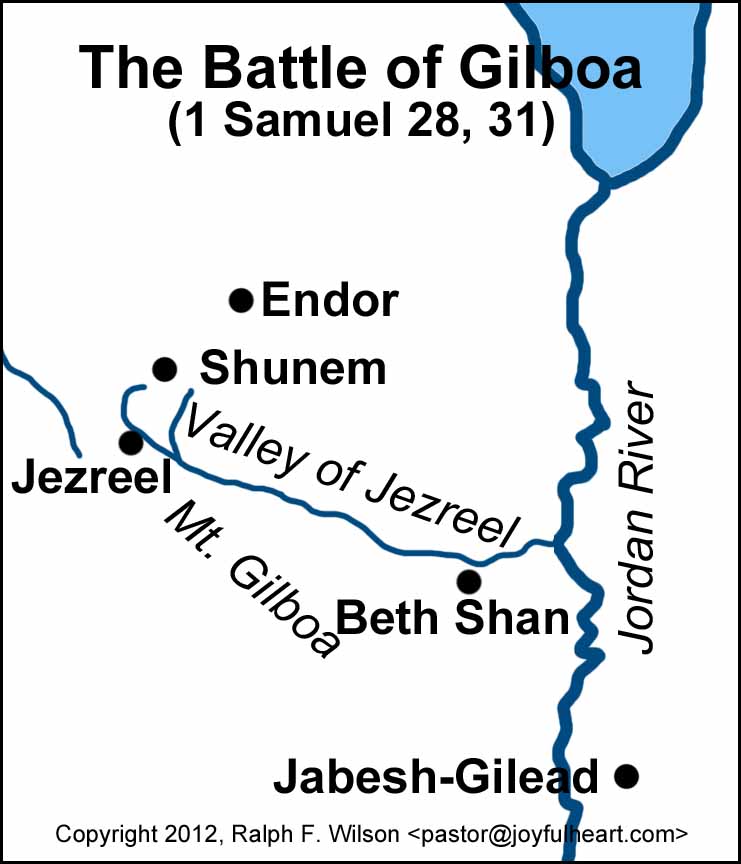
(4) And the Philistines gathered themselves together and came and pitched in Shunem; and Saul gathered all Israel together, and they pitched in Gilboa.

The Philistines gathered and camped at Shunem, and Saul and the Israelites camped at Gilboa.  The two camps were separated by the valley of Jezreel, as seen from this map borrowed from Jesus Walk:


(5) And when Saul saw the host of the Philistines, he was afraid, and his heart greatly trembled. (6) And when Saul enquired of the Lord, the Lord did not answer him, neither by dreams, nor by Urim, nor by prophets.

When Saul saw the Philistines, he was very afraid, and he enquired of the Lord.  However, the Lord had left Saul (1 Samuel 16:14), and He did not answer him, not by dreams, and not by the Urim and Thummim which would have been in the ephod of the priest who was no longer with him for he had killed them all except for Abiathar (1 Samuel 22) who had escaped with the ephod to David (1 Samuel 23:9).  The Lord did not answer Saul through any prophets, either.

(7) Then Saul said to his servants, "Seek me a woman who has a familiar spirit, that I may go to her and enquire of her." And his servants said to him, "Behold, a woman who has a familiar spirit at Endor."

Saul, who had once wisely put out of his country all the wizards and fortune-tellers and the like, now sought one.  His servants told him there was such a woman at Endor, a city in the tribe of Manasseh.  It is interesting to note that the word translated as "enquired" in verse 6 is not the same word translated as "enquire" here.  In verse 6 the original word is "shaal" and means "inquire, ask, demand, beg."  In verse 7 the word is "darash" which means "tread, frequent, usually to follow, by implication to seek or ask, specifically to worship."  It seems to me that the words should have been reversed, but Saul had ceased following the Lord.  Brown-Driver-Briggs Hebrew Definitions adds that "darash" meant to "resort to."  I get the idea that Saul was getting desperate for an answer from a fortune-teller.

(8) And Saul disguised himself and put on other raiment, and he went, and two men with him, and they came to the woman by night. And he said, "I pray you, divine to me by the familiar spirit and bring up for me the one I shall name to you."

Saul disguised himself and put on different clothing than his royal garments, and he went with two men to the woman at night.  He asked that she exercise her art of divination to bring up from the dead the person Saul would ask of her.  It seems necromancy, communicating with the dead, was her particular art.

(9) And the woman said to him, "Behold, you know what Saul has done, how he has cut off those who have familiar spirits and the wizards out of the land; why then do you lay a snare for my life, to cause me to die?"

The woman, not knowing that it was Saul who enquired of her, told him that Saul, the king, had cut off all those with familiar spirits and wizards from the land, so asking her to do this was to put her life in danger.

(10) And Saul swore to her by the Lord, saying, "As the Lord lives, there shall no punishment happen to you for this thing." (11) Then the woman said, "Whom shall I bring up to you?" And he said, "Bring me up Samuel."

Saul swore to the woman by the Lord that no punishment would happen to her, so she asked him who it was he wanted her to bring up from the dead.  He told her he wanted the prophet Samuel.

(12) And when the woman saw Samuel, she cried with a loud voice, and the woman spoke to Saul, saying, "Why have you deceived me? For you are Saul!"

When the woman saw Samuel, she cried out with a loud voice.  It's interesting to note that many of the old commentators I study go to great lengths to explain this was not really Samuel because no one could bring up the dead.  However, if no one could bring up spirits of the dead, then why would the Lord forbid them from doing so?  There is a spirit world that is very real, and the Lord does not want us dabbling in such arts.  It opens the door to dark spirits and those that would pretend to be something they are not to ensnare us.  I think it's possible that the woman may have practiced in deceit and was not accustomed to actually seeing a spirit she called for, and this caused her to cry out.  Actually, since she dealt with "familiar" spirits, perhaps she was used to a spirit that would in turn supposedly communicate with the one she sought.  Whatever the case, she was shocked to see Samuel.  How she knew it was Saul who enquired of her is not explained but it must have been by divine revelation.

(13) And the king said to her, "Do not be afraid, for what did you see?" And the woman said to Saul, "I saw gods ascending out of the earth." 

Saul told the woman not to be afraid, but to tell him what she saw.  Although she said she saw gods, plural, the word she used was "elohiym" which usually refers to the one true God in three persons, if you will, Father, Son, and Holy Spirit.  This was a sight she had never seen before, and she perceived it as magnificent as a god.  

(14) And he said to her, "What is his form?" And she said, "An old man coming up, and he is covered with a mantle." And Saul perceived that it was Samuel, and he stooped with his face to the ground and bowed himself.

Saul asked the woman in what form was the so-called god.  She said it was an old man coming up, covered with a robe.  I have so many questions and thoughts here!  It's obvious by his questions that Saul did not see what the woman saw.  The fact that an old man would "come up" from the ground makes me believe it was a demonic spirit.  But Saul perceived it must be Samuel, and he bowed to the ground before him.  And the idea that Saul would bow before a demonic spirit is a most sad fact as to the state of Saul at this point in his life.

(15) And Samuel said to Saul, "Why have you disquieted me, to bring me up?" And Saul answered, "I am sore distressed, for the Philistines make war against me, and God is departed from me and answers me no more, neither by prophets, nor by dreams; therefore I have called you that you may make known to me what I shall do."

Now scripture states that it was Samuel who spoke to Saul.  He asked why Saul had disquieted him to bring him up.  This cannot be the soul of Samuel as he would be at rest in Abraham's bosom (Luke 16:22) or in heaven (Luke 23:43).  Nothing could disturb or trouble him, and his soul would not be in the ground.  But if it was truly Samuel who spoke to Saul, then I believe it was his body that came forth from the ground, and that could only be by the power of God.  It appears that Samuel appeared before the woman had done anything to bring him forth (verses 11 and 12 above).  God has control over everything and everybody, living or dead, and although He would not answer Saul by prayers or dreams, etc., He had a message for him, but in a way that would make Saul know He was no longer with Him.  Saul told Samuel how the Philistines had made war against him and how God had deserted him, and he had called Samuel to ask him what he should do.

(16) Then Samuel said, "Why then do you ask of me, seeing the Lord is departed from you and has become your enemy?"

Samuel asked Saul why he would ask him what to do as he had been God's prophet, and God had departed from Saul, as he himself knew.

(17) "And the Lord has done to him as He spoke by me, for the Lord has torn the kingdom out of your hand and given it to your neighbor, to David; (18) Because you did not obey the voice of the Lord nor execute His fierce wrath on Amalek, therefore has the Lord done this thing to you this day."

Samuel told Saul that the Lord had done just what He had said He would do (1 Samuel 13:14), for He had torn the kingdom out of his hand and had given it to David.  And that was because Saul had not obeyed the voice of the Lord.  In 1 Samuel 13, Saul had offered an unlawful sacrifice, specifically against the way the Lord had told him to wait to do.  Additionally, the Lord had told Saul to completely destroy the Amalekites, including all their livestock.  However, Saul spared King Agag and the best of the livestock (1 Samuel 15:9).  Therefore the Lord had torn the kingdom away from Saul, rejecting him and not answering him.

(19) "Moreover the Lord will also deliver Israel with you into the hand of the Philistines, and tomorrow you and your sons will be with me; the Lord shall also deliver the host of Israel into the hand of the Philistines."

This specter of Samuel told Saul that the Lord was going to deliver him and his sons, as well as Israel, into the hands of the Philistines.  Even more alarming to Saul, he told him that he and his sons would be with him the next day.  At the very least, it meant they would be dead, but if this was a demon taking on the shape of Samuel which actually Saul couldn't see (verse 14), then it meant they would be in hell.  However, I'm sure that the loving Jonathan would be in heaven, so this could only mean they would be dead.  The hymnist Charles Wesley wrote:

“What do these solemn words portend?
A ray of hope when life shall end.
Thou and thy sons, though slain, shall be
To-morrow in repose with me.
Not in a state of hellish pain,
If Saul with Samuel do remain:
Not in a state of damn’d despair,
If loving Jonathan be there.”

Although a beautiful sentiment, Wesley could not know the fate of Saul and his sons' souls.  But his feeling was that God would have mercy on Saul, and well He might have, and they would all be with Samuel in heaven.  However, that is supposing that this apparition of Samuel was indeed his spirit, and I don't believe it was.  God was allowing this body of Samuel (maybe it was his body, but Saul couldn't see it) or this demonic spirit to tell him that he and his sons would die sometime in the near future, which was sometimes the meaning of the original word "machar" that was translated as "tomorrow."

(20) Then Saul fell straightway all along on the earth and was sore afraid because of the words of Samuel, and there was no strength in him, for he had eaten no bread all the day nor all the night.

Saul fell stretched out on the ground and was very afraid because of the words of Samuel.  There was no strength in him to rise up again because he had not eaten all that day and all that night.

(21) And the woman came to Saul and saw that he was sore troubled, and said to him, "Behold, your handmaid has obeyed your voice, and I have put my life in my hand and have hearkened to your words which you spoke to me. (22) Now therefore, I pray you, hearken you also to the voice of your handmaid, and let me set a morsel of bread before you, and eat that you may have strength when you go on your way."

The woman came to Saul and saw how troubled he was.  She reasoned with him that since she had done what he asked of her and had even put her life in danger by doing it, that he might do what she asked, and let her give him some bread so that he might regain his strength and go on his way.  I am sure she was afraid of what might happen to her if the king was found dead at her place, she being a worker of dark arts that the king himself had banned from the country.

(23) But he refused and said, "I will not eat." But his servants, together with the woman, compelled him, and he hearkened to their voice. So he arose from the earth and sat upon the bed.

Saul at first refused to eat, but his servants and the woman talked him into it.  He got up from off the ground and sat upon a bed.

(24) And the woman had a fat calf in the house, and she hasted and killed it, and took flour and kneaded it, and baked unleavened bread of it. (25) And she brought it before Saul and before his servants, and they ate. Then they rose up and went away that night.

The woman hurried and killed a fat calf she had, dressed it, and made unleavened bread to go along with it.  She brought the meal to Saul and his servants, and they ate and then went on their way that same night.

All the details of how Samuel was able to be brought out of the spirit world to speak to Saul were not given, so we are left to imagine how it happened.  The facts are that there is a spirit world where guardian angels and demons exist.  And Saul did not actually see the being he assumed was Samuel, but as God is supreme over all, He compelled the spirit to tell Saul what He wanted him to hear.  And because our Lord is all-good all the time and desires that all men be saved (1 Timothy 2:4), He most likely was letting Saul know his end was near so that he could repent and make peace with his Maker.  I don't believe any spirit has the ability to know the future; that is something that is only known by God, but as everything and everybody is at His command, even spirits can be compelled to say what He wills them to say.

Sunday, April 12, 2026

David and Abigail

Continuing a chronological Bible study:

(1 Samuel 25:1) And Samuel died, and all the Israelites were gathered together and lamented him and buried him in his house at Ramah. And David arose and went down to the wilderness of Paran.

David had spared Saul's life and returned to his stronghold.  Meanwhile, Samuel had died.  All the Israelites had gathered together to mourn his death, and they buried him at his house in Ramah.  The first 24 chapters of the book of Samuel were thought to have been written by Samuel himself, but obviously he could not have written the rest of 1 Samuel and 2 Samuel after he died.  Those have been attributed to the prophets Nathan and Gad.  

David came out of his hiding place and went down to the wilderness of Paran.  Scripture doesn't say specifically that he went there upon hearing of Samuel's death or that he went there to mourn him.  The wilderness of Paran was far south of Ramah.

(2) And was a man in Maon whose possessions were in Carmel, and the man very great, and he had three thousand sheep and a thousand goats, and he was shearing his sheep in Carmel.

Meanwhile, there was a man in Maon, north of the wilderness of Paran, in the tribe of Judah, who was very wealthy and had 3000 sheep and 1000 goats.  His possessions were in Carmel, just north of Maon, and he was there in Carmel shearing his sheep.

(3) Now the name of the man was Nabal, and the name of his wife, Abigail, a woman of good understanding and of a beautiful countenance, but the man was churlish and evil in his doings, and he was of the house of Caleb.

The name of the man was Nabal, and he was a rude and evil man of the house of Caleb.  Interestingly, his name meant "fool."  His wife was Abigail, and it appears she was a knowledgeable woman with common sense.  She was also beautiful.

(4) And David heard in the wilderness that Nabal was shearing his sheep, (5) And David sent out ten young men, and David said to the young men, "Get up to Carmel, and go to Nabal, and greet him in my name."

David heard that Nabal was shearing his sheep in Carmel, and he sent out ten men to go to Carmel to meet with Nabal and greet him in David's name.

(6) And thus you shall say to him who lives, "Peace to you, and peace to your house, and peace to all that you have. (7) And now I have heard that you have shearers. Now your shepherds who were with us, we did not hurt them, neither was anything missing from them, all the while they were in Carmel."

David told the ten young men to first offer a blessing of peace to Nabal and to his house and all that he had.  Evidently, David had had occasion to be with Nabal's shepherds, probably because the sheep were feeding near the wilderness of Paran which was not far from Maon and Carmel.  David wanted his messengers to tell Nabal this, and to let him know that he and his army had not hurt the shepherds, nor taken anything from them.

(8) "Ask your young men, and they will show you. Therefore, let the young men find favor in your eyes, for we come on a good day. Give, I pray you, whatever comes to your hand to your servants and to your son David."

David, through his messengers, would ask that Nabal ask his own shepherds to verify that he and his army had not harmed them in any way.  Therefore, David hoped one good turn deserved another and his messengers found favor in his eyes.  They had gone to Nabal on a good day when he would be making a feast for his shearers, as was the custom.  David would have his messengers ask if they might be given whatever was at hand that might be spared for David and his men.

(9) And when David's young men came, they spoke to Nabal according to all those words in the name of David and ceased.

David's messengers went to Nabal and told him all that David had told them to say.  Then they waited for Nabal's reply.

(10) And Nabal answered David's servants, and said, "Who is David? And who is the son of Jesse? There are many servants nowadays who break away every man from his master. (11) Shall I then take my bread and my water and my flesh that I have killed for my shearers and give it to men whom I do not know where they are from?"

However, Nabal answered David's servants with haughtiness and disdain.  Could it be that he actually did not know David and Jesse, or was it his way of saying that it meant nothing to him whoever had sent them?  That appears to be the more likely case.  After all, David and Nabal were from the same tribe, and surely he knew the fame of David who had slain his ten thousands (1 Samuel 21:11).  He suggested that David and his men were nothing more than rebellious servants who had broken away from their master, and he would never consider giving any of his food and drink that he had prepared for his own shearers to just anyone from who knows where.

(12) So David's young men turned their way and went again and came and told him all those sayings.

David's messengers left Nabal and went back to David and told him all that Nabal had said.

(13) And David said to his men, "Gird you every man his sword." And they girded on every man his sword, and David also girded on his sword, and there went up after David about four hundred men, and two hundred stayed by the stuff.

David did not take Nabal's rudeness and condescension lightly.  He instructed his men to gird themselves with their swords, which four hundred of them did while the other two hundred remained with their supplies.

(14) But one of the young men told Abigail, Nabal's wife, saying, "Behold, David sent messengers out of the wilderness to salute our master, and he railed on them."

One of Nabal's men told Abigail, Nabal's wife, about David sending messengers to salute her husband.  The original word "barak" that was translated as "salute" means more completely "to bless, to kneel," so David's men had certainly conveyed humility, kindness, and respect toward Nabal.  However, Nabal had berated them with contempt.

(15) "But the men were very good to us, and we were not hurt, neither did we miss anything, as long as we were conversant with them when we were in the fields. (16) They were a wall to us both by night and day all the while we were with them keeping the sheep."

The young man told Abigail how David and his men had been very good to them while they had been in close proximity to them in the wilderness.  They did not hurt them nor take anything from them all the while they were near them in the fields.  As a matter of fact, they had been a wall of protection to them, protecting and defending them against those who might have done them harm.

(17) "Now therefore, know and consider what you will do, for evil is determined against our master and against all his household, for he is a son of Belial that one cannot speak to him."

The young man told Abigail that something bad was about to happen because of how her husband had treated David and his men.  It's interesting that a servant of her husband felt comfortable enough to call him a son of Belial, an evil worthless man, to his wife.  She obviously knew what kind of man her husband was and that no one could speak to him reasonably and rationally.  The man told Abigail to consider what she should do to prevent destruction to her household.

(18) Then Abigail made haste and took two hundred loaves, and two bottles of wine, and five sheep ready dressed, and five measures of parched grain, and a hundred clusters of raisins, and two hundred cakes of figs, and laid them on asses. (19) And she said to her servants, "Go on before me; behold, I come after you." But she did not tell her husband Nabal.

Abigail hurriedly gathered many provisions, loaves, wine, dressed sheep, parched corn, raisins, and fig cakes, and laid them upon donkeys.  She sent her servants on before her, saying she would come after them.  She did not tell her husband Nabal what she was doing.

(20) And it was as she rode on the ass, that she came down by the cover of the hill, and behold, David and his men came down toward her, and she met them.

I believe the sense is that Abigail came on her donkey on the side of the hill under a cover of bushes or trees and saw David and his men before they saw her.  Then she met them.

(21) Now David had said, "Surely in vain have I kept all that he had in the wilderness, so that nothing was missed of all that was his, and he has requited me evil for good. (22) So and more also do God to the enemies of David if I leave of all that is his by the morning light any who pisses against the wall."

David HAD said, so I don't believe he said this to Abigail, but these were the things he had said and was intending to do at that moment.  David felt he had foolishly been good to Nabal's men expecting good in return, but Nabal had returned evil for David's good.  I believe the sense of what David said after that was that he wished the Lord to bless his enemies and perhaps pour evil on himself if he left even one male, man or beast, before the morning.  This was obviously rash and excessive anger on David's part that, and if followed through, would have brought death and destruction to many innocent people.

(23) And when Abigail saw David, she hasted, and lighted off the ass, and fell before David on her face, and bowed herself to the ground, (24) And fell at his feet, and said, "On me, my lord, on me this iniquity! And let your handmaid, I pray you, speak in your audience, and hear the words of your handmaid."

When Abigail saw David, she hurried and dismounted her donkey and fell on her face at David's feet.  She pleaded with him to put all the blame of her husband's actions on her and to allow her to speak in her defense.  She calls him her lord as a sign of respect and reverence to him, probably to atone for her husband's rudeness in speaking of him as a runaway servant (verse 10).

(25) "Let not my lord, I pray you, regard this man of Belial, Nabal, for as his name is, so is he; Nabal his name, and folly with him, but I your handmaid did not see the young men of my lord whom you sent."

Abigail pleaded with David not to pay any attention to such a foolish and worthless man as her husband.  She said he was just as his name indicated, a fool, and therefore his actions were foolish.  However, she said, she had not seen the young men David had sent to her husband.

(26) "Now therefore, my lord, as the Lord lives and your soul lives, seeing the Lord has withheld you from coming to bloodshed and from avenging yourself with your own hand, now let your enemies and they who seek evil to my lord, be as Nabal. (27) And now this blessing which your handmaid has brought to my lord, let it be given to the young men who follow my lord."

Abigail said that as surely as the Lord lived (and David), the Lord had so far withheld David from committing the bloodshed he had intended to avenge himself.  Therefore she prayed a curse upon the enemies of David, either that they be as foolish and utterly impotent to hurt David as was her husband, or that David's anger toward Nabal and his vengeance fall upon his enemies who deserved it more than this foolish man, her husband.  Then as a blessing, she asked that all that she had brought with her (verse 18) be given to David's men.

(28) "I pray you, forgive the trespass of your handmaid, for the Lord will certainly make my lord a sure house, for my lord fights the battles of the Lord, and evil has not been found in you all your days. (29) Yet a man has risen to pursue you and to seek your soul, but the soul of my lord shall be bound in the bundle of life with the Lord your God; and the souls of your enemies, them shall He sling out, as from the middle of a sling."

Abigail asked that David forgive her intrusion in troubling him with her petition.  She either knew the fame of David and that he was blessed by God, or she spoke under influence of the Holy Spirit.  It was probably a bit of both.  She told him that the Lord was going to make an enduring house of David because he fought the battles of the Lord.  She knew no evil had been found in him, yet a man (Saul) had risen up to pursue him and to ultimately kill him.  However, she knew that David's life was bound up in the bundle of life with the Lord, precious to Him, favored and preserved by Him.  But the lives of his enemies the Lord would cast out as quickly and forcefully as a stone slung from a slingshot.

(30) "And it shall come to pass, when the Lord shall have done to my lord according to all the good that He has spoken concerning you, and shall have appointed you ruler over Israel, (31) That this shall be no grief to you, nor offense of heart to my lord, either that you have shed blood without cause, or that my lord has avenged himself. But when the Lord shall have dealt well with my lord, then remember your handmaid."

Abigail continued with her plea to David.  She asked that when the Lord had fulfilled His promise to make him ruler over Israel, that this incident be of no grief or regret to him because he had avenged himself and shed innocent blood without cause.  However, when the Lord had dealt well with David in delivering him out of the hands of his enemies and seating him as king of Israel, she wished for him to remember her and her plea and advice not to shed blood.

(32) And David said to Abigail, "Blessed the Lord God of Israel, who sent you this day to meet me. (33) And blessed is your advice, and blessed are you, because you have kept me this day from coming to bloodshed and from avenging myself with my own hand."

David recognized the hand of the Lord in sending Abigail to meet him and praised Him.  He was also thankful to Abigail for giving him such good advice and preventing him from doing something he would surely have regretted if he had shed innocent blood just to avenge himself because of one foolish man.

(34) "For indeed, as the Lord of Israel lives, who has kept me back from hurting you, except you had hasted and come to meet me, surely there would not have been left to Nabal by the morning light any that pisses against the wall."

David admitted that as surely as the Lord lived, He who had kept David from hurting Abigail, had she not hurried and come to meet him, he would have killed Nabal and all the males of men and beasts in his house and in his employ by morning light.

(35) So David received of her hand what she had brought him, and said to her, "Go up in peace to your house; see, I have hearkened to your voice and have respected your person."

David received the gifts that Abigail had brought on her donkeys.  After all, that is all he had requested of Nabal, even less (verse 8).  He told her to go back to her house in peace for he had respected her and listened to her and had done what she requested.

(36) And Abigail came to Nabal, and behold, he held a feast in his house, like the feast of a king, and Nabal's heart was merry within him, for he was very drunk; therefore, she told him nothing, less or more, until the morning light.

When Abigail returned to her house to Nabal, she found he had held a great feast in his house, and he was very drunk.  Therefore she told him nothing of her encounter with David.

(37) But it came to pass in the morning, when the wine had gone out of Nabal, and his wife had told him these things, that his heart died within him, and he became as a stone.

The next morning, when Nabal was sober again, Abigail told him all that had transpired between her and David.  Nabal, probably terrified at the notion of what he had barely escaped and perhaps feared it might still happen, passed out and became motionless as a stone.

(38) And it came to pass about ten days after, that the Lord struck Nabal that he died.

After being in a comatose state for about ten days, the Lord struck Nabal with death.

(39) And when David heard that Nabal was dead, he said, "Blessed the Lord, who has pleaded the cause of my reproach from the hand of Nabal and has kept his servant from evil, for the Lord has returned the wickedness of Nabal upon his own head. And David sent and communed with Abigail to take her to him as wife.

When David heard that Nabal was dead, he praised the Lord for preventing him from doing evil but taking up his cause Himself and issuing judgment. "'Vengeance is Mine,' saith the Lord" (Romans 12:19).  And the Lord's way was much more just, as He just took out Nabal and no one else in his family or household.  David then sent messengers to Abigail and asked her to be his wife.

(40) And when the servants of David had come to Abigail to Carmel, they spoke to her, saying, "David sent us to you, to take you to him as wife." (41) And she arose and bowed herself on her face to the earth, and said, "Behold, your handmaid, a servant to wash the feet of the servants of my lord."

David had sent servants to Abigail at her home in Carmel, and they told her that David had sent for her to be his wife.  With the same humility she had shown to David when she met with him, Abigail bowed herself before the servants and said she considered herself only worthy to be a servant to wash the feet of David's servants.  It was as Abigail had requested, "...when the Lord shall have dealt well with my lord, then remember your handmaid." (verse 31)  The Lord had Himself dealt with this man who had done David wrong and brought this good woman to him to be his wife.

(42) And Abigail hurried, and arose, and rode on an ass, with five damsels of hers who went after her, and she went after the messengers of David, and became his wife.

Abigail hurried and rode on a donkey after the messengers of David and brought with her five damsels or maidservants who rode after her.  She indeed became David's wife.

(43) David also took Ahinoam of Jezreel, and they were also both of them his wives.

David also took Ahinoam of Jezreel, a town of Judah near Carmel.  This was not the same Ahinoam as was married to Saul (1 Samuel 14:50).  So both Abigail and Ahinoam were David's wives.

(44) But Saul had given Michal his daughter, David's wife, to Phalti, the son of Laish, who was of Gallim.

It seems that Saul had previously given David's wife Michal, who was Saul's daughter, to another man in marriage, Phalti or Phaltiel, as called elsewhere.  David’s taking of two wives could be seen as indicative of his growing power and importance, although he was still being pursued by Saul.

Saturday, November 22, 2025

Saul Tries to Kill David

Continuing a chronological Bible study after a brief interlude of psalms:

(1 Samuel 19:1) And Saul spoke to Jonathan his son and to all his servants that they should kill David.

When we last left Saul in chapter 18, he had become so jealous of David that he hated him and wanted him to die.  He kept putting him out front in battles with the Philistines, hoping they would kill him.  He even tried once to kill him himself, but the more he tried, the more the Lord protected David, and the more the people grew to love David.  David had now married Saul's daughter Michal and as son-in-law to the king, he was next in line for Saul's throne, which of course, the Lord had already given him, but Saul didn't know that part yet, though he suspected it would eventually happen.  After so many failed attempts at trying to kill David, Saul now told his son and his servants to kill him.

(2) But Jonathan Saul's son delighted much in David, and Jonathan told David, saying, "Saul my father seeks to kill you; now therefore, I pray you, take heed to yourself until the morning, and abide in a secret place and hide yourself."

However, Saul did not realize how much even his son Jonathan loved David, and Jonathan told David Saul's plan to kill him.  He pleaded with David to be on guard and hide in a secret place until the morning.

(3) "And I will go out and stand beside my father in the field where you are, and I will speak with my father about you, and what I see, that I will tell you."

Jonathan continued talking to David.  He said that the next day he would stand with his father near the place David was, and he would talk to his father about David and then report back to him what Saul had to say.

(4) And Jonathan spoke good of David to Saul his father, and said to him, "Let not the king sin against his servant, against David, because he has not sinned against you and because his works toward you are very good. (5) For he did put his life in his hand and killed the Philistine, and the Lord wrought a great salvation for all Israel. You saw it and did rejoice. Why then will you sin against innocent blood, to kill David without a cause?"

Jonathan did speak to his father about David.  He reminded him of how David put his life on the line to kill Goliath, and the Lord had brought a great victory and deliverance for Israel.  He reminded his father how he himself had rejoiced.  He urged him not to sin against David who had done nothing wrong to him, and not to spill innocent blood, killing David without a cause.

(6) And Saul hearkened to the voice of Jonathan, and Saul swore, "As the Lord lives, he shall not be slain."

Saul listened to Jonathan and seemed to be affected by the truth of what he had to say and was convicted, at least at the present time, that he was wrong in seeking the life of David, and he would stop trying to kill him.

(7) And Jonathan called David, and Jonathan showed him all those things. And Jonathan brought David to Saul, and he was in his presence as in times past.

Jonathan told David all that Saul had said and brought him back into the palace to Saul where he had been formerly.

(8) And there was war again, and David went out and fought with the Philistines and struck them with a great slaughter, and they fled from him.

Then there was war again with the Philistines, and David went out and fought against them, striking them with a mighty blow and great slaughter that they fled from him.

(9) And the evil spirit from the Lord was upon Saul as he sat in his house with his javelin in his hand, and David played with his hand.

The evil spirit from the Lord came upon Saul again.  David played the harp with his hands to sooth Saul's spirit.  Saul had his javelin in his hand.

(10) And Saul sought to strike David even to the wall with the javelin, but he slipped away out of Saul's presence, and he struck the javelin into the wall, and David fled and escaped that night.

Forgetting his vow in verse 6 not to harm David, again Saul tried to pin David to the wall with his javelin, but David slipped away and fled, escaping that night.

(11) Saul also sent messengers to David's house to watch him and to kill him in the morning, and Michal David's wife told him, saying, "If you do not save your life tonight, tomorrow you shall be slain."

Saul sent his messengers to David's house, which surely was very near or even a part of the palace as David had married the king's daughter, to watch him and to kill him in the morning.  Michal, David's wife, warned him to do something to save his life that night or else he would be killed the next day.

(12) So Michal let David down through a window, and he went and fled and escaped.

Michal let David down through a window, probably on a cord or some such makeshift cord, and David was able to escape in the night without Saul's messengers' knowledge.

(13) And Michal took an image and laid it in the bed and put a pillow of goats' hair for his bolster and covered it with a cloth. (14) And when Saul sent messengers to take David, she said, "He is sick."

Michal took an "image," not merely a picture, but something with substance like a statue, and laid it in David's bed.  She put a pillow of goats' hair under it and covered it with a cloth.  Then when Saul's messengers came into their house in the morning looking for David, she told them he was sick in bed.

(15) And Saul sent the messengers again to see David, saying, "Bring him up to me in the bed that I may kill him."

Saul sent his messengers back to David's house and told them to bring him back to him, bed and all, if he wasn't able to rise, so that Saul could kill him.

(16) And when the messengers had come in, behold, an image in the bed with a pillow of goats' hair for his bolster.

When the messengers went into David's house, they found that all that lay in the bed was a statue with a pillow of goats' hair propping it up.

(17) And Saul said to Michal, "Why have you deceived me so? And sent away my enemy that he has escaped?" And Michal answered Saul, "He said to me, 'Let me go; why should I kill you?'"

Saul asked his daughter why she had deceived him and let his enemy escape, as if she owed more to the wicked passion of her father than she did for her beloved husband.  But rather than telling him that she couldn't allow her husband to be killed, she lied and told her father that David had threatened her if she did not let him go.

(18) So David fled, and escaped, and came to Samuel, to Ramah, and told him all that Saul had done to him. And he and Samuel went and dwelt in Naioth.

David fled to Samuel in Ramah, Samuel being the one who had anointed him king.  He told Samuel all that Saul had done to him, and David and Samuel went and dwelt in Naioth, a place within Ramah, Samuel's home.

(19) And it was told Saul, saying, "Behold, David is at Naioth in Ramah." (20) And Saul sent messengers to take David, and when they saw the company of the prophets prophesying, and Samuel standing as appointed over them, the Spirit of God was upon the messengers of Saul, and they also prophesied.

It was told to Saul that David was in Naioth, so he sent messengers to take David.  However, when they came to David and Samuel, they saw a whole company of prophets prophesying by inspiration of God with Samuel standing over them.  The Spirit of the Lord came upon Saul's messengers, and they, too, began prophesying, forgetting their mission.  "Prophesying" does not always mean foretelling the future; it most often meant telling the Lord's truths, but sometimes those meant telling the future outcome.  In this case, all the prophets and Saul's messengers also, were probably praising God and declaring His truths.

(21) And when it was told Saul, he sent other messengers, and they prophesied likewise. And Saul sent messengers again the third time, and they prophesied also.

When that was told to Saul, he sent more messengers to take David, but they wound up prophesying also, forgetting their mission.  Saul sent messengers a third time, and they, too, wound up prophesying and not bringing David back to Saul.

(22) Then he also went to Ramah and came to a great well in Sechu, and he asked and said, "Where are Samuel and David?" And one said, "Behold, at Naioth in Ramah."

Therefore, Saul went himself to find David but evidently did not know exactly where to go.  He stopped at a well and enquired about the whereabouts of David and Samuel and was told they were at Naioth.

(23) And he went there to Naioth in Ramah, and the Spirit of God was upon him also, and he went on, and prophesied, until he came to Naioth in Ramah.

So Saul went toward Naioth, and the Spirit of the Lord came upon him, too, and he went onward, prophesying, until he came to Naioth in Ramah.

(24) And he also stripped off his clothes and prophesied before Samuel in like manner and lay down naked all that day and all that night. Therefore they say, "Is Saul also among the prophets?"

When he came to Samuel, Saul stripped off his clothes and prophesied before Samuel.  He may not have been completely naked, but enough so to be completely humbled before the Lord.  He lay there like that all day and all night.  That "proverb" that came about in 1 Samuel 10:12, when Saul prophesied in a company of prophets, was revived, as people wondered again if Saul was a prophet.

There is no doubt now, that Saul was David's enemy, not because of anything David had done, but because of Saul's jealousy.  The Lord continued to protect David through his loved ones, Jonathan and Michal, and even by His own arm as he turned all David's enemies into prophets, possibly even prophesying that David would become king!

Sunday, October 19, 2025

David is Secretly Anointed

Continuing a chronological Bible study:

(1 Samuel 16:1) And the Lord said to Samuel, "How long will you mourn for Saul, seeing I have rejected him from reigning over Israel? Fill your horn with oil and go; I will send you to Jesse the Bethlehemite, for I have provided Me a king among his sons."

At the end of the last chapter, the Lord had completely rejected Saul as king over Israel after he had disobeyed the Lord's commandment again.  Samuel had cried to the Lord and still mourned for Saul, how long the scripture doesn't say, but in 1 Samuel 13:14, when Samuel first told Saul his kingdom would not continue, and God had sought a man after his own heart to replace him, David was not yet born.  And now the Lord was telling Samuel to fill his horn with oil to make ready for a journey and go and see Jesse the Bethlehemite, the father of David.  God told Samuel he had made one of Jesse's sons His king.

Something else that struck me about this verse was that the Lord in effect told Samuel to stop mourning because He had rejected Saul.  For one, it was useless to continue mourning when God had made His decision and was not going to change it.  But also, to keep mourning over someone who had rejected God and whom God rejected seems to elevate that person over God.  There comes a time when we must give such people over to God and trust He will deal with them righteously, which He will because He is completely righteous, just, loving, merciful, and all good.  He also wishes all people to be saved, but some people are more hard-headed, and it takes a little more trouble in their lives to turn them.  God knows what they need and we must trust Him to deal with them, and we must turn our attention back to God and what we should be doing for His kingdom.

(2) And Samuel said, "How can I go? If Saul hears, he will kill me." And the Lord said, "Take a heifer with you and say, 'I have come to sacrifice to the Lord.'"

Samuel wondered how he would be able to do what God instructed when surely Saul would kill him if he heard about it.  The Lord told Samuel to take a heifer with him, and if questioned, just say he was going to sacrifice it to the Lord.  In those times, there were occasions when a sacrifice might be made anywhere for different reasons, so that should satisfy Saul.

(3) "And call Jesse to the sacrifice, and I will show you what you shall do; you shall anoint to Me whom I name to you."

The Lord told Samuel to call Jesse to the sacrifice, and He would tell Samuel what to do.  He was to anoint the person whom the Lord named to him at that time.

(4) And Samuel did that which the Lord spoke and came to Bethlehem. And the elders of the town trembled at his coming, and said, "Do you come peaceably?"

Samuel did what the Lord had told him to do, and he went to Bethlehem with a heifer.  The elders of the town were fearful of why Samuel might be coming to them.  As a prophet of the Lord, he might have come to denounce them and bring some judgment on them for their sins.  Therefore, they asked if he had come to them peaceably.

(5) And he said, "Peaceably. I have come to sacrifice to the Lord; sanctify yourselves and come with me to the sacrifice." And he sanctified Jesse and his sons and called them to the sacrifice.

Samuel said he had come peaceably to sacrifice to the Lord, and he invited the elders to sanctify themselves and go with him to the sacrifice.  Sanctifying themselves would probably have consisted of washing themselves and changing to clean garments and preparing their hearts and minds to offer acceptably to the Lord.  Samuel then called Jesse and his sons to sanctify themselves and go to the sacrifice, as well.

(6) And it came to pass, when they had come, that he looked on Eliab and said, "Surely the Lord's anointed is before Him."

When Jesse and his sons came, Samuel took notice of Jesse's oldest son, Eliab, and thought that he must have been the one that God wanted anointed as king.

(7) But the Lord said to Samuel, "Do not look on his countenance or on the height of his stature because I have refused him; for not as man sees, for man looks on the outward appearance, but the Lord looks on the heart."

However, the Lord told Samuel not to look at Eliab's appearance or his height as qualifications for being king.  The Lord had not chosen Eliab because He did not look at the outward appearance of a man, but rather He looked at the heart.

(8) Then Jesse called Abinadab and made him pass before Samuel. And he said, "Neither has the Lord chosen him." (9) Then Jesse made Shammah pass by. And he said, "Neither has the Lord chosen him."

Jesse called his second son, Abinadab, to pass before Samuel, but he said that the Lord had not chosen him.  The same with Jesse's third son, Shammah; Samuel said the Lord had not chosen him either.

(10) Again, Jesse made seven of his sons pass before Samuel. And Samuel said to Jesse, "The Lord has not chosen these." (11) And Samuel said to Jesse, "Are all your children here?" And he said, "There remains yet the youngest, and behold, he keeps the sheep." And Samuel said to Jesse, "Send and fetch him, for we will not sit down till he comes here."

One by one, Jesse had seven of his sons pass before Samuel, but each time Samuel told him the Lord had not chosen them.  He then asked Jesse if all his sons were there.  Jesse told him there was only the youngest left who was tending the sheep.  Samuel told Jesse to send for him, for they would not sit down at the table to eat of that part of the peace offerings which belonged to Samuel as he had offered the sacrifice, and which he had invited Jesse and his sons to partake of, until the youngest son joined them.

(12) And he sent and brought him in. Now he was ruddy and with a beautiful countenance and good-looking. And the Lord said, "Arise, anoint him, for this is he."

Jesse sent for his youngest son, David, and brought him to Samuel.  David had a ruddy complexion and was good-looking with a beautiful countenance.  It's funny, I always thought of ruddy as sort of rough and ruddy or red, more like Esau (Genesis 25:25), whom I pictured red, rough, and hairy.  However, the dictionary definition of ruddy is "having a fresh, healthy red color."  That seems more fitting for young David, fresh-faced and good-looking.  The Lord told Samuel that David was the one He wanted anointed.

(13) Then Samuel took the horn of oil and anointed him in the midst of his brethren, and the Spirit of the Lord came upon David from that day forward. So Samuel rose up and went to Ramah.

Samuel took the horn of oil he had carried with him and anointed David in the midst of his brothers.  Dr. John Gill in his Exposition of the Bible, wrote that the sense was more like he "anointed him from the midst of his brethren," as in he was chosen from the midst of his brothers.  Or I suppose that if he did anoint him in the midst of his brothers, that they had no idea it was because he was to be king, for there was "secrecy with which Samuel was directed to manage this affair, and which was necessary to observe, to keep it from the knowledge of Saul."  The Spirit of the Lord came upon David that day and was with him from that day forward.  Samuel, having done his duty, rose up and went back to Ramah.

(14) But the Spirit of the Lord departed from Saul, and an evil spirit from the Lord troubled him.

However, the Spirit of the Lord departed from Saul.  It's not as if the Lord had only so much Spirit to give, and when He gave it to David, it must come from Saul.  But David was now God's chosen leader, His anointed, and Saul no longer was because of his disobedience.  An evil spirit then troubled Saul.  It is said to be from the Lord, but I imagine that just withdrawing His Holy Spirit would make Saul susceptible to evil spirits.  I think of it as like it was for Job; God gave Satan permission to torment him.  God doesn't have an evil spirit, but evil spirits are definitely under His command, and He could call them at any time to exact His purposes. 

(15) And Saul's servants said to him, "Behold now, an evil spirit from God troubles you. (16) Let our lord command your servants before you to seek out a man, a skillful player on a harp, and it shall come to pass, when the evil spirit from God is upon you, that he shall play with his hand, and you shall be well."

Saul's servants observed that he was troubled by an evil spirit.  They asked that they be allowed to seek out a harpist who would play when the evil spirit was upon him, as “music hath charms to sooth the savage breast.”

(17) And Saul said to his servants, "Provide me now a man who can play well and bring him to me." (18) Then answered one of the servants, and said, "Behold, I have seen a son of Jesse the Bethlehemite who is skillful in playing, a mighty valiant man, a man of war, prudent in matters, a handsome person, and the Lord is with him."

Saul told his servants to find him such a man.  One of his servants said he knew of a son of Jesse who was skillful in playing, as well as a valiant man of war who spoke well and was handsome, and most of all, the Lord was with him.  He had all the qualities that would make him fit to be in the palace of the king.  I find it interesting that the servants could tell that the Lord was with David, and that He had sent an evil spirit to Saul.  They could discern spirits, and it seemed just a simple matter of fact.

(19) Therefore Saul sent messengers to Jesse, and said, "Send me David your son, who is with the sheep." (20) And Jesse took a donkey with bread, a bottle of wine, and a kid, and sent them by David his son to Saul.

Saul sent messengers to Jesse and told him to send his son David to him.  Jesse took a donkey and loaded on it bread, a bottle of wine, and a kid goat, as gifts to the king, and he sent David with them to Saul.

(21) And David came to Saul and stood before him, and he loved him greatly, and he became his armor bearer. (22) And Saul sent to Jesse, saying, "Let David, I pray you, stand before me, for he has found favor in my sight."

When David came before Saul, the king was very pleased with him, and he put him into his service.  The original word "keliy" that was translated as "armor" actually was transcribed most often as "vessel" or "instrument."  There is no evidence that David was an armor bearer for Saul, so it is most likely that he became a personal servant to Saul, bearing household vessels, or it may just be that he was a bearer of musical instruments.  Saul sent word to Jesse asking that David be allowed to stay with him as he had found favor with him.

(23) And it came to pass, when the spirit from God was upon Saul, that David took a harp and played with his hand, so Saul was refreshed and was well, and the evil spirit departed from him.

David did stay with Saul, and whenever the evil spirit came upon Saul, David would play his harp for him, and Saul would become refreshed and well, and the evil spirit left him.  Certainly, it appears that Saul knew nothing of David's being anointed as his successor.  I believe it can be safely assumed that his anointing was done privately.  Had even his brothers known that David was to be king, that word would have spread quickly.

Tuesday, October 14, 2025

The Lord Rejects Saul

Continuing a chronological Bible study:

(1 Samuel 15:1) Samuel also said to Saul, "The Lord sent me to anoint you king over His people, over Israel; now therefore, hearken to the voice of the words of the Lord."

At the end of the last chapter, we were told how Saul re-established his kingdom over Israel after Jonathan's victory.  Saul fought his enemies on all sides, including the Moabites, the Ammonites, the Edomites, and the Philistines, defending Israel against them.  He assembled an army and struck the Amalekites, delivering Israel out of the hands of all who plundered them. It may be that Samuel spoke to Saul sometime before he struck the Amalekites, judging by what comes next.  Samuel told Saul that the Lord had sent him to anoint him as king over His people, therefore Saul had an obligation to listen to and obey the commands of the Lord.

(2) "Thus says the Lord of hosts, 'I remember what Amalek did to Israel, how he laid wait for him on the way, when he came up from Egypt. (3) Now go and strike Amalek and utterly destroy all that they have, and do not spare them, but kill both man and woman, infant and suckling, ox and sheep, camel and donkey.'"

Samuel told Saul the words of the Lord of all hosts, the heavenly host of angels, Israel's army, and all the armies of the world.  He remembered what the Amalekites had done to Israel when they were coming out of Egypt when they were faint and weary (Exodus 17:8).  In Deuteronomy 25:17-19, God retold about the event, about how the Amalekites killed the most feeble of the Israelites who lagged behind the others.  God said then that when Israel had been given rest in their promised land, He would blot out the remembrance of Amalek from under heaven.  It seems the time was now, some four hundred years later!  He told Saul to utterly destroy the Amalekites, not sparing any of them, not man, woman, child, or any of their animals.  All were to be totally wiped out.

(4) And Saul gathered the people together and numbered them in Telaim, two hundred thousand footmen and ten thousand men of Judah.

Saul gathered the people together in a place called Telaim, which may be Telem in Judah (Joshua 15:24).  He assembled two hundred thousand footmen and another ten thousand men from Judah.  As has been discussed before, Samuel probably wrote these accounts later in his life and after a time when Israel and Judah were two separate kingdoms.

(5) And Saul came to a city of Amalek and laid wait in the valley. (6) And Saul said to the Kenites, "Go, depart, get down from among the Amalekites, lest I destroy you with them; for you showed kindness to all the children of Israel when they came up out of Egypt. So the Kenites departed from among the Amalekites.

Saul and his army went to a city in Amalek and laid wait in the valley.  The Kenites were not Israelites but were on friendly terms with the Israelites.  They were apparently living among the Amalekites, and Saul sent word to them to get away from the Amalekites so they would not be destroyed with the Amalekites, and that was because they had shown kindness to Israel when they came out of Egypt.  Jethro, Moses's father-in-law had been a Kenite, and these people were likely his posterity.  The Kenites heeded Saul's warning and departed from the Amalekites.

(7) And Saul struck the Amalekites from Havilah to when you come to Shur that is across from Egypt. (8) And he took Agag the king of the Amalekites alive and utterly destroyed all the people with the edge of the sword.

Saul struck the Amalekites from one end of their country to the other, from Havilah in the northeast to Shur in the southwest.  He utterly destroyed all the people, at least the ones he came across in the land; it seems some escaped as we will hear about the Amalekites again.  However, Saul did spare the king of the Amalekites, Agag.

(9) But Saul and the people spared Agag, and the best of the sheep, and of the oxen, and of the fatlings, and the lambs, and all that was good, and would not utterly destroy them. But everything vile and wasted, that they destroyed utterly.

The Lord had said to destroy absolutely every living thing, but Saul saved all the best of the animals, and I suppose you could say the best of the people, the king.  Anything that was good, and I imagine useful to Saul, he would not destroy, but anything defective and not good, he did destroy.

(10) Then came the word of the Lord to Samuel, saying, (11) "It repents Me that I have set up Saul as king, for he has turned back from following Me and has not performed My commandments." And it grieved Samuel, and he cried to the Lord all night.

The Lord spoke to Samuel.  Repent means to change, reverse course.  When people repent of their wrongdoing, they have a change of heart, they are sorrowful for what they have done, they confess their wrongdoing, and they change their ways.  The Lord's nature does not change; He does no wrong, and His heart never changes.  What does change is how He deals with matters.  He showed kindness and mercy to Saul as he was once a fine and good man (1 Samuel 9:2), and he must have followed the Lord initially for the Lord said that he had now turned away from following Him.  The Lord would now change His purpose for Saul and how He would deal with him because he had turned from the Lord and did not obey His commandments.  It's the way the Lord blessed His people when they did good and chastised them when they sinned.  His love for them never changed, but how He dealt with them did.

The Lord knew all along what Saul would do; nothing takes Him by surprise so that He must change course.  The change is written the way it is for our benefit, for our instruction.  God knew all along that Saul was just a placeholder for David, the king He wanted for Israel, a man after His own heart (Acts 13:22).  Actually, the Lord had already changed the course for Saul in 1 Samuel 13:14 when He through Samuel told Saul his kingdom would not continue because he had not kept God's commandment.  So He actually never changed, but He was letting Samuel know how he dealt with Saul was about to change.  It grieved Samuel very much, and he cried to the Lord all night.

(12) And when Samuel rose early to meet Saul in the morning, it was told Samuel, saying, "Saul came to Carmel, and behold, he set him up a place and is gone about and passed on and gone down to Gilgal.

Samuel rose up early the next morning to meet Saul, but he was told that Saul was not there.  He was told that Saul had come to Carmel in Judah which would have been on his way back from Amalek.  He had set up a "place" for himself there.  The original word "yad" literally means "hand."  Maybe "hand" didn't make sense to the KJV translators, so they used a generic "place."  But this probably was some sort of hand as a monument to himself; "he set him up a hand."  The hand represented power, strength, dominion, or even direction, so it could have pointed to the place where Saul had gained his victory.  From Carmel, it sounds as if he did not make a straight trek back, but went here and there, probably in some sort of celebratory manner, and then went to Gilgal where he probably expected to meet Samuel there.

(13) And Samuel came to Saul, and Saul said to him, "Blessed you of the Lord; I have performed the commandment of the Lord."

Samuel came to Saul, and Saul greeted him, calling him blessed of the Lord because he had sent him on a great mission and he had succeeded.  It's remarkable that he thought he had performed the commandment of the Lord.  Either he really did think that doing 90% of the Lord's commandment was performing well, or he knew he had not completely obeyed God's commandment, and he was lying to Samuel to save himself from Samuel's reproof.

(14) And Samuel said, "What then is this bleating of the sheep in my ears and the lowing of the oxen which I hear?" (15) And Saul said, "They have brought them from the Amalekites, for the people spared the best of the sheep and of the oxen to sacrifice to the Lord your God, and the rest we have utterly destroyed."

If Saul had performed the commandment of the Lord, which was to utterly destroy every living thing (verse 3), then why did Samuel hear the bleating of sheep and lowing of oxen?  Notice Saul said "they" had brought them back from the Amalekites.  He seems to always shift the blame to someone else.  "The people" had spared the best of the sheep and oxen to sacrifice to the Lord, something He had not asked for and had strictly commanded against.  But they all utterly destroyed the rest of the livestock.  Also I have noticed that Saul always seems to say, "the Lord your God."  He doesn't say "the Lord our God" or "the Lord my God."  I can't help but think it was his way of trying to manipulate Samuel's feelings by saying all he did was for his Lord.  "You wouldn't want to take from your Lord, would you?"

(16) Then Samuel said to Saul, "Stay, and I will tell you what the Lord has said to me this night." And he said to him, "Say on." (17) And Samuel said, "When you were little in your own sight, were you not made the head of the tribes of Israel, and the Lord anointed you king over Israel?"

Samuel told Saul he wanted to tell him what the Lord had spoken to him that night before.  He reminded Saul that when he was little in his own sight, as he had said in 1 Samuel 9:21, that he was of the smallest tribe and of the least of the families in his tribe, God had made him king over Israel.

(18) "And the Lord sent you on a journey, and said, 'Go and utterly destroy the sinners, the Amalekites, and fight against them until they are consumed.' (19) Why then, did you not obey the voice of the Lord, but did fly upon the spoil and did evil in the sight of the Lord?"

Samuel continued relaying how the Lord had then sent Saul on a mission to utterly destroy the Amalekites until every living thing was consumed.  He asked Saul why he did not obey the command of the Lord, but seized upon the spoil of the Amalekites and therefore had done evil in the sight of the Lord by disobeying Him.

(20) And Saul said to Samuel, "Yes, I have obeyed the voice of the Lord and have gone the way which the Lord sent me and have brought Agag the king of Amalek and have utterly destroyed the Amalekites. (21) But the people took of the spoil, sheep and oxen, the chief of the things which should have been utterly destroyed, to sacrifice to the Lord your God in Gilgal."

Incredibly, Saul told Samuel that he had obeyed the Lord, but it was those people who took the spoil that he knew should have been destroyed, but it was to sacrifice to Samuel's Lord, a good thing, right?  Even though he said he had obeyed the Lord, he admitted that he had spared the king of the Amalekites and brought him back.  Saul may have thought he had done what was most important to the Lord, and that was what should be important to Samuel, but at the very least, Saul showed a careless respect for the Lord and His commands.

(22) And Samuel said, "Has the Lord delight in burnt offerings and sacrifices, as in obeying the voice of the Lord? Behold, to obey is better than sacrifice, to hearken than the fat of rams. (23) For rebellion is the sin of witchcraft, and stubbornness is iniquity and idolatry. Because you have rejected the word of the Lord, He has also rejected you from king."

Samuel asked Saul if he thought the Lord had more delight in burnt offerings and sacrifices, or rather in obedience to Him.  Then he said rebellion was witchcraft, or divination, which is how the original word "qesem" was usually translated.  Either word refers to seeking knowledge by occult means and from a spirit other than God.  Samuel said that stubbornness was a sin and idolatry.  It's the idolatry of oneself, judging himself to be more knowledgeable than God at a given moment.  I can't help but think of the current times when everything seems acceptable.  Surely God didn't know how the times would change, and divorce, abortion, same-sex marriage, etc., would demand different rules--man elevating himself over God.  Samuel told Saul that because he had rejected the word of the Lord, God had rejected him as king.

(24) And Saul said to Samuel, "I have sinned, for I have transgressed the commandment of the Lord and your words because I feared the people and obeyed their voice."

Saul told Samuel he recognized that he had sinned against the commandment of the Lord, but it was because he feared the people.  Once again he blamed the people.  He admitted that he feared the people more than he did the Lord.  Actually, I don't believe that was really true; he just wanted to lay the blame elsewhere.  "I have sinned, but..."  Anytime there is a "but," it negates what came before it.

(25) "Now therefore, I pray you, pardon my sin and turn again with me, that I may worship the Lord." (26) And Samuel said to Saul, "I will not return with you, for you have rejected the word of the Lord, and the Lord has rejected you from being king over Israel."

Saul asked Samuel to pardon his sin and continue with him to Gilgal to worship the Lord, possibly in offering sacrifice to Him to atone for his sin.  However, Samuel told him he would not go with him because he had rejected the word of the Lord, and the Lord had therefore rejected him as king over Israel.  Samuel had not seen any true repentance of Saul, and he left him for the Lord to deal with, as we sometimes have to do.  Ephesians 5:11 says to have no fellowship with the unfruitful works of darkness but reprove them.  There comes a point when a person's fruits or actions show what is really in his heart, and we can no longer have fellowship with that person, but it doesn't mean we can't still love and pray for him.  However, several places in the Bible tell us how keeping company with sinners will eventually corrupt and harm us:

Do not be unequally yoked together with unbelievers. For what fellowship has righteousness with lawlessness? And what communion has light with darkness? (2 Corinthians 6:14)

Be not deceived: Evil companionships corrupt good morals. (1 Corinthians 15:33)

...Do you not know that friendship with the world is enmity with God? Whoever therefore wants to be a friend of the world makes himself an enemy of God. (James 4:4)

A violent man entices his neighbor and leads him in a way that is not good. (Proverbs 16:29)

And do not be conformed to this world, but be transformed by the renewing of your mind, that you may prove what is that good and acceptable and perfect will of God. (Romans 12:2)

And many more, but once again, this does not mean we have nothing to do with sinners.  We are all sinners, and Jesus associated with sinners, fortunately for us!  But He didn't live with the sinners; they weren't His closest disciples.  That is the point.  He loved and helped sinners; He encouraged us to love and help them.  But He would tell them to go and sin no more.  And He also said whoever would not receive you or hear your words, shake the dust off your feet of that place and leave.  And that doesn't mean you won't come back to see or talk to that person again, especially if it is someone close, but the danger comes when you commune with that person continually, and you begin to accept his sin as okay which shows approval of it, and before you know it, you find yourself slipping into his ways.  With that, one last verse:

The highway of the upright is to depart from evil; he who keeps his way preserves his soul. (Proverbs 16:17)

Sometimes you just have to remove yourself from bad company and friends and not associate with them anymore in order to save your own soul.

(27) And as Samuel turned around to go away, he laid hold on the skirt of his robe, and it tore. (28) And Samuel said to him, "The Lord has torn the kingdom of Israel from you this day and has given it to a neighbor of yours, better than you. (29) And also the Strength of Israel will not lie or repent, for He is not a man that He should repent."

As Samuel turned around to leave, Saul grabbed hold of his robe to detain him.  Since it only says "he" and "his," we can't be positive that it wasn't Samuel who tore his own robe or that he might have torn Saul's robe.  Any way that it happened had the same meaning.  Samuel told Saul it was a sign that the Lord had torn the kingdom of Israel away from him and had given it to a better man than he was, a neighbor of his.  The Lord was the Strength of Israel.  Undoubtedly, little Israel could never in history have made it this far without God's mighty hand.  Samuel told Saul that the Lord did not lie when He said He was taking the kingdom away from Saul, and He would not change His mind the way a mere man might.

(30) Then he said, "I have sinned; honor me now, I pray you, before the elders of my people and before Israel and turn again with me that I may worship the Lord your God." (31) So Samuel turned again after Saul, and Saul worshipped the Lord.

Saul acknowledged he had sinned, and there was no "but" this time or blaming of others.  He acknowledged that he himself had sinned, and he asked that Samuel stay with him to worship the Lord.  However, note that it was to not embarrass him among the people of Israel.  Once again, it was all about Saul.  However, there was probably some wisdom in that, that the people not totally reject Saul until the Lord raised up David who may not have even been born yet.  That seems a plausible reason for why Samuel turned back to Saul, after all.  Besides, Saul was begging, and Samuel was a good and Godly man.  Samuel stayed with Saul while he worshipped the Lord.  Note that scripture didn't say that Samuel worshipped the Lord with Saul.  I'm sure he didn't agree with the things Saul did and said in his worship, so he allowed those things to be between Saul and his Lord.

(32) Then Samuel said, "Bring here to me Agag the king of the Amalekites. And Agag came to him cautiously. And Agag said, "Surely the bitterness of death is past." (33) And Samuel said, "As your sword has made women childless, so shall your mother be childless among women." And Samuel hewed Agag in pieces before the Lord in Gilgal.

Then Samuel told Saul to bring Agag, the king of the Amalekites whom Saul had spared, to him.  Agag came forward to Samuel cautiously and seemed to suggest that all the death and violence could be put behind them, and perhaps his life could be spared.  However, Samuel told him that just as his sword had made women childless, he was going to make Agag's mother childless, and he proceeded to chop Agag to pieces.  He did this before the Lord; he finished the job that God had commanded Saul do.

(34) Then Samuel went to Ramah, and Saul went up to his house to Gibeah of Saul. (35) And Samuel came no more to see Saul until the day of his death. Nevertheless, Samuel mourned for Saul, and the Lord repented that He had made Saul king over Israel.

Then Samuel left and went back to his residence in Ramah, and Saul went to his place in Gibeah.  Samuel never again went to see Saul, but he still mourned for him and probably prayed for him.  Just as discussed above, one can still love and care and pray for someone without being his constant companion.  Once again, we have that word "repent."  Samuel just said that the Lord did not repent (verse 29).  However, I believe the context is that the Lord does not repent the way man repents.  Our dictionary definition of "repent" is "to feel sorry, self-reproachful, or contrite for past conduct; regret or be conscience-stricken about a past action, attitude, etc."  Obviously, the Lord does not do that.  The Biblical meaning does mean that for people who have a change of heart and repent for their sins.  But another meaning is to merely change direction.  That's what the Lord did.  He changed direction from having Saul as king to making David king.

Wednesday, October 1, 2025

Invasion of the Philistines and King Saul's First Great Error

Continuing a chronological Bible study:

(1 Samuel 13:1) Saul reigned one year, and when he had reigned two years over Israel, 

Before the parenthetical chapter of Samuel's address to the people in chapter 12, the people had come to accept Saul as their rightful king after he had defeated the Ammonites, and he was made king officially (again) in 1 Samuel 11:15.  Since then he had reigned one year with nothing in it worth recording, but after he had reigned two years over Israel, the following occurred:

(2) Saul chose him three thousand of Israel; two thousand were with Saul in Michmash and in Mount Bethel, and a thousand were with Jonathan in Gibeah of Benjamin, and the rest of the people he sent every man to his tent.

Saul chose three thousand men of the men of Israel.  Two thousand were under Saul's command and he placed them at Michmash and at Mount Bethel, with probably one thousand in each place.  A thousand men were with Jonathan, who we will learn was Saul's son, and they were at Gibeah.  Saul sent the rest of the people back to their tents.  This map borrowed from Precept Austin shows the three posts occupied by the three thousand men across from Philistia:


(3) And Jonathan struck the garrison of the Philistines in Geba, and the Philistines heard. And Saul blew the trumpet throughout all the land, saying, "Let the Hebrews hear!"

Jonathan and his men struck a garrison of the Philistines that was in Geba, which was between Gibeah and Michmash, seen in the inset of the map above.  The Philistines heard about it, which led Saul to blow the trumpet, or order it to be blown throughout the land to let the people know that the Philistines were preparing to attack.

(4) And all Israel heard it said Saul had struck a garrison of the Philistines, and Israel had also become an abomination to the Philistines. And the people were called together after Saul to Gilgal.

All Israel heard that Saul had struck a garrison of the Philistines.  Although it had actually been Jonathan and his men, they were undoubtedly directed by Saul.  That had made the Philistines filled with hate for the Israelites which might lead to severe retribution.  Therefore the people were called to Saul at Gilgal east of where their posts were.

(5) And the Philistines gathered themselves together to fight with Israel, thirty thousand chariots, and six thousand horsemen, and people as the sand on the seashore in multitude, and they came up and pitched in Michmash eastward from Beth Aven.

The Philistines gathered themselves together to fight against Israel, with thirty thousand chariots, six thousand horsemen, and people as numerous as sand on the seashore.  They pitched at Michmash which is where Saul had had his men until he went to Gilgal.  Michmash was to the east of Beth Aven which was said to be east of Bethel.

(6) When the men of Israel saw that they were in danger (for the people were distressed), then the people hid themselves in caves, in thickets, in rocks, in high places, and in pits.

The men of Israel saw that they were in danger.  The probable interpretation of the parenthetical part is that the Philistine people were distressing the Israelites, and they saw they were in danger and hid themselves in various places.

(7) And some of the Hebrews went over Jordan to the land of Gad and Gilead. As for Saul, he was still in Gilgal, and all the people following him, trembling.

Some of the Israelites went as far as east of the Jordan River to Gad and Gilead.  Saul stayed in Gilgal, which appears to be one of those times he was supposed to stay there until Samuel came to him to give him advice and counsel (1 Samuel 10:8).  The people following him, probably his army of two thousand (verse 2) stayed with him, but with trembling hearts.

(8) And he tarried seven days, according to the time set by Samuel, but Samuel did not come to Gilgal, and the people were scattered from him.

Saul indeed waited for seven days as he had been directed by Samuel, but Samuel did not come.  Saul's people were scattering and deserting him.

(9) And Saul said, "Bring here a burnt offering to me, and peace offerings." And he offered the burnt offering.

Saul ordered animals be brought to him for a burnt offering and for peace offerings, and he offered the burnt offering, which would not have been his place to do.  He had been instructed to wait for Samuel to make the offerings (1 Samuel 10:8).

(10) And it came to pass, that as soon as he had made an end of offering the burnt offering, behold, Samuel came, and Saul went out to meet him that he might salute him.

As soon as Saul had finished his burnt offering, he saw Samuel coming, and he went out to meet and greet him.  The fact that Samuel appeared so soon after Saul quit waiting tells me that Saul was a bit too impatient and rushed the time.  If this was the seventh day, he should have waited until the end of that day, as Samuel did indeed show up that day.

(11) And Samuel said, "What have you done?" And Saul said, "Because I saw that the people were scattered from me, and you did not come within the days appointed, and the Philistines gathered themselves together at MichMash; (12) Therefore I said, 'The Philistines will come down now upon me to Gilgal, and I have not made supplication to the Lord.' I forced myself therefore and offered a burnt offering."

Samuel asked Saul what he had done as he obviously saw that Saul had sacrificed without him.  Saul said that because he saw his men deserting him, and Samuel had not come in the appointed time, and the Philistines were gathering themselves against him, he felt he would soon be overtaken by the Philistines, so he "forced" himself to offer a burnt offering.  

Lots to unpack there.  First of all, as it was the same day, Samuel had come in the appointed time.  Saul had been either impatient or fearful or both.  If he was impatient, then he showed himself to be disrespectful and even arrogant.  He knew he had done wrong or he wouldn't have made so many excuses, and one of his excuses was to blame Samuel for not coming on time.  The fact that he said he "forced" himself sounds like while he tried to knock Samuel down a notch, he was trying to raise himself up a notch, insinuating that he knew what he was supposed to do, but because of Samuel's delay, he had to force himself to go against what Samuel had told him.  If he was just plain afraid of the Philistines, then he lacked faith in God that He would protect him if he did what God had asked of him through Samuel.  There are many Bible verses that speak of patience and waiting on the Lord and His timing, but these seem to sum up Saul and his situation perfectly:

(Psalm 27:14) Wait on the LORD; be of good courage, and He shall strengthen your heart; wait, I say, on the LORD.

(Proverbs 20:22) Do not say, “I will recompense evil;" wait on the LORD, and He shall save you. 

(Psalm 37:34) Wait on the LORD, and keep His way, and He shall exalt you to inherit the land; when the wicked are cut off, you shall see.

Saul said he had not made supplication (verse 12), so he offered the burnt offering.  He could have made supplication to the Lord without the offering.  Had he prayed to the Lord, the Lord would have strengthened his heart to enable him to wait longer.  Had he not rushed to do something about the Philistines and had waited as he was supposed to, the Lord would save him.  Had he waited on the Lord and did as he had been instructed, the Lord would exalt him and his kingdom.  Impatience and lack of faith in God were not good qualities in a king.

(13) And Samuel said to Saul, "You have done foolishly. You have not kept the commandment of the Lord your God which He commanded you, for now would the Lord have established your kingdom on Israel forever."

Indeed, Samuel told Saul that he had acted foolishly.  If he had kept the commandment of the Lord which Samuel had told him, the Lord would have established his kingdom forever.  Had he waited as he was supposed to, the Lord would have exalted him (Psalm 37:34 above).

(14) "But now your kingdom shall not continue. The Lord has sought Him a man after His own heart, and the Lord has commanded him to be captain over his people because you have not kept that which the Lord commanded you."

Samuel told Saul that because he had not done what the Lord through Samuel told him to do, his kingdom would not continue.  The Lord had sought another to reign over His people.  According to this wonderful timeline found at Biblical Archeology, David wasn't even born yet when Samuel uttered this prophecy about the Lord choosing David, a man after His own heart (Acts 13:22):


(15) And Samuel arose and got himself up from Gilgal to Gibeah of Benjamin. And Saul numbered the people present with him, about six hundred men.

Samuel rose up and went from there at Gilgal (verse 7) to Gibeah.  Note that he didn't tell Saul what he should do about his predicament.  That had been the reason Saul was supposed to go to Gilgal and wait on Samuel to show him what he should do (1 Samuel 10:8).  Saul took the opportunity to number the people who were still with him, and they numbered six hundred men.

(16) And Saul, and Jonathan his son, and the people present with them, abode in Gibeah of Benjamin, but the Philistines encamped in Michmash.

Saul, his son Jonathan, and the six hundred men present with them, also went to Gibeah where they abode while the Philistines were encamped at Michmash.

(17) And the spoilers came out of the camp of the Philistines in three companies; one company turned to the way to Ophrah, to the land of Shual, (18) And another company turned the way to Beth Horon, and another turned to the way of the border that looks to the valley of Zeboim toward the wilderness.

The Philistines sent out three companies of soldiers to ravage and spoil the land, demonstrating how useless the Israelite king that the people had so wanted, really was.  God allowed this to convince the people of their vain confidence in a king when their trust should have been in their Lord God.  Never was their country more exposed to violence and plunder than it was at that time under their king.

(19) Now there was no smith found throughout all the land of Israel, for the Philistines said, "Lest the Hebrews make swords or spears." (20) But all the Israelites went down to the Philistines to sharpen every man his share, and his hoe, and his axe, and his pickaxe. (21) Yet they had a file for the pickaxes, and for the hoes, and for the forks, and for the axes, and to sharpen the goads.

Because the Philistines ruled over the Israelites at that time, they did not allow Israel to have a blacksmith because they were afraid they would make weapons.  The Israelites were forced to go to the Philistines to have their tools sharpened.  However, the Israelites were permitted to have files or some blunt instrument, as that is what the original word suggests, "bluntness."

(22) So it came to pass in the day of battle, that there was neither sword nor spear found in the hand of any of the people with Saul and Jonathan, but with Saul and with Jonathan his son, there was found.

Because the Philistines did not allow the Israelites to have a blacksmith, none of the men with Saul had a sword or a spear.  However, Saul and Jonathan did, but they were the only ones.

(23) And the garrison of the Philistines went out to the passage of Michmash.

I believe the sense is that the Philistine post was moving outward from Michmash to the way leading to it, which meant they were also moving closer to Saul and his small army.

It's not looking too well for King Saul and the people who had depended on him.  This chapter ends with a cliffhanger that will conclude in the next chapter.