Showing posts with label KJV. Show all posts

Sunday, October 19, 2014

The Tree of Life, the Lord Who Heals You

Continuing a personal Bible study I am doing with the chronological order set forth by Skip Andrews:

(Exodus 15:22) So Moses brought Israel from the Red Sea, and they went out into the wilderness of Shur; and they went three days in the wilderness, and found no water.

Moses had just brought the children of Israel through the Red Sea by the miraculous parting of it by God.  They now came from the Red Sea and went into the wilderness of Shur.  They went three days in the wilderness and had found no water.

(Numbers 33:8) And they departed from before Pi Hahiroth and passed through the midst of the sea into the wilderness, and went three days' journey in the wilderness of Etham, and camped in Marah.

Numbers 33:8 gave a little more detail about exactly where the Israelites had been and were now.  Before they went through the Red Sea, they had journeyed from Succoth and had camped at Etham at the edge of the wilderness (Exodus 13:20).  Then the Lord told Moses to turn and camp near Pi Hahiroth, between Migdol and the sea (Exodus 14:2).  When they left Pi Hahiroth, they passed through the midst of the Red Sea into the wilderness on the other side, also apparently called the wilderness of Etham, and they camped at Marah.

Some have speculated that since scripture said they had previously camped at Etham, "supposedly" crossed the Red Sea, and returned to Etham, that there probably was not a miraculous crossing of the Red Sea, or at the very least, they went into the sea and came right back out where they went in.  I have found a couple of good explanations for this.  Actually, the wilderness surrounding the Aqaba Peninsula of the Red Sea, which is where the Israelites most likely crossed, is surrounded by wilderness, and this old map shows that it could be a wilderness by the same name on both sides:

http://www.covenantkeepers.co.uk/red_sea.htm

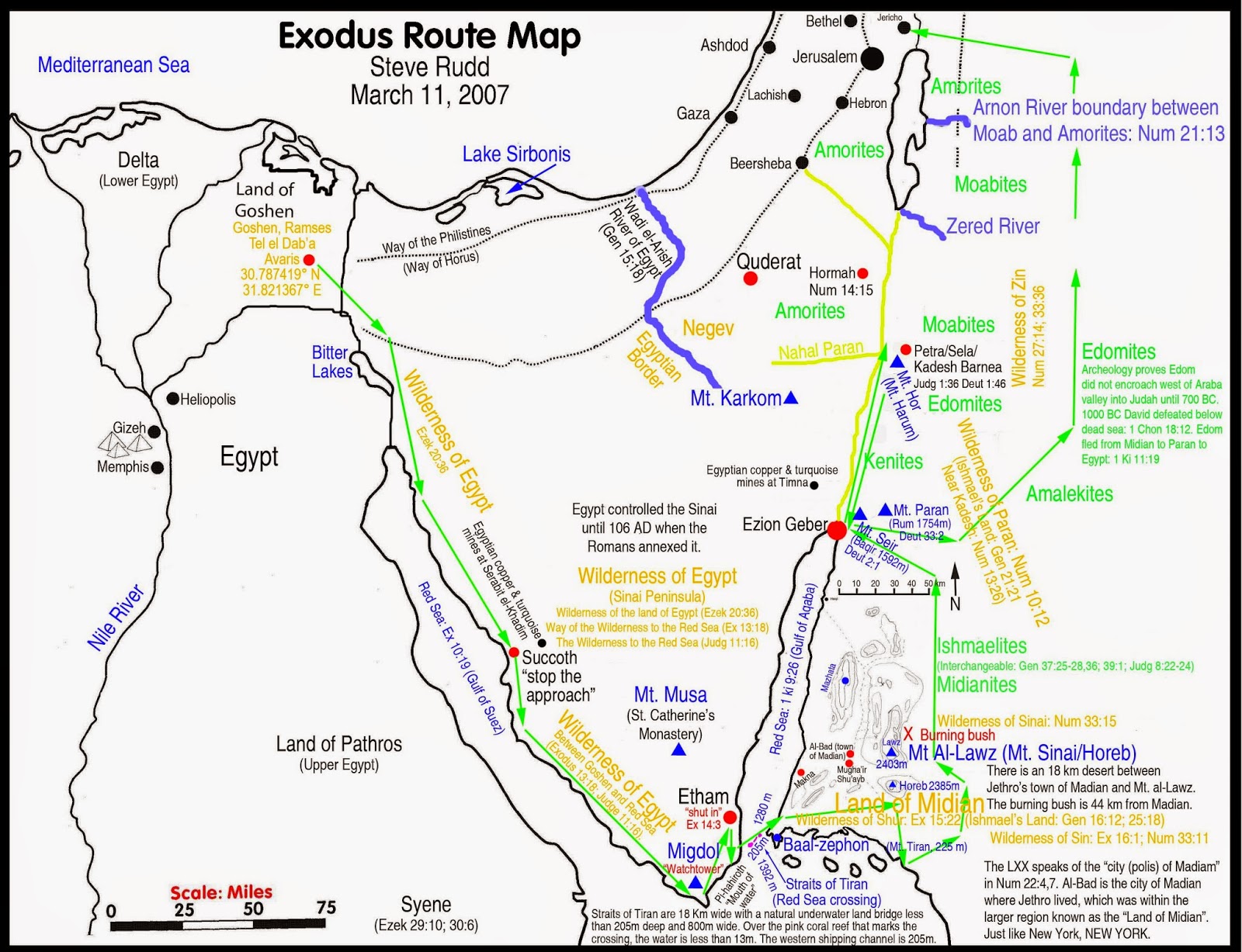
Exodus 13:20 first said that they camped "at Etham", "at the edge of the wilderness", and this one stated they went "in the wilderness of Etham".  But Exodus 15:22 said they came out of the Red Sea into the wilderness of Shur, which isn't shown on the above map.  Albert Barnes, in his "Notes on the Bible", wrote that the wilderness of Etham was the part of the wilderness of Shur that adjoined Etham, and that the "wilderness of Shur" referred "to the whole district between the northeastern frontier of Egypt and Palestine. The word is undoubtedly Egyptian, and is derived probably from the word Khar which designated all the country between Egypt and Syria proper."  I read another possible explanation for the confusion from a site linked at the map below, that suggested that Numbers 33:8 never mentioned Etham at all, but that the original word was "them".  Indeed, my source for the Brown-Driver-Briggs' Hebrew Definitions shows Etham to mean "with them".  Steve Rudd wrote in the article that Numbers 33:8 should have read more like, "They journeyed from before Hahiroth and passed through the midst of the sea into the wilderness; and they went three days' journey in the wilderness all of them together and camped at Marah."  Mr. Rudd used a different Bible translation, but I can get the gist of his meaning; they journeyed three days in the wilderness (of Shur, the same wilderness mentioned in Exodus 15:22) and all of them camped at Marah.  Therefore the wilderness of Shur mentioned in Exodus 15:22 is the same place as the wilderness of Etham mentioned in Numbers 33:8.  Here is Mr. Rudd's map of the exodus including these places:

http://www.bible.ca/archeology/bible-archeology-exodus-route-etham.htm

While on the subject of Bible translations, I have preferred the King James Version ever since I read some convincing articles about the questionable veracity of some of the newer translations, and I wrote about those a few years ago in a blog post entitled, Which Version of the Truth Will You Use?  I have recently received a comment and links that suggested the sites I referenced for my decision were not properly sourced, lacked proper proof, and were from a rather radical way of thinking.  I have posted some of those comments and links in the comment section of that original post.  It is true I have not totally researched the subject, and am certainly no expert on the it.  I welcome more educated opinions, as at this point, I don't choose to spend that much time on the study of the history of the different manuscripts and Bible translations.  I do believe that God is well able to preserve His Word, and we get enough from any translation to know Him.  Right now I am enjoying the commentaries of the scholars from the 1700 and 1800's, who would have used the KJV, as they are giving me insights I have not had occasion to consider from more recent writings.  If I live long enough to finish my current study, I will definitely make a more in-depth study of the early manuscripts!

(Exodus 15:23) And when they came to Marah, they could not drink of the waters of Marah, for they were bitter; therefore the name of it was called Marah. (24) And the people murmured against Moses, saying, “What shall we drink?”

Now we return to Exodus, chapter 15.  After going three days into the wilderness and finding no water, the Israelites came to Marah, but they couldn't drink the water there because it was bitter.  Indeed the name Marah means "bitter".  The water had to have been extremely bitter for people who had been three days without water and who must have been very thirsty, not to be able to drink it.  The people began grumbling against Moses and asking him what they were to drink.

(Exodus 15:25) And he cried to the LORD; and the LORD showed him a tree, which when he had cast it into the waters, the waters were made sweet.  There He made for them a statute and an ordinance, and there He proved them, (26) And said, “If you will diligently heed the voice of the LORD your God and will do what is right in His sight, and will give ear to His commandments and keep all His statutes, I will put none of the diseases on you which I have brought on the Egyptians; for I am the LORD who heals you.”

When the Israelites complained to him, Moses in turn, cried out to the Lord for help.  The Lord then showed him a tree.  Interestingly, that original word "yarah" meant "throw, shoot, or cast".  It was sometimes used figuratively to mean "to point out" (as if by aiming a finger), and therefore, could also imply "teach", and finally perhaps "show", but that seems the weakest of all the meanings.  The Lord showed Moses a tree; "he" cast it into the water and the water was made sweet.  It sounds like the Lord showed it to Moses and Moses threw it in the water, but learning the complete true meaning of the original word, it makes me wonder if the Lord Himself threw the tree into the water.  Probably not, as He had been using Moses all along to perform His miracles, but I don't see anything in the words that would completely negate that idea.  Any capitalization of "He" is done by me out of respect and not done by the KJV translators.  Some of the other translations use capital letters, and don't in this instance, so they all believe it was Moses who cast the tree.

Why throw a tree instead of touching his rod to the water?  Some scholars believe there was something in that particular tree that made the waters sweet.  I doubt that.  Even if it were true, it's not likely one tree would have sweetened flowing water enough for their huge number of people and cattle.  I prefer to believe as some others wrote that the tree was symbolic of Christ, the Tree of Life.  Indeed, the scripture went on to say that the Lord gave them an ordinance and there He proved them.  It's not that He gave them any particular new law to follow, but He showed them a principle, that if they looked to the Tree of Life, He would sweeten the bitter things of life, but without Him, it was too bitter to handle.  In fact, the Lord told them that if they would diligently listen to their Lord, do what was right in His eyes, listen and keep His commandments, He would put none of the diseases that had plagued the Egyptians upon them, because He was the Lord who healed them from those afflictions.  I think it's important to point out that God doesn't seek to punish all who do not obey Him, but rather without His protection and intervention, the things of life will punish us; we experience that "hell on earth", so to speak.  If and when He does bring about a "punishment", it is always about teaching the people where their salvation really lies and bringing them back to Him.  One other point about using the tree to sweeten the waters--perhaps an added result is that Moses didn't come to depend on his own "power" through the rod, but could plainly see that the power was always the Lord's, used by any number of means.

(27) And they came to Elim, where there were twelve wells of water and seventy palm trees; and they camped there by the waters.

The Israelites then came to Elim, a name which meant "palms" or "palm trees".  This place had plenty of water and shade for all of them and their livestock, and there they camped by the waters.  Note the significance of the numbers--twelve wells, perhaps one for each of the twelve tribes of Israel, and seventy palm trees, which may represent the seventy elders which will come to be appointed by Moses.  Again I see this as a picture of a life following the Tree of Life.  He will bring you through the bitter trials of life to a place of blessing and plenty.  We must remember that He doesn't always take away the bitterness of life, but He does help us through it.  "I can do all things through Christ who strengthens me." (Philippians 4:13)  That scripture is not meant to mean that we can do any superhuman thing we want because Christ strengthens us; rather it means we can persevere through all things because of Christ who strengthens us.  "Yea, though I walk through the valley of the shadow of death, I will fear no evil, for You are with me..." (Psalm 23:4)  We still have to walk through the valleys, but God is with us. 

(Numbers 33:9) And they removed from Marah, and came to Elim; and in Elim were twelve fountains of water and seventy palm trees; and they pitched there.

Chronologically, we now go forward again to Numbers, chapter 33, which chronicles the travels of the Israelites after they left Egypt.  Verse 9 also told that they left Marah, the place with the bitter waters, and came to Elim, where there were twelve fountains or wells of water and seventy palm trees, and they camped there.

(10) And they removed from Elim and camped by the Red Sea. (11) And they removed from the Red Sea and camped in the wilderness of Sin.

The children of Israel then moved from Elim and camped again by the Red Sea, surely another part of it.  From there they moved into the Wilderness of Sin.  What an interesting and appropriate name for the wilderness where the Israelites would wander!  It appears the people moved from one "wilderness" to another, at first at the edge of the wilderness, then in the wilderness of Etham, in the wilderness of Shur, and now in the wilderness of Sin.  Quoting Matthew Henry in his Commentary on the Whole Bible, "Our removals in this world are but from one wilderness to another."

This was a short study this time, but as it sets up the complete chapter of Exodus 16 for next time, I will stop here, and resume the chronological study in the next blog post.

Sunday, July 27, 2014

Why We Can Trust the Bible to Be the True Word of God

Continuing a chronological Bible study:

(Exodus 10:1) And the LORD said to Moses, “Go in to Pharaoh, for I have hardened his heart and the hearts of his servants, that I may show these signs of Mine before him, (2) And that you may tell in the hearing of your son and your son’s son what things I have done in Egypt, and My signs which I have done among them, that you may know that I am the LORD.”

The Lord told Moses to go back before Pharaoh once again.  I've explored the thought before that God could have changed Pharaoh's heart at any time or could have destroyed him and removed him as an obstacle at any time, but He told Moses at this time that He allowed Pharaoh's heart to remain hardened, as well as the hearts of his servants, so that He might have further opportunities to show His signs and wonders.  God further told Moses that because of all these miraculous things He had done in Egypt, Moses would have a story to pass down so that future generations would know that He was the one true eternal Lord and Savior of the world.  God's purpose was that this event be written by Moses to serve as a permanent record that would last until the ends of the earth for our instruction in the awesome power of our Lord over our enemies, and in His faithfulness, love, and mercy.  There lies the beginning of our Bible today!  God intended for us to have a record of Him.  If it was God's intention, can we really doubt that He could make sure we had a true record?  I think about how people today who profess to be Christians (me included, in my immature days) don't believe the Bible to be the true inspired inerrant Word of God.  After all, I can hear my own silly self saying many years ago, there have been errant human hands all over the creating of the Bible.  However, I have come to realize and have faith that my God is big enough to see that His Word remain intact.  And here we read of His intention that there be a record, so we can be certain it came to fruition.  Jesus Himself more than likely used the Septuagint, the first translation of the Hebrew Bible, and here is what He said about it:

"Think not that I am come to destroy the law, or the prophets: I am not come to destroy, but to fulfill. For verily I say unto you, till heaven and earth pass, one jot or one tittle shall in no wise pass from the law, till all be fulfilled. Whosoever therefore shall break one of these least commandments, and shall teach men so, he shall be called the least in the kingdom of heaven: but whosoever shall do and teach them, the same shall be called great in the kingdom of heaven." - Matthew 5:17-19

Jesus believed that Bible, that Word of God, that law and the prophets, from which He taught.  He did not come to change one thing about that Bible, but He was the fulfillment of all that was written.  He had no problem relying on a humanly translated Bible; nor should we!  However, He did warn against those who would break the commandments written of in scripture and teach men to do the same.  Additionally, and perhaps more powerfully, Jesus said at the very end of the Bible, in Revelation, chapter 22:

“I, Jesus, have sent My angel to testify to you these things...For I testify unto every man that hears the words of the prophecy of this book, if any man shall add unto these things, God shall add unto him the plagues that are written in this book: And if any man shall take away from the words of the book of this prophecy, God shall take away his part out of the book of life, and out of the holy city, and from the things which are written in this book. He who testifies these things says, 'Surely I come quickly.'" - Revelation 22:16a and18-20a

While most would argue and say this referred only to the book of Revelation, there are too many other instances in the Bible where God warned not to add to or subtract from His word (Deut. 4:2, Deut. 12:32, Prov. 30:6).  Surely, if it was so important that we not add or subtract from the word of God, He would certainly see to it that His word was preserved intact!  Now that is not to say that there haven't been inaccurate translations of the Bible, especially in more recent times.  I do believe there are errant translations and I studied this in depth and wrote about it in this blog post.  Included in that post are some links that further explain in depth how and when the Bible became perverted.  I had occasion to read again one of the links I provided and most heartily recommend it again here:  1611 King James Bible. Com

Now after saying that I am certain that God's Word has remained intact and we can trust it, I have added that there are, after all, human perversions.  But once again, our God is big enough to make sure we get His true Word.  He said that if we seek Him with all our heart, we WILL FIND HIM, and that means the true HIM:

"But if from there you will seek the LORD your God, you shall find Him if you seek Him with all your heart and with all your soul." - Deuteronomy 4:29

Okay, now back to Exodus:

(3) And Moses and Aaron came in to Pharaoh and said to him, “Thus says the LORD God of the Hebrews, ‘How long will you refuse to humble yourself before Me? Let My people go, that they may serve Me.'"

Moses and Aaron went before Pharaoh and spoke the words of the Lord so that Pharaoh knew they were the very words of the Lord by beginning, "Thus says the Lord..."  How long would Pharaoh refuse to humble himself before the Lord and let God's people go?  Of course, God already knew how long it would be, but this does show that Pharaoh did have the choice.  He could have humbled himself before the Lord and repented and allowed the people to go before now.  Yes, God had a purpose in allowing Pharaoh's heart to remain hardened throughout all the plagues.  But the same God who was allowing time for the Israelites and even the Egyptians to know this was the true God, would have most assuredly accepted Pharaoh's true repentance, if there was any.  We always have a choice; no one is doomed to hell against his will for God's purposes.  However, as God is all-knowing and knows the future and what would happen in every possible instance, He can plan to carry out His will accordingly.  You can bet, if Pharaoh had humbled himself and relented, God would have found another way to carry out His will and show his signs and wonders to be recorded throughout history.

(4) "'Or else, if you refuse to let My people go, behold, tomorrow I will bring the locusts into your coast. (5) And they shall cover the face of the earth, that one will not be able to see the earth; and they shall eat the residue of what is left, which remains to you from the hail, and they shall eat every tree which grows for you out of the field. (6) And they shall fill your houses, the houses of all your servants, and the houses of all the Egyptians, which neither your fathers nor your fathers’ fathers have seen, since the day that they were on the earth to this day.’” And he turned and went out from Pharaoh.

Moses (through his spokesman Aaron) continued the words of the Lord that if Pharaoh again refused to let God's people go, the next day God would bring locusts into Pharaoh's territory.  They would be so thick on the face of the earth that no one would be able to see.  They would consume whatever vegetation had remained after the hailstorm, including every tree.  They would be so thick they would fill the houses of Pharaoh and his servants and all the Egyptians.  This would be a plague of locusts such as had never been seen since the beginning of time.  With that, Moses (with his spokesman Aaron) turned and left Pharaoh.

(7) And Pharaoh's servants said to him, “How long shall this man be a snare to us? Let the men go, that they may serve the LORD their God; do you not yet know that Egypt is destroyed?”

Pharaoh's servants got it!  They told Pharaoh to let the men go to serve their Lord, because Egypt was as good as destroyed because of his refusal to let them go thus far.

(8) And Moses and Aaron were brought again to Pharaoh, and he said to them, “Go, serve the LORD your God, but who are they that shall go?”

Evidently, at the urging of his servants, Moses and Aaron were brought back in to Pharaoh.  Pharaoh appears to have relented somewhat and told them to go serve their Lord, but he wanted to know just who was going.  Pharaoh received much value and profit from the labor of the Israelites, and feared that they would not return if they all went, so he wanted an account of just who was going.

(9) And Moses said, “We will go with our young and our old, with our sons and our daughters, with our flocks and our herds we will go, for we must hold a feast to the LORD.”

Moses insisted that they all should go, including all their flocks and herds.  They were going to participate in a feast to the Lord, so all had to go.  The adults would surely prepare the feast, and the children would be expected to witness it.  The animals would be needed for the feast and for sacrifice to the Lord.

(10) And he said to them, “Let the LORD be so with you, as I will let you go, and your little ones; look to it; for evil is before you. (11) Not so! Go now, you who are men, and serve the LORD, for that is what you desired.” And they were driven out from Pharaoh’s presence.

Pharaoh's meaning in verse 10 is a little difficult to understand, but with the finished thought in verse 11, you get the gist.  He was probably mocking or cursing them, saying, in effect, it was at their peril if they tried to take their little ones.  It is obvious he did not intend to let them take their children.  He said only the men could go and serve their Lord.  He suggested that since they desired to go, they should accept his compromise and go and serve the Lord since that is what they said they wanted to do.  With that word, Moses and Aaron were driven out from Pharaoh's presence.

(12) And the LORD said to Moses, “Stretch out your hand over the land of Egypt for the locusts, that they may come up upon the land of Egypt, and eat every herb of the land, all that the hail has left.”

Of course, only letting the men go, was not what God commanded, and He instructed Moses to stretch out his hand over the land of Egypt and, in effect, summon the locusts.  They would eat every herb left in the land after the hailstorm.

(13) And Moses stretched forth his rod over the land of Egypt, and the LORD brought an east wind upon the land all that day, and all that night; and when it was morning, the east wind brought the locusts.

This is not the first time the scripture says that God told Moses to stretch out his hand, and Moses wrote that he then stretched out his rod.  Moses may have been making it a point to show that it was the rod of God, God Himself, who summoned the plagues.  Of course, that is what God Himself told Moses to do in the beginning, but I still find it interesting that Moses quoted God's words, "Stretch out your hand...", but then made it a point to show that it was God through this rod of God that did the summoning.  I believe it is further proof of how accurate Moses tried to be in his writing, and how modest he usually was regarding himself.  God had said "tomorrow" He would send the locusts.  This time rather than immediately bringing locusts upon the land, He first brought the east wind, blowing all the rest of that day and that night, and when it was morning, on the morrow, then came the locusts. 

(14) And the locusts went up over all the land of Egypt, and rested in all the coasts of Egypt; very grievous were they; before them there had been no such locusts as they, nor shall there be such after them. (15) For they covered the face of the whole earth, so that the land was darkened; and they ate every herb of the land and all the fruit of the trees which the hail had left; and there remained not any green thing in the trees, or in the herbs of the field, through all the land of Egypt.

The locusts went all over the land of Egypt, but they miraculously rested within the coasts of Egypt.  God had used natural means, the winds that were at His disposal, to bring the locusts, but it was indeed a miracle that they came just when He had said they would, and they remained within the borders of Egypt.  The locusts were more severe than had ever been seen in the land since the beginning, as God had said in verse 6 they would be.  They were so thick that the land was darkened, and they ate every bit of green that had remained in Egypt after the hailstorm.

(16) Then Pharaoh called for Moses and Aaron in haste, and said, “I have sinned against the LORD your God and against you. (17) Now therefore, please forgive my sin only this once, and entreat the LORD your God, that He may take away from me this death only.”

Moses and Aaron had been driven out of Pharaoh's presence, but now he called them back quickly.  Of course, he realized the power of God and he knew the right words to say to ask that they ask their God to remove the plague of locusts.  Just as we might imagine the prayer of any sinner, Pharaoh asked that he be forgiven "just this one time", insinuating that he would not sin again.  However, Pharaoh's words are not sincere.  He is as sorry as one who has just been caught is sorry that he got caught, but it is not a sincere repentance to God.  He just said the words he hoped would work to take this plague away.

(18) And he went out from Pharaoh and entreated the LORD. (19) And the LORD turned a mighty strong west wind, which took away the locusts and cast them into the Red sea; there remained not one locust in all the coasts of Egypt.

Sincere or not, Moses took Pharaoh's words at face value, and went out from Pharaoh and asked the Lord, in Pharaoh's behalf, to remove the locusts.  And the Lord did as Moses asked, now sending a mighty west wind to take all the locusts away and casting them into the Red Sea.  Evidence that this was truly a miracle of God was that not a single locust was left within the borders of Egypt!

(20) But the LORD hardened Pharaoh's heart, so that he would not let the children of Israel go.

Once again might come the discussion about a just God hardening the heart of a man against his will.  There was a discussion about this in Exodus, chapter 4, especially verse 21.  Additionally, there was discussion about it in chapter 9, verse 14, when God determined to send all His plagues on Pharaoh's heart.  It was evident that Pharaoh had not been sincere or truly repentant, so it may be that God truly did harden his heart at this time, or rather kept it hardened, until the fruition of the plagues.  His heart was already hard and unrepentant, and he would not let the children of Israel go.

(21) And the LORD said to Moses, “Stretch out your hand toward heaven, that there may be darkness over the land of Egypt, darkness which may even be felt.” (22) And Moses stretched forth his hand toward heaven, and there was a thick darkness in all the land of Egypt three days. (23) They did not see one another; nor did anyone rise from his place for three days; but all the children of Israel had light in their dwellings.

With no further warning to Pharaoh, God told Moses to stretch his hand toward heaven which would bring darkness over the land of Egypt, and that he did.  It was a darkness so thick and dark that it was even felt.  Although God could have used any means to bring darkness, it seems reasonable to think that perhaps it was caused by a thick fog, because it could be felt, and perhaps the heavy misty dampness of the fog is what put out all the candles and fires in the Egyptian homes.  It was so dark and thick that the Egyptians could not see one another, nor did they even try to arise from their places for three days.  However, the Israelites had light in their homes.

As so many of the plagues seemed to do, this plague showed God's control over one of the Egyptians' chief objects of worship, the Sun-god.  I don't know that God was purposely choosing a plague for each one of the Egyptian gods; the fact was, that the Egyptians used nature and things created by God as their gods.  Of course, God was greater than anything or anyone He Himself created.  If all of heaven and earth is at God's disposal, and one has false gods he came up with himself, then they are bound to be controlled by God; it's just going to happen without any particular plan on God's part to expose one's false gods.

(24) And Pharaoh called to Moses and said, “Go, serve the LORD; only let your flocks and your herds be kept back; let your little ones also go with you.”

After three days of the thick darkness, Pharaoh called Moses in and he decided to relent a little further this time.  He would allow all the people to go, including the little ones, but their herds and flocks must be kept back.  Obviously, Pharaoh was trying to make sure the Israelites would return; their livestock would be his security that the Israelites would not permanently leave Egypt, leaving him without all their forced labor from which he had obviously profited.  Also, when you think about it, he and the Egyptians had lost a great deal of their livestock to the plagues; all the more reason he may have wanted the livestock to stay, and not risk them leaving forever.

(25) And Moses said, “You must give us also sacrifices and burnt offerings, that we may sacrifice to the LORD our God. (26) Our cattle also shall go with us; there shall not a hoof be left behind, for from them we must take to serve the LORD our God, and even we do not know with what we must serve the LORD until we arrive there.”

Moses refused Pharaoh's offer, saying the livestock was necessary as they would need some of them to offer as sacrifices and burnt offerings to the Lord, and they would not know which animals they would need until they got to the place where they would serve the Lord.

(27) But the LORD hardened Pharaoh’s heart, and he would not let them go.

Of course, Pharaoh would not agree to this.  If he had relented, we may be sure it would have been short-lived, as it has been obvious that he had not been sincere in any repentance up to this point.  Therefore, the Lord may have hardened his heart because, "He had yet another miracle to work for the complete conviction of the Egyptians and triumph of his people; and till that was wrought He permitted the natural obstinacy of Pharaoh’s haughty heart to have its full sway, after each resistance of the gracious influence which was intended to soften and bring him to repentance." (Adam Clarke's Commentary on the Bible)

(28) And Pharaoh said to him, “Get away from me; take heed to yourself and see my face no more, for in the day you see my face you shall die.” (29) And Moses said, “You have spoken well; I will see your face no more.”

Pharaoh got angry when he couldn't make Moses adhere to his terms, and sent him away, saying he never wanted to see him again.  He was so angry that he told Moses to take heed, for if he ever saw him again, Moses would die!  Pretty strong words against someone Pharaoh himself had on more than one occasion called before him to save him from God's plagues.  To threaten someone with death who had shown himself quite able to inflict plagues away from his presence wasn't very smart.  But how often do people say dumb things they don't mean in anger?  In this case, Moses told Pharaoh he had spoken true words.  He may have known by a spirit of prophecy that he would not again be sent to Pharaoh, and that Pharaoh would soon meet death at the Red Sea.

(Exodus 11:1) And the LORD said to Moses, “I will bring yet one more plague on Pharaoh and on Egypt; afterwards he will let you go from here. When he lets you go, he will surely thrust you out of here altogether."

I have included chapter 11 in this present study as it became evident that this short chapter was a continuation of Moses's last meeting with Pharaoh.  It seems these words of the Lord had been given previously to Moses so that he had known for certain that he would not be sent again to Pharaoh.  It is also possible they were being divinely given to him as he spoke to Pharaoh, but it will soon become apparent that Moses was still in the presence of Pharaoh.  This is the reason that Moses said that Pharaoh had spoken well in that he would not see him again, because the Lord told him that He would bring one final plague on Pharaoh and the Egyptians, and after that, Pharaoh would let the Israelites go. As a matter of fact, he wouldn't only let them go, he would thrust them out of there!

(2) “Speak now in the hearing of the people, and let every man ask from his neighbor and every woman from her neighbor, jewels of silver and jewels of gold.” (3) And the LORD gave the people favor in the sight of the Egyptians. Moreover the man Moses was very great in the land of Egypt, in the sight of Pharaoh’s servants and in the sight of the people.

The children of Israel were about to be delivered from their bondage in Egypt, and would have left empty-handed, having been slaves to the Egyptians without rightful pay, but their Lord saw to it that they were justly rewarded for their services.  They did not have to raid, loot, or steal, but had only to ask of their neighbors, and the Lord gave them such favor with the Egyptians, that the Egyptian people would gladly give the Israelites articles of silver and gold.  Furthermore, Moses was held in high regard by Pharaoh's servants and by the Egyptian people.  They had seen what he had done in the name of the Israelites' God, and they came to respect him.  I believe it is fair to conclude that many Egyptians were indeed saved because of their witnessing of the many plagues up to this point, as was suggested was one of the reasons for the prolonging of the plagues--see post notes on Exodus 4, verse 21.  This does not mean that the Egyptians wouldn't die a physical death, but if saved by believing on the Lord who had wrought such miracles in their country, they wouldn't have to die an eternal death in hell.

(4) And Moses said, “Thus says the LORD, ‘About midnight I will go out into the midst of Egypt; (5) And all the firstborn in the land of Egypt shall die, from the firstborn of Pharaoh who sits on his throne, even to the firstborn of the maidservant who is behind the mill, and all the firstborn of the animals. (6) And there shall be a great cry throughout all the land of Egypt, such as was not like it before, nor shall be like it any more.'"

Moses spoke to Pharaoh; after he had said Pharaoh had spoken well, he now spoke these words of the Lord to Pharaoh.  At about midnight the Lord would go through the midst of Egypt and all the firstborn of man and beast, including Pharaoh's firstborn son, would die.  There would be a great wailing of grief throughout the land of Egypt when all the firstborn died, such as had never been heard before, nor would ever be afterward.  This is what the Lord had warned to Pharaoh in the beginning, in Exodus 4:22-23, that if he did not let God's son Israel go, He would slay Pharaoh's firstborn son. 

(7) "‘But against any of the children of Israel a dog shall not move its tongue against man or beast, that you may know that the LORD does make a difference between the Egyptians and Israel. (8) And all these your servants shall come down to me and bow themselves down to me, saying, "Get out, and all the people who follow you," and after that I will go out.'” And he went out from Pharaoh in a great anger.

The firstborn of all the Egyptians would die, but there was not to be so much as a dog moving its tongue toward a snarl or growl against the Israelites.  In that, they would know that the Lord did distinguish between His children Israel and the Egyptians.  Then Pharaoh's own servants would bow before the Lord and tell Him and His people to get out of their land, and at that point, they would go; that was a certainty.  And with that final message, Moses went out from Pharaoh's presence in anger.

(9) And the LORD said to Moses, “Pharaoh will not heed you, so that My wonders may be multiplied in the land of Egypt.”

Moses was angered, justifiably, it would seem, by the stubborn arrogance of Pharaoh, but the Lord reminded him that Pharaoh would not yet listen to him, for God's express purpose in magnifying His wonders in the land of Egypt.  This is something I must remind myself--even though I may feel justified in my anger against a Godless government and its ungodly agenda that leads the people astray, I must remember that God alone raises up leaders for His purposes.  Sadly, His purposes may be for judgment against a country's wickedness, as in the case of Egypt, but good can ultimately come to the individual persons who come to the end of themselves and look to their Lord for their salvation.  When things are too easy, we often become lazy and forgetful and unthankful for all that the Lord has done for us; we can even take Him for granted and compromise His word and relegate Him to a distant second place.  It is in His mercy, that God will allow terrible tragedies that bring us back to Him!

(10) And Moses and Aaron did all these wonders before Pharaoh; and the LORD hardened Pharaoh's heart, so that he would not let the children of Israel go out of his land.

I believe this is a sort of parenthetical comment relating to all the signs and wonders up to this point.  Moses and Aaron had brought all these miraculous plagues in the sight of Pharaoh, but the Lord had hardened Pharaoh's heart so that he would not let the Israelites go out of his land up to this point, so that the Lord's wonders could be multiplied in the land of Egypt for the maximum good of the most people.  I believe that means not only the Israelite people at this time, but also the pagan Egyptians who would come to know God as Lord, and maybe most importantly, to the countless generations of Jews and Gentiles who would afterward read the report of these marvelous wonders, and come to know the Lord as their Savior!

Friday, May 4, 2012

Job Repents and the Lord Blesses His Latter Days More Than His Beginning

Continuing a Bible study of Job:

(Job 42:1) Then Job answered the LORD, and said, (2) "I know that You can do everything, and that no thought can be withheld from You. (3) Who is he who hides counsel without knowledge? Therefore I have uttered what I did not understand, things too wonderful for me, which I did not know."

Job acknowledges that God is all-powerful and has unlimited dominion.  "No thought can be withheld from You" could mean there are no secret thoughts from God, or it might mean that there is no thought of God's that He can't bring to pass.  Job quotes what God had asked about him, and admits that he spoke about things he did not understand.

(4) "Hear, I beseech you, and I will speak; I will demand of you, and you will declare to me."

The NKJV translators added the words "you said" to the second part of verse 4.  I'm not a fan of the newer translations of the Bible and now might be a good time to link to my article on why I trust KJV to be the most accurate:  "Which Version of the Truth Will You Use?"

Job may very well be quoting God, as he seemed to do in verse 3.  As John Wesley put it, "The words which God had uttered to Job by way of challenge, Job returns to him in way of submission."  It is also possible, if anything is being quoted, that Job is referring to his own request to speak directly to God and have Him answer him.  Maybe it's not a quote at all, but Job requesting the Lord hear his humble confession.  "I beseech you" is a humble "I beg of you".  "Demand" is probably not the best sense of the original word, "shaal".  I believe the better sense is one of the word's other definitions, "to ask (as a favor), beg".  So again, "I beg of you to hear me and then You will set me straight."

(5) "I have heard of You by the hearing of the ear, but now my eye sees You. (6) Therefore I abhor myself, and repent in dust and ashes."

Up to now, Job only knew God through tradition and from what he had heard and had been taught, and it was therefore imperfect information, but now having this personal contact with God, he sees his Lord much more clearly, and humbles himself before Him and repents of his sins.  There is much discussion among Biblical scholars as to whether or not Job actually saw God with his eyes.  God told Moses in Exodus 33:20, "for there shall no man see me, and live."  I believe God could take on any form He wanted and could have been visible to Job, but we really only have Job's words that now his eyes saw God, and clearly that "seeing" could mean "understanding", as when Jesus later spoke of having eyes and not seeing.  The only thing we know for fact about Job's contact with God is that God spoke to him out of a whirlwind.

(7) And so it was, that after the LORD had spoken these words to Job, the LORD said to Eliphaz the Temanite, "My wrath is kindled against you, and against your two friends, for you have not spoken of Me what is right, as My servant Job has. (8) Therefore take unto you now seven bulls and seven rams, and go to My servant Job, and offer up for yourselves a burnt offering; and My servant Job will pray for you. For I will accept him, lest I deal with you according to your folly, in that you have not spoken of Me what is right, like My servant Job."

It is very interesting when you think about all that Job and his three friends had said about God.  The friends had said many right things about God, and Job had said many wrong things, but God accepted Job, and not his friends.  Only through sacrifice and Job's praying for them, would God accept them.  Two things come to mind.  God judges the heart of men which He saw clearly all along, even if we didn't.  Immediately after God spoke, Job was overwhelmed by the conviction of guilt and repented.  There is no indication that his friends felt any differently after hearing the words of God.  Albert Barnes points out that if the matter had been left at verse 6 with Job abhorring himself and repenting in dust and ashes, the impression would have been that it was Job totally in error, and his friends were justified.  The second and perhaps most important point is that Job's friends judged Job himself.  It may not be that they said anything terribly wrong about God, but they presumed to judge Job's heart, and that is something we are commanded not to do.  We may judge actions, and are in fact told to judge fruit, but there were no evil actions of Job's for his friends to condemn.  They just assumed that he must have acted evilly if all these afflictions had come upon him.  It must be noted that God did not mention Elihu because he dealt more mercifully and truthfully with Job, not condemning him personally, but only rebuking his sinful expressions.

(9) So Eliphaz the Temanite and Bildad the Shuhite and Zophar the Naamathite went and did as the LORD commanded them, the LORD also accepted Job. (10) And the LORD turned the captivity of Job when he prayed for his friends. Indeed, also the LORD gave Job twice as much as he had before.

When they obeyed the Lord and sacrificed to Him and had Job pray for them, the Lord accepted Job's friends, as He did Job when Job also obeyed by praying over his friends and offering their sacrifice to the Lord.  The Lord then reversed Job's situation, giving him twice as much as he had before.

(11) Then all his brothers, all his sisters, and all those who had been his acquaintances before, came there to him and ate food with him in his house; and they bemoaned him and comforted him for all the evil that the LORD had brought upon him; every man also gave him a piece of money, and every one an earring of gold. (12) So the LORD blessed the latter days of Job more than his beginning, for he had fourteen thousand sheep, and six thousand camels, and a thousand yoke of oxen, and a thousand female donkeys.

The Lord blessed Job with more possessions than he had had in his former days, using all the people in Job's circle and having them bring money and gold to him.

(13) He also had seven sons and three daughters. (14) And he called the name of the first Jemima, the name of the second Kezia, and the name of the third Keren-Happuch. (15) In all the land were found no women so beautiful as the daughters of Job, and their father gave them an inheritance among their brothers.

Job was also blessed with more children, and his daughters were the most beautiful women in the world.  In Job's day, it would have been uncommon for daughters to receive an inheritance when there were sons, but Job showed no partiality to his sons.  Dr. John Gill points out that this is a beautiful picture of Christ, with whom "there is neither male nor female, no difference between them, but being all children, they are heirs, heirs of God and joint heirs with Christ, and equally partake of the same inheritance with the saints in light."

(16) After this Job lived one hundred and forty years, and saw his sons and his sons' sons, even four generations. (17) So Job died, old and full of days.

Job lived an additional 140 years, seeing his children's children, and even his grandchildren's children, and so it was a full and blessed life.

Saturday, April 14, 2012

Unique Creations of God

Continuing a Bible study in Job, God is still speaking to Job in chapter 39:

(Job 39:1) "Do you know the time when the wild mountain goats bear young? Or can you mark when the deer gives birth? (2) Can you number the months that they fulfill? Or do you know the time when they bear young? (3) They bow themselves, they bring forth their young ones, they cast out their sorrows."

Knowing the time alone that these animals take to deliver their young is nothing extraordinary in itself, but Adam Clarke points out something else is his "Commentary on the Bible".  There are some peculiarities surrounding the birth of especially "hinds", or deer.  "The hind with young is by instinct directed to a certain herb, named seselis, which facilitates the birth. Thunder, also, which looks like the more immediate hand of Providence, has the same effect."  Mr. Clarke then refers to Psalms 29:9, “The voice of the Lord makes the hinds to calve."  The word translated as "sorrows" is actually one meaning "cords, bands, or rope"; it was used to mean the placenta or umbilical cord.  "Sorrows" was a nice way of expressing the pangs of birth.

(4) "Their young ones are in good liking, they grow up with corn; they go forth, and do not return to them."

To be in good liking is to be plump or healthy.  The word translated as corn can actually mean any grain or even open field or country.  The fawns and the young goats leave their mothers early.  I believe the idea is that even though most baby animals need considerable attention and care from their mothers for a time, the young of the mountain goats and deer are protected by God alone.  These young animals are exposed to so many dangers and predators in their young lives that if it weren't for the protection of God, none would make it to adulthood.

(5) "Who has sent out the wild ass free? Or who has loosed the bands of the wild ass, (6) Whose home I have made the wilderness, and the barren land his dwellings? (7) He scorns the multitude of the city; neither does he regard the crying of the driver. (8) The range of the mountains is his pasture, and he searches after every green thing."

There are two different words both translated as "wild ass' in verse 5.  The first, "pereh" refers to "running wild" or the "onager" or "wild ass".  The second, "arod" is said to mean "onager" or "wild ass", but is only used once in the Bible here.  Perhaps there are two different types of wild animals discussed here, but the point is that the wild ass is untamed and unsubdued, and who has made him that way?  He doesn't regard any man and the vast wilderness and desert are his home. 

(9) "Will the unicorn be willing to serve you? Or abide by your crib? (10) Can you bind the unicorn with his band in the furrow? Or will he harrow the valleys after you? (11) Will you trust him because his strength is great? Or will you leave your labor to him? (12) Will you believe him, that he will bring home your seed, and gather it into your barn?"

The word translated as "unicorn" was used several times in the Bible, but no one knows exactly what animal to which the word refers.  It may have been a type of wild bull now extinct, or some even wonder if it was a rhinoceros.  The image of the unicorn works just fine here.  Is it possible to tame the wild unicorn and train him to work for you and that you trust him to do your work? 

(13) "Did you give the goodly wings to the peacocks, or wings and feathers to the ostrich?"

The word translated as "peacocks" is used only once in the Bible, so speculation was probably used.  Most scholars think it refers to the ostrich.  However, the word that is translated as "ostrich" is a different word.  It is only translated as "ostrich" in this one verse, and is translated as "feathers" in three other places in the Bible.  Some scholars think the word should be "storks", but the next verse seems to describe an ostrich.  The word translated as "feathers" here is another word.  AND the two words translated as "wings" above are two different words!  Whew!  This is a tough one to translate certainly, but let's take it one word at a time and see if we can come up with the right context.

To begin with, "Did you give" was added by the KJV translators; actually their words were "Gavest thou".  So taking that out, we begin with "goodly".  That word is said to mean "to rejoice, to exult, to leap for joy, to wave or flap joyously, to delight oneself, to solace oneself".  When the word was used in the only two other times it occurred in the Bible, it was translated as "rejoice" and "solace".  The original word for the first "wings" above does seem to mean "wings" as it is used frequently that way.  Then we come to the word that is only used once and is said to mean "peacocks", however Strong's and Brown-Driver-Briggs both define it as something with a piercing cry or wail.  The KJV translators obviously connected goodly feathers and wails to the peacock. The second word that was translated as "wings" is not used nearly so often as the first "wings", but it does seem to mean "feathers" or "wings".  Interestingly, the word translated as "feather(s)" is most often translated as "stork".  The only place in the Bible it was ever used as "feathers" was here.  Finally is the word translated as "ostrich", which is more often translated as "feathers" or "plumage"; it is only translated as "ostrich" here.  Whew!

So with the translations above, we have something along the order of, "rejoicing wailing bird, feathers or wings and a stork and feathers or plumage".  Considering the next verses do seem to describe an ostrich, perhaps God is asking if Job created the ostrich in such a unique way; she cries and seems to flap joyously and has the feathers of the stork, but....

(14) "Which leaves her eggs in the earth, and warms them in dust; (15) And forgets that the foot may crush them, or that the wild beast may break them. (16) She is hardened against her young ones, as though they were not hers; her labor is in vain without fear; (17) Because God has deprived her of wisdom, neither has He imparted to her understanding. (18) When she lifts herself on high, she scorns the horse and its rider."

I do believe the point is that the ostrich is such a unique creation of God with its appearance and flapping wings and stature that makes it appear as if it thinks it can rival the horse and rider.  Yet it doesn't have the wisdom, concern, or maternal instincts to care for its eggs or its young.

(19) "Have you given the horse strength? Have you clothed his neck with thunder? (20) Can you make him afraid as a grasshopper? The glory of his nostrils is terrible. (21) He paws in the valley, and rejoices in his strength; he goes on to meet the armed men. (22) He mocks at fear, and is not frightened; neither does he turn back from the sword. (23) The quiver rattles against him, the glittering spear and the shield. (24) He swallows the ground with fierceness and rage; neither does he believe that it is the sound of the trumpet. (25) He says among the trumpets, 'Ha ha!'; and he smells the battle from afar, the thunder of the captains and the shouting."

Here is another poetic description of a unique creation of God, the strong horse with its blazing mane, here pictured as a warhorse with no fear, snorting fiercely and pawing the earth, undeterred by the sounds of war, but ready to charge.  Did Job create him this way?

(26) "Does the hawk fly by your wisdom, and stretch her wings toward the south? (27) Does the eagle mount up at your command, and make her nest on high? (28) She dwells and abides on the rock, upon the crag of the rock, and the strong place. (29) From there she seeks the prey, and her eyes behold from afar. (30) Her young ones also suck up blood, and where the slain are, there is she."

Here are two more awesome and unique creations of God, the hawk and the eagle.  Does Job manage them?

Saturday, March 31, 2012

"We Cannot Figure (Almighty God) Out"

Continuing a Bible study of Job, Elihu is still speaking:

(Job 37:1) "At this also my heart trembles, and is moved out of its place."

Referring back to the end of the last chapter, Elihu is moved by God’s majesty in the thunder and lightning.

(2) "Hear attentively the noise of His voice, and the sound that goes out of His mouth. (3) He directs it under the whole heaven, and His lightning to the ends of the earth. (4) After it a voice roars; He thunders with the voice of His excellency, and He will not stay them when His voice is heard. (5) God thunders marvelously with His voice; He does great things which we cannot comprehend."

John Wesley imagines that while Elihu was speaking, it began to thunder and lightning before the storm that would soon bring God on the scene. Elihu tells Job to really listen to the thunder of God's voice, which He alone directs like an arrow to the mark, that it may do the work for which He sends it (the lightning, too). After the lightning, the thunder roars, and God does not hold them back when He speaks. God thunders marvelously, an awesome exhibition of his majesty and power; He does great and wonderful things man cannot comprehend.

(6) "For He says to the snow, 'Be thou on the earth'; likewise to the small rain and the great rain of His strength."

Elihu continues describing other wonders of nature that come as a direct result of God's appointment.

(7) "He seals up the hand of every man, that all men may know His work."

The word translated as "seals" more completely means "closes up, locks up, or stops", so God stops men from their work with his snow and rains, and they in turn, may see and recognize the awesome work of God.

(8) "Then the beasts go into dens, and remain in their places. (9) Out of the south comes the whirlwind, and cold out of the north. (10) By the breath of God frost is given, and the breadth of the waters is straitened."

The word translated as "breadth" (or "width") may mean more completely "expanse", and "straitened" is "constraint" or "distress". The thought being conveyed here is that water is made straight and hard and confined, not flowing. It is frozen by the breath of God.

(11) "Also by watering He wearies the thick cloud; He scatters His bright cloud. (12) And it is turned around by His counsels, that they may do whatever He commands them on the face of the world in the earth."

The clouds become wearied or overburdened with water and shower down the rain; God scatters bright white clouds on a sunny day. The clouds are subject to God's command. I found it interesting that the KJV translation says "the world in the earth". Newer translations use "the whole earth", but that is not what the original text said. After researching the original words, I believe it refers to the "land" or "habitable part" in the earth.

(13) "He causes it to come, whether for correction, or for His land, or for mercy."

All of nature is at the command of God, and He uses nature to feed and grow His land, but also for mercy and correction of the land's inhabitants.

(14) "Listen to this, O Job; stand still and consider the wondrous works of God. (15) Do you know when God dispatched them, and caused the light of His cloud to shine? (16) Do you understand the balancing of the clouds, the wondrous works of Him who is perfect in knowledge?"

Elihu encourages Job to really consider the works of God. Can he really understand and know the wondrous works of an awesome God who is perfect?

(17) "How your garments are warm, when He quiets the earth by the south wind? (18) Have you, with Him, spread out the sky, which is strong, as a molten looking glass?"

With a little sarcasm, Elihu wonders if Job has helped God spread the vast sky and blow the wind.

(19) "Teach us what we shall say to Him, for we cannot order our speech because of darkness. (20) Will it be told to Him that I speak? If a man speaks, surely he will be swallowed up."

I believe this is still sarcasm, because Job considers himself so wise, Elihu asks him what the rest of them could possibly say to God because they are all in darkness. Most of the old commentaries don't attribute sarcasm with these statements, but feel they are statements filled with awe and rhetorical because God knows all. But because Elihu prefaced them by asking Job if he were with God when He created the sky and the wind, I have to believe he is still being facetious, asking Job to teach him what to say. The last sentence could have been uttered with more awe than sarcasm. Obviously there is no need to tell God when someone speaks, as He knows all, but if a man were to speak or argue his case with God, he is soon swallowed up by the magnificence and perfection that is God Almighty.

(21) "And now men do not see the bright light which is in the clouds, but the wind passes, and cleanses them. (22) Fair weather comes out of the north; with God is awesome majesty."

Elihu seems to return to his discussion of thunder and lightning and clouds. Whether the bright light is lightning hidden in the dark clouds, or the sun that is covered by clouds, men cannot see it until the wind brings fair skies. The word I translated as "awesome" is actually "terrible" in the KJV. "Terrible" has a terrible connotation these days, so I always like to think "awesome", but perhaps I need to review the original meaning of the word transcribed as "terrible". "Yare" means "to fear, to revere, to frighten, to be made afraid, dreadful, terrible, to cause astonishment and awe, be held in awe, to inspire reverence or godly fear or awe". So I suppose "awesome" is okay, but I must remember it is God-fearing, understanding God holds my life and the earth and universe in His hands, kind of awe!

(23) "Regarding the Almighty, we cannot figure Him out; He is excellent in power, and in judgment and in abundant justice; He will not afflict. (24) Men do therefore fear Him; He respects not any who are wise of heart."

Once again Elihu returns to his sentiment that God's ways are higher (more complicated and harder to understand) than our ways. But He always judges righteously and is just and will not afflict or oppress. He will sometimes allow affliction and oppression, and certainly there are times when the Lord Himself is active in what may seem like affliction and oppression, but it is always about chastisement and correction and turning His people back to Him. And THAT is a most merciful thing because ONLY in Him is there life!

God is about His own plans and His will, and shows no partiality to those wise in their own eyes and in their own hearts. Wise in their own eyes is foolishness to the Lord. Wise in their own hearts takes it a step further to me. That speaks to me as pride, pride that we know better, that we can really know the mind of God! Even though Job's friends were godly and righteous men, and felt like they thoroughly understood scripture, none really knew the mind of God or what had taken place regarding Job. Oh, that is a lesson for me! It is wonderful to try to thoroughly know scripture, and indeed, it is there for the purpose of our learning and knowledge, and it is the ONLY source of wisdom, but even with it, we can never really know the complete workings of God. However, God does send us the Holy Spirit to guide and direct us, but we must be careful to always be in tune to Him and not to deceiving spirits that cause us to judge the hearts of men unjustly and cause us to become prideful.

Next time in Job, God appears on the scene!

Sunday, March 25, 2012

Only Scratching the Surface of Bible Study

Continuing a Bible study on Job, Elihu is still speaking:

(Job 36:1) Elihu also proceeded and said, (2) "Bear with me a little, and I will show you that I have yet to speak on God's behalf."

Aha! Apparently Elihu has not been exactly speaking words from the Holy Spirit. He pretty much admits it was he himself who thinks Job is stupid! Not a good way to get someone to want to listen any further, Elihu!

(3) "I will fetch my knowledge from afar, and will ascribe righteousness to my Maker. (4) For truly my words are not false; he who is perfect in knowledge is with you."

Elihu says he will reach to the higher ways of God to show that God is always righteous. He believes his words will be absolute truth because he claims to speak from the Spirit of God.

(5) "Behold, God is mighty, and despises no one; He is mighty in strength and wisdom. (6) He does not preserve the life of the wicked, but gives justice to the poor. (7) He does not withdraw His eyes from the righteous, but they are on the throne with kings; yes, He does establish them forever, and they are exalted."

God constantly watches over the righteous and exalts them to the level of kings.

(8) "And if they are bound in fetters, and held in cords of affliction, (9) Then He shows them their work, and their transgressions, that they have exceeded."

If the righteous are afflicted, then God reveals their exceedingly sinful transgressions to them.

(10) "He also opens their ear to discipline, and commands that they return from iniquity. (11) If they obey and serve Him, they shall spend their days in prosperity, and their years in pleasures. (12) But if they do not obey, they shall perish by the sword, and they shall die without knowledge."

Elihu obviously thinks he knows this is the reason for Job's affliction; Job was righteous, but when he strayed, he did not respond to God's chastisement.

(13) "But the hypocrites in heart store up wrath; they do not cry when He binds them."

Those who are hypocrites in their hearts are not broken and return to the Lord, but instead rebel. Elihu undoubtedly must see Job as a hypocrite, that he is afflicted because he will not humble himself before the Lord.

(14) "They die in youth, and their life is among the unclean."

A hypocrite will die before his time and his life will be among those who are the most vile and impure. Interestingly, the word translated as "unclean" means more completely "sodomite" or "male temple prostitute". In every other place in the Bible it is used, it is translated as "sodomite". It also didn't escape my attention that it might be concluded that "they die in youth...among the unclean", meaning the unclean die before their time, as well. It is a fact that homosexuals do die on the average at an alarmingly younger age than do heterosexuals. I did a study on this several years ago, and if statistics haven't changed, it's a death age of between 40 and 45, and that is excluding AIDS related deaths!

(15) "He delivers the poor in their affliction, and opens their ears in oppression."

Elihu returns to his point that God will deliver the afflicted if they will call upon Him. "Depressed" or "lowly" are better meanings of "poor" in this case. God will open their ears and cause them to understand their iniquity and the reason for their affliction.

(16) "Even so He would have removed you out of the (narrow) strait into a broad place, where there is no constraint, and that which should be set on your table would be full of abundance."

Likewise, God would have delivered Job if he had returned to God with a broken heart. I took a little liberty with some of the translations in the scripture above. My intention here is not to make a new translation of a scripture, but to fully understand the original meanings of the words, and sometimes I use what I consider to be a better word in order for me to better understand a passage. The original KJV used only "strait", but originally there were two words used, "peh" meaning "mouth" or "opening", and "tsar" meaning "narrow" or "tight". "Constraint" was my word, but it is one of the meanings of the original word "mutsaq" which KJV translators translated as "straitness". The KJV used "fatness" instead of "abundance", but again, I did use one of the original meanings of the word.

(17) "But you have fulfilled the judgment of the wicked; judgment and justice take hold of you."

Some of the old commentaries take this to mean that Job had acted like the wicked, therefore he was chastised as they were. Others take it to mean that he had reacted as the wicked do when they are chastised. The word translated as "fulfilled" means also "to be full", so the meaning may be simply that Job is full of what would have been the chastisement for the wicked, and then a reiteration of that fact, judgment and justice have taken hold of Job.

(18) "Because there is wrath, beware lest He take you away with His stroke; then a great ransom cannot deliver you. (19) Will He esteem your riches? No, not gold, nor all the forces of strength."

I believe rather than the wrath of God, Elihu means Job's anger against God. Because Job has received the chastisement of the wicked, he has acted in anger. Elihu warns Job he could be taken away with one stroke of God, and then nothing could deliver him, not gold nor all the strength in the world.

(20) "Do not desire the night, when people are cut off in their place. (21) Take heed, regard not iniquity, for this have you chosen rather than affliction."

"The night" here seems to imply death, "when people are cut off". Job had said he desired death. Elihu tells him to take care and not wish for death. He says to entertain such wishes is to be sinful, and Job has chosen to be sinful rather than accept God's chastisement.

(22) "Behold, God exalts by His power; who teaches like Him? (23) Who has assigned Him His way, or who can say, 'You have done evil'?"

In a sense, Elihu is reiterating his point that God's ways are higher than man's. There is no one who can teach like Him; no one knows the whole picture as God does. God answers to no man, nor should he, as God obviously knows best.

(24) "Remember that you magnify His work, which men behold. (25) Every man may see it; man may behold it from afar."

Another meaning of the word translated as "magnify" is "laud", and synonyms of that are "praise" and "glorify". I believe Elihu is reminding Job to praise the Lord and His magnificent works. While it may be the works of God that men may behold from far and wide, I think perhaps the meaning here might be that Job should openly praise and glorify God where every man may behold it.

(26) "Behold, God is great, and we do not know Him, neither can the number of His years be searched out."

We cannot truly know God or fully comprehend Him. God is eternal; there is no researching Him from His beginning.

(27) "For He makes small the drops of water; they pour down rain according to their vapor, (28) Which the clouds do drip and drop upon man abundantly. (29) Also can anyone understand the spreading of clouds, or the noise of His tabernacle? (30) Behold, He spreads His light upon it, and covers the bottom of the sea."

Elihu gives examples of common and seemingly simple works of God that are too wondrous for man to fully understand. The noise of God's tabernacle is obviously thunder. The light is lightning spread upon the cloud or perhaps His tabernacle. The lightning spreads far and wide over all the earth, reaching even to the bottom of the seas.

(31) "For by them He judges the people; He gives food in abundance. (32) With clouds He covers the light, and commands it not to shine by the cloud that comes between. (33) The thunder declares it; the cattle also, concerning the vapor."

Wow! Think about it; God judges the people with a rainstorm. Rain can be a blessing or it can be a curse. The same storm could actually bless some people while it destroyed others. The KJV's translation of 33a is "The noise thereof sheweth concerning it". He's talking about the noise of the storm, so for my study notes, "The thunder declares it" was much more succinct and to the point. This translation suggests that an approaching storm is announced with thunder and cattle's instincts.

Interestingly, an old commentary of Adam Clarke states this is a "very unhappy" translation. I will have to quote him on this, because it was not plain to me. He says the original text read, "Yaggid alaiv reo Mikneh aph al oleh". "Yaggid" or "nagad" as read by KJV translators means "to make known, declare". "Alaiv" or "al" is a preposition or a conjunction that can mean almost anything! Not literally, but it can have various meanings, "upon, on the ground of, according to, on account of, on behalf of, concerning, beside, in addition to, together with, beyond, above, over, by, on to, towards, to, against, because that, because, notwithstanding, although" and more. "Reo" or "rea" means "crash, noise, shout, or roar". So "the noise declares concerning it" seems to be an appropriate translation, however, Adam Clarke suggests it is, "Its loud noise shall proclaim concerning HIM".

Examining the second part of the verse, "mikneh" or "miqneh" generally means "cattle or livestock", but it also can mean "something bought, property, acquisition, possession, purchase, substance". "Aph" means "also, yea, furthermore, moreover". Then there's that little word "al" again with various possible meanings. Finally, and here's the kicker, "oleh" or "alah" means "to ascend, be high, mount up, arise, break [the day], carry up, cast up, cut off, dawn, depart, exalt, excel, fall, fetch up, get up, go (away, up), grow (over), increase, lay, leap, levy, lift (self) up, light, offer, make to pay, prefer, put (on), raise, recover, restore, (make to) rise (up), scale, set (up), shoot forth (up), spring (up), stir up, take away (up), work". Whew! What the KJV translators may have considered "going up" to be "vapor", may not have been vapor at all. It's still a stretch for me to grasp Mr. Clarke's translation, "A magazine of wrath against iniquity", but I could see perhaps, "His possessions exalt Him", or all of nature exalts Him. Wow! My current "in-depth" Bible study only scratches the surface! But that is why Bible study can be a life-long endeavor, and the Holy Spirit can show you something new every time you read the Bible! It's very exciting!

Sunday, March 4, 2012

God Cannot Continue to Bless a Hypocritical Nation

Continuing a Bible study in Job:

(Job 34:1) Furthermore Elihu answered and said, (2) "Hear my words, O you wise men; and give ear to me, you who have knowledge. (3) For the ear tests words, as the mouth tastes meat. (4) Let us choose to us judgment; let us know among ourselves what is good."

The "ear" in verse 3 is not the same original word as "ear" in verse 2. It denotes a broader sense; Elihu wants them to test the words, roll them over in their minds, and really grasp and understand them. One of the definitions put forth in The Brown-Driver-Briggs' Hebrew Definitions is "to uncover the ear to reveal; the receiver of divine revelation". Elihu believes he is speaking from divine revelation from God and he wants the men to receive what the Holy Spirit is speaking. He encourages the men to examine and explore what is true and right.

(5) "For Job has said, 'I am righteous, and God has taken away my judgment; (6) Should I lie against my right? My wound is incurable without transgression.'"

Taking away his judgment means that he feels God denied him a fair hearing. Lying against his right would be for Job to say he is wicked and deserved his affliction, even though he knew himself to be innocent. He felt his afflictions were without cause, or at least were more than he deserved.

(7) "What man is like Job, who drinks up scorning like water, (8) Who goes in company with the workers of iniquity, and walks with wicked men?"

Elihu asks what man is like Job, who indulges in scornful and reproachful speeches to God. Perhaps a foolish or wicked man would do such a thing, but to see Job, a pious man who followed God, behaving this way, is another matter.

(9) "For he has said, 'It profits a man nothing that he should delight himself with God.'"

Job never said this exactly, but he did imply it when he said that God can destroy the wicked and the righteous alike.

(10) "Therefore listen to me, you men of understanding; far be it from God to do wickedness, and from the Almighty to commit iniquity. (11) For the work of a man shall He render to him, and cause every man to find according to his ways. (12) Yes, surely God will not do wickedly, neither will the Almighty pervert judgment."

Elihu states that it is impossible for God to do evil, sin, or pervert judgment, which he feels Job has insinuated. God will treat each man as he deserves. Elihu isn't necessarily accusing Job of doing wickedness resulting in his afflictions, but he is emphatically stating that to accuse God of perverting judgment is in error.

(13) "Who has given Him a charge over the earth? Or who has disposed the whole world?"

It's a rhetorical question, for no one has given God authority. HE IS the authority! He is the original authority and ruler over all. The word translated as "disposed" means more completely "to put, place, set, appoint, make". So who has made the whole world, appointed its place and time, and put everything into order? God, of course!

(14) "If He set his heart upon man, He will gather unto Himself his spirit and his breath; (15) All flesh will perish together, and man will return to dust."

The KJV translators assumed the second phrase after the comma should also begin with "if" and read "if He will gather unto Himself his spirit and his breath", but they did italicize the word telling us they added it to the original text. I think the meaning is right without the additional "if". If God sets His heart upon man, He will gather man's soul and spirit to Himself, and then man's flesh returns to dust.

(16) "If you now have understanding, hear this; listen to the sound of my words. (17) Will even he who hates right govern? And will you condemn Him who is most just?"

The sense is that it was impossible to believe that one who was unjust could govern the universe. Therefore God is just, and Elihu believes Job has condemned the most just Ruler of the universe.

(18) "Is it fit to say to a king, 'You are wicked?' And to princes, 'You are ungodly'? (19) How much less to Him who is not partial to princes, nor regards the rich more than the poor, for they all are the work of His hands."

Elihu's argument is that Job would never consider telling a king or prince he was wicked or ungodly, so how dare he condemn the one who made that king and that prince?
How true it is that we often indulge in language to God that we would never consider to an earthly authority!

(20) "In a moment will they die, and the people will be troubled at midnight, and pass away; and the mighty will be taken away without hand."

At a moment's notice, those kings and princes and the rich will die, and the people will be shaken. "At midnight" probably is meant to give an image of something happening suddenly and without awareness like a robber breaking in at midnight or a storm that hits in the middle of the night. Even the mighty will be taken away without a human hand. People can be removed from this earth without any help from any other person on earth. The NKJV says "the mighty will be taken away without 'a' hand", and the other newer translations pretty much agree that it means they can be taken away without a human hand. Albert Barnes points out that the original KJV says it all the way it was probably originally meant. The Almighty takes away the mighty men without "hand", but by His "Word", or His will.

(21) "For His eyes are on the ways of man, and He sees all his steps. (22) There is no darkness, nor shadow of death, where the workers of iniquity may hide themselves."

The meaning is clear; no one can escape God's notice.

(23) "For He will not lay upon man more than right; that he should enter into judgment with God."

The KJV translators added the phrase "than right". Even without that "help", I believe the gist is that God is just and doesn't lay so much on man that He should be called into question by man.

(24) "He will break in pieces mighty men without number, and set others in their place. (25) Therefore He knows their works; and He overturns them in the night, so that they are destroyed. (26) He strikes them as wicked men in the open sight of others, (27) Because they turned back from Him, and would not consider any of His ways, (28) So that they cause the cry of the poor to come to Him, and He hears the cry of the afflicted."

Again the meaning is clear; God knows the work of wicked men and He strikes them down.

(29) "When He gives quietness, who then can make trouble? And when He hides His face, who then can behold Him, whether it be done against a nation, or against a man only? (30) That the hypocrite not reign, lest the people be ensnared."

God is the sovereign ruler. Not only does He cause destruction, but He causes peace that no man can interrupt. He can turn away from a single person or an entire nation. Wow! I think there is a more powerful meaning to verse 30 than might appear at first glance. Okay, so obviously God wouldn't want a hypocrite to reign. He wants true followers. The people can indeed be ensnared by a hypocritical ruler. But there's more. If God were to bless the hypocritical ruler and therefore the people and the nation, they could be ensnared by believing that they were doing good. This scripture so speaks to me about the situation in our country today! Our country has actually come to believe that it's okay to kill innocent babies by the millions! After all, abortion is lawful and a RIGHT, according to liberals. Laws tell us it's okay and normal for homosexuals to marry. These laws do indeed ensnare the people and cause them to sin. If God were to continue to bless our country after so much wickedness, He wouldn't be God!

2 Peter 2:6 says, "And turning the cities of Sodom and Gomorrah into ashes, condemned them to destruction, making them an example to those who afterward would live ungodly." Sodom and Gomorrah were to serve as an example, but this nation and even people who call themselves Christians, think we can just ignore God's word on this, and continue on our merry blessed way. Recall also the passage in Matthew 10, verses 14 and 15, "And whoever will not receive you nor hear your words, when you depart from that house or city, shake off the dust from your feet. Verily I say to you, it will be more tolerable for the land of Sodom and Gomorrah in the day of judgment than for that city!" Places that refuse to hear God's word are doomed to a fate worse than Sodom and Gomorrah! Then there's Paul's long passage in Romans 1 about the progressive behavior of those who reject God. I often marvel that we can be given so absolutely perfect an illustration and still not see. In a nutshell, people refuse to see God's creation as just that, GOD's creation. They don't glorify God, they aren't thankful, and become fools thinking they are wiser than the truth. They change the truth and glory of God to a man-made image, a lie, (as in New Age religions or those that say "we all worship the same god") and they worship God's creation more than Him. They dishonor their bodies and begin to lust for those of their same sex. Because they did not LIKE to retain God in their knowledge...and this point is worth emphasizing. They know better but they choose NOT to remember God, God turns them over to all sorts of their vile behaviors. The last scripture is a hugely important one for all the lukewarm Christians who try to say we shouldn't judge and should just let people live the way they want. Who cares if we stand up for the "right" of a woman to kill her child and for homosexual "marriage" by electing the very people who continue to enforce and force those evil laws on the people? After all, if we personally don't think it's right, who cares if other people do it? Who really cares if we pretend it's in the interest of a "greater good" to look past the atrocities of a leader and lift him up? Who really cares if we agree to elevate sinful behavior to rights because, after all, times have changed. Well, God cares: "Who, knowing the righteous judgment of God, that those who practice such things are deserving of death, not only do the same but also approve of those who practice them." - Romans 1:32

(31) "Surely it is meet to be said unto God, 'I have borne chastisement; I will not offend any more; (32) Teach me what I do not see; if I have done iniquity, I will do no more.'"

It was difficult to find a proper (better) one-word translation of the word "meet" here, but it is part of a phrase the gist of which indicates a causal relationship, with what came before leading to the natural response of what comes next, sort of like "So therefore..." It should also be noted that the original KJV translators added the word "chastisement" to give a better understanding of the word they translated as "borne" (borne what?). However, I don't think it was necessary to add to the text as "nasah" (the word translated as "borne") can stand alone as it also means "endured", "suffered", or "been laden". Elihu seems to be suggesting to Job that he humble himself before the Lord, continue to endure, and pray for understanding so that he doesn't offend or do iniquity anymore.

(33) "Should it be according to your mind? He will recompense it, whether you refuse or whether you choose, and not I; therefore speak what you know."

Paraphrased, "Should things be as you say? Does God need to govern as you see fit? God will render reward or punishment whether you or I choose it or not. If you know better than this or can add anything in your defense, let's hear it."

(34) "Let men of understanding tell me, and let a wise man listen to me. (35) Job has spoken without knowledge, and his words were without wisdom. (36) My desire is that Job may be tried to the end, because of his answers for wicked men. (37) For he adds rebellion to his sin; he claps his hands among us, and multiplies his words against God."

So Elihu says, that Job has spoken without wisdom and knowledge, that is. Interestingly, the word translated as "desire" is "abeh" and is only used once in all of the Bible. Some scholars believe it was meant to be "abba", and Elihu is asking the Father to allow Job to be thoroughly or fully tried or examined. Other scholars point out that "abba" is used nowhere else in Job, so which lone word do we accept? Perhaps it IS Elihu's desire that Job be thoroughly examined because of his views which he has expressed, which seem to favor the wicked. Indeed, Elihu implies that Job has indeed sinned to bring on his affliction, and now he has added rebellion against God to his original sin. "Claps his hands" may be taken different ways, but obviously is intended as derogatory by Elihu. Either Job claps his hands in impatience, perhaps even as a way to silence his opposition, or as a symbol of his prideful triumph; either way Elihu sees it as disrespectful to God.

For a large part, it seemed to me that Elihu may have been truly speaking by the inspiration of the Holy Spirit, but it does seem he went a little too far in his assessment of Job's general spirit and did ultimately accuse him of sinful behavior. Only God knows Job's heart. In Elihu's defense, he knows God is always just and can't stomach Job's apparent disrespect. But this seems to be a case of when man sometimes wants to take over. If Elihu were to only speak the words of the Holy Spirit and not start adding his own, his words would have been better accepted.

Saturday, May 21, 2011

Job Wishes He Had Never Been Born

(Job 2:1) Again there was a day when the sons of God came to present themselves before the LORD, and Satan came also among them to present himself before the LORD. (2) And the LORD said to Satan, "From where do you come?" And Satan answered the LORD and said, "From going to and fro on the earth, and from walking up and down in it."

As in the last study of the first chapter of Job, once again we have a rather matter-of-fact conversation between God and Satan, as Satan has been given power over the world, and walks about as a roaring lion seeking whom he may devour, as we see here.

(3) And the LORD said to Satan, "Have you considered My servant Job, that there is none like him on the earth, a pious and an upright man, one who fears God and shuns evil? And still he holds fast to his integrity, although you moved Me against him, to destroy him without cause."

Note here that although it was Satan who was given permission to destroy all that Job had, God takes full responsibility for it, as Satan could do nothing without the consent of God.

(4) And Satan answered the LORD, and said, "Skin for skin, yes, all that a man has he will give for his life. (5) But put forth Your hand now, and touch his bone and his flesh, and he will curse You to Your face!"

Satan seeks to do more to Job in an effort to turn him from God, but can only do what God allows him to do.

(6) And the LORD said to Satan, "Behold, he is in your hand, but spare his life."

God allows Satan to do whatever he wants to Job's body, but he cannot kill him.

(7) So Satan went out from the presence of the LORD, and struck Job with painful boils from the sole of his foot to the crown of his head. (8) And he took for himself a potsherd with which to scrape himself and he sat down among the ashes. (9) Then his wife said to him, "Do you still retain your integrity? Curse God and die!" (10) But he said to her, "You speak as one of the foolish women speaks. What? Shall we receive good from the hand of God, and shall we not accept evil?" In all this Job did not sin with his lips.

Note that Satan did not kill Job's wife, even though he had been allowed to. There is probably a very good reason and a very good lesson in that. Often Satan uses those who are close to us to tempt us. Job's wife was surely a good woman as Job points out she is talking like a foolish woman, indicating she probably knows better.

(11) Now when Job's three friends heard of all this evil that had come upon him, each one came from his own place, Eliphaz the Temanite, Bildad the Shuhite, and Zophar the Naamathite, for they had made an appointment together to come to mourn with him and to comfort him. (12) And when they lifted up their eyes from afar, and did not recognize him, they lifted up their voices and wept; and each one tore his robe and sprinkled dust on his head toward heaven. (13) So they sat down with him on the ground seven days and seven nights, and no one spoke a word to him, for they saw that his grief was very great.

There are other scriptures that indicate that seven days may have been a usual time of mourning. Job's friends sat in silent mourning with him and allowed him to be the first to speak.

(Job 3:1) After this Job opened his mouth and cursed the day of his birth. (2) And Job spoke, and said, (3) "Let the day perish on which I was born, and the night on which it was said, 'A male child is conceived.' (4) Let that day be darkness; let not God regard it from above, neither let the light shine upon it."

"Perish the day I was born! Let that day be blotted out of history." Job laments that he was ever born.

(5) "Let darkness and the shadow of death claim it; let a cloud dwell upon it; let the blackness of the day terrify it. (6) As for that night, let darkness seize it; let it not be joined to the days of the year, let it not come into the number of the months."

Job wishes the day he was born had never happened.

(7) "Lo, let that night be desolate; let no joyful voice come into it."

This is a good time to point out that I generally use just the King James Version of the Bible in my transcription notes. There is good reason for that, as I have written before in Which Version of the Truth Will You Use? I guess you could say I also use a little of the New King James version to replace some of the "thee's" and "thou's" of the 1600's Old English with more modern easier-to-understand language. However, I also make it a point to look at the original meaning of the words in the Hebrew and Greek. Sometimes, as I did above, I use a different word, based on the original meaning of the word, than either the KJV or the NKJV. My transcriptions of Bible scriptures are not meant to be a new version of the Bible; they are simply my notes of scriptures rewritten to help me best understand them, and I share these notes on this blog.

I say all that to explain that I have used the word "desolate" in verse 7. It was translated as "solitary" in the KJV, and "barren" in the NKJV. The original word "galmud" can mean sterile, desolate, or solitary. KJV translated it correctly, but that word didn't exactly express the idea well to me, and as I sometimes do, I felt the NKJV may have changed the meaning a little with their word. "Desolate" gave me a better impression of the meaning of Job's statement.

(8) "Let them curse it who curse the day, those who are ready to raise up Leviathan."

The last word was translated as "mourning" in the KJV. The original word is actually "livyathan", or our English "leviathan", and since that word is used in other places in the Bible where it is not translated as "mourning", I saw no reason to try to interpret it as that here. However, as with all the Leviathan scriptures, it's a little difficult to know exactly what Job means here. Leviathan seems to have been a big and terrible and formidable creature, so perhaps the meaning here is to equate the day with some mark of infamy.

(9) "Let the stars of its twilight be dark; let it look for light, but have none; neither let it see the dawning of the day; (10) Because it did not shut up the doors of my mother's womb, nor hide sorrow from my eyes. (11) Why did I not die from the womb? Why did I not perish when I came out of the belly? (12) Why did the knees receive me? Or why the breasts, that I should nurse? (13) For now I should have lain still and been quiet, I should have slept; then I would have been at rest,"

Death in scripture is often called sleep. If Job had died at birth, he imagines that he would now be at rest and not suffering so.

(14) "With kings and counselors of the earth, who built desolate places for themselves;"

I believe Job means here that he would have been laid at rest with kings and counselors and people of like great distinction, in great sepulchres built for themselves. I don't think he's referring to the vanity of building things that do not last, for he seems to continue with the thought that it would be a good thing if he were at rest with all the others who would be at rest, too.

(15) "Or with princes who had gold, who filled their houses with silver; (16) Or why was I not hidden like a stillborn child, like infants who never saw light? (17) There the wicked cease from troubling, and there the weary are at rest. (18) There the prisoners rest together; they do not hear the voice of the oppressor. (19) The small and great are there, and the servant is free from his master."

Even the prisoners and the servants may rest there, small and great alike may rest, and that sounds good to Job in his misery.

(20) "Why is light given to him who is in misery, and life to the bitter of soul, (21) Who long for death, but it does not come, and dig for it more than for hidden treasures; (22) Who rejoice exceedingly, and are glad when they can find the grave? (23) Why is light given to a man whose way is hidden, and whom God has hedged in?"

Why are light and life given to those in misery, those hedged in with no way of escape, those whom Job supposes just want to die?

(24) "For my sighing comes before I eat, and my roarings are poured out like the waters. (25) For the thing which I greatly feared has come upon me, and that which I was afraid of has come upon me. (26) I was not in safety, neither had I rest, nor was I quiet; yet trouble came."

This could be a small interesting insight into the life of Job. Job was a good and pious man, but did he have an inner fear? There is a slight indication of this when he worried that his children might have sinned and therefore offered burnt offerings for them. We are told repeatedly in scripture to "fear not". Fearing not in the face of adversity is having faith in God, and even in this terrible tragedy of Job's, God is in complete control. Perhaps a better explanation for so pious a man is that this is part of the reverential fear that Job had for God. He knew that everything he had was in God's hands and could be taken away at any time: "The Lord gave, and the Lord has taken away."