Showing posts with label 1 Chronicles 14. Show all posts

Monday, July 13, 2026

David Defeats the Philistines

Continuing a chronological Bible study:

(1 Chronicles 12:8) And of the Gadites there separated themselves to David into the hold to the wilderness men of might, men of war fit for the battle, who could handle shield and buckler, whose faces the faces of lions and as swift as the roes on the mountains.

David had overtaken Jerusalem.  The Philistines heard that David had been made king over all of Israel and came looking for him.  This passage in 1 Chronicles 12 does not belong here chronologically.  I have been following a chronological study created by Skip Andrews and can't change now or I would surely miss something.  This passage refers to a time when David was still hiding out from Saul long before he was king and residing in Jerusalem.  It was obviously missed earlier and perhaps placed here to name the men who had previously joined David.  Men from the tribe of Gad on the other side of the Jordan River had joined with David.  They were valiant and courageous men of war, who were skilled in the instruments of war, and whose faces were like the faces of lions, bold, stern, and fierce.  Additionally, they were very swift.

(9) Ezer the first, Obadiah the second, Eliab the third, (10) Mishmannah the fourth, Jeremiah the fifth, (11) Attai the sixth, Eliel the seventh, (12) Johanan the eighth, Elzabad the ninth, (13) Jeremiah the tenth, Machbanai the eleventh.

Those eleven warriors named above from the tribe of Gad joined with David.  

(14) These were the sons of Gad, captains of the host, one of the least over a hundred and the greatest over a thousand.

Those Gadites who joined David were captains of large numbers of men in their own tribe, or perhaps the meaning is that David made them captains.

(15) These are they who went over Jordan in the first month when it had overflowed all its banks, and they put to flight all in the valleys, toward the east and toward the west.

These men had come over to David at a time when the Jordan River had overflowed its banks, at a time when it was probably so deep they had to swim over it, another sign of their fearless boldness.  It seems this band of warriors had put to flight all in the valleys on their way over.

(2 Samuel 5:18) The Philistines also came and spread themselves in the valley of Rephaim.  (1 Chronicles 14:9) And the Philistines came and spread themselves in the valley of Rephaim.

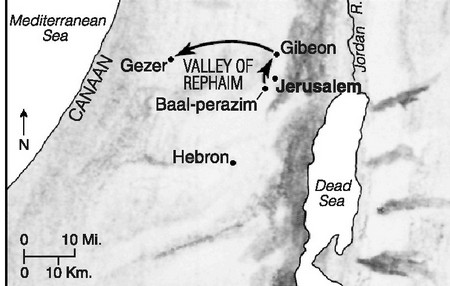
Meanwhile, back to David and the Philistines at Jerusalem, the Philistines came and spread themselves out in the Valley of Rephaim, which this map borrowed from Precept Austin shows to be just west of Jerusalem.

(2 Samuel 23:13) And three of the thirty chief went down and came to David in the harvest time to the cave of Adullam, and the troop of the Philistines pitched in the valley of Rephaim.

Three of David's chief men went to him in the cave of Adullam where he had apparently gone when the Philistines came and pitched in the Valley of Rephaim.

(14) And David was then in a hold, and the garrison of the Philistines was then in Bethlehem.

This map borrowed from BibleWalks shows in more detail the Valley of Rephaim in the upper right quadrant of the map with Jerusalem in the far right and Bethlehem about six miles south which is where the Philistines were then while David was in the cave of Adullam in the lower left quadrant of the map:


(15) And David longed, and said, "Oh that one would give me drink of the water of the well of Bethlehem which is by the gate."

David longingly said he wished he could have a drink of the water from the well of Bethlehem which is said to be about three-quarters of a mile to the north of Bethlehem, subsequently called David's well.

(16) And the three mighty men broke through the host of the Philistines and drew water out of the well of Bethlehem that was by the gate and took it and brought it to David. Nevertheless he would not drink of it but poured it out to the Lord.

The three mighty men took it upon themselves to break through the army of the Philistines to go to the well of Bethlehem and bring water back to David.  However, David did not drink it but poured it out before the Lord.

(17) And he said, "Be it far from me, O Lord, that I should do this. Is this not the blood of the men who went in jeopardy of their lives?" Therefore he would not drink it. These things did these three mighty men.

Evidently David had not expected anyone to actually go get him water from the well.  He had just meant to express that it would have been welcome at that time.  He felt he could not drink the water because it represented the blood of the men who had risked their lives just to bring him water.  This was one of the exploits of those three mighty men.  

(1 Chronicles 11:15) Now three of the thirty captains went down to the rock to David, into the cave of Adullam; and the host of the Philistines encamped in the valley of Rephaim. (16) And David was then in the hold, and the Philistines' garrison was then at Bethlehem. (17) And David longed, and said, "Oh that one would give me drink of the water of the well of Bethlehem, that is at the gate!" (18) And the three broke through the host of the Philistines, and drew water out of the well of Bethlehem, that was by the gate, and took it, and brought it to David, but David would not drink of it, but poured it out to the LORD, (19) And said, "My God forbid it me, that I should do this thing. Shall I drink the blood of these men who have put their lives in jeopardy? For with the jeopardy of their lives they brought it." Therefore he would not drink it. These things did these three mightiest.

1 Chronicles 11 told of the same incident, almost verbatim.

(2 Samuel 5:19) And David enquired of the Lord, saying, "Shall I go up to the Philistines? Will You deliver them into my hand?" And the Lord said to David, "Go up, for I will doubtless deliver the Philistines into your hand."

Then David asked the Lord if he should go out to the Philistines and if He would deliver them into his hands.  The Lord answered David that he should go forth for He would certainly deliver them into his hands.

(20) And David came to Baal Perazim, and David struck them there, and said, "The Lord has broken forth upon my enemies before me as the breach of waters." Therefore he called the name of that place Baal Perazim.

It seems the Philistines, at least some of them, had moved to a place later called Baal Perazim which was said to be in between Bethlehem and Jerusalem.  David struck them there, and said that the Lord had broken forth on the Philistines as floods or rivers of waters overflow a land and overturn all that stands in their way.  He called the place Baal Perazim which literally meant "possessor of breaches" or "lord of the breaks."

(21) And there they left their images, and David and his men burned them.

The Philistines had left their images, their false gods, which they had no doubt brought with them to protect and defend them and give them victory over the Israelites.  David and his men burned all their images.

(1 Chronicles 14:10) And David enquired of God, saying, "Shall I go up against the Philistines? And will You deliver them into my hand?" And the LORD said to him, "Go up, for I will deliver them into your hand." (11) So they came up to Baal Perazim; and David struck them there. Then David said, "God has broken in on my enemies by my hand like the breaking forth of waters." Therefore they called the name of that place Baal Perazim. (12) And when they had left their gods there, David gave a commandment, and they were burned with fire.

1 Chronicles 14 told of the same incident with only a little added detail that David commanded the pagan gods to be burned which they then were.

(2 Samuel 5:22) And the Philistines came up yet again and spread themselves in the valley of Rephaim.

More Philistines came forth and spread themselves in the valley of Rephaim.

(23) And when David enquired of the Lord, He said, "You shall not go up, but circle around behind them and come upon them over against the mulberry trees."

David wisely consulted his Lord before each of his advances, for the Lord told him this time not to go forth against the Philistines, but to encircle them from behind specifically in an area across from mulberry trees.

(24) "And let it be when you hear the sound of a going in the tops of the mulberry trees, then you shall stir yourself, for then shall the Lord go out before you to strike the host of the Philistines."

The Lord went on to instruct David that when he heard the rustling of the trees indicating the advancement of the Philistines, he was then to move toward the Philistines for the Lord would go out before him to strike them.  The Lord purposely used different methods to keep David dependent on Him.  If He struck His enemies the same way every time, David could become complacent and believe it was of himself that his enemies were overcome.

(25) And David did so as the Lord had commanded him and struck the Philistines from Gibeon until you come to Gezer.

David did as the Lord instructed and struck the Philistines all across the valley of Rephaim from Gibeon to Gezer, as seen on the first map above.

(1 Chronicles 14:13) And the Philistines yet again spread themselves abroad in the valley. (14) Therefore David enquired again of God, and God said to him, "Go not up after them; turn away from them, and come upon them over against the mulberry trees. (15) And it shall be, when you shall hear a sound of going in the tops of the mulberry trees, then you shall go out to battle, for God is gone forth before you to strike the host of the Philistines." (16) David therefore did as God commanded him, and they struck the host of the Philistines from Gibeon even to Gezer.

1 Chronicles 14 told of the same incident.

(17) And the fame of David went out into all lands, and the Lord brought the fear of him upon all nations.

Because of his exploits, David became famous throughout the surrounding lands, and the Lord caused the nations to fear him.

(1 Chronicles 13:1) And David consulted with the captains of thousands and hundreds, with every leader.

Then David consulted with all the captains of his troops of varying numbers.

(2) And David said to all the congregation of Israel, "If it seems good to you and of the Lord our God, let us send abroad to our brethren everywhere left in all the land of Israel and with them to the priests and Levites in their cities and suburbs, that they may gather themselves to us."

David spoke to the representatives of all the congregation of Israel and suggested that if it seemed good to them and was in accord with the will of God, they should send word to all their brethren left in Israel who had not yet come there and to all the priests and Levites, that they all might gather there to them.

(3) "And let us bring again the ark of our God to us for we did not enquire at it in the days of Saul.

David proposed that they should bring the ark of the Lord, that symbol of God's divine presence, to the royal city, for they had not enquired of it in the days of Saul, him being rather indifferent to it.

(4) And all the congregation said that they would do so, for the thing was right in the eyes of all the people.

All the congregation of Israel agreed that was what they should do as it seemed right to all of them.  One of David's first concerns as king was to restore religion which had been corrupted and neglected in the days of Saul.

Saturday, July 11, 2026

David's Family is Enlarged in Jerusalem

Continuing a chronological Bible study:

(2 Samuel 5:13) And David took more concubines and wives out of Jerusalem after he had come from Hebron, and there were yet sons and daughters born to David. 

David and his men had conquered the stronghold of Zion in the northern part of Jerusalem and built inward (2 Samuel 5:9).  It appears he had conquered all of Jerusalem by this time.  He took more wives and concubines out of Jerusalem and had more sons and daughters there.

(14) And these are the names of those who were born to him in Jerusalem, Shammua, and Shobab, and Nathan, and Solomon, (15) Ibhar also, and Elishua, and Nepheg, and Japhia, (16) And Elishama, and Eliada, and Eliphalet.

It appears that eleven sons were born to David in Jerusalem, and they are named here.

(1 Chronicles 3:5) And these were born to him in Jerusalem, Shimeah, and Shobab, and Nathan, and Solomon, four, of Bathshua the daughter of Ammiel;

1 Chronicles 3 also told of the sons born to David in Jerusalem with a little more detail.  Shammua is called Shimeah here, and David's first four sons born to him in Jerusalem were borne of Bathsheba, called Bathshua here, the daughter of Ammiel.

(6) Ibhar also, and Elishama, and Eliphelet, (7) And Nogah, and Nepheg, and Japhia, (8) And Elishama, and Eliada, and Eliphelet, nine.  

Nine more sons were added to the list of sons of David, to the four born to Bathsheba, bringing the total to thirteen, whereas 2 Samuel 5 named only eleven.  Elishama and Eliphelet are named twice here.  It is possible that they died young and subsequently had brothers named after them.  However, one of the Elishamas might actually be Elishua from the list in 2 Samuel 5, as Elishua is not listed here.  Nogah is also listed here and not in 2 Samuel 5.  Again, he may have died young.

(9) These were all the sons of David, besides the sons of the concubines, and Tamar their sister.

These apparently were the sons of David born to his wives only, and do not include sons born to his concubines.  Here is added the name of a daughter, Tamar.

(1 Chronicles 14:3) And David took more wives at Jerusalem, and David begat more sons and daughters.

1 Chronicles 14 also tells of David's additional wives and children in Jerusalem.

(4) Now these are the names of his children which he had in Jerusalem, Shammua, and Shobab, Nathan, and Solomon, (5) And Ibhar, and Elishua, and Elpalet, (6) And Nogah, and Nepheg, and Japhia, (7) And Elishama, and Beeliada, and Eliphalet.

This list of thirteen sons agrees with the list in 1 Chronicles 3 with a little variance in spelling.  Although this reference purports to list the names of his "children" not just his sons, Tamar is not listed here.

(2 Samuel 5:17) But when the Philistines heard that they had anointed David king over Israel, all the Philistines came up to seek David, and David heard and went down to the hold.

It might be that the Philistines had lain low while Israel was in the midst of a civil war, but now that they heard that that had been resolved and David was now king of all Israel, they went seeking David.  David heard about it and went down to a stronghold, surely to strategize.

(1 Chronicles 14:8) And when the Philistines heard that David was anointed king over all Israel, all the Philistines went up to seek David. And David heard and went out against them.

David then went out against the Philistines.

I'm going to end this short post here as the next passage takes me to a place I don't quite understand.  I am following a chronological Bible study created by Skip Andrews.  For now, we know that David had become king of all Israel, and his house grew as he married more wives and had many more sons.  When the Philistines heard that he was king, they came looking for him, and he went after them, more details to follow, I am sure.

Sunday, July 5, 2026

David Vows to Be a Godly King

Continuing a chronological Bible study:

(2 Samuel 5:11) And Hiram king of Tyre sent messengers to David, and cedar trees, and carpenters, and masons, and they built David a house.

David had become king over all Israel and had taken the castle Zion within the northern city limits of Jerusalem.  Hiram, king of Tyre, then sent messengers to David.  This map borrowed from Reading the Bible - 2021 shows the location of Tyre in relation to Israel.  Tyre was geographically part of the territory allotted to the tribe of Asher according to the Biblical division of Canaan but was never conquered or taken by Israel when they entered the Promised Land.  Hiram, the king of Tyre, was friendly with Israel, and he sent messengers to David, probably offering congratulations, and he also sent cedar logs, carpenters, and masons, who built a house for David.


(12) And David perceived that the Lord had established him king over Israel and that He had exalted his kingdom for His people Israel's sake.

David realized that the Lord Himself had established him as king of Israel as he saw how the Lord was blessing and enlarging him.  He perceived that it was for the Lord's people Israel's sake more than for his own benefit.

(1 Chronicles 14:1) Now Hiram king of Tyre sent messengers to David, and a timber of cedars, with masons and carpenters, to build him a house. (2) And David perceived that the Lord had confirmed him king over Israel for his kingdom was lifted up on high because of His people Israel.

1 Chronicles 14:1-2 also told of how the king of Tyre sent materials and men to build David a house.  David understood these blessings to be confirmation from God that it was He who lifted up David's kingdom for the benefit of His people Israel.

(Psalm 101:1) (A Psalm of David) I will sing of mercy and judgment, unto You, O Lord, I will sing.

Although there is no Biblical proof that David wrote this psalm at this particular time, it fits here nicely, as he seems to consider what kind of king he will be.  He would be merciful and just for His Lord.

(2) I will behave myself wisely in a perfect way. O when will You come to me? I will walk within my house with a perfect heart.

David determined to behave himself wisely in a perfect way.  Although no man is perfect, and we know that David would not always act perfectly, he would strive to walk in the Lord's way.  By asking when the Lord would come to him suggests that he would aim to walk within his house with a perfect heart until God called him to a particular objective.  It might mean that he called on God to walk with him as without God, he could not behave wisely in a perfect way.  However, more than likely, this psalm was actually written at a time before David was finally made king over all Israel.  He was ready to be king and contemplated what sort of king he would be whenever the Lord finally fulfilled His promise to him.

(3) I will set no wicked thing before my eyes; I hate the work of them who turn aside; it shall not cleave to me.

As king, David would not allow wickedness in his sight for what fascinates the eye is very apt to gain admission into the heart, just as the fruit first pleased Eve's sight, and then prevailed over her mind and then her actions.  David hated the work of those who turned aside from God's law, and he would not allow their wickedness to cling to him.  He would have nothing to do with wickedness or the workers of it.

(4) A froward heart shall depart from me; I will not know wickedness.

David might mean he would not allow himself to have a perverted heart and therefore would not know wickedness, or perhaps he meant he would not allow men with perverted hearts to be in his court.  He would not allow wickedness to be around him.

(5) Whoever privately slanders his neighbor, him will I cut off; he who has a high look and a proud heart, I will not suffer.

David vowed to cut off from him anyone who privately slandered another who had no opportunity to defend himself, in other words, a gossiper.  This was not someone who had a valid complaint against his neighbor that he expressed publicly looking for justice.  David would not tolerate prideful arrogant men around him.

(6) My eyes shall be upon the faithful of the land that they may dwell with me. He who walks in a perfect way, he shall serve me.

David would seek out and engage the services of only faithful upright followers of God.  Only those who walked in the way of the Lord would serve David in his court.

(7) He who works deceit shall not dwell within my house; he who tells lies shall not tarry in my sight.

Dishonest and deceitful men would not be allowed to dwell with David.  Anyone who told lies would not be permitted to stay in his court.

(8) I will early destroy all the wicked of the land that I may cut off all wicked doers from the city of the Lord.

One of David's first actions as king would be to destroy all the wicked of the land so that there would remain no wickedness in the city of the Lord, where holiness only should dwell.  David had now been well established as king of all Israel, and he resolved to be a good and wise king.

Charles Spurgeon, in his Treasury of David, wrote that the 101st psalm was called "The Householder's Psalm," an ideal model for the head of every family.  It was also called "The Mirror for Magistrates" as a model for rulers and judges.  Indeed, if all followed the ideals set forth in this psalm, our world would be a much better place!