Showing posts with label Sihon. Show all posts

Saturday, July 12, 2025

Jephthah the Ninth Judge

Continuing a chronological Bible study:

(Judges 10:1) And after Abimelech there arose to defend Israel Tola the son of Puah, the son of Dodo, a man of Issachar; and he dwelt in Shamir in Mount Ephraim.

In the last chapter and post, Abimelech, the son of Gideon's concubine, set himself up as a king in Israel, but after three years, he was killed.  After his death, God raised up Tola, son of Puah, grandson of Dodo, to defend and deliver Israel.  He was from the tribe of Issachar, but as judge, he dwelt in Shamir in Mount Ephraim.

(2) And he judged Israel twenty-three years, and died, and was buried in Shamir.

Tola was judge of Israel for twenty-three years, and it can be assumed that the land was at rest during this time.  He eventually died and was buried in Shamir.

(3) And after him arose Jair, a Gileadite, and he judged Israel twenty-two years.

After Tola died, God raised up Jair from the land of Gilead on the east side of the Jordan River.  He judged Israel for twenty-two years.  It is reasonable to assume that the land was at rest during this time, as well.

(4) And he had thirty sons who rode on thirty donkey colts, and they had thirty cities which are called Havoth Jair to this day, which are in the land of Gilead.

Jair had thirty sons who probably rode on white donkeys (Judges 5:10), acting as circuit judges.  It appears that Jair gave each of his sons a city in the land of Gilead, and the thirty cities were called Havoth Jair, meaning the villages of Jair.

(5) And Jair died and was buried in Camon.

After twenty-two years as judge, Jair died and was buried in Camon, a city in Gilead.

(6) And the children of Israel did evil again in the sight of the Lord and served Baalim and Ashtaroth, and the gods of Syria, and the gods of Sidon, and the gods of Moab, and the gods of the children of Ammon, and the gods of the Philistines, and forsook the Lord and did not serve Him.

After Jair died, the children of Israel once again turned to evil ways and served a multitude of false gods, forsaking their Lord God and not serving Him.

(7) And the anger of the Lord was hot against Israel, and He sold them into the hands of the Philistines and into the hands of the children of Ammon.

The anger of the Lord grew hot against Israel, and He delivered them into the hands of the Philistines and the Ammonites.

(8) And that year they vexed and oppressed the children of Israel, eighteen years, all the children of Israel who were on the other side of the Jordan in the land of the Amorites, which is in Gilead.

That year the Philistines and the Ammonites began oppressing the Israelites for the next eighteen years.  Or perhaps what is meant is that by that present time, the Philistines and the Ammonites had been oppressing the Israelites for eighteen years.  It appears that the Israelites who were oppressed were the ones living on the east side of the Jordan River, the tribes of Reuben and Gad, and the half tribe of Manasseh.

(9) Moreover, the children of Ammon passed over the Jordan to fight also against Judah, and against Benjamin, and against the house of Ephraim, so that Israel was sorely distressed.

The Ammonites also crossed over to the west side of the Jordan River to fight against the Israelites in the tribes of Judah, Benjamin, and Ephraim.  All of Israel became severely distressed.

(10) And the children of Israel cried to the Lord, saying, "We have sinned against You, both because we have forsaken our God and also served Baalim."

The Israelites then cried out to the Lord, acknowledging that they had sinned against Him, in forsaking the worship of Him and going to serve the Baals.

(11) And the Lord said to the children of Israel, "Did I not deliver you from the Egyptians, and from the Amorites, from the children of Ammon, and from the Philistines? (12) The Sidonians also, and the Amalekites, and the Maonites, oppressed you, and you cried to Me, and I delivered you out of their hand."

The Lord reminded the children of Israel how many times He had delivered them from their enemies.  Every time they cried out to Him, He delivered them from the hands of their enemies.

(13) "Yet you have forsaken Me and served other gods; therefore I will deliver you no more."

After all the many times the Lord had delivered them from their enemies, they still forsook Him and served multiple false gods.  Therefore, He determined not to deliver them from their enemies anymore.  What a scary thought!  To never again have salvation from the Lord God!

(14) "Go and cry to the gods which you have chosen; let them deliver you in the time of your tribulation."

God fittingly told them to go cry to the gods they had chosen.  Perhaps it would be a more well-remembered lesson if they saw that their feeble false gods could not deliver them from their tribulation.

(15) And the children of Israel said to the Lord, "We have sinned; do to us whatever seems good to You; only deliver us, we pray, this day."

The Israelites acknowledged their sins before God and asked that He inflict on them whatever punishment He thought appropriate, but to please deliver them from their enemies.

(16) And they put away the strange gods from among them and served the Lord, and His soul was grieved for the misery of Israel.

In addition, the Israelites immediately put away all their false gods and began serving only their Lord God.  The Lord, seeing their true repentance, looked upon His people with love and mercy.

(17) Then the children of Ammon were gathered together and encamped in Gilead. And the children of Israel assembled themselves together and encamped in Mizpeh.

Then the Ammonites gathered together and camped in Gilead on the eastern side of the Jordan River.  The Israelites gathered together and camped in Mizpeh, which appears to be a place on the eastern side of the Jordan.  Albert Barnes, in his Notes on the Bible, wrote that it was usually written as "The Mizpeh" and it meant "watch tower" or "lookout" and was located on Mount Gilead.

(18) And the people, princes of Gilead, said to one another, "What man who will begin to fight against the children of Ammon, he shall be head over all the inhabitants of Gilead."

The leaders of the Israelites in Gilead had assembled together but did not have a commander.  They decided among themselves that whatever man would set out to fight against the Ammonites, he would naturally become their head leader or commander.

(Judges 11:1) Now Jephthah the Gileadite was a mighty man of valor, and he was the son of a harlot, and Gilead begat Jephthah.

There was a man named Jephthah who was a Gileadite from the line of Gilead, the son of Machir, the son of Manasseh.  It seems Jephthah's father was also named Gilead, and Jephthah was the son of that Gilead and a harlot.  He was apparently known as a mighty man of valor. 

(2) And Gilead's wife bore him sons, and his wife's sons grew up, and they thrust out Jephthah and said to him, "You shall not inherit in our father's house for you are the son of a strange woman."

Gilead's wife had borne him sons and when they grew up, they kicked Jephthah out of their father's house and said that he would never inherit anything of their father's because he was the son of someone other than their mother, Gilead's wife.

(3) Then Jephthah fled from his brethren and dwelt in the land of Tob, and there were gathered vain men to Jephthah and went out with him.

Jephthah fled from his brothers and dwelt in a place called Tob or perhaps it was a land belonging to a man called Tob.  There men gathered themselves to Jephthah and went around with him.  They are called vain men, the original word being "rake" meaning empty or worthless.  I don't know that they were worthless in the sense they were bad men, but they were probably poor men with no real purpose in life.

(4) And it came to pass in process of time that the children of Ammon made war against Israel.  

It was during this time that the Ammonites made war against the Israelites.

(5) And it was so, that when the children of Ammon made war against Israel, the elders of Gilead went to fetch Jephthah out of the land of Tob. (6) And they said to Jephthah, "Come and be our captain that we may fight with the children of Ammon."

When the Ammonites had made war with Israel, the elders of Gilead went to Jephthah in the land of Tob and asked him to go back with them to be captain over them and fight against the Ammonites.

(7) And Jephthah said to the elders of Gilead, "Did you not hate me and expel me out of my father's house? And why are you come to me now when you are in distress?"

Jephthah asked the elders why they now wanted him back in their time of distress when they had once hated him and expelled him out of his father's house.

(8) And the elders of Gilead said to Jephthah, "Therefore we turn again to you now that you may go with us and fight against the children of Ammon and be our head over all the inhabitants of Gilead."

They were in agreement that they had acted that way against him, but they now came to him with full confidence and asked that he lead them against the Ammonites and actually be the head over all the inhabitants of Gilead.

(9) And Jephthah said to the elders of Gilead, "If you bring me home again to fight against the children of Ammon, and the Lord delivers them before me, shall I be your head?"

Jephthah asked the elders that if they brought him back home to fight against the Ammonites and the Lord indeed delivered them into his hand, would they make him head over them, meaning not just captain of their army, but chief ruler over them.

(10) And the elders of Gilead said to Jephthah, "The Lord be witness between us if we do not so according to your words."

The elders of Gilead agreed that Jephthah would indeed be their ruler, and the Lord was their witness that they had agreed to do what he had said.

(11) Then Jephthah went with the elders of Gilead, and the people made him head and captain over them, and Jephthah uttered all his words before the Lord in Mizpeh.

Jephthah went back with the elders of Gilead where the people made him head and captain over them.  It appears that Jephthah confirmed his plans to the Lord in prayer to be sure he was acting within the will of the Lord.

(12) And Jephthah sent messengers to the king of the children of Ammon, saying, "What have you to do with me that you are come against me to fight in my land?"

Jephthah then sent messengers to the king of the Ammonites and speaking as Israel's ruler, asked why they were invading his land and making war against his people.

(13) And the king of the children of Ammon answered to the messengers of Jephthah, "Because Israel took away my land when they came up out of Egypt from Arnon even to Jabbok and to Jordan; now therefore restore those again peaceably."

The king of Ammon sent a message back that he sought to fight against Israel because they had taken his land from the River Arnon to the Jabbok River to the Jordan River from him when they came from Egypt.  This map borrowed from Bible History shows the rivers in Old Testament Israel, and the Ammonite king's land is clearly visible by the above description:


The king told Jephthah to restore his lands peaceably.

(14) And Jephthah sent messengers again to the king of the children of Ammon, (15) And said to him, "Thus says Jephthah, 'Israel did not take away the land of Moab nor the land of the children of Ammon, (16) But when Israel came up from Egypt and walked through the wilderness to the Red Sea and came to Kadesh, (17) Then Israel sent messengers to the king of Edom, saying, "Let me, I pray you, pass through your land," but the king of Edom would not hearken. And in like manner, they sent to the king of Moab, but he would not, and Israel abode in Kadesh.'"

Jephthah sent messengers back to the king of Ammon telling him that Israel had not taken away the land of Moab or the land of Ammon.  He explained how Israel had come from Egypt and in order to get to the land of Canaan, they sent messengers to the king of Edom asking permission to cross through the land of Edom (Numbers 20:17), but the king had refused them passage.  Likewise, the king of Moab would not allow them passage (Deuteronomy 2:30).  Therefore the children of Israel abode in Kadesh and did not attempt to force their way through either country.

(18) "'Then they went along through the wilderness and compassed the land of Edom and the land of Moab and came by the east side of the land of Moab and pitched on the other side of Arnon but did not come within the border of Moab for Arnon was the border of Moab.'"

Jephthah's messengers continued with the words of Jephthah explaining how the Israelites then went around Edom and Moab and camped on the east side of Moab on the other side of their border at the Arnon River (Numbers 21:13).

(19) "'And Israel sent messengers to Sihon king of the Amorites, the king of Heshbon, and Israel said to him, "Let us pass, we pray you, through your land into our place." (20) But Sihon did not trust Israel to pass through his coast, but Sihon gathered all his people together and pitched in Jahaz and fought against Israel.'"

Israel had then sent messengers to Sihon, king of the Amorites, in Heshbon, the royal city, and asked that they be allowed to pass through his land to get to their land in Canaan.  However, Sihon refused, and then gathered his people to fight against Israel (Numbers 21:23).

(21) "'And the Lord God of Israel delivered Sihon and all his people into the hand of Israel, and they killed him, so Israel possessed all the land of the Amorites, the inhabitants of that country.'"

It was Sihon who instigated war against Israel, and the Lord delivered Sihon and all his people into the hand of the Israelites so that being victors in the war, they lawfully possessed all the land of the Amorites, the inhabitants of that country at that time.

(22) "'And they possessed all the coasts of the Amorites, from Arnon even to Jabbok and from the wilderness even to Jordan.'"

Therefore the Israelites possessed all the land of the Amorites from the Jabbok to the Arnon River, north to south, and from the Arabian wilderness to the Jordan River, east to west.

(23) "'So now the Lord God of Israel has dispossessed the Amorites from before His people Israel, and should you possess it?'"

Jephthah summed up his words in his message to the king of Ammon, saying that since the Lord God of Israel had lawfully dispossessed the Amorites from their land and had given it to His people Israel, could he, the Ammonite king, really expect to possess it?

(24) "'Will you now possess that which Chemosh your god gives you to possess? So whoever the Lord our God shall drive out from before us, them we will possess.'"

Jephthah's message went on to say that although the Ammonites believed that because they had been given that land by their false god Chemosh, and they had a divine right to the land and should never have to relinquish it, Jephthah's claim was that whomever their Lord God of Israel drove out from before them was Israel's to rightfully possess.

(25) "'And now are you any better than Balak the son of Zippor, king of Moab? Did he ever strive against Israel, or did he ever fight against them, (26) While Israel dwelt in Heshbon and her towns, and in Aroer and her towns, and in all the cities that are along by the coasts of Arnon, three hundred years? Why therefore did you not recover them within that time?'"

Jephthah posed the question of whether this king of Ammon thought he was better and wiser than his predecessor Balak, the son of Zippor, who had been the king of Moab and the former possessor of the land that the Israelites took from Sihon.  Balak had never assumed claim or entered into any dispute or war over the land Israel had possessed and inhabited which they had now inhabited for almost 300 years.  Why had he not put in his claim sooner and tried to recover the land before this time?

(27) "'Therefore I have not sinned against you, but you do me wrong to war against me; the Lord the Judge be judge this day between the children of Israel and the children of Ammon.'"

Having explained the history of the disputed land, Jephthah pointed out that he and Israel had not sinned against the king of Ammon and his people, but the king was wrong in commencing a war with Israel when he had no just cause.  Therefore he called on the Lord God of Israel, the righteous Judge of all the earth, to be judge between Israel and the Ammonites and give victory to the party which was right.

(28) However, the king of the children of Ammon did not heed the words of Jephthah which he sent them.

However, the king of Ammon was not moved by the words of Jephthah which had been sent by messenger to him, nor did he regard the appeal Jephthah had made to the Lord God of the universe.

(29) Then the Spirit of the Lord came upon Jephthah, and he passed over Gilead and Manasseh, and passed over Mizpeh of Gilead, and from Mizpeh of Gilead he passed over to the children of Ammon.

The Spirit of the Lord came over Jephthah and led him to pass over Gilead and Manasseh, the countries that belonged to Reuben, Gad, and the half tribe of Manasseh.  He also passed over Mizpeh in Gilead where the Israelites had originally camped against the Ammonites in Gilead (Judges 10:17) and where Jephthah had been made head and captain over the Israelites (Judges 11:11).  From there Jephthah passed over to the children of Ammon under the influence of the Spirit of the Lord.

(30) And Jephthah vowed a vow to the Lord, and said, "If You shall without fail deliver the children of Ammon into my hands, (31) Then it shall be that whatever comes forth of the doors of my house to meet me when I return in peace from the children of Ammon, shall surely be the Lord's, and I will offer it up for a burnt offering."

Jephthah then vowed a vow to the Lord.  Although he had seemed assured of the justness of his cause, he appears to have had some doubt about his success, and he felt the need to make a tragic vow.  He vowed that if the Lord delivered the Ammonites into his hands, then he would offer up as a burnt offering to the Lord whatever came forth out of the door of his house to meet him when he returned from a victorious war with the Ammonites.  This seems to be a very rash, ill-considered vow, coming forth from a level of doubt or fear, as logically, what would come out of his house to meet him other than a loved one?  A dog, perhaps?  But unlikely.

(32) So Jephthah passed over to the children of Ammon to fight against them, and the Lord delivered them into his hands. (33) And he struck them from Aroer, even till you come to Minnith, twenty cities, and to the plain of the vineyards, with a very great slaughter. Thus the children of Ammon were subdued before the children of Israel.

Of course, the Lord delivered the Ammonites into Jephthah's hand!  He was the one who led Jephthah to the Ammonites (verse 29).  He and his army struck the Ammonites all across their country, twenty cities and the plain, in a great slaughter, and the Ammonites were fully subdued before the Israelites.

(34) And Jephthah came to Mizpeh to his house, and behold, his daughter came out to meet him with timbrels and with dances, and she his only child; besides her, he had neither son nor daughter.

Of course, Jephthah's daughter would run out to meet her father!  What had Jephthah been thinking when he vowed his vow?  Perhaps he expected a servant whom he was willing to sacrifice.  Apparently, it was a custom for women to go out to meet returning conquerors with musical instruments, songs, and dances.  There would have been a group of women, so any one of them could have come out first.  But it was his daughter who came out first to meet him, dancing with tambourines.  She was his only child.

(35) And it came to pass, when he saw her, he tore his clothes, and said, "Alas, my daughter! You have brought me very low, and you are one of them who troubles me, for I have opened my mouth to the Lord, and I cannot go back!"

When Jephthah saw it was his only daughter who came out to meet him first, he tore his clothes in a sign of grief and anguish.  He told his daughter how much it grieved and troubled him to see her because he had opened his mouth in a rash vow concerning her, and he could not go back on his word to the Lord.  Actually, in truth, I believe he could have.  Child sacrifice was never acceptable to the Lord.  Even when the Lord tested Abraham's faith by asking him to sacrifice his son, once Abraham had proved his faith in the Lord, the Lord provided another sacrifice.  It would have been a great sin for Jephthah to go back on his word to the Lord, but I believe it was equally great a sin for him to kill his daughter, a sacrifice God never wanted.  However, the Lord knows the heart of man, and I'm sure he judged Jephthah righteous because he put his Lord first.  But what a tragic loss of an innocent life!  I believe this incident was meant as a lesson for us about the consequences of impulsive vows.  Making a vow to the Lord is a very serious matter, and it should only be made after serious consideration.  Words carry great power and moral responsibility, most especially words to our Lord God.  Actually, Jesus said:

"...you have heard that it has been said by those of old, 'You shall not swear falsely, but shall perform to the Lord your oaths,' but I say to you, 'Swear not at all neither by heaven for it is God's throne, nor by the earth for it is His footstool, neither by Jerusalem for it is the city of the great King...But let your communication be 'Yes' for yes, and 'No' for no, for whatever is more than these comes of evil." (Matthew 5:33-35,37)

Jesus said not to swear a vow at all because any more than "yes" or "no" came from evil, or the evil one, the devil, as he would have one swear a vow as Jephthah did so that an innocent life be destroyed, because his purposes are only to kill, steal, and destroy (John 10:10).

(36) And she said to him, "My father, you have opened your mouth to the Lord, do to me according to that which has proceeded out of your mouth, forasmuch as the Lord has taken vengeance for you of your enemies of the children of Ammon."

Jephthah's daughter, in remarkable submission and obedience to her father and great reverence for the Lord, agreed that her father must do as he had vowed to the Lord because the Lord had given him victory over the Ammonites as he had asked of Him.  She willingly consented to his vow.

(37) And she said to her father, "Let this thing be done for me: let me alone two months that I may go up and down on the mountains and bewail my virginity, I and my companions."

She only asked that her father give her two months to mourn the fact that she would die unmarried and childless.  She wished for time to go up and down the mountains, probably first telling her friends she would pass on the way about her coming demise, and then perhaps they would accompany her as she bewailed her virginity.

(38) And he said, "Go." And he sent her away two months, and she went with her companions and bewailed her virginity on the mountains.

Jephthah granted his daughter's request and sent her away for two months.  She went with her companions and friends and bewailed on the mountains the fact that she would die a virgin, unmarried and childless.

(39) And it came to pass at the end of two months, that she returned to her father who did with her according to his vow which he had vowed, and she knew no man. And it was a custom in Israel, (40) The daughters of Israel went yearly to lament the daughter of Jephthah the Gileadite four days in a year.

At the end of two months Jephthah's daughter returned to her father, and he did with her according to his vow, "and she knew no man."  Some Biblical scholars take this to mean Jephthah did not actually sacrifice his daughter, but gave her to the Lord or dedicated her to the Lord.  The verse did not state specifically that Jephthah offered her as a burnt sacrifice as was his vow (verse 31), but states that she was a virgin.  And Jephthah was listed as one of the heroes of faith in Hebrews (Hebrews 11:32).  However, because God did not approve of human sacrifice, I'm sure that act was not the object of his faith that made him one of the heroes of faith.  I believe he was listed for his faith because he did as the Lord directed him (verse 29) and delivered Israel, and it was despite his tragic vow.  The Lord would have delivered Israel, regardless.  However, as stated before, God knows the heart of man, and Jephthah's was purely toward his Lord and above his only daughter, if he did indeed sacrifice her.  Why wouldn't God have stopped Jephthah from sacrificing his daughter as he had stopped Abraham?  Well, the main reason is that God had told Abraham to sacrifice his son (Genesis 22:2).  He did no such thing in this case.  This was the sole doing of Jephthah.  If it seems cruel to allow an innocent young woman to be killed because of her father's rash vow, we must realize that if she was indeed innocent, then she was faithful in fulfilling her purpose in life, as providing an important everlasting lesson in the Bible, and she forever resides with Jesus.

Sunday, February 2, 2025

The Inheritance East of the Jordan River

Continuing a chronological Bible study:

(Joshua 13:1) Now Joshua was old, stricken in years, and the Lord said to him, "You are old, stricken in years, and there remains yet very much land to be possessed."

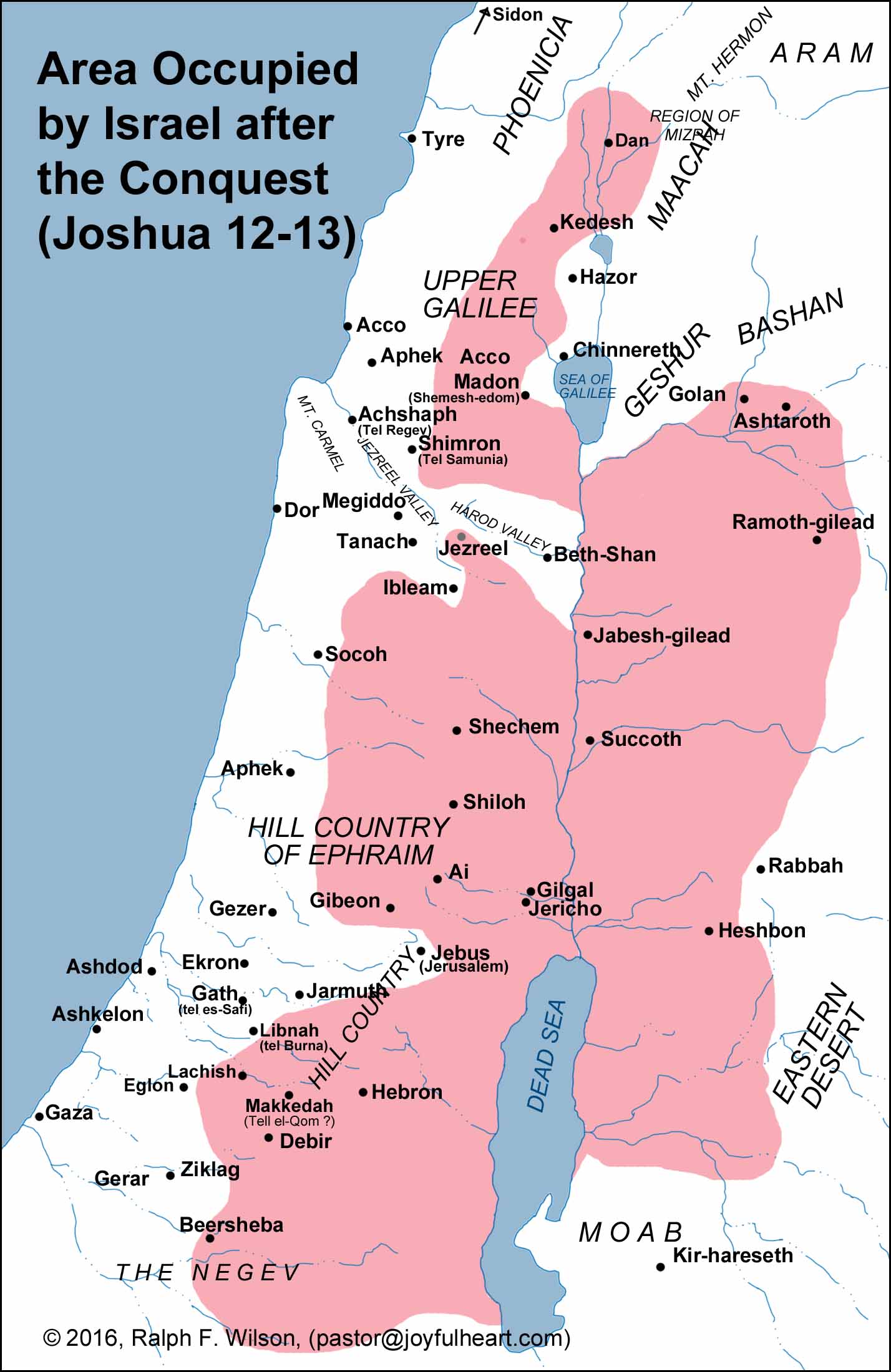
Joshua and the Israelite army had conquered thirty-one kings and territories in the past seven years.  But Joshua was getting old, commentators think about a hundred years old.  It's amazing to think that a man in his nineties could have done what he had done in the past seven years!  But there was still much land to be conquered all around on the outskirts of the conquered area.  This map I found on Pinterest said to have come from jesuswalk.com clearly shows the conquered lands in relation to the whole:


I find it interesting to note that although Joshua had defeated their kings as noted in the last chapter, some of their territories remained outside of Israelite occupation (Gezer, Aphek, Dor, Megiddo, etc.).  It seems reasonable to assume that Joshua may have continued to try to conquer the rest of the lands, but God stopped him because of his advanced age.  Adam Clarke, in his Commentary on the Bible, had an interesting perspective.  As nothing God does is by accident, he suggested that God may have wanted some of the original inhabitants to remain in order to keep the oftentimes unfaithful Israel in check.  

(2) "This is the land that yet remains, all the borders of the Philistines, and all Geshuri,"

The Lord then detailed the lands that were still unconquered, undoubtedly so that Joshua and the Israelites would know what they had a right to claim.  There was the territory of the Philistines in the southwest of Canaan along the Mediterranean Sea, to Geshuri, which appears to be Geshur in the north.  This map borrowed from Big Springs Community Church shows the unconquered lands more clearly than the one above:


(3) "From Sihor before Egypt to the borders of Ekron northward, counted to the Canaanite, five lords of the Philistines, the Gazites, the Ashdodites, the Ashkelonites, the Gittites, and the Ekronites, also the Avites;"

God described in more detail the as of yet unconquered territories of the promised land.  Describing the land of the Philistines, He said it ranged from Sihor before Egypt in the south to Ekron in the north which can be seen in the first map, across from Jerusalem.  The land of Philistia was counted as belonging to the posterity of Canaan, but the Philistines had gotten possession of it.  Because it was counted as Canaanite land, it was part of the promised land.  There were five lords in Philistia rather than kings, and it contained the cities of Gaza, Ashdod, Ashkelon, Ekron, and their inhabitants, and to whatever cities the Gittites and Avites belonged.

(4) "From the south, all the land of the Canaanites and Mearah beside the Sidonians, to Aphek to the borders of the Amorites;"

As near as I can tell by these maps, God is describing all the land of the Canaanites that was not part of the Philistines, from the south upward to Aphek (note there are two Apheks, one in Upper Galilee) to Sidon.

(5) "And the land of the Gebalites, and all Lebanon, toward the sunrising, from Baal Gad under Mount Hermon to the entering into Hamath;"

Gebal was north of Sidon on the Mediterranean coast.  The land of the Gebalites was said to be that east of Tyre, Sidon, and Gebal, the land east of the Lebanon mountains in the north, from Mount Hermon to the entrance of Hamath, seen clearly in this map borrowed from The Biblical Zionist:


(6) "All the inhabitants of the hill country from Lebanon to Misrephoth Maim, all the Sidonians, them I will drive out from before the children of Israel; only divide it by lot to the Israelites for an inheritance as I have commanded you."

The Lord continued to describe the land that was yet unconquered that also included all the hill country from Lebanon to Misrephoth Maim which was south of Tyre, all the land of the Sidonians.  All that very much land yet to be possessed (v. 1) included all the lands described from verse 2 to the Sidonians in verse 6.  All those the Lord would drive out from before the children of Israel.  Even though they were not yet driven out, the Lord wanted Joshua to divide all the promised land by lot to the Israelites for their inheritance.  Most of the early commentators I study suggest that these people were not ever entirely driven out or their land completely possessed by the Israelites, that the promise was always part of a covenant that must be upheld by the Israelites, and they did not do their part.  However, I refer back to Exodus 23:30-31, when the Lord said:

"Little by little I will drive them out from before you, until you have increased, and you inherit the land. And I will set your bounds from the Red Sea to the sea of the Philistines, and from the desert to the river; for I will deliver the inhabitants of the land into your hand, and you shall drive them out before you."

God specifically said that it would be little by little, and indeed all the land was subdued under the reign of David.  Some say that still the people were not specifically driven out, only subdued.  However, throughout ancient and modern history, Israel's borders have changed, and indeed the future Millennial Israel will include all of the promised land.

(7) "Now therefore divide this land for an inheritance to the nine tribes and the half tribe of Manasseh," (8) With whom the Reubenites and the Gadites have received their inheritance which Moses gave them beyond Jordan eastward, as Moses the servant of the Lord gave them,

The Lord told Joshua to divide the land on their present side of the Jordan River for an inheritance to the nine and a half tribes that had not yet received their inheritance.  Reuben, Gad, and the other half tribe of Manasseh had already received their lots on the east side of the Jordan River, given them by Moses.

(9) From Aroer which is on the bank of the River Arnon, and the city that is in the midst of the river, and all the plain of Medeba to Dibon, (10) And all the cities of Sihon king of the Amorites who reigned in Heshbon, to the border of the children of Ammon;

Further describing the lands given to Reuben, Gad, and the half tribe of Manasseh, it was from Aroer in the middle of the Arnon River that separated the land of the Amorites from Moab, and all the plain and cities of Sihon king of the Amorites to the Jabbok River which was the border of the Ammonites.

(11) And Gilead, and the border of the Geshurites and Maachathites, and all Mount Hermon, and all Bashan to Salcah, (12) All the kingdom of Og in Bashan who reigned in Ashtaroth and in Edrei, who remained of the remnant of the giants; for these did Moses smite and cast them out.

They had also received all the kingdom of Og, which included Gilead, the border of the Geshurites and Maachathites, all Mount Hermon, and all Bashan to Salcah.  All that land of Og that had been taken by Moses had been given to Israel, but they had not taken possession of much of it.

(13) Nevertheless, the children of Israel did not expel the Geshurites, nor the Maachathites, but the Geshurites and the Maachathites dwell among the Israelites until this day.

Indeed, Joshua went on to write that the Israelites had not driven out the Geshurites and Maachathites, and they still dwelt with them at the time of his writing.

(14) Only to the tribe of Levi He gave no inheritance; the sacrifices of the Lord God of Israel made by fire are their inheritance, as He said to them.

The tribe of Levi received no land inheritance on either side of the Jordan River.  As they were God's priests, He was to be their inheritance; they were to live off the sacrifices to their Lord God (Deuteronomy 18:1).

(15) And Moses gave to the tribe of the children of Reuben according to their families. (16) And their coast was from Aroer which is on the bank of the river Arnon, the city in the midst of the river, and all the plain by Medeba;

Moses had given to the tribe of Reuben the land from Aroer in the southeast and all the plain of Medeba.

(17) Heshbon, and all her cities in the plain, Dibon, and Bamoth Baal, and Beth Baal Meon, (18) And Jahazah, and Kedemoth, and Mephaath, (19) And Kirjathaim, and Sibmah, and Zereth Shahar in the mount of the valley, (20) And Beth Peor, and Ashdoth Pisgah, and Beth Jeshimoth, (21) And all the cities of the plain, and all the kingdom of Sihon king of the Amorites, who reigned in Heshbon, whom Moses smote with the princes of Midian, Evi, and Rekem, and Zur, and Hur, and Reba, dukes of Sihon dwelling in the country.

Reuben's inheritance included all these cities in the former kingdom of Sihon.  It had been taken by Moses when he defeated the king of Sihon and all his princes.  I can't begin to try to locate all these cities, but I found this map at Psalms to God Podcast that shows a general view of all the tribes and their allotments:


(22) Balaam also, the son of Beor, the soothsayer, the children of Israel killed with the sword, among those who were killed by them. 

The Israelites had also killed Balaam, the soothsayer, at the same time as the princes (Numbers 31:8).

(23) And the border of the children of Reuben was Jordan and its border. This was the inheritance of the children of Reuben after their families, the cities and the villages.

The northwestern border of the land possessed by the descendants of Reuben was the Jordan River.  All the land, cities, and villages between the Jordan and Aroer in the southeast made up the inheritance of the children of Reuben.

(24) And Moses gave to the tribe of Gad, to the children of Gad according to their families. (25) And their coast was Jazer and all the cities of Gilead, and half the land of the children of Ammon, to Aroer before Rabbah; (26) And from Heshbon to Ramath Mizpah and Betonim, and from Mahanaim to the border of Debir; (27) And in the valley Beth Haram, and Beth Nimrah, and Succoth, and Zaphon, the rest of the kingdom of Sihon king of Heshbon, with the Jordan as border to the edge of the Sea of Chinnereth on the other side of the Jordan eastward. (28) This is the inheritance of the children of Gad after their families, the cities and their villages.

Moses gave as an inheritance to the children of Gad the land from Jazer in the south to Rabbah in the west, with the Jordan River as the western border.  The northern border was quite unique, and I will let the map show the general area that was allotted to Gad.  Once again trying to locate all those cities is quite a dizzying task.  The Aroer before Rabbah would have to be a different Aroer from the one at the middle of the Arnon River.  Also Debir would have to be a different Debir.  All the cities of Gilead would only pertain to those cities within the area of Gad, as half of Gilead was given to the half tribe of Manasseh.  The same would have to be said for all the kingdom of Sihon that was given to Reuben (v. 21), as it states here that there was the rest of the kingdom of Sihon that was given to Gad.  Half the land of the children of Ammon refers to that part that Sihon king of the Amorites took from the Ammonites.

(29) And Moses gave to the half tribe of Manasseh, and this was of the half tribe of the children of Manasseh by their families. (30) And their coast was from Mahanaim, all Bashan, all the kingdom of Og king of Bashan, and all the towns of Jair, which are in Bashan, sixty cities; (31) And half Gilead, and Ashtaroth, and Edrei, cities of the kingdom of Og in Bashan, to the children of Machir the son of Manasseh, to the one half of the children of Machir by their families.

To the half tribe of Manasseh, the land from Mahanaim, which must have been the southern border as Gad also had that border (v. 26), including all the land of Bashan that included sixty cities, half of Gilead, and the royal cities of Og, Ashtaroth and Edrei.  The land is said to have been given to half the children of Machir, who was Manasseh's son.

(32) These are what Moses had distributed for inheritance in the plains of Moab on the other side of the Jordan by Jericho eastward.

The lands described above from verse 9 to this verse were all the lands that had been distributed by Moses to the tribes of Reuben, Gad, and the half tribe of Manasseh, on the eastern side of the Jordan River, east of Jericho.

(33) But to the tribe of Levi Moses did not give inheritance; the Lord God of Israel was their inheritance, as He said to them.

Once again, Joshua points out that the tribe of Levi did not receive any land as their inheritance, because as priests, the Lord God was their inheritance.

As Joshua was now old, God had him rest from his battles, even though there was still much land to be conquered.  However, for now, He wanted Joshua to portion out the lots of inheritance, and it was to include all the land that had been promised, even those not yet conquered.  This chapter began with the allotments that had already been given to the tribes of Reuben, Gad, and the half tribe of Manasseh. 

Wednesday, January 29, 2025

Kings Defeated by Israel

Continuing a chronological Bible study:

(Joshua 12:1) Now these are the kings of the land whom the children of Israel smote and possessed their land on the other side of the Jordan toward the rising of the sun, from the River Arnon to Mount Hermon, and all the plain on the east:

In the last chapter and post, Joshua and his army had concluded their conquest of their promised land on the west side of the Jordan River.  Now began a summary and list of the kings whom Israel defeated in order that the Israelites could possess their land.  The list started with the kings Israel defeated on the east side of the Jordan River from the Arnon River in the south to Mount Hermon in the north and all the plains between the two.  

(2) Sihon king of the Amorites who dwelt in Heshbon and ruled from Aroer which is on the bank of the River Arnon, and from the middle of the river and from half Gilead even to the River Jabbok, the border of the children of Ammon, (3) And from the plain to the Sea of Chinneroth on the east and to the sea of the plain, the Salt Sea on the east, the way to Beth Jeshimoth, and from the south under Ashdoth Pisgah.

The first king the Israelites defeated in order to take possession of their land was Sihon king of the Amorites.  He dwelt in Heshbon and ruled half of Gilead from Aroer in the middle of the Arnon River, which was the boundary between the Amorites and the Moabites, to the Jabbok River which bordered the Ammonites, from the plain of Moab to the Sea of Chinneroth on the east and to the Salt Sea on the east, the way to Beth Jeshimoth, a place in the plains of Moab, and from the south under Ashdoth Pisgah, which meant literally the ravines of Pisgah, named for the springs of Pisgah which flowed from Mount Pisgah.  It is very difficult for me to grasp the exact locations of these territories, but I found a map on Pinterest said to be a map of the lands taken and kings defeated by Moses and Joshua from this chapter in Joshua.  The map was originally found at thesentone.files.wordpress.com:


(4) And the coast of Og king of Bashan of the remnant of the giants who dwelt at Ashtaroth and at Edrei, (5) And reigned in Mount Hermon, and in Salcah, and in all Bashan, to the border of the Geshurites and the Maachathites, and half Gilead, the border of Sihon king of Heshbon.

The Israelites also defeated Og king of Bashan who was of the remnant of giants, said to be the only one left in Deuteronomy 3:11.  Og dwelt at Ashtaroth and at Edrei and reigned over Mount Hermon and Salcah, and over all of Bashan, to the border of the Geshurites and the Maachathites, and half of Gilead to the border of Sihon king of Heshbon.

(6) Them did Moses the servant of the Lord and the children of Israel smite, and Moses the servant of the Lord gave it as a possession to the Reubenites, and the Gadites, and the half tribe of Manasseh.

Sihon and Og were the two kings who had been destroyed under the direction of Moses.  Moses gave those lands to the tribes of Reuben, Gad, and the half tribe of Manasseh (Deuteronomy 3:11-17).

(7) And these are the kings of the country which Joshua and the children of Israel smote on this side of the Jordan on the west, from Baal Gad in the valley of Lebanon even to the mount Halak that goes up to Seir, which Joshua gave to the tribes of Israel for a possession according to their divisions, (8) In the mountains, and in the valleys, and in the plains, and in the springs, and in the wilderness, and in the south country, the Hittites, the Amorites, and the Canaanites, the Perizzites, the Hivites, and the Jebusites:

Following in verse 9 begins a list of the kings defeated by Joshua and the Israelite army on the western side of the Jordan River, from Baal Gad in the valley of Lebanon in the north to Halak in Edom in the south, which Joshua would later divide among the tribes of Israel for their possession.  All the land contained in this area, all the mountains, valleys, plains, springs, the wilderness, and the south country, inhabited by the Hittites, the Amorites, the Canaanites, the Perizzites, the Hivites, and the Jebusites, Israel had conquered.

(9) The king of Jericho, one; the king of Ai, which is beside Bethel, one;

The list of kings defeated by Joshua begins with Jericho, one king, and next was the king of Ai, one king, which brings the tally to two kings.

(10) The king of Jerusalem, one; the king of Hebron, one; (11) The king of Jarmuth, one; the king of Lachish, one; (12) The king of Eglon, one; the king of Gezer, one;

The list continues with the kings of Jerusalem, Hebron, Jarmuth, Lachish, and Eglon, who were the five kings who had allied against Israel and were taken and hanged.  Next was Gezer who came to help Lachish.  That brings the number to eight kings.

(13) The king of Debir, one; the king of Geder, one; (14) The king of Hormah, one; the king of Arad, one; (15) The king of Libnah, one; the king of Adullam, one; 

Israel also defeated the kings of Debir, Geder, Hormah, Arad, Libnah, and Adullam, some of which were not mentioned among the major battles of chapters 10 and 11.  That brings the number of kings defeated to fourteen.

(16) The king of Makkedah, one; the king of Bethel, one; (17) The king of Tappuah, one; the king of Hepher, one; (18) The king of Aphek, one; the king of Lasharon, one; 

The kings of Makkedah, Bethel, Tappuah, Hepher, Aphek, and Lasharon, bring the total to twenty kings defeated.

(19) The king of Madon, one; the king of Hazor, one; (20) The king of Shimron Meron, one; the king of Achshaph, one; (21) The king of Taanach, one; the king of Megiddo, one;

The kings of Madon, Hazor, Shimron Meron, Achshaph, Taanach, and Megiddo, bring the total to twenty-six.

(22) The king of Kedesh, one; the king of Jokneam of Carmel, one; (23) The king of Dor in the coast of Dor, one; the king of the nations of Gilgal, one;

The kings of Kedesh, Jokneam, Dor, and Gilgal were defeated by the Israelites.  Many Bible commentators say that the Gilgal where the king was defeated is not the same place as the Gilgal where Joshua lodged at first on the western side of the Jordan River (Joshua 4:19).  However, the way it is written in the verse, "nations of Gilgal," suggests there were several smaller cities or perhaps even nomadic tribes under one rule, so the king of the nations of Gilgal would not necessarily have been in the Gilgal where Joshua lodged, but could have still been over it, the way I see it.  The number of kings defeated by Joshua comes to thirty.

(24) The king of Tirzah, one; all the kings, thirty-one.

Finally, the king of Tirzah was defeated, bringing the total number of kings defeated by Joshua to thirty-one.  Thus completes the list of all the kings defeated by Israel in order to take possession of their promised land.  There were two kings defeated on the east side of the Jordan River under the direction of Moses, and thirty-one kings defeated by Joshua on the west side of the Jordan.

Sunday, January 5, 2025

The Gibeonites' Deceit to Obtain Peace with the Israelites

Continuing a chronological Bible study:

(Joshua 9:1) And it came to pass when all the kings on this side of the Jordan, in the hills, and in the valleys, and in all the coasts of the great sea toward Lebanon, the Hittite, and the Amorite, the Canaanite, the Perizzite, the Hivite, and the Jebusite, heard, (2) That they gathered themselves together to fight with Joshua and with Israel with one accord.

In the last chapter and post, Israel had completely destroyed Ai and its king.  When the kings on the side of the Jordan River that the Israelites were now on, the Hittite, Amorite, Canaanite, Perizzite, Hivite, and Jebusite kings, in the hills and valleys and coasts toward Lebanon, heard how they had destroyed Jericho and Ai, they gathered together and agreed to unite against Israel.

(3) And when the inhabitants of Gibeon heard what Joshua had done to Jericho and to Ai, (4) They worked craftily and went and made as if they had been ambassadors, and took old sacks on their donkeys, and wine bottles old and torn and bound up, (5) And old shoes and patched on their feet, and old garments on them, and all the bread of their provision was dry and moldy.

Gibeon was a large royal metropolitan city of the Hivites.  When its inhabitants heard about what Joshua had done in Jericho and Ai, it seems they took matters into their own hands and schemed.  They acted as if they were ambassadors from some faraway country.  They wore old worn out and patched clothing and shoes and took upon their donkeys old sacks, old torn and tied up wineskins, and moldy bread, to make it look as if they had traveled a long way.

(6) And they went to Joshua to the camp at Gilgal and said to him and to the men of Israel, "We have come from a far country; now therefore make a league with us."

They went to Joshua and the men of Israel to their camp at Gilgal and indeed told them they were from a faraway country, and they desired a league with Israel.

(7) And the men of Israel said to the Hivites, "Perhaps you dwell among us, so how shall we make a league with you?"

The men of Israel replied to the Gibeonites who were indeed part of the Hivites, although they did not know that for certain, that it might be that they dwelled among them so they could not possibly be in league with them, as they had come to destroy them.  Additionally, they were forbidden to make any covenant or show any mercy to the countries they had come to destroy (Deuteronomy 7:2).

(8) And they said to Joshua, "We are your servants." And Joshua said to them, "Who are you, and where do you come from?"

The Gibeonites declared themselves servants to Joshua, meaning in this agreement they would do whatever he wanted to make an alliance with him.  It seems Joshua was suspicious and demanded to know just who they were and where they came from.

(9) And they said to him, "From a very far country your servants have come because of the name of the Lord your God, for we have heard the fame of Him and all that He did in Egypt, (10) And all that He did to the two kings of the Amorites beyond Jordan, to Sihon king of Heshbon and to Og king of Bashan at Ashtaroth."

They did not tell Joshua what country they had come from but only said it was a very far country.  They said they had come because of the name of the Israelite God, and they had heard about what He had done in Egypt and to Sihon and Og, the Amorite kings on the other side of the Jordan River.  They didn't mention Jericho and Ai, but perhaps because they had supposedly come from so far away, they would not have heard about those yet.  That was probably part of their scheme to make them less suspicious to Joshua.  They made it sound as if they were awed by their Lord's great and glorious works and perhaps would embrace the Israelite religion.  I can't help but wonder why on earth they wouldn't truly want to after hearing of all those miraculous works, they and all the Canaanite nations!  

(11) "Therefore the elders and all the inhabitants of our country spoke to us, saying, 'Take victuals with you for the journey and go to meet them, and say to them, "We are your servants; now therefore, make a league with us."'"

The Gibeonites told Joshua that the elders and inhabitants of their country asked them to take provisions and make the long journey to the Israelites to meet them, perhaps the implication was before the Israelites had a chance to come hostilely into their country.  They were instructed to come to them and declare they were ready to make an agreement with them.  As their servants, they meant they were ready to do whatever was asked of the Israelites in order to make an alliance with them.

(12) "This our bread we took hot for our provision out of our houses on the day we came forth to go to you, but now, behold, it is dry and it is moldy."

The Gibeonites began to lay it on a bit thicker, saying that they had taken hot bread for provision when they departed on their journey, and now the bread was dry and moldy.  It seems to me a little suspicious that they would feel the need to show Joshua their bread to prove they had come a long way, so he would believe their story must be true.  A more natural and logical way may have been to merely ask for food as theirs had supposedly become dry and moldy.  But I suppose it's easy to Monday morning quarterback, and it appears their method worked for them.

(13) "And these bottles of wine which we filled were new, and behold, they are torn; and our garments and our shoes have become old because of the very long journey."

The Gibeonites continued trying to prove they had come a long way by telling Joshua their wineskins had been new, but were now torn, and their clothes and shoes had worn out.  

(14) And the men took of their victuals and did not ask counsel at the mouth of the Lord.

The men of Israel took the Gibeonites' provisions from them as they were showing them to them, and it seems they believed them.  However, they did not think to seek counsel from their Lord.  It looks to be another lesson so soon in their new land that they needed to seek to follow the Lord in all things.

(15) And Joshua made peace with them and made a league with them, to let them live, and the princes of the congregation swore to them.

Joshua himself did not seek counsel from the Lord, but made peace with the Gibeonites and made an agreement with them that they be allowed to live in peace.  The princes of Israel made an oath that they would keep the covenant they made with them.  

(16) And it came to pass at the end of three days after they had made a league with them, that they heard that they were their neighbors and that they dwelt among them.

Three days later, the Israelites discovered that the Gibeonites were their neighbors and dwelt among them in their promised land.

(17) And the children of Israel journeyed and came to their cities on the third day. Now their cities were Gibeon, and Chephirah, and Beeroth, and Kirjath Jearim.

On the third day after making league with the Gibeonites and now having discovered they were their neighbors, the Israelites went to their cities.  Gibeon was the metropolis with Chephirah, Beeroth, and Kirjath Jearim, being suburbs of it.

(18) And the children of Israel did not attack them because the princes of the congregation had sworn to them by the Lord God of Israel. And all the congregation murmured against the princes.

Israel did not attack Gibeon and its suburbs because the Israelite princes had sworn to them by their Lord God that they would let them live.  However, the congregation murmured against the princes, possibly fearing the wrath of the Lord because they did not completely destroy them as they were commanded to do to all the inhabitants of their promised land, or perhaps because they had a more selfish reason in that they would not be able to plunder their cities and inhabit them.

(19) But all the princes said to all the congregation, "We have sworn to them by the Lord God of Israel; now therefore, we may not touch them."

The princes told the murmuring congregation that they had sworn to the Gibeonites by their Lord God of Israel, so they would not break their oath and they would not touch them.  Interestingly, even though the Israelites had not sought God's counsel, God approved of their upholding their covenant with the Gibeonites, as evidenced much later when God avenged the wrong Saul did to the Gibeonites in violation of their covenant (2 Samuel 21:1).  It is a merciful loving God who blesses us even though we do not always follow exactly in His ways.  His ways are perfect, and if we always sought His counsel, our ways would be perfect as God desires the best for us.  But even when we mess up, He can make things work to the good if we love God and are called according to His purposes (Romans 8:28).  A perfect example is when God promised Abraham and Sarah a son, but Sarah grew impatient and decided to help God by giving Abraham her maidservant to birth a son, Ishmael, and it all caused troubles in the lives of all concerned.  God still blessed Abraham with his son Isaac, but things would have been much better and smoother had Sarah trusted in God's promise and had patience to wait on God's timing.

No doubt, things would have been better for Joshua had he asked God's counsel before making a covenant with the Gibeonites, but He honored Israel's oath.  Who knows?  God might have spared the Gibeonites anyway because they had come to Israel to make peace, but you can be sure His covenant would have been perfect and better for the Israelites than the one they struck without Him.

(20) "This we will do to them, we will even let them live, lest wrath be upon us because of the oath which we swore to them."

The princes went on to tell the congregation of Israel that they would let the Gibeonites live because they would not bring the wrath of God upon them because they had sworn by His name.

(21) And the princes said to them, "Let them live, but let them be hewers of wood and drawers of water to all the congregation, as the princes had promised them."

The princes continued telling the congregation to let the Gibeonites live as the princes had promised them.  However, they would be made to be woodcutters and water carriers for the entire congregation, which were thought of as low and demeaning types of work.

(22) And Joshua called for them, and he spoke to them, saying, "Why have you deceived us, saying, 'We are very far from you,' when you dwell among us?"

Joshua called for the Gibeonites and asked them why they had lied to the Israelites, telling them they had come from afar when they were actually their neighbors living among them.

(23) "Now therefore, you are cursed, and there shall none of you be freed from being bondmen and hewers of wood and drawers of water for the house of my God."

Although Israel would still honor their oath with the Gibeonites even though they had lied to them, Joshua declared they would all be servants, woodcutters and water carriers, specifically for the house of the Lord, which was for all the congregation (v. 21).  They became the servants of the Levites who were servants to the priests.  That actually became a fulfillment of a curse pronounced by Noah in Genesis 9:25, "Cursed be Canaan; a servant of servants he shall be to his brethren."

(24) And they answered Joshua and said, "Because it was certainly told your servants how that the Lord your God commanded His servant Moses to give you all the land and to destroy all the inhabitants of the land from before you, therefore we were very much afraid of our lives because of you and have done this thing."

The Gibeonites answered Joshua's question about why they had lied.  They had heard that their Lord God had commanded Moses to give the Israelites all the land of Canaan and that they were to destroy all the land's inhabitants.  They were very much afraid for their lives, so they deceived the Israelites the way they did to save their own lives.

(25) "And now, behold, we are in your hand; as it seems good and right to you to do to us, do."

The Gibeonites, realizing they were at Joshua's mercy because they had lied to him, told him they would do whatever he deemed good and right, in order to continue to live among them.

(26) And so he did to them and delivered them out of the hand of the children of Israel that they did not kill them.

Joshua did as he said and made the Gibeonites servants to them, but he allowed them to live among them.  In doing so, he had delivered them out of the hand of the Israelites who would have killed them if they had their way.

(27) And Joshua made them that day hewers of wood and drawers of water for the congregation and for the altar of the Lord, even to this day, in the place which He should choose.

That very day Joshua made the Gibeonites woodcutters and water bearers for the congregation and for the altar of the Lord.  Perhaps since the Lord had not yet chosen the place for His tabernacle, the Gibeonites actually did serve all the congregation, or maybe the meaning was that by serving the Levites who served the priests, they were doing their part for the entire congregation as their labor served the Lord's altar.  However they served in the beginning, they did come to serve the Levites when the tabernacle was placed in the place of the Lord's choosing.

Had the Israelites consulted God first before making an oath with the Gibeonites, things would have worked out better for them.  Additionally, things would have worked out better for the Gibeonites if they had been honest in the beginning.  If they had come truthfully and sincerely to Joshua seeking peace and renouncing their idolatry, they could have lived among the Israelites in freedom and in peace.  However, in this way, they barely escaped with their lives and were doomed to live as servants in menial labor.  God's way is always perfect.  If only we always sought His counsel and obeyed all His commandments, our lives could be perfect as He desires for us.

Tuesday, November 26, 2024

Rahab Hides the Israelite Spies

Continuing a chronological Bible study:

(Joshua 2:1) And Joshua the son of Nun sent out of Shittim two men to spy secretly, saying, "Go view the land, even Jericho." And they went and came into a harlot's house, named Rahab, and lodged there.

In the first chapter of Joshua in the last post, God had commissioned Joshua to take over in the place of Moses to lead the people into their promised land.  The first thing that comes to mind in this, the beginning of chapter 2, is the fact that Joshua is always called the son of Nun, as if Nun was a very important person.  However, I can find nothing that Nun did other than to father Joshua.  He is mentioned 29 times in the Bible, but always "Joshua, the son of Nun."  When would Joshua become important enough in his own right that "son of Nun" could be dropped?  I found a fascinating possible answer on this page:  Why is Joshua referred to in the Torah as “bin” Nun?  It seems that most of the time when someone was referred to as the son of someone, it was written as "ben."  The author of this page wrote that the Torah actually had the word as "bin" with Joshua and suggested that the words were not meant to be "bin Nun," but "binnun," a form of the word "binah" which meant something to the effect of "the understanding one."  Indeed, Joshua seems to have been an excellent student who would not depart from the tabernacle, even after Moses left (Exodus 33:11).  Therefore, this would have been a sort of new name given to Joshua, as the Lord often renamed His servants, Jacob to Israel, Simon to Peter, etc.  And as Judas Iscariot was almost always referred to as the one who betrayed Jesus, and James and John were the sons of thunder, this was Joshua, the understanding one.

Now back to commentary on Joshua 2:1, Joshua sent out two spies from their camp in Shittim in the plains of Moab, telling them to secretly check out the land, especially the land around Jericho.  The two spies went into the land and found lodging at Rahab the harlot's house.

(2) And it was told the king of Jericho, saying, "Behold, there came men here tonight of the children of Israel to search out the country."

It was told to the king of Jericho that men from the Israelites had come into their land that night to search out their country.

(3) And the king of Jericho sent to Rahab, saying, "Bring forth the men that have come to you, who have entered into your house, for they have come to search out all the country."

It was evidently specifically told to the king that the Israelite men were lodging at Rahab's house, as he sent word to her to bring the men to him because he knew they had come to search out their country.

(4) And the woman took the two men and hid them, and said, "There came men to me, but I knew not where they were from."

However, Rahab hid the two Israelite spies and reported back to the king that men had come to her, but she didn't know where they had come from.  I find it interesting that most of the old commentators I study, John Wesley, Albert Barnes, Matthew Henry, Adam Clarke, and John Gill, made a big deal of Rahab lying, writing that lying was never justified.  I hope that it's not me trying to justify a sin, but I honestly don't read, "Never tell a lie" in the Ten Commandments.  The ninth commandment says, "You shall not bear false witness against your neighbor."  You don't tell a lie about someone that will hurt them.  You don't falsely accuse them of something.  Rahab's lie helped the men.  In Hebrews 11:31, Rahab is honored for her act of faith, and there is no caveat that her unjust lie was forgiven her.  I admit that there are other scriptures that specifically say, "Do not lie" (Colossians 3:9, Leviticus 19:11, Proverbs 6:16-17, and others).  However, most of these refer to cheating and defrauding people.  I concede that telling insignificant lies that don't appear to hurt anyone might lead one down a slippery slope of telling lies more easily, so they should always be avoided.  However, as Peter and the apostles said in Acts 5:29, "We ought to obey God rather than men."  Certainly, when we are called to do or say something against God, we are to obey God even if that requires lying.  My point is not to condone lying, but I don't see that lying to the enemies of God to protect His men should be called out as an evil that had to be forgiven.  As a heathen and a harlot, Rahab surely must have been led by the Spirit of God to protect the men.  So was her lying to save them really an evil sin?

(5) "And it came to pass at the shutting of the gate, when it was dark, that the men went out; where the men went, I do not know; pursue after them quickly, for you shall overtake them."

Rahab went on to tell the men looking for the Israelite spies, that when it was dark, the spies left her house, and she did not know where they had gone.  She encouraged them to pursue them quickly, as they might be able to overtake them, but of course, she was still lying and knew that was not the case.

(6) But she had brought them up to the roof of the house and hid them with the stalks of flax which she had laid in order on the roof.

Rahab had actually brought the spies up to the roof of her house and had hidden them under stalks of flax that she had laid on her roof, probably to dry them.

(7) And the men pursued after them the way to Jordan to the fords, and as soon as they who pursued after them were gone out, they shut the gate.

The men went out to the fords of the Jordan, assuming the spies had gone that way back to their camp.  Verse 5 spoke of the shutting of the gate, but apparently Rahab had meant that it was the time for the shutting of the city gate, but it actually wasn't shut until the men pursuing the spies had gone out of it.

(8) And before they lay down, she came up to them on the roof, (9) And she said to the men, "I know that the Lord has given you the land and that your terror has fallen upon us, and that all the inhabitants of the land faint because of you."

Before the spies had lain down under the flax, probably meaning to go to sleep, as they were already hiding under the flax, Rahab had gone up to the roof to talk to them.  She said that she knew the Lord had given them their land, which would appear to be a divine revelation to her.  She knew God's people were a formidable people who struck terror in the hearts of the inhabitants of their land.

(10) "For we have heard how the Lord dried up the water of the Red Sea for you when you came out of Egypt and what you did to the two kings of the Amorites on the other side of the Jordan, Sihon and Og, whom you utterly destroyed."

Rahab told the spies that she and her people had heard how the Lord had dried up the Red Sea to allow His people to escape from the Egyptians, as well as how they had completely destroyed the Amorites and their kings.

(11) "And as soon as we had heard, our hearts melted; neither did there remain any more courage in any man, because of you, for the Lord your God, He is God in heaven above and on earth beneath."

Rahab said that when she and her people had heard what God was doing for the Israelites, their countrymen melted in fear and had no courage.  Whether others did or not, Rahab herself realized that the Israelites' God must be the one true God of heaven and earth.  I still believe there was some divine revelation to Rahab to have her come to this conclusion about their God.

(12) "Now therefore, I pray you, swear to me by the Lord, since I have shown you kindness, that you will also show kindness to my father's house and give me a true token, (13) And you will save alive my father, and my mother, and my brethren, and my sisters, and all that they have, and deliver our lives from death."

Rahab asked the spies to swear to her that since she had done a great kindness to them in hiding them from their enemies, that they would in return show kindness to her and her father's house.  She asked for some sort of token that would assure her that her entire family would be spared from death.

(14) And the men answered her, "Our life for yours if you do not utter this business of ours. And it shall be, when the Lord has given us the land, that we will deal kindly and truly with you."

The spies pledged their lives for hers as long as she (and her family) did not discuss this arrangement with her to anyone else.  Rahab had done what she did because she had faith in the one true God of the spies.  They could not have people trying to mimic Rahab's actions just to save themselves, so she must keep their agreement to herself.  They assured her that when the Lord had given them their land, they would indeed deal kindly and truly with Rahab and her family.

(15) Then she let them down by a cord through the window, for her house was on the town wall, and she dwelt upon the wall.

Rahab's house was on the town wall.  Perhaps the back wall of her house was part of the town wall which made it possible for escape even though the town gates were shut.  Rahab let the spies down by a cord through a window on the town wall.

(16) And she said to them, "Get to the mountain, lest the pursuers meet you, and hide yourselves there three days until the pursuers have returned, and afterward you may go your way."

Rahab told the spies to go to a mountain that was obviously near the city and hide themselves there so that their pursuers would not meet them on their way back from the fords.  She advised them that they stay in the mountain for three days to be sure the pursuers had returned, and then they could go on their way.

(17) And the men said to her, "We are blameless of this your oath which you have made us swear."

I believe what the spies meant to say to Rahab was that they would indeed faithfully adhere to the oath they made with her, and in that way they would be blameless, providing she upheld her part of the oath and did not tell a soul about their agreement (v. 14) and that she would do the following:

(18) "Behold, when we come into the land, you shall bind this line of scarlet thread in the window which you let us down by, and you shall bring your father, and your mother, and your brethren, and all your father's household, home to you."

The spies told Rahab that when they came back into her land to conquer it, she was to take a scarlet cord, probably the one by which she had let them down, and hang it in the window, the same one by which she had let them down, and bring all her father's family into her home.

(19) "And it shall be, whoever shall go out of the doors of your house into the street, his blood be on his head and we guiltless, and whoever shall be with you in the house, his blood be on our head if any hand be on him."

The spies went on to tell Rahab that as long as every member of her family stayed inside her house, they would be safe.  However, if any of them went outside her house, it would be their own fault when their blood was spilled, but if anyone within her house was harmed, their blood would be on the heads of the spies for not upholding their oath.

(20) "And if you utter this our business, then we will be quit of your oath which you have made us to swear."

The spies reiterated the fact that Rahab must not utter a word about their agreement, or they would not be bound by their oath.

(21) And she said, "According to your words, so be it." And she sent them away, and they departed. And she bound the scarlet line in the window.

Rahab agreed that she would do as the men said, and she sent them away.  She then went ahead and immediately bound the scarlet cord to her window.

(22) And they went and came to the mountain and abode there three days, until the pursuers were returned. And the pursuers sought them throughout all the way but did not find them.

The spies went to the mountain as Rahab had directed them and stayed there three days until the pursuers returned from searching for the spies throughout all the way from Jericho to the Jordan and back again.  They did not find them, of course, because Rahab had hidden them and then directed that they hide in the mountain.

(23) So the two men returned and descended from the mountain and passed over and came to Joshua the son of Nun and told him all that befell them.

After the three days, the men descended from the mountain, passed back over the Jordan River, and returned to Joshua, where they told him everything that had happened to them.

(24) And they said to Joshua, "Truly the Lord has delivered into our hands all the land, for even all the inhabitants of the country faint because of us."

Unlike the spies Moses sent to search out the land of Canaan back in Numbers 13, who reported that they would be unable to go against the people of Canaan, these two spies were confident that their Lord had delivered the land to them because of Rahab's report that their whole country was terrorized and in fear because of the Israelites.  Whereas the spies of Moses did not have faith enough to trust the word of their Lord that they should go in and possess their land He had given them, these two spies had no need to see or hear anymore, but trusted that God had indeed delivered the land to them.

Sunday, November 10, 2024

Praise the Lord!

I have been following a chronological Bible study proposed by Skip Andrews.  About this and the past few psalms, Mr. Andrews wrote, "Although we may not be able to precisely date these Psalms at this time, their general themes fit the topics we have just read in Deuteronomy."  Continuing with Psalm 135:

(Psalm 135:1) Praise the Lord. Praise the name of the Lord, praise, O you servants of the Lord!

The author of this psalm, as well as the occasion on which it was written, is unknown.  Some commentators believe that the first short sentence was meant to be the title of the psalm--Praise the Lord.  The psalmist indeed began his psalm by exhorting the people, God's own people, meant to be His servants, to praise their Lord.  

(2) You who stand in the house of the Lord, in the courts of the house of our God, (3) Praise the Lord for the Lord is good; sing praises to His name for it is pleasant.

Those who stood in the house of the Lord, the priests and Levites, as well as the people who stood in the courts outside the temple, were exhorted to praise the Lord because He was so good.  They were exhorted to sing praises to His name because it was pleasant.  His very name was delightful to His people and cause for praise, but also it was pleasant to sing praises to Him.  Singing songs of praise very definitely lifts the spirit.  

(4) For the Lord has chosen Jacob to Himself, Israel for His special treasure.

The people were to praise the Lord because He was good, and also because He chose Jacob (Israel) to be His own special treasure, His chosen people.

(5) For I know that the Lord is great, and our Lord is above all gods.

The psalmist professed his knowledge that the Lord was great and above all other gods, that is, those who were falsely worshiped as gods, as there is really only one true God.  

(6) Whatever the Lord pleased, He did in heaven and in earth, in the seas and all deep places.

The Lord did and does whatever He pleases in the heavens, all the universe, and in the earth, in the seas and all the deep places of the earth.

(7) He causes the vapors to ascend from the ends of the earth; He makes lightnings for the rain; He brings the wind out of His treasures.

The Lord causes the "nasi" to ascend from all over the earth.  As this verse speaks of weather-related things, "vapor" is the best translation here.  The Lord causes the mist to rise from the earth to water it.  However, interestingly, the word means more generally something raised or exalted and is literally 126 times out of 130 used in the Bible to mean a prince or some other type of ruler.  The Lord raises up all sorts of things and people for His purposes.  The Lord makes the rain and the lightning and the wind.

(8) Who destroyed the firstborn of Egypt, both of man and beast.

The Lord who raises up also brings down or destroys, as He did the firstborn of men and animals in Egypt.

(9) He sent tokens and wonders into the midst of you, O Egypt, upon Pharaoh and upon all his servants.

The Lord sent many signs and wonders, the miracles and plagues, in the midst of Egypt to Pharaoh and all his people.

(10) Who destroyed great nations and killed mighty kings, (11) Sihon king of the Amorites and Og king of Bashan, and all the kingdoms of Canaan, (12) And gave their land a heritage, a heritage to Israel His people.

Their Lord was the one who destroyed great nations and mighty kings, including Sihon king of the Amorites and Og king of Bashan, and all the nations and kings in the land of Canaan, and He gave their lands to His own people as an inheritance to them.

(13) Your name, O Lord, forever; Your memorial, O Lord, throughout all generations.

The Lord's name and His fame endures forever, throughout all generations, to the present when we still read of His glory and that will continue forever.

(14) For the Lord will judge His people, and He will repent Himself concerning His servants.

I believe the sense of "judge" here means that the Lord will rule and govern His people, more specifically, protect and defend them, because the verse went on to say the Lord would repent, which means to turn away, change Himself concerning His people who deserved complete destruction because of their many sins.  However, the Lord always repented from His plan to completely destroy them for their wickedness and always saved at least a remnant.

(15) The idols of the heathen, silver and gold, the work of men's hands.

The idols of the heathen nations were but silver and gold, something mere men fashioned with their hands.

(16) They have mouths, but they do not speak; eyes they have, but they do not see; (17) They have ears, but they do not hear; neither is there breath in their mouths.

Those manmade idols had mouths, but they couldn't speak; they had eyes and ears, but they couldn't see or hear.  They had no living breath in them; they were only objects made by man.

(18) They who make them are like them, and everyone who trusts in them.

Those who made those idols, as well as everyone who trusted in them, were as blind and stupid as those lifeless idols were.

(19) Bless the Lord, O house of Israel; bless the Lord, O house of Aaron.

The psalmist exhorted God's chosen people, Israel, to bless the Lord, and also the house of Aaron, the Levites and the priests, should also bless Him.  I often wonder how mere people can bless the Lord, as it is He who blesses us.  However, we can bless Him with our praise and worship and our adherence to His word.

(20) Bless the Lord, O house of Levi; you who fear the Lord, bless the Lord.

The psalmist indeed included the Levites among those who should bless the Lord, as well as all people who feared the Lord, those who respected and reverenced Him as Lord.

(21) Blessed be the Lord out of Zion who dwells at Jerusalem. Praise the Lord!

The Lord of Zion, representative of the kingdom of the Lord, also the physical city of Jerusalem, where He dwelt among His people, was to be blessed and praised.

This psalm briefly addressed the history of the Israelites but was mainly a psalm of praise.  It both began and ended with an exhortation to praise the Lord.  Matthew Henry called it one of the Hallelujah Psalms that praised the Lord.

Saturday, August 24, 2024

Joshua to Succeed Moses

Continuing a chronological Bible study: 

(Deuteronomy 31:1) And Moses went and spoke these words to all Israel.

In the last chapter Moses had been speaking to the people about the choice they had before them, life following their Lord God, or death without Him.  It appears he now appeared to them another time, or perhaps it was just a change in subject.  He spoke the following words to them.

(2) And he said to them, "I am a hundred and twenty years old this day; I can no more go out and come in; also the Lord has said to me, 'You shall not go over this Jordan.'"

Moses began by telling the people that he was old, 120 years old, and he could no longer easily go to and fro.  Additionally, he told them, the Lord had said he would not be going over the Jordan into their promised land (Deuteronomy 3:27).

(3) "The Lord your God, He will go over before you, He will destroy these nations from before you, and you shall possess them; Joshua, he shall go over before you as the Lord has said."

As Moses would not be going over with them, he encouraged the people by telling them that the Lord would go before them to destroy the nations which occupied the land, and that Joshua would lead them as the Lord had previously said (Deuteronomy 3:28).

(4) "And the Lord shall do to them as He did to Sihon and Og, kings of the Amorites, and to the land of them whom He destroyed."

The Lord would deliver those nations to them as He had done for them to the nations of Sihon and Og (Numbers 21:25).  Just as He had given Sihon and Og's lands to the Israelites to possess, so would He give this land of Canaan to them.

(5) "And the Lord shall give them up before your face, that you may do to them according to all the commandments which I have commanded you."

The Lord would give those nations of Canaan over to the Israelites to do to them as He had directed in Deuteronomy 7:1-3, utterly destroy them, showing no mercy, nor making any agreements or marriages with them.

(6) "Be strong and of a good courage, fear not, nor be afraid of them, for the Lord your God, He who does go with you, He will not fail you nor forsake you."

Moses encouraged the people to be strong and of good courage and not to fear those nations they were going in to destroy, for their Lord God would be going with them, and He would not fail to fulfill His promises to them that they would destroy the Canaanites and possess their land.

(7) And Moses called to Joshua and said to him in the sight of all Israel, "Be strong and of a good courage, for you must go with this people to the land which the Lord has sworn to their fathers to give them and you shall cause them to inherit it."

Moses then called Joshua and spoke to him in front of all the people.  He told him also to be strong and of good courage for he would be leading the people into the land which the Lord had sworn to their forefathers to give them, and he was to be the one to lead them to victory over the nations of Canaan so that they might inherit their land.

(8) "And the Lord, He who does go before you; He will be with you, He will not fail you, neither forsake you; fear not, neither be dismayed."

Moses encouraged Joshua by telling him that the Lord would be going before him and that He would not fail to fulfill His promises that He would deliver the Canaanite nations to them.  Moses told him not to fear and not to be discouraged.

(9) And Moses wrote this law and delivered it to the priests, the sons of Levi, who bore the ark of the covenant of the Lord, and to all the elders of Israel.

Moses wrote this book of the laws of God, this book of Deuteronomy, or perhaps it rather meant the entire Pentateuch, the first five books of the Bible, that had been written by him.  As this was the end of his life, it makes sense he would have delivered all of his writings to the priests and to the elders of Israel.

(10) And Moses commanded them, saying, "At the end of seven years, in the solemnity of the year of release, in the Feast of Tabernacles, (11) When all Israel has come to appear before the Lord your God in the place which He shall choose, you shall read this law before all Israel in their hearing."

Moses commanded the priests and elders that at the end of seven years, actually every seven years, when it was the year of rest for the land and the remission of debts to poor debtors, at the end of that year at the Feast of Tabernacles when all Israel came to appear before the Lord in the place of His choosing, they were to read that book of law before all Israel in their hearing.

(12) "Gather the people together, men, and women, and children, and your stranger within your gates, that they may hear, and that they may learn, and fear the Lord your God, and observe to do all the words of this law."

Normally it was all males that were required to attend the feasts, but at that particular seventh year Feast of Tabernacles, the men were to gather their entire families, men, women, children, and any strangers among them, to hear the words of the law, and to learn the words of the law and God's commandments that they might have the correct reverential fear and respect for their Lord God, and do as He had commanded in the law.

(13) "And their children, who have not known, may hear and learn to fear the Lord your God, as long as you live in the land where you go over Jordan to possess it."

By reading the law every seven years, future generations of children who had not known the law, would be able to hear it and learn it and learn to fear their Lord God in the land their fathers were going over the Jordan River to possess.

(14) And the Lord said to Moses, "Behold, your days approach that you must die; call Joshua and present yourselves in the tabernacle of the congregation that I may give him a charge." And Moses and Joshua went and presented themselves in the tabernacle of the congregation.

Then the Lord spoke to Moses.  He told him that he would soon die.  Therefore, He told him to call Joshua and have them both present themselves in the tabernacle so that He could give Joshua a charge.  Moses and Joshua did just as the Lord commanded and presented themselves before Him in the tabernacle.

(15) And the Lord appeared in the tabernacle in a pillar of a cloud, and the pillar of the cloud stood over the door of the tabernacle.

The Lord appeared to Moses and Joshua in a bright pillar shaped cloud as He had often appeared in the wilderness.  The pillar of cloud stood over the door of the tabernacle.

(16) And the Lord said to Moses, "Behold, you shall sleep with your fathers; and this people will rise up and go a whoring after the gods of the strangers of the land where they go among them and will forsake Me and break My covenant which I have made with them."

The Lord told Moses that he would die, and the people would eventually fall away from God and break their covenant with Him to start worshiping the idols of the nations of the land of Canaan.

(17) "Then My anger shall be kindled against them in that day, and I will forsake them, and I will hide My face from them, and they shall be devoured, and many evils and troubles shall befall them, so that they will say in that day, 'Are not these evils come upon us because our God is not among us?'"

When the people fell away from Him, God said His righteous anger would grow against them and He would turn away from them.  When He did that, removed His favors and protection from them, then would many evils and troubles come upon them until they were devoured.  The people would then realize that all those troubles had come upon them because God was no longer among them.  It's as I have often said, God doesn't necessarily have to proactively send an evil punishment; just by turning His face and His protection away, the evils of the world naturally occur.  It seems the Israelites will come to realize that.

(18) "And I will surely hide My face in that day for all the evils which they shall have done, in that they are turned to other gods."

Indeed God said He would turn His face away from His people because of their evil deeds turning to other gods.  Let those other gods protect them and let them see how well that works for them!

(19) "Now therefore write this song for you and teach it to the children of Israel; put it in their mouths that this song may be a witness for Me against the children of Israel."

The Lord told Moses to write a song that He would dictate to him, and he would record in the next chapter.  He told Moses to teach the song to the Israelites so that they could recite it, and it would be a witness against them when they called it to mind in the future.

(20) "For when I shall have brought them into the land which I swore to their fathers, that flows with milk and honey, and they shall have eaten and filled themselves and grown fat, then they will turn to other gods and serve them and provoke Me and break My covenant."

God prophesied that after He had brought the Israelites into the land He had sworn to their forefathers, that land that abounded with all good things, they will have become fat and happy and complacent, and then they would turn to other gods and worship them, provoking their Lord God and breaking their covenant with Him.

(21) "And it shall come to pass, when many evils and troubles have befallen them, that this song shall testify against them as a witness, for it shall not be forgotten out of the mouths of their descendants, for I know their imagination which they go about even now before I have brought them into the land which I swore."

When it came to pass that God had turned from them and many evils and troubles had come upon them, they would remember that song which God had given them as a witness and a forewarning.  God knew this would eventually come to pass because He knew their hearts and the inclinations they had toward idolatry even at that moment before He had even brought them into the land He had sworn to their forefathers.

(22) Moses therefore wrote this song the same day and taught it to the children of Israel.

Moses indeed wrote the song the Lord told him to write, and he taught it to the Israelites.

(23) And He gave Joshua the son of Nun a charge, and said, "Be strong and of a good courage, for you shall bring the children of Israel into the land which I swore to them, and I will be with you."

The Lord then commissioned Joshua, first telling him to be strong and of good courage, to bring the Israelites into the land the Lord was giving them.  He then assured Joshua that He would be with him.

(24) And it came to pass when Moses had made an end of writing the words of this law in a book until they were finished, (25) That Moses commanded the Levites who bore the ark of the covenant of the Lord, saying, (26) "Take this book of the law and put it in the side of the ark of the covenant of the Lord that it may be there for a witness against you."

When Moses had finished writing the book of the law, he told the Levites who carried the ark of the covenant, specifically the priests, to place the book beside the ark, on the side of it, that it would be a constant visible witness against the people.

(27) "For I know your rebellion and your stiff neck; behold, while I am yet alive with you this day, you have been rebellious against the Lord, and how much more after my death?"

Moses said he knew how rebellious the people had been against God and His laws as he had witnessed for the past forty years in the wilderness.  He wondered aloud how much more rebellious they would be after he was gone.

(28) "Gather to me all the elders of your tribes and your officers that I may speak these words in their ears, and call heaven and earth to record against them."

Moses asked that all the elders and officers of the people be gathered to him so that he might speak the words of his song in their hearing, and call heaven and earth to record that day against them, to bear witness of what he delivered to them, and to bear witness against them should they disobey the laws he had given them, and to bear witness that they had been warned about what would happen if they did disobey.

(29) "For I know that after my death you will become utterly corrupt and turn aside from the way which I have commanded you; and evil will befall you in the latter days because you will do evil in the sight of the Lord, to provoke Him to anger through the work of your hands."

By a spirit of prophecy or perhaps only by what God had told him, Moses said he knew that after his death the people would become totally corrupt and turn away from the laws of God that He commanded through Moses.  Evil would come upon them because they had done evil in the sight of the Lord and provoked Him to righteous anger because of the things they did.

(30) And Moses spoke in the ears of all the congregation of Israel the words of this song until they were ended.

Moses began to recite the song the Lord directed him to write in the hearing of all Israel, or at least to their leaders whom he had gathered to him.  He recited all the words of the song from beginning to end in the following chapter.