Showing posts with label Jonathan. Show all posts

Saturday, June 13, 2026

Ishbosheth Is Murdered

Continuing a chronological Bible study:

(2 Samuel 4:1) And when Saul's son heard that Abner was dead in Hebron, his hands were feeble, and all the Israelites were troubled.

In the last chapter and post, Abner had joined forces with David, but Joab accused him of deception and killed him, unbeknownst to David.  When Saul's son Ishbosheth, who Abner had set up as king over Israel, heard that he was dead, his hands probably trembled in fear.  But the meaning may more likely be that his hands were weakened because in Abner, he had lost his main support and strength.  All the Israelites were troubled by the news of Abner's death.

(2) And Saul's son had two men, captains of bands, the name of the one Baanah, and the name of the other Rechab, the sons of Rimmon a Beerothite of the children of Benjamin (for Beeroth also was reckoned to Benjamin, (3) And the Beerothites fled to Gittaim and were sojourners there until this day).

Ishbosheth had two men who were captains of troops in his army, two brothers, Baanah and Rechab, sons of Rimmon, a Beerothite of the tribe of Benjamin.  The Beerothites had previously fled from Beeroth to Gittaim, another city in Benjamin, probably at the news of Saul's death (1 Samuel 31:7), gathered from what follows in the next verse.  

(4) And Jonathan, Saul's son, had a son lame of feet. He was five years old when the tidings came of Saul and Jonathan out of Jezreel, and his nurse took him up and fled, and it came to pass, as she made haste to flee, that he fell and became lame. And his name was Mephibosheth.

Saul's eldest son, Jonathan, had a son named Mephibosheth who was five years old when his father and grandfather were killed.  When the news came of their death, the boy's nurse scooped him up and fled, but at some point, he fell and became permanently lame.

(5) And the sons of Rimmon the Beerothite, Rechab and Baanah, went and came about the heat of the day to the house of Ishbosheth, who lay on a bed at noon.

Back to Ishbosheth's two captains, Rechab and Baanah, they went into the house of Ishbosheth one day during the heat of the day when Ishbosheth rested on his bed.

(6) And they came there into the midst of the house, as though they would have fetched wheat, and they struck him under the fifth rib, and Rechab and Baanah his brother escaped. (7) For when they came into the house, he lay on his bed in his bedchamber, and they struck him, and killed him, and beheaded him, and took his head, and got away through the plain all night.

Rechab and Baanah, who were captains in Ishbosheth's own army, came into his house as though they were just fetching some wheat as must have been customary for them to do to feed the soldiers.  However, they went into Ishbosheth's bedchamber and stabbed him under the fifth rib as he rested on his bed.  Under the fifth rib appears to be the deliberate choice of murderers as this is the third time in recent study someone has been stabbed and killed in that location.  That is roughly the location of the lung or heart and would prove to be a fatal wound.  After they killed him, the brothers beheaded him and took his head and escaped into the plains where they apparently ran the rest of the day and all night.

(8) And they brought the head of Ishbosheth to David to Hebron, and said to the king, "Behold the head of Ishbosheth the son of Saul your enemy who sought your life, and the Lord has avenged my lord the king this day of Saul and of his seed."

They took Ishbosheth's head to David at Hebron, expecting him to consider it a very acceptable gift, as they presented it as being of his enemy who had sought his life and claimed it was of the Lord who had avenged him of Saul and his offspring.

(9) And David answered Rechab and Baanah his brother, the sons of Rimmon the Beerothite, and said to them, "As the Lord lives who has redeemed my soul out of all adversity, (10) When one told me, saying, 'Behold, Saul is dead,' thinking to have brought good tidings, I took hold of him and killed him in Ziklag who thought that I would have given him a reward for his tidings, (11) How much more, when wicked men have slain a righteous person in his own house on his bed? Shall I not therefore now require his blood of your hand and take you away from the earth?"

David answered the brothers in a way they had not expected.  First of all, he acknowledged that the Lord had been the one to deliver his soul out of all adversity; he did not need the aid of murderers.  He told them of the time when the young man came to him to tell him of Saul's death (and how he had finished him off), thinking David would have thought that good news and perhaps rewarded him, he instead had him killed (2 Samuel 1:15).  He rhetorically asked the brothers how much more should he do to wicked men who had slain a righteous man in his own house in his own bed.

(12) And David commanded his young men, and they killed them, and cut off their hands and their feet, and hanged them up over the pool in Hebron. But they took the head of Ishbosheth and buried it in the sepulchre of Abner in Hebron.

David commanded his men to kill Rechab and Baanah.  They cut off their hands and their feet and then hanged them up over the pool in Hebron.  Dr. John Gill, in his Exposition of the Bible, said that they cut off the hands because those had killed Ishbosheth, and they cut off the feet because those had taken them into Ishbosheth's house and bedchamber to kill him.  The Jews called it measure for measure.  Then David and his men took the head of Ishbosheth and buried it in the sepulcher of Abner in Hebron.

David was showing himself to be a just king.  Even though these men had killed a supposed enemy to David, as well as the man who killed Saul, David's fiercest enemy, David showed a strict regard for justice.  Those murderers had taken the law into their own hands and had executed men who were at the time innocent according to the law.  David would not allow vigilante justice.  David, as king, would render capital punishment, and these men had confessed to the murders, and David had them put to death.  

David had been equally incensed when Joab had murdered Abner, but at the time felt he was too new to the kingdom (and not fully accepted as king of all Israel since Ishbosheth still ruled at the time) to make Joab's execution one of his first acts, especially since he was of high office and very powerful.  David had said that the Lord would judge Joab according to his deed.

Tuesday, May 19, 2026

Genealogy of Saul

My chronological Bible study now takes me to 1 Chronicles 8:

(1 Chronicles 8:29) And at Gibeon dwelt the father of Gibeon, whose wife's name was Maachah, (30) And his firstborn son Abdon, and Zur, and Kish, and Baal, and Nadab, (31) And Gedor, and Ahio, and Zacher.

Here we have a partial genealogy of Saul beginning with his grandfather who was said to be the father of Gibeon, evidently being the founder and builder of that city.  Although he is not specifically named here, his name was Jehiel, according to 1 Chronicles 9:35.  His wife's name was Maachah, and his sons were Abdon, his firstborn, followed by Zur and then Kish, who was Saul's father.  Then came Baal, Nadab, Gedor, Ahio, and Zacher.

(32) And Mikloth begat Shimeah. And these also dwelt with their brethren in Jerusalem, over against them.

Mikloth was the youngest of Jehiel's sons, and his son was Shimeah.  All these men dwelt with their brethren in Jerusalem, across from them.

(33) And Ner begat Kish, and Kish begat Saul, and Saul begat Jonathan, and Malchishua, and Abinadab, and Eshbaal.

All these names give me a headache, especially when they don't always agree with other accounts.  Were we not just told in verse 29 that the father of Gibeon was Kish's father?  And 1 Chronicles 9:35 names the father of Gibeon as Jehiel.  Moreover, 1 Samuel 9:1 stated that the father of Kish was actually Abiel.  Jehiel/Abiel, maybe a misreading?  1 Samuel 14:50 states that Ner was the uncle of Saul, not his father.  Sometimes in Biblical genealogies, some generations were skipped, perhaps thought of as less important.  For example, one might be said to be the son of X, when X was actually his grandfather or even great-grandfather.  If someone along the line died young and wasn't alive when the genealogy was written, he may have been omitted.  Also sometimes names were changed when a person's life dictated a new name because of its meaning.  I feel like I get lost in the weeds trying to reconcile all these names when they probably aren't that important in the scheme of things.  Yes, genealogies and names were important to God's people, but to readers of the Bible thousands of years later, maybe not so much.  If there is an important relationship, it will be mentioned again, for that is the way of God's word, to confirm a thing two or three times, and then it will be established as truth (Deuteronomy 19:15, Matthew 18:16).

We do know for a fact that Kish was the father of Saul, and Saul's firstborn son was Jonathan.  Also we know that Malchishua and Abinadab were also Saul's sons, as they were his sons who died at the same time as Jonathan (1 Samuel 31:2).  His son Eshbaal did not die in the battle, and he becomes Ishbosheth later in scripture.  That is understandable as the name "Baal" which originally meant "Lord" took on a bad connotation when it was learned to be the same name as an important pagan god.

(34) And the son of Jonathan was Meribbaal, and Meribbaal begat Micah.

Once again, we have a different name for Jonathan's son that was named Mephibosheth in 2 Samuel 4:4.  Once again, since his name had Baal in it, perhaps it was later changed.  Meribbaal/Mephibosheth had a son named Micah.

(35) And the sons of Micah, Pithon, and Melech, and Tarea, and Ahaz. 

Mephibosheth's son Micah had sons, Pithon, Melech, Tarea, and Ahaz.  They are not mentioned in the Bible as having done anything of historical significance.

(36) And Ahaz begat Jehoadah; and Jehoadah begat Alemeth, and Azmaveth, and Zimri; and Zimri begat Moza. (37) And Moza begat Binea; Rapha was his son, Eleasah his son, Azel his son; (38) And Azel had six sons, whose names are these, Azrikam, Bocheru, and Ishmael, and Sheariah, and Obadiah, and Hanan. All these were the sons of Azel.

The list of Saul's descendants continues.  Once again, I do not believe that any of these men are mentioned elsewhere in the Bible except in another genealogy in 1 Chronicles 9.

(39) And the sons of Eshek his brother were, Ulam his firstborn, Jehush the second, and Eliphelet the third.

One would assume that Eshek was Azel's brother, but he was not mentioned as a son in verse 37; perhaps that was because he was being given his own line in scripture.  Who really knows as all these people are only listed in genealogies and not expounded upon elsewhere in scripture.

(40) And the sons of Ulam were mighty men of valor, archers, and had many sons, and sons' sons, a hundred and fifty. All these are of the sons of Benjamin.

The sons of Ulam were said to be mighty men of valor, archers.  We were told in 1 Chronicles 12:2 that the Benjamites, Saul's brethren, were skillful with bows.  Ulam had many sons and grandsons, 150, and so the progeny of Saul would become very vast.  All these men listed above were from the tribe of Benjamin.

(1 Chronicles 9:35) And in Gibeon dwelt the father of Gibeon, Jehiel, whose wife's name was Maachah.

The next chapter of 1 Chronicles also gives a genealogy of Saul.  Here we are given the name of the so-called father of Gibeon that was not mentioned in 1 Chronicles 8:29.

(36) And his firstborn son Abdon, then Zur, and Kish, and Baal, and Ner, and Nadab, (37) And Gedor, and Ahio, and Zechariah, and Mikloth.

The sons of Jehiel are repeated from 1 Chronicles 8:30-31, but Ner is added before Nadab.  This would agree with 1 Samuel 14:50 which said that Ner was Saul's uncle.  If Kish, the father of Saul, was Ner's brother, then Ner would be Saul's uncle.

(38) And Mikloth begat Shimeam. And they also dwelt with their brethren at Jerusalem, over against their brethren.

This is almost an exact repetition of 1 Chronicles 8:32, except that Shimeam was called Shimeah there.

(39) And Ner begat Kish; and Kish begat Saul; and Saul begat Jonathan, and Malchishua, and Abinadab, and Eshbaal. 

Just as 1 Chronicles 8:33 said that Ner begat Kish, here it is said again, surely by the same author, but I don't believe that is possible.  However, Ner and Kish were closely related, most likely brothers.  The sons of Saul are repeated from 1 Chronicles 8:33.

(40) And the son of Jonathan was Meribbaal, and Meribbaal begat Micah. (41) And the sons of Micah were, Pithon, and Melech, and Tahrea.

Meribbaal, or Mephibosheth, had a son named Micah, and Micah's sons are listed, except this time Ahaz was omitted.  However, he is mentioned in the next verse:

(42) And Ahaz begat Jarah; and Jarah begat Alemeth, and Azmaveth, and Zimri; and Zimri begat Moza; (43) And Moza begat Binea; and Rephaiah his son, Eleasah his son, Azel his son.

In 1 Chronicles 8:36, the son of Ahaz was listed as Jehoadah rather than Jarah.  Perhaps both names refer to the same person.  The rest of the names are as recorded in 1 Chronicles 8.

(44) And Azel had six sons, whose names are these, Azrikam, Bocheru, and Ishmael, and Sheariah, and Obadiah, and Hanan; these were the sons of Azel.

The names of the sons of Azel are the same as recorded in 1 Chronicles 8.  In this genealogy, Eshek and Ulam are not mentioned.

Both chapters 8 and 9 of 1 Chronicles deals with vast genealogies, not just the genealogy of Saul, but because the chronological study has just recorded the history of Saul, these particular genealogies were inserted here.

Saturday, May 16, 2026

David's Lamentation for Saul and Jonathan

Continuing a chronological Bible study:

(2 Samuel 4:4) And Jonathan, Saul's son, had a son lame of feet. He was five years old when the tidings came of Saul and Jonathan out of Jezreel, and his nurse took him up and fled; and it came to pass, as she made haste to flee, that he fell and became lame. And his name was Mephibosheth.

In the last post, Saul and Jonathan had both been killed by the Philistines in the valley of Jezreel.  When the Israelites all around the area heard what had happened, they fled their cities.  This seems to be the case for Jonathan's five-year-old son and his nurse.  As the nurse fled with the boy, Mephibosheth, he fell from her arms and became permanently lame in both feet.  

(2 Samuel 1:1) Now it came to pass after the death of Saul, when David had returned from the slaughter of the Amalekites, and David had abode two days in Ziklag, (2) It came even to pass on the third day, that behold, a man came out of the camp from Saul with his clothes rent and earth upon his head, and it was, when he came to David, that he fell to the earth and did obeisance.

During the battle between the Philistines and the Israelites, David had returned to his home in Ziklag to find a band of Amalekite raiders had destroyed the city.  He pursued after the Amalekites and killed them.  He then apparently went back to Ziklag where he had been two days, when on the third day, a man came out of the camp of Saul, dirty and his clothes torn, and when he came to David, he fell to the ground and bowed before him.

(3) And David said to him, "From where did you come?" And he said to him, "Out of the camp of Israel I am escaped." (4) And David said to him, "How went the matter? I pray you, tell me." And he answered that, "The people have fled from the battle, and many of the people also are fallen and dead, and Saul and Jonathan his son are dead, also."

David asked the man where he came from, and he told him he had come from the camp of Saul.  David asked how the battle had gone, and the man told him about how the Israelite people had fled and that many of them had fallen and were dead.  He told David that Saul and Jonathan were dead, too.

(5) And David said to the young man who told him, "How do you know that Saul and Jonathan his son are dead?" 

David asked the young man how he knew that Saul and Jonathan were dead, and he told him an account we have not heard thus far in scripture:

(6) And the young man who told him, said, "As I happened by chance upon Mount Gilboa, behold, Saul leaned upon his spear, and lo, the chariots and horsemen followed hard after him."

According to this man, he happened to come to Mount Gilboa just as Saul had leaned on his sword or spear after being severely wounded by Philistine archers.  Philistine chariots and horsemen were pursuing him hard.

(7) "And when he looked behind him, he saw me and called to me. And I answered, 'Here I am.' (8) And he said to me, 'Who are you?' And I answered him, 'I am an Amalekite.'"

Supposedly, Saul had not immediately died when he leaned on his sword or spear, and when he saw the young man, he called to him and asked who he was.  The man answered that he was an Amalekite, not a Philistine.

(9) "He said to me again, 'Stand, I pray you, on me, and slay me, for anguish has come upon me because my life is yet whole in me.' (10) So I stood upon him and killed him because I was sure that he could not live after he had fallen, and I took the crown that was on his head and the bracelet that was on his arm and have brought them here to my lord."

Supposedly, Saul asked the young man to stand upon him and kill him, putting him out of his pain and anguish, because he had not yet died, but was surely mortally wounded.  The man did as Saul asked because he was sure Saul could not live as he was, and he took Saul's crown and bracelet and brought them to David.

(11) Then David took hold of his clothes and rent them, and likewise, all the men who were with him. (12) And they mourned and wept and fasted until evening for Saul and for Jonathan his son and for the people of the Lord and for the house of Israel because they had fallen by the sword.

David and his men tore their clothes, a sign of grief and anguish.  They mourned and fasted until the evening for Saul, Jonathan, and all the people of the Lord who had been killed by the Philistines.

(13) And David said to the young man who told him, "Where are you from?" And he answered, "I am the son of a stranger, an Amalekite." (14) And David said to him, "How was it you were not afraid to stretch forth your hand to destroy the Lord's anointed?"

David then asked the young man where he came from.  He replied he was the son of an Amalekite, to which David asked how it was that he had not feared to kill the Lord's anointed king.

(15) And David called one of the young men, and said, "Go near, fall upon him!" And he struck him that he died. (16) And David said to him, "Your blood be on your head, for your mouth has testified against you, saying, 'I have slain the Lord's anointed.'"

David then ordered one of his men to go kill the young Amalekite, because as David told him, he had killed the Lord's anointed by his own testimony.  That seems rather harsh since Saul had pleaded with the man to finish him off, and also the man had come to David with the king's crown and bracelet.  It does not appear that he had been up to no good.  However, David had long said that no one could lift his hand against the Lord's anointed and be guiltless (1 Samuel 26:9), so he evidently thought this execution was just.

(17) And David lamented with this lamentation over Saul and over Jonathan his son. (18) (Also he bade them teach the children of Judah "The Bow;" behold, it is written in the book of Jasher.)

David wrote what follows, a song of sorrow for Saul and Jonathan that he apparently entitled "The Bow."  It has been referred to as "Song of the Bow."  He called for it to be taught to the children of Judah, and it was included in the book of Jasher, a lost Biblical text.

(19) "The beauty of Israel is slain upon your high places. How are the mighty fallen!"

David referred to Saul and Jonathan as the beauty of Israel, Saul the king and Jonathan his first-born son, the pride of Israel, who were killed on Mount Gilboa.  How suddenly and unexpectedly had those strong and valiant men fallen!

(20) "Tell it not in Gath, publish it not in the streets of Ashkelon, lest the daughters of the Philistines rejoice, lest the daughters of the uncircumcised triumph."

David's wish was that the news of their deaths not be broadcast to the Philistine cities where the young pagan women of the Philistines might sing and dance in the streets because of the death of Israel's king.

(21) "You mountains of Gilboa, no dew, neither rain upon you, nor fields of offerings, for there the shield of the mighty is vilely cast away, the shield of Saul, not anointed with oil."

David wrote that the mountains of Gilboa should have no rain or dew nor any fruitful hills for there the shield of mighty Saul was vilely cast away upon them, as if it was not the shield of God's anointed one.

(22) "From the blood of the slain, from the fat of the mighty, the bow of Jonathan did not turn back, and the sword of Saul did not return empty."

Jonathan's bow never turned away from the mightiest of enemies, but succeeded in its missions, as the sword of Saul did not return having not accomplished its missions.

(23) "Saul and Jonathan, lovely and pleasant in their lives, and in their death they were not divided; they were swifter than eagles, they were stronger than lions."

I believe the sense is that Saul and Jonathan were united in life by love for one another, and thusly they died together.  They were mighty men, swift in pursuing their enemies to the relief of the distressed, and strong in bodily strength and courage of mind.

(24) "You daughters of Israel, weep over Saul, who clothed you in scarlet, with delights, who put ornaments of gold upon your apparel."

The young women of Israel who used to come out to meet Saul with songs and dances in days of victories were now called to weep over Saul, the one who had enriched their nation that provided for their fine apparel and gold ornaments.

(25) "How are the mighty fallen in the midst of the battle! O Jonathan, slain in high places! (26) I am distressed for you, my brother Jonathan; very pleasant have you been to me; your love to me was wonderful, surpassing the love of women."

David again lamented how suddenly the mighty had fallen in battle.  He then turned his attention solely to his beloved friend, Jonathan.  He was most distressed over his death.  Jonathan was his dearest brother, David having married his sister, but he stuck closer to him than a brother; he loved him as his own soul (1 Samuel 18:1).  Jonathan's love and devotion for David surpassed the love of women in his life.  Jonathan was more loyal to David than David's own wife, Michal, Jonathan's sister.

(27) "How are the mighty fallen, and the weapons of war perished!"

David ended his song with a repetition of how the mighty had fallen.  Arms of war had been lost, but I believe David rather meant that the two greatest assets of war, the valiant Saul and Jonathan, had perished.  

Although David was now free from the persecution of Saul and could have rejoiced in that fact, he was most respectful and forgiving and held no hard feelings against Saul.  He was most kind and even wrote a song to commemorate Saul's good characteristics, encouraging it to be taught to children so as to cement a good legacy of Saul.  What a beautiful illustration of what it is to be loving and forgiving toward even our enemies.  It's no wonder that David was a man after God's own heart!

Thursday, May 14, 2026

The Death of Saul

Continuing a chronological Bible study:

(1 Samuel 31:1) Now the Philistines fought against Israel, and the men of Israel fled from before the Philistines and fell down slain in Mount Gilboa.

When we last left the Philistines and the Israelites, the Philistines had positioned themselves to attack Israel, and Saul had gone to a medium to find out what he should do, as the Lord would no longer answer him.  This is likely the next day, as he had received word of what would happen to him the next day after his consultation.  The Philistines began their attack on the Israelites, and the Israelites had fled from them but were evidently caught and killed at Mount Gilboa.

(2) And the Philistines followed hard on Saul and on his sons, and the Philistines killed Jonathan, and Abinadab, and Malchishua, Saul's sons.

The Philistines pushed hard on Saul and his sons, and eventually killed Saul's sons, Jonathan, Abinadab, and Malchishua.

(3) And the battle went sore against Saul, and the archers hit him, and he was sore wounded of the archers.

The battle went badly for Saul, and he was hit by Philistine archers.  He was evidently severely wounded by the archers.

(4) Then Saul said to his armorbearer, "Draw your sword and thrust me through with it, lest these uncircumcised come and thrust me through and abuse me." But his armorbearer would not, for he was sore afraid. Therefore Saul took a sword and fell upon it.

Saul told his armorbearer to draw his sword and finish him off so that the uncircumcised (pagan) Philistines would not have a chance to abuse and kill him.  However, his armorbearer was afraid to do such a thing, so Saul took a sword himself and fell upon it.

(5) And when his armorbearer saw that Saul was dead, he fell likewise upon his sword and died with him. (6) So Saul died, and his three sons, and his armorbearer, and all his men, that same day together.

When Saul's armorbearer saw that Saul was dead, he fell upon his sword also and died with Saul.  So it was that Saul, his three sons, his armorbearer, and all his men, all died that same day, as had been foretold by the spirit supposedly conjured up by the medium (1 Samuel 28:19).

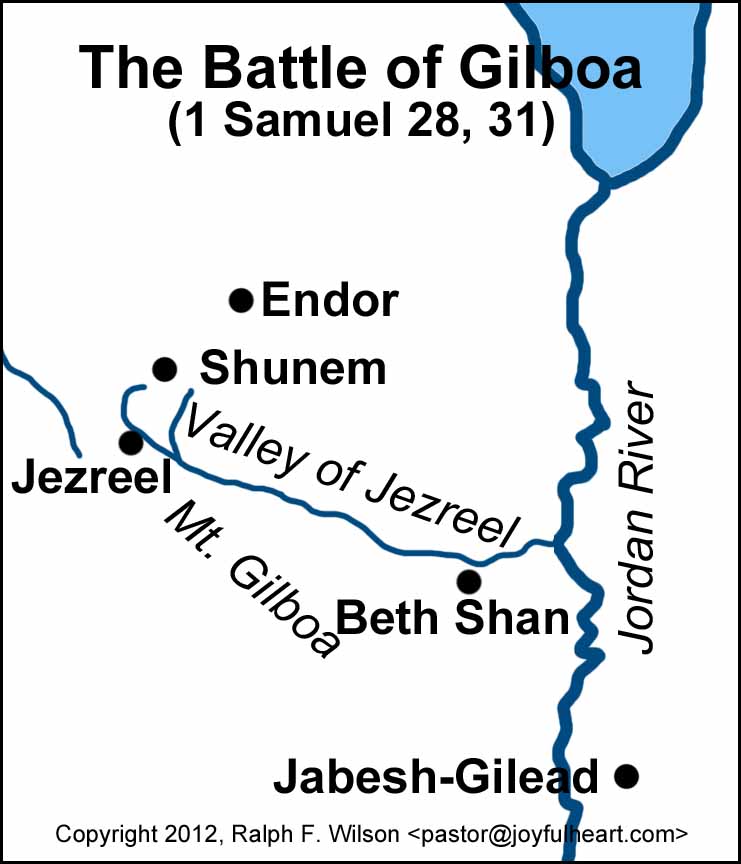
(7) And when the men of Israel on the other side of the valley and those on the other side of the Jordan, saw that the men of Israel fled and that Saul and his sons were dead, they forsook the cities and fled, and the Philistines came and dwelt in them.

When the Israelites who were on the other side of the valley from where the battle took place, as well as those just over the Jordan River in that area, saw that their brethren fled and that Saul and his sons were dead, they, too, fled from their cities, and the Philistines came and dwelt in them.  This map previously borrowed from Jesus Walk shows that area:


(8) And it came to pass on the next day, when the Philistines came to strip the slain, that they found Saul and his three sons fallen in Mount Gilboa. (9) And they cut off his head and stripped off his armor and sent into the land of the Philistines round about, to publish it in the house of their idols and among the people. (10) And they put his armor in the house of Ashtaroth, and they fastened his body to the wall of Beth Shan.

The next day, when the Philistines went to strip all the bodies to take what was valuable as their spoil, they found Saul and his sons dead at Mount Gilboa.  They cut off Saul's head and stripped off his armor and proclaimed the news throughout the land of the Philistines round about them, and in the house of their idols to whom they surely ascribed the success they had.  They then took Saul's body and hung it on a wall in Beth Shan where they then dwelt.  They put his armor in the house of their idol, much like Goliath's sword had been placed in the tabernacle (1 Samuel 21:9).  I find it sad that Saul had wanted to kill himself so that the Philistines would not abuse his body, but they had still abused it in death.

(11) And when the inhabitants of Jabesh Gilead heard of that which the Philistines had done to Saul, (12) All the valiant men arose and went all night and took the body of Saul and the bodies of his sons from the wall of Beth Shan and came to Jabesh and burned them there.

When the inhabitants of Jabesh, which was further south and on the other side of the Jordan, as seen on the map above, heard what the Philistines had done to Saul, valiant men rose up and traveled all night to Beth Shan, and they took Saul's body and the bodies of his sons, which it seems were also hung on the wall, back to Jabesh and burned them there.  It was out of respect and gratitude to their king that they removed his body and the bodies of his sons that had been hung as trophies for the Philistines.  There was no time or safe place or perhaps it was even too late to embalm the bodies and give them a safe burial, but it was also a sign of respect that they burned the mutilated bodies and prevented any possible further abuse from the enemy.

(13) And they took their bones and buried them under a tree at Jabesh and fasted seven days.

The men of Jabesh Gilead then took the bones of Saul and his sons and buried them under a tree there, and they fasted for seven days in honor and mourning for Saul.

(1 Chronicles 10:1) Now the Philistines fought against Israel; and the men of Israel fled from before the Philistines, and fell slain on Mount Gilboa.

1 Chronicles 10:1-14 retells the incidence of Saul's death.  The Philistines fought against Israel, and the Israelites fled from before them and were killed at Mount Gilboa.

(2) And the Philistines followed hard after Saul and after his sons, and the Philistines killed Jonathan, and Abinadab, and Malchishua, the sons of Saul.

The Philistines pushed hard after Saul and his sons, and they killed his three sons, Jonathan, Abinadab, and Malchishua.

(3) And the battle went sore against Saul, and the archers hit him, and he was wounded by the archers. (4) Then Saul said to his armorbearer, “Draw your sword, and thrust me through with it, lest these uncircumcised come and abuse me." But his armorbearer would not, for he was sore afraid. So Saul took a sword and fell upon it. (5) And when his armorbearer saw that Saul was dead, he also fell on his sword and died. (6) So Saul died, and his three sons, and all his house died together.

1 Chronicles 10:3-6 retells the killing of Saul, almost verbatim.  The Philistine archers had wounded him, and he asked his armorbearer to finish him off so that the Philistines would not abuse him.  However, the armorbearer could not bring himself to do it, so Saul fell on a sword himself and died.  Thus Saul, his three sons, and all his house died together.

(7) And when all the men of Israel who were in the valley saw that they had fled and that Saul and his sons were dead, they forsook their cities and fled, and the Philistines came and dwelt in them. (8) And it came to pass on the next day, when the Philistines came to strip the slain, that they found Saul and his sons fallen in Mount Gilboa. (9) And when they had stripped him, they took his head, and his armor, and sent into the land of the Philistines round about, to carry tidings to their idols, and to the people.

When the Israelites all around the region saw their brethren fleeing and heard what had happened to Saul and his sons, they too fled, and the Philistines took over the cities.  The Philistines went the next day and stripped Saul of his armor and cut off his head, and they sent word round about in the land of the Philistines to let their people and their idols know what they had done.

(10) And they put his armor in the house of their gods and fastened his head in the temple of Dagon.

The Philistines put Saul's armor in the house of their gods, Ashtaroth being named specifically in the account recorded in 1 Samuel 31.  Here in 1 Chronicles 10, a new bit of information is added in that the Philistines fastened Saul's head in the temple of their god, Dagon.

(11) And when all Jabesh Gilead heard all that the Philistines had done to Saul, (12) They arose, all the valiant men, and took away the body of Saul, and the bodies of his sons, and brought them to Jabesh, and buried their bones under the oak in Jabesh, and fasted seven days.

With the combination of 1 Samuel 31:11-13 and 1 Chronicles 10:11-12, we have a more complete account of what the valiant men of Jabesh Gilead did when they heard what the Philistines had done to Saul.  They traveled all night and took the body of Saul and the bodies of his sons from the wall of Beth Shan and came to Jabesh and burned them there.  Then they took the bones of Saul and his sons and buried them under an oak tree there, and they fasted for seven days in honor and mourning for Saul.

(13) So Saul died for his transgression which he committed against the Lord, against the word of the Lord which he did not keep, and also for asking of a familiar spirit to enquire, (14) And enquired not of the Lord; therefore He slew him and turned the kingdom to David the son of Jesse.

Thus Saul died for his transgressions, acting at least three times in direct contradiction to the commandments of the Lord, not waiting on Samuel to offer a burnt offering (1 Samuel 13:12-13), sparing the king of Amalek as well as the choice livestock (1 Samuel 15:3), and by consulting a medium (Leviticus 19:31).  Verse 14 suggests that Saul did not enquire of the Lord, but he did, and the Lord would not answer him (1 Samuel 28:6).  However, the idea is that one must not inquire of witches, wizards, or fortune-tellers, but only of the Lord their God.  And had Saul enquired of the Lord long before he did, he would have avoided his desperation in the end.  The Lord had finally taken Saul out, giving the kingdom to David, as He had planned for a long time (1 Samuel 15:28).  He likely would not have killed Saul, had he been more humble and gracious and compliant to God's will.

And thus ends the reign of Saul, chosen by God against His will, to teach the people how an earthly king would always fail because he was nothing but a flawed human, but the people had chosen that for themselves rather than to be led by their perfect God (1 Samuel 8:7).  Saul was at first a good and humble man when God chose him to reign over His people (1 Samuel 9:17), but he became proud and jealous over time and even somewhat deranged in the end.  Now God would have David to reign over His people, a man after His own heart, but still a flawed man.

Tuesday, February 10, 2026

Saul Pursues David

Continuing a chronological Bible study:

(1 Samuel 23:14) And David abode in the wilderness in strong holds and remained in a mountain in the wilderness of Ziph. And Saul sought him every day, but God did not deliver him into his hand.

David had come out of hiding to fight the Philistines in Keilah, but when God told him that the men of Keilah would turn him over to Saul, he fled again.  He hid out in the strong rocks and caves of a mountain in the wilderness of Ziph, a city in the southern part of Judah.  Saul sought him every day, but God did not allow him to find him.

(15) And David saw that Saul had come out to seek his life, and David was in the wilderness of Ziph in a wood.

It appears that David may have heard or seen Saul coming near to where he was, and he hid out in the woods of Ziph.  He had 600 men with him; perhaps the forest was a better place for them to hide.

(16) And Jonathan Saul's son arose and went to David in the wood and strengthened his hand in God. (17) And he said to him, "Fear not, for the hand of Saul my father shall not find you, and you shall be king over Israel, and I shall be next to you, and that also Saul my father knows."

Saul's son, Jonathan, came to David in the woods.  He encouraged and strengthened David's faith in the Lord.  That is what good Christian friends are supposed to do, lift each other up in times of trouble and build them up spiritually.  He told David not to fear Saul because he would not find him, that he would be king over Israel.  Whether Jonathan received a revelation that that would indeed happen, or he had faith that it would happen, he was sure that David would be king, and that he, Jonathan, would always be next to him, not wishing to be the next king which would have naturally been the case as the son of Saul, but next to David, God's chosen king and his best friend, to aid him in whatever was needed.  And his father knew that to be the case, also.

(18) And they two made a covenant before the Lord, and David abode in the wood, and Jonathan went to his house.

Jonathan and David renewed their covenant of friendship and loyalty, and David stayed there in the woods while Jonathan went back to his home.

(19) Then the Ziphites came up to Saul at Gibeah, saying, "Does not David hide himself with us in strong holds in the woods in the hill of Hachilah which is on the south of Jeshimon? (20) Now therefore, O king, come down according to all the desire of your soul to come down, and our part shall be to deliver him into the king's hand."

Saul had returned to his usual residence in Gibeah, and the people of Ziph came to him there and informed him that David was hiding in the woods there, specifically in a hill called Hachilah, south of Jeshimon in Judah.  These were men of David's own tribe of Judah who were turning him in.  It's just as David had said in the last post in Psalm 31:11, he was a reproach even to his neighbors.  The Ziphites encouraged the king to go down to Ziph, and they would deliver David to him.

(21) And Saul said, "Blessed are you of the Lord, for you have compassion on me. (22) Go, I pray you, prepare yet and know and see his place where his haunt is, who has seen him there, for it is told me that he deals very subtly."

Saul commended the Ziphites for telling him where David was hiding and considered them blessed of the Lord because they had compassion on him on account of his troubles with David.  It always turns my stomach when evil people call on God to help them in their evil schemes, as if God wanted Saul to kill His anointed.  Talk about using God's name in vain!  I suppose as Saul was once a follower of God, perhaps he didn't even realize how far he had dropped out of God's favor.  He told the Ziphites to go back and make sure they knew exactly where David was, as he knew him to be quite crafty in his hiding.

(23) "See therefore, and take knowledge of all the lurking places where he hides himself, and come again to me with the certainty, and I will go with you, and it shall come to pass, if he is in the land, that I will search him out throughout all the thousands of Judah."

Saul continued, telling the Ziphites to go and learn all of David's hideouts, and when they returned to him with certainty, he would then go with them to Ziph, and he would search him out throughout all the thousands of people in Judah.  This delay of Saul's may have actually been of the Lord to give David time to get away.

(24) And they arose and went to Ziph before Saul, but David and his men were in the wilderness of Maon in the plain on the south of Jeshimon.

The Ziphites returned to their land, but David and his men had moved to the wilderness of Maon in the plain rather than on the hill where he had been; he was now even further south of Jeshimon.

(25) Saul also and his men went to seek him. And they told David; therefore he came down to a rock and abode in the wilderness of Maon. And when Saul heard, he pursued after David in the wilderness of Maon.

Saul and his men then went to seek David, perhaps because the Ziphites had returned and informed him of where David was, or maybe because he got impatient, we aren't told.  Then it was told to David that Saul and his men had come down to get him, and he went to a rock, probably a rocky cave, to hide in the wilderness of Maon.  Then Saul heard David was there and pursued him there.

(26) And Saul went on this side of the mountain, and David and his men on that side of the mountain; and David made haste to get away for fear of Saul, for Saul and his men surrounded David and his men to take them.

Saul and his men went to the very mountain where David was hiding.  They were on one side of the mountain, and David was on the other.  David ran to get away from Saul, but by then Saul and his men had him and his men surrounded.

(27) But there came a messenger to Saul, saying, "Hurry and come, for the Philistines have invaded the land!" (28) Therefore Saul returned from pursuing after David and went against the Philistines. Therefore they called that place Sela Hammahlekoth.

At that moment, certainly designed by God in His perfect timing, a messenger came to Saul to tell him that the Philistines had invaded their land.  So Saul left off his pursuit of David and returned to fight the Philistines.  Afterward, the place was called Sela Hammahlekoth, which literally meant "rock of divisions," which I suppose referred to the fact that Saul was on one side of the rocky mountain and David on the other, with just the top of the rocky mountain between them or dividing them.

(29) And David went up from there and dwelt in strong holds at En Gedi.

So David left the wilderness of Maon and went to En Gedi which was a deserted and cavernous place at the Dead Sea, and he likely dwelt in the caves there.

Tuesday, December 16, 2025

Jonathan Warns David, and David Leaves

Continuing a chronological Bible study:

(1 Samuel 20:1) And David fled from Naioth in Ramah and came and said before Jonathan, "What have I done? What is my iniquity? And what is my sin before your father that he seeks my life?"

When we last left David, Saul had his servants surrounding David's house at night waiting to kill him the next morning, but his wife Micah let him down out a window where he fled to Samuel in Ramah, and then Samuel and David went to Naioth.  Saul went to Naioth after him, but the Lord put a spirit of prophecy on Saul, and he was detained a day and a night, giving David time to escape from Naioth.  He came to Jonathan and begged to know what he had done that made Saul seek to kill him.

(2) And he said to him, "God forbid, you shall not die; behold, my father will do nothing either great or small, but that he will show it to me; and why should my father hide this thing from me? It is not so."

Jonathan told David he was sure his father was not trying to kill him because his father always told him his plans, great or small, and he could not believe that his father would hide so great a thing from him.  He was sure it was not true.

(3) And David swore moreover, and said, "Your father certainly knows that I have found grace in your eyes, and he said, 'Do not let Jonathan know this, lest he be grieved,' but truly, as the Lord lives and your soul lives, there is but a step between me and death."

David swore to Jonathan that he knew it to be true.  He told him that his father surely knew that David had found great favor with Jonathan and that he had hidden his intentions from Jonathan because of their great friendship.  He swore to him that he knew his life was in imminent danger.

(4) Then Jonathan said to David, "Whatever your soul desires, I will do for you." (5) And David said to Jonathan, "Behold, tomorrow is the new moon, and I should not fail to sit with the king at the meal, but let me go that I may hide myself in the field until the third day at evening."

Jonathan assured David he would do whatever David asked him to do.  David told him that the next day was the new moon which was the first day of the month, as the months of the Hebrews were lunar months, counted from new moon to new moon.  On the new moon they offered sacrifices and had a feast (Numbers 28:11), and David said he would be expected to join the king at the feast.  However, he asked Jonathan to let him go and hide out until the third day when the feast was over.

(6) "If your father at all misses me, then say, 'David earnestly asked of me that he might run to Bethlehem his city, for a yearly sacrifice there for all the family.'"

David told Jonathan that if his father asked about him, to tell him that David wanted to go to Bethlehem for a yearly sacrifice there for all his family.  That may have been true and not just an excuse as his family did indeed make yearly sacrifices (1 Samuel 1:21).

(7) "If he says thus, 'It is well,' your servant shall have peace, but if he is very angry, be sure that evil is determined by him."

David told Jonathan that if his father said that it was well and good that David should go to his family feast, then he knew he would be safe.  However, if his father became very angry, then Jonathan could be sure that Saul determined evil against David.

(8) "Therefore you shall deal kindly with your servant, for you have brought your servant into a covenant of the Lord with you; notwithstanding, if there is in me iniquity, slay me yourself, for why should you bring me to your father?"

David knew that Jonathan would deal kindly with him because of a covenant of friendship between Jonathan and David, of which Jonathan had been the initiator.  However, David said that if there was any iniquity found in him, he implored that Jonathan kill him himself rather than bring him to his father.

(9) And Jonathan said, "Far be it from you! For if I knew certainly that evil was determined by my father to come upon you, then wouldn't I tell you?"

Jonathan told David that thought should be far from him that he would conceal his father's ill intentions against him.  If he had known of any such intentions, he would have certainly told David.

(10) Then David said to Jonathan, "Who shall tell me? Or what if your father answers you roughly?"

David asked Jonathan how he would know how Saul had responded when he wasn't at the feast.  What if his father dealt with him harshly because he knew that he loved David and may have protected him?

(11) And Jonathan said to David, "Come and let us go out into the field." And both of them went out into the field. (12) And Jonathan said to David, "O Lord God of Israel, when I have sounded out my father anytime tomorrow or the third day, and behold, if there is good toward David, and then I do not send to you and show it to you, (13) The Lord do so and much more to Jonathan, but if it please my father to do you evil, then I will show it to you and send you away, that you may go in peace, and the Lord be with you, as He has been with my father."

Jonathan asked David to go out into the field with him, probably so that they could talk more freely, not being overheard by Saul's servants.  They went out to the field, and Jonathan assured David by the Lord God of Israel, that when he knew the mood and intentions of his father, he would certainly tell him.  Let the vengeance of the Lord fall on him if he failed to tell David.  He would tell him if the news was good, and if it was bad, he would tell him and help him get away, that he may go in peace.  He added the blessing that the Lord be with him as He had been with his father, suggesting that he might be aware that David was to succeed his father as king.

(14) "And you shall not only while I yet live show me the kindness of the Lord, that I not die, (15) But you shall not cut off your kindness from my house forever; no, not when the Lord has cut off the enemies of David every one from the face of the earth."

For David's part in this covenant, Jonathan asked that he show kindness to him when he came to the throne and not take away his life.  He asked that David not cut off that kindness from his family forever, or for as long as he was on the throne.  Not even after the Lord had cut off all his enemies and presumably then he had peace, he was never to cut off his kindness to Jonathan's posterity.

(16) So Jonathan made a covenant with the house of David, "Let the Lord even require at the hand of David's enemies."

It appears that this covenant was to go beyond David's time on the throne and was to continue with his descendants, "the house of David."  If either side broke this covenant, Jonathan asked that the Lord punish the violators by the hand of David's enemies.

(17) And Jonathan caused David to swear again because he loved him, for he loved him as he loved his own soul.

Jonathan asked David to swear to this oath, for he loved him like a brother or even closer, like himself, and he desired that their families continue to observe their covenant throughout their generations.

(18) Then Jonathan said to David, "Tomorrow is the new moon, and you shall be missed because your seat will be empty. (19) And when you have stayed three days, you shall go down quickly and come to the place where you did hide yourself when the business was and shall remain by the stone Ezel."

Jonathan reiterated the fact that the next day was the new moon and that David would not be at the feast.  He went on to instruct him to wait three days and then go down to the place where he had hidden before when the business of Saul seeking David's life first became known to them (1 Samuel 19:2).  He told him to remain at a stone called Ezel.

(20) "And I will shoot three arrows to the side, as though I shot at a mark. (21) And behold, I will send a lad, 'Go find the arrows.' If I expressly say to the lad, 'Behold, the arrows are on this side of you, take them,' then you come, for there is peace to you and no hurt, as the Lord lives. (22) But if I say thus to the young man, 'Behold, the arrows are beyond you,' go your way for the Lord has sent you away."

Jonathan devised a signal for David.  After the three days, he would go out to the field and shoot three arrows.  He would tell the servant with him to go fetch the arrows.  If he expressly told the young man that the arrows were to the side of him, then David was to come forth because Jonathan meant that it was safe and no harm would come to him; as sure as the Lord lived, he could be assured of his safety.  However, if he said to the young man that the arrows were beyond him, that was David's signal to go away, for it was not safe.  Jonathan said it would mean that the Lord had sent him away.  They assigned everything to the will of God.  If Saul became angry at David's absence, it would be the will of God that David should leave.

(23) "And the matter which you and I have spoken of, behold, the Lord be between you and me forever."

Jonathan added, as if it might be the only parting message he could make if David was to flee after his signal, that the Lord was the witness to their covenant that should remain forever.

(24) So David hid himself in the field, and when the new moon had come, the king sat down to eat the meal. (25) And the king sat upon his seat as at other times, upon a seat by the wall, and Jonathan arose, and Abner sat by Saul's side, and David's place was empty.

David hid in the field as he and Jonathan had planned.  The new moon came the following day, and Saul sat down to eat the feast.  He sat at his usual place by the wall.  Jonathan arose, probably out of respect for his father who had come to the table.  Abner, Saul's cousin and the captain of his army, sat by Saul's side, and David's place was empty.

(26) Nevertheless, Saul spoke not anything that day, for he thought, "Something has befallen him; he is not clean, surely, he is not clean."

However, Saul didn't say anything about David not being there.  He assumed something had happened that made him unclean and not lawful for him to attend the feast.

(27) And it came to pass on the next day, the second day of the month, that David's place was empty, and Saul said to Jonathan his son, "Why has the son of Jesse not come to eat, neither yesterday nor today?" (28) And Jonathan answered Saul, "David earnestly asked leave of me to go to Bethlehem. (29) And he said, 'Let me go, I pray you, for our family has a sacrifice in the city, and my brother has commanded me to be there, and now, if I have found favor in your eyes, let me get away, I pray you, and see my brethren.' Therefore he comes not to the king's table."

On the second day of the feast, when David was absent again, Saul asked Jonathan why he was not there for two days in a row.  Jonathan gave Saul the prearranged story that David had asked to return to his home for a sacrifice his family was having, saying that his brother had commanded his attendance.  David had pleaded with Jonathan, and in Saul's absence, Jonathan gave him permission to go.

(30) Then Saul's anger was kindled against Jonathan, and he said to him, "You son of the perverse rebelliousness! Do I not know that you have chosen the son of Jesse to your own shame and to the shame of your mother's nakedness?"

Saul became angry with Jonathan, calling him rebellious and saying that he knew he had chosen David over his own family and had brought shame to himself and to his mother.  After all, Jonathan should have succeeded Saul to the throne, so what would men think?  They might assume Jonathan had no right to the throne, that a son-in-law took his place, perhaps because his mother had played the whore, and he was no son of Saul.  Saul felt that Jonathan had brought shame on the entire family.

(31) "For as long as the son of Jesse lives upon the ground, you shall not be established, nor your kingdom. Now, therefore, send and fetch him to me, for he shall surely die."

Indeed, Saul told Jonathan that as long as David lived, Jonathan would never be established as king.  Therefore, he told Jonathan to go get David and bring him back to him, as he must die.

(32) And Jonathan answered Saul his father, and said to him, "Why shall he be killed? What has he done?" (33) And Saul cast a javelin at him to strike him, by which Jonathan knew that it was determined of his father to kill David.

Jonathan asked Saul why David should be killed, what he had done to deserve death.  Saul was so angry that he cast his javelin at Jonathan with the intention of hitting him with it.  Jonathan knew without a doubt that Saul intended to kill David.

(34) So Jonathan arose from the table in fierce anger and ate no food the second day of the month, for he was grieved for David because his father had done him shame.

Jonathan was also very angry and arose from the table without eating of the feast.  He grieved for David, and he was angry because of what his father had done to him in calling him perverse and rebellious and even trying to kill him in his anger.

(35) And it came to pass in the morning, that Jonathan went out into the field at the time appointed with David, and a little lad with him. (36) And he said to the lad, "Run, find out now the arrows which I shoot." As the lad ran, he shot an arrow beyond him.

The next morning Jonathan went out to the field with a lad with him, as he had prearranged with David.  He told the lad to run ahead and fetch the arrows he was going to shoot.  He then shot an arrow beyond the lad as he was running.

(37) And when the lad had come to the place of the arrow which Jonathan had shot, Jonathan cried after the lad, and said, "Isn't the arrow beyond you?"

The young man went to the place at which the arrow had been shot, but Jonathan cried out to him that he thought the arrow was beyond him, which of course was the signal to David that he should run away.

(38) And Jonathan cried after the lad, "Make speed, haste, do not stay!" And Jonathan's lad had gathered up the arrows and came to his master. (39) But the lad did not know anything. Only Jonathan and David knew the matter. (40) And Jonathan gave his artillery to his lad and said to him, "Go, carry them to the city."

Jonathan then called to his lad to get the arrows quickly, which he did and came back to Jonathan.  The lad knew nothing of David in the field and that Jonathan had just given him a signal.  Jonathan gave his bow and arrows to the young man and told him to take them back to the city.

(41) As soon as the lad was gone, David arose out of a place toward the south and fell on his face to the ground and bowed himself three times, and they kissed one another and wept with one another until David exceeded.

As soon as the young man left, David came out from hiding and fell on his face to the ground.  He bowed himself three times before Jonathan, probably reverencing him as the prince who could have had him killed, but instead was his great faithful friend.  They kissed one another and wept until David's emotions exceeded.  He was losing more than his friend Jonathan.  He had lost his wife and his family before that.  He had lost the altar of God as he was to be in exile.

(42) And Jonathan said to David, "Go in peace, since we have sworn both of us in the name of the Lord, saying, 'The Lord be between you and me, and between my descendants and your descendants forever.'" And he arose and departed, and Jonathan went into the city.

Jonathan told David he could go in peace because of the covenant that he and David had made that would remain throughout their generations of descendants.  David rose up and departed, and Jonathan went to the city. 

Saturday, November 22, 2025

Saul Tries to Kill David

Continuing a chronological Bible study after a brief interlude of psalms:

(1 Samuel 19:1) And Saul spoke to Jonathan his son and to all his servants that they should kill David.

When we last left Saul in chapter 18, he had become so jealous of David that he hated him and wanted him to die.  He kept putting him out front in battles with the Philistines, hoping they would kill him.  He even tried once to kill him himself, but the more he tried, the more the Lord protected David, and the more the people grew to love David.  David had now married Saul's daughter Michal and as son-in-law to the king, he was next in line for Saul's throne, which of course, the Lord had already given him, but Saul didn't know that part yet, though he suspected it would eventually happen.  After so many failed attempts at trying to kill David, Saul now told his son and his servants to kill him.

(2) But Jonathan Saul's son delighted much in David, and Jonathan told David, saying, "Saul my father seeks to kill you; now therefore, I pray you, take heed to yourself until the morning, and abide in a secret place and hide yourself."

However, Saul did not realize how much even his son Jonathan loved David, and Jonathan told David Saul's plan to kill him.  He pleaded with David to be on guard and hide in a secret place until the morning.

(3) "And I will go out and stand beside my father in the field where you are, and I will speak with my father about you, and what I see, that I will tell you."

Jonathan continued talking to David.  He said that the next day he would stand with his father near the place David was, and he would talk to his father about David and then report back to him what Saul had to say.

(4) And Jonathan spoke good of David to Saul his father, and said to him, "Let not the king sin against his servant, against David, because he has not sinned against you and because his works toward you are very good. (5) For he did put his life in his hand and killed the Philistine, and the Lord wrought a great salvation for all Israel. You saw it and did rejoice. Why then will you sin against innocent blood, to kill David without a cause?"

Jonathan did speak to his father about David.  He reminded him of how David put his life on the line to kill Goliath, and the Lord had brought a great victory and deliverance for Israel.  He reminded his father how he himself had rejoiced.  He urged him not to sin against David who had done nothing wrong to him, and not to spill innocent blood, killing David without a cause.

(6) And Saul hearkened to the voice of Jonathan, and Saul swore, "As the Lord lives, he shall not be slain."

Saul listened to Jonathan and seemed to be affected by the truth of what he had to say and was convicted, at least at the present time, that he was wrong in seeking the life of David, and he would stop trying to kill him.

(7) And Jonathan called David, and Jonathan showed him all those things. And Jonathan brought David to Saul, and he was in his presence as in times past.

Jonathan told David all that Saul had said and brought him back into the palace to Saul where he had been formerly.

(8) And there was war again, and David went out and fought with the Philistines and struck them with a great slaughter, and they fled from him.

Then there was war again with the Philistines, and David went out and fought against them, striking them with a mighty blow and great slaughter that they fled from him.

(9) And the evil spirit from the Lord was upon Saul as he sat in his house with his javelin in his hand, and David played with his hand.

The evil spirit from the Lord came upon Saul again.  David played the harp with his hands to sooth Saul's spirit.  Saul had his javelin in his hand.

(10) And Saul sought to strike David even to the wall with the javelin, but he slipped away out of Saul's presence, and he struck the javelin into the wall, and David fled and escaped that night.

Forgetting his vow in verse 6 not to harm David, again Saul tried to pin David to the wall with his javelin, but David slipped away and fled, escaping that night.

(11) Saul also sent messengers to David's house to watch him and to kill him in the morning, and Michal David's wife told him, saying, "If you do not save your life tonight, tomorrow you shall be slain."

Saul sent his messengers to David's house, which surely was very near or even a part of the palace as David had married the king's daughter, to watch him and to kill him in the morning.  Michal, David's wife, warned him to do something to save his life that night or else he would be killed the next day.

(12) So Michal let David down through a window, and he went and fled and escaped.

Michal let David down through a window, probably on a cord or some such makeshift cord, and David was able to escape in the night without Saul's messengers' knowledge.

(13) And Michal took an image and laid it in the bed and put a pillow of goats' hair for his bolster and covered it with a cloth. (14) And when Saul sent messengers to take David, she said, "He is sick."

Michal took an "image," not merely a picture, but something with substance like a statue, and laid it in David's bed.  She put a pillow of goats' hair under it and covered it with a cloth.  Then when Saul's messengers came into their house in the morning looking for David, she told them he was sick in bed.

(15) And Saul sent the messengers again to see David, saying, "Bring him up to me in the bed that I may kill him."

Saul sent his messengers back to David's house and told them to bring him back to him, bed and all, if he wasn't able to rise, so that Saul could kill him.

(16) And when the messengers had come in, behold, an image in the bed with a pillow of goats' hair for his bolster.

When the messengers went into David's house, they found that all that lay in the bed was a statue with a pillow of goats' hair propping it up.

(17) And Saul said to Michal, "Why have you deceived me so? And sent away my enemy that he has escaped?" And Michal answered Saul, "He said to me, 'Let me go; why should I kill you?'"

Saul asked his daughter why she had deceived him and let his enemy escape, as if she owed more to the wicked passion of her father than she did for her beloved husband.  But rather than telling him that she couldn't allow her husband to be killed, she lied and told her father that David had threatened her if she did not let him go.

(18) So David fled, and escaped, and came to Samuel, to Ramah, and told him all that Saul had done to him. And he and Samuel went and dwelt in Naioth.

David fled to Samuel in Ramah, Samuel being the one who had anointed him king.  He told Samuel all that Saul had done to him, and David and Samuel went and dwelt in Naioth, a place within Ramah, Samuel's home.

(19) And it was told Saul, saying, "Behold, David is at Naioth in Ramah." (20) And Saul sent messengers to take David, and when they saw the company of the prophets prophesying, and Samuel standing as appointed over them, the Spirit of God was upon the messengers of Saul, and they also prophesied.

It was told to Saul that David was in Naioth, so he sent messengers to take David.  However, when they came to David and Samuel, they saw a whole company of prophets prophesying by inspiration of God with Samuel standing over them.  The Spirit of the Lord came upon Saul's messengers, and they, too, began prophesying, forgetting their mission.  "Prophesying" does not always mean foretelling the future; it most often meant telling the Lord's truths, but sometimes those meant telling the future outcome.  In this case, all the prophets and Saul's messengers also, were probably praising God and declaring His truths.

(21) And when it was told Saul, he sent other messengers, and they prophesied likewise. And Saul sent messengers again the third time, and they prophesied also.

When that was told to Saul, he sent more messengers to take David, but they wound up prophesying also, forgetting their mission.  Saul sent messengers a third time, and they, too, wound up prophesying and not bringing David back to Saul.

(22) Then he also went to Ramah and came to a great well in Sechu, and he asked and said, "Where are Samuel and David?" And one said, "Behold, at Naioth in Ramah."

Therefore, Saul went himself to find David but evidently did not know exactly where to go.  He stopped at a well and enquired about the whereabouts of David and Samuel and was told they were at Naioth.

(23) And he went there to Naioth in Ramah, and the Spirit of God was upon him also, and he went on, and prophesied, until he came to Naioth in Ramah.

So Saul went toward Naioth, and the Spirit of the Lord came upon him, too, and he went onward, prophesying, until he came to Naioth in Ramah.

(24) And he also stripped off his clothes and prophesied before Samuel in like manner and lay down naked all that day and all that night. Therefore they say, "Is Saul also among the prophets?"

When he came to Samuel, Saul stripped off his clothes and prophesied before Samuel.  He may not have been completely naked, but enough so to be completely humbled before the Lord.  He lay there like that all day and all night.  That "proverb" that came about in 1 Samuel 10:12, when Saul prophesied in a company of prophets, was revived, as people wondered again if Saul was a prophet.

There is no doubt now, that Saul was David's enemy, not because of anything David had done, but because of Saul's jealousy.  The Lord continued to protect David through his loved ones, Jonathan and Michal, and even by His own arm as he turned all David's enemies into prophets, possibly even prophesying that David would become king!

Wednesday, November 12, 2025

David Marries Saul's Daughter Michal While Saul's Jealousy Grows

Continuing a chronological Bible study after a brief interlude of psalms:

(1 Samuel 18:1) And it came to pass when he had made an end of speaking to Saul, that the soul of Jonathan was knit with the soul of David, and Jonathan loved him as his own soul.

At the end of 1 Samuel 17, David had reacquainted himself to Saul after killing Goliath when Saul had not recognized him.  Then after speaking to Saul, he won the heart of Saul's son Jonathan who saw in David qualities that he loved and was attracted to, probably because they were much like his own, and Jonathan loved David as he loved himself.  This is the love that God commanded for all His people in Leviticus 19:18, "You shall love your neighbor as yourself."

(2) And Saul took him that day and would let him go no more home to his father's house.

Formerly, David had been Saul's musician to calm his demons and must have been little noticed by the king, but now Saul brought him into his palace to stay.  He didn't allow David to go back and forth to his father's house as he had done before.

(3) Then Jonathan and David made a covenant because he loved him as his own soul. (4) And Jonathan stripped himself of the robe that was on him and gave it to David, and his garments, even to his sword, and to his bow, and to his girdle.

Jonathan made a covenant of friendship with David because he had a great love for him.  He stripped himself of his princely garments as he was the son of the king and gave them to David.  He even gave him his sword, his bow, and his belt.  This was due to the great kinship he felt for David and probably to have David look the part of a prince rather than a shepherd.

(5) And David went out wherever Saul sent him and behaved himself wisely, and Saul set him over the men of war, and he was accepted in the sight of all the people and also in the sight of Saul's servants.

David went wherever Saul sent him, and he was made a leader over the men of war.  He always behaved wisely, so that he was accepted by all the people and by Saul's own servants, as well. 

(6) And it came to pass as they came, when David was returned from the slaughter of the Philistine, that the women came out of all cities of Israel, singing and dancing, to meet King Saul with tambourines with joy and with instruments of music.

At that time, when Saul and David had returned from the killing of Goliath and their victory over the Philistines, the women came out as they usually did after great victories, singing and dancing with tambourines and other musical instruments, to meet King Saul returning from battle.

(7) And the women sang as they played, and said, "Saul has slain his thousands, and David his ten thousands." (8) And Saul was very angry, and the saying displeased him, and he said, "They have ascribed to David ten thousands, and to me they have ascribed thousands. And what can he have more but the kingdom?" (9) And Saul eyed David from that day and forward.

Although they were supposed to be greeting their king, the women began singing that Saul had killed his thousands, but David had killed his ten thousands.  That made Saul angry with jealousy.  The way Saul saw it, as he had already bestowed great honor on David, and now the people saw him as greater in battle than he was, the only thing left for David to accomplish was to have the kingdom, and Saul watched David carefully from that day forward.

(10) And it came to pass on the next day, that the evil spirit from God came upon Saul, and he prophesied in the midst of the house. And David played with his hand, as at other times, and a javelin was in Saul's hand.

The next day that evil spirit from God that had tormented him before came upon Saul, and he prophesied inside the house.  We aren't told what he prophesied, so it may have been the rantings of a mad man since the evil spirit had come upon him.  David was playing music with his hand, probably the harp, as he had done other times when the evil spirit had come upon Saul.  Saul held a javelin in his hand.

(11) And Saul cast the javelin, for he said, "I will strike David to the wall." And David avoided out of his presence twice.

Saul cast the javelin at David, saying that he would pin him to the wall.  However, David escaped Saul twice, as it appears Saul tried twice to pin David.

(12) And Saul was afraid of David because the Lord was with him and was departed from Saul.

Then was Saul afraid of David because he could see that the Lord was with him, protecting him, and that He had departed from Saul.

(13) Therefore Saul removed him from him, and made him his captain over a thousand, and he went out and came in before the people.

Saul then removed David from his court, but probably because he did fear David and God's hand on him, he did not completely dismiss him, but he made him captain over a troop of one thousand, perhaps hoping he would be slain by the enemy at the head of his troop.  However, David went out and came back again before the people, probably with great honor and respect, which was the opposite of what Saul desired.  It reminds me of the psalm David wrote that I studied in the last chapter, which may have been better placed chronologically after this chapter, "Let them fall by their own counsels..." (Psalm 5:10).  That is, let his enemies' plans fail; let their plots work against them and expose their guilt.  But then again, it may have been perfectly placed as an answer to David's prayer.

(14) And David behaved himself wisely in all his ways, and the Lord was with him. (15) Therefore when Saul saw that he behaved himself very wisely, he was afraid of him.

David always behaved himself wisely, and the Lord was with him.  That made Saul fear him even more as he was gaining favor more and more because of his wise conduct, and that was further proof that the Lord was surely with David.

(16) But all Israel and Judah loved David because he went out and came in before them.

All of Israel and David's own tribe, Judah, loved him as he went before the people.

(17) And Saul said to David, "Behold my elder daughter Merab, her will I give you as wife, only be valiant for me and fight the Lord's battles." For Saul said, "Let not my hand be upon him, but let the hand of the Philistines be upon him."

As Saul had promised to the one who killed Goliath, he offered his daughter Merab to David as his wife on the condition that he remain valiant for him and fight the Lord's battles.  Saul still hated David, but rather than him trying to kill him, he would put David out there against his enemies so that the Philistines would kill him.

(18) And David said to Saul, "Who am I? And what is my life, or my father's family in Israel, that I should be son-in-law to the king?"

David seemed surprised at Saul's offer, although that had been promised to the one who killed Goliath.  However, David had not killed Goliath to get all the rewards.  He did it to defend God's honor and that of His people Israel.  You see David's humility here, as he asked Saul why such a lowly man as he was, a shepherd, from a family that was not particularly greatly esteemed or upper-class, should become son-in-law to the king.

(19) But it came to pass at the time when Merab, Saul's daughter, should have been given to David, that she was given to Adriel the Meholathite as wife.

However, Saul did not follow through with his word.  When it came time for Merab to marry David, Saul gave her instead to Adriel, a Meholathite, probably one from Abel-Meholath (Judges 7:22).  Although that could be seen as a great injustice to David, in his modesty before displayed, David showed no signs of resentment.

(20) And Michal Saul's daughter loved David, and they told Saul, and the thing pleased him.

A younger daughter of Saul, Michal, loved David, and when it was told to Saul, he was pleased with the idea, probably because it gave him a chance to save face with the people after his breach of promise and perhaps another chance to put David in harm's way.

(21) And Saul said, "I will give him her, that she may be a snare to him, and that the hand of the Philistines may be against him." Therefore Saul said to David, "You shall this day be my son-in-law in the twain."

Saul decided he would give Micah to David as his wife so that he could use her as a trap for David, that the Philistines would come against him.  He told David that he would be his son-in-law "in the twain."  As the word means "two," he either meant David would have a second chance to become his son-in-law, or perhaps it referred to the second of his two daughters.  Actually, Dr. John Gill, in his Exposition of the Bible, suggested it meant he would have both daughters, as Merab had actually been betrothed to David, although she never married him.

(22) And Saul commanded his servants, "Commune with David secretly and say, 'Behold, the king has delight in you, and all his servants love you. Now therefore be the king's son-in-law." (23) And Saul's servants spoke those words in the ears of David. And David said, "Does it seem to you a light thing to be a king's son-in-law, seeing that I am a poor man and lightly esteemed?"

It appears that David needed some persuasion to take the deal, and Saul sent his servants to flatter David and encourage him to become the king's son-in-law, by telling him that the king had delight in him, and all his servants loved him.  However, David told them that this was no trifling matter, that a poor shepherd, such as he was, should up and become the king's son-in-law.

(24) And the servants of Saul told him, saying, "In this manner spoke David." (25) And Saul said, "Thus shall you say to David, 'The king desires not any dowry, but a hundred foreskins of the Philistines, to be avenged of the king's enemies.'" But Saul thought to make David fall by the hand of the Philistines.

Saul's servants told him what David had said.  He sent his servants back to David to tell him, since it seemed to him that David mentioned his poverty as a reason why he could not afford a proper dowry to become the king's son-in-law, that Saul did not desire a dowry, but he wanted a hundred foreskins of the Philistines to be avenged of his enemies.  Of course, his real desire was that David be killed by the Philistines.

(26) And when his servants told David these words, it pleased David well to be the king's son-in-law. And the days were not expired, (27) When David arose and went, he and his men, and killed of the Philistines two hundred men, and David brought their foreskins, and they gave them in full count to the king, that he might be the king's son-in-law. And Saul gave him Michal his daughter as wife.

When Saul's servants told David what Saul said, it pleased him to consent to being Saul's son-in-law.  After all, David willingly went out wherever Saul sent him (verse 5).  David wasted no time, and he and his men killed two hundred Philistines, double what Saul had asked for, and brought all their foreskins back to Saul.  It seems David felt satisfied then that he was worthy to accept the position of the king's son-in-law.  Saul, realizing he could not refuse, gave Michal his daughter to David as his wife.

(28) And Saul saw and knew that the Lord was with David and that Michal, Saul's daughter, loved him. (29) And Saul was yet the more afraid of David, and Saul became David's enemy continually.

Saul could tell that the Lord was with David and now he was married to his daughter, whom he realized loved David very much.  Their marriage, which Saul had hoped would destroy David before it ever happened, would now pave the way for his ascending to Saul's throne.  That made him even more afraid of David, and he became David's constant enemy.

(30) Then the princes of the Philistines went forth, and it came to pass after they went forth, David behaved himself more wisely than all the servants of Saul, so that his name was much set by.

Then the princes of the Philistines went to war against the Israelites, being provoked by their loss after David killed Goliath.  So much for Goliath's word that if an Israelite killed him, the Philistines would become the servants of Israel (1 Samuel 17:9).  David behaved himself more wisely than all the servants of Saul, probably showing himself to be more expert in the art of war and more successful in his attacks on the Philistines than all the others.  His name came to be prized, valuable, as was the original meaning of the word "yaqar" that was translated as "set by."  He was held in high esteem by the people.

It is very noteworthy that David's prayer in Psalm 5 that his enemies fall by their own counsels was continually answered by God in that all Saul's schemes to destroy David only served to make him greater and more well esteemed by all the people.  Once a mere shepherd boy, he was now a prince next in line for the king's throne.

Monday, October 6, 2025

Jonathan Defeats the Philistines

Continuing a chronological Bible study:

(1 Samuel 14:1) Now it came to pass one day that Jonathan, the son of Saul, said to the young man who bore his armor, "Come and let us go over to the Philistines' garrison that is on the other side." But he did not tell his father.

At the end of the last chapter, three companies of Philistines had pretty much surrounded Saul, Jonathan, and their small army of six hundred men.  The Philistines were busy plundering the land and not immediately intent on attacking Saul and his men.  It appears they must have remained like that for at least a couple of days or more, because "one day" Jonathan, Saul's son, decided it was time to do something.  He told his armor-bearer that they should go over to the Philistine garrison that was on the other side of them.  However, he did not tell his father of his plan.

(2) And Saul tarried in the uttermost part of Gibeah under a pomegranate tree in Migron, and the people with him were about six hundred men, (3) And Ahijah, the son of Ahitub, Ichabod's brother, the son of Phinehas, the son of Eli, the Lord's priest in Shiloh, wearing an ephod. And the people did not know that Jonathan was gone.

Saul waited in the uppermost part of Gibeah under a pomegranate tree in Migron which was north of Gibeah in the field of Gibeah.  He still had his six hundred men, no more or no less, and that included Ahijah the priest.  He came from the line of Eli who had been the Lord's priest in Shiloh.  Ichabod was the child that Phinehas's wife bore prematurely on hearing the news that the ark had been taken and that her husband and Eli, her father-in-law, had died (1 Samuel 4:19).  Ichabod apparently had an older brother named Ahitub, whose son was Ahijah.  Saul and the people with him did not know that Jonathan was gone.

(4) And between the passages, by which Jonathan sought to go over to the Philistines' garrison, a sharp rock on the one side and a sharp rock on the other side, and the name of the one Bozez and the name of the other Seneh. 

I believe "the passages" refers to the common passageways from one place to another that were now obstructed by the Philistines.  Jonathan had to find another way to cross over to the Philistine garrison.  Between the passages were two large sharp rocks that were known and even named, one Bozez meaning "shining" which might suggest smooth and slippery, and the other Seneh meaning "thorn" or "bramble."  

(5) The forefront of the one was situated northward opposite Michmash and the other southward opposite Gibeah.

I believe the sense is that both rocks were in the way between the passages, not across from each other, but the northern one faced Michmash and the southern one faced Gibeah.

(6) And Jonathan said to the young man who bore his armor, "Come and let us go over to the garrison of these uncircumcised; it may be that the Lord will work for us, for there is no restraint to the Lord to save by many or by few."

Jonathan again told his armor bearer that they should go over to the garrison of the Philistines, and in additional encouragement, he said that the Lord might do the work for them, as there was no limit to God's power.  God could save with an army or with just a few men.  That shows that Jonathan had great faith in the Lord.  He hadn't said that the Lord would definitely do the work for them, because he had not received a word from the Lord, but he had no doubt that his Lord was well able if it was in His will to do so.

(7) And his armorbearer said to him, "Do all that is in your heart; turn, behold, I am with you according to your heart."

Jonathan's armor bearer told Jonathan to do what was in his heart to do, to turn the way he wanted to go, and he would willingly follow him.

(8) Then Jonathan said, "Behold, we will pass over to these men, and we will let them discover us. (9) If they say thus to us, 'Wait until we come to you,' then we will stand still in our place and will not go up to them. (10) But if they say thus, 'Come up to us,' then we will go up, for the Lord has delivered them into our hand, and this be a sign to us."

Jonathan told his armor bearer that they would pass over to the Philistines and let them discover them.  Then if the Philistines told them to wait there until they came to them, they would stand there and not go to them.  However, if they said, "Come up to us," they would see that as a sign that the Lord had delivered the Philistines into their hands, and they would indeed go to the Philistines.  That would be a sign from the Lord telling them what they should do.

It's funny; my first instinct was that Jonathan should have prayed to the Lord, that it was a bit arrogant to set up his own scheme and expect the Lord to go along with it.  Well, for one thing, we don't know that Jonathan didn't pray first.  He probably did have some sort of leading to make him take such a bold step.  But then I also realized that I have done the same thing.  When the Lord doesn't speak directly to you, then asking Him to show you the right way between two choices with a sign from Him seems perfectly acceptable and shows faith in Him to direct your paths, "In all your ways acknowledge Him, and He shall direct your paths" (Proverbs 3:6).  Jonathan did acknowledge God and His power to save them (verse 6), and he had faith that He would direct them in the way they should go.

(11) And both of them showed themselves to the garrison of the Philistines, and the Philistines said, "Behold, the Hebrews come forth out of the holes where they had hid themselves."

Jonathan and his armor bearer did indeed reveal themselves to the Philistines at that post, and the Philistines took note among themselves that the Hebrews had come out of hiding.

(12) And the men of the garrison answered Jonathan and his armor bearer, and said, "Come up to us, and we will show you something." And Jonathan said to his armor bearer, "Come up after me, for the Lord has delivered them into the hand of Israel."

The men at the garrison responded to Jonathan and his armor bearer's presence, by telling them to come up to them and they would show them something.  Jonathan told his armor bearer to follow him, as he had full faith and confidence that the Lord had delivered those Philistines into Israel's hand.  Not that it made a difference in the way the Philistines told them to come to them, but they did use the exact phrase "Come up to us" that Jonathan had put forth in his plan (verse 10). 

(13) And Jonathan climbed up upon his hands and upon his feet, and his armor bearer after him, and they fell before Jonathan, and his armor bearer slew after him.

Jonathan climbed up on his hands and knees in a way not easily accessible.  He didn't go the way the Philistines would have expected him to go on the main passageway.  He evidently caught the men off guard, and they fell before him.  Obviously, we know Who really knocked them down.  His armor bearer then killed the men.

(14) At that first slaughter which Jonathan and his armor bearer made, was about twenty men, within as it were a half acre of land.

Jonathan and his armor bearer killed about twenty men at that garrison and within half an acre from it.

(15) And there was trembling in the host, in the field, and among all the people. The garrison and the spoilers, they also trembled, and the earth quaked, so it was a very great trembling.

The Philistine host trembled with fear, those in the field, and among all the people.  Men inside the garrison who had not been outside and killed, and the plunderers who ravaged the land, were also terrified and panic-stricken, especially when the earth began to quake, as well, which was surely by God.

(16) And the watchmen of Saul in Gibeah of Benjamin looked, and behold, the multitude melted away, and they went on stampeding.

The watchmen of Saul at Gibeah saw the Philistine army melting away, as they fled and stampeded over one another.

(17) Then Saul said to the people with him, "Number now, and see who is gone from us." And when they had numbered, behold, Jonathan and his armor bearer were not there.

Saul then ordered a roll be taken, and when it was, it was discovered that Jonathan and his armor bearer were not there.

(18) And Saul said to Ahijah, "Bring the ark of God here" (for the ark of God was at that time with the children of Israel).

Saul told the priest Ahijah to bring the ark of God to him, for the Israelites had brought the ark with them.

(19) And it came to pass, while Saul talked to the priest, that the noise in the host of the Philistines went on and increased, and Saul said to the priest, "Withdraw your hand."

While Saul was talking to the priest, the noise of the Philistines grew louder, and Saul told the priest to stop what he was doing, which was surely to inquire of the Lord over the ark.  Saul once again showed some impatience.

(20) And Saul and all the people with him assembled themselves, and they came to battle, and behold, every man's sword was against his fellow, very great confusion.

Saul and his men assembled themselves to battle against the Philistines, but they witnessed their enemy fighting themselves because there was so much confusion.  God, whom Saul was too impatient to hear from, had already taken care of the matter.

(21) Moreover, the Hebrews who were with the Philistines before that time, who went up with them into the camp from round about, even they also turned to be with the Israelites who were with Saul and Jonathan.

The Israelites who had been with the Philistines as their servants, had also gone with the Philistines to their camp from the areas round about the camp.  They then went and joined Saul and Jonathan.

(22) Likewise, all the men of Israel who had hid themselves in Mount Ephraim, when they heard that the Philistines fled, even they also followed hard after them in the battle.

Additionally, the men of Israel who had been hiding in Mount Ephraim, in caves, rocks, thickets, and pits (1 Samuel 13:6), when they heard that the Philistines had fled, they also joined Saul's army and chased after the fleeing Philistines.  The historian Josephus wrote that at this time Saul's army had increased to 10,000.

(23) So the Lord saved Israel that day, and the battle passed over to Beth Aven. 

So the Lord had saved Israel that day with only two men, as Jonathan had had faith He could (verse 6).  Now the battle shifted to Beth Aven. 

(24) And the men of Israel were distressed that day for Saul had adjured the people, saying, "Cursed the man who eats food until evening, that I may be avenged on my enemies." So none of the people tasted food.

It appears that when Saul had assembled his people to pursue the Philistines (verse 20), he had given them a strict order that none of them was to eat anything until the evening so that no time would be lost in making victory over the Philistines, that "he" might be avenged on "his" enemies.  That sounds a bit arrogant and self-centered considering it had been Jonathan and his armor bearer who had thus far done the avenging.

(25) And all the land came to a wood, and there was honey on the ground. (26) And when the people had come into the wood, behold, the honey dropped, but no man put his hand to his mouth, for the people feared the oath.

As the people were pursuing the Philistines, they came into a wooded area where there was honey on the ground.  Honey was dripping all over, but no one dared pick up any to eat because of the severe command of Saul that carried with it a curse (verse 24).

(27) But Jonathan had not heard when his father charged the people with the oath; therefore he put forth the end of the rod that was in his hand and dipped it in a honeycomb and put his hand to his mouth, and his eyes were enlightened.

Jonathan had not heard his father's order, and he took his rod and dipped the end of it in a honeycomb and ate the honey.  His eyes brightened as he became refreshed.

(28) Then answered one of the people who said, "Your father straitly charged the people with an oath, saying, 'Cursed the man who eats food this day.'" And the people were faint.

Someone spoke up and told Jonathan that his father had ordered that no one eat until the evening and had issued the order with a curse. And all the people were faint with hunger.

(29) Then Jonathan said, "My father has troubled the land. See, I pray you, how my eyes have been enlightened because I tasted a little of this honey. (30) How much more, if the people had eaten freely today of the spoil of their enemies which they found? For now would there not have been a much greater slaughter among the Philistines?"

Jonathan said that his father had distressed the people with his order.  He told the people to observe how his eyes had brightened because he was refreshed with a little bit of honey.  He added that had the people been allowed to eat freely of the spoil of the Philistines as they came upon it, there would probably have been a much greater slaughter of their enemies by that time.

(31) And they struck the Philistines that day from Michmash to Aijalon, and the people were very faint.

The people struck the Philistines from Michmash, the place where the camp of the Philistines was when Jonathan first attacked them, to Aijalon in Judah, about twelve miles.  It appears the people did not eat the honey as Jonathan had encouraged them to do.  By this time, they were extremely faint.  

(32) And the people flew upon the spoil, and took sheep, and oxen, and calves, and killed them on the ground, and the people ate them with the blood.

The people were so starved they rushed upon the spoil of the Philistines and took sheep, oxen, and calves, and killed them on the spot and ate them raw with the blood still in them, which was against God's law.  

(33) Then they told Saul, saying, "Behold, the people sin against the Lord in that they eat with the blood." And he said, "You have transgressed; roll a great stone to me this day." (34) And Saul said, "Disperse yourselves among the people, and say to them, 'Bring me here every man's ox, and every man's sheep, and slaughter them here, and eat, and do not sin against the Lord in eating with the blood.'" And all the people brought every man his ox with him that night and killed them there.

It was told to Saul that the people had sinned against the Lord in eating flesh with the blood.  Saul then told the people that they had sinned and asked that a large stone be rolled to him.  He then sent word among the people to bring their oxen and their sheep, whatever they intended to eat, and slaughter them there on the stone where they could properly drain the blood, and thusly not sin against the Lord.  All the people brought their animals that night to the stone and killed them there. 

So it was night by the time the people flew upon the spoil of the Philistines and ate ravenously flesh of the animals with the blood.  So they had waited to eat until the evening.  Note that the people feared the order of Saul more than they feared sinning against the Lord.   

(35) And Saul built an altar to the Lord; the same was the first altar that he built to the Lord.

Saul built an altar to the Lord.  It was the first one he had built himself.  He had before sacrificed at altars that were already there, but this was the first he built himself.   

(36) And Saul said, "Let us go down after the Philistines by night and plunder them until the morning light, and let us not leave a man of them." And they said, "Do whatever seems good to you." Then the priest said, "Let us draw near here to God."

Saul then proposed that they go after the Philistines by night and plunder them all night long until the morning light and not leave a man of them alive.  The people agreed to do whatever Saul thought was right.  Then the priest suggested that they should draw near to God to ask what He wanted them to do.

(37) And Saul asked counsel of God, "Shall I go down after the Philistines? Will You deliver them into the hand of Israel?" But He did not answer him that day.

Saul had already made up his mind what he wanted to do.  He just wanted God to bless his plan.  He had not inquired of God first what he should do.  He went through the motions now that the priest had suggested it, and he asked God if he should go after the Philistines, and would He deliver them into the hand of Israel.  But God did not answer him.  From the beginning, Saul had not waited for instruction from the Lord.  In verse 19, he was too impatient to wait for the priest to inquire of the Lord and had gone through with his own plan.  He had made a foolish strict order that caused the people to sin.  He now made a decision to go after the Philistines that night and now made a show of pretending that he sought the Lord's guidance.  The Lord did not play that game.

(38) And Saul said, "Draw near here, all the chief of the people, and know and see where this sin has been this day. (39) For as the Lord lives who saves Israel, though it be in Jonathan my son, he shall surely die." But not a man among all the people answered him.

Saul called all the chiefs of the people together to determine what sin had been committed that day, for he concluded that the reason the Lord didn't answer was because there was sin among them.  He never considered it might be his own.  Then Saul made another rash oath.  He said as the Lord who saved Israel lived, even if the sin was found in his own son, even he would die.  But none of the people answered him.  They knew Jonathan had eaten honey against his father's order, but he had done it unknowingly, and besides, they probably had affection for him as he was the one who had truly saved them that day.

Saul did proclaim that the Lord was the one who saved Israel, but in his arrogance, he was more concerned about someone not obeying his order than any real sin against God.  If someone disobeyed his order, was that really a sin?  It always seems that Saul gives a show of religion, but God is not the true object of his heart.  It always seems to be about Saul first.  Jesus said in Matthew 15:9, "But in vain they do worship Me, teaching for doctrines the commandments of men."  James said in James 1:26, "If any man among you seems to be religious and does not bridle his tongue, but deceives his own heart, this man's religion is vain."  Those seem to sum up Saul pretty well.

(40) Then he said to all Israel, "You be on one side, and I and Jonathan my son will be on the other side." And the people said to Saul, "Do what seems good to you." (41) Therefore Saul said to the Lord God of Israel, "Give a perfect lot." And Saul and Jonathan were taken, but the people escaped.

Then Saul spoke to all the people, instructing them to divide into two groups, he and Jonathan on one side against all the people on the other.  The people again told Saul he should do what seemed good to him.  Saul then asked the Lord to give a perfect lot, as if He didn't always, and have it land on the guilty party.  The lot showed that the guilty party was among Saul and Jonathan, and the people were shown to be innocent.

(42) And Saul said, "Cast between me and Jonathan my son." And Jonathan was taken.

Saul, having no sense of his own guilt, would have his own son put to death because he did not obey his order.  It's interesting that God would show Jonathan as the guilty one.  Eating the honey was not a sin against God.  However, it wasn't God's intention that Jonathan be killed, but rather to reveal Saul's arrogant rashness in making such an oath.

(43) Then Saul said to Jonathan, "Tell me what you have done." And Jonathan told him, and said, "I only tasted a little honey with the end of the rod in my hand; lo, I must die."

Saul asked Jonathan what he had done to have the lot fall to him, what "sin" had he committed?  Jonathan told him that he had only tasted a little honey with the end of his rod, and for that, he must die.  Jonathan didn't even try to defend himself with the fact he had not heard his father's order.  He willingly accepted his fate.  Or was he rather pointing out that for so trivial a matter, he must die, pointing out the absurdity of so harsh a punishment for something that was not a sin against God.  Since God was using this as a lesson for Saul, I'm sure His spirit could have been directing responses.

(44) And Saul answered, "God do so and more also, for you shall surely die, Jonathan."

Saul's point was that God may do even more evil if he did not follow through with his oath, so he told Jonathan he must surely die.

(45) And the people said to Saul, "Shall Jonathan die, who has wrought this great salvation in Israel? God forbid! As the Lord lives, there shall not one hair of his head fall to the ground, for he has worked with God this day." So the people rescued Jonathan that he did not die.

The people spoke up for Jonathan, asking if Jonathan with whom God had surely worked to bring salvation to Israel should die.  It was obvious that he had not offended God, but God had used him mightily to save Israel.  Adam Clarke put it this way, in his Commentary on the Bible, "Here was a righteous and impartial jury, who brought in a verdict according to the evidence."  After all, no man should die except for a breach of the law of God, and Jonathan had not broken any law of God, so he should not die.  So the people rescued Jonathan from his death penalty, but actually, it was God who saved him by exposing Saul's arrogance and recklessness.

(46) Then Saul went up from following the Philistines, and the Philistines went to their own place.

Saul gave up following the Philistines since he did not get an answer from the Lord, and he probably thought he had lost the opportunity, since his plan had been to attack at night.  The Philistines who remained went back to their own place.

(47) So Saul took the kingdom over Israel and fought against all his enemies on every side, against Moab, and against the children of Ammon, and against Edom, and against the kings of Zobah, and against the Philistines, and wherever he turned himself, he vexed them. (48) And he gathered a host and struck the Amalekites and delivered Israel out of the hands of those who plundered them.

Saul established his sovereignty over Israel.  It seemed to have been taken from him when he was in Gibeah with only 600 men and surrounded by Philistines.  Having obtained victory over the Philistines, he recovered his kingdom and resumed his administration.  He fought his enemies on all sides, defending Israel against them.  Wherever he turned, he troubled his enemies.  He assembled an army and struck the Amalekites, as well, delivering Israel out of the hands of all who plundered them.

(49) Now the sons of Saul were Jonathan, and Ishui, and Malchishua, and the names of his two daughters were, the name of the firstborn Merab, and the name of the younger Michal.

Saul had three sons, Jonathan, Ishui, and Malchishua, and two daughters, Merab and Michal.  Actually, Dr. John Gill, in his Exposition of the Bible, pointed out that Saul had other children.  He had another son named Ishbosheth, sometimes called Eshbaal.  The commentators I study presume that the reason he wasn't mentioned here is because the author intended to mention only Saul's sons who went with him into the battles.  Saul also had other children by a concubine, or second wife, Rizpah.

(50) And the name of Saul's wife was Ahinoam, the daughter of Ahimaaz, and the name of the captain of his army was Abner, the son of Ner, Saul's uncle. (51) And Kish, the father of Saul, and Ner, the father of Abner, were the sons of Abiel.

Saul's wife was Ahinoam, the daughter of Ahimaaz.  The captain of his army was Abner, the son of Saul's uncle Ner, making Abner his cousin.  Saul's father Kish and his uncle Ner were brothers and the sons of Abiel.

(52) And there was fierce war against the Philistines all the days of Saul, and when Saul saw any strong man, or any valiant man, he took him to him.

Saul continued to fight fierce battles against the Philistines all the days of his life.  Whenever he saw any strong or valiant man, he took them for his purposes, just as Samuel had forewarned the people he would do, in 1 Samuel 8:11, "This will be the manner of the king who shall reign over you: he will take your sons and appoint them for himself..."