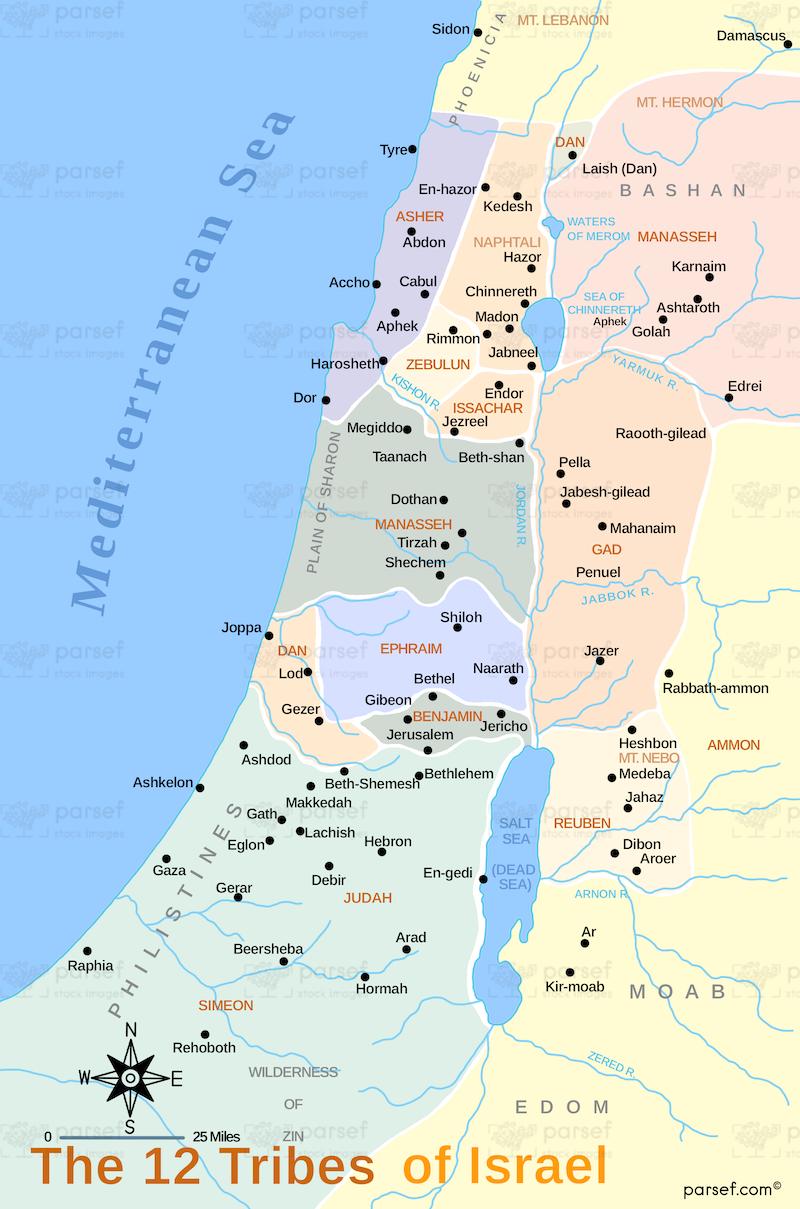
Continuing a chronological Bible study:
(2 Samuel 3:1) Now there was long war between the house of Saul and the house of David, but David waxed stronger and stronger, and the house of Saul waxed weaker and weaker.
In the last chapter and post, David had been anointed king over Judah, and even though Saul was dead, the captain of his army, Abner, made Saul's son Ishbosheth king over Israel, all of Israel except Judah, that is. There was war between the two factions, but it seems David's men must have usually won the battles as David grew stronger and the house of Saul grew weaker.
(2) And to David were sons born in Hebron, and his firstborn was Amnon of Ahinoam the Jezreelitess;
While David reigned in Hebron, sons were born to him. His firstborn son was Amnon, and his mother was Ahinoam, David's wife, the Jezreelitess.
(3) And his second, Chileab, of Abigail the wife of Nabal the Carmelite; and the third Absalom the son of Maacah the daughter of Talmai king of Geshur;
David's second son was born to his wife Abigail, the widow of Nabal, and his name was Chileab. Apparently, David took a third wife, Maacah, daughter of Talmai king of Geshur, and she gave him his son, Absalom.
(4) And the fourth, Adonijah the son of Haggith; and the fifth, Shephatiah the son of Abital; (5) And the sixth, Ithream, by Eglah David's wife. These were born to David in Hebron.
It appears that David married as many wives as he had sons, or rather vice versa. His fourth wife was Haggith and she gave him Adonijah; his fifth wife Abital gave him Shephatiah, and his sixth wife, Eglah, gave him Ithream. These six sons were born to David in Hebron.
(1 Chronicles 3:1) Now these were the sons of David who were born to him in Hebron, the firstborn Amnon of Ahinoam the Jezreelitess; the second Daniel, of Abigail the Carmelitess;
1 Chronicles 3 also named David's sons. However, Chileab, the son of Abigail, is called Daniel here. Daniel is probably his real given name. Chileab means "like his father," so that may have been a nickname as Junior might be now because he was so much like his father.
(2) The third Absalom the son of Maacah, the daughter of Talmai, king of Geshur; the fourth, Adonijah the son of Haggith; (3) The fifth, Shephatiah of Abital; the sixth, Ithream by Eglah his wife. (4) These six were born to him in Hebron, and there he reigned seven years and six months, and in Jerusalem he reigned thirty-three years.
The rest of David's sons who were born to him in the seven and a half years he reigned in Hebron are repeated. David then reigned in Jerusalem for thirty-three years.
(2 Samuel 3:6) And it came to pass, while there was war between the house of Saul and the house of David, that Abner made himself strong for the house of Saul.
During the time there was war between the house of David and the house of Saul, Abner was strong in his support for the house of Saul.
(7) And Saul had a concubine whose name was Rizpah, the daughter of Aiah; and Ishbosheth said to Abner, "Why have you gone in to my father's concubine?"
Saul had a concubine whose name was Rizpah, and it seems that Abner had had sexual relations with her, and Saul's son Ishbosheth demanded to know why he had done such a thing.
(8) Then was Abner very angry for the words of Ishbosheth, and said, "Am I a dog's head, which against Judah do show kindness this day to the house of Saul your father, to his brethren, and to his friends, and have not delivered you into the hand of David, that you charge me today with a fault concerning this woman?"
Abner was angry with Ishbosheth because of his accusation against him, although he did not really deny it. He asked Ishbosheth if he was no better than the head of a dead dog who did not care with whom he lay. He who had defended the house of Saul, his brethren, and his friends, against the tribe of Judah, and had not allowed him to be delivered into the hand of David, he that loyal supporter of Saul, that is who Ishbosheth dared to accuse of fault concerning Saul's concubine. Abner might have actually been owning up to the fact that he had had sexual relations with Saul's concubine, but that it could not be seen as a fault because of his fierce loyalty to the house of Saul.
(9) "So do God to Abner, and more also, except, as the Lord has sworn to David, even so I do to him, (10) To transfer the kingdom from the house of Saul, and to set up the throne of David over Israel and over Judah, from Dan to Beersheba."
Abner was so angry that he wished God to destroy him if he did not see that the kingdom of Saul was transferred to David to be king over all of Israel. It's interesting that he apparently knew all along what the will of God was, but he was actively working against it to set up Ishbosheth as king. That confirms that he had probably been doing it for only his own self-interests. Now God used Abner's desire for revenge against Ishbosheth to bring forth His will to have David king over all Israel.
(11) And he could not answer Abner a word again because he feared him.
Ishbosheth had nothing to say to Abner because he feared him. After all, it was Abner who had made him king, and with the king's army at his command, Abner could easily take him out.
(12) And Abner sent messengers to David on his behalf, saying, "Whose is the land?" Saying, "Make your league with me, and behold, my hand will be with you to bring about all Israel to you."
Abner then sent messengers to David on his own behalf, not from Ishbosheth. I believe his point was that he was acknowledging that the land was David's, and that he now desired to make a covenant of friendship with him, and he would do everything he could to bring all of Israel under his reign.
(13) And he said, "Well, I will make a league with you, but one thing I require of you, that is, you shall not see my face except you first bring Michal Saul's daughter, when you come to see my face."
David agreed it was well and good to join with Abner, but first before that could happen, Abner must bring David's wife Michal, Saul's daughter, to him. It seems that even though David had had six wives since Michal, he must have still cared for her, or perhaps it was to demonstrate honor to Saul's family that his daughter might share with him the benefits of his reign.
(14) And David sent messengers to Ishbosheth Saul's son, saying, "Deliver my wife Michal whom I espoused to me for a hundred foreskins of the Philistines."
David then sent messengers to Ishbosheth telling him to deliver his wife Michal to him. David added that he had purchased her at a great expense and danger to his life by killing a hundred Philistines and bringing their foreskins to Saul as he required in order to marry his daughter (1 Samuel 18:25).
(15) And Ishbosheth sent and took her from her husband, from Phaltiel the son of Laish.
Ishbosheth had Michal removed from her husband, Phaltiel, or Phalti, as he was called in 1 Samuel 25:44, when it was first told that Saul had given his daughter to him.
(16) And her husband went with her along weeping behind her to Bahurim. Then Abner said to him, "Go, return." And he returned.
Michal's current husband went along with her as far as Bahurim, a city in the tribe of Benjamin, because he evidently loved her very much and did not want to lose her, but he was forced to give her up by command of the king and the king's captain.
(17) And Abner had communication with the elders of Israel, saying, "You sought for David in times past to be king over you. (18) Now then do it, for the Lord has spoken of David, saying, 'By the hand of my servant David I will save My people Israel out of the hand of the Philistines and out of the hand of all their enemies.'"
Abner communicated with the elders of Israel, reminding them that it was generally known that David had been anointed to be king over Israel, certainly after Saul's death. He encouraged them to now make David their king, implying he would no longer oppose him. He reminded them of the words of the Lord declaring that it would be David who would save Israel out of the hand of the Philistines and all their enemies. There is no record in the Bible of the Lord saying those words, but He probably did say them to Samuel when He first said He wanted David as king, and they were not recorded, but probably verbally passed down and now general knowledge.
(19) And Abner also spoke in the ears of Benjamin, and Abner went also to speak in the ears of David in Hebron all that seemed good to Israel and that seemed good to the whole house of Benjamin.
Abner spoke these same words especially to the tribe of Benjamin of which was the family of Saul. He spoke these same words in the hearing of David, or perhaps the meaning is rather that after speaking to the elders of the other tribes, he brought the news to David that all were agreeable that David should be king over them.
(20) So Abner came to David to Hebron, and twenty men with him. And David made Abner and the men with him a feast. (21) And Abner said to David, "I will arise and go and will gather all Israel to my lord the king, that they may make a league with you, and that you may reign over all that your heart desires." And David sent Abner away, and he went in peace.
Abner went to David in Hebron with twenty men. David received them and made a feast for them. Abner told David that he would go and do all he could to gather all of Israel to come into agreement with David as their king. He said he would do this so that David could reign over all that his heart desired, although David had not expressed any impatience to take over the entire kingdom, but had been content to wait on God's timing. David sent Abner on his way in peace, having made a covenant of peace with him.
(22) And behold, the servants of David and Joab came from a troop and brought in a great spoil with them, but Abner was not with David in Hebron, for he had sent him away, and he was gone in peace. (23) When Joab and all the host with him had come, they told Joab, saying, "Abner the son of Ner came to the king, and he has sent him away, and he has gone in peace."
After Abner had left David, Joab, the captain of David's army, came with his men, apparently after some military excursion against the enemy, and they brought in a very large spoil after evidently conquering the enemy. Some in David's court told Joab about Abner coming to David, and instead of seizing him, David had allowed him to go in peace.
(24) Then Joab came to the king, and said, "What have you done? Behold, Abner came to you; why is it you have sent him away, and he is quite gone?"
Joab asked David what he had done in allowing Abner to come to him and letting him go in peace, implying that he should have seized him as the enemy.
(25) "You know Abner the son of Ner, that he came to deceive you and to know your going out and your coming in and to know all that you do."
Joab told David that surely Abner had come to deceive him and to learn his movements in order to surely destroy him.
(26) And when Joab had come out from David, he sent messengers after Abner who brought him again from the well of Sirah, but David did not know it.
When Joab left David, he sent messengers after Abner who was apparently at the well of Sirah, which the historian Josephus said was two and a half miles from Hebron. The messengers brought him from there back to Joab, but David did not know any of this.
(27) And when Abner was returned to Hebron, Joab took him aside in the gate to speak with him quietly and struck him there under the fifth rib that he died, for the blood of Asahel his brother.
When the messengers brought Abner back to Hebron, Joab met him at the gate and pulled him aside supposedly to speak to him in private, but he stabbed him under the fifth rib, in the same place Abner had struck Joab's brother Asahel, and he died.
(28) And afterward, when David heard, he said, "I and my kingdom are guiltless before the Lord forever from the blood of Abner the son of Ner; (29) Let it rest on the head of Joab and on all his father's house, and let there not fail from the house of Joab one who has an issue, or who is a leper, or who leans on a staff, or who falls on the sword, or lacks bread."
When David heard what Joab had done, he declared that he and his kingdom were guiltless before God forever for the murder of Abner, that it was wholly on the head of Joab and his father's house. It may be that David made that declaration publicly because Joab was his general, and he wanted it known that he did not command that his general kill Abner, that it was totally on Joab. David went on to curse the family of Joab, wishing that there would always be one who had an issue of blood, or gonorrhea, as it sometimes meant, or one who was a leper, or one who was lame or fell on a sword or lacked food. David said this in his anger, but I can't help but think he should have cursed Joab alone, not his innocent family after him.
(30) So Joab and Abishai his brother killed Abner because he had slain their brother Asahel at Gibeon in the battle.
It appears that Abishai was in on the plan to murder Abner because he had killed Asahel, the brother of Joab and Abishai, sons of David's sister, Zeruiah. So it would appear that David's curse would be on his sister's house, all the more reason he should have directed his anger to Joab and maybe Abishai only. But he had said it in anger; it was not meant as a prophetic curse.
(31) And David said to Joab and to all the people who were with him, "Rend your clothes, and gird yourself with sackcloth, and mourn before Abner." And King David followed the bier.
David told Joab and all the people with him to mourn Abner by the usual expressions of mourning, by tearing their clothes and putting on sackcloth. King David followed the bed on which Abner's body was laid and carried to the grave.
(32) And they buried Abner in Hebron; and the king lifted up his voice and wept at the grave of Abner, and all the people wept.
They buried Abner in Hebron. David wept loudly at the grave of Abner, and all the people with him wept.
(33) And the king lamented over Abner, and said, "Did Abner die as a fool dies?"
David lamented over Abner and said words over his grave. He asked if Abner had died as a fool dies. The word that was translated as "fool" is "nabal" and also meant stupid and wicked. I believe David's point was that Abner had not died as a criminal or for any wickedness he had done. He was unjustly murdered before his time.
(34) "Your hands were not bound nor your feet put into fetters; as a man falls before wicked men, so you fell." And all the people wept again over him.
Abner had not been bound and fettered as a criminal who knew his fate. He had fallen as one murdered by wicked men. This made the people weep again over Abner. This he said in the presence of Joab whom he had told to mourn Abner with him.
(35) And when all the people came to cause David to eat food while it was yet day, David swore, saying, "So do God to me and more also, if I taste bread or anything else till the sun be down."
The people came to David to persuade him to eat, but he refused, swearing an oath that he wished for God to do the greatest evils against him if he even tasted bread before sundown, as he would continue his mourning for Abner until then.
(36) And all the people took notice, and it pleased them, as whatever the king did pleased all the people. (37) For all the people and all Israel understood that day that it was not of the king to kill Abner the son of Ner.
The people took notice of how David conducted himself throughout the entire death and burial of Abner, and it pleased them, for they understood that David had never intended for Abner to be killed.
(38) And the king said to his servants, "Do you not know that there is a prince and a great man fallen this day in Israel?"
Perhaps in explanation to his servants as to why he mourned the man who had so recently been considered an enemy, David explained that Abner had been a great man and even a prince in the house of Saul, as he was Saul's first cousin and a member of the royal family, as well as having the important position as Saul's general.
(39) "And I am this day weak, though anointed king, and these men the sons of Zeruiah are too hard for me. The Lord shall reward the doer of evil according to his wickedness."
Although David had been anointed king, he was very new to the kingdom and had not yet been fully accepted by all of Israel, but Abner had been working on that. Joab and Abishai, the sons of David's sister Zeruiah, were yet too powerful for David to make one of his first acts as king to punish them. He said that the Lord would take care of their just punishment.