Showing posts with label Achish. Show all posts

Tuesday, May 5, 2026

The Philistines Mistrust David

Continuing a chronological Bible study:

(1 Samuel 29:1) Now the Philistines gathered together all their armies to Aphek, and the Israelites pitched by a fountain which is in Jezreel.  

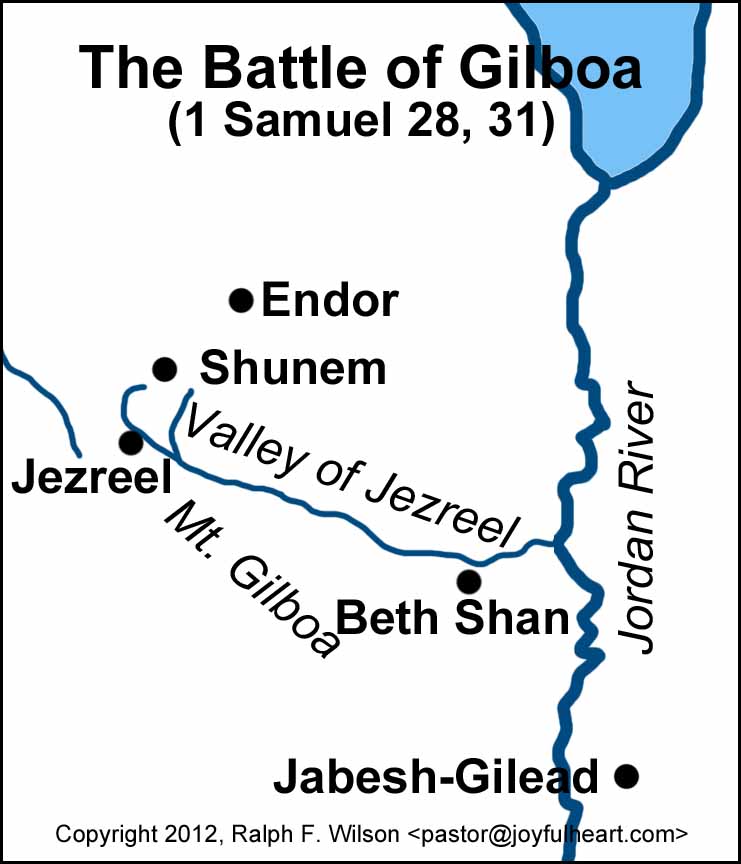
In the last chapter, before Saul consulted the medium, the Philistines had been at Shunem, and Saul's troops were at Gilboa with the valley of Jezreel between them.  Now it appears the Philistines had moved to Aphek, and the Israelites were camped by a fountain that was in Jezreel.  This map borrowed from here was the best I could find to show these locations:


(2) And the lords of the Philistines passed on by hundreds and by thousands, but David and his men passed on in the rear with Achish.

The five lords of the Philistines marched as heads of groups of hundreds and thousands of Philistine soldiers, and David and his men brought up the rear with Achish.

(3) Then the princes of the Philistines said, "What do these Hebrews?" And Achish said to the princes of the Philistines, "Is this not David, the servant of Saul the king of Israel, who has been with me these days or these years, and I have found no fault in him since he fell to me to this day."

The lords of the Philistines asked Achish what the Hebrews were doing with them.  The king reminded them that they were with David who had been with him for many days, in fact a year and part of another year, and he had not yet found any fault in him ever since he came to him.

(4) And the princes of the Philistines were angry with him, and the princes of the Philistines said to him, "Make this fellow return that he may go again to his place which you have appointed him and let him not go down with us to battle, lest in the battle he be an adversary to us. For with what should he reconcile himself to his master, if not with the heads of these men? (5) Is this not David, of whom they sang to one another in dances, saying, 'Saul slew his thousands, and David his ten thousands'?" 

The Philistine princes were angry with the king and told him to send David back to the place he had appointed for him, Ziklag, and not to let him go to battle with them.  After all, they reasoned, what better way to reconcile himself to Saul than to bring him the heads of the Philistines?  Wasn't this the same David of whom the people sang to one another, that Saul had killed his thousands, but David his ten thousands (1 Samuel 18:7)?

(6) Then Achish called David, and said to him, "Surely, as the Lord lives, you have been upright, and your going out and your coming in with me in the host is good in my sight, for I have not found evil in you since the day of your coming to me to this day; nevertheless, the lords do not favor you. (7) Therefore now return and go in peace, that you do not displease the lords of the Philistines."

So Achish called David to him.  It's interesting to note that Achish, a pagan Philistine, spoke of the Lord as surely living.  So he certainly had knowledge of the Lord.  Perhaps he just wanted to swear to David by David's Lord so that he would pay greater regard to what he had to tell him.  He told David that he had been upright with him in all his comings and goings ever since he first came to him until that very day.  However, the Philistine princes did not favor him, so he asked David to return to his place in peace so that he did not displease them.

(8) And David said to Achish, "But what have I done? And what have you found in your servant so long as I have been with you to this day, that I may not go fight against the enemies of my lord, the king?"

Achish had already told David that he had done nothing wrong as long as he had been with him.  It was very deceitful for David to push to go to battle against the enemies of the Philistines since he most assuredly would not have defended the Philistines against the Israelites, and most likely, would have killed them.

(9) And Achish answered and said to David, "I know that you are good in my sight, as an angel of God; nevertheless, the princes of the Philistines have said, 'He shall not go up with us to the battle.' (10) Therefore now, rise up early in the morning with your master's servants who have come with you, and as soon as you are up early in the morning and have light, depart."

Achish repeated that David had always been good in his sight, however, the lords who were also commanders in the upcoming battle, had declared David was not to go with them, so Achish told David and his men to leave at first light the next morning.  Once again, Achish had spoken of God.  He had been very gracious to David and had perhaps learned about David's God through David's actions.  It's the way Christians ought to live so as to bring non-believers to their Lord, their only salvation.  It would have been very detrimental to David's witness and testimony to be found as such a conniving deceiver.  I believe that God, in His mercy, protected Achish at this moment in time from David's betrayal, and He protected David from further sinning.

(11) So David and his men rose up early to depart in the morning to return to the land of the Philistines. And the Philistines went up to Jezreel.

So David hearkened to the king, and he and his men rose up early the next morning to go back to Ziklag in the land of the Philistines.  The Philistines went to Jezreel where the Israelites were encamped.

(1 Chronicles 12:19) And there fell of Manasseh to David when he came with the Philistines against Saul to battle, but they did not help him, for the lords of the Philistines upon advisement sent him away, saying, "He will fall to his master Saul against our heads."

Some of the tribe of Manasseh had fallen in with David when he had come with Achish and the Philistines to fight against Saul, but they had not helped him because the king and the lords of the Philistines had sent David and his men away fearing wisely that he would fall in line with Saul against them.

(20) As he went to Ziklag, there fell to him of Manasseh, Adnah, and Jozabad, and Jediael, and Michael, and Jozabad, and Elihu, and Zilthai, captains of the thousands that were of Manasseh. (21) And they helped David against the band of raiders, for they were all mighty men of valor and were captains in the host.

As David went back to Ziklag, more from the tribe of Manasseh fell in with him, namely Adnah, Jozabad, Jediael, Michael, Jozabad, Elihu, and Zilthai, who were captains of the troops of thousands that were of Manasseh.  There must have been two Jozabads, as that name is mentioned twice.  These men went on to help David against a band of raiders that I believe speaks of a future event.  These were all mighty men and were captains in David's army.

(22) For at that time, day by day, there came to David to help him until a great host like the host of God.

It seems that day by day David's army grew until it was a great army like the army of God, which it surely was, as God was undoubtedly implemental in bringing these mighty men to help David.

Sunday, May 3, 2026

Saul Consults a Spirit Medium

Continuing a chronological Bible study:

(1 Samuel 28:1) And it came to pass in those days, that the Philistines gathered their armies together for warfare, to fight with Israel. And Achish said to David, "Know you assuredly, that you shall go out with me to battle, you and your men."

In the last chapter and post, David had let his faith falter, and he went to seek refuge from Saul in the land of the enemy, the Philistines.  He had lied and had secured Achish's trust in him, so now the king fully expected that David and his men would fight against the Israelites.

(2) And David said to Achish, "Surely you shall know what your servant can do." And Achish said to David, "Therefore will I make you keeper of my head forever."

David answered Achish in a way that made the king trust that David would fight against the Israelites, and Achish told David that he would make him his personal bodyguard forever.

(3) Now Samuel was dead, and all Israel had lamented him and buried him in Ramah, in his own city. And Saul had put away those who had familiar spirits and the wizards out of the land.

The prophet Samuel was dead, and all Israel had lamented his death, and they buried him in his own city, Ramah.  I believe the point may be that Samuel had been Saul's spiritual adviser, and now he no longer had him to advise him on matters like war.  It appears that Saul had previously removed all wizards and those who had familiar spirits, which would have included witches, fortune-tellers, astrologers, and the like.  To attempt to know what God has not thought proper to reveal, is a sin against His wisdom, providence, and goodness, and specifically against His commandment against such attempts (Leviticus 19:31, Isaiah 8:19).  

(4) And the Philistines gathered themselves together and came and pitched in Shunem; and Saul gathered all Israel together, and they pitched in Gilboa.

The Philistines gathered and camped at Shunem, and Saul and the Israelites camped at Gilboa.  The two camps were separated by the valley of Jezreel, as seen from this map borrowed from Jesus Walk:


(5) And when Saul saw the host of the Philistines, he was afraid, and his heart greatly trembled. (6) And when Saul enquired of the Lord, the Lord did not answer him, neither by dreams, nor by Urim, nor by prophets.

When Saul saw the Philistines, he was very afraid, and he enquired of the Lord.  However, the Lord had left Saul (1 Samuel 16:14), and He did not answer him, not by dreams, and not by the Urim and Thummim which would have been in the ephod of the priest who was no longer with him for he had killed them all except for Abiathar (1 Samuel 22) who had escaped with the ephod to David (1 Samuel 23:9).  The Lord did not answer Saul through any prophets, either.

(7) Then Saul said to his servants, "Seek me a woman who has a familiar spirit, that I may go to her and enquire of her." And his servants said to him, "Behold, a woman who has a familiar spirit at Endor."

Saul, who had once wisely put out of his country all the wizards and fortune-tellers and the like, now sought one.  His servants told him there was such a woman at Endor, a city in the tribe of Manasseh.  It is interesting to note that the word translated as "enquired" in verse 6 is not the same word translated as "enquire" here.  In verse 6 the original word is "shaal" and means "inquire, ask, demand, beg."  In verse 7 the word is "darash" which means "tread, frequent, usually to follow, by implication to seek or ask, specifically to worship."  It seems to me that the words should have been reversed, but Saul had ceased following the Lord.  Brown-Driver-Briggs Hebrew Definitions adds that "darash" meant to "resort to."  I get the idea that Saul was getting desperate for an answer from a fortune-teller.

(8) And Saul disguised himself and put on other raiment, and he went, and two men with him, and they came to the woman by night. And he said, "I pray you, divine to me by the familiar spirit and bring up for me the one I shall name to you."

Saul disguised himself and put on different clothing than his royal garments, and he went with two men to the woman at night.  He asked that she exercise her art of divination to bring up from the dead the person Saul would ask of her.  It seems necromancy, communicating with the dead, was her particular art.

(9) And the woman said to him, "Behold, you know what Saul has done, how he has cut off those who have familiar spirits and the wizards out of the land; why then do you lay a snare for my life, to cause me to die?"

The woman, not knowing that it was Saul who enquired of her, told him that Saul, the king, had cut off all those with familiar spirits and wizards from the land, so asking her to do this was to put her life in danger.

(10) And Saul swore to her by the Lord, saying, "As the Lord lives, there shall no punishment happen to you for this thing." (11) Then the woman said, "Whom shall I bring up to you?" And he said, "Bring me up Samuel."

Saul swore to the woman by the Lord that no punishment would happen to her, so she asked him who it was he wanted her to bring up from the dead.  He told her he wanted the prophet Samuel.

(12) And when the woman saw Samuel, she cried with a loud voice, and the woman spoke to Saul, saying, "Why have you deceived me? For you are Saul!"

When the woman saw Samuel, she cried out with a loud voice.  It's interesting to note that many of the old commentators I study go to great lengths to explain this was not really Samuel because no one could bring up the dead.  However, if no one could bring up spirits of the dead, then why would the Lord forbid them from doing so?  There is a spirit world that is very real, and the Lord does not want us dabbling in such arts.  It opens the door to dark spirits and those that would pretend to be something they are not to ensnare us.  I think it's possible that the woman may have practiced in deceit and was not accustomed to actually seeing a spirit she called for, and this caused her to cry out.  Actually, since she dealt with "familiar" spirits, perhaps she was used to a spirit that would in turn supposedly communicate with the one she sought.  Whatever the case, she was shocked to see Samuel.  How she knew it was Saul who enquired of her is not explained but it must have been by divine revelation.

(13) And the king said to her, "Do not be afraid, for what did you see?" And the woman said to Saul, "I saw gods ascending out of the earth." 

Saul told the woman not to be afraid, but to tell him what she saw.  Although she said she saw gods, plural, the word she used was "elohiym" which usually refers to the one true God in three persons, if you will, Father, Son, and Holy Spirit.  This was a sight she had never seen before, and she perceived it as magnificent as a god.  

(14) And he said to her, "What is his form?" And she said, "An old man coming up, and he is covered with a mantle." And Saul perceived that it was Samuel, and he stooped with his face to the ground and bowed himself.

Saul asked the woman in what form was the so-called god.  She said it was an old man coming up, covered with a robe.  I have so many questions and thoughts here!  It's obvious by his questions that Saul did not see what the woman saw.  The fact that an old man would "come up" from the ground makes me believe it was a demonic spirit.  But Saul perceived it must be Samuel, and he bowed to the ground before him.  And the idea that Saul would bow before a demonic spirit is a most sad fact as to the state of Saul at this point in his life.

(15) And Samuel said to Saul, "Why have you disquieted me, to bring me up?" And Saul answered, "I am sore distressed, for the Philistines make war against me, and God is departed from me and answers me no more, neither by prophets, nor by dreams; therefore I have called you that you may make known to me what I shall do."

Now scripture states that it was Samuel who spoke to Saul.  He asked why Saul had disquieted him to bring him up.  This cannot be the soul of Samuel as he would be at rest in Abraham's bosom (Luke 16:22) or in heaven (Luke 23:43).  Nothing could disturb or trouble him, and his soul would not be in the ground.  But if it was truly Samuel who spoke to Saul, then I believe it was his body that came forth from the ground, and that could only be by the power of God.  It appears that Samuel appeared before the woman had done anything to bring him forth (verses 11 and 12 above).  God has control over everything and everybody, living or dead, and although He would not answer Saul by prayers or dreams, etc., He had a message for him, but in a way that would make Saul know He was no longer with Him.  Saul told Samuel how the Philistines had made war against him and how God had deserted him, and he had called Samuel to ask him what he should do.

(16) Then Samuel said, "Why then do you ask of me, seeing the Lord is departed from you and has become your enemy?"

Samuel asked Saul why he would ask him what to do as he had been God's prophet, and God had departed from Saul, as he himself knew.

(17) "And the Lord has done to him as He spoke by me, for the Lord has torn the kingdom out of your hand and given it to your neighbor, to David; (18) Because you did not obey the voice of the Lord nor execute His fierce wrath on Amalek, therefore has the Lord done this thing to you this day."

Samuel told Saul that the Lord had done just what He had said He would do (1 Samuel 13:14), for He had torn the kingdom out of his hand and had given it to David.  And that was because Saul had not obeyed the voice of the Lord.  In 1 Samuel 13, Saul had offered an unlawful sacrifice, specifically against the way the Lord had told him to wait to do.  Additionally, the Lord had told Saul to completely destroy the Amalekites, including all their livestock.  However, Saul spared King Agag and the best of the livestock (1 Samuel 15:9).  Therefore the Lord had torn the kingdom away from Saul, rejecting him and not answering him.

(19) "Moreover the Lord will also deliver Israel with you into the hand of the Philistines, and tomorrow you and your sons will be with me; the Lord shall also deliver the host of Israel into the hand of the Philistines."

This specter of Samuel told Saul that the Lord was going to deliver him and his sons, as well as Israel, into the hands of the Philistines.  Even more alarming to Saul, he told him that he and his sons would be with him the next day.  At the very least, it meant they would be dead, but if this was a demon taking on the shape of Samuel which actually Saul couldn't see (verse 14), then it meant they would be in hell.  However, I'm sure that the loving Jonathan would be in heaven, so this could only mean they would be dead.  The hymnist Charles Wesley wrote:

“What do these solemn words portend?
A ray of hope when life shall end.
Thou and thy sons, though slain, shall be
To-morrow in repose with me.
Not in a state of hellish pain,
If Saul with Samuel do remain:
Not in a state of damn’d despair,
If loving Jonathan be there.”

Although a beautiful sentiment, Wesley could not know the fate of Saul and his sons' souls.  But his feeling was that God would have mercy on Saul, and well He might have, and they would all be with Samuel in heaven.  However, that is supposing that this apparition of Samuel was indeed his spirit, and I don't believe it was.  God was allowing this body of Samuel (maybe it was his body, but Saul couldn't see it) or this demonic spirit to tell him that he and his sons would die sometime in the near future, which was sometimes the meaning of the original word "machar" that was translated as "tomorrow."

(20) Then Saul fell straightway all along on the earth and was sore afraid because of the words of Samuel, and there was no strength in him, for he had eaten no bread all the day nor all the night.

Saul fell stretched out on the ground and was very afraid because of the words of Samuel.  There was no strength in him to rise up again because he had not eaten all that day and all that night.

(21) And the woman came to Saul and saw that he was sore troubled, and said to him, "Behold, your handmaid has obeyed your voice, and I have put my life in my hand and have hearkened to your words which you spoke to me. (22) Now therefore, I pray you, hearken you also to the voice of your handmaid, and let me set a morsel of bread before you, and eat that you may have strength when you go on your way."

The woman came to Saul and saw how troubled he was.  She reasoned with him that since she had done what he asked of her and had even put her life in danger by doing it, that he might do what she asked, and let her give him some bread so that he might regain his strength and go on his way.  I am sure she was afraid of what might happen to her if the king was found dead at her place, she being a worker of dark arts that the king himself had banned from the country.

(23) But he refused and said, "I will not eat." But his servants, together with the woman, compelled him, and he hearkened to their voice. So he arose from the earth and sat upon the bed.

Saul at first refused to eat, but his servants and the woman talked him into it.  He got up from off the ground and sat upon a bed.

(24) And the woman had a fat calf in the house, and she hasted and killed it, and took flour and kneaded it, and baked unleavened bread of it. (25) And she brought it before Saul and before his servants, and they ate. Then they rose up and went away that night.

The woman hurried and killed a fat calf she had, dressed it, and made unleavened bread to go along with it.  She brought the meal to Saul and his servants, and they ate and then went on their way that same night.

All the details of how Samuel was able to be brought out of the spirit world to speak to Saul were not given, so we are left to imagine how it happened.  The facts are that there is a spirit world where guardian angels and demons exist.  And Saul did not actually see the being he assumed was Samuel, but as God is supreme over all, He compelled the spirit to tell Saul what He wanted him to hear.  And because our Lord is all-good all the time and desires that all men be saved (1 Timothy 2:4), He most likely was letting Saul know his end was near so that he could repent and make peace with his Maker.  I don't believe any spirit has the ability to know the future; that is something that is only known by God, but as everything and everybody is at His command, even spirits can be compelled to say what He wills them to say.

Wednesday, April 29, 2026

David Flees to the Philistines

Continuing a chronological Bible study:

(1 Samuel 27:1) And David said in his heart, "I shall now perish one day by the hand of Saul; nothing better for me than that I should speedily escape into the land of the Philistines, and Saul shall despair of me, to seek me anymore in any coast of Israel; so shall I escape out of his hand."

In the last chapter, David had just spared Saul's life a second time.  Although Saul had said he would no longer seek to harm him (1 Samuel 26:21), David had true reason not to trust him.  It appears here that David feared that Saul would kill him someday and that he must escape to a place where he thought Saul would not desire to pursue him.  How could he believe this when God had so protected him and had promised he would be king of Israel?  As happens to the best of us, our faith slips sometimes in the midst of troubles.  As the father of the possessed son said to Jesus, "Lord, I believe; help my unbelief!" (Mark 9:24), we all need supernatural divine help sometimes to have total faith.  Oh, that we would learn to trust the Lord because He has always been trustworthy!  Then again, could it be that this was just another of David's hiding places, that he might have always thought if he stayed where he was, Saul would surely find him and kill him, so he moved on to the next place?  But again, then again, a prophet of God had told David to leave a pagan country, Moab, and go to Judah (1 Samuel 22:5), so surely God did not wish for David to go to another pagan land in which to dwell.  However, as David had previously said when he blamed Saul for driving him away from his inheritance into the land of pagans serving false gods (1 Samuel 26:19), he believed he was being driven out again, and he decided to quickly escape to the land of the Philistines where he hoped Saul would not seek to pursue him.

(2) And David arose, and he passed over with the six hundred men who were with him to Achish, the son of Maoch, king of Gath. (3) And David dwelt with Achish at Gath, he and his men, every man with his household, and David with his two wives, Ahinoam the Jezreelitess, and Abigail the Carmelitess, Nabal's wife.

David and his six hundred men went to the king of Gath, Achish, the son of Maoch.  He had fled to him before (1 Samuel 21:10) but he had cast him out when David feigned madness because he feared Achish.  But now with his six hundred men with him, David must have appeared a safe bet; especially if he knew David to be an enemy of Saul's, he might feel better protected against Saul with David and his men in his city.  So David and his wives, along with his men and their households, dwelt in Gath.

(4) And it was told Saul that David had fled to Gath, and he sought him no more again.

When Saul was told that David was in Gath, he did not try to go after him.  Was it because he had indeed had a change of heart for David after he had spared his life twice?  Or had David been wise in going there calculating that Saul would not want to pursue him there?  I am certain that God would have protected him in Judah, and God through a prophet had sent him to Judah in the first place, so I don't believe it was God's will that David go to a pagan country, but it appears that God blessed and protected him, regardless.

(5) And David said to Achish, "If I have now found grace in your eyes, let them give me a place in some town in the country that I may dwell there, for why should your servant dwell in the royal city with you?" (6) Then Achish gave him Ziklag that day; therefore Ziklag pertains to the kings of Judah to this day. (7) And the time that David dwelt in the country of the Philistines was a full year and four months. 

David asked the king Achish to let him have a town in the country in which to dwell, rather than living in the royal city.  Achish gave him Ziklag, twelve miles from Gath, which actually was originally Israelite land (Joshua 15:31) but must have come into the hands of the Philistines.  But now David had it back, and it remained his at least to the writing of this account.  It still makes me wonder if David had been wrong about going to a pagan land, and God blessed him anyway, or if this was a divinely inspired plan to retake some of their land.  Most likely, God just used this opportunity, knowing that David would do what he did, but it would not have been His preferred will to have David live in a pagan land.  David stayed with the Philistines for a year and four months.

(8) And David and his men went up and invaded the Geshurites, and the Gezrites, and the Amalekites, for those were of old the inhabitants of the land, as you go to Shur, even to the land of Egypt.

From Ziklag, David and his men went up and invaded the Geshurites, the Gezrites, and the Amalekites, some of the old inhabitants of the land of Canaan that had not been expelled from the promised land.  I can't say that I see any fault on David's part at this juncture, as God intended that these lands be possessed by the Israelites (Joshua 13).

(9) And David struck the land and left neither man nor woman alive, and took away the sheep, and the oxen, and the asses, and the camels, and the apparel, and returned and came to Achish.

David struck those lands, killing everyone, man and woman, and took all the livestock, camels, and apparel, and went to Achish.  According to the word of God, none of these pagan nations in the promised land were to be spared (Deuteronomy 7:2), so perhaps David felt he was finishing a job left undone.  However, the Amalekites seem to have been spread far and wide, as they will rear their ugly heads again.

(10) And Achish said, "Where have you made a road today?" And David said, "Against the south of Judah, and against the south of the Jerahmeelites, and against the south of the Kenites."

Achish asked where David had been that day.  The original word "pashat" transcribed as "road" more completely meant "to strip, invade, spread out," so in that way David had made an inroad, and Achish wanted to know where.  David told him that he had gone against people in the south of Judah, against the Jerahmeelites who were the descendants of Jerahmeel, the son of Hezron, the grandson of Judah, and the Kenites who were the posterity of Jethro, Moses's father-in-law.  This obviously wasn't exactly true.  Yes, he had been south of Judah, but not against the Jerahmeelites and the Kenites, but rather against the Geshurites, the Gezrites, and the Amalekites.  This map borrowed from Jesus Walk shows where David had actually been and where he told Achish he had been:


(11) And David saved neither man nor woman alive to bring to Gath, saying, "Lest they should tell on us, saying, 'So did David, and so his manner all the while he dwells in the country of the Philistines.'"

David did not allow any man or woman of the Geshurites, the Gezrites, and the Amalekites, to live, for fear that they would tell Achish what he had actually done.  And of course, the king and the people would expect that to be David's behavior all the while he was in the country of the Philistines.

(12) And Achish believed David, saying, "He has made his people Israel utterly abhor him; therefore he shall be my servant forever."

Achish believed David, supposing he had made his own people Israel to hate him, so he felt he was secure with a servant and ally in David.  This made David's sin of lying all the more grievous.  While Achish was a Philistine and an enemy to the Israelites, David used the king's gracious hospitality in giving him Ziklag and allowing him to stay in his country for a year and four months.  That is certainly no way to make proselytes!  Christians should always act Christ-like.  To do otherwise is hypocritical and leaves a stain on Christianity in the eyes of non-believers.  God would have certainly protected David had he stayed in Judah.  At this point, I don't know of any definite negative effects of his lying, but at the very least, it had a negative impact on David's faith and closeness with his Lord and on his conscience as he later would plead with the Lord to remove from him the way of lying (Psalm 119:29).

(1 Chronicles 12:1) Now these were they who came to David to Ziklag while he kept himself close because of Saul, the son of Kish, and they among the mighty men, helpers of the war. (2) Armed with bows and could use both the right hand and the left with the bow, of Saul's brethren of Benjamin.

1 Chronicles 12 tells of mighty men of war who joined David while he was at Ziklag hiding out from Saul.  These men were skillful with bows and could use either hand which was an advantage to them.  They were of Saul's tribe of Benjamin.

(3) The chief was Ahiezer, then Joash, the sons of Shemaah the Gibeathite; and Jeziel and Pelet, the sons of Azmaveth; and Berachah, and Jehu the Antothite, (4) And Ismaiah the Gibeonite, a mighty man among the thirty and over the thirty; and Jeremiah, and Jahaziel, and Johanan, and Josabad the Gederathite, (5) Eluzai, and Jerimoth, and Bealiah, and Shemariah, and Shephatiah the Haruphite, (6) Elkanah, and Jesiah, and Azareel, and Joezer, and Jashobeam, the Korhites, (7) And Joelah, and Zebadiah, the sons of Jeroham of Gedor.

It appears there were thirty Benjamite men who came to David at Ziklag even though only 23 are named.  Ismaiah the Gibeonite appears to have been the commander over the thirty men.  These particular men were not mentioned elsewhere in scripture, although some have the same names as others mentioned.  The only exception might be Azmaveth, but he wasn't one of the men who came to David but the father of two of his sons who did.

At this point in his season of life, things seem to be going well with David.  His plan had worked, and Saul no longer sought him.  However, he had to lie to maintain his safety, and of course, that lie would have to be maintained for the sixteen months he lived in Gath.  That would have to take a spiritual toll and cause some sort of separation from God.  He had lost faith in God to protect him and bless him and had taken matters into his own hands.  Probably the worst thing that could happen was that it had worked!  It would keep him among his enemies, lying to have peace, separated from his people and most importantly from his Lord.  Although the Lord seems to have still blessed David at this point, and perhaps even used him to conquer some territory the Israelites had failed to take, up to this point, his lack of faith and his deceits would have to take a toll and would have consequences as we will most likely see in coming chapters.  God's commands are not about His being a dictator over us; they are designed to give us a perfect and peaceful life with all the blessings of the Lord.  David could not enjoy perfect peace while living among the enemy and lying to cover his tracks.  Only in complete faith in the protection and provision of our Lord may we find perfect joy and peace.  But, as always, David's life gives us confidence that even when we sometimes fail Him, God still loves us and forgives us.  Through Jesus our intercessor, He is able to still see us as pure.  That's not to say that we have free reign to do as we want, but God knows our hearts, just as He knew that David was a man after His own heart, even though he often failed Him.

Sunday, December 21, 2025

David Takes Consecrated Bread

Continuing a chronological Bible study:

(1 Samuel 21:1) Then came David to Nob to Ahimelech the priest, and Ahimelech was afraid at the meeting of David, and said to him, "Why are you alone and no man with you?"

Jonathan had warned David that Saul intended to kill him, and David had run away.  He came to Nob, a city of priests, where the tabernacle was at that time.  I imagine David felt safe in the tabernacle of the Lord where he might receive counsel of the Lord.  The high priest Ahimelech was afraid when he saw David alone.  He may have heard of the king's displeasure with him, but also as the king's son-in-law, he should have had attendants with him.  David coming alone did not seem right, and he sensed trouble.  He asked David why he had come alone.

(2) And David said to Ahimelech the priest, "The king has commanded me some business and has said to me, 'Let no man know anything of the business whereabout I send you and what I have commanded you,' and I have appointed my servants to such and such a place."

David then told the high priest a lie, telling him that the king had sent him on some business and had sworn him to secrecy, so he had sent his servants away.  As good a man as David was, living a life of integrity as he had proclaimed in the last post in Psalm 26, this is the second time that we read of David lying (1 Samuel 20:6).

(3) "Now therefore, what is under your hand? Give five loaves of bread in my hand or what there is present."

David asked the priest what he had on hand, with regard to bread or something to eat, as we may assume he had had nothing to eat on his journey.  He asked the priest to give him five loaves of bread or whatever he had on hand.

(4) And the priest answered David, and said, "No common bread under my hand, but there is hallowed bread, if the young men have kept themselves at least from women."

The priest told David that he had no common bread on hand, but there was hallowed bread that had been devoted for sacred use.  However, he seemed willing to give it to David and any of his men if they had abstained from women and were considered clean.

(5) And David answered the priest and said to him, "Of a truth, women kept from us about these three days since I came out, and the vessels of the young men are holy, and the bread is in a manner common, yea, though it were sanctified this day in the vessel."

It seems as if David may have had some men with him that he had sent away when he came to Ahimelech, unless he was still lying.  He told the priest that they had not been with women for three days since he had left and been on this journey.  Whether or not it was true, that was the length of time the law required for sanctifying themselves after being with women.  David added that the vessels of his young men were holy, not having been defiled with any ceremonial uncleanness.  He also suggested that the bread was common at that time anyway as it had been removed from the showbread table, as may be assumed because the priest said he had it on hand, as bread taken off the showbread table was then lawful to be eaten by the priest and his family.  Supposedly, in case of necessity through hunger, the bread might be lawfully allowed to strangers.

(6) So the priest gave him hallowed bread, for there was no bread there but the showbread that was taken from before the Lord to put hot bread in the day when it was taken away.

The priest gave David the hallowed bread, that which had been taken off the showbread table before the Lord, in order to place fresh bread there.  It was lawful for the priests only to eat the showbread; but David and his companions were starving and no other bread could be had at the time.  Therefore he and his companions ate of it without sin, and this we know because Jesus referred to this incident in Mark 2:25-26, implying that because he had need and was hungry, his actions were not sinful, because strict legalistic adherence to laws to the detriment of people was not aligned with the spirit of the law.  "I desire mercy and not sacrifice," said the Lord (Hosea 6:6), and it was repeated by Jesus (Matthew 12:7).  Jesus also spoke of the law of the Sabbath, saying it was made for man, and not man for the Sabbath, once again meaning it should not be so legalistically adhered to so as to cause detriment to people.

(7) Now a certain man of the servants of Saul was there that day, detained before the Lord, and his name was Doeg, an Edomite, the chiefest of the herdsmen of Saul.

There was a servant of Saul's named Doeg who was either at the tabernacle or in close proximity to it.  He was the chief of the herdsmen of Saul and so might be considered more loyal to Saul than just any herdsman.  He was detained before the Lord, probably just meaning he himself chose to stay, tarrying to worship the Lord.

(8) And David said to Ahimelech, "And is there not here under your hand spear or sword? For I have neither brought my sword nor my weapons with me because the king's business required haste."

David asked the priest if he had any weapons on hand because he had not brought any weapons with him because the king's business had required haste.  I suppose you could say that part of what David told the priest was true.  It was the king's business to kill him, and he indeed had to leave in haste.

(9) And the priest said, "The sword of Goliath the Philistine whom you killed in the valley of Elah, behold it wrapped in a cloth behind the ephod. If you will take that, take it, for there is no other save that here." And David said, "None like that; give it to me."

The priest told David that the sword of Goliath, the giant David had killed, was there wrapped in a cloth behind the place where the priestly garment lay.  He told him he could take that if he wanted it, for there was nothing else there.  David said there was nothing like it, definitely because of its size, but David had been well able to use it to cut off Goliath's head (1 Samuel 17:51), and also because it would serve as a symbol of God's faithfulness in delivering him as He had previously done.

(10) And David arose and fled that day for fear of Saul and went to Achish the king of Gath.

David fled from there to Gath, to Achish, the king of Gath.  It seems strange that David would flee to an enemy king, but Saul's rage was so great and David's life in such danger, that perhaps he felt a little safety in the presence of a rival king to Saul.  "The enemy of my enemy is my friend," as the proverb goes.

(11) And the servants of Achish said to him, "Isn't this David the king of the land? Did they not sing one to another of him in dances, saying, 'Saul has slain his thousands, and David his ten thousands'? (12) And David laid up these words in his heart and was sore afraid of Achish the king of Gath.

However, the servants of Achish considered David to be the king or at least recognized him as the king elect of Israel as they remembered the women dancing and singing that while Saul had killed his thousands, David had killed his ten thousands (1 Samuel 18:7).  Perhaps they even meant that David was the king of their land, as Goliath had proposed that if any man were to kill him, the Philistines would become subjects of Israel (1 Samuel 17:9), and maybe they thought David had come to overthrow Achish and take the crown.  Either way, David became afraid of what Achish might do to him when he knew that. 

(13) And he changed his behavior toward them and feigned himself mad in their hands and scrabbled on the doors of the gate and let his spittle fall down on his beard.

David changed his behavior toward the servants of Achish and pretended to be mad "in their hands," which sounds as if they may have taken hold of David.  He scratched on the doors of the gate and drooled down his beard.

(14) Then Achish said to his servants, "Lo, you see the man is mad. Why have you brought him to me? (15) Have I need of mad men that you have brought this fellow to play the mad man in my presence? Shall he come into my house?"

Achish's servants brought David to him, but because he saw him as mad, he demanded to know why his servants brought a mad man to him as if he needed a mad man in his house.  Although this psalm ends right here, we can assume that the king sent him away, as 1 Samuel 22 begins with the fact that David left.  However, my chronological study takes me to Psalms next.

David pretending to be mad when he wasn't is yet another example of his dishonesty.  I have often pondered whether or not every lie is a sin against God.  What makes me wonder that is that the commandment against lying actually says, "You shall not bear false witness against your neighbor."  Do not tell a lie about your neighbor.  Is that the same as telling a lie to an enemy of God to save one's life?  I suppose it could represent a lack of faith in God to deliver one out of danger when he believes he must do something to deliver himself.  Quoting Matthew Henry, in his Commentary on the Whole Bible, "Justly are troubles called temptations, for many are by them drawn into sin."  By this, he suggests that because of his troubles, David was drawn into the sin of lying.  And surely, even if it was not an actual sin against God, everything we do has a chain reaction, whether good or bad.  And there is a slippery slope we find ourselves on when we start with little white lies as they make it easier to tell bigger lies.