Showing posts with label Balaam. Show all posts

Monday, March 31, 2025

Joshua's Farewell Address and Death

Continuing a chronological Bible study:

(Joshua 23:1) And it came to pass a long time after that the Lord had given rest to Israel from all their enemies round about, that Joshua waxed old, stricken in age.

Israel had divided the land of Canaan among the tribes, and the people lived in peace and rest from all their enemies surrounding them.  Several years had passed, and Joshua had become very old.

(2) And Joshua called for all Israel, for their elders, and for their heads, and for their judges, and for their officers, and said to them, "I am old, stricken in age."

Joshua called to him all the elders and chief people in Israel, including heads of the tribes, judges, and officers.  He began by telling them that he had become very old.

(3) "And you have seen all that the Lord your God has done to all these nations because of you, for the Lord your God is He who has fought for you."

He reminded them that they had seen all that the Lord had done to the nations of Canaan for His people Israel.  He had fought for His people and had brought them to this point of peace and rest.

(4) "Behold, I have divided to you by lot these nations that remain, to be an inheritance for your tribes, from Jordan, with all the nations that I have cut off, even to the Great Sea westward."

I believe Joshua's point was that all of Canaan had been divided by lot to them, even the nations that remained unconquered.  Those unconquered parts, along with all the nations Joshua had cut off with the sword, all the way to the Mediterranean Sea, had been divided as an inheritance to the tribes.

(5) "And the Lord your God, He shall expel them from before you and drive them from out of your sight, and you shall possess their land, as the Lord your God has promised you."

Joshua encouraged the leaders of Israel that the Lord willed that they should inherit all of the land of Canaan, and He would drive the rest of the Canaanites out of their land, and they would be able to possess all of it, as their Lord had promised them.  It has been discussed before that they never did fully possess all the land that God had promised them because they were not obedient to the Lord to hold up their side of the covenant.  However, God said they would possess their land, and a passage in the book of the prophet Amos confirms that they eventually will possess it (Amos 9:15).

(6) "Be therefore very courageous to keep and to do all that is written in the book of the law of Moses, that you not turn aside from it to the right hand or to the left."

Joshua was giving the leaders of Israel the same words he had received from the Lord when the reins were handed over to him after the death of Moses (Joshua 1:7).  He cautioned them to be courageous in keeping the commandments of the law, that they not turn aside from it.

(7) "That you do not come among these nations, these that remain among you, neither make mention of the name of their gods nor cause to swear, neither serve them nor bow yourselves to them."

Specifically, Joshua cautioned them against going among the pagan nations of people that remained and acknowledging their gods.  They were not to even speak their names, much less swear by them, serve them, or bow down to them.

(8) "But cleave to the Lord your God as you have done to this day."

They were to cleave only to their Lord God through their obedience, service, and worship of Him alone, as they had done since their time in Canaan to that point.  It can't be said that they were always so faithful while in the wilderness.

(9) "For the Lord has driven out from before you great nations and strong, but you, no man has been able to stand before you to this day."

The reason Joshua gave for them always cleaving to their Lord was because of the good things He had done for them.  He had driven out great and strong nations from before them so that no man was able to stand before them even to that day.

(10) "One man of you shall chase a thousand, for the Lord your God is He who fights for you, as He promised you."

One man of them would be able to chase a thousand of his enemies only because it was their Lord who fought for them as He had promised He would (Leviticus 26:8, Deuteronomy 1:30).

(11) "Take good heed therefore to yourselves, that you love the Lord your God."

Joshua impressed upon them the need to be careful and on guard that they always love, honor, and obey their Lord God.

(12) "Else if you do in any way go back and cleave to the remnant of these nations, these that remain among you, and shall make marriages with them and go in to them and they to you, (13) Know for a certainty that the Lord your God will no more drive out these nations from before you, but they shall be snares and traps to you and scourges in your sides and thorns in your eyes, until you perish from off this good land which the Lord your God has given you."

For if they turned away from their Lord and attached themselves to the remnant of the pagan nations in their land and made and consummated marriages with them, they could know for absolute certain that their Lord would no longer go before them to drive out those remaining nations.  They would remain as snares and traps to them, very troublesome and distressing, drawing them into idolatry and immorality.

(14) "Behold this day, I am going the way of all the earth, and you know in all your hearts and in all your souls that not one thing has failed of all the good things which the Lord your God spoke concerning you; all have come to pass to you, and not one thing of it has failed."

Joshua told them that he was going to die just as all living things eventually do.  He was about to leave them without a human leader, but he reiterated why they should put all their love and faith and trust in their Lord God to lead them.  They knew in their hearts that He had not failed to give them any good thing He had promised.  All He had promised had come to pass; therefore, they should continue to have total faith in Him.

(15) "Therefore it shall come to pass, as all good things have come upon you, which the Lord your God promised you, so shall the Lord bring upon you evil things until He has destroyed you from off this good land which the Lord your God has given you. (16) When you have transgressed the covenant of the Lord your God which He commanded you and have gone and served other gods and bowed yourselves to them, then shall the anger of the Lord be kindled against you, and you shall perish quickly from off the good land which He has given to you."

However, Joshua warned them, just as the Lord had given them all good things as He had promised, He also most assuredly would bring bad things to them until they were destroyed off that good land if they turned away from Him and their covenant with Him to serve idols.  If they did that, His anger would burn against them, and they would perish quickly from off their good land that He had given them.  Just because they had all good things at that time, didn't mean they could keep them always if they chose to turn from their Lord.

I take note here that the number one sin that will always kindle God's anger against His people is idolatry.  It is just one of ten big commandments of the Lord, yet it is the one He always mentions that will cause Him to turn away from His people.  However, is not every sin rooted in idolatry?  It may be idolatry of money or power or even self, but there is always something that we choose to make more important than God and His commandments when we sin.  And when we choose something else over God, He may let us have our way, and He will turn away from us.  He will never force Himself on us; He gives us a choice.  However, we must live with the consequence of our choice.  When we begin to see all good things in our lives as blessings from Him, we naturally want to love and follow Him.  Why would we want to follow after some empty idol that can never give us more than some brief pleasure?  In God there is a lifetime of joy and fulfillment and eternal life.  Money and power or anything that we build of ourselves can never do that.

Joshua's farewell address continued in the next and last chapter of Joshua:

(Joshua 24:1) And Joshua gathered all the tribes of Israel to Shechem and called for the elders of Israel, and for their heads, and for their judges, and for their officers, and they presented themselves before God.

Joshua then gathered all the tribes, and especially the leaders of Israel, the elders, the judges, the officers, and the heads of the tribes, to Shechem, and they presented themselves before God.  Shechem was a significant place in Israel's history as it was the place where the Lord made His promise to Abraham that He would give his descendants that land, and he built an altar there (Genesis 12:6-7).  Jacob had also built an altar there (Genesis 33:18-20).  Mount Gerizim and Mount Ebal, where they shouted blessings and cursings (Joshua 8:33), were at Shechem.

(2) And Joshua said to all the people, "Thus says the Lord God of Israel, 'Your fathers dwelt on the other side of the flood in old time, Terah, the father of Abraham and the father of Nachor, and they served other gods.'"

Joshua spoke prophetically to the people the words of the Lord.  He began by telling them about their ancestors on the other side of the flood, or rather river, including Terah, the father of Abraham and Nachor, who served other gods.  The original word translated as "flood" most often meant "river" and was most of the time transcribed that way by the KJV translators, but for some reason they translated it as "flood" this time.  Perhaps the meaning might be that the people's ancestors since the flood had served other gods.  It was understood that before the flood all people except Noah and his family had served other gods, but for their fathers more recently to have turned to false gods would be a very grievous thing.  However, most Biblical scholars believe the meaning should be river rather than flood, and that Joshua spoke of their ancestors who had lived on the other side of the Euphrates River.

Some Biblical scholars think that the verse should read that their fathers, Terah, Abraham, and Nahor, served other gods.  Of course, it is possible that Abram served other gods as he saw his father do until God called him away from his family, but I saw no actual example of his serving other gods.  I read the verse as your fathers, including Terah, served other gods.  "The father of Abraham and Nachor" just described who Terah was.

(3) "'And I took your father Abraham from the other side of the flood and led him throughout all the land of Canaan, and multiplied his seed, and gave him Isaac.'"

The Lord took Abraham out of that idolatrous family and place, telling him to get out of his country and away from his family and his father's house (Genesis 12:1).  He took him through the land of Canaan and told him He would give his descendants that land (Genesis 12:7).  The Lord indeed gave Abraham many descendants, and he had given him his son Isaac.

(4) "'And I gave to Isaac, Jacob and Esau, and I gave to Esau Mount Seir to possess it, but Jacob and his children went down to Egypt.'"

Isaac had two sons, twins, Jacob and Esau, who had been "two nations" in their mother's womb (Genesis 25:23).  God gave Esau an inheritance in Mount Seir, leaving the promised land of Canaan to Jacob's descendants alone.  However, first Jacob and his children went to Egypt.

(5) "'I sent Moses also and Aaron, and I plagued Egypt, according to that which I did among them, and afterward I brought you out.'"

God sent Moses and Aaron to Egypt also to demand the release of His people who were in bondage in Egypt.  He plagued Egypt with ten plagues because they refused to let His people go, and then He brought them out.

(6) "'And I brought your fathers out of Egypt, and you came to the sea, and the Egyptians pursued after your fathers with chariots and horsemen to the Red Sea.'"

The Lord brought His people out of Egypt, and the Egyptians chased them with chariots and horsemen which would suggest they would soon be able to overtake the people on foot.  They chased them to the Red Sea.

(7) "'And when they cried to the Lord, He put darkness between you and the Egyptians, and brought the sea upon them, and covered them, and your eyes have seen what I have done in Egypt, and you dwelt in the wilderness a long time.'"

The people cried out in distress at the Red Sea.  The pillar of cloud that led them then went behind them and was a cloud of darkness to the Egyptians and light to the Israelites.  He then parted the sea and after His people crossed the Red Sea on dry land, He then let the waters back down to cover the Egyptians.  Many of the people who had been children at the time had seen what their Lord had done in Egypt.  They had been in the wilderness a long time, forty years, because of the unbelief of their fathers, and until those fathers had died in the wilderness.

(8) "'And I brought you into the land of the Amorites who dwelt on the other side of the Jordan, and they fought with you, and I gave them into your hand, that you might possess their land, and I destroyed them from before you.'"

The Lord brought His people to the kingdoms of Sihon and Og on the eastern side of the Jordan River.  Those nations fought with them, but the Lord had delivered their enemies into their hand and destroyed them so that they might possess that land.

(9) "'Then Balak the son of Zippor, king of Moab, arose and warred against Israel and sent and called Balaam the son of Beor to curse you.'"

Then Balak, the king of Moab, warred against the Israelites.  He called for the prophet Balaam to curse the Israelites.

(10) "'But I would not hearken to Balaam; therefore he blessed you still, so I delivered you out of his hand.'"

However, the Lord would not allow Balaam to speak curses to Israel, and he instead blessed them; thus the Lord had delivered His people out of the hand of Balaam and likewise, Balak.

(11) "'And you went over the Jordan and came to Jericho, and the men of Jericho fought against you, the Amorites, and the Perizzites, and the Canaanites, and the Hittites, and the Girgashites, the Hivites, and the Jebusites, and I delivered them into your hand.'"

Then the Israelites crossed over the Jordan River and came into their promised land where the men of Jericho fought against them, but the Lord delivered their enemies into their hand.

(12) "'And I sent the hornet before you which drove them out from before you, even the two kings of the Amorites, not with your sword nor with your bow.'"

The Lord sent hornets before them to drive out the Canaanites including two kings of the Amorites.  I'm not sure if these were actual hornets or figurative speech about how the Lord drove out their enemies, not by the Israelites' swords or bows, but by the Lord's power only.  Twice the Lord spoke prophetically about sending hornets to drive out their enemies (Exodus 23:28, Deuteronomy 7:20), and here the Lord through Joshua said that He had done just that.  However, in the actual battles, it doesn't say that the Lord sent hornets.  Joshua 10:10 told how the Lord discomfited their enemies and chased them, but it said nothing about Him sending hornets.  However, it did say that He then sent hailstones.  Again in Joshua 11:8 it says the Lord chased their enemies, but it doesn't say it was with hornets.  Of course, that might be an ideal way to chase soldiers and kings, but I think if actual hornets were sent, scripture would have specifically said so.  In many other places in the Bible, scripture said specifically what sort of pest was being sent, and immediately after Joshua 10:10, scripture was specific about sending hailstones, so I just believe it would have been specific about sending hornets, as well, if He had sent them.  I truly believe this was figurative speech or perhaps a word that the translators were not familiar with, and it just meant that God Himself chased and drove out the enemy by His own power.

(13) "'And I have given you a land for which you did not labor and cities which you did not build, and you dwell in them; of the vineyards and oliveyards which you did not plant, you do eat.'"

The Lord had given His people a ready-made land that they did not have to dig and cultivate, and He had given them cities they did not have to build, and He had given them fruits of the land that they did not plant.  He had given them, as He had promised, a land flowing with milk and honey and many good things.

(14) "Now therefore, fear the Lord and serve Him in sincerity and in truth, and put away the gods which your fathers served on the other side of the flood and in Egypt, and serve the Lord."

Having concluded the words of the Lord in verse 13, these are the words of Joshua telling the people that because of their Lord's mercies and goodness in all that He had done for them, they should reverence Him and serve only Him in sincerity with no hypocrisy and in the truth found only in His word.  He had told them in verse 2 about how their fathers since the flood had served other gods, and he urged them to put away those false gods and serve their Lord God.

(15) "And if it seems evil to you to serve the Lord, choose you this day whom you will serve, whether the gods which your fathers served on the other side of the flood, or the gods of the Amorites in whose land you dwell, but as for me and my house, we will serve the Lord."

Joshua challenged the people that if it seemed evil, or say just burdensome and unpleasant, to serve the Lord, then they should choose whom they would rather serve.  Did they wish to serve the gods of their fathers or the gods of the Amorites who had been in their land before them?  Let their choice be whatever they wished, but as for Joshua, he was resolute in the fact that he and his house would serve the Lord.

(16) And the people answered and said, "God forbid that we should forsake the Lord to serve other gods."

The people answered that they would never think of forsaking their Lord to serve other gods.

(17) "For the Lord our God, He who brought us up and our fathers out of the land of Egypt from the house of bondage, and who did those great signs in our sight and preserved us in all the way in which we went and among all the people through whom we passed, (18) And the Lord drove out from before us all the people, even the Amorites who dwelt in the land; we will also serve the Lord for He is our God."

The people went on to explain why they would never think of forsaking their Lord, because of all the great things He had done for them.  He had freed them from bondage, preserved them wherever they went among enemies, and then drove out the enemies who had dwelt in the land He was giving them.  They declared their choice was to also serve the Lord their God.

(19) And Joshua said to the people, "You cannot serve the Lord for He is a holy God; He is a jealous God; He will not forgive your transgressions nor your sins. (20) If you forsake the Lord and serve strange gods, then He will turn and do you hurt and consume you after He has done you good."

I believe both verses should be taken as one sentence.  I think Joshua's point was that the people would not be able to serve a holy God jealous that His people be only His and serve only Him, if they continued in sin.  As Jesus said in Matthew 6:24, "no man can serve two masters..."  They must wholeheartedly choose to serve their Lord or they would be forsaking Him, choosing another master, and then the Lord would turn away from them and that in itself would destroy them.  The Lord God is our only choice for life.  Since the beginning of time, since Adam and Eve brought sin on man, we sinful creatures are unable to stand before such a holy God.  It is only by His love and mercy that He gave us a way to be acceptable in His presence, but if we choose not to go that way, then we are doomed to be left in our sin, and in the righteous judgment of God, we have chosen to accept the consequences of sin, which is death.  God has set before each of us two choices, life and death, and He urges that we choose life if we want to live (Deuteronomy 30:19).  The other choice leads only to death.

(21) And the people said to Joshua, "No, but we will serve the Lord."

The people declared that they would not serve other gods but would serve their Lord God only.

(22) And Joshua said to the people, "You are witnesses against yourselves that you have chosen for you the Lord, to serve Him." And they said, "Witnesses!"

Joshua declared that they would be witnesses against themselves if they should turn away from their Lord after their testimony that day.  They would be self-condemned by their own words.  The people agreed that they were indeed witnesses to that truth.

(23) "Now therefore put away the strange gods which are among you and incline your heart to the Lord God of Israel."

Joshua told them therefore they were to put away the strange gods among them.  There may have been actual physical small idols of worship that had been kept from their fathers before them, or it might rather be that Joshua spoke of idols of the heart, secret sentiments they had toward some idol.  Whatever the idol that took their hearts away from their Lord, they were to put away, and they were to incline their hearts toward the Lord God of Israel only.

(24) And the people said to Joshua, "The Lord our God we will serve, and His voice we will obey."

The people confirmed that they would serve and obey their Lord God.

(25) So Joshua made a covenant with the people that day and set them a statute and an ordinance in Shechem.

Joshua established that covenant with the people and made it a permanent law that they and their descendants would always bind themselves to God only.

(26) And Joshua wrote these words in the book of the law of God, and took a great stone, and set it up there under an oak that was by the sanctuary of the Lord.

Joshua wrote the words of their covenant established that day in the book of the law that would have been in the ark of the covenant which must have been with him at Shechem that day.  He took a great stone and set it up under an oak tree that was by that holy place of the Lord.  I don't believe this was meant to have been at the actual sanctuary.  The word that was translated as "sanctuary" also means "a consecrated thing or place, holy place."  Joshua had brought the people to Shechem to a holy place of their fathers, and there he placed a memorial stone which wouldn't have been necessary if they were at the actual sanctuary.

(27) And Joshua said to all the people, "Behold, this stone shall be a witness to us, for it has heard all the words of the Lord which He spoke to us; it shall be therefore a witness to you, lest you deny your God."

Joshua told the people that that stone would act as a witness of the covenant they had made, as it was a symbolic reminder of the words of the Lord that had been spoken there that day and of the witness against the people should they turn from Him.

(28) So Joshua let the people depart, every man to his inheritance.

With that, Joshua let the people go back to their lands that they possessed as their inheritance from God.

(29) And it came to pass after these things that Joshua the son of Nun, the servant of the Lord, died a hundred and ten years old.

It was shortly after this that Joshua died at 110 years of age.  I think now is a good time to reflect on the reason why Joshua is always identified as the son of Nun.  Joshua is such an important figure in the Bible in his own right, and Nun is never mentioned other than being the father of Joshua.  As studied previously, I found that the original words were "Joshua bin Nun" rather than "Joshua ben Nun," which would have meant Joshua was the son of Nun.  "Bin Nun" or "binnun" meant the "understanding one."  From the beginning, Joshua was an excellent student of Moses and wouldn't leave the tabernacle even after Moses did (Exodus 33:11).  Additionally, he always demonstrated complete faith in God when others failed in their faith.  Perhaps this moniker of "Joshua the understanding one" did demonstrate that Joshua was a man in his own right.  

This time, in my study, I reflected on just the word "nun" which means "perpetuity."  The name Joshua, "yehoshua," means "Jehovah-saved."  Jehovah, the name of the Lord, the self-existent eternal God, which is what Jehovah means, saves eternally.  Was Joshua Jehovah-saved in perpetuity?  Biblical scholars often speak of Joshua being an Old Testament type of Jesus.  Actually, their names are the same in Hebrew, but in Greek in the New Testament, Jesus (in English) became Ieous.  Joshua was the one who brought the people into their promised land on earth, but Jesus brings them into the heavenly promised land.  Joshua succeeded Moses who represented the law, and Jesus's gospel succeeded the law.  Joshua made a new covenant with the people before he died, and Jesus brought a New Covenant of grace.  While names are very important in the Bible, and Joshua being eternally saved by Jehovah who saves, and being an Old Testament type of Jesus who was the one who ultimately fulfilled that salvation through His death and resurrection, I have to note that according to the genealogy in 1 Chronicles 7:27, Joshua was indeed the son of Nun.  Perhaps Joshua was always referred to as the son of Nun because all the symbology in both those names was the very essence of who he was.

(30) And they buried him in the border of his inheritance in Timnath Serah, which is in Mount Ephraim, on the north side of the hill of Gaash.

The people buried Joshua in his own inheritance in the mountains of Ephraim in the city which he built, Timnath Serah, on the north side of Mount Gaash in the mountainous region.

(31) And Israel served the Lord all the days of Joshua and all the days of the elders who outlived Joshua and who had known all the works of the Lord that He had done for Israel.

The Israelites kept their covenant and served the Lord all the days of Joshua and all the days of the elders who had lived during the time of Joshua and beyond, men who had known all the things the Lord had done for His people.

(32) And the bones of Joseph which the children of Israel brought up out of Egypt, they buried in Shechem in a parcel of ground which Jacob bought from the sons of Hamor, the father of Shechem, for a hundred pieces of silver, and it became the inheritance of the children of Joseph.

The Israelites had brought the bones of Joseph out of Egypt as he had requested (Genesis 50:25) and as Moses directed (Exodus 13:19).  They buried them in Shechem in a parcel of ground that Jacob had bought from the sons of Hamor, the father of Shechem, for a hundred pieces of silver (Genesis 33:19), in the land that became the inheritance of the sons of Joseph, specifically Ephraim.

(33) And Eleazor the son of Aaron died, and they buried him in a hill of Phinehas his son which was given him in Mount Ephraim.

Eleazar the priest, the son of Aaron, also died, and they buried him in a hill of Phinehas, Eleazar's son, which had been given to him in Mount Ephraim.  The priests had no land of their own but were given cities in which to live, so the Ephraimites had undoubtedly given this piece of land to either Eleazar or his son, Phinehas.

So ends the book of Joshua.  Obviously, the last five verses couldn't have been written by him but were added after his death.  Once again, I can't help but reflect on what a great man Joshua was and how like Jesus he was, the perfect illustration of the Christ to come.  In addition to the similarities before mentioned, it doesn't appear that Joshua ever married or had any children.  He devoted his entire life to the service of God, from his time as a young man learning from Moses up until his death.  Of course, Joshua was only human and must have sinned sometime in his life, but I don't recall any such thing being recorded thus far in the Bible.  Joshua never worked to provide for himself and never asked for much.  Even the inheritance he had apparently once asked for (Joshua 19:50), he didn't ask for when the time came to divide up the inheritance, but the people gave it to him.  And it wasn't even a choice land but rather a rough mountainous region where he built the city of Timnath Serah.  He lived as a servant of the people and most importantly of his God, and he led his people to their rest in their promised land.  Jesus, about 1400 years later, would bring people to that true eternal rest.

Also notable in the last chapter of Joshua is the retelling of history and of the marvelous things the Lord had done for His people.  Throughout the Bible, the people were retold history so that they would never forget the goodness of the Lord, and so should we always reflect on the good things the Lord has done for us.  No matter what circumstances we find ourselves in, we can always be thankful for the greatest gift of all, eternal salvation in Him that was only possible through the sacrifice and death of Jesus Christ.

Sunday, February 2, 2025

The Inheritance East of the Jordan River

Continuing a chronological Bible study:

(Joshua 13:1) Now Joshua was old, stricken in years, and the Lord said to him, "You are old, stricken in years, and there remains yet very much land to be possessed."

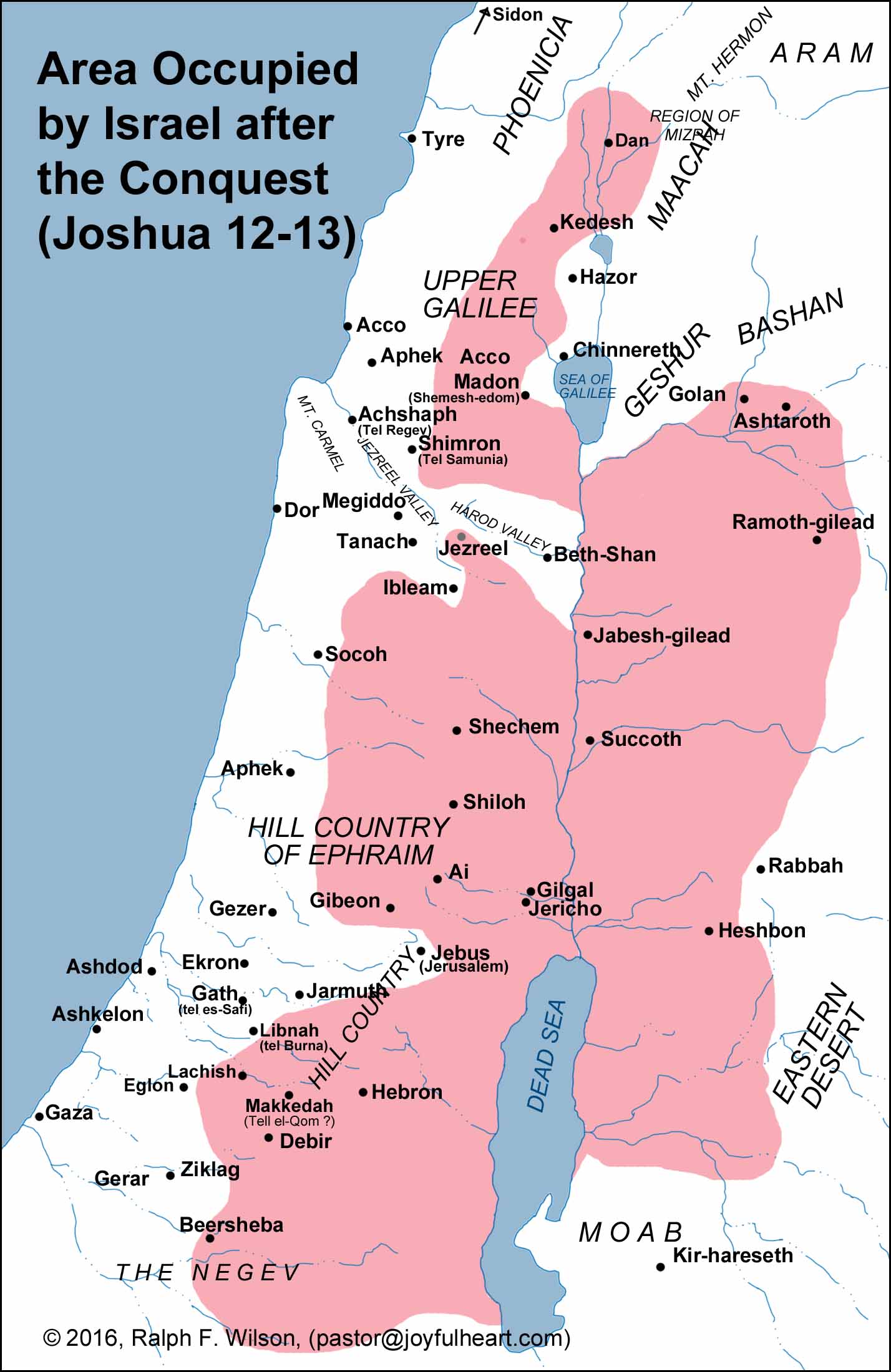
Joshua and the Israelite army had conquered thirty-one kings and territories in the past seven years.  But Joshua was getting old, commentators think about a hundred years old.  It's amazing to think that a man in his nineties could have done what he had done in the past seven years!  But there was still much land to be conquered all around on the outskirts of the conquered area.  This map I found on Pinterest said to have come from jesuswalk.com clearly shows the conquered lands in relation to the whole:


I find it interesting to note that although Joshua had defeated their kings as noted in the last chapter, some of their territories remained outside of Israelite occupation (Gezer, Aphek, Dor, Megiddo, etc.).  It seems reasonable to assume that Joshua may have continued to try to conquer the rest of the lands, but God stopped him because of his advanced age.  Adam Clarke, in his Commentary on the Bible, had an interesting perspective.  As nothing God does is by accident, he suggested that God may have wanted some of the original inhabitants to remain in order to keep the oftentimes unfaithful Israel in check.  

(2) "This is the land that yet remains, all the borders of the Philistines, and all Geshuri,"

The Lord then detailed the lands that were still unconquered, undoubtedly so that Joshua and the Israelites would know what they had a right to claim.  There was the territory of the Philistines in the southwest of Canaan along the Mediterranean Sea, to Geshuri, which appears to be Geshur in the north.  This map borrowed from Big Springs Community Church shows the unconquered lands more clearly than the one above:


(3) "From Sihor before Egypt to the borders of Ekron northward, counted to the Canaanite, five lords of the Philistines, the Gazites, the Ashdodites, the Ashkelonites, the Gittites, and the Ekronites, also the Avites;"

God described in more detail the as of yet unconquered territories of the promised land.  Describing the land of the Philistines, He said it ranged from Sihor before Egypt in the south to Ekron in the north which can be seen in the first map, across from Jerusalem.  The land of Philistia was counted as belonging to the posterity of Canaan, but the Philistines had gotten possession of it.  Because it was counted as Canaanite land, it was part of the promised land.  There were five lords in Philistia rather than kings, and it contained the cities of Gaza, Ashdod, Ashkelon, Ekron, and their inhabitants, and to whatever cities the Gittites and Avites belonged.

(4) "From the south, all the land of the Canaanites and Mearah beside the Sidonians, to Aphek to the borders of the Amorites;"

As near as I can tell by these maps, God is describing all the land of the Canaanites that was not part of the Philistines, from the south upward to Aphek (note there are two Apheks, one in Upper Galilee) to Sidon.

(5) "And the land of the Gebalites, and all Lebanon, toward the sunrising, from Baal Gad under Mount Hermon to the entering into Hamath;"

Gebal was north of Sidon on the Mediterranean coast.  The land of the Gebalites was said to be that east of Tyre, Sidon, and Gebal, the land east of the Lebanon mountains in the north, from Mount Hermon to the entrance of Hamath, seen clearly in this map borrowed from The Biblical Zionist:


(6) "All the inhabitants of the hill country from Lebanon to Misrephoth Maim, all the Sidonians, them I will drive out from before the children of Israel; only divide it by lot to the Israelites for an inheritance as I have commanded you."

The Lord continued to describe the land that was yet unconquered that also included all the hill country from Lebanon to Misrephoth Maim which was south of Tyre, all the land of the Sidonians.  All that very much land yet to be possessed (v. 1) included all the lands described from verse 2 to the Sidonians in verse 6.  All those the Lord would drive out from before the children of Israel.  Even though they were not yet driven out, the Lord wanted Joshua to divide all the promised land by lot to the Israelites for their inheritance.  Most of the early commentators I study suggest that these people were not ever entirely driven out or their land completely possessed by the Israelites, that the promise was always part of a covenant that must be upheld by the Israelites, and they did not do their part.  However, I refer back to Exodus 23:30-31, when the Lord said:

"Little by little I will drive them out from before you, until you have increased, and you inherit the land. And I will set your bounds from the Red Sea to the sea of the Philistines, and from the desert to the river; for I will deliver the inhabitants of the land into your hand, and you shall drive them out before you."

God specifically said that it would be little by little, and indeed all the land was subdued under the reign of David.  Some say that still the people were not specifically driven out, only subdued.  However, throughout ancient and modern history, Israel's borders have changed, and indeed the future Millennial Israel will include all of the promised land.

(7) "Now therefore divide this land for an inheritance to the nine tribes and the half tribe of Manasseh," (8) With whom the Reubenites and the Gadites have received their inheritance which Moses gave them beyond Jordan eastward, as Moses the servant of the Lord gave them,

The Lord told Joshua to divide the land on their present side of the Jordan River for an inheritance to the nine and a half tribes that had not yet received their inheritance.  Reuben, Gad, and the other half tribe of Manasseh had already received their lots on the east side of the Jordan River, given them by Moses.

(9) From Aroer which is on the bank of the River Arnon, and the city that is in the midst of the river, and all the plain of Medeba to Dibon, (10) And all the cities of Sihon king of the Amorites who reigned in Heshbon, to the border of the children of Ammon;

Further describing the lands given to Reuben, Gad, and the half tribe of Manasseh, it was from Aroer in the middle of the Arnon River that separated the land of the Amorites from Moab, and all the plain and cities of Sihon king of the Amorites to the Jabbok River which was the border of the Ammonites.

(11) And Gilead, and the border of the Geshurites and Maachathites, and all Mount Hermon, and all Bashan to Salcah, (12) All the kingdom of Og in Bashan who reigned in Ashtaroth and in Edrei, who remained of the remnant of the giants; for these did Moses smite and cast them out.

They had also received all the kingdom of Og, which included Gilead, the border of the Geshurites and Maachathites, all Mount Hermon, and all Bashan to Salcah.  All that land of Og that had been taken by Moses had been given to Israel, but they had not taken possession of much of it.

(13) Nevertheless, the children of Israel did not expel the Geshurites, nor the Maachathites, but the Geshurites and the Maachathites dwell among the Israelites until this day.

Indeed, Joshua went on to write that the Israelites had not driven out the Geshurites and Maachathites, and they still dwelt with them at the time of his writing.

(14) Only to the tribe of Levi He gave no inheritance; the sacrifices of the Lord God of Israel made by fire are their inheritance, as He said to them.

The tribe of Levi received no land inheritance on either side of the Jordan River.  As they were God's priests, He was to be their inheritance; they were to live off the sacrifices to their Lord God (Deuteronomy 18:1).

(15) And Moses gave to the tribe of the children of Reuben according to their families. (16) And their coast was from Aroer which is on the bank of the river Arnon, the city in the midst of the river, and all the plain by Medeba;

Moses had given to the tribe of Reuben the land from Aroer in the southeast and all the plain of Medeba.

(17) Heshbon, and all her cities in the plain, Dibon, and Bamoth Baal, and Beth Baal Meon, (18) And Jahazah, and Kedemoth, and Mephaath, (19) And Kirjathaim, and Sibmah, and Zereth Shahar in the mount of the valley, (20) And Beth Peor, and Ashdoth Pisgah, and Beth Jeshimoth, (21) And all the cities of the plain, and all the kingdom of Sihon king of the Amorites, who reigned in Heshbon, whom Moses smote with the princes of Midian, Evi, and Rekem, and Zur, and Hur, and Reba, dukes of Sihon dwelling in the country.

Reuben's inheritance included all these cities in the former kingdom of Sihon.  It had been taken by Moses when he defeated the king of Sihon and all his princes.  I can't begin to try to locate all these cities, but I found this map at Psalms to God Podcast that shows a general view of all the tribes and their allotments:


(22) Balaam also, the son of Beor, the soothsayer, the children of Israel killed with the sword, among those who were killed by them. 

The Israelites had also killed Balaam, the soothsayer, at the same time as the princes (Numbers 31:8).

(23) And the border of the children of Reuben was Jordan and its border. This was the inheritance of the children of Reuben after their families, the cities and the villages.

The northwestern border of the land possessed by the descendants of Reuben was the Jordan River.  All the land, cities, and villages between the Jordan and Aroer in the southeast made up the inheritance of the children of Reuben.

(24) And Moses gave to the tribe of Gad, to the children of Gad according to their families. (25) And their coast was Jazer and all the cities of Gilead, and half the land of the children of Ammon, to Aroer before Rabbah; (26) And from Heshbon to Ramath Mizpah and Betonim, and from Mahanaim to the border of Debir; (27) And in the valley Beth Haram, and Beth Nimrah, and Succoth, and Zaphon, the rest of the kingdom of Sihon king of Heshbon, with the Jordan as border to the edge of the Sea of Chinnereth on the other side of the Jordan eastward. (28) This is the inheritance of the children of Gad after their families, the cities and their villages.

Moses gave as an inheritance to the children of Gad the land from Jazer in the south to Rabbah in the west, with the Jordan River as the western border.  The northern border was quite unique, and I will let the map show the general area that was allotted to Gad.  Once again trying to locate all those cities is quite a dizzying task.  The Aroer before Rabbah would have to be a different Aroer from the one at the middle of the Arnon River.  Also Debir would have to be a different Debir.  All the cities of Gilead would only pertain to those cities within the area of Gad, as half of Gilead was given to the half tribe of Manasseh.  The same would have to be said for all the kingdom of Sihon that was given to Reuben (v. 21), as it states here that there was the rest of the kingdom of Sihon that was given to Gad.  Half the land of the children of Ammon refers to that part that Sihon king of the Amorites took from the Ammonites.

(29) And Moses gave to the half tribe of Manasseh, and this was of the half tribe of the children of Manasseh by their families. (30) And their coast was from Mahanaim, all Bashan, all the kingdom of Og king of Bashan, and all the towns of Jair, which are in Bashan, sixty cities; (31) And half Gilead, and Ashtaroth, and Edrei, cities of the kingdom of Og in Bashan, to the children of Machir the son of Manasseh, to the one half of the children of Machir by their families.

To the half tribe of Manasseh, the land from Mahanaim, which must have been the southern border as Gad also had that border (v. 26), including all the land of Bashan that included sixty cities, half of Gilead, and the royal cities of Og, Ashtaroth and Edrei.  The land is said to have been given to half the children of Machir, who was Manasseh's son.

(32) These are what Moses had distributed for inheritance in the plains of Moab on the other side of the Jordan by Jericho eastward.

The lands described above from verse 9 to this verse were all the lands that had been distributed by Moses to the tribes of Reuben, Gad, and the half tribe of Manasseh, on the eastern side of the Jordan River, east of Jericho.

(33) But to the tribe of Levi Moses did not give inheritance; the Lord God of Israel was their inheritance, as He said to them.

Once again, Joshua points out that the tribe of Levi did not receive any land as their inheritance, because as priests, the Lord God was their inheritance.

As Joshua was now old, God had him rest from his battles, even though there was still much land to be conquered.  However, for now, He wanted Joshua to portion out the lots of inheritance, and it was to include all the land that had been promised, even those not yet conquered.  This chapter began with the allotments that had already been given to the tribes of Reuben, Gad, and the half tribe of Manasseh. 

Saturday, October 17, 2020

Sanctity, Purity, and Rights and Duties of Citizenship

Continuing a chronological Bible study:

(Deuteronomy 23:1) "He who is wounded in the stones, or has his privy member cut off, shall not enter into the congregation of the LORD."

Most of the book of Deuteronomy up to this point has been a speech of Moses reviewing the laws of God.  He continued in this chapter.  A man who had been wounded in the testes or had his penis cut off could not enter into the congregation of the Lord.  This is a description of what was called a eunuch in the Bible.  Biblical scholars have mixed views on what exactly is meant by entering "into the congregation of the Lord."  Many thought it must only refer to holding office or having high honor in Israel, because it didn't seem likely that a man who might have been born that way would be completely cut off from the Lord.  However, it seems in keeping with the laws of purity and perfection for God's special people, that eunuchs were not allowed the same privileges as the children of Israel.  Compare Leviticus 21:17-23:

"Speak to Aaron, saying, 'Whoever he be of thy seed in their generations that hath any blemish, let him not approach to offer the bread of his God. For any man who has a defect shall not approach: a man blind or lame, who has a disfigured face or any limb too long, a man who has a broken foot or broken hand, or is a hunchback or a dwarf, or a man who has a defect in his eye, or eczema or scab, or has his stones broken. No man of the descendants of Aaron the priest, who has a defect, shall come near to offer the offerings made by fire to the LORD. He has a defect; he shall not come near to offer the bread of his God. He may eat the bread of his God, both the most holy and the holy; only he shall not go near the veil or approach the altar, because he has a defect, lest he profane My sanctuaries; for I the LORD sanctify them.'"

That passage did refer to the tribe of Levi, the priests, so it is reasonable to assume that "the congregation of the Lord" might mean that the eunuch described in verse 1 could not come near to the Lord, but was allowed in the general congregation of Israel.  There were proselytes or converts allowed to live among the children of Israel who could partake of some of the privileges of the Israelites.  A eunuch certainly had the privileges of any proselyte.  For those who believe that it is a cruel God who would keep people with deformities who were created by Him out of His presence, I believe this is symbolic of we sinners in this fallen world who could not approach the perfect God of the universe Who cannot tolerate being in the presence of sin.  We have to have Jesus cover our sins with His perfect sacrificial blood in order to approach God.  Indeed there is a prophecy in Isaiah 56, verses 3 through 7, that tells of the time when the ban against imperfect people would be lifted by the Messiah:

"Do not let the son of the foreigner who has joined himself to the LORD speak, saying, 'The LORD has utterly separated me from His people,' nor let the eunuch say, 'Here I am, a dry tree.' For thus says the LORD, 'To the eunuchs who keep My Sabbaths, and choose what pleases Me, and hold fast My covenant, even to them I will give in My house and within My walls a place and a name better than that of sons and daughters; I will give them an everlasting name that shall not be cut off. Also the sons of the foreigner who join themselves to the LORD, to serve Him, and to love the name of the LORD, to be His servants; everyone who keeps from defiling the Sabbath, and holds fast My covenant, even them I will bring to My holy mountain, and make them joyful in My house of prayer. Their burnt offerings and their sacrifices will be accepted on My altar, for My house shall be called a house of prayer for all nations.'”

Once again we see Jesus in the Old Testament!  Now back to the study of Deuteronomy 23:

(2) "A bastard shall not enter into the congregation of the LORD; even to his tenth generation shall he not enter into the congregation of the LORD."

An illegitimate child was likewise forbidden to approach the presence of the Lord; even to the tenth generation of his descendants, they could not enter into the presence of the Lord.  Like the eunuch above, I am sure the illegitimate child could enjoy the privileges of a proselyte.  Also like the eunuchs and all people with deformities, there would come a time when those born of illegitimate births would also be accepted by the Lord when they accepted the sacrifice of the Messiah.  I couldn't help but take note of what importance the Lord puts on marriage and the proper family unit as He designed it, that even to the tenth generation, that illegitimate birth tainted the perfection of those who came afterward.

(3) "An Ammonite or Moabite shall not enter into the congregation of the LORD; even to their tenth generation shall they not enter into the congregation of the LORD forever."

The same applied to the Ammonites and Moabites, but once again, I am sure if they desired to convert to the Jewish religion, they could reside among the children of Israel as proselytes.  Note that this also states that the prohibition held till the tenth generation and then the word "forever" is added.  Ten is a number that symbolized perfection and completeness, so I believe that it is safe to assume that the Ammonite and Moabite blood that tainted the perfection of God's special people, as well as the tainted blood from an illegitimate union, would forever forbid one to enter the presence of the Lord, until the time of the Messiah, that is.

(4) “Because they did not meet you with bread and water on the road when you came out of Egypt, and because they hired against you Balaam the son of Beor from Pethor of Mesopotamia, to curse you."

The reason why the Ammonites and Moabites, who were descendants of Lot, and might otherwise be among the children of Israel, were not allowed to approach the presence of the Lord was because they did not aid the children of Israel when they came out of Egypt, and they in fact, sought to curse them by hiring Balaam.

(5) "Nevertheless the LORD your God would not listen to Balaam, but the LORD your God turned the curse into a blessing for you, because the LORD your God loves you."

Regarding Balaam, hired by the Ammonites and Moabites to curse Israel, Moses told the people that the Lord did not hearken to Balaam's curse, but turned the curse into a blessing because He loved His people so. 

(6) “You shall not seek their peace nor their prosperity all your days forever."

The children of Israel were not to ally themselves with the Ammonites and Moabites; they were to make no peace treaties or trade and commerce agreements with them.  This did not mean that they were to treat them with malice.  They should always act in kindness and live as peaceably as possible with their neighbors, but they were to make no formal agreements for peace or prosperity that required something on their part.

(7) “You shall not abhor an Edomite, for he is your brother; you shall not abhor an Egyptian, because you were a stranger in his land."

The children of Israel were not to hate the Edomites, for as descendants of Esau, they were nearest akin to Israel of all the nations, for Jacob and Esau had been twin brothers.  They were to hold no grudges against the Egyptians; they had been strangers in their land, and had partaken of one of the richest and most fruitful parts of the country.  Although they ultimately were treated harshly in Egypt, they should forgive and treat any Egyptian the way they would have wished to be treated, by God's Golden Rule.

(8) "The children who are begotten of them shall enter into the congregation of the LORD in their third generation."

The descendants of the Edomites and Egyptians were welcome to become proselytes of Israel, and by the third generation of them who had become proselytes, they were welcome to become members of the congregation.

(9) “When the army goes forth against your enemies, then keep yourself from every wicked thing."

When Israel went forth against their enemies into Canaan, they were to keep themselves pure and resist gratifying themselves with the lusts of malice, covetousness, or idolatry, etc.

(10) "If there be among you any man, who is not clean by reason of uncleanness that by chance occurred to him by night, then he shall go outside the camp; he shall not come within the camp."

From the wording "by chance...by night", this may be a reference to Leviticus 15:16 about an involuntary "seed of copulation" that might occur in the night.  Even involuntarily, a semen discharge from a man would make him unclean before the Lord, and he was to go outside the camp to keep the Israelite camp pure from all moral, ceremonial, or even natural uncleanness.

(11) “But it shall be, when evening comes on, he shall wash with water; and when the sun is down, he shall come into the camp."

After being outside the camp for that day he discovered his uncleanness from during the previous night, when evening came at the end of that day, he was to wash himself and he would be allowed back into the camp at sundown, which was actually the beginning of the next day according to the Israelite days.

(12) "You shall have a place also outside the camp, where you shall go out; (13) And you shall have a paddle among your weapons, and it shall be, when you ease yourself outside, you shall dig with it and turn back and cover that which comes from you."

There was to be a designated place outside the camp where the Israelites could go to relieve themselves.  They had a paddle or some type of implement that they used to dig a hole and cover their refuse, in order to keep their camp clean and healthy.

(14) “For the LORD your God walks in the midst of your camp, to deliver you and to give up your enemies before you; therefore your camp shall be holy, that He sees no unclean thing among you and turns away from you."

Most importantly, it was to keep their camp holy, for their Lord God dwelt among them to lead them and save them from falling into the hands of their enemies, and to, in fact, deliver their enemies into their hands.  Therefore, they were to keep Him from seeing any unclean thing in their camp which would make Him turn away from them.

(15) “You shall not deliver to his master the servant who has escaped from his master to you."

This is to be understood of the slave who was owned by one in the pagan countries they would soon be overtaking.  If the servant had fled from his master to one of the Israelites, it had to be assumed that he was either fleeing unjust oppression or desired to be among the Israelites, and he was not to be refused and sent back to his pagan master.

(16) "He shall dwell with you and among you, in the place which he chooses in one of your gates, where it seems best to him; you shall not oppress him."

This runaway servant was not to be detained in any particular place, or remanded to the custody of the one to whom he had first run, but could dwell where he wished within their gates, and he was not to be oppressed in any way.  

(17) "There shall be no whore of the daughters of Israel, nor a sodomite of the sons of Israel."

The children of Israel were forbidden to become whores or sodomites.  The children of Israel were to be pure.  Prostitution was a common part of religious observances among idolatrous nations, but such a practice was not at all honoring to the God of Israel, but an abomination.

(18) “You shall not bring the hire of a whore, or the price of a dog, into the house of the LORD your God for any vow, for even both these are abomination to the LORD your God."

In this context, "dog" refers to a sodomite, the ancient scholars say.  A woman prostitute was called a whore and a male prostitute was called a dog.  Indeed, it follows that the hire of a whore refers to the one in verse 17, so the price of a dog refers to the sodomite in verse 17.  See Revelation 22:15 that obviously refers to a human dog and not an animal in its list of wicked people.  In verse 18 here, not only were the Israelites forbidden to be whores and sodomites, they must never even bring the money or any other thing that was used as payment for the services of a whore or sodomite into the house of the Lord.  Such practices were such an abomination to the Lord, even the money received by them was abomination to Him.

(19) "You shall not lend upon usury to your brother; usury of money, usury of victuals, usury of anything that is lent upon usury."

The Israelites were forbidden to charge interest or any increase on anything lent to their fellow Israelites, including money, food, or provisions, that is, anything

(20) "To a stranger you may lend upon usury; but to your brother you shall not lend upon usury, that the LORD your God may bless you in all that you set your hand to in the land where you go to possess it."

In further clarification, Moses told the people they could charge interest to a stranger, as they were allowed to trade and do commerce with their pagan neighbors.  However, they were never to charge interest to one of their own, as the Lord commanded, so that He would continue to bless them in all they did in their promised land they were about to go in and possess.

(21) “When you make a vow to the LORD your God, you shall not delay to pay it, for the LORD your God will surely require it of you, and it would be sin in you."

Whenever an Israelite made a vow to the Lord, whether a sacrifice or offering or even some action he vowed to perform, he was to do it right away and not delay the payment of the vow.  The Lord would require that he not lie and mock the Lord by vainly and flippantly making promises to Him that he did not keep, for that would be sin against God.

(22) “But if you forego vowing, it shall be no sin in you."

However, if a person did not make a vow, even if it was within his means to do so, there was no sin.  Of course, this referred only to freewill vows, not of those sacrifices and offerings required by law.  It was far worse to promise something to the Lord in the heat of passion and not deliver it, than to never promise anything at all.

(23) “That which has gone from your lips you shall keep and perform, a freewill offering, according as you have vowed to the LORD your God, which you have promised with your mouth."

When a freewill vow was voiced aloud to the Lord, it must be kept and performed.  This would make the children of Israel careful of not making rash vows, because once they were made, an exact and rigid performance of them was expected.

(24) “When you come into your neighbor’s vineyard, you may eat your fill of grapes at your pleasure, but you shall not put any in your container."

This law provided for the poor traveler, but was not limited to just that.  Anyone was allowed to eat from a vineyard, but was forbidden to take any grapes away for later.  It taught the children of Israel charity and hospitality for their hungry neighbors.

(25) “When you come into the standing corn of your neighbor, then you may pluck the ears with your hand, but you shall not move a sickle to your neighbor’s standing corn."

Likewise, one was allowed to pluck an ear of corn from a cornfield that did not belong to him, but he was forbidden to use a sickle to cut down stalks or to take any corn with him.  The law humanely provided for the immediate hunger of travelers, but only what could be plucked by hand and eaten at the moment.

The laws in this chapter emphasized the necessity of purity and cleanliness in order to be a part of God's special people and to be in His presence, but the last also directed God's people to be trustworthy, humane, and unselfish.

Sunday, October 6, 2019

The Israelites' Holy War With Midian

Continuing a chronological Bible study:

(Numbers 31:1) And the LORD spoke to Moses, saying, (2) "Avenge the children of Israel on the Midianites; afterward you shall be gathered to your people.”

The events of chapter 31 follow those of chapter 27, after an interruption where the Lord reviewed the law of sacrifices and the law of vows in the previous three chapters.  In Numbers 27:13 the Lord had told Moses that once he had been permitted to see the promised land, he would die, and would not be allowed to enter the land of Canaan because he had rebelled against the commandment of the Lord (Numbers 20:12).

Now the Lord told Moses that he was first to make war upon the Midianites to avenge the children of Israel for the injury they had done to them by sending their daughters among them to entice them to adultery and idolatry.  After that, he would be gathered to his people, meaning he would die as all his people before him.

(3) And Moses spoke to the people, saying, “Arm some of yourselves for war, and let them go against the Midianites, and avenge the LORD on Midian."

Moses then told the people to arm some of their able-bodied men of war and let them go against the Midianites to avenge the LORD.  Note the Lord had said in verse 2 to avenge the children of Israel, but Moses now called it vengeance for the Lord.  The Israelites had indeed suffered and lost 24,000 people due to the iniquity they were drawn into by the Midianites, but Moses recognized this had been an affront to their Lord and called the people to avenge His name and honor which had been dishonored by their sins of lewdness and idolatry.

(4) "Of every tribe a thousand, throughout all the tribes of Israel, shall you send to the war."

Each tribe was to send 1000 men to war.

(5) So there were delivered out of the thousands of Israel, a thousand of every tribe, twelve thousand armed for war.

The people did as Moses had instructed, and delivered out of each tribe 1000 men armed for war, for a total of 12,000 men from the tribes of Reuben, Simeon, Judah, Issachar, Zebulun, Dan, Naphtali, Gad, Asher, Ephraim, Manasseh, and Benjamin.  The tribe of Levi, as priests and caretakers of the tabernacle, would not have sent men to war.

(6) And Moses sent them to the war, a thousand of every tribe, them and Phinehas the son of Eleazar the priest, to the war, with the holy instruments and the trumpets to blow in his hand.

Moses sent the thousand men from each tribe to war.  We see that the tribe of Levi did participate; Phinehas the son of Eleazar the priest, went to war with holy articles from the sanctuary and trumpets to blow, signifying this was the Lord's battle.

(7) And they warred against the Midianites, as the LORD commanded Moses; and they killed all the males.

The 12,000 Israelite soldiers warred against the Midianites as the Lord had commanded Moses they do, and they killed all the males.  This means all the males who warred against them, or the ones who did not escape; it cannot mean every last Midianite male, as the Midianites would later raise their war heads again.

(8) And they killed the kings of Midian, besides the rest of them who were slain, namely, Evi, Rekem, Zur, Hur, and Reba, five kings of Midian; Balaam also, the son of Beor, they slew with the sword.

They also killed the kings of Midian, in addition to every other male who was killed.  The five kings of Midian who were killed were Evi, Rekem, Zur, Hur, and Reba.  They also killed Balaam, who was either still in Midian on his way back to his home, or had returned to Midian, as we were told in Numbers 24:25 he "returned to his place" after his meeting with Balak that had been intended, but failed, to curse Israel.

(9) And the children of Israel took the women of Midian captive, and their little ones, and took as spoil all their cattle, all their flocks, and all their goods.

The Israelites took the women and their children captive, and took as spoil all their cattle, flocks, and goods.  Once again it must be understood that not all the women were taken captive, just as not all the men were killed, because the Midianites would come against Israel again; but all who came against them and did not escape were killed and their women and children taken captive.

(10) And they burnt all their cities wherein they dwelt, and all their goodly castles, with fire.

The Israelites burned all the cities where the people mentioned in the above verses dwelt.  They also burned the castles which probably belonged to the kings they had killed.

(11) And they took all the spoil, and all the prey, of men and of beasts.

The Israelites took all the spoil of the goods, and all the prey of men and livestock.

(12) And they brought the captives, the prey, and the spoil, to Moses, and Eleazar the priest, and to the congregation of the children of Israel, to the camp at the plains of Moab by Jordan near Jericho.

The Israelite soldiers brought the captives and their large booty to Moses and Eleazar the priest, and to the congregation at their camp in the plains of Moab by the Jordan River across from Jericho.

(13) And Moses, Eleazar the priest, and all the leaders of the congregation, went to meet them outside the camp.

Moses, Eleazar, and all the leaders of the congregation, actually went out of the camp to meet the returning Israelites outside the camp.

(14) And Moses was angry with the officers of the army, the captains over thousands and captains over hundreds, who had come from the battle.

Moses turned out to be very angry with the officers of the Israelite army, those captains over thousands and captains over hundreds, who had come back from the battle with their captives and their rich booty.

(15) And Moses said to them, “Have you saved all the women alive? (16) Behold, these caused the children of Israel, through the counsel of Balaam, to commit trespass against the LORD in the matter of Peor, and there was a plague among the congregation of the LORD."

Moses was angry they had kept all the women alive.  After all, they were the main ones who first caused the Israelites to sin against their Lord, when they, apparently at the counsel of Balaam, went among the Israelites and enticed them into lewdness and eventually idolatry; and because of that, there had been a plague among the congregation of Israel.

(17) “Now therefore, kill every male among the little ones, and kill every woman who has known a man intimately."

Moses instructed the Israelite army to kill every male child and every woman who had known a man intimately.  Only the female children were spared.  Usually women and children were spared in these situations, as they were usually unable to resist.  However in this case, the women were the most guilty of wrongdoing against the Israelites, and the male children would later have become men and warriors against them.  Besides, the Lord God, the author, creator, and supporter of life, has every right to dispose of it when He sees proper; and as righteous and just, He cannot do anything but what is right and just.  Knowing all that is and what will be, He knows what each life would have done.  Also just because someone is taken away from this physical life doesn't always mean the end; God also takes people to save them from the evil to come (Isaiah 57:1), which could very well describe the future existence of these particular children.  Taking the children away to be with Him would be a most loving and merciful act.

(18) "But all the women children, who have not known a man intimately, keep alive for yourselves."

The female children were spared and could be taken by the Israelites.  They could be maidservants, or they could even become wives of Israelite men if they embraced the Israelite religion.

(19) "And you do abide outside the camp seven days; whoever has killed any person, and whoever has touched any slain, purify yourselves and your captives on the third day and on the seventh day.

Even though the Israelite soldiers had acted as the Lord had commanded them, they had become unclean and defiled by touching the dead, and had to go through the prescribed purification process.  Anyone who had killed or had come in contact with any slain, were to purify themselves and their captives (the female children) on the third and on the seventh day of the seven days they remained outside the camp.

(20) "And purify all clothing, and all that is made of skins, and all work of goats' hair, and all things made of wood."

They were to purify all their spoils.  All clothing, skins, works of goats' hair, such as coverings of tents were made from, and all things made of wood, were to be purified by washing them.

(21) And Eleazar the priest said to the men of war who had gone to the battle, “This is the ordinance of the law which the LORD commanded Moses: (22) Only the gold, the silver, the brass, the iron, the tin, and the lead, (23) Everything that may abide the fire, you shall put through the fire, and it shall be clean; nevertheless it shall be purified with the water of purification; all that cannot endure fire you shall put through the water."

Eleazar the priest told the men who had gone to battle about the law of purification of unclean people and things, according to what Moses had said as received from the Lord.  Items made of gold, silver, brass, and the like, that could withstand fire, were to be put through the fire and would be cleaned that way.  However, they were also to be purified with the water of purification, water mixed with the ashes of the burnt red heifer (Numbers 19:17).  All items that could not endure fire were to be washed with water.

(24) “And you shall wash your clothes on the seventh day and be clean, and afterward you may come into the camp.”

After cleansing and purifying everything else, on the seventh day they were to wash their own clothes, and then they were allowed to come into the camp.

(25) And the LORD spoke to Moses, saying, (26) "Take the sum of the prey that was taken, of man and of beast, you and Eleazar the priest and the chief fathers of the congregation."

The Lord then told Moses to make a count of all the plunder that was taken, both of man and beast.  Moses, Eleazar the priest, and the chiefs of the congregation were to do this.

(27) "And divide the prey into two parts, between them who took part in the war, who went out to battle, and all the congregation."

The plunder was to be divided into two equal parts between those who had gone into battle and all those others of the congregation.  Because all the Israelites were harmed by the Midianites, they all were to share in the plunder.  However, since there were just 12,000 men of war who had gone to battle, they had a far greater share of the plunder, as well they should, since they had been the ones who faced the dangers of war.

(28) "And levy a tribute for the LORD on the men of war who went out to battle, one of every five hundred of the persons, the cattle, the donkeys, and the sheep; (29) Take it of their half, and give it to Eleazar the priest, for a heave offering to the LORD."

There was to be a tribute or tax on the men who had gone to battle to be given to their Lord.  One out of every 500 of the people (the female children), and one of every 500 of the cattle, and likewise of the donkeys and the sheep, was to be taken from the soldiers' half of the plunder, and was to be given to Eleazar for a heave offering to the Lord, as a way to thank or give a tithe of sorts to the Lord for their success and victory and for all the plunder they had taken.

(30) “And from the children of Israel’s half you shall take one of every fifty, of the persons, of the cattle, the donkeys, and the flocks, of all manner of beasts, and give them to the Levites, who keep the charge of the tabernacle of the LORD.”

From the congregation's half of the plunder, they were to take one of every fifty of the people, of the cattle, and of every kind of livestock or animals taken, and those were to be given to the Levites who were employed in the service of the tabernacle.

(31) And Moses and Eleazar the priest did as the LORD commanded Moses.

Moses and Eleazar did just as the Lord had commanded to Moses they do.

(32) And the booty, being the rest of the prey which the men of war had caught, was six hundred and seventy-five thousand sheep, (33) And seventy-two thousand cattle, (34) And sixty-one thousand donkeys, (35) And thirty-two thousand persons in all, of women who had not known a man intimately.

These verses seem to reference the total booty, or the live prey of the booty.  I'm not sure what is meant by the "rest of the prey", unless perhaps it was what remained after the soldiers' seven days outside the camp, before it was counted.  The original word translated as "rest" was "yether" and it means "overhanging (by implication) an excess, remainder".  However, it can also mean "abundance, affluence, superiority, excellency", so perhaps the meaning was that the abundance of the total prey numbered 675,000 sheep, 72,000 cattle, 61,000 donkeys, and 32,000 young woman or girls who had never known a man intimately.

(36) And the half, the portion of them who went out to war, was in number three hundred and thirty-seven thousand five hundred sheep, (37) And the LORD'S tribute of the sheep was six hundred and seventy-five. (38) And the cattle were thirty-six thousand, of which the LORD’s tribute was seventy-two. (39) And the donkeys were thirty thousand five hundred, of which the LORD’s tribute was sixty-one. (40) And the persons were sixteen thousand, of which the LORD’s tribute was thirty-two persons.

The half portion of that total prey that went to the men who went out to war numbered 337,500 sheep, 36,000 cattle, 30,500 donkeys, and 16,000 virgins.  The Lord's tribute of these numbered 675 sheep, 72 cattle, 61 donkeys, and 32 virgins.

(41) And Moses gave the tribute, the LORD'S heave offering, to Eleazar the priest, as the LORD commanded Moses.

Moses gave the tribute of 675 sheep, 72 cattle, 61 donkeys, and 32 virgins, to Eleazar the priest, for a heave offering, as the Lord had commanded to Moses.  People given as an offering to the Lord cannot be understood as being sacrificed, but with this heave offering they were presented, or perhaps even ceremonially raised and lowered, in dedication to God and afterward would have been reserved for the priests' use.

(42) And of the children of Israel's half, which Moses divided from the men that warred, (43) Now the half belonging to the congregation was three hundred and thirty-seven thousand five hundred sheep, (44) And thirty-six thousand cattle, (45) And thirty thousand five hundred donkeys, (46) And sixteen thousand persons.

The children of Israel's half of the prey which Moses had divided out of the total prey, totaled 337,500 sheep, 36,000 cattle, 30,500 donkeys, and 16,000 virgins.

(47) Of the children of Israel's half, Moses took one portion of fifty, of man and of beast, and gave them to the Levites, who kept the charge of the tabernacle of the LORD, as the LORD commanded Moses.

Of the children of Israel's half, Moses took one of each fifty, of the virgins, and of each species of animal, and gave them to the Levites who kept charge of the tabernacle, just as the Lord had commanded he do.  Although the numbers given to the Levites was not recorded here, it can be easily calculated.  The children of Israel, being required to give one in fifty, gave ten times more than the soldiers who gave one in 500; therefore their numbers were 6750 sheep, 720 cattle, 610 donkeys, and 320 virgins.

(48) And the officers who were over thousands of the army, the captains of thousands and captains of hundreds, came near to Moses; (49) And they said to Moses, “Your servants have taken a count of the men of war who are under our command, and not a man of us is missing."

The officers of the army of Israelites came to Moses and reported to him that after waging war with a whole nation, killing all the males and the kings, burning their cities, taking so many captives and such a large booty, miraculously not a single one of the 12,000 soldiers was killed or missing.

(50) "We have therefore brought an oblation for the LORD, what every man has gotten, of jewels of gold, chains, and bracelets, rings, earrings, and necklaces, to make an atonement for our souls before the LORD."

In thanksgiving for success and sparing all their lives, the officers brought a freewill offering over and above the tribute that was levied upon them.  It seems to read that they brought to the Lord all the gold jewels and jewelry that the soldiers had taken as plunder.  They said it was to make atonement for their souls before the Lord, perhaps for their error in judgment in sparing all the women.

(51) And Moses and Eleazar the priest took the gold from them, even all the crafted jewels.

Moses and Eleazar received all the gold and fashioned jewelry from them.

(52) And all the gold of the offering that they offered up to the LORD, from the captains of thousands, and from the captains of hundreds, was sixteen thousand seven hundred and fifty shekels. (53) (The men of war had taken spoil, every man for himself.)

The value of all the gold the officers had offered to the Lord was 16,750 shekels.  The opinion on what a shekel of gold was worth in those times varies, but with one conversion chart I used at Convert-me.com it calculated it was equal to 0.4 ounce.  16,750 shekels would equal 6700 ounces of gold.  At the current US value of over $1500 an ounce, that would make it worth well over $10,000,000.  With this large amount, I have to believe the meaning of the parenthetical 53rd verse was that the amount was so large because every man of war had taken some gold for himself which he now offered to the Lord.  However, there are some who believe that the meaning was that some men held back the gold they took for themselves and it was not part of the offering.  That would seem to imply the meaning of the parenthetical remark was that the amount was so small because the men held back, and that just doesn't seem to be the logical meaning to me.  Whether they gave all their gold or they gave of their gold, it was still quite a large freewill offering they gave to their Lord over and above the tribute they were required to give Him.

(54) And Moses and Eleazar the priest took the gold from the captains of thousands and of hundreds, and brought it into the tabernacle of the congregation, for a memorial for the children of Israel before the LORD.

Moses and Eleazar took the gold from the officers and brought it into the tabernacle, probably laying it up in some chamber there, in remembrance of the victory the Israelites had obtained because of their Lord's goodness and protection, that they would remember this victory and trust Him in all future endeavors.  That's the way I took the meaning to be, but some Biblical scholars suggest it was laid up in the tabernacle to remind the Lord that they had given it to Him.  I really don't like that suggestion and wouldn't think it would be acceptable to the Lord if it was a bribe for purely selfish reasons.  However, Matthew Henry, in his Commentary on the Whole Bible, put it a little more softly:  "...that he (God), being well pleased with this thankful acknowledgment of favours bestowed, might continue and repeat his mercies to them."

I rather think the moral of this story, or rather historical incident, is that the people obeyed the Lord in avenging the children of Israel, thus avenging the Lord because their lewdness and idolatry had greatly dishonored Him.  Being imperfect as all men are, they erred in their judgment in keeping all the women alive, but did as Moses instructed they do when this was brought to their attention.  Their success in war was remarkable that so small an army could overcome such multitudes, and still more miraculous that not one soldier was killed or missing.  Again quoting Matthew Henry, this time in his Concise Commentary on the Whole Bible, the army then "...presented the gold they found among the spoils, as an offering to the Lord. Thus they confessed, that instead of claiming a reward for their service, they needed forgiveness of much that had been amiss, and desired to be thankful for the preservation of their lives, which might justly have been taken away." 

Saturday, June 22, 2019

Balaam and Balak

Continuing a chronological Bible study, and reaching the conclusion to a literal chiffhanger from the last chapter and post:

(Numbers 23:1) And Balaam said to Balak, “Build me here seven altars, and prepare me here seven oxen and seven rams."

At the end of the last chapter, Balak had taken Balaam up to the high places of his idol Baal to allow him to see the Israelites below them.  Balaam now asked that Balak build right there in one of the high places devoted to Baal seven altars, and to prepare for him seven oxen and seven rams.  There was much speculation among the early Biblical scholars I study about Balaam's motive in this.  Most seemed to think it was perverse, that perhaps he was "bribing God" with so many altars, that building seven altars was heathenish, that they were built for the seven known planets at the time.  I may stand corrected as I read on, but at this point, I give Balaam full benefit of the doubt that he had seen the light.  Seven is also the number of perfection.  Maybe Balaam asked for these preparations that would seem familiar and acceptable to Balak, so that he would be more susceptible to hearing the truth from the one true God.  As the apostle Paul wrote in 1 Corinthians 9:19-22:

"For though I am free from all men, I have made myself a servant to all, that I might win the more; and to the Jews I became as a Jew, that I might win Jews; to those who are under the law, as under the law, that I might win those who are under the law; to those who are without law, as without law (not being without law toward God, but under law toward Christ), that I might win those who are without law; to the weak I became as weak, that I might win the weak. I have become all things to all men, that I might by all means save some."

(2) And Balak did as Balaam had spoken; and Balak and Balaam offered on every altar a bullock and a ram.

Balak did as Balaam had instructed him, and together they offered on each altar a bull and a ram.

(3) And Balaam said to Balak, “Stand by your burnt offering, and I will go; perhaps the LORD will come to meet me, and whatever He shows me I will tell you.” And he went to a high place.

Balaam asked Balak to stand by his burnt offerings while he went away from him to another high place to meet with the Lord if He would come to meet him.  Balaam told Balak that whatever his Lord showed him, that is what he would tell him.

(4) And God met Balaam, and he said to Him, “I have prepared seven altars, and I have offered on every altar a bull and a ram.”

God did indeed meet with Balaam, and Balaam told him he had prepared seven altars and had offered a bull and a ram on each.  Again Biblical scholars believe Balaam was boasting to the Lord, hoping to gain His favor in what he desired to do all along for his client, Balak.  I still don't necessarily see this; we shall see how God responds to it:

(5) And the LORD put a word in Balaam's mouth, and said, “Return to Balak, and thus you shall speak.”

The Lord did not reprimand Balaam, but told him to return to Balak and speak to him the words the Lord put in his mouth, which is exactly what the Lord had told him to do in chapter 22 of Numbers.  I see no reason to add to the story that Balaam was still trying to force his own will and bribe his Lord.

(6) And he returned to him, and there he was, standing by his burnt offering, he and all the princes of Moab.

Balaam returned to Balak to find him doing just as he had told him to do, standing by his burnt offering, he and all his princes.  They were surely anticipating a favorable response from Balaam.

(7) And he took up his parable, and said, “Balak the king of Moab has brought me from Aram, out of the mountains of the east, saying, ‘Come, curse Jacob for me, and come, defy Israel.'"

Balaam "took up his parable", or advanced his words of wisdom as received from God.  He said that Balak the king of Moab had brought him there to curse and defy Israel.  So far, so good, with respect to how Balak might receive these words, and with how Balaam was following his Lord's will and not his own.

(8) “How shall I curse whom God has not cursed? Or how shall I defy whom the LORD has not defied?"

Balaam went on to say how could he possibly curse whom God had not cursed, and how could he defy whom God had not defied, again showing his willingness to only do what God had told him to do, and telling Balak what he had said he would tell him--whatever his Lord showed him, he would tell him.

(9) "For from the top of the rocks I see him, and from the hills I behold him; lo, the people shall dwell alone, and shall not be reckoned among the nations. (10) Who can count the dust of Jacob, and the number of one-fourth of Israel? Let me die the death of the righteous, and let my last end be like his!”

Balaam went on to pronounce a blessing on Israel, rather than the curse Balak expected.  From the high places of Baal where he was, he could see Israel.  The Israelites were to dwell alone and separate and would never be reckoned among the other nations, but would always be a distinct nation.  Adam Clarke, in his Commentary on the Bible, rightly noted that this was a prophecy that had been literally fulfilled through a period of thousands of years to the present day, and was truly an astonishing fact.  Balaam went on to ask who could even count the infinite multitude as numerous as the dust of the earth; who could number even a fourth of them?  When he died, as all men do, he wished to die as the righteous died, and wished for his end to be as Jacob's (Israel's) was.  The death of the righteous was far superior to the death of the wicked.  How could death be better one way or another?  It can only be if there is something after that death.  The original word "achariyth" that was translated as "end", Strong's more fully defines as "posterity" and Brown-Driver-Briggs adds to that "after part, latter time".  Especially when you consider the fact that Balaam said "last end", he was undoubtedly speaking of what came after death.  The last end of Jacob was peace, rest, and eternal life. It was so blessed, Balaam wished his end to be like Jacob's.

(11) And Balak said to Balaam, “What have you done to me? I took you to curse my enemies, and, behold, you have altogether blessed them."

In utter disbelief, Balak cried out to Balaam to ask what had Balaam done to him.  Balak had brought Balaam there to curse Israel, whom he considered his enemies, and Balaam had instead completely blessed them.

(12) And he answered and said, “Must I not take heed to speak that which the LORD has put in my mouth?”

Balaam answered Balak with the question of should he not take heed to speak only what the Lord had put in his mouth.  Most of the great scholars I study at this point, still suggest that Balaam had been pretending regard for the Lord.  I still don't see it.  Maybe because Balaam went this far, instead of shutting off Balak in the beginning, is why they feel his heart had not been changed.  They say he would have to speak what the Lord would have him speak at this point, against his will, unable to resist the power of the Lord.  While that is true, I've seen no reference to his hardened heart at this point.  I don't see why it couldn't be that he was shown the light by the Lord and was doing all this to show the glory of God in His blessing of Israel.

(13) And Balak said to him, “Please come with me to another place from which you may see them; you shall see only the outer part of them, and shall not see them all; curse them for me from there.”

Then Balak suggested that Balaam go with him to another place where he could see the Israelites, although only the outer edge of them, and he would not see them all.  Balak told Balaam to curse the Israelites for him from there.  I'm not quite sure why Balak thought a different view would change his blessing, but I guess he felt he was a desperate man.  Perhaps he thought Balaam had been overwhelmed by the sight of such an immense camp, or maybe even full of admiration for the glorious sight.  Maybe seeing just a small outer edge of the group would change his perspective.

(14) And he brought him into the field of Zophim, to the top of Pisgah, and built seven altars, and offered a bullock and a ram on every altar.

Balak brought Balaam into the field of a place called Zophim, which literally meant "watchers".  He took him to the top of Mount Pisgah and there again built seven altars and offered a bull and a ram on each altar.  These appear to be the actions of Balak, not Balaam, so once again I don't see Balaam acting wickedly as so many scholars believed.  Balak was the one trying to entice Balaam into giving him what he wanted.

(15) And he said to Balak, “Stand here by your burnt offering while I meet the LORD over there.”

Balaam did agree to meet with the Lord again.  He told Balak to stand by his burnt offering while he went to meet with the Lord.

(16) And the LORD met Balaam, and put a word in his mouth, and said, “Go back to Balak, and thus you shall speak.”

The Lord did meet with Balaam and told him to go back to Balak and tell him the words the Lord had put into his mouth to say.  I don't see a God admonishing Balaam for coming to Him again.  I don't see Balaam asking the Lord to change His mind.  I still don't see a conniving Balaam anxious to change the mind of the Lord for his own benefit.  I see this all as the Lord gaining Balaam's full attention and understanding through the words of the angel, and Balaam going through the motions as the Lord had then told him, "Go, but only speak the word I give you".

(17) And when he came to him, behold, he stood by his burnt offering, and the princes of Moab with him. And Balak said to him, “What has the LORD spoken?”

When Balaam returned to Balak, he was standing by his burnt offering with the princes of Moab with him.  He was most anxious to hear what the Lord had spoken to Balaam.  Balak appears to have at that point realized that Balaam would only do what his Lord would have him do or say, but he was still under the impression that His mind could be encouraged to change.

(18) And he took up his parable, and said, “Rise up, Balak, and hear. Hearken to me, you son of Zippor."

Balaam took up his parable, again delivering the words his Lord had given him.  Balak was already standing by his burnt offering, but the words of the Lord seem to imply he was to raise his attention and carefully listen to what the Lord had to say directly to him.

(19) “God is not a man, that He should lie, neither the son of man, that he should repent; has He said, and will He not do? Or has He spoken, and shall He not make it good?"

God, through Balaam, asked Balak directly about His nature.  Was He a man who lied or like a man that he should change His mind?  No, he said He was not.  Did Balak really think that He had spoken and would not bring it about?

(20) "Behold, I have received commandment to bless; and He has blessed, and I cannot reverse it."

The words of Balaam, put there by God, now told Balak that he had received the command from God to bless Israel.  He had blessed them, and Balaam could not reverse that blessing.

(21) “He has not beheld iniquity in Jacob, neither has He seen perverseness in Israel; the LORD his God is with him, and the shout of a King is among them."

Balaam went on to say the words of his Lord to Balak.  The Lord had not observed any iniquity or perverseness in Israel that He should curse them.  Of course, they had had sin and iniquity, but not to the point that God would curse them and not be their Lord.  The Lord God was with Israel, and the joyful and triumphant shouts that people might give their king was among Israel; He was their King and ruler.

(22) "God brought them out of Egypt; he has strength like a unicorn."

Balaam went on to pronounce that God had brought His people out of Egypt.  "He" meaning Jacob or Israel, had the strength of a unicorn.  It seems no one knows exactly what the original word "reem" translated as "unicorn" really meant.  Since a unicorn is a mythical creature, it is unlikely that that is what is meant, unless the fables of their time suggested an animal of strength that could no longer be held as a slave, as the Israelites had been slaves in Egypt.  Some scholars speculate that it might have actually been a rhinoceros that was meant; the rhino having a single horn was definitely an animal of great strength.

(23) "Surely there is no enchantment against Jacob, neither any divination against Israel; according to this time it shall be said of Jacob and of Israel, 'What has God wrought!'"

Balaam told Balak that there was no enchantment or divination that could prevail to bring about a curse to Israel.  According to that particular time, it would be said of Israel with wonder and amazement, what great things God had done for His people.

(24) "Behold, the people shall rise up as a great lion, and lift up itself as a young lion; he shall not lie down until he eats the prey, and drinks the blood of the slain."

Balaam went on to say that the Israelites would rise up like a great lion, the old king of the forest that was feared and respected by all other animals.  Israel would lift itself up as a young lion, the young predatory lion that would not rest until it devoured its prey.  These images illustrated a people strong and courageous and even victorious against their enemies.

(25) And Balak said to Balaam, “Neither curse them at all, nor bless them at all.”

Balak's response to Balaam was something to the effect of--"Fine, if you won't curse them for me, then don't, but don't bless them, either."  I believe it might be a little late for that request, not that it would have done any good, as God had placed the words in Balaam's mouth, and he was going to say them, regardless of any other requests or orders.

(26) But Balaam answered and said to Balak, “Did I not tell you, saying, ‘All that the LORD speaks, that I must do’?”

Indeed Balaam did answer Balak that he had already told him that whatever the Lord spoke, he must also speak.

(27) And Balak said to Balaam, "Come, I pray thee, I will bring you to another place; perhaps it will please God that you may curse them for me from there.”

Incredibly, Balak suggested they go to a different place and maybe God would curse them from there.  Balak did not have a full understanding of the Almighty never-changing God of the universe.  However, at least at this point, he seemed to realize and acknowledge that there was this God of Balaam and that it was He who hindered Balaam, that it was not Balaam's fault that he did not curse the Israelites for him.  Perhaps now he was trying to please God with a more worthy location from which to curse them.

(28) And Balak brought Balaam to the top of Peor, that looks toward Jeshimon.

Balak took Balaam to the top of Mount Peor, afterwards called Baal-Peor where the idol Baal was worshiped.  There was very likely a temple for Baal here, and perhaps Balak thought that God would appreciate this high place of honor.  Dr. John Gill, in his Exposition of the Entire Bible, pointed out that Jeshimon was the same as Beth Jesimoth in the plains of Moab, thus being the place where Israel camped (Num. 33:49), and a place where Balaam would have a full view of the Israelites.

(29) And Balaam said to Balak, “Build me here seven altars, and prepare me here seven bullocks and seven rams."

Once again Balaam told Balak to build seven altars prepared with seven bulls and seven rams.  Perhaps Balaam shouldn't have kept on tempting or appearing to bribe the Lord, as most scholars believe he did for selfish reasons.  I still don't see it that way.  Only God knows what was in Balaam's heart at this point, but God did allow them to keep going forward with these futile motions.  When you consider the time and labor and even expense spent on preparing multiple sets of seven altars with multiple sets of sacrifices, I believe the answer would make more of an impactful impression on both Balak and Balaam, and was used for God's purposes at this point.  It is true that God first told Balaam not to go to Balak.  However, once He allowed him to go, God's will was to be shown in another way that would be well impressed upon both these men, as Balaam surely needed this reinforcement after his initial actions of pressing forward to go to Balak.

(30) And Balak did as Balaam had said, and offered a bullock and a ram on every altar.

Once again, Balak did as Balaam told him to do, and built the altars (or had them built) and offered a bull and a ram on each altar.  Again considering the time and expense in an action that seemed less and less likely to produce the desired effect, you can see that Balak was a desperate man grasping at straws in order to have Israel cursed.

(Numbers 24:1) And when Balaam saw that it pleased the LORD to bless Israel, he did not go as at other times, to seek to use enchantments, but he set his face toward the wilderness.

This is the first indication I have that perhaps Balaam had tried to use his own means to maybe achieve his more desired answer of the Lord.  He had used sorcery or divination the other times he sought an answer from the Lord.  He now had definitely seen that the Lord was determined to bless Israel, and he did not bother with enchantments or asking the Lord, but just turned his face toward the wilderness to look upon Israel and to pronounce his parable.  I still don't believe this necessarily proves that Balaam had evil and selfish motives at this point.  This is how he had become accustomed to seeking an answer from the Lord, using his enchantments, but now he was totally convinced of the Lord's intentions and will, and did not bother with his enchantments.

(2) And Balaam lifted up his eyes, and he saw Israel encamped according to their tribes; and the Spirit of God came upon him.

Balaam looked upon Israel encamped according to their tribes, and the Spirit of God came upon him.  Whether or not Balaam was filled with the Holy Spirit because he had finally come to have complete faith in God alone, or God was just using his vessel just as He had used the donkey's, God's spirit was now upon him.

(3) And he took up his parable, and said, "Balaam the son of Beor has said, and the man whose eyes are open has said, (4) He has said, who heard the words of God, who saw the vision of the Almighty, falling into a trance, but having his eyes open:"

In prophetic words, Balaam spoke of himself in the third person as a man whose eyes were opened to the truth, one who heard the words of God and who had seen a vision of the Almighty God.  Falling into a trance but having eyes wide open, I believe is Balaam's attempt to explain that although he was wide awake, it was as if the truth came upon him as he was in a sort of trance.  Most scholars would suggest that he was declaring that his eyes had only at that point been opened to the truth, but I still believe they had been opened ever since he saw the angel of the Lord in Numbers 22:31--"Then the LORD opened the eyes of Balaam, and he saw the angel of the LORD standing in the way..."  The only inkling I have had that Balaam was still trying to assert his own will all this time was the fact that he had continued to use sorcery up to this point.  However, if he had learned to always use sorcery to inquire of the Lord, he may have still believed that was the only way to hear from the Lord.  At this point, he realized that was no longer necessary.

(5) "How goodly are your tents, O Jacob, and your tabernacles, O Israel!"

Balaam began the actual blessing of Israel.  How good and pleasing were the tents of Israel!  Not that they were rich or magnificent in structure, but they were in a pleasant order that suggested unity and harmony.  The Israelites didn't have multiple tabernacles, but I believe the sense is that their general church of God where Israel dwelt in tents with their Lord among them, was very good.

(6) "As the valleys are they spread forth, as gardens by the river's side, as the trees of aloes which the LORD has planted, and as cedar trees beside the waters."

As long and broad as the valleys, Israel lay encamped.  As gardens, perhaps because of their beauty and the fact they were laid out in a pleasing manner, Israel lay pleasingly encamped.  As the aloe trees that the Lord had planted, that were beautiful in their natural state as opposed to gardens planted by man, so was Israel.  As the cedar trees beside the waters that grew tall and mighty and majestic, so was the camp of Israel.

(7) "He shall pour the water out of his buckets, and his seed shall be in many waters, and his king shall be higher than Agag, and his kingdom shall be exalted."

Israel would have plentiful blessings as I believe the image of water pouring forth from buckets suggests.  His posterity would be showered with many blessings from the Lord.  Israel's king would be higher and greater than Agag, the king of Amalek, who was probably considered the greatest king on earth at that time.  Israel's kingdom would be exalted in the world.

(8) "God brought him forth out of Egypt; he has as it were the strength of an unicorn; he shall eat up the nations his enemies, and shall break their bones, and pierce them through with his arrows."

God brought Israel forth out of Egypt out of bondage, and now Israel had that strength of a unicorn or rhinoceros, or whatever mighty beast was meant.  He would devour his enemies, breaking their bones, signifying the breaking of their men and their cities, and would utterly slay them.

(9) "He couched, he lay down as a lion, and as a great lion; who shall stir him up? Blessed is he that blesses you, and cursed is he that curses you."

Israel lay as a sleeping lion, the king of the forest respected by all others and having no fear of the others.  Who would dare to rouse the sleeping lion or provoke Israel?  Then speaking directly to Israel, Balaam pronounced the blessing that whoever blessed Israel would be blessed, and whoever cursed Israel would be cursed.

(10) And Balak's anger was kindled against Balaam, and he struck his hands together; and Balak said to Balaam, “I called you to curse my enemies, and behold, you have altogether blessed them these three times."

At this point, Balak had become very angry with Balaam and he struck his hands together in an expression of that anger.  He said to Balaam that he had called him to curse the Israelites whom he called his enemies, but Balaam had completely blessed them instead these three times.

(11) “Now therefore, flee to your place; I thought to promote you to great honor, but, lo, the LORD has kept you back from honor.”

Balak told Balaam to go back to his own country.  He told him that he had intended to promote him to great honor when he cursed Israel for him, but his Lord had kept him from that honor.

(12) And Balaam said to Balak, “Did I not also speak to your messengers whom you sent to me, saying, (13) ‘If Balak were to give me his house full of silver and gold, I could not go beyond the commandment of the LORD, to do good or bad of my own mind; but what the LORD says, that will I speak?'"

Balaam reminded Balak that he had warned his messengers that even if Balak were to give him his entire house full of silver and gold, he would not stray from what the Lord had put in his mouth to speak.

(14) “And now, behold, I go to my people; come, I will advise you what this people will do to your people in the latter days.”

Balaam agreed to go back to his people, but first he wanted to tell Balak what the Israelites, whom he had wanted cursed, would later actually do to his people.

(15) And he took up his parable, and said, "Balaam the son of Beor has said, and the man whose eyes are open has said:"

Balaam spoke the prophetic words of the Lord, beginning with the fact that he had had his eyes opened to the truth.

(16) "He has said, who heard the words of God, and knew the knowledge of the most High, who saw the vision of the Almighty, falling into a trance, but having his eyes open."

Balaam, still speaking of himself in the third person, said he had heard the words of God and thus spoke; he knew what the most high God wanted as he had seen a vision of Him while awake.

(17) "I shall see him, but not now; I shall behold him, but not near; there shall come a Star out of Jacob, and a Scepter shall rise out of Israel, and shall smite the corners of Moab, and destroy all the children of Sheth."

At this point, Balaam seemed to possibly be prophesying about the coming Messiah.  He would see Him in the future, but not yet; he would behold Him from afar.  A Star would come out of Jacob and a scepter would rise out of Israel, descriptive words of the Messiah who would come out of Israel as King.  He would destroy Moab from one corner to the other, and would destroy all the children of Sheth.  Sheth means "substituted" and was the same as Seth, the third son of Adam.  As all nations came from Seth, He would rule over all the world.  Some scholars believe this might refer to some ruler of Moab whom He would destroy.  Some of the Bible commentators believed this prophesied the coming of King David out of Israel who would smite the Moabites.  However, David himself was a sort of illustration of the coming Messiah who would rule the world and destroy all those who opposed Him.

(18) “And Edom shall be a possession; Seir also shall be a possession for his enemies; and Israel shall do valiantly."

Balaam went on to prophesy that Edom, including Mount Seir, would be possessed by Israel.  Indeed David would make the Edomites his servants.  Perhaps the mention of Mount Seir depicted the strongest and most fortified places would fall to their enemy, Israel.  Israel would conquer valiantly!

(19) "Out of Jacob shall come He who shall have dominion, and shall destroy him that remains of the city."

Once again Balaam appeared to be prophesying about the coming Messiah who would have dominion over the entire world, destroying any enemies who remained.

(20) And when he looked on Amalek, he took up his parable, and said, "Amalek was the first of the nations; but his latter end shall be that he perish forever."

Of Amalek, Balaam prophesied that although it might have been first among the nations, whether literally the first nation, or the most powerful or richest, or even that it was the first to war against Israel, its ultimate end would be that it would perish forever.

(21) And he looked on the Kenites, and took up his parable, and said, "Strong is your dwelling place, and you put your nest in a rock. (22) Nevertheless the Kenite shall be wasted, until Asshur shall carry you away captive."

Balaam looked upon the Kenites.  There is some uncertainty as to exactly who the Kenites were, but it seems reasonable to assume that the Kenites were a Canaanite people, who may have derived their name from the city of Kain.  The word translated as "Kenites" in verse 21 is not the same word translated as "Kenite" in verse 22.  "Qeyniy" in verse 21 Strongs' states means "Kenite or member of the tribe of Kajin" stemming from the root word "qayin" which is the word used in verse 22.  "Qayin" means "the name of the first child, also of a place in Palestine".  Qayin would be wasted, which could be the city of Kain, as some scholars suggest, but I believe it was just the nation as a whole--Kain, the Kenites; as Edom, the Edomites, was used; and Amalek, the Amalekites.  The Kenites may have been the securest of the nations as nature had fortified them as they dwelt in the rocky places, but they would waste away until carried away captive by Asshur, or the Assyrians.

(23) And he took up his parable, and said, “Alas! Who shall live when God does this?"

Balaam continued his prophesying, asking the rhetorical question of who could possibly live when God brought all this about.  Some scholars suggest that this might mean that it will happen so far in the future that no one in that present time would live to see it happen.

(24) "And ships shall come from the coast of Chittim, and shall afflict Asshur, and shall afflict Eber, and he also shall perish forever."

Strong's defines Chittim as "...from an unused name denoting Cyprus (only in the plural); a Kittite or Cypriote; hence an islander in general, that is, the Greeks or Romans on the shores opposite Palestine..."  Ships would come from Chittim, or Cyprus, or the islands.  Albert Barnes explained it this way in his Notes on the Bible, "Cyprus, the nearest of the western islands, the only one visible from Palestine, and so the representative to Balaam and to Israel of all those unknown western regions across the Mediterranean Sea, from which were at length to come the conquerors of the mighty empires of the East."  Asshur would carry away Kain, and then Chittim would afflict Asshur, and also Eber.  Most of the older commentaries I study believed Eber referred to the descendants of Eber, or Shem, and were Hebrews.  It makes more sense that they were as Adam Clarke suggested, "Probably not the Hebrews, as some think, but the people on the other side the Euphrates, from עבר  abar, to pass over, go beyond; all which people were discomfited, and their empire destroyed by Alexander the Great."  Indeed, even Strong's states Eber is the same as "eber" meaning "properly a region across...on the opposite side (especially of the Jordan; usually meaning the east)".  Either Eber would also perish forever, or it might even mean that the conqueror from Chittim would also perish.

(25) And Balaam rose up, and went and returned to his place; and Balak also went his way.

With the end of the words of prophecy given him by God, Balaam then rose up and went back toward his home, and Balak also left.  Reading those prophetic words, it is interesting to note how God can use all people to bring about His purposes.  He can use evil nations to bring down other evil nations, but then He also used a donkey, so it should come as no surprise that God can use whomever or whatever He chooses to bring about His will and purposes.