Showing posts with label Zur. Show all posts

Sunday, February 2, 2025

The Inheritance East of the Jordan River

Continuing a chronological Bible study:

(Joshua 13:1) Now Joshua was old, stricken in years, and the Lord said to him, "You are old, stricken in years, and there remains yet very much land to be possessed."

Joshua and the Israelite army had conquered thirty-one kings and territories in the past seven years.  But Joshua was getting old, commentators think about a hundred years old.  It's amazing to think that a man in his nineties could have done what he had done in the past seven years!  But there was still much land to be conquered all around on the outskirts of the conquered area.  This map I found on Pinterest said to have come from jesuswalk.com clearly shows the conquered lands in relation to the whole:
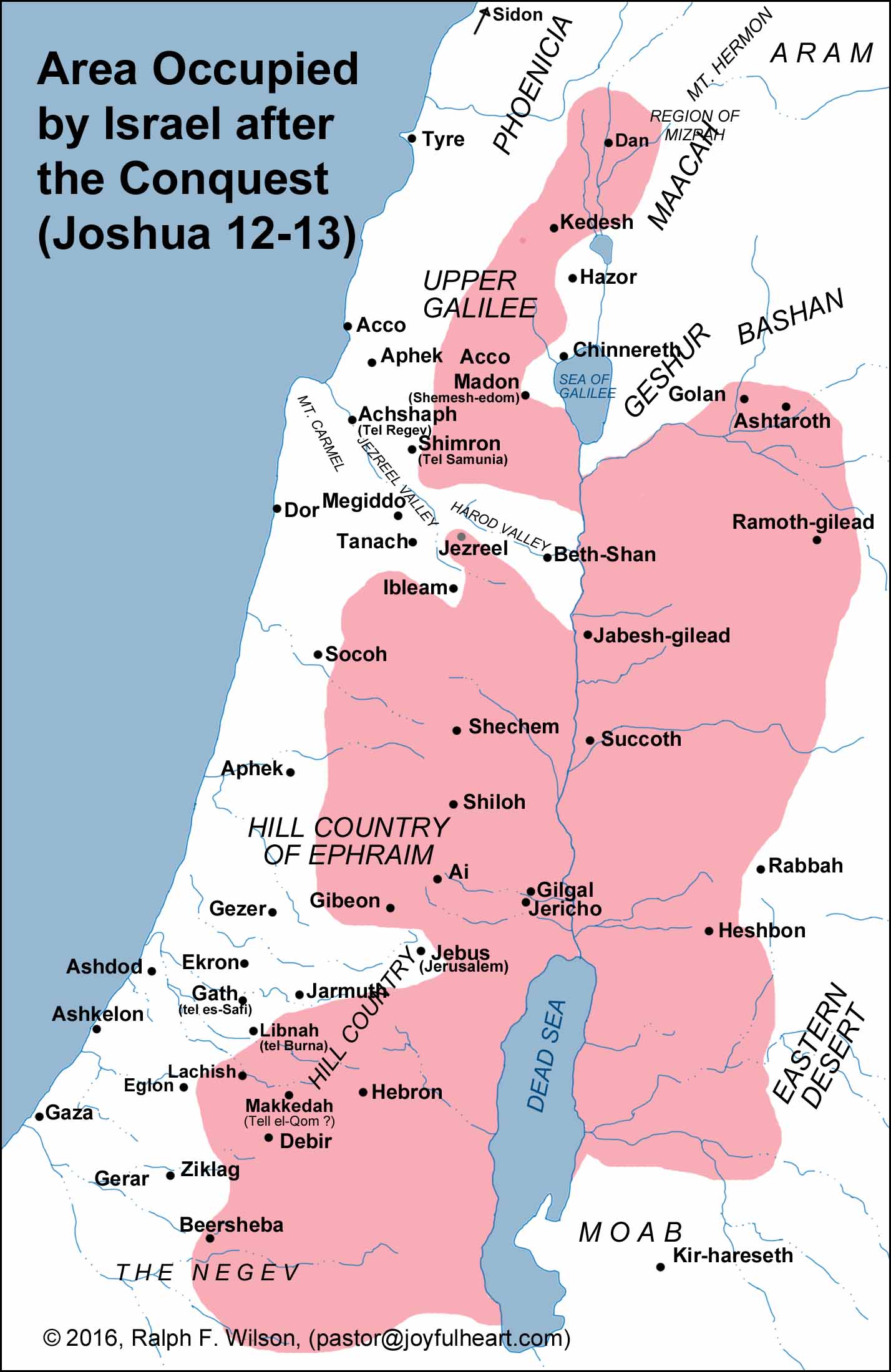

I find it interesting to note that although Joshua had defeated their kings as noted in the last chapter, some of their territories remained outside of Israelite occupation (Gezer, Aphek, Dor, Megiddo, etc.).  It seems reasonable to assume that Joshua may have continued to try to conquer the rest of the lands, but God stopped him because of his advanced age.  Adam Clarke, in his Commentary on the Bible, had an interesting perspective.  As nothing God does is by accident, he suggested that God may have wanted some of the original inhabitants to remain in order to keep the oftentimes unfaithful Israel in check.  

(2) "This is the land that yet remains, all the borders of the Philistines, and all Geshuri,"

The Lord then detailed the lands that were still unconquered, undoubtedly so that Joshua and the Israelites would know what they had a right to claim.  There was the territory of the Philistines in the southwest of Canaan along the Mediterranean Sea, to Geshuri, which appears to be Geshur in the north.  This map borrowed from Big Springs Community Church shows the unconquered lands more clearly than the one above:


(3) "From Sihor before Egypt to the borders of Ekron northward, counted to the Canaanite, five lords of the Philistines, the Gazites, the Ashdodites, the Ashkelonites, the Gittites, and the Ekronites, also the Avites;"

God described in more detail the as of yet unconquered territories of the promised land.  Describing the land of the Philistines, He said it ranged from Sihor before Egypt in the south to Ekron in the north which can be seen in the first map, across from Jerusalem.  The land of Philistia was counted as belonging to the posterity of Canaan, but the Philistines had gotten possession of it.  Because it was counted as Canaanite land, it was part of the promised land.  There were five lords in Philistia rather than kings, and it contained the cities of Gaza, Ashdod, Ashkelon, Ekron, and their inhabitants, and to whatever cities the Gittites and Avites belonged.

(4) "From the south, all the land of the Canaanites and Mearah beside the Sidonians, to Aphek to the borders of the Amorites;"

As near as I can tell by these maps, God is describing all the land of the Canaanites that was not part of the Philistines, from the south upward to Aphek (note there are two Apheks, one in Upper Galilee) to Sidon.

(5) "And the land of the Gebalites, and all Lebanon, toward the sunrising, from Baal Gad under Mount Hermon to the entering into Hamath;"

Gebal was north of Sidon on the Mediterranean coast.  The land of the Gebalites was said to be that east of Tyre, Sidon, and Gebal, the land east of the Lebanon mountains in the north, from Mount Hermon to the entrance of Hamath, seen clearly in this map borrowed from The Biblical Zionist:


(6) "All the inhabitants of the hill country from Lebanon to Misrephoth Maim, all the Sidonians, them I will drive out from before the children of Israel; only divide it by lot to the Israelites for an inheritance as I have commanded you."

The Lord continued to describe the land that was yet unconquered that also included all the hill country from Lebanon to Misrephoth Maim which was south of Tyre, all the land of the Sidonians.  All that very much land yet to be possessed (v. 1) included all the lands described from verse 2 to the Sidonians in verse 6.  All those the Lord would drive out from before the children of Israel.  Even though they were not yet driven out, the Lord wanted Joshua to divide all the promised land by lot to the Israelites for their inheritance.  Most of the early commentators I study suggest that these people were not ever entirely driven out or their land completely possessed by the Israelites, that the promise was always part of a covenant that must be upheld by the Israelites, and they did not do their part.  However, I refer back to Exodus 23:30-31, when the Lord said:

"Little by little I will drive them out from before you, until you have increased, and you inherit the land. And I will set your bounds from the Red Sea to the sea of the Philistines, and from the desert to the river; for I will deliver the inhabitants of the land into your hand, and you shall drive them out before you."

God specifically said that it would be little by little, and indeed all the land was subdued under the reign of David.  Some say that still the people were not specifically driven out, only subdued.  However, throughout ancient and modern history, Israel's borders have changed, and indeed the future Millennial Israel will include all of the promised land.

(7) "Now therefore divide this land for an inheritance to the nine tribes and the half tribe of Manasseh," (8) With whom the Reubenites and the Gadites have received their inheritance which Moses gave them beyond Jordan eastward, as Moses the servant of the Lord gave them,

The Lord told Joshua to divide the land on their present side of the Jordan River for an inheritance to the nine and a half tribes that had not yet received their inheritance.  Reuben, Gad, and the other half tribe of Manasseh had already received their lots on the east side of the Jordan River, given them by Moses.

(9) From Aroer which is on the bank of the River Arnon, and the city that is in the midst of the river, and all the plain of Medeba to Dibon, (10) And all the cities of Sihon king of the Amorites who reigned in Heshbon, to the border of the children of Ammon;

Further describing the lands given to Reuben, Gad, and the half tribe of Manasseh, it was from Aroer in the middle of the Arnon River that separated the land of the Amorites from Moab, and all the plain and cities of Sihon king of the Amorites to the Jabbok River which was the border of the Ammonites.

(11) And Gilead, and the border of the Geshurites and Maachathites, and all Mount Hermon, and all Bashan to Salcah, (12) All the kingdom of Og in Bashan who reigned in Ashtaroth and in Edrei, who remained of the remnant of the giants; for these did Moses smite and cast them out.

They had also received all the kingdom of Og, which included Gilead, the border of the Geshurites and Maachathites, all Mount Hermon, and all Bashan to Salcah.  All that land of Og that had been taken by Moses had been given to Israel, but they had not taken possession of much of it.

(13) Nevertheless, the children of Israel did not expel the Geshurites, nor the Maachathites, but the Geshurites and the Maachathites dwell among the Israelites until this day.

Indeed, Joshua went on to write that the Israelites had not driven out the Geshurites and Maachathites, and they still dwelt with them at the time of his writing.

(14) Only to the tribe of Levi He gave no inheritance; the sacrifices of the Lord God of Israel made by fire are their inheritance, as He said to them.

The tribe of Levi received no land inheritance on either side of the Jordan River.  As they were God's priests, He was to be their inheritance; they were to live off the sacrifices to their Lord God (Deuteronomy 18:1).

(15) And Moses gave to the tribe of the children of Reuben according to their families. (16) And their coast was from Aroer which is on the bank of the river Arnon, the city in the midst of the river, and all the plain by Medeba;

Moses had given to the tribe of Reuben the land from Aroer in the southeast and all the plain of Medeba.

(17) Heshbon, and all her cities in the plain, Dibon, and Bamoth Baal, and Beth Baal Meon, (18) And Jahazah, and Kedemoth, and Mephaath, (19) And Kirjathaim, and Sibmah, and Zereth Shahar in the mount of the valley, (20) And Beth Peor, and Ashdoth Pisgah, and Beth Jeshimoth, (21) And all the cities of the plain, and all the kingdom of Sihon king of the Amorites, who reigned in Heshbon, whom Moses smote with the princes of Midian, Evi, and Rekem, and Zur, and Hur, and Reba, dukes of Sihon dwelling in the country.

Reuben's inheritance included all these cities in the former kingdom of Sihon.  It had been taken by Moses when he defeated the king of Sihon and all his princes.  I can't begin to try to locate all these cities, but I found this map at Psalms to God Podcast that shows a general view of all the tribes and their allotments:


(22) Balaam also, the son of Beor, the soothsayer, the children of Israel killed with the sword, among those who were killed by them. 

The Israelites had also killed Balaam, the soothsayer, at the same time as the princes (Numbers 31:8).

(23) And the border of the children of Reuben was Jordan and its border. This was the inheritance of the children of Reuben after their families, the cities and the villages.

The northwestern border of the land possessed by the descendants of Reuben was the Jordan River.  All the land, cities, and villages between the Jordan and Aroer in the southeast made up the inheritance of the children of Reuben.

(24) And Moses gave to the tribe of Gad, to the children of Gad according to their families. (25) And their coast was Jazer and all the cities of Gilead, and half the land of the children of Ammon, to Aroer before Rabbah; (26) And from Heshbon to Ramath Mizpah and Betonim, and from Mahanaim to the border of Debir; (27) And in the valley Beth Haram, and Beth Nimrah, and Succoth, and Zaphon, the rest of the kingdom of Sihon king of Heshbon, with the Jordan as border to the edge of the Sea of Chinnereth on the other side of the Jordan eastward. (28) This is the inheritance of the children of Gad after their families, the cities and their villages.

Moses gave as an inheritance to the children of Gad the land from Jazer in the south to Rabbah in the west, with the Jordan River as the western border.  The northern border was quite unique, and I will let the map show the general area that was allotted to Gad.  Once again trying to locate all those cities is quite a dizzying task.  The Aroer before Rabbah would have to be a different Aroer from the one at the middle of the Arnon River.  Also Debir would have to be a different Debir.  All the cities of Gilead would only pertain to those cities within the area of Gad, as half of Gilead was given to the half tribe of Manasseh.  The same would have to be said for all the kingdom of Sihon that was given to Reuben (v. 21), as it states here that there was the rest of the kingdom of Sihon that was given to Gad.  Half the land of the children of Ammon refers to that part that Sihon king of the Amorites took from the Ammonites.

(29) And Moses gave to the half tribe of Manasseh, and this was of the half tribe of the children of Manasseh by their families. (30) And their coast was from Mahanaim, all Bashan, all the kingdom of Og king of Bashan, and all the towns of Jair, which are in Bashan, sixty cities; (31) And half Gilead, and Ashtaroth, and Edrei, cities of the kingdom of Og in Bashan, to the children of Machir the son of Manasseh, to the one half of the children of Machir by their families.

To the half tribe of Manasseh, the land from Mahanaim, which must have been the southern border as Gad also had that border (v. 26), including all the land of Bashan that included sixty cities, half of Gilead, and the royal cities of Og, Ashtaroth and Edrei.  The land is said to have been given to half the children of Machir, who was Manasseh's son.

(32) These are what Moses had distributed for inheritance in the plains of Moab on the other side of the Jordan by Jericho eastward.

The lands described above from verse 9 to this verse were all the lands that had been distributed by Moses to the tribes of Reuben, Gad, and the half tribe of Manasseh, on the eastern side of the Jordan River, east of Jericho.

(33) But to the tribe of Levi Moses did not give inheritance; the Lord God of Israel was their inheritance, as He said to them.

Once again, Joshua points out that the tribe of Levi did not receive any land as their inheritance, because as priests, the Lord God was their inheritance.

As Joshua was now old, God had him rest from his battles, even though there was still much land to be conquered.  However, for now, He wanted Joshua to portion out the lots of inheritance, and it was to include all the land that had been promised, even those not yet conquered.  This chapter began with the allotments that had already been given to the tribes of Reuben, Gad, and the half tribe of Manasseh. 

Sunday, October 6, 2019

The Israelites' Holy War With Midian

Continuing a chronological Bible study:

(Numbers 31:1) And the LORD spoke to Moses, saying, (2) "Avenge the children of Israel on the Midianites; afterward you shall be gathered to your people.”

The events of chapter 31 follow those of chapter 27, after an interruption where the Lord reviewed the law of sacrifices and the law of vows in the previous three chapters.  In Numbers 27:13 the Lord had told Moses that once he had been permitted to see the promised land, he would die, and would not be allowed to enter the land of Canaan because he had rebelled against the commandment of the Lord (Numbers 20:12).

Now the Lord told Moses that he was first to make war upon the Midianites to avenge the children of Israel for the injury they had done to them by sending their daughters among them to entice them to adultery and idolatry.  After that, he would be gathered to his people, meaning he would die as all his people before him.

(3) And Moses spoke to the people, saying, “Arm some of yourselves for war, and let them go against the Midianites, and avenge the LORD on Midian."

Moses then told the people to arm some of their able-bodied men of war and let them go against the Midianites to avenge the LORD.  Note the Lord had said in verse 2 to avenge the children of Israel, but Moses now called it vengeance for the Lord.  The Israelites had indeed suffered and lost 24,000 people due to the iniquity they were drawn into by the Midianites, but Moses recognized this had been an affront to their Lord and called the people to avenge His name and honor which had been dishonored by their sins of lewdness and idolatry.

(4) "Of every tribe a thousand, throughout all the tribes of Israel, shall you send to the war."

Each tribe was to send 1000 men to war.

(5) So there were delivered out of the thousands of Israel, a thousand of every tribe, twelve thousand armed for war.

The people did as Moses had instructed, and delivered out of each tribe 1000 men armed for war, for a total of 12,000 men from the tribes of Reuben, Simeon, Judah, Issachar, Zebulun, Dan, Naphtali, Gad, Asher, Ephraim, Manasseh, and Benjamin.  The tribe of Levi, as priests and caretakers of the tabernacle, would not have sent men to war.

(6) And Moses sent them to the war, a thousand of every tribe, them and Phinehas the son of Eleazar the priest, to the war, with the holy instruments and the trumpets to blow in his hand.

Moses sent the thousand men from each tribe to war.  We see that the tribe of Levi did participate; Phinehas the son of Eleazar the priest, went to war with holy articles from the sanctuary and trumpets to blow, signifying this was the Lord's battle.

(7) And they warred against the Midianites, as the LORD commanded Moses; and they killed all the males.

The 12,000 Israelite soldiers warred against the Midianites as the Lord had commanded Moses they do, and they killed all the males.  This means all the males who warred against them, or the ones who did not escape; it cannot mean every last Midianite male, as the Midianites would later raise their war heads again.

(8) And they killed the kings of Midian, besides the rest of them who were slain, namely, Evi, Rekem, Zur, Hur, and Reba, five kings of Midian; Balaam also, the son of Beor, they slew with the sword.

They also killed the kings of Midian, in addition to every other male who was killed.  The five kings of Midian who were killed were Evi, Rekem, Zur, Hur, and Reba.  They also killed Balaam, who was either still in Midian on his way back to his home, or had returned to Midian, as we were told in Numbers 24:25 he "returned to his place" after his meeting with Balak that had been intended, but failed, to curse Israel.

(9) And the children of Israel took the women of Midian captive, and their little ones, and took as spoil all their cattle, all their flocks, and all their goods.

The Israelites took the women and their children captive, and took as spoil all their cattle, flocks, and goods.  Once again it must be understood that not all the women were taken captive, just as not all the men were killed, because the Midianites would come against Israel again; but all who came against them and did not escape were killed and their women and children taken captive.

(10) And they burnt all their cities wherein they dwelt, and all their goodly castles, with fire.

The Israelites burned all the cities where the people mentioned in the above verses dwelt.  They also burned the castles which probably belonged to the kings they had killed.

(11) And they took all the spoil, and all the prey, of men and of beasts.

The Israelites took all the spoil of the goods, and all the prey of men and livestock.

(12) And they brought the captives, the prey, and the spoil, to Moses, and Eleazar the priest, and to the congregation of the children of Israel, to the camp at the plains of Moab by Jordan near Jericho.

The Israelite soldiers brought the captives and their large booty to Moses and Eleazar the priest, and to the congregation at their camp in the plains of Moab by the Jordan River across from Jericho.

(13) And Moses, Eleazar the priest, and all the leaders of the congregation, went to meet them outside the camp.

Moses, Eleazar, and all the leaders of the congregation, actually went out of the camp to meet the returning Israelites outside the camp.

(14) And Moses was angry with the officers of the army, the captains over thousands and captains over hundreds, who had come from the battle.

Moses turned out to be very angry with the officers of the Israelite army, those captains over thousands and captains over hundreds, who had come back from the battle with their captives and their rich booty.

(15) And Moses said to them, “Have you saved all the women alive? (16) Behold, these caused the children of Israel, through the counsel of Balaam, to commit trespass against the LORD in the matter of Peor, and there was a plague among the congregation of the LORD."

Moses was angry they had kept all the women alive.  After all, they were the main ones who first caused the Israelites to sin against their Lord, when they, apparently at the counsel of Balaam, went among the Israelites and enticed them into lewdness and eventually idolatry; and because of that, there had been a plague among the congregation of Israel.

(17) “Now therefore, kill every male among the little ones, and kill every woman who has known a man intimately."

Moses instructed the Israelite army to kill every male child and every woman who had known a man intimately.  Only the female children were spared.  Usually women and children were spared in these situations, as they were usually unable to resist.  However in this case, the women were the most guilty of wrongdoing against the Israelites, and the male children would later have become men and warriors against them.  Besides, the Lord God, the author, creator, and supporter of life, has every right to dispose of it when He sees proper; and as righteous and just, He cannot do anything but what is right and just.  Knowing all that is and what will be, He knows what each life would have done.  Also just because someone is taken away from this physical life doesn't always mean the end; God also takes people to save them from the evil to come (Isaiah 57:1), which could very well describe the future existence of these particular children.  Taking the children away to be with Him would be a most loving and merciful act.

(18) "But all the women children, who have not known a man intimately, keep alive for yourselves."

The female children were spared and could be taken by the Israelites.  They could be maidservants, or they could even become wives of Israelite men if they embraced the Israelite religion.

(19) "And you do abide outside the camp seven days; whoever has killed any person, and whoever has touched any slain, purify yourselves and your captives on the third day and on the seventh day.

Even though the Israelite soldiers had acted as the Lord had commanded them, they had become unclean and defiled by touching the dead, and had to go through the prescribed purification process.  Anyone who had killed or had come in contact with any slain, were to purify themselves and their captives (the female children) on the third and on the seventh day of the seven days they remained outside the camp.

(20) "And purify all clothing, and all that is made of skins, and all work of goats' hair, and all things made of wood."

They were to purify all their spoils.  All clothing, skins, works of goats' hair, such as coverings of tents were made from, and all things made of wood, were to be purified by washing them.

(21) And Eleazar the priest said to the men of war who had gone to the battle, “This is the ordinance of the law which the LORD commanded Moses: (22) Only the gold, the silver, the brass, the iron, the tin, and the lead, (23) Everything that may abide the fire, you shall put through the fire, and it shall be clean; nevertheless it shall be purified with the water of purification; all that cannot endure fire you shall put through the water."

Eleazar the priest told the men who had gone to battle about the law of purification of unclean people and things, according to what Moses had said as received from the Lord.  Items made of gold, silver, brass, and the like, that could withstand fire, were to be put through the fire and would be cleaned that way.  However, they were also to be purified with the water of purification, water mixed with the ashes of the burnt red heifer (Numbers 19:17).  All items that could not endure fire were to be washed with water.

(24) “And you shall wash your clothes on the seventh day and be clean, and afterward you may come into the camp.”

After cleansing and purifying everything else, on the seventh day they were to wash their own clothes, and then they were allowed to come into the camp.

(25) And the LORD spoke to Moses, saying, (26) "Take the sum of the prey that was taken, of man and of beast, you and Eleazar the priest and the chief fathers of the congregation."

The Lord then told Moses to make a count of all the plunder that was taken, both of man and beast.  Moses, Eleazar the priest, and the chiefs of the congregation were to do this.

(27) "And divide the prey into two parts, between them who took part in the war, who went out to battle, and all the congregation."

The plunder was to be divided into two equal parts between those who had gone into battle and all those others of the congregation.  Because all the Israelites were harmed by the Midianites, they all were to share in the plunder.  However, since there were just 12,000 men of war who had gone to battle, they had a far greater share of the plunder, as well they should, since they had been the ones who faced the dangers of war.

(28) "And levy a tribute for the LORD on the men of war who went out to battle, one of every five hundred of the persons, the cattle, the donkeys, and the sheep; (29) Take it of their half, and give it to Eleazar the priest, for a heave offering to the LORD."

There was to be a tribute or tax on the men who had gone to battle to be given to their Lord.  One out of every 500 of the people (the female children), and one of every 500 of the cattle, and likewise of the donkeys and the sheep, was to be taken from the soldiers' half of the plunder, and was to be given to Eleazar for a heave offering to the Lord, as a way to thank or give a tithe of sorts to the Lord for their success and victory and for all the plunder they had taken.

(30) “And from the children of Israel’s half you shall take one of every fifty, of the persons, of the cattle, the donkeys, and the flocks, of all manner of beasts, and give them to the Levites, who keep the charge of the tabernacle of the LORD.”

From the congregation's half of the plunder, they were to take one of every fifty of the people, of the cattle, and of every kind of livestock or animals taken, and those were to be given to the Levites who were employed in the service of the tabernacle.

(31) And Moses and Eleazar the priest did as the LORD commanded Moses.

Moses and Eleazar did just as the Lord had commanded to Moses they do.

(32) And the booty, being the rest of the prey which the men of war had caught, was six hundred and seventy-five thousand sheep, (33) And seventy-two thousand cattle, (34) And sixty-one thousand donkeys, (35) And thirty-two thousand persons in all, of women who had not known a man intimately.

These verses seem to reference the total booty, or the live prey of the booty.  I'm not sure what is meant by the "rest of the prey", unless perhaps it was what remained after the soldiers' seven days outside the camp, before it was counted.  The original word translated as "rest" was "yether" and it means "overhanging (by implication) an excess, remainder".  However, it can also mean "abundance, affluence, superiority, excellency", so perhaps the meaning was that the abundance of the total prey numbered 675,000 sheep, 72,000 cattle, 61,000 donkeys, and 32,000 young woman or girls who had never known a man intimately.

(36) And the half, the portion of them who went out to war, was in number three hundred and thirty-seven thousand five hundred sheep, (37) And the LORD'S tribute of the sheep was six hundred and seventy-five. (38) And the cattle were thirty-six thousand, of which the LORD’s tribute was seventy-two. (39) And the donkeys were thirty thousand five hundred, of which the LORD’s tribute was sixty-one. (40) And the persons were sixteen thousand, of which the LORD’s tribute was thirty-two persons.

The half portion of that total prey that went to the men who went out to war numbered 337,500 sheep, 36,000 cattle, 30,500 donkeys, and 16,000 virgins.  The Lord's tribute of these numbered 675 sheep, 72 cattle, 61 donkeys, and 32 virgins.

(41) And Moses gave the tribute, the LORD'S heave offering, to Eleazar the priest, as the LORD commanded Moses.

Moses gave the tribute of 675 sheep, 72 cattle, 61 donkeys, and 32 virgins, to Eleazar the priest, for a heave offering, as the Lord had commanded to Moses.  People given as an offering to the Lord cannot be understood as being sacrificed, but with this heave offering they were presented, or perhaps even ceremonially raised and lowered, in dedication to God and afterward would have been reserved for the priests' use.

(42) And of the children of Israel's half, which Moses divided from the men that warred, (43) Now the half belonging to the congregation was three hundred and thirty-seven thousand five hundred sheep, (44) And thirty-six thousand cattle, (45) And thirty thousand five hundred donkeys, (46) And sixteen thousand persons.

The children of Israel's half of the prey which Moses had divided out of the total prey, totaled 337,500 sheep, 36,000 cattle, 30,500 donkeys, and 16,000 virgins.

(47) Of the children of Israel's half, Moses took one portion of fifty, of man and of beast, and gave them to the Levites, who kept the charge of the tabernacle of the LORD, as the LORD commanded Moses.

Of the children of Israel's half, Moses took one of each fifty, of the virgins, and of each species of animal, and gave them to the Levites who kept charge of the tabernacle, just as the Lord had commanded he do.  Although the numbers given to the Levites was not recorded here, it can be easily calculated.  The children of Israel, being required to give one in fifty, gave ten times more than the soldiers who gave one in 500; therefore their numbers were 6750 sheep, 720 cattle, 610 donkeys, and 320 virgins.

(48) And the officers who were over thousands of the army, the captains of thousands and captains of hundreds, came near to Moses; (49) And they said to Moses, “Your servants have taken a count of the men of war who are under our command, and not a man of us is missing."

The officers of the army of Israelites came to Moses and reported to him that after waging war with a whole nation, killing all the males and the kings, burning their cities, taking so many captives and such a large booty, miraculously not a single one of the 12,000 soldiers was killed or missing.

(50) "We have therefore brought an oblation for the LORD, what every man has gotten, of jewels of gold, chains, and bracelets, rings, earrings, and necklaces, to make an atonement for our souls before the LORD."

In thanksgiving for success and sparing all their lives, the officers brought a freewill offering over and above the tribute that was levied upon them.  It seems to read that they brought to the Lord all the gold jewels and jewelry that the soldiers had taken as plunder.  They said it was to make atonement for their souls before the Lord, perhaps for their error in judgment in sparing all the women.

(51) And Moses and Eleazar the priest took the gold from them, even all the crafted jewels.

Moses and Eleazar received all the gold and fashioned jewelry from them.

(52) And all the gold of the offering that they offered up to the LORD, from the captains of thousands, and from the captains of hundreds, was sixteen thousand seven hundred and fifty shekels. (53) (The men of war had taken spoil, every man for himself.)

The value of all the gold the officers had offered to the Lord was 16,750 shekels.  The opinion on what a shekel of gold was worth in those times varies, but with one conversion chart I used at Convert-me.com it calculated it was equal to 0.4 ounce.  16,750 shekels would equal 6700 ounces of gold.  At the current US value of over $1500 an ounce, that would make it worth well over $10,000,000.  With this large amount, I have to believe the meaning of the parenthetical 53rd verse was that the amount was so large because every man of war had taken some gold for himself which he now offered to the Lord.  However, there are some who believe that the meaning was that some men held back the gold they took for themselves and it was not part of the offering.  That would seem to imply the meaning of the parenthetical remark was that the amount was so small because the men held back, and that just doesn't seem to be the logical meaning to me.  Whether they gave all their gold or they gave of their gold, it was still quite a large freewill offering they gave to their Lord over and above the tribute they were required to give Him.

(54) And Moses and Eleazar the priest took the gold from the captains of thousands and of hundreds, and brought it into the tabernacle of the congregation, for a memorial for the children of Israel before the LORD.

Moses and Eleazar took the gold from the officers and brought it into the tabernacle, probably laying it up in some chamber there, in remembrance of the victory the Israelites had obtained because of their Lord's goodness and protection, that they would remember this victory and trust Him in all future endeavors.  That's the way I took the meaning to be, but some Biblical scholars suggest it was laid up in the tabernacle to remind the Lord that they had given it to Him.  I really don't like that suggestion and wouldn't think it would be acceptable to the Lord if it was a bribe for purely selfish reasons.  However, Matthew Henry, in his Commentary on the Whole Bible, put it a little more softly:  "...that he (God), being well pleased with this thankful acknowledgment of favours bestowed, might continue and repeat his mercies to them."

I rather think the moral of this story, or rather historical incident, is that the people obeyed the Lord in avenging the children of Israel, thus avenging the Lord because their lewdness and idolatry had greatly dishonored Him.  Being imperfect as all men are, they erred in their judgment in keeping all the women alive, but did as Moses instructed they do when this was brought to their attention.  Their success in war was remarkable that so small an army could overcome such multitudes, and still more miraculous that not one soldier was killed or missing.  Again quoting Matthew Henry, this time in his Concise Commentary on the Whole Bible, the army then "...presented the gold they found among the spoils, as an offering to the Lord. Thus they confessed, that instead of claiming a reward for their service, they needed forgiveness of much that had been amiss, and desired to be thankful for the preservation of their lives, which might justly have been taken away." 

Saturday, July 6, 2019

Israel Enticed by Daughters of Moab and Midian to Whoredom and Idolatry

Continuing a chronological Bible study:

(Numbers 25:1) And Israel abode in Shittim, and the people began to commit whoredom with the daughters of Moab.

In the past few chapters and posts, Israel was camped in the plains of Moab along the Jordan River across from Jericho.  This is where they camped when Balak brought Balaam to see them in order to curse them because he feared them coming into his land.  Instead Balaam, with God's words in his mouth, had greatly blessed them.  Now we see more specifically that they dwelt in Shittim.  "Shittiym" literally means "acacia trees", and Shittim was so named because of the abundance of acacia trees that grew there.  Thanks to this wonderfully clear map compliments of Ralph F. Wilson, we see that Shittim was the same place in the plains of Moab where they had been in the past three chapters:


While they were encamped at Shittim, which would be their last station in the wilderness before they entered Canaan, it seems they began to mingle with the women of Moab, and Midian, too, as we'll soon see.  They began to commit whoredom which probably meant sexually and spiritually.  I still couldn't see why the old commentaries I study still wanted to blame Balaam for this, until Matthew Henry, in his Commentary on the Whole Bible, referenced Revelation 2:14, when the Lord addressed the churches, and said this:

“But I have a few things against you, because you have there those who hold the doctrine of Balaam, who taught Balak to put a stumbling block before the children of Israel, to eat things sacrificed to idols, and to commit fornication."

If the Lord said it, I know it is true!  That verse in Revelation shows that the whoredom was both sexual and spiritual.  Albert Barnes, in his Notes on the Bible, wrote that records of the neighboring cities of the plain suggest that these people were more than just "ordinarily licentious".  In his prophecy, Balaam had said that whoever blessed Israel would be blessed, and that those who cursed Israel would be cursed.  Perhaps he encouraged the Moabites and Midianites to charm the Israelites by sending in their women.  Matthew Henry wrote so eloquently and truthfully:

"Those are our worst enemies that draw us to sin, for that is the greatest mischief any man can do us. If Balak had drawn out his armed men against them to fight them, Israel had bravely resisted, and no doubt had been more than conquerors; but now that he sends his beautiful women among them, and invites them to his idolatrous feasts, the Israelites basely yield, and are shamefully overcome: those are smitten with his harlots that could not be smitten with his sword. Note, we are more endangered by the charms of a smiling world than by the terrors of a frowning world."

(2) And they called the people to the sacrifices of their gods; and the people did eat, and bowed down to their gods. 

Indeed, we see that the charming women of Moab coaxed many of the Israelites to commit spiritual whoredom by eating things sacrificed to idols and bowing down to them.

(3) And Israel joined to Baal-peor, and the anger of the LORD was kindled against Israel.

It seems Israel wholly accepted the false god Baal-peor, so called probably because Baal was worshiped at the top of Peor.  The righteous anger of the Lord was aroused against Israel.  No sin could be worse than idolatry.  There is only salvation and life in the one true God; any other god leads only to sin and death. 

Recently, I have reflected on how all people innately know that there is something larger than themselves, and they feel a need to worship it.  We all instinctively know there is a God; it's just many follow false ones.  Even atheists who think they don't believe in a god, believe in something, whether it's nature or something within themselves that has to be cultivated and reached at a higher level.  We know there is something higher than ourselves.  What makes it higher?  Why do we think it needs to be worshiped?  To me, it only makes sense that we instinctively know that there was a Creator God who created us and everything around us and we owe everything to Him.  The egotistical part of us sometimes wants to run from that.  We may listen to Satan, who whispers the same lies as he did in the garden of Eden, "Did God really say that? You won't die. God knows you can be as God."  We instinctively know God; God in His mercy, gave us that innate knowledge, so that we may all accept Him.  When you think about it, why would anyone go anywhere else to look for that Higher Being?  What other god has ever been so historically written about and tested with such scrutiny?  Why would God who wants us to seek and find Him be obscure and hard to find, as some would believe in an obscure god and believe they have found the true answer?  There is none but Him, and we all know it, although some choose to reject it.

(4) And the LORD said to Moses, "Take all the heads of the people, and hang them up before the LORD against the sun, that the fierce anger of the LORD may be turned away from Israel."

The Lord told Moses to take all the leaders of the people and hang them up before the Lord.  I don't believe as some that they were to be hung by the neck.  The original word "yaqa" means "to be dislocated, be alienated" and can also mean "hang up".  I think this hanging up was more to put them on display before the Lord and having them face the sun.  Being in full sunshine might have been to make them public and in full view of the congregation, but it may have also been as Dr. John Gill suggested in his Exposition of the Entire Bible, "...and if it was the sun that was worshipped in this idol, as some think, they were hanged against the sun, to show that the idol they worshipped was not able to deliver them; but, in the face of it, and as it were in defiance of it, they were ordered to be hanged up."  This was done to hopefully begin to remedy the situation and appease the fierce anger of the Lord.

(5) And Moses said to the judges of Israel, “Every one of you slay his men who were joined to Baal-peor.”

Moses told each of the judges of Israel to kill or order to be killed his men who had joined themselves to Baal-peor.  There are varying interpretations of these verses.  I originally felt like the rulers were hung up in view of the people and then Moses told the judges to find the guilty ones under each one's jurisdiction and kill just the guilty ones.  It might be as some suggested, that the literal heads of the people were hung before the Lord.  Note the Lord said to take all the heads of the people, and Moses, in response, told the judges to slay the guilty parties.  It may have been just the guilty heads were hung, or it might be that the leaders of the people were hung because they were, if not guilty themselves, at least complicit by doing nothing to rein in the behavior of the people under their charge.  Our rulers are held to higher standards.

(6) And, behold, one of the children of Israel came and brought to his brethren a Midianitish woman in the sight of Moses, and in the sight of all the congregation of the children of Israel, who were weeping before the door of the tabernacle of the congregation.

While the congregation stood weeping before the door of the tabernacle with Moses, because of all that was going on with the heads and the slaying of the people joined with Baal-peor, one of the Israelites actually had the audacity to bring a Midianite woman with him in the sight of Moses and all the congregation.

(7) And when Phinehas, the son of Eleazar, the son of Aaron the priest, saw it, he rose up from among the congregation, and took a javelin in his hand; (8) And he went after the man of Israel into the tent, and thrust both of them through, the man of Israel, and the woman through her belly. So the plague was stayed from the children of Israel.

When Phinehas, the son of Eleazar, son of Aaron, saw this man and this Midianite woman, he took his javelin and went after the man and woman and killed them both.  Phinehas was in line to be high priest, and obviously a righteous judge to follow the order of Moses to slay all those who had joined themselves to Baal-peor.  Indeed, the Lord approved of this righteous act to cleanse the camp of those who had joined themselves to Baal-peor, and stayed the plague from the children of Israel.  Whether this was an actual pestilence that had broken out among the people because of their physical and spiritual adultery, as the historian Josephus suggested, or a plague of death ordered by the Lord to kill all those who had allowed themselves to be joined to Baal-peor, this judgment was stopped because of the zealous act of Phinehas.

(9) And those who died in the plague were twenty-four thousand.

24,000 died in this "plague".  Much attention was given by the commentaries I study to the fact that the Apostle Paul said in 1 Corinthians 10:8 about this incident, "Neither let us commit fornication, as some of them committed, and fell in one day twenty-three thousand."  I personally didn't see a need to reconcile the numbers, but the commentators did, and as they did so with almost unanimity, I will consider it important enough to note here.  They seem to agree that Paul spoke of the ones who "fell" as opposed to Moses counting all who died, by hanging, slaying, or some immediate plague of the Lord.  I would think those who were slain by the judges would be considered fallen, so maybe the additional 1000 were those hung before the Lord before the slaying began.  Any way you look at it, a great number of Israelites were killed because of their great sin of idolatry and adultery.

(10) And the LORD spoke to Moses, saying, (11) “Phinehas the son of Eleazar, the son of Aaron the priest, has turned My wrath away from the children of Israel, while he was zealous for My sake among them, that I did not consume the children of Israel in My jealousy."

The Lord told Moses that it was the zeal of Phinehas that turned His wrath away from the children of Israel.  It was because he was zealous for his Lord's sake.  The original word "qinah" that was translated as "sake" can also mean "zeal".  Phinehas acted with the zeal of the Lord; he was zealous with the Lord's zeal.  The Lord knows the heart, and because of the terrible affront and disrespect for his Lord, Phinehas had jumped up and acted decisively to destroy those who had acted so irreverently.  Some of the commentators I study made it a point to say that Phinehas's deed of vengeance cannot be condoned as a routine way of handling such instances, condemning revenge.  Once again, I say that God knows the heart, and this was, after all, a different time when the Lord actually dwelt among His people.  Phinehas could not allow such a detestable act to be done in the presence of His Lord.  Now we have Jesus and the teaching that we love our enemies and do good for them and let vengeance be the Lord's.  It's not that the law changed; it's that Jesus's blood now covers sin.  Phinehas shed blood to cover the sin of Israel for the Lord's sake, and that was a picture of the Christ to come who would have His blood shed to cover our sins.

Note that the Lord's jealousy is not as trivial as what we think of jealousy today.  We think of jealousy as envy.  The Lord is certainly not envious that people look to false idols rather than to Him!  As I have explored before, there are two other dictionary definitions of "jealous", "solicitous or vigilant in maintaining or guarding something" and "intolerant of unfaithfulness or rivalry".  I believe these are the more accurate descriptions of God's jealousy for His people.  God loved His people as the most loving husband would love his spouse, actually much more, and He is jealous for their fidelity, solicitous and vigilant in guarding it, because that is what is best for His people.  It's not that He is envious and needs His children's love and fidelity; it's because His children need it!  He loves His children and in His mercy, He is jealous and zealous to turn them back to their only source of eternal life with Him.

(12) “Therefore say, ‘Behold, I give to him My covenant of peace.'"

The Lord continued speaking to Moses and told him to declare that the Lord gave Phinehas His covenant of peace, as he had certainly made peace between God and His people by his heroic action.

(13) "'And he shall have it, and his seed after him, the covenant of an everlasting priesthood, because he was zealous for his God, and made an atonement for the children of Israel.'"

The Lord said He gave Phinehas His covenant of peace.  He may have meant the everlasting priesthood, as that is what His covenant with Levi was called in Malachi 2:5--"My covenant was with him (Levi) of life and peace."  Even though Phinehas was in line for the priesthood and would have it upon his father's death, here the Lord had promised him at that moment an everlasting priesthood for him and his descendants after him because of his zeal for his Lord.  And because he was zealous for his Lord, he had made atonement for the children of Israel, which was the duty of the priests.

(14) Now the name of the Israelite who was slain, who was slain with the Midianite woman, was Zimri the son of Salu, a prince of a chief house among the Simeonites.

The Israelite who was killed by Phinehas is identified as Zimri, son of Salu.  The word "ab" translated as "chief" literally means "father", so Zimri was probably called a prince of his father Salu's house, one of the families of the Simeonites.

(15) And the name of the Midianite woman who was slain was Cozbi the daughter of Zur; he was head of the people of a chief house in Midian.

The Midianite woman is also identified as Cozbi, the daughter of Zur, who was later said to be one of the five kings of the Midianites (Numbers 31:8).

(16) And the LORD spoke to Moses, saying, (17) "Vex the Midianites, and smite them."

The Lord spoke again to Moses telling him to "vex" the Midianites.  The original word used was "tsarar" and literally meant "to cramp an adversary", by implication "to besiege", and actually the Lord went on to tell Moses to smite or slay them.

(18) "For they vex you with their wiles, by which they have beguiled you in the matter of Peor, and in the matter of Cozbi, the daughter of a prince of Midian, their sister, who was slain in the day of the plague for Peor's sake."

The reason the Lord gave to slay the Midianites was because they had vexed the Israelites with their wiles, that is, with cunning methods to draw them into association and kinship with them.  The Midianites had charmed and misled the Israelites into accepting the false idol Baal-peor, and in accepting the likes of Cozbi, the daughter of a prince of Midian, who had been brought into their midst, but who was slain in the day of the plague that had been sent because of the worshiping of Baal-peor.

The moral of this story, or rather this historical event, as "All scripture is given by inspiration of God, and is profitable for doctrine, for reproof, for correction, for instruction in righteousness" (2 Tmothy 3:16), is to show how easily we can be led astray by our fleshly desires.  And the fact that satisfying our fleshly lusts will almost always lead to more sin and idolatry.  Think about how Israel abode in Shittim with their promised land in full view.  God had done so much for them, and they were finally at their destination, and yet they allowed themselves to be tempted by these women, and seemed to be happy to stay where they were.  They enjoyed mingling with the beautiful women which led to committing lewdness with them, and then they were easily drawn into doing other things with them, like participating in the idolatrous feasts and eventually worshiping their god.  Zimri had taken it a step further bringing a harlot boldly back to the Israelite camp.  Moses and the congregation of Israel were weeping at the door of the tabernacle in sorrow and repentance for the sin they had committed and for the resulting plague.  Zimri shamefully brought a harlot among them and went into a tent with her, which implies he planned on more than a casual visit.  He declared his sin as Sodom, a reference to Isaiah 3:9, and gloried in his shameful act in dishonoring God.

Once we give into temptation, it becomes easier to pile on sin until the point we turn completely away from God or He turns His face from us and gives us over to our vile affections (Romans 1:26).  Also in Romans 1 is the verse, "Though they know God’s righteous decree that those who practice such things deserve to die, they not only do them but give approval to those who practice them" (Romans 1:32).  This was an obvious censure by God to those who give approval to those who sin.  Not only must we be vigilant against our own temptation to sin, but we must be zealous for God and His laws.  God hates the lukewarm Christian (Revelation 3:16).  This is not to say that we are to go around killing sinners, certainly not!  As was discussed earlier, we are in a different age where Jesus now dwelt with sinners, and is an intercessor between sinful man and a righteous God who cannot look upon sin.  In the Old Testament we get glimpses of Christ through the actions of OT heroes like Phinehas here who interceded for the people and rid them of the sin in their camp.  Through his zealous act, Israel was saved from the plague.  Although we don't take justice into our own hands now, we have plenty of references in the New Testament that tell us not to condone sin, but to be zealous for God's laws.  We love the sinner, but hate the sin.  We are all sinners, and we certainly don't want to be hated and shunned for our sins, but neither should we want to be left to wallow in it and die.  It's a far more loving thing to want to remove the stumbling blocks that cause people to sin, such as sinful laws like abortion on demand and homosexual marriage.  Let's be zealous for things that honor God and zealous to remove things that dishonor Him!