
Continuing a chronological Bible study:
(2 Samuel 6:1) Again David gathered together all the chosen of Israel, thirty thousand.
David had become established as king of all Israel. He had just defeated the Philistines in and around Jerusalem. He had proposed to all the people that they should bring the ark of the covenant to them in Jerusalem. He now gathered thirty thousand of the choicest men of Israel.
(2) And David arose and went with all the people who were with him from Baale of Judah to bring up from there the ark of God, whose name is called by the name of the Lord of hosts who dwells between the cherubim.
David went with the thirty thousand men he had gathered to him to Baale of Judah to bring the ark from there. This was the same as Baalah in Judah that was also known as Kirjath Jearim according to Joshua 15:9. God's name is Jehovah which is the original Hebrew for Lord. He dwelt between the cherubim that overshadowed the mercy seat which was above the ark.
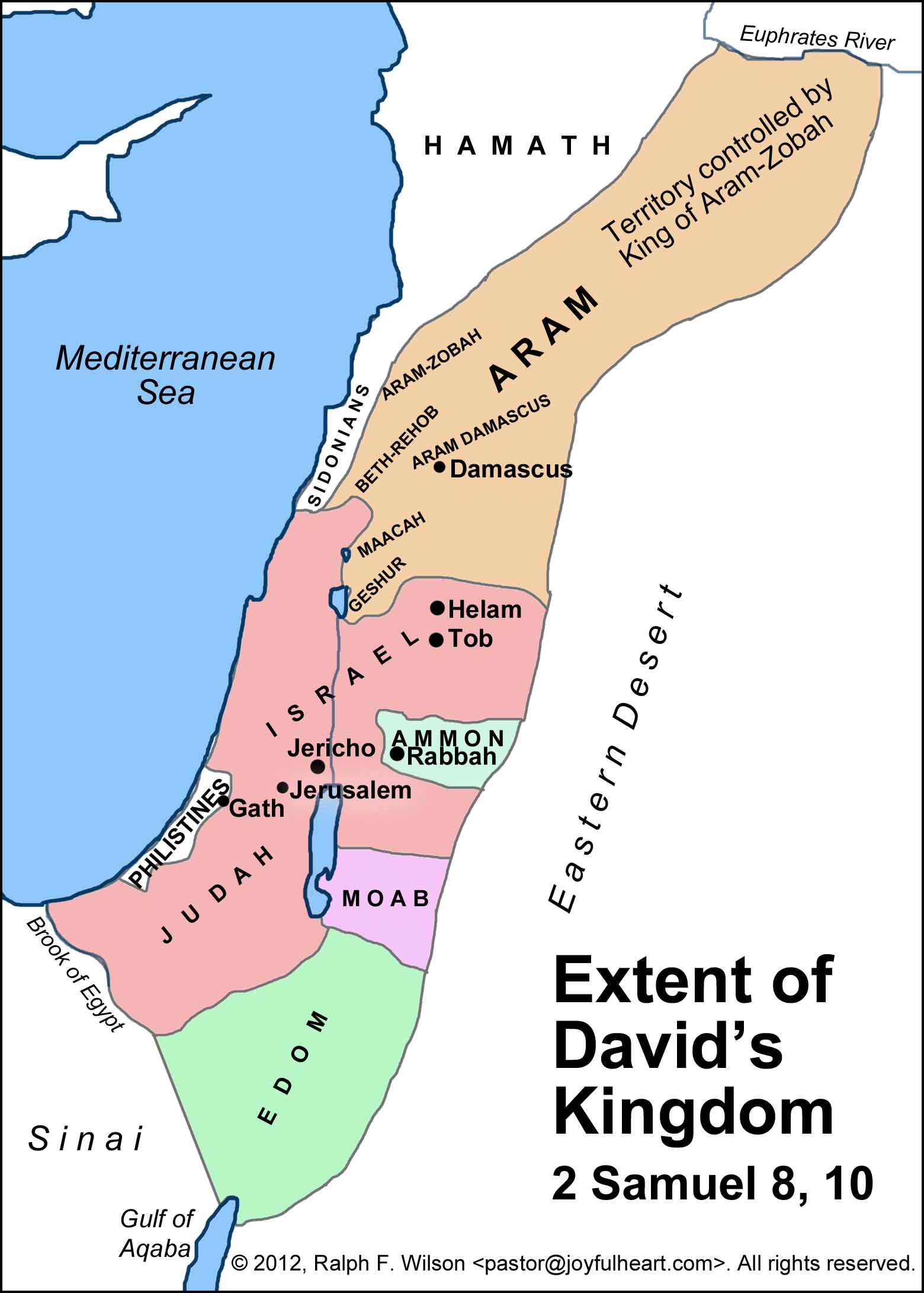
(1 Chronicles 13:5) So David gathered all Israel together from Shihor of Egypt to the entering of Hamath to bring the ark of God from Kirjath Jearim.
1 Chronicles 13 also told of the event. Rather than all the people, it was likely the thirty thousand representatives of them whom David gathered together from the southern border at Egypt to the northern border at Hamath as seen on this map borrowed from JesusWalk:
(6) And David went up and all Israel to Baalah, to Kirjath Jearim, which belonged to Judah, to bring up from there the ark of God the Lord who dwells between the cherubim whose name is proclaimed.
David and the 30,000 representatives of all Israel went to Kirjath Jearim in Judah to the ark of God the Lord, Jehovah, whose name was proclaimed there where He dwelt between the cherubim above the mercy seat.
(2 Samuel 6:3) And they set the ark of God upon a new cart and brought it out of the house of Abinadab that was in Gibeah, and Uzzah and Ahio, the sons of Abinadab, drove the new cart.
The people brought the ark out of the house of Abinadab in Gibeah, which was a prominent hill in Kirjath Jearim. They set the ark of God on a new cart, thinking to honor the ark of God by placing it on a cart never before used for anything else. However, the priests were to have carried it on their shoulders, according to Numbers 7:9. They should not have put it in a cart, even new, like any common thing. Uzzah and Ahio, the sons of Abinadab, drove the cart.
(4) And they brought it out of the house of Abinadab, which was at Gibeah, accompanying the ark of God, and Ahio went before the ark.
They brought the cart out of the house of Abinadab which had held the ark of God, and it appears that Ahio actually went before the ark while Uzzah drove the cart.
(5) And David and all the house of Israel played before the Lord on all manner of fir wood, even on harps, and on psalteries, and on timbrels, and on cornets, and on cymbals.
David and all the house of Israel with him played before the Lord on musical instruments made of fir wood, on harps, on other stringed instruments, on tambourines, on cornets, and on cymbals. Once again, they thought they were honoring God, but even David who would seem was well versed in the law of God, had failed to properly honor the ark.
(1 Chronicles 13:7) And they carried the ark of God in a new cart out of the house of Abinadab, and Uzzah and Ahio drove the cart. (8) And David and all Israel played before God with all their might, and with singing, and with harps, and with psalteries, and with timbrels, and with cymbals, and with trumpets.
1 Chronicles 13 told of the same incident. Rather than finishing the story, my chronological study takes me to Psalm 78:
(Psalm 78:1) (Maschil of Asaph) Give ear, O my people, to my law; incline your ears to the words of my mouth.
This psalm was already studied in full in this chronological study by Skip Andrews, so I'm not sure why it would be repeated now. Asaph was a Levite, appointed by David as one of the chief musicians responsible for leading worship before the Ark of the Covenant. I suppose that is why it might be relevant at this chronological time. Asaph wrote a few of the psalms, and he wrote this maschil, an instructive psalm. He called on the people to listen to the doctrine he was about to deliver.
(2) I will open my mouth in a parable; I will utter dark sayings of old, (3) Which we have heard and known, and our fathers have told us.
Asaph would speak freely and openly with analogies, metaphors, and examples. When you think about it, the entire Old Testament was purposefully analogous to the lives of believers after the coming of Jesus. "All scripture is given by inspiration of God, and is profitable for doctrine, for reproof, for correction, for instruction in righteousness..." (2 Timothy 3:16). Those who want to discard the Old Testament because it is not relevant anymore are very much in error as God intended it to be used for teaching us.
This scripture actually was prophecy referring to Jesus and why He spoke in parables as it says in Matthew 13:34-35, "All these things Jesus spoke to the multitude in parables; and without a parable He did not speak to them, that it might be fulfilled which was spoken by the prophet, saying, 'I will open my mouth in parables; I will utter things which have been kept secret from the foundation of the world.'" Asaph would speak of dark sayings, or perplexing things, of old, from the foundation of the world, things they had only heard of, such as the fall of man by means of Satan, and how he continued to steal, kill, and destroy (John 10:10). Perhaps he would speak prophetically of the Gospel which was kept secret until the Messiah came but had been ordained even before the world (1 Corinthians 2:7).
(4) We will not hide them from their children, showing to the generation to come the praises of the Lord, and His strength, and His wonderful works that He has done.
The people of that present time would not hide those mysteries from their children and from their children's children but would pass on their knowledge of such things to future generations. They would demonstrate to them how praiseworthy their Lord was, how strong He was, and all the wonderful things He had done for His people.
(5) For He established a testimony in Jacob and appointed a law in Israel, which He commanded our fathers that they should make them known to their children.
The Lord had established a testimony in the house of Jacob, or Israel, as Jacob was the patriarch. He had appointed a law in Israel which He commanded fathers to teach their children (Deuteronomy 6:7).
(6) That the generation to come might know them, even the children who should be born who should arise and declare them to their children.
Then the next generation would know those mysteries of old and would pass them on to any children they would have who would, in turn, pass them on to their children. I believe that is what has become lost in this world; so many people do not know the real truth of God because they have never heard the truth.
(7) That they might set their hope in God and not forget the works of God but keep His commandments.
By teaching every generation, they would continue to set their hope in God and never forget His wondrous works, and they would keep His commandments. Once again, I can't help but think how this has become lost, and that is the reason why so many people are without hope in our day and age.
(8) And might not be as their fathers, a stubborn and rebellious generation, a generation that did not set their heart aright and whose spirit was not steadfast with God.
If the future generations were taught the wonders of their Lord, they would not have to be like their forefathers, a stubborn and rebellious generation like those Israelites in the wilderness and those who rejected Christ, those who did not set their hearts to seek after their Lord to walk in faithfulness with Him.
(9) The children of Ephraim, armed, carrying bows, turned back in the day of battle. (10) They kept not the covenant of God and refused to walk in His law. (11) And forgot His works and His wonders that He had showed them.
The children of the tribe of Ephraim, although armed and well equipped with the best weapons of the time, failed in faith and courage and retreated before the enemy, possibly referring to the failure of Ephraim to drive out the Canaanites from their promised land (Judges 1:29). It may be that Ephraim here means all of Israel just as Jacob did. In that case, it might refer to the time the Israelites fled before the Philistines and the ark of the Lord was taken. That might be the most appropriate meaning here. They had failed in their faith and did not keep the covenant of the Lord, forgetting all His wondrous works that proved He would always be there for them.
(67) Moreover, He refused the tabernacle of Joseph and chose not the tribe of Ephraim, (68) But chose the tribe of Judah, the Mount Zion which He loved.
The chronological study then skips forward to verse 67. If this refers to the ark, the Lord refused the tribe of Ephraim, the son of Joseph, therefore also refusing him, where the ark had formerly been in Shiloh. He now chose the tribe of Judah, specifically Mount Zion, the city of David, for His ark to dwell.
(69) And He built His sanctuary like high, like the earth which He has established forever.
The Lord built His sanctuary exalted, as if it were on a high hill, prominent and permanent, not to be moved from place to place as the tabernacle had been but established as firmly as the earth itself.
(70) He chose David also His servant and took him from the sheepfolds, (71) From following the ewes great with young He brought him, to feed Jacob His people, and Israel His inheritance.
The Lord had chosen David out of the sheep fields; from tending to pregnant ewes, the Lord brought him to rather tend to His people Israel.
(72) So he fed them according to the integrity of his heart and guided them by the skillfulness of his hands.
David led the people according to the integrity of his heart, striving to be upright and pure in the administration of his government, and guided them by the skillfulness of his hands, which represented his power and actions.
Once again, I feel like this chronological order is rather disjointed and even disruptive of the historical event unfolding here. While David led the people according to the integrity of his heart, in this case, he had forgotten the law of the Lord as we will soon understand in the coming study.
