Showing posts with label Saul. Show all posts

Monday, October 26, 2026

David's Psalm of Deliverance

Continuing a chronological Bible study:

(Psalm 18:1) (To the chief musician, of David, the servant of the Lord, who spoke to the Lord the words of this song in the day the Lord delivered him from the hand of all his enemies and from the hand of Saul. And he said,) "I will love You, O Lord, my strength."

The song that David spoke to the Lord in 2 Samuel 22, after the Lord had delivered him from his enemies round about and preserved him as he enlarged his kingdom, became the 18th Psalm.  David prefaced it by first declaring his love for his Lord whom he considered his very strength.  He could not have accomplished his victories without Him.

(2) The Lord is my rock and my fortress and my deliverer; my God, my strength, in whom I will trust, my buckler, and the horn of my salvation, my high tower.

The Lord was David's rock, his unmoving support, his fortress and defense and protection, and also his deliverer, delivering him out of the hands of danger and his enemies.  He would trust in the Lord, his very strength, his shield, and the horn of his salvation as the horn of a wild beast that pushes, scatters, and destroys its enemies, and saves him.  He was his high tower, not only his place of defense, but out of reach of his enemies and where he could easily see danger approaching.

(3) I will call upon the Lord to be praised; so shall I be saved from my enemies.

David would call upon his Lord in times of need, the Lord who was worthy to be praised because of His goodness and mercy, and He would save him from his enemies.

(4) The sorrows of death compassed me, and the floods of ungodly men made me afraid.

Dangerous and deadly troubles surrounded David, and ungodly men came upon him like a flood and made him afraid.

(5) The sorrows of hell compassed me about; the snares of death prevented me.

As explored in the song in 2 Samuel 22, the word translated as "sorrows" meant more specifically "cords" and by implication, might indicate "sorrows."  But the meaning is more like the cords of hell were pulling David down, and the snares of deadly traps confronted him.

(6) In my distress I called upon the Lord and cried to my God; He heard my voice out of His temple, and my cry came before Him into His ears.

When in distress, David had called upon his Lord who heard him from His heavenly temple.

(7) Then the earth shook and trembled; the foundations also of the hills moved and were shaken because He was angry.

Then God in His anger appeared on David's behalf in a glorious manner, to the terror and confusion of all his enemies, which is compared to an earthquake.

(8) There went up a smoke out of His nostrils, and fire out of His mouth devoured; coals were kindled by it.

All these seem to be figurative expressions denoting the greatness of God's anger.

(9) He bowed the heavens also and came down, and darkness was under His feet.

By producing thick and dark clouds, the heavens would seem to come down to the earth.  The Lord would be enveloped in the darkness as no one is able to see Him, but His presence would undoubtedly be known.

(10) And He rode upon a cherub and did fly; yea, He did fly upon the wings of the wind.

God rode upon His cherubs, elsewhere called His chariots (Psalm 68:17).  I believe the sense is that He used His thousands of angels to exact His will, and everything is at His disposal as is the wind.

(11) He made darkness His secret place; His pavilion round about him were dark waters and thick clouds of the skies.

Again, the Lord was enveloped in the darkness, thick clouds and dark watery fog, as no one is able to see Him.

(12) At the brightness before Him, His thick clouds passed, hail and coals of fire. (13) The Lord also thundered in the heavens, and the Highest gave His voice, hail and coals of fire.

The Lord is pictured as coming in a violent storm.  He was enveloped in darkness and then shot out bright lightning.  He thundered in the heavens and rained down hailstones and coals of fire.

(14) Yea, He sent out His arrows and scattered them, and He shot out lightnings and discomfited them.

The Lord sent out His thunderbolts and lightning and confused and scattered His enemies.

(15) Then the channels of waters were seen, and the foundations of the world were discovered at Your rebuke, O Lord, at the blast of the breath of Your nostrils.

The unseen places were revealed when the Lord blasted His rebuke.

(16) He sent from above, He took me, He drew me out of many waters. (17) He delivered me from my strong enemy and from those who hated me, for they were too strong for me.

David gave all credit to the Lord for lifting him out of his troubles and delivering him from his enemies, for he knew they were too strong for him to have done it on his own.

(18) They prevented me in the day of my calamity, but the Lord was my stay.

David's enemies had confronted him and intercepted his way in his time of distress, but the Lord was his support.

(19) He brought me forth also into a large place; He delivered me because He delighted in me.

The Lord brought David into a wide open place of freedom from his straits.  It pleased the Lord to deliver David, the man He had chosen to lead His people, the man after His own heart.

(20) The Lord rewarded me according to my righteousness; according to the cleanness of my hands has he recompensed me. (21) For I have kept the ways of the Lord and have not wickedly departed from my God. (22) For all His judgments were before me, and I did not put away His statutes from me. (23) I was also upright before Him, and I kept myself from my iniquity. (24) Therefore has the Lord recompensed me according to my righteousness, according to the cleanness of my hands in His eyesight.

David made it sound like it was because of his own goodness that the Lord rewarded him and delivered him.  It was not because of David's works but because of his heart that wanted to follow his Lord; that is what the Lord rewarded.  However, I give David a little leniency here because before Jesus, all people had was God's law and His commandments to obey them, and he desired to do that because he loved his Lord, and that was what pleased the Lord and made Him delight in saving him.

(25) With the merciful, You will show Yourself merciful; with an upright man You will show Yourself upright. (26) With the pure You will show Yourself pure, and with the froward, You will show Yourself froward.

The Lord metes to everyone the same measure which he metes out to others (Luke 6:38), and therefore He will perform mercy and truth to those who are merciful and true to others.  However, that means He will also be contrary to those who are contrary to Him.

(27) For You will save the afflicted people but will bring down high looks.

The Lord saves the afflicted and oppressed, but He hates the proud (Proverbs 6:16-17, 16:5), and He will bring them down.

(28) For You will light my candle; the Lord my God will enlighten my darkness.

The Lord would light David's candle as He was the light of his life.  He would enlighten his darkness, shedding light on his paths, imparting His light to David's understanding.

(29) For by You I have run through a troop, and by my God I have leaped over a wall.

I believe the sense is that David had been able to break through the armed troops of his enemies and to scale the walls of their strongest fortresses because God had led and enabled him.

(30) God, His way is perfect; the word of the Lord is tried; He is a buckler to all those who trust in Him.

The Lord's way is perfect and just.  His word has been tried and tested throughout the ages and has been proven to be true.  Therefore, it is easy to have full trust in Him, and He is a shield and defense and protection to all those who do trust in Him.

(31) For who is God, save the Lord? Or who is a rock, save our God? (32) God, who girds me with strength and makes my way perfect.

David asked the rhetorical question about who was the one true God of the universe?  It could be no one except his Lord Jehovah.  No one else was the solid rock of shelter and protection.  It was only God who gave him strength and made his ways perfect.  No other silly god could do what his God, the one true God, could do.

(33) He makes my feet like hinds' and sets me upon my high places. (34) He teaches my hands to war so that a bow of steel is broken by my arms.

The Lord had made David's feet as swift and sure as deer's feet and set him on high out of reach of his enemies.  He taught him how to war against his enemies, leading him in the way of the Lord who would achieve victory for him.

(35) You have also given me the shield of Your salvation, and Your right hand has held me up, and Your gentleness has made me great.

The Lord had shielded David and saved him.  In a larger sense, He gave him the salvation that meant eternal life.  The Lord had sustained David in times of trouble, and His kindness, gentleness, and patience, had made David great.  He had brought him up from a low estate to be king of Israel.

(36) You have enlarged my steps under me, that my feet did not slip.

The Lord had made ample room for David's feet to walk without hindrance or obstruction.

(37) I have pursued my enemies and overtaken them; neither did I turn again till they were consumed. (38) I have wounded them that they were not able to rise; they are fallen under my feet.

David had pursued his enemies and overtaken them.  He did not turn back until they were destroyed.  Whether he killed them or just wounded them, they were no longer able to rise up against him.  They had fallen under him.

(39) For You have girded me with strength to the battle; You have subdued under me those who rose up against me. (40) You have also given me the necks of my enemies that I might destroy them who hate me.

David gave all credit to the Lord for giving him strength for the battles and for subduing his enemies.  The Lord Himself had given David the necks of his enemies, either to kill them or to put a yoke upon their necks to make them tributaries.

(41) They cried but none to save, to the Lord but He did not answer them.

David's enemies had cried out to their gods, but there were none who could save them.  They even tried crying out to David's God, the one true God, but He would not answer them.

(42) Then I beat them small as the dust before the wind; I cast them out as the dirt in the streets.

David beat his enemies and scattered them like dust in the wind.  He cast them out as dirt in the streets, disorganized, scattered, and left to be trodden down.

(43) You have delivered me from the strivings of the people; You have made me the head of the heathen; a people I have not known shall serve me.

The Lord had delivered David from the strivings of his own people.  He had united Israel again under David.  He had made him the head of the nations surrounding Israel; as tributaries, people he had never known would serve him.

(44) As soon as they hear of me, they shall obey me; the strangers shall submit themselves to me. (45) The strangers shall fade away and be afraid out of their close spaces.

As soon as his tributaries understood David's command, they would instantly comply with it.  Foreign nations would fear David and diminish in numbers and in power until they completely faded away.

(46) The Lord lives, and blessed, my Rock, and let the God of my salvation be exalted.

The Lord Jehovah lives and is to be praised and blessed.  He was David's rock, his refuge and protector, the source of all his help and salvation.  He alone should be exalted above all.

(47) God who avenges me and subdues the people under me, (48) He delivers me from my enemies; yea, You lift me up above those who rise up against me; You have delivered me from the violent man.

God alone was the one who avenged David and subdued the people under him.  He delivered him from his enemies, lifting him up out of reach of those who rose up against him.  He delivered him from the violent man, which being singular, might mean the one behind all the enemies of David, Israel, and the Lord, Satan.

(49) Therefore will I give thanks to You, O Lord, among the heathen, and sing praises to Your name.

Because of all the great and wonderful things his Lord had done, David would sing His praises to all, even the heathen.  This may be prophecy about Jesus Christ that the apostle Paul would later quote as being proof that the calling of the Gentiles (the heathen) was predicted, and that what then took place during his time was the fulfillment of that prediction.

(50) Great deliverance He gives to His king and shows mercy to His anointed, to David, and to his descendants forevermore.

The Lord had given David deliverance and continued to show mercy to the one He had chosen to be king of Israel, David.  He would continue to show that mercy to his descendants forevermore as He promised him in 1 Chronicles 17:14.

This psalm was the same song of David from 2 Samuel 22 with very few differences.  The Jewish rabbis have counted 74 differences between the two, most of them very minute.  It is supposed that David himself may have changed it slightly when he sent this psalm to the chief musician.

Monday, October 19, 2026

David's Song of Deliverance

Continuing a chronological Bible study:

(2 Samuel 8:15) And David reigned over all Israel, and David executed judgment and justice to all his people.

David now reigned over all of Israel.  The past few posts named David's mightiest warriors as he was their commander-in-chief.  Here begins a description of his officials.  He was a just ruler.

(16) And Joab the son of Zeruiah was over the host; and Jehoshaphat the son of Ahilud was recorder;

Joab, the son of David's sister Zeruiah, was the general over David's army of mighty men.  Jehoshaphat was the recorder, the one who kept the minutes, so to speak, the chronicler of events.

(17) And Zadok the son of Ahitub, and Ahimelech the son of Abiathar, were the priests; and Seraiah was the scribe;

Zadok and Ahimelech were the priests, and Seraiah was the scribe, akin to the secretary of state.

(18) And Benaiah the son of Jehoiada was over both the Cherethites and the Pelethites; and David's sons were chief rulers.

The historian Josephus wrote that the Cherethites and the Pelethites were the king's bodyguards.  Indeed 1 Chronicles 11:25, in the list of David's mightiest men, named Benaiah as head of David's guard.  David's sons, as princes, were the chief ministers and managers of the king's court.

(1 Chronicles 18:14) So David reigned over all Israel and executed judgment and justice among all his people. (15) And Joab the son of Zeruiah was over the host; and Jehoshaphat the son of Ahilud, recorder. (16) And Zadok the son of Ahitub, and Abimelech the son of Abiathar, were the priests; and Shavsha was scribe; (17) And Benaiah the son of Jehoiada was over the Cherethites and the Pelethites; and the sons of David were chief about the king.

1 Chronicles 18 recorded the same officials, except that here the priest was called Abimelech instead of Ahimelech, and the scribe was called Shavsha instead of Seraiah. 

(2 Samuel 22:1) And David spoke to the Lord the words of this song in the day the Lord had delivered him out of the hand of all his enemies and out of the hand of Saul.

According to Albert Barnes, in his Notes on the Bible, this song "belongs to the early part of David’s reign when he was recently established upon the throne of all Israel, and when his final triumph over the house of Saul, and over the pagan nations, Philistines, Moabites, Syrians, Ammonites, and Edomites, was still fresh."

(2) And he said, "The Lord is my rock, and my fortress, and my deliverer."

David declared that the Lord was his rock, his foundation, his sturdy support.  He was his fortress, his defense, and his deliverer, as He had delivered him from all his enemies and brought him to the throne.

(3) "The God of my rock, in Him I will trust; my shield and the horn of my salvation, my high tower and my refuge, my Savior, You save me from violence."

David found further words to say the same thing.  The Lord God was the foundation and support for his stand, and he would put all his trust in Him.  He was his defense as a shield and as the horn of a horned beast might save him.  He was his high tower, his fortress, defense, and refuge, but high above the reach of his enemies.  The Lord was his Savior who saved him from his enemies and all violence.

(4) "I will call on the Lord, worthy to be praised; so shall I be saved from my enemies."

Just because of who He is, the perfect, holy, just, gracious, loving, and merciful God of the universe, He was to be praised.  David knew that he just needed to call on Him, and he would be saved from his enemies.

(5) "When the waves of death compassed me, the floods of ungodly men made me afraid, (6) The sorrows of hell compassed me about, the snares of death prevented me, (7) In my distress I called upon the Lord and cried to my God, and He did hear my voice out of His temple and my cry to His ears."

David spoke of times when ungodly men and deadly situations came upon him like a flood.  The original word that was translated as "sorrows" was "chebel" and literally meant "a rope or a noose" which by implication could mean "sorrows."  Just as the snares of death confronted David, so did the snares of hell seek to pull him in.  When all those things happened, David cried out to the Lord, and He heard him from His temple, His dwelling place in heaven.

(8) "Then the earth shook and trembled; the foundations of heaven moved and shook because He was angry."

Then the wrath of the Lord was kindled, and He rose up like an earthquake that shook the earth and the very foundations of heaven.

(9) "There went up a smoke out of His nostrils and fire out of His mouth devoured; coals were kindled by it."

Expressing the Lord's anger as a devouring fire denoted just how fierce it was.

(10) "He bowed the heavens also and came down, and darkness under His feet."

The Lord seemed to bend the heavens toward the earth, and He descended in the dark clouds of a storm.

(11) "And He rode upon a cherub and did fly, and He was seen upon the wings of the wind."

I believe the sense is that the Lord used His angels to bring the wind and the storm.

(12) "And He made darkness pavilions round about Him, dark waters, thick clouds of the skies."

The Lord was covered in darkness, dark clouds and fog, as He cannot be seen by the naked eye, but He is ever present.

(13) "Through the brightness before Him were coals of fire kindled."

The brightness before Him even though He was in dark clouds might refer to lightning darting out from Him.

(14) "The Lord thundered from heaven, and the Most High uttered His voice."

It reasonably follows that the Lord's voice in thunder followed the lightning.

(15) "And He sent out arrows and scattered them, lightning, and He discomfited them."

The Lord sent out lightning as arrows and confused and scattered His enemies.

(16) "And the channels of the sea appeared, the foundations of the world were discovered, at the rebuking of the Lord, at the blast of the breath of His nostrils."

The sense is that the hidden and covered things were uncovered and revealed at the anger and rebuke of the Lord.

(17) "He sent from above, He took me, He drew me out of many waters; (18) He delivered me from my strong enemy, from them who hated me, for they were too strong for me."

The Lord plucked David out of the floods of ungodly men and snares of death all around.  He delivered him from his enemies for they were too strong for David to save himself.

(19) "They prevented me in the day of my calamity, but the Lord was my stay."

David's enemies confronted him in what would appear to be the day of his destruction, but the Lord was his support.

(20) "He brought me forth also into a large place; He delivered me because He delighted in me."

The Lord brought David out of his narrow straits and difficulties into a broad state of freedom and comfort.  He had delivered him because it delighted Him to do so, not because of anything David had done to deserve it.

(21) "The Lord rewarded me according to my righteousness; according to the cleanness of my hands has He recompensed me."

David appears to say that it was because of his own righteousness and good behavior that the Lord had rescued him.  I suppose it could be David's way of saying that he had strived to follow God's leading, and he had done no wrong to his fellow men who were trying to kill him undeservedly, and he felt the Lord had blessed and delivered him.  And it is true that God saw him as a man after His own heart (Acts 13:22).

(22) "For I have kept the ways of the Lord and have not wickedly departed from my God. (23) For all His judgments were before me, and His statutes, I did not depart from them. (24) I was also upright before Him and have kept myself from my iniquity. (25) Therefore the Lord has recompensed me according to my righteousness, according to my cleanness in His eyesight."

David had strived to follow the ways of his Lord; he did not depart from His commandments.  He felt he was upright before the Lord and had kept himself from iniquity.  And I suppose in the Old Testament, before Jesus, that was the best that people could do to be seen as righteous before God.  Indeed, the Lord had seen fit to deliver David from his enemies.

(26) "With the merciful You will show Yourself merciful, with the upright man You will show Yourself upright. (27) With the pure You will show Yourself pure, and with the froward You will show Yourself unsavory."

The Lord metes out to people the same measure which they mete out to others (Luke 6:38).  Therefore, He would be merciful, upright, and pure to those who were merciful, upright, and true to others.  However, He would be contrary to those who were contrary to Him.

(28) "And the afflicted people You will save, but Your eyes are upon the haughty You may bring down."

The Lord will save the poor and afflicted, but He hates the proud and haughty (Proverbs 6:16-17, 16:5), and He will bring them down.

(29) "For You are my lamp, O Lord, and the Lord will lighten my darkness."

The Lord was David's light; He would shine the light of truth and righteousness and light his paths.  The Lord would bring him out of the darkness with His light.

(30) "For by You I have run through a troop; by my God have I leaped over a wall."

David's meaning was that he had been able to break through the armed troops of his enemies and to scale the walls of their strongest cities because God had led and enabled him.

(31) "God, His way is perfect; the word of the Lord is tried; He is a buckler to all those who trust in Him."

God's way is perfect, and His word has been tried and proven.  No other book in history has been challenged and picked apart as much as the Bible, and yet it still stands true and proven.  The Lord is a shield and a protector to all those people who trust in Him and His word.

(32) "For who is God, save the Lord? And who is a rock, save our God?"

David asked the rhetorical question of who the one true God could possibly be, except for Jehovah, the Self-existent eternal Lord.  There is no one else who could be that steadfast defense and protection, that rock.

(33) "God my strength and power, and He makes my way perfect."

It was only through God that David had his strength and power, and it was God who led him in His perfect way and gave David success.

(34) "He makes my feet like hinds' feet and sets me upon my high places."

The Lord made David's feet as light and swift as the feet of a deer to set him on high places of refuge and safety.

(35) "He teaches my hands to war so that a bow of steel is broken by my arms."

David acknowledged that it was the Lord who gave him the skill and the strength to succeed in his battles.

(36) "You have also given me the shield of Your salvation, and Your gentleness has made me great."

The Lord had saved David, and he could have become proud and haughty, those things the Lord hated.  However, the Lord's loving and merciful ways had taught David humility and made him a great king.

(37) "You have enlarged my steps under me so that my feet did not slip."

David had been before straitened and hindered in his goings, but now that the Lord had removed the obstacles in his way, he could walk freely and not stumble.

(38) "I have pursued my enemies and destroyed them and did not turn back until I had consumed them. (39) And I have consumed them and wounded them that they could not arise; yea, they are fallen under my feet."

David had been able to pursue his enemies and destroy them.  He had been given the strength to not turn back, but to persevere, until he finished them, killing them or wounding them so that they would not be able to rise up again.

(40) "For You have girded me with strength to battle; those who rose up against me You have subdued under me."

David gave all the credit to the Lord as He was the one who gave David the strength to battle his enemies.  It was the Lord who had subdued his enemies under his feet.

(41) "You have also given me the necks of my enemies that I might destroy them who hate me."

The Lord had given David the necks of his enemies that he might destroy them, meaning that he might break their necks and kill them, or in other cases, he might put a yoke upon their necks to make them tributaries.

(42) "They looked, but none to save, to the Lord, but He did not answer them."

David's enemies looked around them for someone to save them, probably crying out to their gods who could not save them.  They even cried out to the one true God, but He would not answer them.

(43) "Then I beat them as small as the dust of the earth; I stamped them as the mire of the street and spread them abroad."

David had beaten his enemies to pieces and scattered them so that they were no more.

(44) "You also have delivered me from the strivings of my people; You have kept me head of the heathen; a people I knew not shall serve me. (45) Strangers shall submit themselves to me; as soon as they hear, they shall be obedient to me. (46) Strangers shall fade away, and they shall be afraid out of their close spaces."

The Lord had saved David from the strife of his own people; He had united Israel again.  He had also made him head of the nations round about Israel; people he had not known would be in subjection to him and obedient to him.  Those nations would fade away as their people would fear to come out of their safe spaces.

(47) "The Lord lives, and blessed my Rock! And exalted be the God of the rock of my salvation!"

The Lord Jehovah lives, and David ascribed blessing, honor, and glory to his Protector, and wished his Savior to be exalted above all others.

(48) "It is God who avenges me and who brings down the people under me, (49) And who brings me forth from my enemies; You also have lifted me up on high above them who rose up against me; You have delivered me from the violent man."

David acknowledged that it was God who avenged the wrong done to him and subdued his enemies.  God alone delivered him from his enemies as he triumphed over those who rose up against him.  He alone lifted David up to the throne when all odds were against him.  He alone had delivered him from the violent man, any man who had been his enemy at the time, or perhaps his meaning was that all his enemies were under the influence of one particular violent man, Satan.

(50) "Therefore I will give thanks to You, O Lord, among the heathen, and I will sing praises to Your name."

For all the marvelous things the Lord had done for David, he was happy to give thanks and sing praises to Him among all nations.  This could be an allusion to Christ, as in the New Testament, Paul cited scripture very similar to this and ascribed to it prophecy of Christ calling the heathen, the Gentiles (Romans 15:9).

(51) "The tower of salvation for His king, and shows mercy to His anointed, to David, and to his descendants forevermore."

The Lord was David's tower, his rock, his very salvation, and He showed great mercy to him and had promised to do so to his descendants forevermore (2 Samuel 7:13, 1 Chronicles 17:14).

This song of deliverance sung by David was one of those songs of praise David vowed to sing to his Lord, and it would become one of his many psalms, specifically Psalm 18, studied in the next post.

Friday, September 18, 2026

The Lord's Covenant with David

Continuing a chronological Bible study:

(2 Samuel 6:20) Then David returned to bless his household. And Michal the daughter of Saul came out to meet David, and said, "How glorious was the king of Israel today who uncovered himself today in the eyes of the handmaids of his servants, as one of the vain fellows shamelessly uncovers himself!"

As David brought the ark of the covenant of the Lord into Jerusalem, he ditched his royal robes, wore a linen ephod, and danced with all his might before the Lord (2 Samuel 6:14).  His first wife Michal had watched him from a window and had much disdain for him (2 Samuel 6:16).  Now that the ark was in its place and the celebration had ended, David returned to his house to bless it.  Michal came out to meet him and spoke in an ironical jeering way, meaning the reverse, how inglorious was the king who had put off his royal robes and danced in the street like some low-life commoner.  Her words oozed with contempt, not only for David, but for the people she felt were beneath her class.

(21) And David said to Michal, "It was before the Lord who chose me before your father and before all his house, to appoint me ruler over the people of the Lord, over Israel; therefore will I play before the Lord."

David told Michal he had acted as he had for the Lord, in gratitude and humility for appointing him to be the king of Israel.  He seems to have made it a point to humble her pride by saying that the Lord had chosen him over her father and over his household.  He also made a point of saying he would continue to praise and glorify the Lord with all his might, in any way the Spirit moved him, and would not consider it beneath his dignity. 

(22) "And I will yet be more vile than this and will be base in my own sight, and of the maidservants which you have spoken of, of them shall I be had in honor."

David continued by telling Michal that if she considered his behavior vile that day, he would be even more vile in the future, humbling himself all the more, believing he could never condescend too low to exalt the Lord.  And as for the handmaidens she had spoken of, he would be content with the honor they would give him as he lowered himself to their level, at least that was the way Michal saw it.

(23) Therefore Michal the daughter of Saul had no child to the day of her death.

Michal never had any children, partly because David probably had nothing more to do with her intimately since she despised him so, but maybe more so by God's judgment against her and possibly the fact that He would not have the descendants of David mixed with the descendants of Saul.

(2 Samuel 7:1) And it came to pass, when the king sat in his house, and the Lord had given him rest round about from all his enemies, (2) That the king said to Nathan the prophet, "See now, I dwell in a house of cedar, but the ark of God dwells within curtains."

David was then at peace in his palace made of cedar logs that Hiram king of Tyre had sent him, along with builders to build him a house (2 Samuel 5:11).  He spoke to a prophet Nathan who would become one of David's closest advisors.  It did not seem right to David that he should dwell in his nice cedar house while the ark of God dwelt in a tent with curtains for walls.

(3) And Nathan said to the king, "Go, do all that is in your heart, for the Lord is with you."

At this point, Nathan told the king to go ahead and do whatever was in his heart to do, for the Lord was with him.  While the Lord was indeed with David, it turns out that it was not the Lord's will for David to build Him a house.

(1 Chronicles 17:1) Now it came to pass, as David sat in his house, that David said to Nathan the prophet, "Lo, I dwell in a house of cedars, but the ark of the covenant of the Lord is under curtains." (2) Then Nathan said to David, "Do all that is in your heart, for God is with you."

1 Chronicles 17 told of the same incident.

(2 Samuel 7:4) And it came to pass that night, that the word of the Lord came to Nathan, saying, (5) "Go and tell My servant David, thus says the Lord, 'Shall you build me a house for Me to dwell in?'"

That night the word of the Lord came to Nathan and told him to go to David and tell him His words that began by asking if it was David's intention to build Him a house.

(6) "'Whereas I have not dwelt in a house since the time that I brought up the children of Israel out of Egypt, even to this day, but have walked in a tent and in a tabernacle.'"

The word of the Lord continued to instruct Nathan on what he was to say to David, that ever since He had brought the children of Israel out of Egypt, to this day, He had never dwelt in a permanent house but had dwelt in a tent or tabernacle as it moved from place to place.

(7) "'In all where I have walked with all the children of Israel, have I spoke a word with any of the tribes of Israel, whom I commanded to feed My people, saying, "Why do you not build Me a house of cedar?"'"

The Lord's words continued with what Nathan was to tell David.  He asked if in all the years He had walked with the children of Israel, had He ever told any of the rulers of the tribes that He wanted them to build a permanent house for Him?

(8) "Now therefore, so shall you say to My servant David, 'Thus says the Lord of hosts, "I took you from the sheepfold, from following the sheep, to be ruler over My people, over Israel, (9) And I was with you wherever you went and have cut off all your enemies out of your sight and have made you a great name like to the name of the great who are on the earth."'"

Nathan was to tell David the Lord's words that He had taken him from being a shepherd to be the ruler over His people Israel, and He had been with him all the while during his journey to actually taking the throne, cutting off all his enemies and building his reputation as one of the greatest men in the world.

(10) "'"Moreover, I will appoint a place for My people Israel and will plant them that they may dwell in a place of their own and move no more; neither shall the children of wickedness afflict them anymore as before; (11) And as since the time that I commanded judges over My people Israel and have caused you to rest from all your enemies."' Also the Lord tells you that He will make you a house."

Through the Lord's words Nathan was to tell David, the Lord was appointing the place where His people Israel could rest in their own place and have no need to move anymore.  He had promised them the land of Canaan, but they had not been entirely alone and were much distressed by the former inhabitants of the land.  The clauses are a bit difficult to navigate, but I believe the sense is that although the children of Israel had been in their promised land for a while, now with this kingdom of David, the Lord would establish His people in their land and give them peace from all their enemies.  And to David, He would make a great house, a kingdom.

(12) "'And when your days be fulfilled and you shall sleep with your fathers, I will set up your descendant after you who shall proceed out of your body, and I will establish his kingdom.'"

When the days of David's life were fulfilled, and he was laid to rest with his forefathers, then the Lord would set up his descendant after him, one who "shall proceed" from him, meaning a future descendant, and the Lord would establish that descendant's kingdom.

(13) "'He shall build a house for My name, and I will establish the throne of his kingdom forever.'"

The Lord said that that descendant of David's, whom we know to be Solomon, would be the one to build the Lord's house for the honor and glory of His name, and He would establish the throne of that descendant's kingdom forever, and that is because the Messiah would descend from him, and His reign would be forever.

(14) "'I will be his Father, and he shall be My son. If he commits iniquity, I will chasten him with the rod of men and with the stripes of the children of men, (15) But My mercy shall not depart away from him, as I took from Saul whom I put away before you.'"

The Lord would be as a father to David's descendant, chastising him when necessary by the means of men, but His mercy would always be with him.  He would never take His mercy away from David's descendant as He had removed it from Saul when He removed him from the throne in favor of David.

(16) "'And your house and your kingdom shall be established forever before you; your throne shall be established forever.'"

The Lord promised David that his house and his kingdom would be established forever.  And that's a promise that could not be made to any earthly king except for the one from whose line would come the Messiah.  How blessed was David to have this special covenant with his Lord!

(17) According to all these words and according to all this vision, so Nathan spoke to David.

Nathan told David all the words of the Lord that he had seen and heard in a vision, even though it contradicted what he had told David before.  Nathan was a Godly prophet who was faithful to the word of God.

The same incident was recorded in 1 Chronicles 17:

(1 Chronicles 17:3) And it came to pass the same night, that the word of God came to Nathan, saying, (4) "Go and tell David My servant, 'Thus says the Lord, "You shall not build Me a house to dwell in, (5) For I have not dwelt in a house since the day that I brought up Israel to this day, but have gone from tent to tent and from tabernacle. (6) Wherever I have walked with all Israel, did I speak a word to any of the judges of Israel whom I commanded to feed My people, saying, 'Why have you not built me a house of cedars?'"' (7) Now therefore, thus shall you say to My servant David, 'Thus says the Lord of hosts, "I took you from the sheepfold, from following the sheep, that you should be ruler over My people Israel."'"

This account varies little from the account in 2 Samuel 7.  At this point, I was struck by another observation that didn't hit me in the other account.  David in the Old Testament was said to be a type of Christ, his throne a precursor for Christ the King who would sit on David's throne forever.  God called David from a shepherd of sheep to be a shepherd of His people.  Jesus called His disciples from fishermen of fish to be fishers of men (Matthew 4:19).

(8) "'"And I have been with you wherever you have walked and have cut off all your enemies from before you and have made you a name like the name of the great men who are in the earth. (9) Also I will ordain a place for My people Israel and will plant them, and they shall dwell in their place and shall be moved no more; neither shall the children of wickedness waste them anymore, as at the beginning, (10) And since the time that I commanded judges over My people Israel. Moreover I will subdue all your enemies."' Furthermore I tell you that the Lord will build you a house. (11) '"And it shall come to pass, when your days are expired that you must go with your fathers, that I will raise up your seed after you, which shall be of your sons, and I will establish his kingdom. (12) He shall build Me a house, and I will establish his throne forever. (13) I will be his father, and he shall be My son, and I will not take My mercy away from him, as I took from him who was before you, (14) But I will settle him in My house and in My kingdom forever, and his throne shall be established forevermore."'" (15) According to all these words, and according to all this vision, so did Nathan speak to David.

Again, these are pretty much the same words as in the account in 2 Samuel 7 with little variance.

(2 Samuel 7:18) Then King David went in and sat before the Lord, and he said, "Who am I, O Lord God? And what is my house, that You have brought me this far?"

David went into the tabernacle he had prepared for the ark and sat before the Lord.  In humility, he asked the Lord why he, a sinful unworthy creature, and his family, should be given all the blessings and honor the Lord had given him thus far.

(19) "And this was yet a small thing in Your sight, O Lord God, but You have spoken also of Your servant's house for a great while to come. And is this the manner of men, O Lord God?"

Bringing David to the throne thus far was a small thing compared to the future kingdom of his house the Lord promised would be forevermore.  Then David asked a rhetorical question, if similar treatment to such an inferior as David was to God, would ever be done by men, and the obvious answer was no, so he marveled that the Lord would do so for him.

(20) "And what can David say more to You? For You, Lord God, know Your servant."

What more could David say?  Words could not express his sense of humble gratitude, but the Lord knew his heart.

(21) "For Your word's sake, and according to Your own heart, You have done all these great things to make Your servant know."

For the sake of the Lord's word that David would be made king and his kingdom established forevermore, and according to His heart, His own pleasure, mercy, and grace, and not according to any merits or deeds of David, the Lord had done all these great things.  And He had let David know the future plans He had for David's kingdom through these words he had just received from Nathan.

(22) "Therefore You are great, O Lord God, for none is like You, neither any God besides You, according to all that we have heard with our ears."

The translation "therefore" just doesn't sit well with me.  What?  Because God did all these wonderful things for David, therefore He is great?  Actually, there were two words that were translated as "therefore," "al" meaning "on account of" and "ken" meaning "rightly, so."  I can see why the translators used "therefore" and "wherefore," but I rather think it was intended to be more like "on account of Your being great, O Lord, it rightly follows You have done all these great things."  Because God's very nature is greatness and goodness, He can be nothing but, and there is no all-good, all-powerful, all-seeing, God, but Him.  David understood that, not only because of what the Lord had done for him, but for everything people had heard about in history, like God's deliverance of His people from Egypt.

(23) "And what one nation in the earth is like Your people, like Israel, whom God went to redeem for a people to Himself and to make Him a name and to do for You great things and terrible, for Your land, before Your people whom You redeemed to You from Egypt, the nations and their gods?"

David asked the rhetorical question of what nation in all the earth was like Israel, the people God chose to make His people, whom He went to Egypt to deliver out of bondage, to make His great name known and glorified, as well as His people's, because of all the great and awesome things He did and they did through Him, for His promised land, the land He promised for His people, those miraculous things He did when redeeming His people from Egypt, as well as from the Canaanite nations and their gods.

(24) "For You have confirmed to Yourself Your people Israel a people to You forever, and You, Lord, have become their God."

The Lord had confirmed for Himself His people Israel, not for anything they had done, but just because He chose them.  He chose them to be His people forever and made a covenant with them that they would make Him their God, following only Him and His word and His commandments.

(25) "And now, O Lord God, the word that You have spoken concerning Your servant and concerning his house, establish it forever and do as You have said."

David prayed that the Lord do as He promised.  My first reaction was why?  God had already said that He would.  But those covenants with God are two-sided and conditional, and it appears that David realized that.  If he or his posterity after him did not walk with God, they would be driven from the throne.  Therefore, he prayed that these things would indeed be established forever.

A flood of thoughts come to me regarding this.  I find myself accepting a word from God as a done deal, or that is my goal, so I do not have to constantly pray for it.  However, Ezekiel 36:37 says, "Thus says the Lord God, 'I will yet for this be enquired of by the house of Israel, to do it for them...'"  This was after promises He had made for His people.  He had promised, but He still would be inquired of by the people.  This seems to imply that He wants us to continually pray for the thing He has promised.  I can see that this makes us conscious of the fact that it is only through Him that those promises are fulfilled, and it keeps us ever dependent on Him, our only source of life and salvation.  

However, somehow I believe those promises God makes will be fulfilled, regardless of what we do.  We might just not be a part of it.  Even though the people and even David's descendant kings rebelled against God, God still established His kingdom forever through Jesus Christ, the Messiah.  He just did it without His people Israel, but we should be ever thankful that it worked out the way it did.  That was the only way that we Gentiles were able to be grafted into the house of God's people.

(26) "And let Your name be magnified forever, saying, 'The Lord of hosts is the God over Israel,' and let the house of Your servant David be established before You."

David desired that those things the Lord promised would magnify and glorify God, and that the world would recognize that the one true God of all the universe was over Israel and protected and blessed its people.  Once again, David prayed that the Lord's word that his house would be established before Him would come to fulfillment.

(27) "For You, O Lord of hosts, God of Israel, have revealed to Your servant, saying, 'I will build you a house.' Therefore has Your servant found in his heart to pray this prayer to You."

Because the all-powerful, sovereign, one true God of the universe, and God over Israel, had blessed him so by telling him He would build his house, his heart overflowed with feelings he had to pour out to God.  John Wesley wrote, "That prayer that is found in the tongue only will not please God. It must be found in the heart. That must be lifted up and poured out before God."  I would add what Paul said in Romans 8:26, "Likewise the Spirit also helps our infirmities, for we know not what we should pray for as we ought, but the Spirit itself makes intercession for us with groanings which cannot be uttered."  Those are the things of the heart, not just vain repetitions (Matthew 6:7).

(28) "And now, O Lord God, You are that God, and Your words be true, and You have promised this goodness to Your servant."

David professed that his Lord was that one true Lord of hosts, God of the universe, and God of Israel, and His words were always true.  That is God's very nature; He can be nothing but true.  And He had promised these good things to David.

(29) "Therefore now let it please You to bless the house of Your servant, that it may continue forever before You, for You, O Lord God, have spoken, and with Your blessing, let the house of Your servant be blessed forever."

Finally, David prayed that it be acceptable and pleasing to the Lord to bless his house that it might continue forever.  For it to be pleasing to the Lord, David and his house must continue to follow their Lord, so in a sense, he was praying that they all be acceptable to the Lord so that He would be pleased to bless them.  However, they didn't all hold up their end of the covenant, but the Lord had spoken, and the house of David would be blessed forever with the coming Messiah.  And that certainly pleased the Lord!  "For God so loved the world that He gave His only begotten Son, that whosoever believes in Him should not perish, but have everlasting life." (John 3:16)  "Yet it pleased the Lord to bruise Him; He has put Him to grief. When You make His soul an offering for sin, He shall see His seed, He shall prolong His days, and the pleasure of the Lord shall prosper in His hand."  (Isaiah 53:10)  Because God loved His sinful creation so much, it pleased Him to have Christ die for us to save us!  And what is even more incredible, although it is hard to imagine anything more incredible, is that God Himself came down to the earth in the human form of Jesus to save us!  (John 1:1, John 10:30, Colossians 1:15-17, Isaiah 9:6)  It pleased God to die for us!  "Greater love has no man than this, that a man lay down his life for his friends." (John 15:13)

(1 Chronicles 17:16) And David the king came and sat before the Lord, and said, "Who am I, O Lord God, and what is my house, that You have brought me this far?" 

1 Chronicles 17 also told of David's thankful prayer to the Lord in response to Nathan's vision.

(17) "And yet this was a small thing in Your eyes, O God, for You have spoken of Your servant's house for a great while to come and have regarded me according to the estate of a man of high degree, O Lord God. (18) What can David speak more to You for the honor of Your servant? For You know Your servant. (19) O Lord, for Your servant's sake, and according to Your own heart, You have done all this greatness, in making known all these great things. (20) O Lord, there is none like You, neither any God besides You, according to all that we have heard with our ears. (21) And what one nation in the earth is like Your people Israel, whom God went to redeem to be His own people, to make You a name of greatness and terribleness, by driving out nations from before Your people whom You have redeemed out of Egypt? (22) For Your people Israel did You make Your own people forever, and You Lord became their God. (23) Therefore now, Lord, let the thing that You have spoken concerning Your servant and concerning his house be established forever, and do as You have said. (24) Let it even be established that Your name may be magnified forever, saying, 'The Lord of hosts, the God of Israel, is a God to Israel.' And let the house of David Your servant be established before You."

These are pretty much the same words with little variance as in 2 Samuel 7:19-26.  Verse 26 had said, "The Lord of hosts is the God over Israel."  1 Chronicles 17:24 seems to repeat itself, "...the God of Israel, is a God to Israel."  I believe the sense is that the Self-identified God of Israel, what God called Himself, truly was what He called Himself, a God to Israel, having taken such good care of them, providing for them, delivering them from danger, and preserving them.

(25) "For You, O my God, have told Your servant that You will build him a house; therefore Your servant has found in his heart to pray before You. (26) And now, Lord, You are God, and have promised this goodness to Your servant. (27) Now therefore, let it please You to bless the house of Your servant that it may be before You forever, for You blessed, O Lord, and blessed forever."

The Lord had blessed David's house and had blessed it forever, to be blessed forever, and David prayed that that would be always pleasing to the Lord to do so.  Of course, that would be eternally pleasing to the Lord through Jesus Christ.

Tuesday, August 18, 2026

The King of Glory Entering Zion

Continuing a chronological Bible study:

(2 Samuel 6:16) And as the ark of the Lord came into the city of David, Michal Saul's daughter looked through a window and saw King David leaping and dancing before the Lord, and she despised him in her heart.

David, with a large and loud procession, was finally bringing the ark of the Lord to its resting place in the city of David.  His first wife, Michal, Saul's daughter, watched from a window and saw David leaping and dancing before the Lord.  She despised him in her heart probably because she thought such behavior was beneath the dignity of the king.  She appears to have the same distant relationship with the Lord as did her father and did not understand the love and joy David had for Him.

(17) And they brought in the ark of the Lord and set it in its place in the midst of the tabernacle that David had pitched for it; and David offered burnt offerings and peace offerings before the Lord.

David had prepared a place for the ark and pitched for it a tent (1 Chronicles 15:1).  Those who bore the ark on their shoulders now brought it and set it down in that place.  David then offered burnt offerings and peace offerings before the Lord.

(2 Chronicles 1:4) But the ark of God David had brought up from Kirjath Jearim to the place David had prepared for it, for he had pitched a tent for it at Jerusalem.

David had brought the ark of the Lord from Kirjath Jearim to the place he had prepared for it in Jerusalem.

(Psalm 15:1) (A Psalm of David) Lord, who shall abide in Your tabernacle? Who shall dwell in Your holy hill?

It is reasonable to assume that David may have composed this short psalm when he had moved the ark of God to Zion.  He contemplated who should be able to dwell in the Lord's tabernacle and who should dwell in the holy hill of Zion.

(2) He who walks uprightly and works righteousness and speaks the truth in his heart.

Only one who walked uprightly in honesty and integrity, upholding the commandments of the Lord, one who practiced what he believed with good works, and who spoke the true feelings of his heart with no deceit in him, only that sort of man could dwell in the Lord's tabernacle.

(3) He who does not backbite with his tongue, nor does evil to his neighbor, nor takes up a reproach against his neighbor.

Only one who did not speak evil against his neighbor, do any evil against him, or spread gossip about him, could be allowed to dwell in the Lord's tabernacle.

(4) In whose eyes a vile person is despised, but he honors them who fear the Lord; he who swears to his own hurt and does not change.

Only one who despised evil and evil doers but honored those who feared the Lord, and one who kept his word and did not renege even to his own detriment, was one who could dwell in the Lord's tabernacle.

(5) He who does not put out his money at usury, nor takes reward against the innocent. He who does these shall never be moved.

He should be one who never lent his money at usury, with interest, to profit himself.  He should never take a bribe against the innocent.  The one who did the things in this short psalm could stand firm in the tabernacle of the Lord and never be moved.

(Psalm 24:1) (A Psalm of David) The earth is the Lord's, and the fulness thereof, the world, and they who dwell therein.

It is believed that this psalm was indeed composed on the occasion of bringing the ark from the house of Obed Edom to Mount Zion.  David began by declaring the earth was the Lord's, including everything and everyone in it.

(2) For He has founded it upon the seas and established it upon the floods.

The earth is the Lord's because He created it and laid its foundation on the waters.  It was firmly established on the floods and cannot be shaken.

(3) Who shall ascend into the hill of the Lord? Or who shall stand in His holy place?

Similar to Psalm 15, David again asked who should be sufficiently holy enough to ascend the hill of the Lord and stand in His holy place.

(4) He who has clean hands and a pure heart, who has not lifted up his soul to vanity, nor sworn deceitfully. 

Only one whose actions and conversation were holy and unblameable, who had not desired the vain things of life such as honors, riches, pleasures, and the like, who had not borne false witness nor failed to keep his promises, should be allowed in the Lord's holy place.

(5) He shall receive the blessing from the Lord, and righteousness from the God of his salvation.

Such a person would receive blessings from the Lord, and righteousness from the God of his salvation.  It's interesting to note that he must be righteous to receive righteousness.  It is only through salvation in Christ that anyone is ever considered righteous because Christ's blood covers his sins, as everyone, even the one the world may consider the most righteous, sins and falls short of the glory of God (Romans 3:23).

(6) This is the generation of those who seek Him, who seek Your face, O Jacob. Selah.

As Jacob is another name for Israel, and the psalmist surely did not mean to say people were seeking Jacob's face, I believe the sense is that "O Jacob" (Israel) is the generation of people who seek the Lord to truly have a relationship with Him.  Selah is a pause to reflect.

(7) Lift up your heads, O you gates! And be lifted up, you everlasting doors, and the King of glory shall come in.

This does appear to mean the gates and doors of the tabernacle David had prepared for the ark.  The King of glory was coming to rest there.

(8) Who is this King of glory? The Lord strong and mighty, the Lord mighty in battle.

Who is the King of Glory for whom the gates should come to attention and open up?  The all-powerful Lord Almighty God who had shown His power in many times delivering His people from their enemies.

(9) Lift up your heads, O you gates! Lift up, you everlasting doors, and the King of glory shall come in.

David repeated the exhortation from verse 7 to awaken all to the great importance of what was being witnessed there.  Their Lord God, King of glory, was coming to rest there among His people.

(10) Who is this King of glory? The Lord of hosts, He is the King of glory. Selah.

The Lord of hosts, Lord of men and angels, Lord of the universe, Lord of the worlds and everything in them, is the King of glory.  All true glory is concentrated upon the one true God.  It was an incredible honor and blessing that such a God, Israel's God, was coming to rest among them.

There is a prophetic glimpse of the future held in this psalm, a time when the gates of heaven would open before Jesus, and His saints would be considered righteous because of His salvation and would be able to go through the gate to everlasting life in heaven.

Monday, July 13, 2026

David Defeats the Philistines

Continuing a chronological Bible study:

(1 Chronicles 12:8) And of the Gadites there separated themselves to David into the hold to the wilderness men of might, men of war fit for the battle, who could handle shield and buckler, whose faces the faces of lions and as swift as the roes on the mountains.

David had overtaken Jerusalem.  The Philistines heard that David had been made king over all of Israel and came looking for him.  This passage in 1 Chronicles 12 does not belong here chronologically.  I have been following a chronological study created by Skip Andrews and can't change now or I would surely miss something.  This passage refers to a time when David was still hiding out from Saul long before he was king and residing in Jerusalem.  It was obviously missed earlier and perhaps placed here to name the men who had previously joined David.  Men from the tribe of Gad on the other side of the Jordan River had joined with David.  They were valiant and courageous men of war, who were skilled in the instruments of war, and whose faces were like the faces of lions, bold, stern, and fierce.  Additionally, they were very swift.

(9) Ezer the first, Obadiah the second, Eliab the third, (10) Mishmannah the fourth, Jeremiah the fifth, (11) Attai the sixth, Eliel the seventh, (12) Johanan the eighth, Elzabad the ninth, (13) Jeremiah the tenth, Machbanai the eleventh.

Those eleven warriors named above from the tribe of Gad joined with David.  

(14) These were the sons of Gad, captains of the host, one of the least over a hundred and the greatest over a thousand.

Those Gadites who joined David were captains of large numbers of men in their own tribe, or perhaps the meaning is that David made them captains.

(15) These are they who went over Jordan in the first month when it had overflowed all its banks, and they put to flight all in the valleys, toward the east and toward the west.

These men had come over to David at a time when the Jordan River had overflowed its banks, at a time when it was probably so deep they had to swim over it, another sign of their fearless boldness.  It seems this band of warriors had put to flight all in the valleys on their way over.

(2 Samuel 5:18) The Philistines also came and spread themselves in the valley of Rephaim.  (1 Chronicles 14:9) And the Philistines came and spread themselves in the valley of Rephaim.

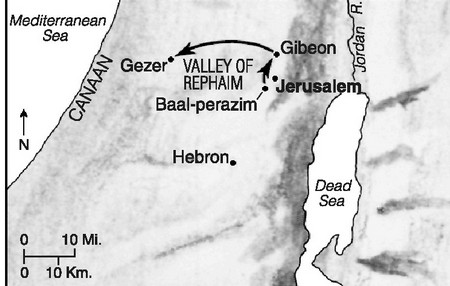
Meanwhile, back to David and the Philistines at Jerusalem, the Philistines came and spread themselves out in the Valley of Rephaim, which this map borrowed from Precept Austin shows to be just west of Jerusalem.


(2 Samuel 23:13) And three of the thirty chief went down and came to David in the harvest time to the cave of Adullam, and the troop of the Philistines pitched in the valley of Rephaim.

Three of David's chief men went to him in the cave of Adullam where he had apparently gone when the Philistines came and pitched in the Valley of Rephaim.

(14) And David was then in a hold, and the garrison of the Philistines was then in Bethlehem.

This map borrowed from BibleWalks shows in more detail the Valley of Rephaim in the upper right quadrant of the map with Jerusalem in the far right and Bethlehem about six miles south which is where the Philistines were then while David was in the cave of Adullam in the lower left quadrant of the map:


(15) And David longed, and said, "Oh that one would give me drink of the water of the well of Bethlehem which is by the gate."

David longingly said he wished he could have a drink of the water from the well of Bethlehem which is said to be about three-quarters of a mile to the north of Bethlehem, subsequently called David's well.

(16) And the three mighty men broke through the host of the Philistines and drew water out of the well of Bethlehem that was by the gate and took it and brought it to David. Nevertheless he would not drink of it but poured it out to the Lord.

The three mighty men took it upon themselves to break through the army of the Philistines to go to the well of Bethlehem and bring water back to David.  However, David did not drink it but poured it out before the Lord.

(17) And he said, "Be it far from me, O Lord, that I should do this. Is this not the blood of the men who went in jeopardy of their lives?" Therefore he would not drink it. These things did these three mighty men.

Evidently David had not expected anyone to actually go get him water from the well.  He had just meant to express that it would have been welcome at that time.  He felt he could not drink the water because it represented the blood of the men who had risked their lives just to bring him water.  This was one of the exploits of those three mighty men.  

(1 Chronicles 11:15) Now three of the thirty captains went down to the rock to David, into the cave of Adullam; and the host of the Philistines encamped in the valley of Rephaim. (16) And David was then in the hold, and the Philistines' garrison was then at Bethlehem. (17) And David longed, and said, "Oh that one would give me drink of the water of the well of Bethlehem, that is at the gate!" (18) And the three broke through the host of the Philistines, and drew water out of the well of Bethlehem, that was by the gate, and took it, and brought it to David, but David would not drink of it, but poured it out to the LORD, (19) And said, "My God forbid it me, that I should do this thing. Shall I drink the blood of these men who have put their lives in jeopardy? For with the jeopardy of their lives they brought it." Therefore he would not drink it. These things did these three mightiest.

1 Chronicles 11 told of the same incident, almost verbatim.

(2 Samuel 5:19) And David enquired of the Lord, saying, "Shall I go up to the Philistines? Will You deliver them into my hand?" And the Lord said to David, "Go up, for I will doubtless deliver the Philistines into your hand."

Then David asked the Lord if he should go out to the Philistines and if He would deliver them into his hands.  The Lord answered David that he should go forth for He would certainly deliver them into his hands.

(20) And David came to Baal Perazim, and David struck them there, and said, "The Lord has broken forth upon my enemies before me as the breach of waters." Therefore he called the name of that place Baal Perazim.

It seems the Philistines, at least some of them, had moved to a place later called Baal Perazim which was said to be in between Bethlehem and Jerusalem.  David struck them there, and said that the Lord had broken forth on the Philistines as floods or rivers of waters overflow a land and overturn all that stands in their way.  He called the place Baal Perazim which literally meant "possessor of breaches" or "lord of the breaks."

(21) And there they left their images, and David and his men burned them.

The Philistines had left their images, their false gods, which they had no doubt brought with them to protect and defend them and give them victory over the Israelites.  David and his men burned all their images.

(1 Chronicles 14:10) And David enquired of God, saying, "Shall I go up against the Philistines? And will You deliver them into my hand?" And the LORD said to him, "Go up, for I will deliver them into your hand." (11) So they came up to Baal Perazim; and David struck them there. Then David said, "God has broken in on my enemies by my hand like the breaking forth of waters." Therefore they called the name of that place Baal Perazim. (12) And when they had left their gods there, David gave a commandment, and they were burned with fire.

1 Chronicles 14 told of the same incident with only a little added detail that David commanded the pagan gods to be burned which they then were.

(2 Samuel 5:22) And the Philistines came up yet again and spread themselves in the valley of Rephaim.

More Philistines came forth and spread themselves in the valley of Rephaim.

(23) And when David enquired of the Lord, He said, "You shall not go up, but circle around behind them and come upon them over against the mulberry trees."

David wisely consulted his Lord before each of his advances, for the Lord told him this time not to go forth against the Philistines, but to encircle them from behind specifically in an area across from mulberry trees.

(24) "And let it be when you hear the sound of a going in the tops of the mulberry trees, then you shall stir yourself, for then shall the Lord go out before you to strike the host of the Philistines."

The Lord went on to instruct David that when he heard the rustling of the trees indicating the advancement of the Philistines, he was then to move toward the Philistines for the Lord would go out before him to strike them.  The Lord purposely used different methods to keep David dependent on Him.  If He struck His enemies the same way every time, David could become complacent and believe it was of himself that his enemies were overcome.

(25) And David did so as the Lord had commanded him and struck the Philistines from Gibeon until you come to Gezer.

David did as the Lord instructed and struck the Philistines all across the valley of Rephaim from Gibeon to Gezer, as seen on the first map above.

(1 Chronicles 14:13) And the Philistines yet again spread themselves abroad in the valley. (14) Therefore David enquired again of God, and God said to him, "Go not up after them; turn away from them, and come upon them over against the mulberry trees. (15) And it shall be, when you shall hear a sound of going in the tops of the mulberry trees, then you shall go out to battle, for God is gone forth before you to strike the host of the Philistines." (16) David therefore did as God commanded him, and they struck the host of the Philistines from Gibeon even to Gezer.

1 Chronicles 14 told of the same incident.

(17) And the fame of David went out into all lands, and the Lord brought the fear of him upon all nations.

Because of his exploits, David became famous throughout the surrounding lands, and the Lord caused the nations to fear him.

(1 Chronicles 13:1) And David consulted with the captains of thousands and hundreds, with every leader.

Then David consulted with all the captains of his troops of varying numbers.

(2) And David said to all the congregation of Israel, "If it seems good to you and of the Lord our God, let us send abroad to our brethren everywhere left in all the land of Israel and with them to the priests and Levites in their cities and suburbs, that they may gather themselves to us."

David spoke to the representatives of all the congregation of Israel and suggested that if it seemed good to them and was in accord with the will of God, they should send word to all their brethren left in Israel who had not yet come there and to all the priests and Levites, that they all might gather there to them.

(3) "And let us bring again the ark of our God to us for we did not enquire at it in the days of Saul.

David proposed that they should bring the ark of the Lord, that symbol of God's divine presence, to the royal city, for they had not enquired of it in the days of Saul, him being rather indifferent to it.

(4) And all the congregation said that they would do so, for the thing was right in the eyes of all the people.

All the congregation of Israel agreed that was what they should do as it seemed right to all of them.  One of David's first concerns as king was to restore religion which had been corrupted and neglected in the days of Saul.

Sunday, June 14, 2026

David Anointed King Over All of Israel

Continuing a chronological Bible study:

(2 Samuel 5:1) Then came all the tribes of Israel to David to Hebron, and spoke, saying, "Behold we, your bone and your flesh."

In the last chapter and post, Ishbosheth, the acting king of all Israel except for Judah where David was king, had been murdered, and David had the murderers executed for their crime.  Now representatives of all the tribes of Israel came to David.  They spoke to David and began by telling him they acknowledged that they were all part of the family of Israel.

(2) "Also in time past, when Saul was king over us, you were he who led out and brought in Israel, and the Lord said to you, 'You shall feed My people Israel, and you shall be a captain over Israel.'"

The reps told David that they realized that when Saul was king of all Israel, it had been David who led out the armies of Israel to fight against their enemies, obtained victories, and brought them home again.  They also acknowledged that the Lord had said that David was to tend His flock, His people Israel, and that He was to reign over them.  Once again, as in 2 Samuel 3:18, we have words quoted as the Lord's words of which we don't find in the Bible.  The Lord probably did say those words at some point, and they had become known by the people.

(3) So all the elders of Israel came to the king to Hebron, and King David made a league with them in Hebron before the Lord, and they anointed David king over Israel.

Then all the elders of Israel came to David at Hebron, and David made an agreement with them, surely promising to rule over all of Israel justly and righteously, and this he did before the Lord and in His name, I'm sure.  So the elders anointed David king over all of Israel. 

(1 Chronicles 11:1) Then all Israel gathered themselves to David to Hebron, saying, "Behold we, your bone and your flesh."

This same incident is recorded in 1 Chronicles 11.  Representatives of all Israel, as all the people of Israel could not have all come, came to David acknowledging that they were all of one family of Israel.

(2) "And moreover in time past, even when Saul was king, you were he who led out and brought in Israel, and the Lord your God said to you, 'You shall feed My people Israel, and you shall be ruler over My people Israel." (3) Therefore came all the elders of Israel to the king to Hebron, and David made a covenant with them in Hebron before the Lord, and they anointed David king over Israel, according to the word of the Lord by Samuel.

As stated before, the reps acknowledged that even when Saul was king, it was David who had led the troops to victories and brought them home again.  They also knew that the Lord had told David he was to rule over Israel.  So the elders of Israel came to David, and David made a covenant with all Israel, and they anointed him king of all Israel as the Lord had determined when He spoke to the prophet Samuel (1 Samuel 16:1).

(1 Chronicles 12:23) And these are the numbers of the bands ready armed for war who came to David to Hebron to turn the kingdom of Saul to him, according to the word of the Lord.

1 Chronicles 12 numbers the men who were able men of war who came to David in Hebron to make him king over all of Israel in the following verses.

(24) The children of Judah who bore shield and spear, six thousand and eight hundred, ready armed for war.

From the tribe of Judah that had already made David their king, 6800 armed men ready for war came to David.

(25) Of the children of Simeon, mighty men of valor for war, seven thousand and one hundred. (26) Of the children of Levi, four thousand and six hundred.

From the tribe of Simeon, 7100 valiant men of war came to David.  Even from the tribe of Levi, who were the priests and their attendants, 4600 men came to David.

(27) And Jehoiada was the leader of the Aaronites, and with him, three thousand and seven hundred; (28) And Zadok, a young man mighty of valor, and of his father's house, twenty-two captains.

The Aaronites were Levites, but these would have been direct descendants of Aaron.  Jehoiada was captain over that family, and he alone brought 3700 men with him.  Also from the tribe of Levi came Zadok, a young man of valor, and 22 captains from his father's house.

(29) And of the children of Benjamin, the kindred of Saul, three thousand (for until then the greatest part of them had kept the ward of the house of Saul).

Only 3000 men came from the tribe of Benjamin, as it seems being of the family of Saul, most men maintained their allegiance to the house of Saul up to that point.

(30) And of the children of Ephraim, twenty thousand and eight hundred mighty men of valor, famous throughout the house of their fathers. 

From the tribe of Ephraim, a whopping 20,800 famous men of valor came to David in Hebron.

(31) And of the half tribe of Manasseh, eighteen thousand who were expressed by name to come and make David king.

From the half tribe of Manasseh that was on the same side of the Jordan River, 18,000 men who were expressly named, either specifically called by name for the purpose, or by volunteering by name, came to David to make him king.

(32) And of the children of Issachar who had understanding of the times to know what Israel ought to do, the heads of them were two hundred, and all their brethren were at their command.

The men of the tribe of Issachar it seems had a unique understanding of the times to know what Israel should do.  There were two hundred heads, and the rest were at their command, apparently having full confidence in their leaders' direction.  Perhaps this meant only 200 went to David to make him king, but all the tribe would have been in agreement that he should be made king.

(33) Of Zebulun, such as went forth to battle, expert in war, with all instruments of war, fifty thousand who could keep rank, not of double heart.

The tribe of Zebulun sent 50,000 men of war who were experts in all instruments of war and ready to organize and go to war if necessary.  These men were steadfast in their loyalty to David.

(34) And of Naphtali, a thousand captains, and with them with shield and spear, thirty-seven thousand.

The tribe of Naphtali sent 1000 captains and 37,000 armed men with them.

(35) And of the Danites, expert in war, twenty-eight thousand and six hundred. (36) And of Asher, such as went forth to battle, expert in war, forty thousand.

From the tribe of Dan came 28,600, and from Asher, 40,000, all men expert in war.

(37) And on the other side of Jordan, of the Reubenites, and the Gadites, and of the half tribe of Manasseh, with all manner of instruments of war for the battle, a hundred and twenty thousand.

From the eastern side of the Jordan River came 120,000 men from the tribes of Reuben, Gad, and the other half tribe of Manasseh, with all manner of instruments of war with them.

(38) All these men of war who could keep rank, came with a perfect heart to Hebron to make David king over all Israel, and all the rest also of Israel were of one heart to make David king.

All these mighty men of valor, well-disciplined and well able to organize for war, if necessary, came with a perfect heart and one mind to make David king over all of Israel.  And it seems that by that time, all of Israel was unanimous in making David king, even the tribe of Benjamin, Saul's tribe.

(39) And there they were with David three days, eating and drinking, for their brethren had prepared for them. (40) Moreover, they who were near them, even to Issachar and Zebulun and Naphtali, brought bread on asses, and on camels, and on mules, and on oxen, meat, meal, cakes of figs, and bunches of raisins, and wine, and oil, and oxen, and sheep abundantly, for there was joy in Israel.

All these tens of thousands of men were with David for three days, celebrating, eating, and drinking, for their brethren who were near enough to them, even as far as the tribes of Issachar, Zebulun, and Naphtali, brought huge amounts of food and wine on all animals that could carry it.  There was great joy in Israel for the people were united again as one people Israel under King David.  This map borrowed from Maps of the World shows the twelve tribes at this time:

(1 Chronicles 29:26) Thus David the son of Jesse reigned over all Israel.

From that point onward, David reigned over all of Israel.

(2 Samuel 5:5) In Hebron he reigned over Judah seven years and six months, and in Jerusalem he reigned thirty-three years over all Israel and Judah.

David had reigned over Judah in Hebron for seven years and six months.  He was about to begin his reign over all of Israel which would last thirty-three years.

Saturday, June 13, 2026

Ishbosheth Is Murdered

Continuing a chronological Bible study:

(2 Samuel 4:1) And when Saul's son heard that Abner was dead in Hebron, his hands were feeble, and all the Israelites were troubled.

In the last chapter and post, Abner had joined forces with David, but Joab accused him of deception and killed him, unbeknownst to David.  When Saul's son Ishbosheth, who Abner had set up as king over Israel, heard that he was dead, his hands probably trembled in fear.  But the meaning may more likely be that his hands were weakened because in Abner, he had lost his main support and strength.  All the Israelites were troubled by the news of Abner's death.

(2) And Saul's son had two men, captains of bands, the name of the one Baanah, and the name of the other Rechab, the sons of Rimmon a Beerothite of the children of Benjamin (for Beeroth also was reckoned to Benjamin, (3) And the Beerothites fled to Gittaim and were sojourners there until this day).

Ishbosheth had two men who were captains of troops in his army, two brothers, Baanah and Rechab, sons of Rimmon, a Beerothite of the tribe of Benjamin.  The Beerothites had previously fled from Beeroth to Gittaim, another city in Benjamin, probably at the news of Saul's death (1 Samuel 31:7), gathered from what follows in the next verse.  

(4) And Jonathan, Saul's son, had a son lame of feet. He was five years old when the tidings came of Saul and Jonathan out of Jezreel, and his nurse took him up and fled, and it came to pass, as she made haste to flee, that he fell and became lame. And his name was Mephibosheth.

Saul's eldest son, Jonathan, had a son named Mephibosheth who was five years old when his father and grandfather were killed.  When the news came of their death, the boy's nurse scooped him up and fled, but at some point, he fell and became permanently lame.

(5) And the sons of Rimmon the Beerothite, Rechab and Baanah, went and came about the heat of the day to the house of Ishbosheth, who lay on a bed at noon.

Back to Ishbosheth's two captains, Rechab and Baanah, they went into the house of Ishbosheth one day during the heat of the day when Ishbosheth rested on his bed.

(6) And they came there into the midst of the house, as though they would have fetched wheat, and they struck him under the fifth rib, and Rechab and Baanah his brother escaped. (7) For when they came into the house, he lay on his bed in his bedchamber, and they struck him, and killed him, and beheaded him, and took his head, and got away through the plain all night.

Rechab and Baanah, who were captains in Ishbosheth's own army, came into his house as though they were just fetching some wheat as must have been customary for them to do to feed the soldiers.  However, they went into Ishbosheth's bedchamber and stabbed him under the fifth rib as he rested on his bed.  Under the fifth rib appears to be the deliberate choice of murderers as this is the third time in recent study someone has been stabbed and killed in that location.  That is roughly the location of the lung or heart and would prove to be a fatal wound.  After they killed him, the brothers beheaded him and took his head and escaped into the plains where they apparently ran the rest of the day and all night.

(8) And they brought the head of Ishbosheth to David to Hebron, and said to the king, "Behold the head of Ishbosheth the son of Saul your enemy who sought your life, and the Lord has avenged my lord the king this day of Saul and of his seed."

They took Ishbosheth's head to David at Hebron, expecting him to consider it a very acceptable gift, as they presented it as being of his enemy who had sought his life and claimed it was of the Lord who had avenged him of Saul and his offspring.

(9) And David answered Rechab and Baanah his brother, the sons of Rimmon the Beerothite, and said to them, "As the Lord lives who has redeemed my soul out of all adversity, (10) When one told me, saying, 'Behold, Saul is dead,' thinking to have brought good tidings, I took hold of him and killed him in Ziklag who thought that I would have given him a reward for his tidings, (11) How much more, when wicked men have slain a righteous person in his own house on his bed? Shall I not therefore now require his blood of your hand and take you away from the earth?"

David answered the brothers in a way they had not expected.  First of all, he acknowledged that the Lord had been the one to deliver his soul out of all adversity; he did not need the aid of murderers.  He told them of the time when the young man came to him to tell him of Saul's death (and how he had finished him off), thinking David would have thought that good news and perhaps rewarded him, he instead had him killed (2 Samuel 1:15).  He rhetorically asked the brothers how much more should he do to wicked men who had slain a righteous man in his own house in his own bed.

(12) And David commanded his young men, and they killed them, and cut off their hands and their feet, and hanged them up over the pool in Hebron. But they took the head of Ishbosheth and buried it in the sepulchre of Abner in Hebron.

David commanded his men to kill Rechab and Baanah.  They cut off their hands and their feet and then hanged them up over the pool in Hebron.  Dr. John Gill, in his Exposition of the Bible, said that they cut off the hands because those had killed Ishbosheth, and they cut off the feet because those had taken them into Ishbosheth's house and bedchamber to kill him.  The Jews called it measure for measure.  Then David and his men took the head of Ishbosheth and buried it in the sepulcher of Abner in Hebron.

David was showing himself to be a just king.  Even though these men had killed a supposed enemy to David, as well as the man who killed Saul, David's fiercest enemy, David showed a strict regard for justice.  Those murderers had taken the law into their own hands and had executed men who were at the time innocent according to the law.  David would not allow vigilante justice.  David, as king, would render capital punishment, and these men had confessed to the murders, and David had them put to death.  

David had been equally incensed when Joab had murdered Abner, but at the time felt he was too new to the kingdom (and not fully accepted as king of all Israel since Ishbosheth still ruled at the time) to make Joab's execution one of his first acts, especially since he was of high office and very powerful.  David had said that the Lord would judge Joab according to his deed.

Saturday, June 6, 2026

Abner Joins David, But Joab Murders Him

Continuing a chronological Bible study:

(2 Samuel 3:1) Now there was long war between the house of Saul and the house of David, but David waxed stronger and stronger, and the house of Saul waxed weaker and weaker.

In the last chapter and post, David had been anointed king over Judah, and even though Saul was dead, the captain of his army, Abner, made Saul's son Ishbosheth king over Israel, all of Israel except Judah, that is.  There was war between the two factions, but it seems David's men must have usually won the battles as David grew stronger and the house of Saul grew weaker.

(2) And to David were sons born in Hebron, and his firstborn was Amnon of Ahinoam the Jezreelitess;

While David reigned in Hebron, sons were born to him.  His firstborn son was Amnon, and his mother was Ahinoam, David's wife, the Jezreelitess.

(3) And his second, Chileab, of Abigail the wife of Nabal the Carmelite; and the third Absalom the son of Maacah the daughter of Talmai king of Geshur;

David's second son was born to his wife Abigail, the widow of Nabal, and his name was Chileab.  Apparently, David took a third wife, Maacah, daughter of Talmai king of Geshur, and she gave him his son, Absalom.

(4) And the fourth, Adonijah the son of Haggith; and the fifth, Shephatiah the son of Abital; (5) And the sixth, Ithream, by Eglah David's wife. These were born to David in Hebron.

It appears that David married as many wives as he had sons, or rather vice versa.  His fourth wife was Haggith and she gave him Adonijah; his fifth wife Abital gave him Shephatiah, and his sixth wife, Eglah, gave him Ithream.  These six sons were born to David in Hebron.

(1 Chronicles 3:1) Now these were the sons of David who were born to him in Hebron, the firstborn Amnon of Ahinoam the Jezreelitess; the second Daniel, of Abigail the Carmelitess;

1 Chronicles 3 also named David's sons.  However, Chileab, the son of Abigail, is called Daniel here.  Daniel is probably his real given name.  Chileab means "like his father," so that may have been a nickname as Junior might be now because he was so much like his father.

(2) The third Absalom the son of Maacah, the daughter of Talmai, king of Geshur; the fourth, Adonijah the son of Haggith; (3) The fifth, Shephatiah of Abital; the sixth, Ithream by Eglah his wife. (4) These six were born to him in Hebron, and there he reigned seven years and six months, and in Jerusalem he reigned thirty-three years.

The rest of David's sons who were born to him in the seven and a half years he reigned in Hebron are repeated.  David then reigned in Jerusalem for thirty-three years.

(2 Samuel 3:6) And it came to pass, while there was war between the house of Saul and the house of David, that Abner made himself strong for the house of Saul.

During the time there was war between the house of David and the house of Saul, Abner was strong in his support for the house of Saul.

(7) And Saul had a concubine whose name was Rizpah, the daughter of Aiah; and Ishbosheth said to Abner, "Why have you gone in to my father's concubine?"

Saul had a concubine whose name was Rizpah, and it seems that Abner had had sexual relations with her, and Saul's son Ishbosheth demanded to know why he had done such a thing.

(8) Then was Abner very angry for the words of Ishbosheth, and said, "Am I a dog's head, which against Judah do show kindness this day to the house of Saul your father, to his brethren, and to his friends, and have not delivered you into the hand of David, that you charge me today with a fault concerning this woman?"

Abner was angry with Ishbosheth because of his accusation against him, although he did not really deny it.  He asked Ishbosheth if he was no better than the head of a dead dog who did not care with whom he lay.  He who had defended the house of Saul, his brethren, and his friends, against the tribe of Judah, and had not allowed him to be delivered into the hand of David, he that loyal supporter of Saul, that is who Ishbosheth dared to accuse of fault concerning Saul's concubine.  Abner might have actually been owning up to the fact that he had had sexual relations with Saul's concubine, but that it could not be seen as a fault because of his fierce loyalty to the house of Saul.

(9) "So do God to Abner, and more also, except, as the Lord has sworn to David, even so I do to him, (10) To transfer the kingdom from the house of Saul, and to set up the throne of David over Israel and over Judah, from Dan to Beersheba."

Abner was so angry that he wished God to destroy him if he did not see that the kingdom of Saul was transferred to David to be king over all of Israel.  It's interesting that he apparently knew all along what the will of God was, but he was actively working against it to set up Ishbosheth as king.  That confirms that he had probably been doing it for only his own self-interests.  Now God used Abner's desire for revenge against Ishbosheth to bring forth His will to have David king over all Israel.

(11) And he could not answer Abner a word again because he feared him.

Ishbosheth had nothing to say to Abner because he feared him.  After all, it was Abner who had made him king, and with the king's army at his command, Abner could easily take him out.

(12) And Abner sent messengers to David on his behalf, saying, "Whose is the land?" Saying, "Make your league with me, and behold, my hand will be with you to bring about all Israel to you."

Abner then sent messengers to David on his own behalf, not from Ishbosheth.  I believe his point was that he was acknowledging that the land was David's, and that he now desired to make a covenant of friendship with him, and he would do everything he could to bring all of Israel under his reign.

(13) And he said, "Well, I will make a league with you, but one thing I require of you, that is, you shall not see my face except you first bring Michal Saul's daughter, when you come to see my face."

David agreed it was well and good to join with Abner, but first before that could happen, Abner must bring David's wife Michal, Saul's daughter, to him.  It seems that even though David had had six wives since Michal, he must have still cared for her, or perhaps it was to demonstrate honor to Saul's family that his daughter might share with him the benefits of his reign.

(14) And David sent messengers to Ishbosheth Saul's son, saying, "Deliver my wife Michal whom I espoused to me for a hundred foreskins of the Philistines."

David then sent messengers to Ishbosheth telling him to deliver his wife Michal to him.  David added that he had purchased her at a great expense and danger to his life by killing a hundred Philistines and bringing their foreskins to Saul as he required in order to marry his daughter (1 Samuel 18:25).

(15) And Ishbosheth sent and took her from her husband, from Phaltiel the son of Laish.

Ishbosheth had Michal removed from her husband, Phaltiel, or Phalti, as he was called in 1 Samuel 25:44, when it was first told that Saul had given his daughter to him.

(16) And her husband went with her along weeping behind her to Bahurim. Then Abner said to him, "Go, return." And he returned.

Michal's current husband went along with her as far as Bahurim, a city in the tribe of Benjamin, because he evidently loved her very much and did not want to lose her, but he was forced to give her up by command of the king and the king's captain.

(17) And Abner had communication with the elders of Israel, saying, "You sought for David in times past to be king over you. (18) Now then do it, for the Lord has spoken of David, saying, 'By the hand of my servant David I will save My people Israel out of the hand of the Philistines and out of the hand of all their enemies.'"

Abner communicated with the elders of Israel, reminding them that it was generally known that David had been anointed to be king over Israel, certainly after Saul's death.  He encouraged them to now make David their king, implying he would no longer oppose him.  He reminded them of the words of the Lord declaring that it would be David who would save Israel out of the hand of the Philistines and all their enemies.  There is no record in the Bible of the Lord saying those words, but He probably did say them to Samuel when He first said He wanted David as king, and they were not recorded, but probably verbally passed down and now general knowledge.

(19) And Abner also spoke in the ears of Benjamin, and Abner went also to speak in the ears of David in Hebron all that seemed good to Israel and that seemed good to the whole house of Benjamin.

Abner spoke these same words especially to the tribe of Benjamin of which was the family of Saul.  He spoke these same words in the hearing of David, or perhaps the meaning is rather that after speaking to the elders of the other tribes, he brought the news to David that all were agreeable that David should be king over them.

(20) So Abner came to David to Hebron, and twenty men with him. And David made Abner and the men with him a feast. (21) And Abner said to David, "I will arise and go and will gather all Israel to my lord the king, that they may make a league with you, and that you may reign over all that your heart desires." And David sent Abner away, and he went in peace.

Abner went to David in Hebron with twenty men.  David received them and made a feast for them.  Abner told David that he would go and do all he could to gather all of Israel to come into agreement with David as their king.  He said he would do this so that David could reign over all that his heart desired, although David had not expressed any impatience to take over the entire kingdom, but had been content to wait on God's timing.  David sent Abner on his way in peace, having made a covenant of peace with him.

(22) And behold, the servants of David and Joab came from a troop and brought in a great spoil with them, but Abner was not with David in Hebron, for he had sent him away, and he was gone in peace. (23) When Joab and all the host with him had come, they told Joab, saying, "Abner the son of Ner came to the king, and he has sent him away, and he has gone in peace."

After Abner had left David, Joab, the captain of David's army, came with his men, apparently after some military excursion against the enemy, and they brought in a very large spoil after evidently conquering the enemy.  Some in David's court told Joab about Abner coming to David, and instead of seizing him, David had allowed him to go in peace.

(24) Then Joab came to the king, and said, "What have you done? Behold, Abner came to you; why is it you have sent him away, and he is quite gone?"

Joab asked David what he had done in allowing Abner to come to him and letting him go in peace, implying that he should have seized him as the enemy.

(25) "You know Abner the son of Ner, that he came to deceive you and to know your going out and your coming in and to know all that you do."

Joab told David that surely Abner had come to deceive him and to learn his movements in order to surely destroy him.

(26) And when Joab had come out from David, he sent messengers after Abner who brought him again from the well of Sirah, but David did not know it.

When Joab left David, he sent messengers after Abner who was apparently at the well of Sirah, which the historian Josephus said was two and a half miles from Hebron.  The messengers brought him from there back to Joab, but David did not know any of this.

(27) And when Abner was returned to Hebron, Joab took him aside in the gate to speak with him quietly and struck him there under the fifth rib that he died, for the blood of Asahel his brother.

When the messengers brought Abner back to Hebron, Joab met him at the gate and pulled him aside supposedly to speak to him in private, but he stabbed him under the fifth rib, in the same place Abner had struck Joab's brother Asahel, and he died.

(28) And afterward, when David heard, he said, "I and my kingdom are guiltless before the Lord forever from the blood of Abner the son of Ner; (29) Let it rest on the head of Joab and on all his father's house, and let there not fail from the house of Joab one who has an issue, or who is a leper, or who leans on a staff, or who falls on the sword, or lacks bread."

When David heard what Joab had done, he declared that he and his kingdom were guiltless before God forever for the murder of Abner, that it was wholly on the head of Joab and his father's house.  It may be that David made that declaration publicly because Joab was his general, and he wanted it known that he did not command that his general kill Abner, that it was totally on Joab.  David went on to curse the family of Joab, wishing that there would always be one who had an issue of blood, or gonorrhea, as it sometimes meant, or one who was a leper, or one who was lame or fell on a sword or lacked food.  David said this in his anger, but I can't help but think he should have cursed Joab alone, not his innocent family after him.

(30) So Joab and Abishai his brother killed Abner because he had slain their brother Asahel at Gibeon in the battle.

It appears that Abishai was in on the plan to murder Abner because he had killed Asahel, the brother of Joab and Abishai, sons of David's sister, Zeruiah.  So it would appear that David's curse would be on his sister's house, all the more reason he should have directed his anger to Joab and maybe Abishai only.  But he had said it in anger; it was not meant as a prophetic curse.

(31) And David said to Joab and to all the people who were with him, "Rend your clothes, and gird yourself with sackcloth, and mourn before Abner." And King David followed the bier.

David told Joab and all the people with him to mourn Abner by the usual expressions of mourning, by tearing their clothes and putting on sackcloth.  King David followed the bed on which Abner's body was laid and carried to the grave.

(32) And they buried Abner in Hebron; and the king lifted up his voice and wept at the grave of Abner, and all the people wept.

They buried Abner in Hebron.  David wept loudly at the grave of Abner, and all the people with him wept.

(33) And the king lamented over Abner, and said, "Did Abner die as a fool dies?"

David lamented over Abner and said words over his grave.  He asked if Abner had died as a fool dies.  The word that was translated as "fool" is "nabal" and also meant stupid and wicked.  I believe David's point was that Abner had not died as a criminal or for any wickedness he had done.  He was unjustly murdered before his time.

(34) "Your hands were not bound nor your feet put into fetters; as a man falls before wicked men, so you fell." And all the people wept again over him.

Abner had not been bound and fettered as a criminal who knew his fate.  He had fallen as one murdered by wicked men.  This made the people weep again over Abner.  This he said in the presence of Joab whom he had told to mourn Abner with him.

(35) And when all the people came to cause David to eat food while it was yet day, David swore, saying, "So do God to me and more also, if I taste bread or anything else till the sun be down."

The people came to David to persuade him to eat, but he refused, swearing an oath that he wished for God to do the greatest evils against him if he even tasted bread before sundown, as he would continue his mourning for Abner until then.

(36) And all the people took notice, and it pleased them, as whatever the king did pleased all the people. (37) For all the people and all Israel understood that day that it was not of the king to kill Abner the son of Ner.

The people took notice of how David conducted himself throughout the entire death and burial of Abner, and it pleased them, for they understood that David had never intended for Abner to be killed.

(38) And the king said to his servants, "Do you not know that there is a prince and a great man fallen this day in Israel?"

Perhaps in explanation to his servants as to why he mourned the man who had so recently been considered an enemy, David explained that Abner had been a great man and even a prince in the house of Saul, as he was Saul's first cousin and a member of the royal family, as well as having the important position as Saul's general.

(39) "And I am this day weak, though anointed king, and these men the sons of Zeruiah are too hard for me. The Lord shall reward the doer of evil according to his wickedness."

Although David had been anointed king, he was very new to the kingdom and had not yet been fully accepted by all of Israel, but Abner had been working on that.  Joab and Abishai, the sons of David's sister Zeruiah, were yet too powerful for David to make one of his first acts as king to punish them.  He said that the Lord would take care of their just punishment.