Showing posts with label 2 Samuel 6. Show all posts

Friday, September 18, 2026

The Lord's Covenant with David

Continuing a chronological Bible study:

(2 Samuel 6:20) Then David returned to bless his household. And Michal the daughter of Saul came out to meet David, and said, "How glorious was the king of Israel today who uncovered himself today in the eyes of the handmaids of his servants, as one of the vain fellows shamelessly uncovers himself!"

As David brought the ark of the covenant of the Lord into Jerusalem, he ditched his royal robes, wore a linen ephod, and danced with all his might before the Lord (2 Samuel 6:14).  His first wife Michal had watched him from a window and had much disdain for him (2 Samuel 6:16).  Now that the ark was in its place and the celebration had ended, David returned to his house to bless it.  Michal came out to meet him and spoke in an ironical jeering way, meaning the reverse, how inglorious was the king who had put off his royal robes and danced in the street like some low-life commoner.  Her words oozed with contempt, not only for David, but for the people she felt were beneath her class.

(21) And David said to Michal, "It was before the Lord who chose me before your father and before all his house, to appoint me ruler over the people of the Lord, over Israel; therefore will I play before the Lord."

David told Michal he had acted as he had for the Lord, in gratitude and humility for appointing him to be the king of Israel.  He seems to have made it a point to humble her pride by saying that the Lord had chosen him over her father and over his household.  He also made a point of saying he would continue to praise and glorify the Lord with all his might, in any way the Spirit moved him, and would not consider it beneath his dignity. 

(22) "And I will yet be more vile than this and will be base in my own sight, and of the maidservants which you have spoken of, of them shall I be had in honor."

David continued by telling Michal that if she considered his behavior vile that day, he would be even more vile in the future, humbling himself all the more, believing he could never condescend too low to exalt the Lord.  And as for the handmaidens she had spoken of, he would be content with the honor they would give him as he lowered himself to their level, at least that was the way Michal saw it.

(23) Therefore Michal the daughter of Saul had no child to the day of her death.

Michal never had any children, partly because David probably had nothing more to do with her intimately since she despised him so, but maybe more so by God's judgment against her and possibly the fact that He would not have the descendants of David mixed with the descendants of Saul.

(2 Samuel 7:1) And it came to pass, when the king sat in his house, and the Lord had given him rest round about from all his enemies, (2) That the king said to Nathan the prophet, "See now, I dwell in a house of cedar, but the ark of God dwells within curtains."

David was then at peace in his palace made of cedar logs that Hiram king of Tyre had sent him, along with builders to build him a house (2 Samuel 5:11).  He spoke to a prophet Nathan who would become one of David's closest advisors.  It did not seem right to David that he should dwell in his nice cedar house while the ark of God dwelt in a tent with curtains for walls.

(3) And Nathan said to the king, "Go, do all that is in your heart, for the Lord is with you."

At this point, Nathan told the king to go ahead and do whatever was in his heart to do, for the Lord was with him.  While the Lord was indeed with David, it turns out that it was not the Lord's will for David to build Him a house.

(1 Chronicles 17:1) Now it came to pass, as David sat in his house, that David said to Nathan the prophet, "Lo, I dwell in a house of cedars, but the ark of the covenant of the Lord is under curtains." (2) Then Nathan said to David, "Do all that is in your heart, for God is with you."

1 Chronicles 17 told of the same incident.

(2 Samuel 7:4) And it came to pass that night, that the word of the Lord came to Nathan, saying, (5) "Go and tell My servant David, thus says the Lord, 'Shall you build me a house for Me to dwell in?'"

That night the word of the Lord came to Nathan and told him to go to David and tell him His words that began by asking if it was David's intention to build Him a house.

(6) "'Whereas I have not dwelt in a house since the time that I brought up the children of Israel out of Egypt, even to this day, but have walked in a tent and in a tabernacle.'"

The word of the Lord continued to instruct Nathan on what he was to say to David, that ever since He had brought the children of Israel out of Egypt, to this day, He had never dwelt in a permanent house but had dwelt in a tent or tabernacle as it moved from place to place.

(7) "'In all where I have walked with all the children of Israel, have I spoke a word with any of the tribes of Israel, whom I commanded to feed My people, saying, "Why do you not build Me a house of cedar?"'"

The Lord's words continued with what Nathan was to tell David.  He asked if in all the years He had walked with the children of Israel, had He ever told any of the rulers of the tribes that He wanted them to build a permanent house for Him?

(8) "Now therefore, so shall you say to My servant David, 'Thus says the Lord of hosts, "I took you from the sheepfold, from following the sheep, to be ruler over My people, over Israel, (9) And I was with you wherever you went and have cut off all your enemies out of your sight and have made you a great name like to the name of the great who are on the earth."'"

Nathan was to tell David the Lord's words that He had taken him from being a shepherd to be the ruler over His people Israel, and He had been with him all the while during his journey to actually taking the throne, cutting off all his enemies and building his reputation as one of the greatest men in the world.

(10) "'"Moreover, I will appoint a place for My people Israel and will plant them that they may dwell in a place of their own and move no more; neither shall the children of wickedness afflict them anymore as before; (11) And as since the time that I commanded judges over My people Israel and have caused you to rest from all your enemies."' Also the Lord tells you that He will make you a house."

Through the Lord's words Nathan was to tell David, the Lord was appointing the place where His people Israel could rest in their own place and have no need to move anymore.  He had promised them the land of Canaan, but they had not been entirely alone and were much distressed by the former inhabitants of the land.  The clauses are a bit difficult to navigate, but I believe the sense is that although the children of Israel had been in their promised land for a while, now with this kingdom of David, the Lord would establish His people in their land and give them peace from all their enemies.  And to David, He would make a great house, a kingdom.

(12) "'And when your days be fulfilled and you shall sleep with your fathers, I will set up your descendant after you who shall proceed out of your body, and I will establish his kingdom.'"

When the days of David's life were fulfilled, and he was laid to rest with his forefathers, then the Lord would set up his descendant after him, one who "shall proceed" from him, meaning a future descendant, and the Lord would establish that descendant's kingdom.

(13) "'He shall build a house for My name, and I will establish the throne of his kingdom forever.'"

The Lord said that that descendant of David's, whom we know to be Solomon, would be the one to build the Lord's house for the honor and glory of His name, and He would establish the throne of that descendant's kingdom forever, and that is because the Messiah would descend from him, and His reign would be forever.

(14) "'I will be his Father, and he shall be My son. If he commits iniquity, I will chasten him with the rod of men and with the stripes of the children of men, (15) But My mercy shall not depart away from him, as I took from Saul whom I put away before you.'"

The Lord would be as a father to David's descendant, chastising him when necessary by the means of men, but His mercy would always be with him.  He would never take His mercy away from David's descendant as He had removed it from Saul when He removed him from the throne in favor of David.

(16) "'And your house and your kingdom shall be established forever before you; your throne shall be established forever.'"

The Lord promised David that his house and his kingdom would be established forever.  And that's a promise that could not be made to any earthly king except for the one from whose line would come the Messiah.  How blessed was David to have this special covenant with his Lord!

(17) According to all these words and according to all this vision, so Nathan spoke to David.

Nathan told David all the words of the Lord that he had seen and heard in a vision, even though it contradicted what he had told David before.  Nathan was a Godly prophet who was faithful to the word of God.

The same incident was recorded in 1 Chronicles 17:

(1 Chronicles 17:3) And it came to pass the same night, that the word of God came to Nathan, saying, (4) "Go and tell David My servant, 'Thus says the Lord, "You shall not build Me a house to dwell in, (5) For I have not dwelt in a house since the day that I brought up Israel to this day, but have gone from tent to tent and from tabernacle. (6) Wherever I have walked with all Israel, did I speak a word to any of the judges of Israel whom I commanded to feed My people, saying, 'Why have you not built me a house of cedars?'"' (7) Now therefore, thus shall you say to My servant David, 'Thus says the Lord of hosts, "I took you from the sheepfold, from following the sheep, that you should be ruler over My people Israel."'"

This account varies little from the account in 2 Samuel 7.  At this point, I was struck by another observation that didn't hit me in the other account.  David in the Old Testament was said to be a type of Christ, his throne a precursor for Christ the King who would sit on David's throne forever.  God called David from a shepherd of sheep to be a shepherd of His people.  Jesus called His disciples from fishermen of fish to be fishers of men (Matthew 4:19).

(8) "'"And I have been with you wherever you have walked and have cut off all your enemies from before you and have made you a name like the name of the great men who are in the earth. (9) Also I will ordain a place for My people Israel and will plant them, and they shall dwell in their place and shall be moved no more; neither shall the children of wickedness waste them anymore, as at the beginning, (10) And since the time that I commanded judges over My people Israel. Moreover I will subdue all your enemies."' Furthermore I tell you that the Lord will build you a house. (11) '"And it shall come to pass, when your days are expired that you must go with your fathers, that I will raise up your seed after you, which shall be of your sons, and I will establish his kingdom. (12) He shall build Me a house, and I will establish his throne forever. (13) I will be his father, and he shall be My son, and I will not take My mercy away from him, as I took from him who was before you, (14) But I will settle him in My house and in My kingdom forever, and his throne shall be established forevermore."'" (15) According to all these words, and according to all this vision, so did Nathan speak to David.

Again, these are pretty much the same words as in the account in 2 Samuel 7 with little variance.

(2 Samuel 7:18) Then King David went in and sat before the Lord, and he said, "Who am I, O Lord God? And what is my house, that You have brought me this far?"

David went into the tabernacle he had prepared for the ark and sat before the Lord.  In humility, he asked the Lord why he, a sinful unworthy creature, and his family, should be given all the blessings and honor the Lord had given him thus far.

(19) "And this was yet a small thing in Your sight, O Lord God, but You have spoken also of Your servant's house for a great while to come. And is this the manner of men, O Lord God?"

Bringing David to the throne thus far was a small thing compared to the future kingdom of his house the Lord promised would be forevermore.  Then David asked a rhetorical question, if similar treatment to such an inferior as David was to God, would ever be done by men, and the obvious answer was no, so he marveled that the Lord would do so for him.

(20) "And what can David say more to You? For You, Lord God, know Your servant."

What more could David say?  Words could not express his sense of humble gratitude, but the Lord knew his heart.

(21) "For Your word's sake, and according to Your own heart, You have done all these great things to make Your servant know."

For the sake of the Lord's word that David would be made king and his kingdom established forevermore, and according to His heart, His own pleasure, mercy, and grace, and not according to any merits or deeds of David, the Lord had done all these great things.  And He had let David know the future plans He had for David's kingdom through these words he had just received from Nathan.

(22) "Therefore You are great, O Lord God, for none is like You, neither any God besides You, according to all that we have heard with our ears."

The translation "therefore" just doesn't sit well with me.  What?  Because God did all these wonderful things for David, therefore He is great?  Actually, there were two words that were translated as "therefore," "al" meaning "on account of" and "ken" meaning "rightly, so."  I can see why the translators used "therefore" and "wherefore," but I rather think it was intended to be more like "on account of Your being great, O Lord, it rightly follows You have done all these great things."  Because God's very nature is greatness and goodness, He can be nothing but, and there is no all-good, all-powerful, all-seeing, God, but Him.  David understood that, not only because of what the Lord had done for him, but for everything people had heard about in history, like God's deliverance of His people from Egypt.

(23) "And what one nation in the earth is like Your people, like Israel, whom God went to redeem for a people to Himself and to make Him a name and to do for You great things and terrible, for Your land, before Your people whom You redeemed to You from Egypt, the nations and their gods?"

David asked the rhetorical question of what nation in all the earth was like Israel, the people God chose to make His people, whom He went to Egypt to deliver out of bondage, to make His great name known and glorified, as well as His people's, because of all the great and awesome things He did and they did through Him, for His promised land, the land He promised for His people, those miraculous things He did when redeeming His people from Egypt, as well as from the Canaanite nations and their gods.

(24) "For You have confirmed to Yourself Your people Israel a people to You forever, and You, Lord, have become their God."

The Lord had confirmed for Himself His people Israel, not for anything they had done, but just because He chose them.  He chose them to be His people forever and made a covenant with them that they would make Him their God, following only Him and His word and His commandments.

(25) "And now, O Lord God, the word that You have spoken concerning Your servant and concerning his house, establish it forever and do as You have said."

David prayed that the Lord do as He promised.  My first reaction was why?  God had already said that He would.  But those covenants with God are two-sided and conditional, and it appears that David realized that.  If he or his posterity after him did not walk with God, they would be driven from the throne.  Therefore, he prayed that these things would indeed be established forever.

A flood of thoughts come to me regarding this.  I find myself accepting a word from God as a done deal, or that is my goal, so I do not have to constantly pray for it.  However, Ezekiel 36:37 says, "Thus says the Lord God, 'I will yet for this be enquired of by the house of Israel, to do it for them...'"  This was after promises He had made for His people.  He had promised, but He still would be inquired of by the people.  This seems to imply that He wants us to continually pray for the thing He has promised.  I can see that this makes us conscious of the fact that it is only through Him that those promises are fulfilled, and it keeps us ever dependent on Him, our only source of life and salvation.  

However, somehow I believe those promises God makes will be fulfilled, regardless of what we do.  We might just not be a part of it.  Even though the people and even David's descendant kings rebelled against God, God still established His kingdom forever through Jesus Christ, the Messiah.  He just did it without His people Israel, but we should be ever thankful that it worked out the way it did.  That was the only way that we Gentiles were able to be grafted into the house of God's people.

(26) "And let Your name be magnified forever, saying, 'The Lord of hosts is the God over Israel,' and let the house of Your servant David be established before You."

David desired that those things the Lord promised would magnify and glorify God, and that the world would recognize that the one true God of all the universe was over Israel and protected and blessed its people.  Once again, David prayed that the Lord's word that his house would be established before Him would come to fulfillment.

(27) "For You, O Lord of hosts, God of Israel, have revealed to Your servant, saying, 'I will build you a house.' Therefore has Your servant found in his heart to pray this prayer to You."

Because the all-powerful, sovereign, one true God of the universe, and God over Israel, had blessed him so by telling him He would build his house, his heart overflowed with feelings he had to pour out to God.  John Wesley wrote, "That prayer that is found in the tongue only will not please God. It must be found in the heart. That must be lifted up and poured out before God."  I would add what Paul said in Romans 8:26, "Likewise the Spirit also helps our infirmities, for we know not what we should pray for as we ought, but the Spirit itself makes intercession for us with groanings which cannot be uttered."  Those are the things of the heart, not just vain repetitions (Matthew 6:7).

(28) "And now, O Lord God, You are that God, and Your words be true, and You have promised this goodness to Your servant."

David professed that his Lord was that one true Lord of hosts, God of the universe, and God of Israel, and His words were always true.  That is God's very nature; He can be nothing but true.  And He had promised these good things to David.

(29) "Therefore now let it please You to bless the house of Your servant, that it may continue forever before You, for You, O Lord God, have spoken, and with Your blessing, let the house of Your servant be blessed forever."

Finally, David prayed that it be acceptable and pleasing to the Lord to bless his house that it might continue forever.  For it to be pleasing to the Lord, David and his house must continue to follow their Lord, so in a sense, he was praying that they all be acceptable to the Lord so that He would be pleased to bless them.  However, they didn't all hold up their end of the covenant, but the Lord had spoken, and the house of David would be blessed forever with the coming Messiah.  And that certainly pleased the Lord!  "For God so loved the world that He gave His only begotten Son, that whosoever believes in Him should not perish, but have everlasting life." (John 3:16)  "Yet it pleased the Lord to bruise Him; He has put Him to grief. When You make His soul an offering for sin, He shall see His seed, He shall prolong His days, and the pleasure of the Lord shall prosper in His hand."  (Isaiah 53:10)  Because God loved His sinful creation so much, it pleased Him to have Christ die for us to save us!  And what is even more incredible, although it is hard to imagine anything more incredible, is that God Himself came down to the earth in the human form of Jesus to save us!  (John 1:1, John 10:30, Colossians 1:15-17, Isaiah 9:6)  It pleased God to die for us!  "Greater love has no man than this, that a man lay down his life for his friends." (John 15:13)

(1 Chronicles 17:16) And David the king came and sat before the Lord, and said, "Who am I, O Lord God, and what is my house, that You have brought me this far?" 

1 Chronicles 17 also told of David's thankful prayer to the Lord in response to Nathan's vision.

(17) "And yet this was a small thing in Your eyes, O God, for You have spoken of Your servant's house for a great while to come and have regarded me according to the estate of a man of high degree, O Lord God. (18) What can David speak more to You for the honor of Your servant? For You know Your servant. (19) O Lord, for Your servant's sake, and according to Your own heart, You have done all this greatness, in making known all these great things. (20) O Lord, there is none like You, neither any God besides You, according to all that we have heard with our ears. (21) And what one nation in the earth is like Your people Israel, whom God went to redeem to be His own people, to make You a name of greatness and terribleness, by driving out nations from before Your people whom You have redeemed out of Egypt? (22) For Your people Israel did You make Your own people forever, and You Lord became their God. (23) Therefore now, Lord, let the thing that You have spoken concerning Your servant and concerning his house be established forever, and do as You have said. (24) Let it even be established that Your name may be magnified forever, saying, 'The Lord of hosts, the God of Israel, is a God to Israel.' And let the house of David Your servant be established before You."

These are pretty much the same words with little variance as in 2 Samuel 7:19-26.  Verse 26 had said, "The Lord of hosts is the God over Israel."  1 Chronicles 17:24 seems to repeat itself, "...the God of Israel, is a God to Israel."  I believe the sense is that the Self-identified God of Israel, what God called Himself, truly was what He called Himself, a God to Israel, having taken such good care of them, providing for them, delivering them from danger, and preserving them.

(25) "For You, O my God, have told Your servant that You will build him a house; therefore Your servant has found in his heart to pray before You. (26) And now, Lord, You are God, and have promised this goodness to Your servant. (27) Now therefore, let it please You to bless the house of Your servant that it may be before You forever, for You blessed, O Lord, and blessed forever."

The Lord had blessed David's house and had blessed it forever, to be blessed forever, and David prayed that that would be always pleasing to the Lord to do so.  Of course, that would be eternally pleasing to the Lord through Jesus Christ.

Sunday, August 23, 2026

The Ark Placed at Zion and David's Song of Thanksgiving

Continuing a chronological Bible study:

(2 Samuel 6:18) And as soon as David had made an end of offering burnt offerings and peace offerings, he blessed the people in the name of the Lord of hosts.

The people had brought the ark of God to the place David had prepared for it at Zion.  David had then offered burnt offerings and peace offerings before the LORD.  When he had finished with the offerings, he blessed the people in the name of the Lord, wishing them all happiness and prosperity and praying to God to bless them with all blessings.

(19) And he dealt among all the people, among the whole multitude of Israel, as well to the women as men, to every one a cake of bread, and a good piece of flesh, and a cake of raisins. So all the people departed every one to his house.

David dealt out to all the people, both men and women, a cake of bread, a piece of flesh, and a raisin cake.  Women had surely not been a part of the procession to bring the ark to Zion, but they now gathered in the celebration of it.  Regarding a "cake of raisins," the KJV translators called the original word "ashiyshah" a flagon and then added the words "of wine."  However, its actual meaning was something pressed together.  I suppose the KJV translators assumed it was wine that came from pressed grapes, but it is highly doubtful that David gave every man and woman in attendance a large bottle of wine.  Other translations have translated the word as some small comfit or cake with fruit.  I picture something like a fig newton.  After they ate their food, all the people then went to their homes.

(1 Chronicles 16:2) And when David had made an end of offering the burnt offerings and the peace offerings, he blessed the people in the name of the Lord. (3) And he dealt to every one of Israel, both man and woman, to everyone a loaf of bread, a good piece of flesh, and a cake of raisins.

1 Chronicles 16:2-3 told of the same event and then expounded on it:

(4) And he appointed certain of the Levites to minister before the ark of the Lord, and to record, and to thank and praise the LORD God of Israel.

David then appointed some Levites to minister before the ark of the Lord and to thank and praise Him.  He appointed them also to record the events.

(5) Asaph the chief, and next to him Zechariah, Jeiel, and Shemiramoth, and Jehiel, and Mattithiah, and Eliab, and Benaiah, and Obed Edom; and Jeiel with psalteries and with harps, but Asaph made a sound with cymbals.

David appointed Asaph, one of the three main singers appointed in 1 Chronicles 15:17, to be the chief minister.  From the second rank singers appointed in 1 Chronicles 15:18, David appointed Zechariah, Jeiel, Shemiramoth, Jehiel, Mattithiah, Eliab, Benaiah, and Obed Edom; and Jeiel was to play with psalteries and harps, and Asaph was to use cymbals.

(6) Benaiah also and Jahaziel the priests with trumpets continually before the ark of the covenant of God.

Benaiah and Jahaziel, the priests, were appointed to play the trumpets continually before the ark.

(7) Then on that day David delivered first this psalm to thank the Lord into the hand of Asaph and his brethren.

David first delivered the following psalm of thanksgiving to Asaph and his brethren to be sung by them.  Then they sang David's song of thanks:

(8) Give thanks to the Lord, call upon His name, make known His deeds among the people.

David called upon the people to give thanks to the Lord, calling upon His name, being the people He chose to have call upon His name.  Make all His good deeds known among the people; speak freely about them in praise to Him.

(9) Sing to Him, sing psalms to Him, talk of all His wondrous works!

Not only speak thanksgiving, but sing it to the Lord, telling of all His wondrous works!

(10) Glory in His holy name; let the heart of them rejoice who seek the Lord.

God's holy name is His very nature, sacred, set apart, and deserving of all reverence and honor.  To glory in that is to give honor, praise, and reverence, to God, recognizing His supreme majesty, power, and holiness.  Let the hearts of them who seek the Lord rejoice because joy comes from a relationship with Him.  When we seek Him, we align with His will, experiencing His peace and fulfillment.

(11) Seek the Lord and His strength, seek His face continually.

We are to seek the Lord and His strength, relying on His infinite power rather than our own limited abilities.  We should seek His face continually, pursuing an ongoing personal relationship with Him in all things.

(12) Remember His marvelous works that He has done, His wonders, and the judgments of His mouth, (13) O you seed of Israel, His servant, you children of Jacob, His chosen ones. (14) He is the Lord our God, His judgments in all the earth.

Remember the Lord's marvelous works, all the wonders of nature and the universe, but also the daily works of provision and protection and salvation.  We are thankful for His word and His guidebook He left for all the earth, those commandments and judgments that keep us on the straight and narrow which lead to life everlasting.  David was speaking those words to God's chosen people Israel, but true Christians are God's spiritual Israel and His chosen saints.

(15) Be you mindful always of His covenant, the word He commanded to a thousand generations, (16) Which He made with Abraham, and of His oath to Isaac, (17) And has confirmed the same to Jacob for a law, to Israel an everlasting covenant, (18) Saying, "To you will I give the land of Canaan, the lot of your inheritance," (19) When you were but few, very few, and strangers in it.

David exhorted the people to always be mindful of their covenant with God that He commanded to a thousand generations after their forefathers.  He first made that covenant with Abraham, to Isaac, and to Jacob, also called Israel, that He would give them the land of Canaan as their inheritance.  He gave it to them when they were few in number and there were still strangers in it.  Eventually the people did not hold up their end of the bargain and would lose their promised land.  However, Canaan, the promised land, represents the Promised Land of heaven for spiritual Israel.

(20) And when they went from nation to nation and from one kingdom to another people, (21) He suffered no man to do them wrong; yea, he reproved kings for their sakes, (22) "Do not touch My anointed and do My prophets no harm."

When His people went from nation to nation, conquering their promised land, the Lord was with them, protecting His people from the kings of those nations and delivering His anointed ones and prophets into their promised land.

(23) Sing to the Lord, all the earth; show forth from day to day His salvation.

David exhorted all peoples of the earth to sing to the Lord and to be that shining light showing forth the Lord's salvation.

(24) Declare His glory among the heathen, His marvelous works among all nations.

The Lord's people are to declare the marvelous works of the Lord to all nations.

(25) For great is the Lord and greatly to be praised; He is also to be feared above all gods.

The Lord is great and to be praised over all other gods and idols of the earth.  He should be feared above all gods as none can stand before Him; He is greater and more powerful than any.

(26) For all the gods of the people are idols, but the Lord made the heavens.

All the false gods of the people are merely idols in the universe that the one true God Himself made.

(27) Glory and honor are in His presence; strength and gladness are in His place.

Glory and honor surround the Lord; majestic splendor emanates from Him.  Strength and gladness are in His place; He is the very source of strength and joy.

(28) Give to the Lord, you kindreds of the people, give to the Lord glory and strength.

All peoples of the nations were to give the Lord the glory due Him.  They were to give their strength over to His will.  "I beseech you therefore, brethren, by the mercies of God, that you present your bodies a living sacrifice, holy, acceptable to God, which is your reasonable service." (Romans 12:1)

(29) Give to the Lord the glory due His name; bring an offering and come before Him; worship the Lord in the beauty of holiness.

Ascribe to the Lord the glory and honor due His name.  Bring an offering and come before Him; present your own bodies to Him to use as He wills.  Worship the Lord in all His holy splendor.

(30) Fear before Him, all the earth; the world also shall be stable that it be not moved.

All the earth should tremble before the Lord as He holds the very earth in His hands.  He is the one who established it firmly in the universe.

(31) Let the heavens be glad and let the earth rejoice, and let men say among the nations, "The Lord reigns."

Let the heavens and the earth rejoice that it is our Lord who reigns!  Imagine if some feeble idol reigned; there would not be much hope in that.  It is because our Lord reigns that we can have faith and not fear as the unsaved fear.  "But I do not want you to be ignorant, brethren, concerning those who have fallen asleep, lest you sorrow as others who have no hope." (1 Thessalonians 4:13)

(32) Let the sea roar and all its fullness; let the fields rejoice and all that is in them.

The sea roars with awesome power that displays the almighty power of the Lord.  The fields rejoice and display splendor and beauty.  All nature shouts the existence of the Lord in a beautiful and powerful manner.

(33) Then shall the trees of the wood sing out at the presence of the Lord because He comes to judge the earth.

The earth sings the praises of the Lord.  When Jesus came into the world and was making His triumphal entry into Jerusalem shortly before His death, the people were shouting praises to Him.  The Pharisees tried to shut them up, but Jesus said that if the people were to hold their peace, the stones would immediately cry out (Luke 19:40).  All creation is made to glorify God (Colossians 1:16; Psalm 19:1).

(34) O give thanks to the Lord, for He is good, for His mercy endures forever.

People are encouraged to give thanks to the Lord because He is good, and He can be nothing but good as that is His very nature, so we have nothing to fear.  And that goodness and His love and mercy endure forever.

(35) And say, "Save us, O God of our salvation, and gather us together, and deliver us from the heathen, that we may give thanks to Your holy name and glory in Your praise."

People call on God for their only salvation and to gather them together into His Christian church.  They call on God who is their only salvation and deliverance from the prince of the world, Satan, and all his heathen demons.  That salvation is the joy of man who will naturally want to thank and glorify the Lord.

(36) Blessed be the Lord God of Israel forever and ever. And all the people said, "Amen," and praised the Lord.

David ended his song by declaring the Lord God of Israel blessed forever and ever.  All the people answered him with an "Amen," and they praised the Lord.

(37) So he left there before the ark of the covenant of the Lord, Asaph and his brethren, to minister before the ark continually, as every day's work required; (38) And Obed Edom with his sixty-eight brethren, Obed Edom also the son of Jeduthun and Hosah to be porters.

David left Asaph and his Levite brethren to minister before the ark continually.  He also left Obed Edom with his sixty-eight brethren.  The way it was written with the punctuation used makes it unclear if Obed Edom and his 68 brothers were also to help minister before the ark, or if they were to be porters.  The fact that Obed Edom was mentioned twice perhaps means he and Hosah were separated from the 68 ministers to be specifically porters.  Then again with the qualifier "also the son of Jeduthun," could we be talking about another Obed Edom?  At this point, it doesn't really matter; suffice it to say that the Levites, the brethren of Asaph and Obed Edom, were left to minister before the ark.

(39) And Zadok the priest, and his brethren the priests, before the tabernacle of the Lord in the high place at Gibeon, (40) To offer burnt offerings to the Lord upon the altar of the burnt offering continually morning and evening, according to all that is written in the law of the Lord, which He commanded Israel.

While the tabernacle was still at Gibeon, David appointed Zadok and his brethren the priests, to be there to offer burnt offerings to the Lord upon the altar of the burnt offering there continually, every morning and evening, as commanded in the law (Exodus 29:42).

(41) And with them Heman and Jeduthun and the rest who were chosen, who were designated by name, to give thanks to the Lord, because His mercy endures forever.

David also appointed Heman and Jeduthun and others who were chosen and designated by name, to assist the priests at the tabernacle, giving thanks to the Lord because of His great mercy that endures forever.

(42) And with them Heman and Jeduthun with trumpets and cymbals for those that should make a sound, and with musical instruments of God. And the sons of Jeduthun were porters.

David left trumpets and cymbals with Heman and Jeduthun to make a loud sound when appropriate, and the musical instruments of God, those appropriate to accompany the singers in praising God in the tabernacle.  Jeduthun's sons were the porters there.

(43) And all the people departed every man to his house, and David returned to bless his house.

At the end of the celebration of the ark coming to Zion and the appointment of all those who would minister before it, all the people went back to their homes, and David returned to his house to bless it.

Tuesday, August 18, 2026

The King of Glory Entering Zion

Continuing a chronological Bible study:

(2 Samuel 6:16) And as the ark of the Lord came into the city of David, Michal Saul's daughter looked through a window and saw King David leaping and dancing before the Lord, and she despised him in her heart.

David, with a large and loud procession, was finally bringing the ark of the Lord to its resting place in the city of David.  His first wife, Michal, Saul's daughter, watched from a window and saw David leaping and dancing before the Lord.  She despised him in her heart probably because she thought such behavior was beneath the dignity of the king.  She appears to have the same distant relationship with the Lord as did her father and did not understand the love and joy David had for Him.

(17) And they brought in the ark of the Lord and set it in its place in the midst of the tabernacle that David had pitched for it; and David offered burnt offerings and peace offerings before the Lord.

David had prepared a place for the ark and pitched for it a tent (1 Chronicles 15:1).  Those who bore the ark on their shoulders now brought it and set it down in that place.  David then offered burnt offerings and peace offerings before the Lord.

(2 Chronicles 1:4) But the ark of God David had brought up from Kirjath Jearim to the place David had prepared for it, for he had pitched a tent for it at Jerusalem.

David had brought the ark of the Lord from Kirjath Jearim to the place he had prepared for it in Jerusalem.

(Psalm 15:1) (A Psalm of David) Lord, who shall abide in Your tabernacle? Who shall dwell in Your holy hill?

It is reasonable to assume that David may have composed this short psalm when he had moved the ark of God to Zion.  He contemplated who should be able to dwell in the Lord's tabernacle and who should dwell in the holy hill of Zion.

(2) He who walks uprightly and works righteousness and speaks the truth in his heart.

Only one who walked uprightly in honesty and integrity, upholding the commandments of the Lord, one who practiced what he believed with good works, and who spoke the true feelings of his heart with no deceit in him, only that sort of man could dwell in the Lord's tabernacle.

(3) He who does not backbite with his tongue, nor does evil to his neighbor, nor takes up a reproach against his neighbor.

Only one who did not speak evil against his neighbor, do any evil against him, or spread gossip about him, could be allowed to dwell in the Lord's tabernacle.

(4) In whose eyes a vile person is despised, but he honors them who fear the Lord; he who swears to his own hurt and does not change.

Only one who despised evil and evil doers but honored those who feared the Lord, and one who kept his word and did not renege even to his own detriment, was one who could dwell in the Lord's tabernacle.

(5) He who does not put out his money at usury, nor takes reward against the innocent. He who does these shall never be moved.

He should be one who never lent his money at usury, with interest, to profit himself.  He should never take a bribe against the innocent.  The one who did the things in this short psalm could stand firm in the tabernacle of the Lord and never be moved.

(Psalm 24:1) (A Psalm of David) The earth is the Lord's, and the fulness thereof, the world, and they who dwell therein.

It is believed that this psalm was indeed composed on the occasion of bringing the ark from the house of Obed Edom to Mount Zion.  David began by declaring the earth was the Lord's, including everything and everyone in it.

(2) For He has founded it upon the seas and established it upon the floods.

The earth is the Lord's because He created it and laid its foundation on the waters.  It was firmly established on the floods and cannot be shaken.

(3) Who shall ascend into the hill of the Lord? Or who shall stand in His holy place?

Similar to Psalm 15, David again asked who should be sufficiently holy enough to ascend the hill of the Lord and stand in His holy place.

(4) He who has clean hands and a pure heart, who has not lifted up his soul to vanity, nor sworn deceitfully. 

Only one whose actions and conversation were holy and unblameable, who had not desired the vain things of life such as honors, riches, pleasures, and the like, who had not borne false witness nor failed to keep his promises, should be allowed in the Lord's holy place.

(5) He shall receive the blessing from the Lord, and righteousness from the God of his salvation.

Such a person would receive blessings from the Lord, and righteousness from the God of his salvation.  It's interesting to note that he must be righteous to receive righteousness.  It is only through salvation in Christ that anyone is ever considered righteous because Christ's blood covers his sins, as everyone, even the one the world may consider the most righteous, sins and falls short of the glory of God (Romans 3:23).

(6) This is the generation of those who seek Him, who seek Your face, O Jacob. Selah.

As Jacob is another name for Israel, and the psalmist surely did not mean to say people were seeking Jacob's face, I believe the sense is that "O Jacob" (Israel) is the generation of people who seek the Lord to truly have a relationship with Him.  Selah is a pause to reflect.

(7) Lift up your heads, O you gates! And be lifted up, you everlasting doors, and the King of glory shall come in.

This does appear to mean the gates and doors of the tabernacle David had prepared for the ark.  The King of glory was coming to rest there.

(8) Who is this King of glory? The Lord strong and mighty, the Lord mighty in battle.

Who is the King of Glory for whom the gates should come to attention and open up?  The all-powerful Lord Almighty God who had shown His power in many times delivering His people from their enemies.

(9) Lift up your heads, O you gates! Lift up, you everlasting doors, and the King of glory shall come in.

David repeated the exhortation from verse 7 to awaken all to the great importance of what was being witnessed there.  Their Lord God, King of glory, was coming to rest there among His people.

(10) Who is this King of glory? The Lord of hosts, He is the King of glory. Selah.

The Lord of hosts, Lord of men and angels, Lord of the universe, Lord of the worlds and everything in them, is the King of glory.  All true glory is concentrated upon the one true God.  It was an incredible honor and blessing that such a God, Israel's God, was coming to rest among them.

There is a prophetic glimpse of the future held in this psalm, a time when the gates of heaven would open before Jesus, and His saints would be considered righteous because of His salvation and would be able to go through the gate to everlasting life in heaven.

Monday, August 17, 2026

The Lord Reigns in Zion

Continuing a chronological Bible study:

(1 Chronicles 15:15) And the children of the Levites bore the ark of God upon their shoulders with its staves, as Moses commanded according to the word of the Lord.

The ark had been in the home of Obed Edom for three months, during which time David learned the proper way to move it.  Now, according to the law the Lord gave through Moses, the Levites carried the ark upon their shoulders rather than in a common cart (2 Samuel 6:3).

(16) And David spoke to the chief of the Levites to appoint their brethren the singers with instruments of music, psalteries and harps and cymbals, sounding, by lifting up the voice with joy.

David spoke to the chief of the Levites and had him appoint singers with musical instruments that along with the singing would result in loud resounding joy.

(17) So the Levites appointed Heman the son of Joel; and of his brethren, Asaph the son of Berechiah; and of the sons of Merari their brethren, Ethan the son of Kushaiah;

The Levites appointed Heman the son of Joel, Asaph the son of Berechiah, and Ethan the son of Kushaiah, to be singers with instruments.

(18) And with them their brethren of the second, Zechariah, Ben, and Jaaziel, and Shemiramoth, and Jehiel, and Unni, Eliab, and Benaiah, and Maaseiah, and Mattithiah, and Elipheleh, and Mikneiah, and Obed Edom, and Jeiel, the porters. 

Considered a second rank, or perhaps backup to the three main singers, were the fourteen above named men.  It seems they were also porters of the sanctuary when they were not singing.

(19) So the singers, Heman, Asaph, and Ethan, were to sound with cymbals of brass; (20) And Zechariah, and Aziel, and Shemiramoth, and Jehiel, and Unni, and Eliab, and Maaseiah, and Benaiah, with psalteries on Alamoth; (21) And Mattithiah, and Elipheleh, and Mikneiah, and Obed Edom, and Jeiel, and Azaziah, with harps on the Sheminith to excel.

All the singers were appointed the instruments they should play when they sang.  The three lead singers, Heman, Asaph, and Ethan, were to play brass cymbals.  Eight men of the second rank were appointed psalteries, which were stringed instruments similar to the lyre.  "Alamoth" was the Hebrew word for "maidens or young women," so perhaps these psalteries were tuned to imitate the sound of young women’s voices.  The other six second rank singers were to play harps on the "Sheminith."  That word meant "eight" so perhaps these were particular eight-stringed harps called lyre harps.  The original word "natsach" that was translated "to excel" meant also "to be eminent" or "set forward."  Perhaps the harps were to be the most prominent or they led the other musicians.

The names of the second rank singers in verses 20-21 are slightly different than first named in verse 18.  Aziel is probably the same as Jaaziel, but Ben is left out and Azaziah added.  Either Ben went by both names or he was replaced soon after being appointed.

(22) And Chenaniah, chief of the Levites, for song; he instructed about the song because he was skillful.

Chenaniah, the chief of the Levites, seems to have been appointed the music conductor because he was skillful in that.

(23) And Berechiah and Elkanah were doorkeepers for the ark.

Berechiah, the father of one of the lead singers, Asaph (verse 17), and Elkanah were doorkeepers for the ark.

(24) And Shebaniah, and Jehoshaphat, and Nethanel, and Amasai, and Zechariah, and Benaiah, and Eliezer, the priests, did blow with the trumpets before the ark of God: and Obed Edom and Jehiah were doorkeepers for the ark.

Shebaniah, Jehoshaphat, Nethanel, Amasai, Zechariah, Benaiah, and Eliezer, the priests, blew trumpets before the ark of God.  These may be the same silver trumpets which were to be blown when the camps and the ark of the Lord moved (Numbers 10:5).

(2 Samuel 6:12) And it was told King David, saying, "The Lord has blessed the house of Obed Edom and all that pertains to him because of the ark of God." So David went and brought up the ark of God from the house of Obed Edom into the city of David with gladness.

When the Lord had struck Uzzah dead for touching the ark, David was afraid to move it any further, and he put it aside in the house of Obed Edom for a time.  David had since learned the proper way to move the ark, and when he had been told that having the ark actually blessed the house of Obed Edom, he was confident he could then move it to the city of David, and that he did with gladness.

(13) And it was that when they who bore the ark of the Lord had gone six paces, he sacrificed oxen and fatlings.

When the Levites had carried the ark six paces, apparently successfully, denoting God's acceptance, they stopped and David sacrificed oxen and fatted sheep (1 Chronicles 15:26) to the Lord.

(14) And David danced before the Lord with all his might, and David was girded with a linen ephod.

David was so glad, in fact, that he danced before the Lord with all his might.  The original word "karar" that was translated as "danced" was only used in the Bible twice and was not the usual word used for dance.  It means specifically "whirl" which implies dancing.  David was whirling with all his might.  He wore a linen ephod like the priests wore.  Perhaps he had laid aside his royal robes because it was lighter and he was better able to dance, and maybe to demonstrate that although he was king, he was willing to be the Lord's minister and servant.

(15) So David and all the house of Israel brought up the ark of the Lord with shouting, and with the sound of the trumpet.

David and all the representatives of the people of Israel brought the ark of the Lord to the city of David with joyful and triumphant shouting, with the trumpets, and surely with all the singers and musicians.

(1 Chronicles 15:25) So David and the elders of Israel and the captains over thousands went to bring up the ark of the covenant of the Lord out of the house of Obed Edom with joy.

1 Chronicles 15 also told of David and the elders and captains of the people bringing the ark of God out of the house of Obed Edom with much joy.

(26) And it came to pass, when God helped the Levites who bore the ark of the covenant of the Lord, that they offered seven bullocks and seven rams.

This version gives the glory to God who helped the Levites who carried the ark.  This time it was acceptable to Him, and they carried the ark without stumbling.  They offered a sacrifice of seven young bulls and seven rams.

(27) And David was clothed with a robe of fine linen, and all the Levites who bore the ark, and the singers, and Chenaniah the master of the song with the singers; David also had upon him an ephod of linen.

David, the Levites who bore the ark, the singers, and Chenaniah the conductor, all wore robes of fine linen.  David also wore an ephod.

(28) Thus all Israel brought up the ark of the covenant of the Lord with shouting, and with sound of the cornet, and with trumpets, and with cymbals, making a noise with psalteries and harps.

All the leaders representing all of Israel brought the ark of God to the city of David with shouting and loud music.

(Psalm 97:1) The Lord reigns; let the earth rejoice; let the multitude of isles be glad!

My chronological Bible study takes me now to Psalm 97, a song of joy about the reign of the Lord.  It is possible the people could have sung such a song as they brought the ark to Zion.  Because the Lord reigns, the entire earth with all its lands can rejoice and be glad.

(2) Clouds and darkness round about Him, righteousness and judgment the habitation of His throne.

The clouds and darkness all around Him may refer to the darkness of the world, but it also might mean that He is covered by clouds and darkness as no man can see Him and live (Exodus 33:20), and often the Lord was described as being in a cloud.  He is a righteous God who executes just judgment because it is His very nature.

(3) A fire goes before Him and burns up His enemies round about.

The very being of God is power consuming all opposition.  Lies, superstitions, and sins cannot stand in His presence.  When He comes to judge, the unrighteous will be as chaff before the flame (Isaiah 5:24).

(4) His lightnings enlightened the world; the earth saw and trembled.

This may be literal in that God's lightnings indeed light up the sky with blazes that make the sun appear dim compared to them.  The inhabitants of the earth see such power and tremble.  

(5) The hills melted like wax at the presence of the Lord, at the presence of the Lord of the whole earth.

Nothing is able to stand against the Lord of the whole earth and the universe beyond it.

(6) The heavens declare His righteousness, and all the people see His glory.

The heavens declare the Lord's righteousness.  Whether by angels and messengers from heaven, or by the vastness and awesomeness of the sky and the universe, the people see the glory of God.

(7) Confounded be all they who serve graven images, who boast themselves of idols; worship Him, all gods.

Let those who serve false gods of engraved images and carved idols, and who boast of their ability to save them, be disappointed, confused, and ashamed.  Let all the false gods bow before the one true God of the universe.

(8) Zion heard and was glad, and the daughters of Judah rejoiced because of Your judgments, O Lord.

In the context of this post, perhaps Zion heard that the Lord God of the universe represented by His ark was coming to rest there.  They were very glad, as were all the surrounding villages, that the Lord and His righteous judgments reigned.

(9) For You, Lord, are high above all the earth; You are exalted far above all gods.

The Lord is infinitely exalted above all men, kings, gods, and angels.

(10) You who love the Lord, hate evil; He preserves the souls of His saints; He delivers them out of the hand of the wicked.

Those who love the Lord must hate evil, as evil cannot stand in the presence of God.  God preserves the souls of His saints and delivers them out of the hands of the wicked.  Although He may choose to preserve their lives and deliver them, this pertains more completely to their souls that no man is able to pluck out of His hand (John 10:29).

(11) Light is sown for the righteous, and gladness for the upright in heart.

Light is sown and laid up in store for the righteous.  Even if they are not immediately delivered from their circumstances, they know the light is coming and they are very glad for that.  "For I reckon that the sufferings of this present time are not worthy to be compared with the glory which shall be revealed in us." (Romans 8:18)

(12) Rejoice in the Lord, you righteous, and give thanks at the remembrance of His holiness.

The righteous rejoice in the Lord and give thanks that He is a holy God.  The holy righteous and just God can be nothing but that, and that is a reason to rejoice and be thankful.  We need not fear any man or any situation when we know that our God is all holy, all good, and all just, all the time.

Wednesday, August 12, 2026

The Majesty of God

Continuing a chronological Bible study:

(2 Samuel 6:6) And when they came to Nachon's threshing floor, Uzzah put forth his hand to the ark of God and took hold of it for the oxen shook it.

After an intermission of parts of Psalm 78, we return to the story of moving the ark of God from Kirjath Jearim to Jerusalem.  The people had put the ark into a new cart, and the sons of Abinadab, Uzzah and Ahio, drove the cart.  When they came to a certain place, Nachon's threshing floor, the oxen shook the cart and the ark, and Uzzah put forth his hand and took hold of the ark to steady it.

(7) And the anger of the Lord was kindled against Uzzah, and God struck him there for his error, and there he died by the ark of God.

The Levites were forbidden to touch the ark upon pain of death according to the law in Numbers 4:15.  This was the last straw, if you will, for the Lord.  His ark was being carried in a common cart which was against the law, as it should have been borne on the shoulders of the priests (Numbers 7:9), but it had gone too far when Uzzah touched the holy ark.  God struck him dead at that point.

(8) And David was displeased because the Lord had made a breach upon Uzzah, and he called the name of the place Perez Uzzah to this day.

David was upset that the Lord had struck down Uzzah.  After all, he had only been trying to save the ark from falling.  The Lord judges the heart of man, so if Uzzah's heart was for his Lord, then he surely is with the Lord now.  However, it was a slippery slope that David's kingdom was on, and the Lord needed to teach David the sacredness of His law if he was to lead God's people.  When little things are permitted to slide, it becomes easier to commit bigger transgressions, but it appears that David did not understand that at this point.  The Lord had made a breach or a breaking forth upon Uzzah, so David called the place Perez Uzzah, which literally meant "the breach or break of Uzzah."

(9) And David was afraid of the Lord that day, and said, "How shall the ark of the Lord come to me?"

David was then afraid of the Lord, afraid of again offending the Lord in his attempt to bring the ark to Jerusalem.

(10) So David would not remove the ark of the Lord to him into the city of David, but David carried it aside into the house of Obed Edom, the Gittite.

David would not at that time move the ark to the city of David, not until he fully understood the Lord's actions regarding it.  He turned aside and carried it into the house of Obed Edom, called a Gittite only because he was from Gath Rimmon, a Levitical city (Joshua 21:24), not because he was from Gath, a Philistine city.  Obed Edom was a Levite as is made known to us later in scripture, so it was an appropriate place in which the ark be held.

(11) And the ark of the Lord continued in the house of Obed Edom the Gittite three months, and the Lord blessed Obed Edom and all his household.

The ark of the Lord stayed in the house of Obed Edom for three months.  Obed Edom had surely known the destruction the ark had made among the Philistines (1 Samuel 5:9) and had seen Uzzah struck dead, but he invited it into his house apparently without fear, surely knowing how to treat it, and the Lord greatly blessed him and all his household.  The historian Josephus said that Obed Edom was very poor before but came into affluent circumstances, being blessed by the Lord.

(1 Chronicles 13:9) And when they came to the threshing floor of Chidon, Uzzah put forth his hand to hold the ark for the oxen stumbled.

1 Chronicles 13 told of the same event, except that a different name is used for the owner of the threshing floor.  He probably answered to two different names as was often the case with people at this time.  The oxen stumbled, and Uzzah put forth his hand to steady the ark.

(10) And the anger of the Lord was kindled against Uzzah, and He struck him because he put his hand to the ark, and there he died before God. (11) And David was displeased because the Lord had made a breach upon Uzzah; therefore that place is called Perez Uzzah to this day.

The Lord struck Uzzah dead for touching the ark which upset David.  He named the place after Uzzah, specifically Perez Uzzah, meaning "break or breach of Uzzah."

(12) And David was afraid of God that day, saying, "How shall I bring the ark of God to me?" (13) So David did not bring the ark to himself, to the city of David, but carried it aside into the house of Obed Edom, the Gittite. (14) And the ark of God remained with the family of Obed Edom in his house three months. And the Lord blessed the house of Obed Edom and all that he had.

David was afraid of what the Lord might do if he continued to try to bring the ark back to the city of David, so he turned aside and carried it into the house of Obed Edom where it remained for three months, and the Lord greatly blessed Obed Edom and his family.

The chronological Bible study structured by Skip Andrews now takes me to Psalm 68:

(Psalm 68:1) (To the Chief Musician, A Psalm or Song of David) Let God arise, let His enemies be scattered, let them also who hate Him flee before Him.

It is feasible that David could have written this psalm during the three months the ark was with Obed Edom, as he surely reflected on the incident and why God would be so angry.  These were the same words used by Moses when the Levites took up the ark upon their shoulders (Numbers 10:35).  As they raised up the ark, they proclaimed their Lord to be rising up and scattering all His enemies as those who hated Him fled from before Him.

(2) As smoke is driven away, so drive them away; as wax melts before the fire, let the wicked perish at the presence of God. 

As smoke is so easily moved by the slightest wind, David wished for the enemies of God to be as easily removed.  As wax cannot withstand fire, so let the enemies of God melt away as easily.

(3) But let the righteous be glad; let them rejoice before God; yea, let them exceedingly rejoice.

The very same God who is a terror to His enemies is a source of joy for the people who follow Him, and they exceedingly rejoice in His goodness and mercy.

(4) Sing unto God, sing praises to His name, extol Him who rides upon the heavens by His name JAH, and rejoice before Him.

David called on people to sing praises to God, their Lord, to extol God who was exalted above the heavens.  They were to extol Him by His Name, JAH, the abbreviated name for Jehovah, the self-existent eternal One, "I AM."  

(5) A father of the fatherless and a judge of the widows, is God in His holy habitation.

From His holy habitation in heaven, God is the defender and protector of orphans and widows.

(6) God sets the solitary in families; He brings out those who are bound with chains, but the rebellious dwell in a dry land.

God brings the solitary, the ones who are alone as with orphans and widows, into families.  All those lonely ones can be brought into the Christian family, into Christ's church.  He brings out all who are bound with chains, oppressed, and slaves to their own sins.  However, the rebellious, who will not hear His call, remain in a dry land devoid of God's blessings.

(7) O God, when You went forth before Your people, when You did march through the wilderness, Selah; (8) The earth shook, the heavens also dropped at the presence of God; Sinai itself was moved at the presence of God, the God of Israel.

I am struck by the realization that even when His people were faithless and sinful, and God made them wander in the wilderness for forty years, He never left them.  Any perceived punishments by God upon His people were always intended to bring them back to Him, their only hope for salvation in a fallen world.  Their God continued to go forth before His people in the wilderness.  Selah meant a pause for effect, for the buildup to the grandeur of God who could make the earth itself shake and make the heavens drop at His command, whether it was rain and hailstones or manna from heaven.  Even Mount Sinai quaked greatly at the presence of God (Exodus 19:18).

(9) You, O God, did send a plentiful rain, whereby You did confirm Your inheritance, when it was weary.

God sent plentiful rain in the desert, water leaped forward from rocks, manna fell from heaven, and His people were showered with blessings and refreshed when they were weary.  They were His chosen heritage, and although for their good He allowed them to be weary, He watchfully tended to their needs.

(10) Your congregation has dwelt in it; You, O God, have prepared of Your goodness for the poor.

The Lord's congregation had dwelt in His inheritance in their promised land.  The Lord had provided for His poor people when they had no resources of their own.

(11) The Lord gave the word; great was the company of those who published it.

The Lord gave the word, His command, and His people, His prophets, carried it forth.  This sounds like prophecy of Jesus Christ, the Word, whom the Lord gave to the world, and there was certainly a great company of those who proclaimed the news of the Messiah and His good news.

(12) Kings of armies did flee, and she who tarried at home divided the spoil. (13) Though you have lain among the pots, you will be as the wings of a dove covered with silver and her feathers with yellow gold. 

Kings of the Canaanites and other pagan nations fled from before the Lord, and even those at home who did not go out to battle against those nations, shared in the bounty.  Even those women at home toiling among the pots would be arrayed in silver and gold.

(14) When the Almighty scattered kings in it, it was as snow in Salmon.

I believe the meaning is that when the Lord scattered the pagan kings, the land was pure as the driven snow.  The meaning of "Salmon" is "shady," so perhaps as Salmon went from dark to white when it snowed, so the promised land went from darkness to light when the Lord scattered the kings from it.

(15) The hill of God, the hill of Bashan, a high hill the hill of Bashan.

This is a rather difficult verse.  I don't believe David was calling the hill of Bashan the hill of God.  I believe he meant the hill of God, Zion, was high and grand as the Bashan Mountains that were said to be grand, majestic, and imposing.

(16) Why do you leap, you high hills? The hill God desires to dwell in; yea, the Lord will dwell forever.

I purposely left out all the words the KJV added for context to try to determine the meaning of this verse.  Why did the higher hills boast of superiority?  I believe it represents the larger kingdoms that boasted of superiority.  But the hill of God, the one He, the eternal God, chose in which to dwell, was out of the reach of those leaping high hills.  They could not compare with the grandeur and majesty of the hill of God, His church.

(17) The chariots of God, twenty thousand, thousands of angels, the Lord is among them, Sinai, in the holy place.

The armies of God were an infinite number, as the original word "ribbo" that was translated as "twenty thousand" meant exactly "a myriad, a very great or indefinitely great number."  The Lord's armies and angels are infinite, and He is among them no less gloriously than he was in Sinai, when He, attended with thousands of His angels, solemnly appeared to deliver the law (Deuteronomy 33:2).

(18) You have ascended on high, You have led captivity captive; You have received gifts for men, yea, the rebellious also, that the Lord God might dwell there.

This appears to be a prophetic statement about Jesus Christ.  Paul quoted this about Jesus in Ephesians 4:8.  Jesus rose from the dead and ascended into heaven and bound captivity.  No longer did people have to be held captive by their sins.  Once Jesus defeated death and rose to heaven, He sent the gift of the Holy Spirit.  He gave this gift even to the rebellious, as most all people are, as we are all sinners.  "But God commends His love toward us, in that, while we were yet sinners, Christ died for us." (Romans 5:8)  Because of Jesus and His gift of salvation and of the Holy Spirit, God is able to dwell among us.

(19) Blessed the Lord who daily loads us, the God of our salvation. Selah

The KJV translators added the words "with benefits" after "loads us."  While it is true that the Lord gives His people daily blessings and benefits, David's meaning might have been that the Lord carries us as the original word "amas" translated as "load" also means "carry a load."  Either way, the Lord is certainly the God of our salvation.  "Selah" means a pause.

(20) Our God is the God of salvation, and to God the Lord belong the issues from death.

The Lord is the God of our salvation, and only He is the author of life and death.  And if it's not your time, meaning God's time, then He will make escapes and deliverances from death.

(21) But God shall wound the head of His enemies, the hairy scalp of such a one as goes on still in his trespasses.

God shall wound the head of His enemies, seemingly a reference to God putting enmity between Eve's posterity and the serpent Satan whereby it would bruise his head (Genesis 3:15), that hairy head, or disheveled head, as it also means.  That disheveled messed-up sinner who persists in his sins, God will wound.  Note it doesn't say "kill."  Although God could certainly kill at any instant anyone He wishes as He is the only author of life and death, I believe He wounds to give sinners a chance to repent.

(22) The Lord said, "I will bring again from Bashan, I will bring again from the depths of the sea, (23) That your foot may be dipped in the blood of enemies, the tongue of your dogs in the same."

The KJV translators added the words "My people" after "bring," and as the Lord definitely delivers His people from the highest heights and the lowest depths, from wherever and whatever their situation, I tend to think of it as originally written and still speaking of His enemies.  He will bring His enemies from wherever they might be hiding.  It is similar to what God said in Amos 9:  "Though they dig into hell...though they climb up to heaven...though they hide themselves in the top of Carmel...though they be hid from My sight in the bottom of the sea..." they would not escape His judgment.  Such imagery as from verse 23 always makes me uncomfortable, but the sense is that vengeance shall be awarded to the oppressed people, and so overwhelming should be the defeat of the enemy that they would have to wade in their blood and dogs would lick it.

(24) They have seen Your goings, O God, the goings of my God, my King, in the sanctuary.

The enemies of God had seen His actions in the destruction of enemies and the deliverance of His people, and in His procession to the sanctuary, which might allude to His permanent place in His people's promised land.

(25) The singers went before, the players on instruments after, among the damsels playing with timbrels.

This seems to refer to a procession after a victory over their enemies, or perhaps to the eventual procession of the ark to the sanctuary.  It was or would be a joyous procession of singers, musicians, and dancers.

(26) Bless you God in the congregations, the Lord, from the fountain of Israel.

David exhorted people to praise the Lord in congregations, not only as individuals, but in public assemblies and processions.  They praised the Lord who would come from the patriarch Jacob, called Israel (Isaiah 48:1), and that was their coming Messiah.

(27) There little Benjamin, their ruler, the princes of Judah, their council, the princes of Zebulun, the princes of Naphtali.

This again seems to allude to a victorious procession where little Benjamin, the smallest of all the tribes, led the congregation.  The princes of Judah, the largest of the tribes, and their company, as well as princes from Zebulun and Naphtali, two tribes of the ones farthest away, also participated.  I believe the sense is that all of Israel, now united, came together to praise the Lord.  Perhaps the more pertinent purpose was to bring them all together for the procession to bring the ark to Zion.

(28) Your God has commanded your strength; strengthen, O God, that which You have wrought for us.

Israel's God had ordained their nation strong.  May He continue to strengthen them to fulfill what He had purposed for them.

(29) Because of Your temple at Jerusalem shall kings bring presents to You.

David may have been looking forward to the Lord's temple being built in Jerusalem where kings would bring presents to Him to honor Him and His religion.  Indeed, when David's son Solomon built the temple, this was so.

(30) Rebuke the company of spearmen, the multitude of the bulls, with the calves of the people, everyone submit himself with pieces of silver; scatter you the people who delight in war.

Spearmen and bulls appear to represent fierce and warlike enemies of God; they, with their nations of people, would eventually come into submission to God and offer gifts or tribute and become subject to Him.  

(31) Princes shall come out of Egypt; Ethiopia shall soon stretch out her hands to God.

This appears to be prophecy about Jesus Christ when salvation would be available to all Gentiles from the farthest reaches of the world.  All people would come to know God, from princes to slaves.

(32) Sing to God, you kingdoms of the earth; O sing praises to the Lord; Selah.

All kingdoms of the world would sing praises to the Lord for their redemption and salvation, "which shall be to all people" (Luke 2:10).

(33) To Him who rides upon the heavens of heavens of old, lo, He does send out His voice, a mighty voice.

Sing praises to the One who dwells in the highest heavens that have existed since the beginning of time!  The Lord sends out His mighty voice as a mighty thunder, but perhaps the meaning is rather that He sends out His gospel of salvation to the world, and that is a very mighty voice that has the power to change and save lives.

(34) Ascribe you strength to God, His excellency over Israel and His strength in the clouds.

Acknowledge that the Lord is all powerful and able to do whatever He pleases, and it pleased Him to make Israel His people (1 Samuel 12:22).  His power sustained and protected His people but was not confined to men on earth.  His excellent, infinite, omnipresent, omniscient, power was over the entire universe.

(35) O God, terrible out of Your holy places, the God of Israel, He who gives strength and power to His people. Blessed be God.

In this day and age, we always think of terrible as bad, but in Biblical context, it meant awesome, and yes, it was terrible to those enemies of God.  The God of Israel inspired awe and fear; His saints to whom He gave strength and power, obeyed with fear and trembling, and His enemies fled in horror.  Blessed be our God!  Amen!

I must say this was one of the hardest chapters of the Bible I've ever attempted to study.  I am ashamed to say that it even brought dread every time I read a complicated verse.  Now I am delighted to read that Adam Clarke, in his Commentary on the Bible, wrote:

I know not how to undertake a comment on this Psalm: it is the most difficult in the whole Psalter; and I cannot help adopting the opinion of Simon De Muis...“In this Psalm there are as many precipices and labyrinths as there are verses or words. It may not be improperly termed, the torture of critics, and the reproach of commentators.” To attempt any thing new on it would be dangerous; and to say what has been so often said would be unsatisfactory. I am truly afraid to fall over one of those precipices, or be endlessly entangled and lost in one of these labyrinths. There are customs here referred to which I do not fully understand; there are words whose meaning I cannot, to my own satisfaction, ascertain; and allusions which are to me inexplicable. Yet of the composition itself I have the highest opinion: it is sublime beyond all comparison; it is constructed with an art truly admirable; it possesses all the dignity of the sacred language; none but David could have composed it; and, at this lapse of time, it would require no small influence of the Spirit that was upon him, to give its true interpretation.

I see that I am in good company!  And I trust that the Holy Spirit will illuminate the mind and spirit of those who read this psalm with whatever He deems pertinent at the time.  

In The Treasury of David by C. H. Spurgeon, he quoted R. H. Ryland, British clergyman and antiquarian, who pointed out something I had not seen in the psalm, perhaps because my mind was somewhat closed because of the difficulty of it all.  The psalm speaks of God and the Lord all through it.  However, David, undoubtedly by inspiration of the Holy Spirit, actually spoke of Elohim (verse 2), Adonai (verse 11), Shaddai (verse 14), Jehovah (verse 16), Jah (verse 18), and AI (verse 19).  

All these Hebrew names of God have distinct meanings; no one name could encompass all that the Lord God is, except perhaps for "I AM" which is what God Himself told Moses was His name (Exodus 3:14).  Elohim meant "ruler, god;" Adonai, "lord;" Shaddai, "almighty, most powerful;" Jehovah, "self-existent, eternal;" Jah, short for Jehovah; and AI short for Ayil meaning "strong, mighty, almighty."  The eye-opening name for me was AI.  AI was a shortened name of Ayil as Jah was for Jehovah.  AI being a name for God is quite interesting as men are now trying to create an AI god.

Saturday, August 1, 2026

Moving the Ark of the Lord to Jerusalem

Continuing a chronological Bible study:

(2 Samuel 6:1) Again David gathered together all the chosen of Israel, thirty thousand.

David had become established as king of all Israel.  He had just defeated the Philistines in and around Jerusalem.  He had proposed to all the people that they should bring the ark of the covenant to them in Jerusalem.  He now gathered thirty thousand of the choicest men of Israel.

(2) And David arose and went with all the people who were with him from Baale of Judah to bring up from there the ark of God, whose name is called by the name of the Lord of hosts who dwells between the cherubim.

David went with the thirty thousand men he had gathered to him to Baale of Judah to bring the ark from there.  This was the same as Baalah in Judah that was also known as Kirjath Jearim according to Joshua 15:9.  God's name is Jehovah which is the original Hebrew for Lord.  He dwelt between the cherubim that overshadowed the mercy seat which was above the ark.

(1 Chronicles 13:5) So David gathered all Israel together from Shihor of Egypt to the entering of Hamath to bring the ark of God from Kirjath Jearim.

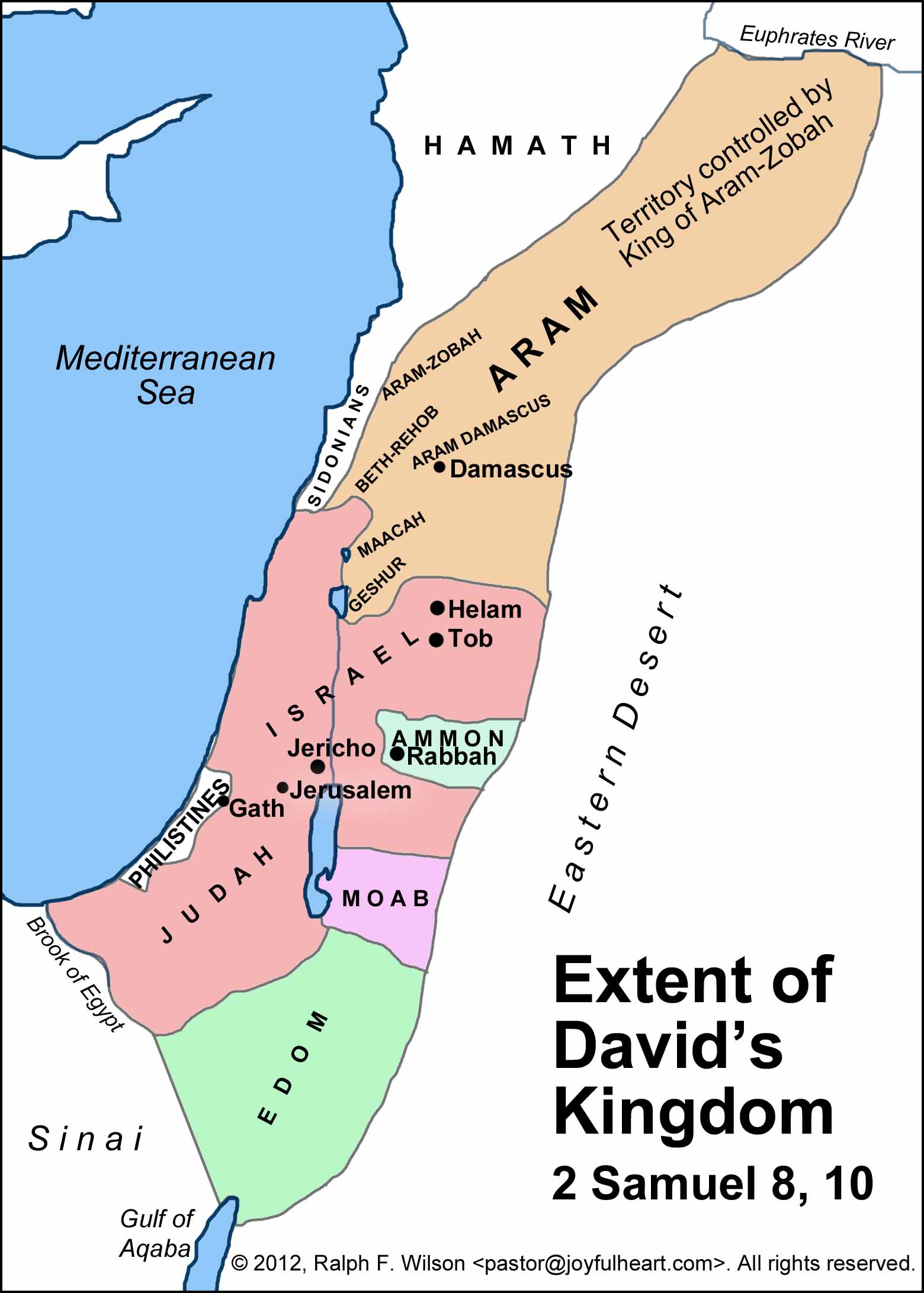
1 Chronicles 13 also told of the event.  Rather than all the people, it was likely the thirty thousand representatives of them whom David gathered together from the southern border at Egypt to the northern border at Hamath as seen on this map borrowed from JesusWalk:


Shihor is believed to be the Brook of Egypt.  David had gathered the thirty thousand men from all over Israel for the purpose of bringing the ark of God from Kirjath Jearim, which was said to be located about 7–9 miles west-northwest of Jerusalem.

(6) And David went up and all Israel to Baalah, to Kirjath Jearim, which belonged to Judah, to bring up from there the ark of God the Lord who dwells between the cherubim whose name is proclaimed.

David and the 30,000 representatives of all Israel went to Kirjath Jearim in Judah to the ark of God the Lord, Jehovah, whose name was proclaimed there where He dwelt between the cherubim above the mercy seat.

(2 Samuel 6:3) And they set the ark of God upon a new cart and brought it out of the house of Abinadab that was in Gibeah, and Uzzah and Ahio, the sons of Abinadab, drove the new cart.

The people brought the ark out of the house of Abinadab in Gibeah, which was a prominent hill in Kirjath Jearim.  They set the ark of God on a new cart, thinking to honor the ark of God by placing it on a cart never before used for anything else.  However, the priests were to have carried it on their shoulders, according to Numbers 7:9.  They should not have put it in a cart, even new, like any common thing.  Uzzah and Ahio, the sons of Abinadab, drove the cart.

(4) And they brought it out of the house of Abinadab, which was at Gibeah, accompanying the ark of God, and Ahio went before the ark.

They brought the cart out of the house of Abinadab which had held the ark of God, and it appears that Ahio actually went before the ark while Uzzah drove the cart.

(5) And David and all the house of Israel played before the Lord on all manner of fir wood, even on harps, and on psalteries, and on timbrels, and on cornets, and on cymbals.

David and all the house of Israel with him played before the Lord on musical instruments made of fir wood, on harps, on other stringed instruments, on tambourines, on cornets, and on cymbals. Once again, they thought they were honoring God, but even David who would seem was well versed in the law of God, had failed to properly honor the ark.  

(1 Chronicles 13:7) And they carried the ark of God in a new cart out of the house of Abinadab, and Uzzah and Ahio drove the cart. (8) And David and all Israel played before God with all their might, and with singing, and with harps, and with psalteries, and with timbrels, and with cymbals, and with trumpets.

1 Chronicles 13 told of the same incident.  Rather than finishing the story, my chronological study takes me to Psalm 78:

(Psalm 78:1) (Maschil of Asaph) Give ear, O my people, to my law; incline your ears to the words of my mouth.

This psalm was already studied in full in this chronological study by Skip Andrews, so I'm not sure why it would be repeated now.  Asaph was a Levite, appointed by David as one of the chief musicians responsible for leading worship before the Ark of the Covenant.  I suppose that is why it might be relevant at this chronological time.  Asaph wrote a few of the psalms, and he wrote this maschil, an instructive psalm.  He called on the people to listen to the doctrine he was about to deliver.

(2) I will open my mouth in a parable; I will utter dark sayings of old, (3) Which we have heard and known, and our fathers have told us.

Asaph would speak freely and openly with analogies, metaphors, and examples.  When you think about it, the entire Old Testament was purposefully analogous to the lives of believers after the coming of Jesus.  "All scripture is given by inspiration of God, and is profitable for doctrine, for reproof, for correction, for instruction in righteousness..." (2 Timothy 3:16).  Those who want to discard the Old Testament because it is not relevant anymore are very much in error as God intended it to be used for teaching us.  

This scripture actually was prophecy referring to Jesus and why He spoke in parables as it says in Matthew 13:34-35, "All these things Jesus spoke to the multitude in parables; and without a parable He did not speak to them, that it might be fulfilled which was spoken by the prophet, saying, 'I will open my mouth in parables; I will utter things which have been kept secret from the foundation of the world.'"  Asaph would speak of dark sayings, or perplexing things, of old, from the foundation of the world, things they had only heard of, such as the fall of man by means of Satan, and how he continued to steal, kill, and destroy (John 10:10).  Perhaps he would speak prophetically of the Gospel which was kept secret until the Messiah came but had been ordained even before the world (1 Corinthians 2:7). 

(4) We will not hide them from their children, showing to the generation to come the praises of the Lord, and His strength, and His wonderful works that He has done.

The people of that present time would not hide those mysteries from their children and from their children's children but would pass on their knowledge of such things to future generations.  They would demonstrate to them how praiseworthy their Lord was, how strong He was, and all the wonderful things He had done for His people.

(5) For He established a testimony in Jacob and appointed a law in Israel, which He commanded our fathers that they should make them known to their children.

The Lord had established a testimony in the house of Jacob, or Israel, as Jacob was the patriarch.  He had appointed a law in Israel which He commanded fathers to teach their children (Deuteronomy 6:7).

(6) That the generation to come might know them, even the children who should be born who should arise and declare them to their children.

Then the next generation would know those mysteries of old and would pass them on to any children they would have who would, in turn, pass them on to their children.  I believe that is what has become lost in this world; so many people do not know the real truth of God because they have never heard the truth.

(7) That they might set their hope in God and not forget the works of God but keep His commandments.

By teaching every generation, they would continue to set their hope in God and never forget His wondrous works, and they would keep His commandments.  Once again, I can't help but think how this has become lost, and that is the reason why so many people are without hope in our day and age.

(8) And might not be as their fathers, a stubborn and rebellious generation, a generation that did not set their heart aright and whose spirit was not steadfast with God.

If the future generations were taught the wonders of their Lord, they would not have to be like their forefathers, a stubborn and rebellious generation like those Israelites in the wilderness and those who rejected Christ, those who did not set their hearts to seek after their Lord to walk in faithfulness with Him.

(9) The children of Ephraim, armed, carrying bows, turned back in the day of battle. (10) They kept not the covenant of God and refused to walk in His law. (11) And forgot His works and His wonders that He had showed them.

The children of the tribe of Ephraim, although armed and well equipped with the best weapons of the time, failed in faith and courage and retreated before the enemy, possibly referring to the failure of Ephraim to drive out the Canaanites from their promised land (Judges 1:29).  It may be that Ephraim here means all of Israel just as Jacob did.  In that case, it might refer to the time the Israelites fled before the Philistines and the ark of the Lord was taken.  That might be the most appropriate meaning here.  They had failed in their faith and did not keep the covenant of the Lord, forgetting all His wondrous works that proved He would always be there for them.

(67) Moreover, He refused the tabernacle of Joseph and chose not the tribe of Ephraim, (68) But chose the tribe of Judah, the Mount Zion which He loved.

The chronological study then skips forward to verse 67.  If this refers to the ark, the Lord refused the tribe of Ephraim, the son of Joseph, therefore also refusing him, where the ark had formerly been in Shiloh.  He now chose the tribe of Judah, specifically Mount Zion, the city of David, for His ark to dwell.

(69) And He built His sanctuary like high, like the earth which He has established forever.

The Lord built His sanctuary exalted, as if it were on a high hill, prominent and permanent, not to be moved from place to place as the tabernacle had been but established as firmly as the earth itself.

(70) He chose David also His servant and took him from the sheepfolds, (71) From following the ewes great with young He brought him, to feed Jacob His people, and Israel His inheritance.

The Lord had chosen David out of the sheep fields; from tending to pregnant ewes, the Lord brought him to rather tend to His people Israel.

(72) So he fed them according to the integrity of his heart and guided them by the skillfulness of his hands.

David led the people according to the integrity of his heart, striving to be upright and pure in the administration of his government, and guided them by the skillfulness of his hands, which represented his power and actions.

Once again, I feel like this chronological order is rather disjointed and even disruptive of the historical event unfolding here.  While David led the people according to the integrity of his heart, in this case, he had forgotten the law of the Lord as we will soon understand in the coming study.