Showing posts with label Abinadab. Show all posts

Saturday, August 1, 2026

Moving the Ark of the Lord to Jerusalem

Continuing a chronological Bible study:

(2 Samuel 6:1) Again David gathered together all the chosen of Israel, thirty thousand.

David had become established as king of all Israel.  He had just defeated the Philistines in and around Jerusalem.  He had proposed to all the people that they should bring the ark of the covenant to them in Jerusalem.  He now gathered thirty thousand of the choicest men of Israel.

(2) And David arose and went with all the people who were with him from Baale of Judah to bring up from there the ark of God, whose name is called by the name of the Lord of hosts who dwells between the cherubim.

David went with the thirty thousand men he had gathered to him to Baale of Judah to bring the ark from there.  This was the same as Baalah in Judah that was also known as Kirjath Jearim according to Joshua 15:9.  God's name is Jehovah which is the original Hebrew for Lord.  He dwelt between the cherubim that overshadowed the mercy seat which was above the ark.

(1 Chronicles 13:5) So David gathered all Israel together from Shihor of Egypt to the entering of Hamath to bring the ark of God from Kirjath Jearim.

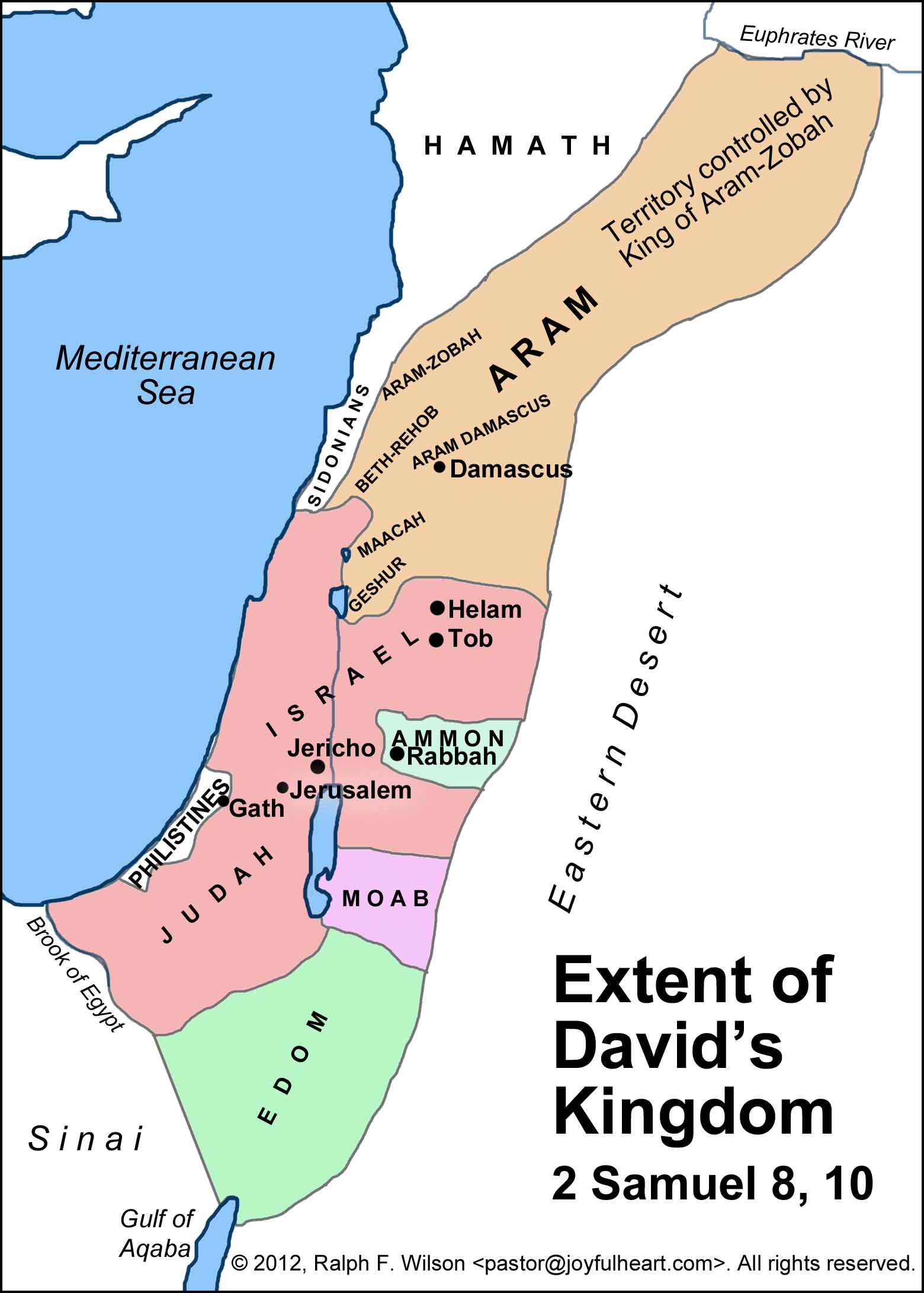
1 Chronicles 13 also told of the event.  Rather than all the people, it was likely the thirty thousand representatives of them whom David gathered together from the southern border at Egypt to the northern border at Hamath as seen on this map borrowed from JesusWalk:


Shihor is believed to be the Brook of Egypt.  David had gathered the thirty thousand men from all over Israel for the purpose of bringing the ark of God from Kirjath Jearim, which was said to be located about 7–9 miles west-northwest of Jerusalem.

(6) And David went up and all Israel to Baalah, to Kirjath Jearim, which belonged to Judah, to bring up from there the ark of God the Lord who dwells between the cherubim whose name is proclaimed.

David and the 30,000 representatives of all Israel went to Kirjath Jearim in Judah to the ark of God the Lord, Jehovah, whose name was proclaimed there where He dwelt between the cherubim above the mercy seat.

(2 Samuel 6:3) And they set the ark of God upon a new cart and brought it out of the house of Abinadab that was in Gibeah, and Uzzah and Ahio, the sons of Abinadab, drove the new cart.

The people brought the ark out of the house of Abinadab in Gibeah, which was a prominent hill in Kirjath Jearim.  They set the ark of God on a new cart, thinking to honor the ark of God by placing it on a cart never before used for anything else.  However, the priests were to have carried it on their shoulders, according to Numbers 7:9.  They should not have put it in a cart, even new, like any common thing.  Uzzah and Ahio, the sons of Abinadab, drove the cart.

(4) And they brought it out of the house of Abinadab, which was at Gibeah, accompanying the ark of God, and Ahio went before the ark.

They brought the cart out of the house of Abinadab which had held the ark of God, and it appears that Ahio actually went before the ark while Uzzah drove the cart.

(5) And David and all the house of Israel played before the Lord on all manner of fir wood, even on harps, and on psalteries, and on timbrels, and on cornets, and on cymbals.

David and all the house of Israel with him played before the Lord on musical instruments made of fir wood, on harps, on other stringed instruments, on tambourines, on cornets, and on cymbals. Once again, they thought they were honoring God, but even David who would seem was well versed in the law of God, had failed to properly honor the ark.  

(1 Chronicles 13:7) And they carried the ark of God in a new cart out of the house of Abinadab, and Uzzah and Ahio drove the cart. (8) And David and all Israel played before God with all their might, and with singing, and with harps, and with psalteries, and with timbrels, and with cymbals, and with trumpets.

1 Chronicles 13 told of the same incident.  Rather than finishing the story, my chronological study takes me to Psalm 78:

(Psalm 78:1) (Maschil of Asaph) Give ear, O my people, to my law; incline your ears to the words of my mouth.

This psalm was already studied in full in this chronological study by Skip Andrews, so I'm not sure why it would be repeated now.  Asaph was a Levite, appointed by David as one of the chief musicians responsible for leading worship before the Ark of the Covenant.  I suppose that is why it might be relevant at this chronological time.  Asaph wrote a few of the psalms, and he wrote this maschil, an instructive psalm.  He called on the people to listen to the doctrine he was about to deliver.

(2) I will open my mouth in a parable; I will utter dark sayings of old, (3) Which we have heard and known, and our fathers have told us.

Asaph would speak freely and openly with analogies, metaphors, and examples.  When you think about it, the entire Old Testament was purposefully analogous to the lives of believers after the coming of Jesus.  "All scripture is given by inspiration of God, and is profitable for doctrine, for reproof, for correction, for instruction in righteousness..." (2 Timothy 3:16).  Those who want to discard the Old Testament because it is not relevant anymore are very much in error as God intended it to be used for teaching us.  

This scripture actually was prophecy referring to Jesus and why He spoke in parables as it says in Matthew 13:34-35, "All these things Jesus spoke to the multitude in parables; and without a parable He did not speak to them, that it might be fulfilled which was spoken by the prophet, saying, 'I will open my mouth in parables; I will utter things which have been kept secret from the foundation of the world.'"  Asaph would speak of dark sayings, or perplexing things, of old, from the foundation of the world, things they had only heard of, such as the fall of man by means of Satan, and how he continued to steal, kill, and destroy (John 10:10).  Perhaps he would speak prophetically of the Gospel which was kept secret until the Messiah came but had been ordained even before the world (1 Corinthians 2:7). 

(4) We will not hide them from their children, showing to the generation to come the praises of the Lord, and His strength, and His wonderful works that He has done.

The people of that present time would not hide those mysteries from their children and from their children's children but would pass on their knowledge of such things to future generations.  They would demonstrate to them how praiseworthy their Lord was, how strong He was, and all the wonderful things He had done for His people.

(5) For He established a testimony in Jacob and appointed a law in Israel, which He commanded our fathers that they should make them known to their children.

The Lord had established a testimony in the house of Jacob, or Israel, as Jacob was the patriarch.  He had appointed a law in Israel which He commanded fathers to teach their children (Deuteronomy 6:7).

(6) That the generation to come might know them, even the children who should be born who should arise and declare them to their children.

Then the next generation would know those mysteries of old and would pass them on to any children they would have who would, in turn, pass them on to their children.  I believe that is what has become lost in this world; so many people do not know the real truth of God because they have never heard the truth.

(7) That they might set their hope in God and not forget the works of God but keep His commandments.

By teaching every generation, they would continue to set their hope in God and never forget His wondrous works, and they would keep His commandments.  Once again, I can't help but think how this has become lost, and that is the reason why so many people are without hope in our day and age.

(8) And might not be as their fathers, a stubborn and rebellious generation, a generation that did not set their heart aright and whose spirit was not steadfast with God.

If the future generations were taught the wonders of their Lord, they would not have to be like their forefathers, a stubborn and rebellious generation like those Israelites in the wilderness and those who rejected Christ, those who did not set their hearts to seek after their Lord to walk in faithfulness with Him.

(9) The children of Ephraim, armed, carrying bows, turned back in the day of battle. (10) They kept not the covenant of God and refused to walk in His law. (11) And forgot His works and His wonders that He had showed them.

The children of the tribe of Ephraim, although armed and well equipped with the best weapons of the time, failed in faith and courage and retreated before the enemy, possibly referring to the failure of Ephraim to drive out the Canaanites from their promised land (Judges 1:29).  It may be that Ephraim here means all of Israel just as Jacob did.  In that case, it might refer to the time the Israelites fled before the Philistines and the ark of the Lord was taken.  That might be the most appropriate meaning here.  They had failed in their faith and did not keep the covenant of the Lord, forgetting all His wondrous works that proved He would always be there for them.

(67) Moreover, He refused the tabernacle of Joseph and chose not the tribe of Ephraim, (68) But chose the tribe of Judah, the Mount Zion which He loved.

The chronological study then skips forward to verse 67.  If this refers to the ark, the Lord refused the tribe of Ephraim, the son of Joseph, therefore also refusing him, where the ark had formerly been in Shiloh.  He now chose the tribe of Judah, specifically Mount Zion, the city of David, for His ark to dwell.

(69) And He built His sanctuary like high, like the earth which He has established forever.

The Lord built His sanctuary exalted, as if it were on a high hill, prominent and permanent, not to be moved from place to place as the tabernacle had been but established as firmly as the earth itself.

(70) He chose David also His servant and took him from the sheepfolds, (71) From following the ewes great with young He brought him, to feed Jacob His people, and Israel His inheritance.

The Lord had chosen David out of the sheep fields; from tending to pregnant ewes, the Lord brought him to rather tend to His people Israel.

(72) So he fed them according to the integrity of his heart and guided them by the skillfulness of his hands.

David led the people according to the integrity of his heart, striving to be upright and pure in the administration of his government, and guided them by the skillfulness of his hands, which represented his power and actions.

Once again, I feel like this chronological order is rather disjointed and even disruptive of the historical event unfolding here.  While David led the people according to the integrity of his heart, in this case, he had forgotten the law of the Lord as we will soon understand in the coming study.

Tuesday, May 19, 2026

Genealogy of Saul

My chronological Bible study now takes me to 1 Chronicles 8:

(1 Chronicles 8:29) And at Gibeon dwelt the father of Gibeon, whose wife's name was Maachah, (30) And his firstborn son Abdon, and Zur, and Kish, and Baal, and Nadab, (31) And Gedor, and Ahio, and Zacher.

Here we have a partial genealogy of Saul beginning with his grandfather who was said to be the father of Gibeon, evidently being the founder and builder of that city.  Although he is not specifically named here, his name was Jehiel, according to 1 Chronicles 9:35.  His wife's name was Maachah, and his sons were Abdon, his firstborn, followed by Zur and then Kish, who was Saul's father.  Then came Baal, Nadab, Gedor, Ahio, and Zacher.

(32) And Mikloth begat Shimeah. And these also dwelt with their brethren in Jerusalem, over against them.

Mikloth was the youngest of Jehiel's sons, and his son was Shimeah.  All these men dwelt with their brethren in Jerusalem, across from them.

(33) And Ner begat Kish, and Kish begat Saul, and Saul begat Jonathan, and Malchishua, and Abinadab, and Eshbaal.

All these names give me a headache, especially when they don't always agree with other accounts.  Were we not just told in verse 29 that the father of Gibeon was Kish's father?  And 1 Chronicles 9:35 names the father of Gibeon as Jehiel.  Moreover, 1 Samuel 9:1 stated that the father of Kish was actually Abiel.  Jehiel/Abiel, maybe a misreading?  1 Samuel 14:50 states that Ner was the uncle of Saul, not his father.  Sometimes in Biblical genealogies, some generations were skipped, perhaps thought of as less important.  For example, one might be said to be the son of X, when X was actually his grandfather or even great-grandfather.  If someone along the line died young and wasn't alive when the genealogy was written, he may have been omitted.  Also sometimes names were changed when a person's life dictated a new name because of its meaning.  I feel like I get lost in the weeds trying to reconcile all these names when they probably aren't that important in the scheme of things.  Yes, genealogies and names were important to God's people, but to readers of the Bible thousands of years later, maybe not so much.  If there is an important relationship, it will be mentioned again, for that is the way of God's word, to confirm a thing two or three times, and then it will be established as truth (Deuteronomy 19:15, Matthew 18:16).

We do know for a fact that Kish was the father of Saul, and Saul's firstborn son was Jonathan.  Also we know that Malchishua and Abinadab were also Saul's sons, as they were his sons who died at the same time as Jonathan (1 Samuel 31:2).  His son Eshbaal did not die in the battle, and he becomes Ishbosheth later in scripture.  That is understandable as the name "Baal" which originally meant "Lord" took on a bad connotation when it was learned to be the same name as an important pagan god.

(34) And the son of Jonathan was Meribbaal, and Meribbaal begat Micah.

Once again, we have a different name for Jonathan's son that was named Mephibosheth in 2 Samuel 4:4.  Once again, since his name had Baal in it, perhaps it was later changed.  Meribbaal/Mephibosheth had a son named Micah.

(35) And the sons of Micah, Pithon, and Melech, and Tarea, and Ahaz. 

Mephibosheth's son Micah had sons, Pithon, Melech, Tarea, and Ahaz.  They are not mentioned in the Bible as having done anything of historical significance.

(36) And Ahaz begat Jehoadah; and Jehoadah begat Alemeth, and Azmaveth, and Zimri; and Zimri begat Moza. (37) And Moza begat Binea; Rapha was his son, Eleasah his son, Azel his son; (38) And Azel had six sons, whose names are these, Azrikam, Bocheru, and Ishmael, and Sheariah, and Obadiah, and Hanan. All these were the sons of Azel.

The list of Saul's descendants continues.  Once again, I do not believe that any of these men are mentioned elsewhere in the Bible except in another genealogy in 1 Chronicles 9.

(39) And the sons of Eshek his brother were, Ulam his firstborn, Jehush the second, and Eliphelet the third.

One would assume that Eshek was Azel's brother, but he was not mentioned as a son in verse 37; perhaps that was because he was being given his own line in scripture.  Who really knows as all these people are only listed in genealogies and not expounded upon elsewhere in scripture.

(40) And the sons of Ulam were mighty men of valor, archers, and had many sons, and sons' sons, a hundred and fifty. All these are of the sons of Benjamin.

The sons of Ulam were said to be mighty men of valor, archers.  We were told in 1 Chronicles 12:2 that the Benjamites, Saul's brethren, were skillful with bows.  Ulam had many sons and grandsons, 150, and so the progeny of Saul would become very vast.  All these men listed above were from the tribe of Benjamin.

(1 Chronicles 9:35) And in Gibeon dwelt the father of Gibeon, Jehiel, whose wife's name was Maachah.

The next chapter of 1 Chronicles also gives a genealogy of Saul.  Here we are given the name of the so-called father of Gibeon that was not mentioned in 1 Chronicles 8:29.

(36) And his firstborn son Abdon, then Zur, and Kish, and Baal, and Ner, and Nadab, (37) And Gedor, and Ahio, and Zechariah, and Mikloth.

The sons of Jehiel are repeated from 1 Chronicles 8:30-31, but Ner is added before Nadab.  This would agree with 1 Samuel 14:50 which said that Ner was Saul's uncle.  If Kish, the father of Saul, was Ner's brother, then Ner would be Saul's uncle.

(38) And Mikloth begat Shimeam. And they also dwelt with their brethren at Jerusalem, over against their brethren.

This is almost an exact repetition of 1 Chronicles 8:32, except that Shimeam was called Shimeah there.

(39) And Ner begat Kish; and Kish begat Saul; and Saul begat Jonathan, and Malchishua, and Abinadab, and Eshbaal. 

Just as 1 Chronicles 8:33 said that Ner begat Kish, here it is said again, surely by the same author, but I don't believe that is possible.  However, Ner and Kish were closely related, most likely brothers.  The sons of Saul are repeated from 1 Chronicles 8:33.

(40) And the son of Jonathan was Meribbaal, and Meribbaal begat Micah. (41) And the sons of Micah were, Pithon, and Melech, and Tahrea.

Meribbaal, or Mephibosheth, had a son named Micah, and Micah's sons are listed, except this time Ahaz was omitted.  However, he is mentioned in the next verse:

(42) And Ahaz begat Jarah; and Jarah begat Alemeth, and Azmaveth, and Zimri; and Zimri begat Moza; (43) And Moza begat Binea; and Rephaiah his son, Eleasah his son, Azel his son.

In 1 Chronicles 8:36, the son of Ahaz was listed as Jehoadah rather than Jarah.  Perhaps both names refer to the same person.  The rest of the names are as recorded in 1 Chronicles 8.

(44) And Azel had six sons, whose names are these, Azrikam, Bocheru, and Ishmael, and Sheariah, and Obadiah, and Hanan; these were the sons of Azel.

The names of the sons of Azel are the same as recorded in 1 Chronicles 8.  In this genealogy, Eshek and Ulam are not mentioned.

Both chapters 8 and 9 of 1 Chronicles deals with vast genealogies, not just the genealogy of Saul, but because the chronological study has just recorded the history of Saul, these particular genealogies were inserted here.

Thursday, May 14, 2026

The Death of Saul

Continuing a chronological Bible study:

(1 Samuel 31:1) Now the Philistines fought against Israel, and the men of Israel fled from before the Philistines and fell down slain in Mount Gilboa.

When we last left the Philistines and the Israelites, the Philistines had positioned themselves to attack Israel, and Saul had gone to a medium to find out what he should do, as the Lord would no longer answer him.  This is likely the next day, as he had received word of what would happen to him the next day after his consultation.  The Philistines began their attack on the Israelites, and the Israelites had fled from them but were evidently caught and killed at Mount Gilboa.

(2) And the Philistines followed hard on Saul and on his sons, and the Philistines killed Jonathan, and Abinadab, and Malchishua, Saul's sons.

The Philistines pushed hard on Saul and his sons, and eventually killed Saul's sons, Jonathan, Abinadab, and Malchishua.

(3) And the battle went sore against Saul, and the archers hit him, and he was sore wounded of the archers.

The battle went badly for Saul, and he was hit by Philistine archers.  He was evidently severely wounded by the archers.

(4) Then Saul said to his armorbearer, "Draw your sword and thrust me through with it, lest these uncircumcised come and thrust me through and abuse me." But his armorbearer would not, for he was sore afraid. Therefore Saul took a sword and fell upon it.

Saul told his armorbearer to draw his sword and finish him off so that the uncircumcised (pagan) Philistines would not have a chance to abuse and kill him.  However, his armorbearer was afraid to do such a thing, so Saul took a sword himself and fell upon it.

(5) And when his armorbearer saw that Saul was dead, he fell likewise upon his sword and died with him. (6) So Saul died, and his three sons, and his armorbearer, and all his men, that same day together.

When Saul's armorbearer saw that Saul was dead, he fell upon his sword also and died with Saul.  So it was that Saul, his three sons, his armorbearer, and all his men, all died that same day, as had been foretold by the spirit supposedly conjured up by the medium (1 Samuel 28:19).

(7) And when the men of Israel on the other side of the valley and those on the other side of the Jordan, saw that the men of Israel fled and that Saul and his sons were dead, they forsook the cities and fled, and the Philistines came and dwelt in them.

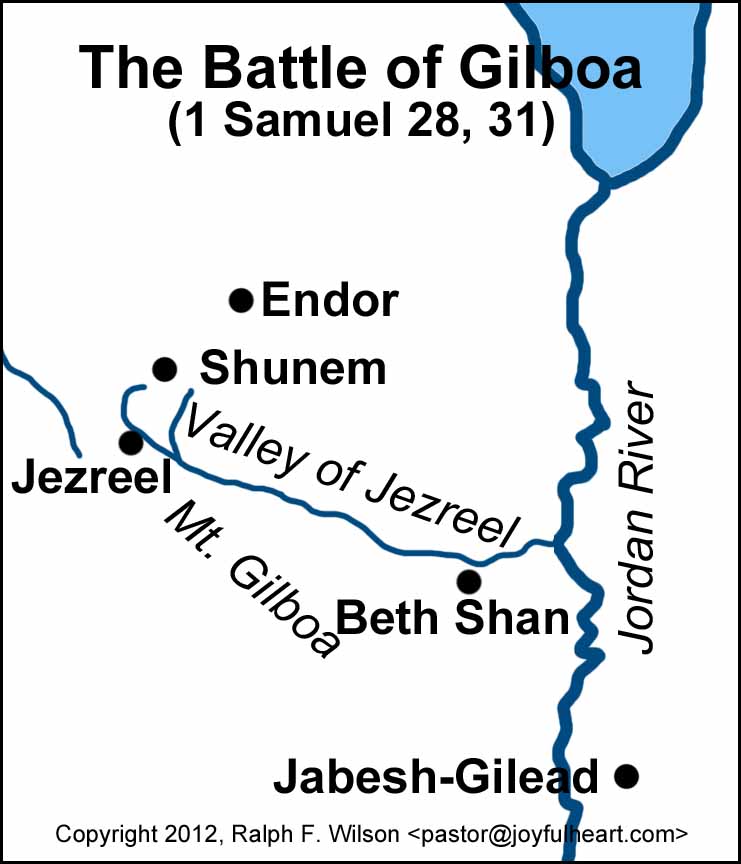
When the Israelites who were on the other side of the valley from where the battle took place, as well as those just over the Jordan River in that area, saw that their brethren fled and that Saul and his sons were dead, they, too, fled from their cities, and the Philistines came and dwelt in them.  This map previously borrowed from Jesus Walk shows that area:


(8) And it came to pass on the next day, when the Philistines came to strip the slain, that they found Saul and his three sons fallen in Mount Gilboa. (9) And they cut off his head and stripped off his armor and sent into the land of the Philistines round about, to publish it in the house of their idols and among the people. (10) And they put his armor in the house of Ashtaroth, and they fastened his body to the wall of Beth Shan.

The next day, when the Philistines went to strip all the bodies to take what was valuable as their spoil, they found Saul and his sons dead at Mount Gilboa.  They cut off Saul's head and stripped off his armor and proclaimed the news throughout the land of the Philistines round about them, and in the house of their idols to whom they surely ascribed the success they had.  They then took Saul's body and hung it on a wall in Beth Shan where they then dwelt.  They put his armor in the house of their idol, much like Goliath's sword had been placed in the tabernacle (1 Samuel 21:9).  I find it sad that Saul had wanted to kill himself so that the Philistines would not abuse his body, but they had still abused it in death.

(11) And when the inhabitants of Jabesh Gilead heard of that which the Philistines had done to Saul, (12) All the valiant men arose and went all night and took the body of Saul and the bodies of his sons from the wall of Beth Shan and came to Jabesh and burned them there.

When the inhabitants of Jabesh, which was further south and on the other side of the Jordan, as seen on the map above, heard what the Philistines had done to Saul, valiant men rose up and traveled all night to Beth Shan, and they took Saul's body and the bodies of his sons, which it seems were also hung on the wall, back to Jabesh and burned them there.  It was out of respect and gratitude to their king that they removed his body and the bodies of his sons that had been hung as trophies for the Philistines.  There was no time or safe place or perhaps it was even too late to embalm the bodies and give them a safe burial, but it was also a sign of respect that they burned the mutilated bodies and prevented any possible further abuse from the enemy.

(13) And they took their bones and buried them under a tree at Jabesh and fasted seven days.

The men of Jabesh Gilead then took the bones of Saul and his sons and buried them under a tree there, and they fasted for seven days in honor and mourning for Saul.

(1 Chronicles 10:1) Now the Philistines fought against Israel; and the men of Israel fled from before the Philistines, and fell slain on Mount Gilboa.

1 Chronicles 10:1-14 retells the incidence of Saul's death.  The Philistines fought against Israel, and the Israelites fled from before them and were killed at Mount Gilboa.

(2) And the Philistines followed hard after Saul and after his sons, and the Philistines killed Jonathan, and Abinadab, and Malchishua, the sons of Saul.

The Philistines pushed hard after Saul and his sons, and they killed his three sons, Jonathan, Abinadab, and Malchishua.

(3) And the battle went sore against Saul, and the archers hit him, and he was wounded by the archers. (4) Then Saul said to his armorbearer, “Draw your sword, and thrust me through with it, lest these uncircumcised come and abuse me." But his armorbearer would not, for he was sore afraid. So Saul took a sword and fell upon it. (5) And when his armorbearer saw that Saul was dead, he also fell on his sword and died. (6) So Saul died, and his three sons, and all his house died together.

1 Chronicles 10:3-6 retells the killing of Saul, almost verbatim.  The Philistine archers had wounded him, and he asked his armorbearer to finish him off so that the Philistines would not abuse him.  However, the armorbearer could not bring himself to do it, so Saul fell on a sword himself and died.  Thus Saul, his three sons, and all his house died together.

(7) And when all the men of Israel who were in the valley saw that they had fled and that Saul and his sons were dead, they forsook their cities and fled, and the Philistines came and dwelt in them. (8) And it came to pass on the next day, when the Philistines came to strip the slain, that they found Saul and his sons fallen in Mount Gilboa. (9) And when they had stripped him, they took his head, and his armor, and sent into the land of the Philistines round about, to carry tidings to their idols, and to the people.

When the Israelites all around the region saw their brethren fleeing and heard what had happened to Saul and his sons, they too fled, and the Philistines took over the cities.  The Philistines went the next day and stripped Saul of his armor and cut off his head, and they sent word round about in the land of the Philistines to let their people and their idols know what they had done.

(10) And they put his armor in the house of their gods and fastened his head in the temple of Dagon.

The Philistines put Saul's armor in the house of their gods, Ashtaroth being named specifically in the account recorded in 1 Samuel 31.  Here in 1 Chronicles 10, a new bit of information is added in that the Philistines fastened Saul's head in the temple of their god, Dagon.

(11) And when all Jabesh Gilead heard all that the Philistines had done to Saul, (12) They arose, all the valiant men, and took away the body of Saul, and the bodies of his sons, and brought them to Jabesh, and buried their bones under the oak in Jabesh, and fasted seven days.

With the combination of 1 Samuel 31:11-13 and 1 Chronicles 10:11-12, we have a more complete account of what the valiant men of Jabesh Gilead did when they heard what the Philistines had done to Saul.  They traveled all night and took the body of Saul and the bodies of his sons from the wall of Beth Shan and came to Jabesh and burned them there.  Then they took the bones of Saul and his sons and buried them under an oak tree there, and they fasted for seven days in honor and mourning for Saul.

(13) So Saul died for his transgression which he committed against the Lord, against the word of the Lord which he did not keep, and also for asking of a familiar spirit to enquire, (14) And enquired not of the Lord; therefore He slew him and turned the kingdom to David the son of Jesse.

Thus Saul died for his transgressions, acting at least three times in direct contradiction to the commandments of the Lord, not waiting on Samuel to offer a burnt offering (1 Samuel 13:12-13), sparing the king of Amalek as well as the choice livestock (1 Samuel 15:3), and by consulting a medium (Leviticus 19:31).  Verse 14 suggests that Saul did not enquire of the Lord, but he did, and the Lord would not answer him (1 Samuel 28:6).  However, the idea is that one must not inquire of witches, wizards, or fortune-tellers, but only of the Lord their God.  And had Saul enquired of the Lord long before he did, he would have avoided his desperation in the end.  The Lord had finally taken Saul out, giving the kingdom to David, as He had planned for a long time (1 Samuel 15:28).  He likely would not have killed Saul, had he been more humble and gracious and compliant to God's will.

And thus ends the reign of Saul, chosen by God against His will, to teach the people how an earthly king would always fail because he was nothing but a flawed human, but the people had chosen that for themselves rather than to be led by their perfect God (1 Samuel 8:7).  Saul was at first a good and humble man when God chose him to reign over His people (1 Samuel 9:17), but he became proud and jealous over time and even somewhat deranged in the end.  Now God would have David to reign over His people, a man after His own heart, but still a flawed man.

Monday, November 3, 2025

David and Goliath

Continuing a chronological Bible study after a brief interlude of psalms:

(1 Samuel 17:1) Now the Philistines gathered together their armies to battle and were gathered together at Shochoh in Judah and pitched between Shochoh and Azekah in Ephes Dammim.

In chapter 16, David had been anointed to be the next king and had meanwhile gone to live in the palace of King Saul as his musician, Saul not knowing David was to replace him.  Chapter 17 reverts back to the Philistine wars (1 Samuel 14:52).  The Philistines gathered their armies together at Shochoh, a city in the tribe of Judah, and actually camped between Shochoh and Azekah in a place called Ephes Dammim.

(2) And Saul and the men of Israel were gathered together and pitched by the valley of Elah and set the battle in array against the Philistines.

Saul gathered his men together and they camped by the valley of Elah, also called the valley of Terebinth for the terebinth or turpentine trees.  Saul set his army in array, prepared to go against the Philistines.

(3) And the Philistines stood on a mountain on one side, and Israel stood on a mountain on the other side, and a valley between them.

The Philistines stood on a mountain on one side, apparently at or near Ephes Dammim, and the Israelites apparently went up a mountain from the valley of Elah and faced the Philistines, with the valley of Elah between them.

(4) And there went out a champion out of the camp of the Philistines, named Goliath, of Gath, whose height was six cubits and a span.

Someone called a champion of the Philistines, named Goliath, went forth out of the camp of the Philistines.  He was a giant of a man, six cubits and a span in height.  A cubit was the length from the cubitus (the elbow) to the end of the middle finger, about eighteen inches.  A span was the span of a hand, from the tip of the middle finger to the bottom of the thumb at the wrist.  That was generally thought to be about half a cubit, or nine inches.  Therefore Goliath was about nine feet nine inches tall.

(5) And a helmet of brass on his head and armed with a coat of mail, and the weight of the coat five thousand shekels of brass.

Goliath wore a helmet of brass on his head and a coat of chain mail that weighed 5000 shekels of brass, or 156 pounds, meaning Goliath must have been a very strong man to carry all that weight.

(6) And greaves of brass on his legs, and a target of brass between his shoulders, 

Goliath had shin armor of brass on his legs and something of brass between his shoulders.  The original word "kiydon" that was translated as "target" was most often translated as "spear" or "shield."  It was likely something of brass to protect his neck.

(7) And the staff of his spear like a weaver's beam, and his spear's head six hundred shekels of iron, and one bearing a shield went before him.

The staff of Goliath's spear was like a weaver's beam on which the weaver's cloth was rolled, but there is no consensus on the exact size of that.  The spear's head weighed 600 shekels of iron, or about eighteen pounds.  One carrying a shield went before Goliath.

(8) And he stood and cried to the armies of Israel, and said to them, "Why have you come out to set battle in array? Am not I a Philistine, and you servants to Saul? Choose you a man for you, and let him come down to me."

Goliath stood in the valley between the two mountains of armies and cried out to the army of Israel.  Why had they set a battle line as if to fight the Philistines?  He seemed to be suggesting that it was needless as he was a Philistine and their dispute could be settled by a battle between just him and a servant to Saul, as he called the Israelites.  He told them to choose a man and send him down into the valley to Goliath.

(9) "If he is able to fight with me and to kill me, then will we be your servants, but if I prevail against him and kill him, then shall you be our servants and serve us."

Goliath proposed that the Israelites send one man out to fight him, and if he was able to kill him, the Philistines would become the servants of Israel.  However, if Goliath was able to kill the Israelite man, then Israel would be servants to the Philistines.

(10) And the Philistine said, "I defy the armies of Israel this day; give me a man that we may fight together."

Goliath taunted the Israelites, challenging them to send one man to fight him.

(11) When Saul and all Israel heard those words of the Philistine, they were dismayed and greatly afraid.

When Saul and the Israelites heard those words of Goliath, they were disheartened and afraid.  Saul had formerly behaved with much courage against his enemies, but now the Spirit of God had left him, and he was afraid.  

(12) Now David was the son of that Ephrathite of Bethlehem Judah, whose name was Jesse, and he had eight sons, and the man went among men an old man in the days of Saul. (13) And the three eldest sons of Jesse followed Saul to the battle, and the names of his three sons who went to the battle, Eliab the firstborn, and next to him Abinadab, and the third Shammah.

David was the youngest son of Jesse, the Ephrathite from Bethlehem Judah.  Jesse had eight sons, and he was considered an old man among men in the days of Saul, maybe said to explain that he was too old for war, but his three oldest sons, Eliab, Abinadab, and Shammah, followed Saul to battle.

(14) And David was the youngest, and the three oldest followed Saul. (15) But David went and returned from Saul to feed his father's sheep at Bethlehem.

David, Jesse's youngest son, did not follow Saul to battle, but left Saul's palace to return to his father to tend his sheep.

(16) And the Philistine drew near morning and evening and presented himself forty days.

Meanwhile, the Philistine Goliath came near the Israelite camp every morning and evening for forty days, daring them to send down a man to fight with him, and probably taunting and ridiculing them for their cowardice in not doing it.

(17) And Jesse said to David his son, "Take now for your brethren an ephah of this parched grain, and these ten loaves, and run to the camp to your brethren, (18) And carry these ten cheeses to the captain of their thousand, and see how your brethren fare and take their pledge."

Jesse told David to take some food out to his brothers at the Israelite camp.  He told him to also take ten cheeses to the captain of one thousand men under whom his brothers fought.  He told him to see how his brothers were faring and bring back what they had to say in return.

(19) Now Saul, and they, and all the men of Israel, were in the valley of Elah, fighting with the Philistines.

Saul, David's brothers, and all the army of Israel, were in the valley of Elah, or probably actually in array on the mountain just above the valley because they weren't actually in battle yet but prepared for it, as it appears that only Goliath was in the valley calling on someone to come down and fight him.

(20) And David rose up early in the morning and left the sheep with a keeper and took and went as Jesse had commanded him, and he came to the trench as the host was going forth to the fight and shouted for the battle. (21) For Israel and the Philistines had put the battle in array, army against army.

David rose up early in the morning, leaving his father's sheep in the care of a keeper, and took the provisions Jesse had told him to take, and went to where the Israelite army was.  He came to the trench of the army just as they were preparing to go forth to battle and shouted for it, for the Israelites and the Philistines had put themselves in battle lines to go forth against each other.

(22) And David left his carriage in the hand of the keeper of the carriage and ran into the army and came and saluted his brothers.

The original word "keliy" that was translated as carriage, actually more precisely meant anything prepared, any apparatus--utensils, vessels, bags, furniture, tools, weapons, etc.  In this case, I'm sure it rather meant the vessels in which were the provisions he brought.  He probably left those in the care of the keeper of such things for the army and ran to greet his brothers among the army.

(23) And as he talked with them, behold, there came up the champion, the Philistine of Gath, Goliath by name, out of the armies of the Philistines, and spoke according to the same words, and David heard.

As David talked to his brothers, Goliath came forth, speaking the same words he had been speaking for forty days, telling the Israelite army to send one man out to fight him.  David heard him.

(24) And all the men of Israel, when they saw the man, fled from him and were sore afraid. (25) And the men of Israel said, "Have you seen this man who has come up? Surely to defy Israel has he come up, and it shall be, the man who kills him, the king will enrich him with great riches and will give him his daughter and make his father's house free in Israel."

When they saw Goliath come forth, all the Israelites were afraid and fled from him.  However, they spoke among themselves, probably trying to encourage one another, that the king had said he would reward the man who killed Goliath, enriching him with great riches, giving him his daughter in marriage, and making his father's house free from tributes or taxes.

(26) And David spoke to the men who stood by him, saying, "What shall be done to the man who kills this Philistine and takes away the reproach from Israel? For who is this uncircumcised Philistine that he should defy the armies of the living God?" (27) And the people answered him after this manner, saying, "So shall it be done to the man who kills him."

David spoke to the men near him and asked what was to be done with the man who killed Goliath and took away the dishonor that the uncircumcised pagan Philistine was doing to Israel, for that detestable man was not one to be defying the armies of the one true living God.  The people told David what they had been discussing in verse 25, that the king would enrich such a man who killed Goliath and reward him and his father's house. 

(28) And Eliab, his oldest brother, heard when he spoke to the men, and Eliab's anger was kindled against David, and he said, "Why did you come down here? And with whom have you left those few sheep in the wilderness? I know your pride and the haughtiness of your heart, for you have come down that you might see the battle."

David's oldest brother Eliab heard what David had been saying to the men, and he grew angry, probably because he felt what David had said was a reproach of him and the others who did not have the courage to fight Goliath.  He asked David why he had come there.  He suggested that he had been negligent in the care of his father's sheep, that perhaps he was too proud to be merely a shepherd, and he had come down to see the battle for selfish reasons.

(29) And David said, "What have I done now? Is there not a cause?"

David asked Eliab what blameworthy thing he had done.  He had merely spoken what he felt.  Was there not a reason for his indignation against this uncircumcised Philistine and a concern for the glory of God and the honor of the people of Israel?

(30) And he turned from him toward another and spoke after the same manner, and the people answered him again after the former manner.

David turned from Eliab and spoke to another man near him, asking him what was to be done about this Philistine and the man who should attempt to kill him, and probably also communicating to him his indignation against the pagan wretch who defied the one true living God and His people.  People told him the same thing about how the king wished to reward the man who killed Goliath.

(31) And when the words were heard which David spoke, they reported them to Saul, and he sent for him.

Eventually the words that David had been speaking reached Saul, and he sent for David.

(32) And David said to Saul, "Let no man's heart fail because of him; your servant will go and fight with this Philistine."

When David came before Saul, he told him that no more should men be afraid of Goliath, nor should Saul worry about who to send, for he volunteered to go fight him.  

(33) And Saul said to David, "You are not able to go against this Philistine to fight with him, for you a youth, and he a man of war from his youth."

Saul told David he was not able to go against Goliath as he was but a youth, and Goliath, besides being a giant of a man, had been an experienced man of war since his youth.

(34) And David said to Saul, "Your servant kept his father's sheep, and there came a lion, and a bear, and took a lamb out of the flock, (35) And I went out after it, and struck it, and delivered it out of its mouth, and when it arose against me, I caught it by its beard, and struck it, and killed it."

David told Saul that as a shepherd of his father's sheep, he had opportunities to fight and kill dangerous beasts who would take lambs from the flock, and he had been successful and rescued the lambs.

(36) "Your servant killed both the lion and the bear, and this uncircumcised Philistine shall be as one of them, seeing he has defied the armies of the living God."

David went on to tell Saul that he had killed a lion and a bear, and he saw the Philistine Goliath as just another beast deserving of death because he had defied the armies of the one true living God.

(37) David said moreover, "The Lord who delivered me out of the paw of the lion, and out of the paw of the bear, He will deliver me out of the hand of this Philistine." And Saul said to David, "Go, and the Lord be with you."

David went on to add that He knew that the Lord who had delivered him from the lion and the bear, would deliver him out of the hand of that Philistine.  David had complete faith that the Lord would give him victory over Goliath.  Saul, seeing that great faith and assuredness of victory, told David to proceed and prayed the Lord be with him.

(38) And Saul armed David with his armor, and he put a helmet of brass upon his head; also he armed him with a coat of mail.

Saul armed David with his own personal armor.  He put a brass helmet on his head and covered him with a chain mail coat.

(39) And David girded his sword upon his armor, and he assayed to go, for he had not proved it. And David said to Saul, "I cannot go with these, for I have not proved them." And David put them off him.

David girded his sword onto the armor and appraised how it would work on him since he had not before tested it.  He then told Saul that he could not use the armor because he had not ever tested and practiced with such armor.  He took the armor off.

(40) And he took his staff in his hand and chose him five smooth stones out of the brook and put them in a shepherd's bag which he had, even in a pouch, and his sling was in his hand, and he drew near to the Philistine.

Having taken off the armor, David took his staff in his hand and picked up five smooth stones out of the brook.  He put them in a shepherd's pouch that he had, and with his sling in his hand, he drew near to the Philistine.

(41) And the Philistine came on and drew near to David, and the man who bore the shield before him. (42) And when the Philistine looked about and saw David, he disdained him for he was a youth, and ruddy, and of fair countenance. (43) And the Philistine said to David, "Am I a dog that you come to me with sticks?" And the Philistine cursed David by his gods.

The Philistine came toward David, with a man bearing a shield before him.  When Goliath the Philistine saw David, that this fresh-faced good-looking kid was going to fight him, he had disdain for David.  He asked him sarcastically if he was dog to be beaten by David's stick or staff.  Goliath then cursed David by his pagan gods.

(44) And the Philistine said to David, "Come to me and I will give your flesh to the fowls of the air and to the beasts of the field."

The Philistine, probably having so much disdain for so pitiful a combatant, that he would not go forth as if to consider this an actual battle, told David to come to him, and he would give his flesh to the birds and the beasts.

(45) Then David said to the Philistine, "You come to me with a sword and with a spear and with a shield, but I come to you in the name of the Lord of hosts, the God of the armies of Israel, whom you have defied. (46) This day will the Lord deliver you into my hand, and I will strike you and take your head from you, and I will give the carcasses of the host of the Philistines this day to the fowls of the air and to the wild beasts of the earth, that all the earth may know that there is a God in Israel."

Then David told Goliath that although he had come to David with a sword and a spear and a shield, he, David, had come in the name of the Lord of all the hosts, the heavenly hosts and the hosts of the world, and particularly the armies of Israel whom Goliath had defied.  And rather than Goliath giving David's flesh to the birds and the beasts, the Lord would deliver Goliath to David, and he would give the carcasses of the Philistines to the birds and the beasts, so that all the world would know that there was the all-powerful living God in Israel.

(47) "And all this assembly shall know that the Lord saves not with sword and spear, for the battle is the Lord's, and He will give you into our hands."

David went on to add that everyone there would know that the Lord did not need the swords and spears of men, for this battle was His and His alone, and He Himself would deliver the Philistines into Israel's hand.

(48) And it came to pass, when the Philistine arose and came and drew near to meet David, that David hasted and ran toward the army to meet the Philistine.

Then the Philistine Goliath came toward David, and David ran toward him and the Philistine army.  So confident in his complete faith of the Lord to deliver him and Israel, he ran directly toward the enemy and did not flee as the Israelite army had done.

(49) And David put his hand in his bag and took from there a stone and slung it and struck the Philistine on his forehead, that the stone sunk into his forehead, and he fell upon his face to the earth.

David then retrieved a stone from his pouch and using his sling, slung the stone and struck Goliath on his forehead.  The stone went deep into his forehead, and Goliath fell on his face to the ground.  Dr. John Gill, in his Exposition of the Bible, pointed out what he called a difficulty, with how David could strike Goliath in the forehead if he was wearing a brass helmet (verse 5).  I see no such difficulty as he could have struck him in between his eyes or even in his eye, as the original word "metsach" also meant "brow."  If David struck right underneath the brow of Goliath's eye, it would account for how the stone could sink deep into Goliath's head, into his brain, and kill him instantly.

(50) So David prevailed over the Philistine with a sling and with a stone and struck the Philistine and killed him, but no sword in the hand of David.

Thus David killed Goliath with just a sling and a stone; he had no sword or spear, nor any such weapon.  The Lord, working through David and his great faith, killed the Philistine just as David said He would in verse 47, "not with sword and spear."

(51) Therefore David ran and stood upon the Philistine and took his sword and drew it out of its sheath and killed him and cut off his head with it. And when the Philistines saw their champion was dead, they fled.

David ran toward the body of Goliath and stood on it.  He took Goliath's sword out of its sheath and cut off his head with his own sword.  When the Philistines saw that their champion had been killed, they fled.

(52) And the men of Israel and of Judah arose and shouted and pursued the Philistines until you come to the valley and to the gates of Ekron. And the wounded of the Philistines fell down by the way to Shaaraim, even to Gath and to Ekron.

The men of Israel and Judah rose up out of their camps and their trenches, shouted, and pursued the fleeing Philistines back to the gates of their own city, Ekron, one of the five principalities of the Philistines.  The wounded of the Philistines fell down by the way to Shaaraim, a city in Judah, and to the borders of Gath and Ekron, Philistine cities.

(53) And the children of Israel returned from chasing after the Philistines, and they spoiled their tents.

The Israelites returned from chasing the Philistines and plundered their camp.

(54) And David took the head of the Philistine and brought it to Jerusalem, but he put his armor in his tent.

David took the head of Goliath to Jerusalem, and he kept Goliath's armor in his own tent.

(55) And when Saul saw David go forth against the Philistine, he said to Abner, the captain of the host, "Abner, whose son is this youth?" And Abner said, "As your soul lives, O king, I cannot tell." (56) And the king said, "Enquire whose son the stripling is."

When Saul had seen David go forth against Goliath, he asked the captain of his army, whose son he was.  Saul had evidently not recognized David when he tried to arm him with his armor.  That seems a bit strange, but then Saul employed David when his mind was plagued by the evil spirit, and even then he may not have had occasion to actually see much of David.  I can imagine servants whisking David into the room of the king who was sitting or lying down and having him play his harp behind the king.  Abner, the captain of his army, said that he did not know whose son David was, so the king sent him on a mission to find out.

(57) And as David returned from the slaughter of the Philistine, Abner took him and brought him before Saul with the head of the Philistine in his hand.

As David returned from killing Goliath and with his head in his hand, Abner took him aside and brought him before the king, Saul.

(58) And Saul said to him, "Whose son are you, young man?" And David answered, "I am the son of your servant Jesse the Bethlehemite."

Saul asked David whose son he was, and David told him he was the son of Jesse, the Bethlehemite, which I suppose differentiated him from any other Jesse.  Perhaps this refreshed Saul's memory of David, but we aren't told that specifically.

Robert Hawker, in his Poor Man's Commentary, made the observation of how illustrative David and this encounter were of the coming Messiah.  Goliath, with his bold and open defiance of Israel and with his taunting of the people, was symbolic of Satan who goes about as a roaring lion, seeking whom he may devour (1 Peter 5:8).  David who was very indignant that no one defended the Lord's honor is likened to Jesus in the prophecy in Isaiah 63:5, he "looked and there was none to help...therefore my own arm brought salvation to me..."  

I saw even more similarities in the event.  As the Messiah defeated Satan without a sword, so David defeated Goliath, actually the Lord Himself through David.  And when David stood upon the body of Goliath, I couldn't help but think of Genesis 3:15 when God prophesied and cursed the serpent in the garden of Eden that the eminent seed of the woman, the Messiah, would bruise the head of the serpent, the devil.  You can just picture Jesus crushing the head of the serpent, and David cut off the head of Goliath.  I am always in awe of the many places you find Jesus in the Old Testament!

Sunday, October 19, 2025

David is Secretly Anointed

Continuing a chronological Bible study:

(1 Samuel 16:1) And the Lord said to Samuel, "How long will you mourn for Saul, seeing I have rejected him from reigning over Israel? Fill your horn with oil and go; I will send you to Jesse the Bethlehemite, for I have provided Me a king among his sons."

At the end of the last chapter, the Lord had completely rejected Saul as king over Israel after he had disobeyed the Lord's commandment again.  Samuel had cried to the Lord and still mourned for Saul, how long the scripture doesn't say, but in 1 Samuel 13:14, when Samuel first told Saul his kingdom would not continue, and God had sought a man after his own heart to replace him, David was not yet born.  And now the Lord was telling Samuel to fill his horn with oil to make ready for a journey and go and see Jesse the Bethlehemite, the father of David.  God told Samuel he had made one of Jesse's sons His king.

Something else that struck me about this verse was that the Lord in effect told Samuel to stop mourning because He had rejected Saul.  For one, it was useless to continue mourning when God had made His decision and was not going to change it.  But also, to keep mourning over someone who had rejected God and whom God rejected seems to elevate that person over God.  There comes a time when we must give such people over to God and trust He will deal with them righteously, which He will because He is completely righteous, just, loving, merciful, and all good.  He also wishes all people to be saved, but some people are more hard-headed, and it takes a little more trouble in their lives to turn them.  God knows what they need and we must trust Him to deal with them, and we must turn our attention back to God and what we should be doing for His kingdom.

(2) And Samuel said, "How can I go? If Saul hears, he will kill me." And the Lord said, "Take a heifer with you and say, 'I have come to sacrifice to the Lord.'"

Samuel wondered how he would be able to do what God instructed when surely Saul would kill him if he heard about it.  The Lord told Samuel to take a heifer with him, and if questioned, just say he was going to sacrifice it to the Lord.  In those times, there were occasions when a sacrifice might be made anywhere for different reasons, so that should satisfy Saul.

(3) "And call Jesse to the sacrifice, and I will show you what you shall do; you shall anoint to Me whom I name to you."

The Lord told Samuel to call Jesse to the sacrifice, and He would tell Samuel what to do.  He was to anoint the person whom the Lord named to him at that time.

(4) And Samuel did that which the Lord spoke and came to Bethlehem. And the elders of the town trembled at his coming, and said, "Do you come peaceably?"

Samuel did what the Lord had told him to do, and he went to Bethlehem with a heifer.  The elders of the town were fearful of why Samuel might be coming to them.  As a prophet of the Lord, he might have come to denounce them and bring some judgment on them for their sins.  Therefore, they asked if he had come to them peaceably.

(5) And he said, "Peaceably. I have come to sacrifice to the Lord; sanctify yourselves and come with me to the sacrifice." And he sanctified Jesse and his sons and called them to the sacrifice.

Samuel said he had come peaceably to sacrifice to the Lord, and he invited the elders to sanctify themselves and go with him to the sacrifice.  Sanctifying themselves would probably have consisted of washing themselves and changing to clean garments and preparing their hearts and minds to offer acceptably to the Lord.  Samuel then called Jesse and his sons to sanctify themselves and go to the sacrifice, as well.

(6) And it came to pass, when they had come, that he looked on Eliab and said, "Surely the Lord's anointed is before Him."

When Jesse and his sons came, Samuel took notice of Jesse's oldest son, Eliab, and thought that he must have been the one that God wanted anointed as king.

(7) But the Lord said to Samuel, "Do not look on his countenance or on the height of his stature because I have refused him; for not as man sees, for man looks on the outward appearance, but the Lord looks on the heart."

However, the Lord told Samuel not to look at Eliab's appearance or his height as qualifications for being king.  The Lord had not chosen Eliab because He did not look at the outward appearance of a man, but rather He looked at the heart.

(8) Then Jesse called Abinadab and made him pass before Samuel. And he said, "Neither has the Lord chosen him." (9) Then Jesse made Shammah pass by. And he said, "Neither has the Lord chosen him."

Jesse called his second son, Abinadab, to pass before Samuel, but he said that the Lord had not chosen him.  The same with Jesse's third son, Shammah; Samuel said the Lord had not chosen him either.

(10) Again, Jesse made seven of his sons pass before Samuel. And Samuel said to Jesse, "The Lord has not chosen these." (11) And Samuel said to Jesse, "Are all your children here?" And he said, "There remains yet the youngest, and behold, he keeps the sheep." And Samuel said to Jesse, "Send and fetch him, for we will not sit down till he comes here."

One by one, Jesse had seven of his sons pass before Samuel, but each time Samuel told him the Lord had not chosen them.  He then asked Jesse if all his sons were there.  Jesse told him there was only the youngest left who was tending the sheep.  Samuel told Jesse to send for him, for they would not sit down at the table to eat of that part of the peace offerings which belonged to Samuel as he had offered the sacrifice, and which he had invited Jesse and his sons to partake of, until the youngest son joined them.

(12) And he sent and brought him in. Now he was ruddy and with a beautiful countenance and good-looking. And the Lord said, "Arise, anoint him, for this is he."

Jesse sent for his youngest son, David, and brought him to Samuel.  David had a ruddy complexion and was good-looking with a beautiful countenance.  It's funny, I always thought of ruddy as sort of rough and ruddy or red, more like Esau (Genesis 25:25), whom I pictured red, rough, and hairy.  However, the dictionary definition of ruddy is "having a fresh, healthy red color."  That seems more fitting for young David, fresh-faced and good-looking.  The Lord told Samuel that David was the one He wanted anointed.

(13) Then Samuel took the horn of oil and anointed him in the midst of his brethren, and the Spirit of the Lord came upon David from that day forward. So Samuel rose up and went to Ramah.

Samuel took the horn of oil he had carried with him and anointed David in the midst of his brothers.  Dr. John Gill in his Exposition of the Bible, wrote that the sense was more like he "anointed him from the midst of his brethren," as in he was chosen from the midst of his brothers.  Or I suppose that if he did anoint him in the midst of his brothers, that they had no idea it was because he was to be king, for there was "secrecy with which Samuel was directed to manage this affair, and which was necessary to observe, to keep it from the knowledge of Saul."  The Spirit of the Lord came upon David that day and was with him from that day forward.  Samuel, having done his duty, rose up and went back to Ramah.

(14) But the Spirit of the Lord departed from Saul, and an evil spirit from the Lord troubled him.

However, the Spirit of the Lord departed from Saul.  It's not as if the Lord had only so much Spirit to give, and when He gave it to David, it must come from Saul.  But David was now God's chosen leader, His anointed, and Saul no longer was because of his disobedience.  An evil spirit then troubled Saul.  It is said to be from the Lord, but I imagine that just withdrawing His Holy Spirit would make Saul susceptible to evil spirits.  I think of it as like it was for Job; God gave Satan permission to torment him.  God doesn't have an evil spirit, but evil spirits are definitely under His command, and He could call them at any time to exact His purposes. 

(15) And Saul's servants said to him, "Behold now, an evil spirit from God troubles you. (16) Let our lord command your servants before you to seek out a man, a skillful player on a harp, and it shall come to pass, when the evil spirit from God is upon you, that he shall play with his hand, and you shall be well."

Saul's servants observed that he was troubled by an evil spirit.  They asked that they be allowed to seek out a harpist who would play when the evil spirit was upon him, as “music hath charms to sooth the savage breast.”

(17) And Saul said to his servants, "Provide me now a man who can play well and bring him to me." (18) Then answered one of the servants, and said, "Behold, I have seen a son of Jesse the Bethlehemite who is skillful in playing, a mighty valiant man, a man of war, prudent in matters, a handsome person, and the Lord is with him."

Saul told his servants to find him such a man.  One of his servants said he knew of a son of Jesse who was skillful in playing, as well as a valiant man of war who spoke well and was handsome, and most of all, the Lord was with him.  He had all the qualities that would make him fit to be in the palace of the king.  I find it interesting that the servants could tell that the Lord was with David, and that He had sent an evil spirit to Saul.  They could discern spirits, and it seemed just a simple matter of fact.

(19) Therefore Saul sent messengers to Jesse, and said, "Send me David your son, who is with the sheep." (20) And Jesse took a donkey with bread, a bottle of wine, and a kid, and sent them by David his son to Saul.

Saul sent messengers to Jesse and told him to send his son David to him.  Jesse took a donkey and loaded on it bread, a bottle of wine, and a kid goat, as gifts to the king, and he sent David with them to Saul.

(21) And David came to Saul and stood before him, and he loved him greatly, and he became his armor bearer. (22) And Saul sent to Jesse, saying, "Let David, I pray you, stand before me, for he has found favor in my sight."

When David came before Saul, the king was very pleased with him, and he put him into his service.  The original word "keliy" that was translated as "armor" actually was transcribed most often as "vessel" or "instrument."  There is no evidence that David was an armor bearer for Saul, so it is most likely that he became a personal servant to Saul, bearing household vessels, or it may just be that he was a bearer of musical instruments.  Saul sent word to Jesse asking that David be allowed to stay with him as he had found favor with him.

(23) And it came to pass, when the spirit from God was upon Saul, that David took a harp and played with his hand, so Saul was refreshed and was well, and the evil spirit departed from him.

David did stay with Saul, and whenever the evil spirit came upon Saul, David would play his harp for him, and Saul would become refreshed and well, and the evil spirit left him.  Certainly, it appears that Saul knew nothing of David's being anointed as his successor.  I believe it can be safely assumed that his anointing was done privately.  Had even his brothers known that David was to be king, that word would have spread quickly.

Monday, September 8, 2025

Samuel Judges Israel

Continuing a chronological Bible study:

(1 Samuel 7:1) And the men of Kirjath Jearim came, and fetched up the ark of the Lord, and brought it into the house of Abinadab in the hill, and sanctified Eleazar his son to keep the ark of the Lord.

In the last chapter, the Philistines sent back the ark of God because keeping it had caused them much death and destruction.  They sent it to Beth Shemesh, where the people were not careful in handling the ark as it should be handled according to the law, and the Lord struck down over 50,000 men.  The men of Beth Shemesh wanted to send the ark away because of all the destruction, and they sent messengers to Kirjath Jearim to have them come and fetch the ark, which they did.  They brought the ark to the house of a man called Abinadab, the one on a hill in Kirjath Jearim, distinguishing him from some other Abinadab.  This Abinadab appears to have been a man of great esteem for religion and righteousness, and he sanctified his son Eleazar to be in charge of the ark of the Lord, to watch over it and guard it from people touching it or using it irreverently.

(2) And it came to pass while the ark abode in Kirjath Jearim, that the time was long, for it was twenty years, and all the house of Israel lamented after the Lord.

The ark of God had remained in Kirjath Jearim for twenty years up to this point.  The people lamented after the Lord, becoming sensible of their evil deeds and repenting of them.  They cried after God who had withdrawn from them.

(3) And Samuel spoke to all the house of Israel, saying, "If you do return to the Lord with all your hearts, put away the strange gods and Ashtaroth from among you, and prepare your hearts to the Lord, and serve Him only, and He will deliver you out of the hand of the Philistines."

Samuel now judged Israel, and he spoke to the people, telling them that if they truly were returning to the Lord with all their hearts, then they should put away the false gods from among them and also Ashtaroth who represented the female gods, destroying all their images and altars from among them.  They should direct their hearts to the Lord only and serve only Him, and then the Lord would deliver them out of the hand of the Philistines, under whose dominion they still were and had been for many years.

(4) Then the children of Israel did put away Baalim and Ashtaroth and served the Lord only.

The Israelites indeed put away the Baals, the male gods, and Ashtaroth, the female gods, and they served the Lord God only.

(5) And Samuel said, "Gather all Israel to Mizpeh, and I will pray for you to the Lord."

Samuel called for all the people to be gathered to Mizpeh on the borders of Judah and Benjamin, and he would pray to the Lord for them.

(6) And they gathered together to Mizpeh, and drew water, and poured it out before the Lord, and fasted on that day, and said there, "We have sinned against the Lord." And Samuel judged the children of Israel in Mizpeh.

Samuel gathered the people to Mizpeh where they drew water and poured it out before the Lord, symbolic of the sincerity of their repentance, as they poured out their hearts in repentance, as water.  They acknowledged that they had sinned against the Lord, and they prayed and fasted.  Samuel judged them there at Mizpeh, listening to them, addressing grievances, and teaching them how to get reconciled with God.

(7) And when the Philistines heard that the children of Israel were gathered together at Mizpeh, the lords of the Philistines went up against Israel. And when the children of Israel heard, they were afraid of the Philistines. (8) And the children of Israel said to Samuel. "Do not cease to cry to the Lord our God for us, that He will save us out of the hand of the Philistines."

When the Philistines heard that the Israelites had gathered together at Mizpeh, the lords of the Philistines gathered forces and went up against Israel in a surprise attack.  When the Israelites became aware of them, they were afraid and cried out to Samuel to continue praying to the Lord that He might save them from the Philistines.

(9) And Samuel took a suckling lamb and offered a burnt offering wholly to the Lord, and Samuel cried to the Lord for Israel, and the Lord heard him. 

Samuel took a suckling lamb and offered a burnt offering to the Lord, the whole lamb being burnt.  Samuel cried out to the Lord for Israel, and the Lord heard his cries.

(10) And as Samuel was offering up the burnt offering, the Philistines drew near to battle against Israel, but the Lord thundered with a great thunder on that day upon the Philistines and confused them, and they were struck down before Israel.

As Samuel was offering up the burnt offering, the Philistines drew near to the Israelites, but the Lord thundered with a great thunder upon them that confused them so that they were struck down before Israel.  The Israelites never had to engage in battle; the Lord Himself struck down the Philistines with His thunder and lightning.  This fulfilled a prophecy of Hannah's, Samuel's mother, in her song, "The adversaries of the Lord shall be broken to pieces; out of heaven shall He thunder upon them." (1 Samuel 2:10)

(11) And the men of Israel went out of Mizpeh and pursued the Philistines and killed them until below Beth Car.

The Israelites then went out of Mizpeh and chased the remaining confused and terrified Philistines as far as below a place called Beth Car, killing them.

(12) Then Samuel took a stone and set it between Mizpeh and Shen and called the name of it Ebenezer, saying, "To this point the Lord has helped us."

Then Samuel set a stone as a monument between Mizpeh and a place called Shen.  He called it Ebenezer, saying the Lord had helped them.  Ebenezer meant literally "stone of the help," and was the same place that the Israelites had pitched in 1 Samuel 4:1; there Samuel wrote that it was called Ebenezer even though it had not yet been named at that point.

(13) So the Philistines were subdued, and they came no more into the border of Israel, and the hand of the Lord was against the Philistines all the days of Samuel.

The Philistines were subdued and no longer came inside the borders of Israel.  The hand of the Lord was against the Philistines all the days of Samuel.

(14) And the cities which the Philistines had taken from Israel were restored to Israel, from Ekron to Gath, and their territory Israel delivered out of the hands of the Philistines. And there was peace between Israel and the Amorites.

All the cities from Ekron to Gath, at least all those between those two cities were restored to Israel.  Dr. John Gill wrote in his Exposition of the Bible, that if Israel had indeed taken back Ekron and Gath, "they were not long held by them, for we soon read of them as in the hands of others."  There was peace between Israel, and as "Josephus calls them the remnant of the Canaanites; these, finding the Philistines were subdued, were quiet and peaceable, and gave Israel no more trouble."

(15) And Samuel judged Israel all the days of his life. (16) And he went from year to year in circuit to Bethel, and Gilgal, and Mizpeh, and judged Israel in all those places.

Samuel judged Israel all the days of his life.  He went in circuit every year to the cities of Bethel, Gilgal, and Mizpeh, and judged Israel from those places where the people would come from all parts for advice and counsel.

(17) And his return was to Ramah, for there was his house, and there he judged Israel, and there he built an altar to the Lord.

After making his circuit, Samuel would return to Ramah where his house was.  As the last judge of Israel, he judged Israel there, at his home base, so to speak, and he built an altar to the Lord there.