Showing posts with label Ashtaroth. Show all posts

Thursday, May 14, 2026

The Death of Saul

Continuing a chronological Bible study:

(1 Samuel 31:1) Now the Philistines fought against Israel, and the men of Israel fled from before the Philistines and fell down slain in Mount Gilboa.

When we last left the Philistines and the Israelites, the Philistines had positioned themselves to attack Israel, and Saul had gone to a medium to find out what he should do, as the Lord would no longer answer him.  This is likely the next day, as he had received word of what would happen to him the next day after his consultation.  The Philistines began their attack on the Israelites, and the Israelites had fled from them but were evidently caught and killed at Mount Gilboa.

(2) And the Philistines followed hard on Saul and on his sons, and the Philistines killed Jonathan, and Abinadab, and Malchishua, Saul's sons.

The Philistines pushed hard on Saul and his sons, and eventually killed Saul's sons, Jonathan, Abinadab, and Malchishua.

(3) And the battle went sore against Saul, and the archers hit him, and he was sore wounded of the archers.

The battle went badly for Saul, and he was hit by Philistine archers.  He was evidently severely wounded by the archers.

(4) Then Saul said to his armorbearer, "Draw your sword and thrust me through with it, lest these uncircumcised come and thrust me through and abuse me." But his armorbearer would not, for he was sore afraid. Therefore Saul took a sword and fell upon it.

Saul told his armorbearer to draw his sword and finish him off so that the uncircumcised (pagan) Philistines would not have a chance to abuse and kill him.  However, his armorbearer was afraid to do such a thing, so Saul took a sword himself and fell upon it.

(5) And when his armorbearer saw that Saul was dead, he fell likewise upon his sword and died with him. (6) So Saul died, and his three sons, and his armorbearer, and all his men, that same day together.

When Saul's armorbearer saw that Saul was dead, he fell upon his sword also and died with Saul.  So it was that Saul, his three sons, his armorbearer, and all his men, all died that same day, as had been foretold by the spirit supposedly conjured up by the medium (1 Samuel 28:19).

(7) And when the men of Israel on the other side of the valley and those on the other side of the Jordan, saw that the men of Israel fled and that Saul and his sons were dead, they forsook the cities and fled, and the Philistines came and dwelt in them.

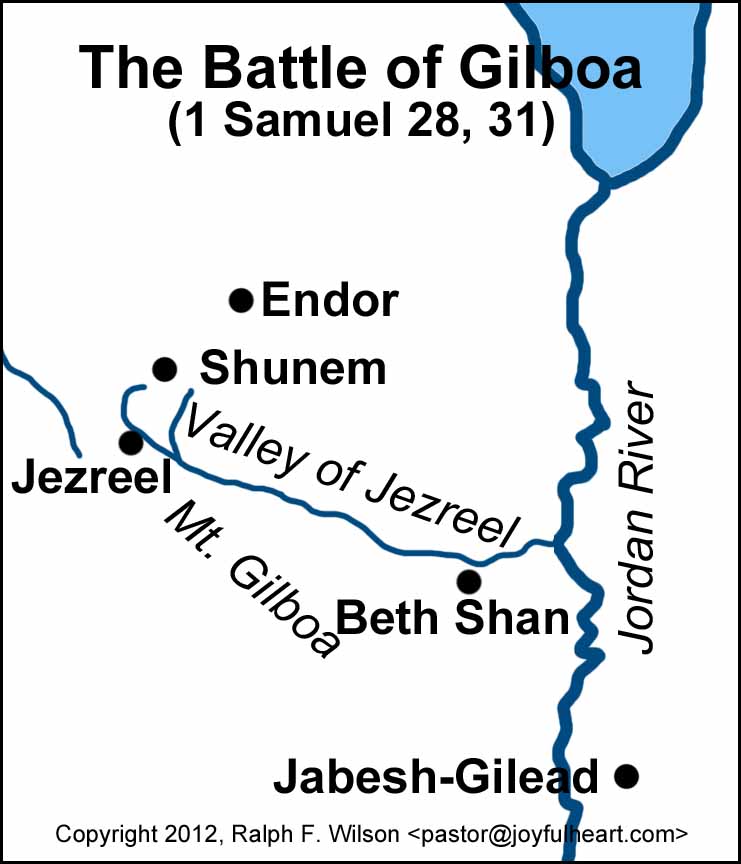
When the Israelites who were on the other side of the valley from where the battle took place, as well as those just over the Jordan River in that area, saw that their brethren fled and that Saul and his sons were dead, they, too, fled from their cities, and the Philistines came and dwelt in them.  This map previously borrowed from Jesus Walk shows that area:


(8) And it came to pass on the next day, when the Philistines came to strip the slain, that they found Saul and his three sons fallen in Mount Gilboa. (9) And they cut off his head and stripped off his armor and sent into the land of the Philistines round about, to publish it in the house of their idols and among the people. (10) And they put his armor in the house of Ashtaroth, and they fastened his body to the wall of Beth Shan.

The next day, when the Philistines went to strip all the bodies to take what was valuable as their spoil, they found Saul and his sons dead at Mount Gilboa.  They cut off Saul's head and stripped off his armor and proclaimed the news throughout the land of the Philistines round about them, and in the house of their idols to whom they surely ascribed the success they had.  They then took Saul's body and hung it on a wall in Beth Shan where they then dwelt.  They put his armor in the house of their idol, much like Goliath's sword had been placed in the tabernacle (1 Samuel 21:9).  I find it sad that Saul had wanted to kill himself so that the Philistines would not abuse his body, but they had still abused it in death.

(11) And when the inhabitants of Jabesh Gilead heard of that which the Philistines had done to Saul, (12) All the valiant men arose and went all night and took the body of Saul and the bodies of his sons from the wall of Beth Shan and came to Jabesh and burned them there.

When the inhabitants of Jabesh, which was further south and on the other side of the Jordan, as seen on the map above, heard what the Philistines had done to Saul, valiant men rose up and traveled all night to Beth Shan, and they took Saul's body and the bodies of his sons, which it seems were also hung on the wall, back to Jabesh and burned them there.  It was out of respect and gratitude to their king that they removed his body and the bodies of his sons that had been hung as trophies for the Philistines.  There was no time or safe place or perhaps it was even too late to embalm the bodies and give them a safe burial, but it was also a sign of respect that they burned the mutilated bodies and prevented any possible further abuse from the enemy.

(13) And they took their bones and buried them under a tree at Jabesh and fasted seven days.

The men of Jabesh Gilead then took the bones of Saul and his sons and buried them under a tree there, and they fasted for seven days in honor and mourning for Saul.

(1 Chronicles 10:1) Now the Philistines fought against Israel; and the men of Israel fled from before the Philistines, and fell slain on Mount Gilboa.

1 Chronicles 10:1-14 retells the incidence of Saul's death.  The Philistines fought against Israel, and the Israelites fled from before them and were killed at Mount Gilboa.

(2) And the Philistines followed hard after Saul and after his sons, and the Philistines killed Jonathan, and Abinadab, and Malchishua, the sons of Saul.

The Philistines pushed hard after Saul and his sons, and they killed his three sons, Jonathan, Abinadab, and Malchishua.

(3) And the battle went sore against Saul, and the archers hit him, and he was wounded by the archers. (4) Then Saul said to his armorbearer, “Draw your sword, and thrust me through with it, lest these uncircumcised come and abuse me." But his armorbearer would not, for he was sore afraid. So Saul took a sword and fell upon it. (5) And when his armorbearer saw that Saul was dead, he also fell on his sword and died. (6) So Saul died, and his three sons, and all his house died together.

1 Chronicles 10:3-6 retells the killing of Saul, almost verbatim.  The Philistine archers had wounded him, and he asked his armorbearer to finish him off so that the Philistines would not abuse him.  However, the armorbearer could not bring himself to do it, so Saul fell on a sword himself and died.  Thus Saul, his three sons, and all his house died together.

(7) And when all the men of Israel who were in the valley saw that they had fled and that Saul and his sons were dead, they forsook their cities and fled, and the Philistines came and dwelt in them. (8) And it came to pass on the next day, when the Philistines came to strip the slain, that they found Saul and his sons fallen in Mount Gilboa. (9) And when they had stripped him, they took his head, and his armor, and sent into the land of the Philistines round about, to carry tidings to their idols, and to the people.

When the Israelites all around the region saw their brethren fleeing and heard what had happened to Saul and his sons, they too fled, and the Philistines took over the cities.  The Philistines went the next day and stripped Saul of his armor and cut off his head, and they sent word round about in the land of the Philistines to let their people and their idols know what they had done.

(10) And they put his armor in the house of their gods and fastened his head in the temple of Dagon.

The Philistines put Saul's armor in the house of their gods, Ashtaroth being named specifically in the account recorded in 1 Samuel 31.  Here in 1 Chronicles 10, a new bit of information is added in that the Philistines fastened Saul's head in the temple of their god, Dagon.

(11) And when all Jabesh Gilead heard all that the Philistines had done to Saul, (12) They arose, all the valiant men, and took away the body of Saul, and the bodies of his sons, and brought them to Jabesh, and buried their bones under the oak in Jabesh, and fasted seven days.

With the combination of 1 Samuel 31:11-13 and 1 Chronicles 10:11-12, we have a more complete account of what the valiant men of Jabesh Gilead did when they heard what the Philistines had done to Saul.  They traveled all night and took the body of Saul and the bodies of his sons from the wall of Beth Shan and came to Jabesh and burned them there.  Then they took the bones of Saul and his sons and buried them under an oak tree there, and they fasted for seven days in honor and mourning for Saul.

(13) So Saul died for his transgression which he committed against the Lord, against the word of the Lord which he did not keep, and also for asking of a familiar spirit to enquire, (14) And enquired not of the Lord; therefore He slew him and turned the kingdom to David the son of Jesse.

Thus Saul died for his transgressions, acting at least three times in direct contradiction to the commandments of the Lord, not waiting on Samuel to offer a burnt offering (1 Samuel 13:12-13), sparing the king of Amalek as well as the choice livestock (1 Samuel 15:3), and by consulting a medium (Leviticus 19:31).  Verse 14 suggests that Saul did not enquire of the Lord, but he did, and the Lord would not answer him (1 Samuel 28:6).  However, the idea is that one must not inquire of witches, wizards, or fortune-tellers, but only of the Lord their God.  And had Saul enquired of the Lord long before he did, he would have avoided his desperation in the end.  The Lord had finally taken Saul out, giving the kingdom to David, as He had planned for a long time (1 Samuel 15:28).  He likely would not have killed Saul, had he been more humble and gracious and compliant to God's will.

And thus ends the reign of Saul, chosen by God against His will, to teach the people how an earthly king would always fail because he was nothing but a flawed human, but the people had chosen that for themselves rather than to be led by their perfect God (1 Samuel 8:7).  Saul was at first a good and humble man when God chose him to reign over His people (1 Samuel 9:17), but he became proud and jealous over time and even somewhat deranged in the end.  Now God would have David to reign over His people, a man after His own heart, but still a flawed man.

Saturday, September 27, 2025

Samuel's Farewell Address as Judge

Continuing a chronological Bible study:

(1 Samuel 12:1) And Samuel said to all Israel, "Behold, I have hearkened to your voice in all that you said to me and have made a king over you."

Samuel had done what the people asked and what God told him to do, and he anointed Saul as the Israelites' king.  In the last chapter, Saul led Israel to a great victory over the Ammonites, and he gained the admiration and support of the people.  Now the prophet Samuel began an address to the people, telling them how he had listened to them and had done what they wanted and found them a king.

(2) "And now, behold, the king walks before you, and I am old and gray headed, and behold, my sons are with you, and I have walked before you from my childhood to this day."

Samuel told the people that they now had a king, and he was old and gray, indicating his plan to step aside and let the king rule the people.  He told them he had walked before them since his childhood, and now his sons were with them, too.  His point was that they had observed him since his childhood, and they could observe his sons, as well, so they knew him well.

(3) "Behold, here I am. Witness against me before the Lord and before His anointed. Whose ox have I taken? Or whose ass have I taken? Or whom have I defrauded? Whom have I oppressed? Or of whose hand have I received a bribe with which to blind my eyes? And I will restore it to you."

Samuel stood before the people encouraging them to tell him where he had wronged them.  Had he ever taken anything of theirs?  Had he defrauded or oppressed anyone?  If he had ever wronged anyone, he wanted them to tell him before God and His anointed king, and he would restore whatever he owed to them.

(4) And they said, "You have not defrauded us, nor oppressed us, neither have you taken anything of any man's hand." (5) And he said to them, "The Lord is witness against you, and His anointed is witness this day, that you have not found anything in my hand." And they answered, "Witness!"

The people said Samuel had never done any of those things to wrong anyone.  Then Samuel told the people that God and His king were witnesses to the fact they had said that, should anyone later try to accuse him of something.  He had been fully cleared before God and the king of any misdeeds.

(6) And Samuel said to the people, "It is the Lord who advanced Moses and Aaron, and who brought your fathers up out of the land of Egypt. (7) Now therefore stand still that I may reason with you before the Lord of all the righteous acts of the Lord, which He did to you and to your fathers."

Samuel reminded the people that it was the Lord who raised up Moses and Aaron to lead the people, and it was the Lord who brought their forefathers out of the land of Egypt.  He asked them to stand there while he reviewed all the great and righteous things the Lord had done for His people.

(8) "When Jacob had come into Egypt, and your fathers cried to the Lord, then the Lord sent Moses and Aaron who brought forth your fathers out of Egypt and made them dwell in this place."

Samuel reminded the people about when Jacob and his family had gone to Egypt and stayed there.  The posterity of Jacob became greatly oppressed by Pharaoh and the Egyptians, and the people cried out to the Lord.  In response to their cries, the Lord sent Moses and Aaron to deliver them out of Egypt and into their promised land flowing with milk and honey and all good things.

(9) "And when they forgot the Lord their God, He sold them into the hand of Sisera, captain of the host of Hazor, and into the hand of the Philistines, and into the hand of the king of Moab, and they fought against them."

When their fathers had forgotten their Lord God and turned away from Him and toward idolatry, the Lord put them into the hand of Sisera, captain of the army of Jabin, king of Canaan, who reigned in Hazor (Judges 4:2).  Other times the Lord sold them into the hand of the king of Moab (Judges 3:14), and into the hand of the Philistines (Judges 13:1).  Sisera, and the king of Moab, and the Philistines all fought against the Israelites and overcame them so that they fell into their hands.  It was a merciful thing when the Lord allowed His people to become oppressed by an enemy.  When they chose to turn away from Him, He allowed them to have what they wanted and turned away from them.  Then they would see their need for Him, which He knew to be the best for their welfare, and they would willingly come back to Him.

(10) "And they cried to the Lord, and said, 'We have sinned because we have forsaken the Lord and have served Baalim and Ashtaroth, but now deliver us out of the hand of our enemies, and we will serve you.'"

Each time they were oppressed by their enemy, the people would cry out to the Lord, repenting of their sins, praying that He deliver them from their enemy, and promising to serve Him only.

(11) "And the Lord sent Jerub-Baal, and Bedan, and Jephthah, and Samuel, and delivered you out of the hand of your enemies on every side, and you dwelled safe."

Samuel reminded the people how each time they cried out to the Lord and repented, He sent the people a deliverer, one in Jerub-Baal who was Gideon.  The Lord also sent "Bedan."  There was no judge named Bedan in the history of the judges.  Biblical scholars have different ideas about who this might be.  Some say it might refer to Samson, as it could be interpreted "of Dan" rather than as a name.  However, in 1 Chronicles 7:17, there was a Bedan who was the son of Ulam, but it doesn't necessarily mean that it was the same Bedan.  Other scholars think that the name was meant to be Barak, and others say that Bedan could be a textual corruption or a scribal error arising from the similarity of Hebrew letters. This theory suggests that the original text may have intended to refer to a different deliverer entirely.  Whoever was meant, the people would have understood who Samuel meant.  Samuel told the people that the Lord had also sent Jephthah and Samuel himself to deliver the people out of the hands of their enemies, and they had dwelt in safety.

(12) And when you saw that Nahash the king of the children of Ammon came against you, you said to me, "No, but a king shall reign over us when the Lord your God was your king."

Even though the Lord had always saved them from their enemies, raising up judges to deliver them, when Nahash king of the Ammonites came against them, they decided they would rather have a king, when the Lord had always been their king.

(13) "Now therefore, behold the king whom you have chosen, whom you have desired! And behold, the Lord has set a king over you. (14) If you will fear the Lord and serve Him and obey His voice and not rebel against the commandment of the Lord, then shall both you and also the king who reigns over you continue following the Lord your God."

Samuel told the people to observe the king whom they had desired.  Even though the Lord and Samuel saw it as a rejection of the Lord, still the Lord gave them the king they desired.  And He even told them through Samuel that if they would fear the Lord, serve Him, and obey Him, and not rebel against His commandments, then both the people and their king could continue in the Lord's guidance and protection, as always.

(15) "But if you will not obey the voice of the Lord and rebel against the commandment of the Lord, then shall the hand of the Lord be against you as against your fathers."

However, Samuel continued, if the people did not obey the Lord and rebelled against His commandments, then the Lord would be against them with His righteous judgments, just as He had done with their fathers.

(16) "Now therefore, stand and see this great thing which the Lord will do before your eyes. (17) Is it not wheat harvest today? I will call to the Lord and He shall send thunder and rain, that you may perceive and see that your wickedness is great, which you have done in the sight of the Lord, in asking for a king."

Samuel instructed the people to stand there and observe the great thing the Lord was about to do.  He pointed out that it was wheat harvest time.  He was going to call on the Lord to send thunder and rain, which was very unusual for that time of year.  Proverbs 26:1 speaks of things extremely rare and unheard of, like "snow in summer" and "rain in harvest."  Therefore, the people would know that it was the Lord sending the thunder and rain as judgment against them, that they would understand their wickedness in rejecting the Lord as their king.

(18) So Samuel called to the Lord, and the Lord sent thunder and rain that day, and all the people greatly feared the Lord and Samuel.

Samuel indeed called to the Lord, and He sent thunder and rain that day.  The historian Josephus said that He sent a terrible storm with thunder, lightning, and hail.  No wonder the people feared God and His power and Samuel who had such favor and therefore power from God.

(19) And all the people said to Samuel, "Pray for your servants to the Lord your God, that we do not die, for we have added to all our sins evil, to ask for a king." 

In their fear, they asked Samuel to pray for the people that they not die, for they could perceive and understand that they had added to their sins by asking for a king.  Note that the people had rejected Samuel as their judge in desiring a king, but they now called themselves his servants.

(20) And Samuel said to the people, "Fear not; you have done all this wickedness, yet do not turn aside from following the Lord, but serve the Lord with all your heart, (21) And do not turn aside after vanity which cannot profit nor deliver, for they are nothing."

Samuel told the people not to fear, for even though they had done all that wickedness, God was not going to destroy them as they feared, provided they follow Him and serve Him with all their hearts and did not turn aside to vain idols that could do nothing for them because they were nothing.

(22) "For the Lord will not forsake His people for His great name's sake, because it has pleased the Lord to make you His people."

Samuel assured the people that God would not forsake them, not because of anything they had done, but for His great name because it had pleased Him to make them His people, again not because of their merit.  If God had given the people what they deserved, there would have been no more Israelite people and therefore no Christian church.  God's purpose in preserving His people was not yet accomplished, so He would always save at least a remnant of His people no matter how wicked they were.  

It pleased the Lord to make Israel His people, and it pleased Him to graft us Gentiles into the vine of Israel.  God first made us only for His pleasure and fellowship.  He did not need us for any fulfillment.  God is already all perfect.  It pleased Him to make us in His own image and after His own likeness (Genesis 1:26).  Micah 6:8 said that the Lord had shown us what was good, and all He required from us was that we "do justly, and to love mercy, and to walk humbly with your God."  Be righteous, love, and walk with God.  That gives Him pleasure.  However, we let sin come between us and God.  God is all-good and all-perfect and cannot abide in sin.  But because God's nature is love, He provided a way for us to remain in communion with Him through the sacrifice of Jesus Christ whose shed blood covers our sins.  Why would He do that?  Why not destroy us all because we did not live up to the purpose for which He created us in the first place?  Because He is love, and because it pleased Him to have us in fellowship with Him.

(23) "Moreover, as for me, God forbid that I should sin against the Lord in ceasing to pray for you, but I will teach you the good and the right way."

I believe Samuel's point was that he would also forgive them for rejecting him as their judge.  He would not sin against the Lord by being arrogant and self-centered when the Lord Himself forgave His people.  He would not cease to pray for them as he always had, and he would teach them the good and right way of the Lord.

(24) "Only fear the Lord and serve Him in truth with all your heart, for consider how great He has done for you. (25) But if you shall still do wickedly, you shall be consumed, both you and your king."

In contrast to the fear Samuel spoke of in verse 20, this fear he spoke of was a reverential fear out of love for the Lord and the knowledge of how great and awesome He was.  He told the people to serve God in truth with all their hearts, considering all the great things He had done for them.  However, if they rebelled against their Lord and chose to depart from Him, they would be consumed.  Without God, they would be destroyed and die, and their king would not be able to save them, as he would perish with them.

Monday, September 8, 2025

Samuel Judges Israel

Continuing a chronological Bible study:

(1 Samuel 7:1) And the men of Kirjath Jearim came, and fetched up the ark of the Lord, and brought it into the house of Abinadab in the hill, and sanctified Eleazar his son to keep the ark of the Lord.

In the last chapter, the Philistines sent back the ark of God because keeping it had caused them much death and destruction.  They sent it to Beth Shemesh, where the people were not careful in handling the ark as it should be handled according to the law, and the Lord struck down over 50,000 men.  The men of Beth Shemesh wanted to send the ark away because of all the destruction, and they sent messengers to Kirjath Jearim to have them come and fetch the ark, which they did.  They brought the ark to the house of a man called Abinadab, the one on a hill in Kirjath Jearim, distinguishing him from some other Abinadab.  This Abinadab appears to have been a man of great esteem for religion and righteousness, and he sanctified his son Eleazar to be in charge of the ark of the Lord, to watch over it and guard it from people touching it or using it irreverently.

(2) And it came to pass while the ark abode in Kirjath Jearim, that the time was long, for it was twenty years, and all the house of Israel lamented after the Lord.

The ark of God had remained in Kirjath Jearim for twenty years up to this point.  The people lamented after the Lord, becoming sensible of their evil deeds and repenting of them.  They cried after God who had withdrawn from them.

(3) And Samuel spoke to all the house of Israel, saying, "If you do return to the Lord with all your hearts, put away the strange gods and Ashtaroth from among you, and prepare your hearts to the Lord, and serve Him only, and He will deliver you out of the hand of the Philistines."

Samuel now judged Israel, and he spoke to the people, telling them that if they truly were returning to the Lord with all their hearts, then they should put away the false gods from among them and also Ashtaroth who represented the female gods, destroying all their images and altars from among them.  They should direct their hearts to the Lord only and serve only Him, and then the Lord would deliver them out of the hand of the Philistines, under whose dominion they still were and had been for many years.

(4) Then the children of Israel did put away Baalim and Ashtaroth and served the Lord only.

The Israelites indeed put away the Baals, the male gods, and Ashtaroth, the female gods, and they served the Lord God only.

(5) And Samuel said, "Gather all Israel to Mizpeh, and I will pray for you to the Lord."

Samuel called for all the people to be gathered to Mizpeh on the borders of Judah and Benjamin, and he would pray to the Lord for them.

(6) And they gathered together to Mizpeh, and drew water, and poured it out before the Lord, and fasted on that day, and said there, "We have sinned against the Lord." And Samuel judged the children of Israel in Mizpeh.

Samuel gathered the people to Mizpeh where they drew water and poured it out before the Lord, symbolic of the sincerity of their repentance, as they poured out their hearts in repentance, as water.  They acknowledged that they had sinned against the Lord, and they prayed and fasted.  Samuel judged them there at Mizpeh, listening to them, addressing grievances, and teaching them how to get reconciled with God.

(7) And when the Philistines heard that the children of Israel were gathered together at Mizpeh, the lords of the Philistines went up against Israel. And when the children of Israel heard, they were afraid of the Philistines. (8) And the children of Israel said to Samuel. "Do not cease to cry to the Lord our God for us, that He will save us out of the hand of the Philistines."

When the Philistines heard that the Israelites had gathered together at Mizpeh, the lords of the Philistines gathered forces and went up against Israel in a surprise attack.  When the Israelites became aware of them, they were afraid and cried out to Samuel to continue praying to the Lord that He might save them from the Philistines.

(9) And Samuel took a suckling lamb and offered a burnt offering wholly to the Lord, and Samuel cried to the Lord for Israel, and the Lord heard him. 

Samuel took a suckling lamb and offered a burnt offering to the Lord, the whole lamb being burnt.  Samuel cried out to the Lord for Israel, and the Lord heard his cries.

(10) And as Samuel was offering up the burnt offering, the Philistines drew near to battle against Israel, but the Lord thundered with a great thunder on that day upon the Philistines and confused them, and they were struck down before Israel.

As Samuel was offering up the burnt offering, the Philistines drew near to the Israelites, but the Lord thundered with a great thunder upon them that confused them so that they were struck down before Israel.  The Israelites never had to engage in battle; the Lord Himself struck down the Philistines with His thunder and lightning.  This fulfilled a prophecy of Hannah's, Samuel's mother, in her song, "The adversaries of the Lord shall be broken to pieces; out of heaven shall He thunder upon them." (1 Samuel 2:10)

(11) And the men of Israel went out of Mizpeh and pursued the Philistines and killed them until below Beth Car.

The Israelites then went out of Mizpeh and chased the remaining confused and terrified Philistines as far as below a place called Beth Car, killing them.

(12) Then Samuel took a stone and set it between Mizpeh and Shen and called the name of it Ebenezer, saying, "To this point the Lord has helped us."

Then Samuel set a stone as a monument between Mizpeh and a place called Shen.  He called it Ebenezer, saying the Lord had helped them.  Ebenezer meant literally "stone of the help," and was the same place that the Israelites had pitched in 1 Samuel 4:1; there Samuel wrote that it was called Ebenezer even though it had not yet been named at that point.

(13) So the Philistines were subdued, and they came no more into the border of Israel, and the hand of the Lord was against the Philistines all the days of Samuel.

The Philistines were subdued and no longer came inside the borders of Israel.  The hand of the Lord was against the Philistines all the days of Samuel.

(14) And the cities which the Philistines had taken from Israel were restored to Israel, from Ekron to Gath, and their territory Israel delivered out of the hands of the Philistines. And there was peace between Israel and the Amorites.

All the cities from Ekron to Gath, at least all those between those two cities were restored to Israel.  Dr. John Gill wrote in his Exposition of the Bible, that if Israel had indeed taken back Ekron and Gath, "they were not long held by them, for we soon read of them as in the hands of others."  There was peace between Israel, and as "Josephus calls them the remnant of the Canaanites; these, finding the Philistines were subdued, were quiet and peaceable, and gave Israel no more trouble."

(15) And Samuel judged Israel all the days of his life. (16) And he went from year to year in circuit to Bethel, and Gilgal, and Mizpeh, and judged Israel in all those places.

Samuel judged Israel all the days of his life.  He went in circuit every year to the cities of Bethel, Gilgal, and Mizpeh, and judged Israel from those places where the people would come from all parts for advice and counsel.

(17) And his return was to Ramah, for there was his house, and there he judged Israel, and there he built an altar to the Lord.

After making his circuit, Samuel would return to Ramah where his house was.  As the last judge of Israel, he judged Israel there, at his home base, so to speak, and he built an altar to the Lord there.

Friday, April 18, 2025

Introduction to the Judges

Continuing a chronological Bible study:

(Judges 2:1) And an Angel of the Lord came up from Gilgal to Bochim, and said, "I made you to go up out of Egypt and have brought you into the land which I swore to your fathers, and I said, 'I will never break My covenant with you.'"

The end of the last chapter described all the places in their promised land where the Israelites had failed to drive the Canaanites out.  Now an Angel of the Lord was said to have come up from Gilgal to a place called Bochim.  He said that He had made the people leave Egypt and had brought them into the land He had sworn to give their forefathers.  This Angel of the Lord appears to be Jesus Christ who last appeared at Gilgal to Joshua (Joshua 5:14).  Some people believe that these words were spoken by the prophet Phinehas, but as the angel did not say, "Thus says the Lord," it appears more likely that this was Jesus Christ, the only one who could have ascribed these words to Himself.  He referred to the past when He had told His people He would never break His covenant with them, that it was an everlasting covenant (Genesis 17:7, Leviticus 26:42).

(2) "'And you shall make no league with the inhabitants of this land; you shall throw down their altars,' but you have not obeyed My voice. Why have you done this?"

The Lord reminded the people that He had specifically commanded them not to make any covenant with the inhabitants of Canaan (Deuteronomy 7:2).  They were to destroy their pagan altars (Deuteronomy 7:5).  However, they had disobeyed Him, and He asked why they had done such a thing.

(3) "Therefore I also said, 'I will not drive them out from before you, but they shall be thorns in your sides, and their gods shall be a snare to you.'"

However, He also reminded them that He had said if they did not drive the inhabitants out of their land, He was not going to do it for them.  He had warned that those inhabitants would be thorns in their sides (Numbers 33:55), and their gods would ensnare them, drawing them away from the worship of the one true God.

(4) And it came to pass when the Angel of the Lord spoke these words to all the children of Israel, that the people lifted up their voices and wept.

After the Angel of the Lord had spoken those words to them, the people wept.  One wonders if they cried out of conviction in their consciences that they had sinned against their Lord, or if they cried because they selfishly feared what was coming to them because they had sinned.  I imagine it was a combination of the two.

(5) And they called the name of that place Bochim, and they sacrificed there to the Lord.

The people called that place where the Lord had spoken to them Bochim, which literally meant "weeping" or "weepers."  They then sacrificed there to the Lord.

(6) And when Joshua had let the people go, the children of Israel went every man to his inheritance to possess the land.

This is not to be understood as happening after the Angel of the Lord spoke to them.  This subject begins with the retelling of what had happened after Joshua had divided the land and everyone went to their own inheritance, and it will continue to explain how the people had behaved after that time.

(7) And the people served the Lord all the days of Joshua and all the days of the elders who outlived Joshua who had seen all the great works of the Lord which He did for Israel.

During the life of Joshua and the lives of the elders who had served with Joshua and had outlived him, the people served the Lord.  Joshua and the elders had personally seen all the great works of the Lord and could continually remind the people of them.  This is an almost precise retelling of Joshua 24:31.

(8) And Joshua the son of Nun, the servant of the Lord, died one hundred and ten years old. (9) And they buried him in the border of his inheritance in Timnath Heres in the mount of Ephraim on the north side of the hill Gaash.

Joshua died at 110 years of age, and the people buried him in his inherited land in Timnath Heres in the mountains of Ephraim on the north side of Mount Gaash.  The account in Joshua called the place Timnath Serah, but "heres" and "serah" mean the same thing, "sun."

(10) And also all that generation was gathered to their fathers, and there arose another generation after them who did not know the Lord nor the works which He had done for Israel.

That entire generation died out, and there arose another generation after them who did not know the Lord nor the great works He had done for Israel.  I have to say, it seems the people of Joshua's generation must not have done a very good job of teaching their children the way they were supposed to (Deuteronomy 11:19).

(11) And the children of Israel did evil in the sight of the Lord and served Baalim.

That next generation of Israelites did evil in the sight of their Lord and served the false god, Baal.  Baalim was the plural of Baal as there were many Baals, Baal Peor (Numbers 25:3), Baal-Berith (Judges 9:4), Baal-Zebub (2 Kings 1:2), etc.

(12) And they forsook the Lord God of their fathers who brought them out of the land of Egypt, and followed other gods of the gods of the people who were all around them, and bowed themselves to them, and provoked the Lord to anger.

The people abandoned the worship of their Lord God and followed the false gods of the Canaanites who remained in their land all around them.  They bowed themselves to the false gods, giving them religious worship and honor, provoking the true God to jealous anger.  God's jealousy is not petty; it's zealous and passionate.  Because He loves us so fervently, He does not want us to fall under the spell of false gods that will only hurt and eventually kill us.  Those pagan gods are of Satan who only wants to steal, kill, and destroy (John 10:10).

(13) And they forsook the Lord and served Baal and Ashtaroth.

The people forsook the worship of their Lord and served the gods of Baal and Ashtaroth.  The Baals were male gods and the Ashtaroths were female gods.

(14) And the anger of the Lord was hot against Israel, and He delivered them into the hands of spoilers who spoiled them, and He sold them into the hands of their enemies round about so that they could not any longer stand before their enemies. (15) Wherever they went out, the hand of the Lord was against them for evil, as the Lord had said, and as the Lord had sworn to them, and they were greatly distressed.

The anger of the Lord was hot against His people; it burned as a flame that consumed them.  He delivered them into the hands of their enemies all around them and allowed those enemies to plunder them of their goods and substance.  They could no longer stand before their enemies.  Wherever they went, in anything they undertook, the Lord was against them, as He had warned them He would be (Leviticus 26:15-25).  The people were greatly distressed.  The Lord used His punishment to bring His people back to Him, their only source of life and blessing (Deuteronomy 30:19, Leviticus 26:23-24).  It's because of His love for His people that He chastises them in order to save them from eternal damnation.

(16) Nevertheless, the Lord raised up judges who delivered them out of the hand of those who spoiled them.

However, in His mercy, the Lord raised up judges who delivered His people out of the hands of their enemies.  That is the subject of this book of the Bible, the judges who ruled Israel in the times between the death of Joshua and the rise of Samuel.

(17) And yet they would not hearken to their judges, but they went a whoring after other gods and bowed themselves to them. They turned quickly out of the way which their fathers walked in, obeying the commandments of the Lord; they did not do so.

Yet the people would not listen to their judges but went after other gods and bowed down before them.  The Bible calls it whoring because it was spiritual adultery.  They turned from the way of their fathers who walked in the way of the Lord, obeying His commandments.  This generation of people did not do as their fathers had done.

(18) And when the Lord raised them up judges, then the Lord was with the judge and delivered them out of the hand of their enemies all the days of the judge, for it repented the Lord because of their groanings by reason of them who oppressed them and vexed them.

When the Lord raised up a judge, He was with that judge and would deliver His people out of the hands of their enemies all the days of that judge.  This repenting of the Lord just meant that He changed course.  He felt compassion for His people who groaned under the oppression of their enemies and turned back toward them, sending them judges to guide them and deliver them from their oppressors.

(19) And it came to pass, when the judge was dead, they returned and corrupted themselves more than their fathers in following other gods to serve them and to bow down to them; they did not cease from their own doings nor from their stubborn way.

However, when that judge died, the people returned to their corruption and served other gods.  They became more corrupted than their fathers ever were, probably seeking new gods and being more constant in their worship of those false gods.  Even though the Lord had been with the judge and therefore with them, they never ceased from their corrupt doings and were stubborn in their own ways.

(20) And the anger of the Lord was hot against Israel, and He said, "Because this people has transgressed My covenant which I commanded their fathers and have not hearkened to My voice, (21) I also will not henceforth drive out any from before them of the nations which Joshua left when he died, (22) That through them I may prove Israel, whether they will keep the way of the Lord to walk in it, as their fathers did keep, or not."

The anger of the Lord was hot against His people every time they fell back into idolatry after He had sent them a judge.  He said that because that generation of people had transgressed His covenant with their forefathers and would not hearken to His commandments, He would not continue to drive out the nations that still remained in their land after Joshua's conquest.  Through those nations that remained in Israel, He would try His people's faith, whether they would return to the ways of their one true God and walk in His ways as their forefathers had done, or if they would not do so.

(23) Therefore the Lord left those nations without driving them out hastily, neither did He deliver them into the hand of Joshua.

Because God knew from the beginning that His people would repeatedly fall back into their corrupt ways, He purposely left some of those nations and did not deliver all of them into the hand of Joshua.  They were designed to be a check on His people.  It was obvious that had He completely driven out all the inhabitants of the land, the people would have completely abandoned their God.  By allowing them to be persecuted by their enemies, it made the people dependent on their Lord, realizing that He was their only source of life and supplier of all their needs.  It's an important lesson to learn that God, in His mercy, does not give us all that we desire, for if He did, we would not recognize our need for Him, and we would surely fall into the ways of the world which lead only to destruction and death.