Showing posts with label Gad. Show all posts

Friday, January 9, 2026

Preserve My Life from Fear of the Enemy

Continuing a chronological Bible study:

(1 Samuel 22:3) And David went from there to Mizpah of Moab, and he said to the king of Moab, "Let my father and my mother, I pray you, come forth to be with you, till I know what God will do for me."

David had previously escaped to a cave and dwelt there.  His family heard he was there and came to him with many other people who desired to help David.  Now he left the cave and went to Mizpah in Moab.  He asked the king of Moab to allow his parents to stay there until he received instructions from the Lord.  David knew his parents would not be safe within reach of Saul.  Perhaps since his father was the grandson of Ruth the Moabitess, David thought his parents would be safe there in Moab.

(4) And he brought them before the king of Moab, and they dwelt with him all the while that David was in the hold.

David brought his parents to the king of Moab, and they stayed with him all the time David was in hiding, in his place of defense, in the cave or in another stronghold.

(5) And the prophet Gad said to David, "Abide not in the hold, depart, and get to the land of Judah." Then David departed and came into the forest of Hareth.

A prophet named Gad came to David and told him not to abide where he was but to go to the land of Judah.  It appears that David must have been still in Moab, and the prophet told him he should go to Judah, David's own tribe.  So David departed and went to the forest of Hareth, where exactly that was is unknown, but I'm sure it was in Judah.  He may have composed the following psalm at that time, as it is said that according to the Syriac Orthodox Church that played a crucial role in the transmission of Biblical texts and theological writings, this psalm was "composed by David when warned by Gad the prophet..."

(Psalm 64:1) (To the Chief Musician, a Psalm of David) Hear my voice, O God, in my prayer; preserve my life from fear of the enemy.

It seems odd that at this time David would be writing songs to the chief musician, but it shows that the psalm was not designed as an expression of mere private prayer but was intended to be used again in the later worship of God.  He probably gave that heading sometime after he wrote the psalm.

David apparently cried out to the Lord with his voice and asked the Lord to hear his prayer.  David certainly wished that his life be preserved, but he was actually praying that he be preserved from fear of the enemy.  He needed help to "Fear not."  He prayed that his faith and trust in the Lord be so strong that he would not be afraid of his enemy.  Or perhaps it was more like he prayed that his situation change so that he had no reason to fear an enemy.

(2) Hide me from the secret counsel of the wicked, from the insurrection of the workers of iniquity.

David prayed that the Lord protect him from the secret plans of the wicked who were pursuing him.  David did not know what their secret plans were, but God knew, and He could protect him from whatever they were.  He prayed for protection from secret plans and also outward violence from those workers of iniquity.

(3) Who whet their tongue like a sword and aim their bitter words like arrows. (4) That they may shoot in secret at the perfect; suddenly do they shoot at him and fear not.

These wicked workers of iniquity used injurious and slanderous words against David.  They attacked him with lies.  They lay in wait to secretly attack the upright with no fear of God nor man that what they were doing was wrong.  Saul, as king, felt he was the law, but apparently he had no fear of the Lord, for he surely knew he sought to kill an innocent man.

(5) They encourage themselves in an evil matter; they commune of laying snares secretly; they say, "Who shall see them?"

The wicked enemies of David talked themselves into a frenzy, convincing themselves with their reasonings and arguments that they were justified in pursuing David.  They discussed their plans for laying traps for him with no fear that anyone would see them.

(6) They search out iniquities; they accomplish a diligent search; both the inward of every one and the heart is deep.

They searched out evil schemes; they examined every plan.  Both the inward thoughts and the secret desires of the hearts of every one of his enemies were deep, crafty, and cunning, so as not to be searched out and fully known.

(7) But God shall shoot at them an arrow; suddenly shall they be wounded.

However, David knew that God knew their secret plans, and He would destroy them with a single arrow.  Very suddenly, God would take them unaware.

(8) So they shall make their own tongue to fall upon themselves; all who see them shall flee away.

The evil things David's enemies had discussed and schemed would come upon themselves.  Those who saw what happened to them would flee for fear the same might come upon them. 

(9) And all men shall fear and shall declare the work of God, for they shall wisely consider His doing.

All men would fear and reverence the Lord when they observed the judgments of God.  They would wisely realize it was indeed the work of God.

(10) The righteous shall be glad in the Lord and shall trust in Him, and all the upright in heart shall glory.

The righteous who observed those judgments would be glad in the Lord and would trust in Him to deliver them as He had done for David.  The upright in heart would rejoice as they had cause for trust and triumph.

The fact that David indicated this psalm was to be presented to the chief musician showed his desire that it be an everlasting model of worship.  Indeed, it is a perfect model of prayer.  David earnestly asked for deliverance from his enemies and then showed his confident faith in God that his deliverance was sure.

Sunday, March 23, 2025

The Eastern Tribes' Altar of Witness

Continuing a chronological Bible study:

(Joshua 22:1) Then Joshua called the Reubenites, and the Gadites, and the half tribe of Manasseh,

In the past few chapters, all of the promised land had been divided and given to each of the tribes.  Cities of refuge had been established, and each tribe gave some of their cities to the Levites where they could dwell since they did not have their own land.  Then Joshua called to him the two and a half tribes who had their inheritance east of the Jordan River.

(2) And said to them, "You have kept all that Moses the servant of the Lord commanded you and have obeyed my voice in all that I commanded you."

When the tribes of Reuben, Gad, and the half tribe of Manasseh desired their lots to be east of the Jordan River, Moses agreed because they said they would leave their families there in safety but would fight with the other tribes west of the Jordan, and they promised not to return to their lots on the east until the land was subdued and every tribe had its inheritance (Numbers 32:18).  The two and a half tribes had obeyed Joshua's every command and went wherever he told them to go (Joshua 1:16).

(3) "You have not left your brethren these many days until this day but have kept the charge of the commandment of the Lord your God."

Joshua commended the men of the tribes of Reuben, Gad, and East Manasseh, for staying with their brethren on the west side of the Jordan up to that point.  It had been very many days according to Dr. John Gill in his Exposition of the Bible, who wrote that the consensus of the Jews was that it had been fourteen years, seven years subduing the land and seven years dividing it.

(4) "And now the Lord your God has given rest to your brethren as He promised them; therefore now return and go to your tents to the land of your possession which Moses the servant of the Lord gave you on the other side of Jordan."

Now that the Lord had given all Israel rest from their enemies and every tribe had been given his lot, Joshua gave the tribes of Reuben, Gad, and East Manasseh, permission to return to their homes on the east side of the Jordan.  They had fulfilled the condition that they wait until the land of Canaan was subdued and only then would they be given their inheritance east of the Jordan (Numbers 32:22).

(5) "But take diligent heed to do the commandment and the law which Moses the servant of the Lord charged you, to love the Lord your God and to walk in all His ways, and to keep His commandments, and to cleave to Him, and to serve Him with all your heart and with all your soul."

Joshua advised his brethren to make sure that they diligently followed the commandments of their Lord to love, honor, and serve Him with all their hearts and souls, and to cleave to Him, walk in His ways, and obey all His commandments.

(6) So Joshua blessed them and sent them away, and they went to their tents. (7) Now to the half of the tribe of Manasseh Moses had given in Bashan, but to the other half Joshua gave among their brethren on this side of Jordan westward. And when Joshua sent them away also to their tents, then he blessed them.

It appears that all of Manasseh had come before Joshua, but as only half of them had received land on the east of the Jordan, Bashan, the kingdom of Og, Joshua sent the half tribe living on the west side of the Jordan to their tents.  Then he sent the two and a half tribes back to their tents on the east of Jordan, and he blessed them.

(8) And he spoke to them, saying, "Return with much riches to your tents, and with very much cattle, with silver, and with gold, and with brass, and with iron, and with very much clothing; divide the spoil of your enemies with your brethren."

Joshua told them to return to their homes with a division of the spoil they had acquired from their enemies, of the cattle, silver, gold, brass, iron, and fine clothing.  Some Biblical scholars think this meant they were to divide the spoil with their brethren who had remained at home on the east of the Jordan to protect the women, children, and livestock.  That may be, as only 40,000 (Joshua 4:13) of the approximately 110,000 able to go to war, according to the census taken in Numbers 26, went to help their brethren in the west. 

(9) And the children of Reuben and the children of Gad and the half tribe of Manasseh returned and departed from the children of Israel out of Shiloh, which is in the land of Canaan, to go to the country of Gilead, to the land of their possession which they possessed according to the word of the Lord by the hand of Moses.

And so the men of the tribes of Reuben, Gad, and the half tribe of Manasseh, departed Shiloh in Canaan to return to their land east of the Jordan River, the country of Gilead (and Bashan), the land they were given according to the word of the Lord through Moses.

(10) And when they came to the borders of Jordan in the land of Canaan, the children of Reuben and the children of Gad and the half tribe of Manasseh built there an altar by Jordan, a great altar to see.

When the two and a half tribes arrived at the Jordan River, they built a great altar built very high to be seen from far away.  Although verse 10 makes it sound as if they built the altar in the land of Canaan, the next verse indicates they built it on their own side of the Jordan, but perhaps visible from Canaan.

(11) And the children of Israel heard say, "Behold, the children of Reuben and the children of Gad and the half tribe of Manasseh have built an altar across from Canaan in the borders of Jordan at the passage of the children of Israel."

The Israelites on the west side of the Jordan River learned by hearsay that the tribes of Reuben, Gad, and the half tribe of Manasseh, had built an altar across from Canaan on the banks of the Jordan where they had passed over when they first came into Canaan.

(12) And when the children of Israel heard, the whole congregation of the children of Israel gathered themselves together at Shiloh, to go up to war against them.

When the Israelites in the land of Canaan learned about the altar, they gathered themselves together at Shiloh where the tabernacle and altar of the Lord were.  They considered the altar built by the two and a half tribes an offense to the Lord that needed to be avenged, and they discussed going to war against them.

(13) And the children of Israel sent to the children of Reuben, and to the children of Gad, and to the half tribe of Manasseh, to the land of Gilead, Phinehas, the son of Eleazar the priest, (14) And with him ten princes, of each chief house a prince throughout all the tribes of Israel, and each one a head of the house of their fathers among the thousands of Israel.

The Israelites in Canaan on the west of the Jordan sent Phinehas, the son of Eleazar the priest, and ten princes, one from each tribe, each from the chief house in their tribe, over the Jordan River to Reuben, Gad, and the half tribe of Manasseh.

(15) And they came to the children of Reuben, and to the children of Gad, and to the half tribe of Manasseh, to the land of Gilead, and they spoke with them, saying, (16) "Thus says the whole congregation of the Lord, 'What trespass is this that you have committed against the God of Israel, to turn away this day from following the Lord, in that you have built you an altar, that you might rebel this day against the Lord?'"

The delegation came to the eastern tribes, telling them that the entire congregation in Canaan wanted to know why they had committed such iniquity against their Lord by building an altar to rebel against Him.  Many people before them had built altars to honor God, but God had said in Deuteronomy 12:13-14, that they were not to offer burnt offerings in any place they wanted, but only in the one place that the Lord Himself would choose.  The western Israelites must have assumed that the tribes on the east wanted to sacrifice at the altar they had made.

(17) "'Is the iniquity of Peor too little for us from which we are not cleansed until this day, although there was a plague in the congregation of the Lord? (18) But that you must turn away this day from following the Lord? And it will be, if you rebel today against the Lord, that tomorrow He will be angry with the whole congregation of Israel.'"

They asked if the sin of worshipping the idol Peor in the plains of Moab (Numbers 25:2) was so small a sin that they must add to it a much greater sin of what they assumed to be continuous idol worship.  They said they had not been cleansed from the shame and disgrace of that sin until this time when they started anew in their promised land, although there had been 24,000 people killed by a plague because of it (Numbers 25:9).  They were convinced that if the two and a half tribes continued with their altar the Lord would be angry with the entire congregation.

(19) "'Nevertheless, if the land of your possession is unclean, pass over to the land of the possession of the Lord where the Lord's tabernacle dwells and take possession among us, but do not rebel against the Lord, nor rebel against us, in building an altar besides the altar of the Lord our God.'"

I believe the sense is that if the two and a half tribes felt their land was unclean because it had not been cleansed from the sins of the former inhabitants, and they felt a need for an altar where they could sacrifice for the atonement of sin, then they should go back to the land of Canaan on the west of the Jordan and possess land there.  But they asked that they not rebel against the Lord and their brethren by building an altar besides the one altar of their Lord God.

(20) "'Did not Achan the son of Zerah commit a trespass in the accursed thing, and wrath fell on all the congregation of Israel? And that man did not perish alone in his iniquity.'"

They reminded them of the sin of Achan when he sinned against the Lord by taking of the accursed things against the commandment of the Lord (Joshua 7:11).  Achan had not perished alone in his iniquity.  The Israelites had lost their first battle with Ai where they fled before their enemies, and thirty-six of them were killed by the men of Ai (Joshua 7:5).

(21) Then the children of Reuben, and the children of Gad, and the half tribe of Manasseh, answered and said to the heads of the thousands of Israel, (22) "The Lord God of gods, He knows, and Israel shall know; if it is in rebellion or if in transgression against the Lord, do not save us this day, (23) That we have built us an altar to turn from following the Lord, or if to offer on it burnt offering or meat offering, or if to offer peace offerings on it, let the Lord Himself require it."

Then the tribes of Reuben, Gad, and the half tribe of Manasseh, answered their accusers.  Their Lord God knew their hearts, and now all of Israel would know, because if they had rebelled against the Lord or transgressed against Him, they asked that the Lord not save them alive that day.  If they had built that altar in order to turn away from following the Lord or to offer sacrifices on it, even if to their Lord God, then let the Lord Himself require their punishment.

(24) "And if we have not done it for fear of this, saying, 'In time to come your children might speak to our children, saying, "What have you to do with the Lord God of Israel? (25) For the Lord has made Jordan a border between us and you, you children of Reuben and children of Gad, you have no part in the Lord." So shall your children make our children cease from fearing the Lord.'"

However, they declared they had rather built the altar because they feared their children might turn away from the Lord.  They saw a time when the children of the Israelites in Canaan would notice a border between them and the two and a half tribes east of the Jordan and determine that it must mean the eastern tribes had no part in the Lord, that He Himself had placed a border between them.  They feared that their children might then cease from fearing and following their Lord God.

(26) "Therefore we said, 'Let us now prepare to build us an altar, not for burnt offering nor for sacrifice, (27) But as a witness between us and you and our generation after us, that we might do the service of the Lord before Him with our burnt offerings and with our sacrifices and with our peace offerings, that your children may not say to our children in time to come, "You have no part in the Lord."'"

Therefore the two and a half tribes built an altar, not for offerings or sacrifice, but as a symbol of their solidarity with Israel and in the worship of the Lord God of Israel.  In the future, children of the tribes in Canaan would know that the two and a half tribes indeed had a part in their Lord God and would allow them to come to Canaan to the altar of the Lord with their offerings and sacrifices.

(28) "Therefore we said that it shall be when they should say so to us or to our generations in time to come, that we may say, 'Behold the pattern of the altar of the Lord which our fathers made, not for burnt offerings, nor for sacrifices, but as a witness between us and you.'"

They built the altar so that in generations to come if the tribes in Canaan suggested that they had no part in their Lord, that they could point to the pattern of their altar built by their fathers, that it was an exact replica of the altar in Canaan, not for offerings or sacrifices, but as a witness between the tribes that they all worshipped the same God.

(29) "God forbid that we should rebel against the Lord and turn this day from following the Lord, to build an altar for burnt offerings, for meat offerings, or for sacrifices, besides the altar of the Lord our God that is before His tabernacle."

The two and a half tribes proclaimed that God forbid they should do such an abhorrent thing as to rebel against their Lord God and build an altar at which to bring sacrifices and offerings, besides the one true altar of the Lord at His tabernacle.  

(30) And when Phinehas the priest and the princes of the congregation and heads of the thousands of Israel with him heard the words that the children of Reuben and the children of Gad and the children of Manasseh spoke, it pleased them.

When Phinehas the priest and the ten princes representing thousands in Israel heard what the two and a half tribes said about the purpose of their altar, they were pleased.

(31) And Phinehas the son of Eleazar the priest said to the children of Reuben, and to the children of Gad, and to the children of Manasseh, "This day we perceive that the Lord is among us because you have not committed this trespass against the Lord; now you have delivered the children of Israel out of the hand of the Lord."

Phinehas the priest then told the two and half tribes that he was sure the Lord was among them all because they had not done what the western Israelites had feared they had done.  And because their hearts and motives were pure, they had saved all of Israel from the anger of the Lord.

(32) And Phinehas the son of Eleazar the priest and the princes returned from the children of Reuben and from the children of Gad, out of the land of Gilead to the land of Canaan to the children of Israel and brought them back word.

Phinehas and the ten princes returned to their tribes on the west of the Jordan River and told them what had transpired with the two and a half tribes on the east side.

(33) And the thing pleased the children of Israel, and the children of Israel blessed God and did not intend to go up against them in battle to destroy the land in which the children of Reuben and Gad dwelt.

All of western Israel was pleased to hear the outcome, and they blessed and thanked God that no trespass had been made against Him, and therefore they did not intend to go to battle against their brethren in the east.

(34) And the children of Reuben and the children of Gad named the altar, "For it is a witness between us that the Lord is God."

The eastern tribes named their altar as it was always to be remembered as a witness between the Israelites on both sides of the Jordan that the Lord was the one true God worshiped by both.  The KJV and many other translations inserted the word "Ed" which meant "witness" to say that the eastern tribes named the altar Ed because it was a witness.  However, the original text did not specify a name, only that it was named for it was to be remembered as a witness that the Israelites on both sides of the Jordan worshipped the same God.

The western tribes had jumped to a wrong conclusion about their eastern brethren.  It may have been wrong to judge them without knowing the facts, but they were zealous for their Lord, wanting no trespass against Him nor any sin in the house of Israel.  Although they had initially planned to go to war with them, they first sent a delegation to confront the two and a half tribes and gave them a chance to respond, so all was worked out peacefully.  It's a good lesson in how Christians ought to resolve conflicts, and additionally, they ought always to remember that God judges the heart, and they can't be too quick to jump to erroneous conclusions just because of how they think a thing looks.

Friday, March 21, 2025

Cities Allotted to Levi

Continuing a chronological Bible study:

(Joshua 21:1) Then came near the heads of the fathers of the Levites to Eleazar the priest and to Joshua the son of Nun and to the heads of the fathers of the tribes of the children of Israel.

In the past chapters and posts, Eleazar the high priest and Joshua, along with heads of the tribes, had divided the land and given inheritance to each of the tribes.  Then the people appointed cities of refuge among their tribes.  Now the heads of the Levites came to Eleazar, and Joshua, and those heads of the other tribes.

(2) And they spoke to them at Shiloh in the land of Canaan, saying, "The Lord commanded by the hand of Moses to give us cities to dwell in, with the suburbs of them for our cattle."

The Levites reminded them that the Lord had commanded through Moses that they should have cities and suburbs within the other tribes, to live in and keep livestock.  The Levites had not been given a lot of their own as had been given the other tribes, because as the priests, God was to be their inheritance.  However, God did provide for them cities in which to dwell within the other tribes (Numbers 35:2).

(3) And the children of Israel gave to the Levites out of their inheritance at the commandment of the Lord, these cities and their suburbs.

The Israelites indeed gave to the Levites cities out of their inheritance in which to dwell, descriptions of which follow.

(4) And the lot came out for the families of the Kohathites, and the children of Aaron the priest of the Levites had by lot out of the tribe of Judah, and out of the tribe of Simeon, and out of the tribe of Benjamin, thirteen cities.

The first lot came out for the Kohathites, descendants of Kohath, a son of Levi.  The children of Aaron the priest, son of Amram who was a son of Kohath, were the only priests of the Levites.  The other Levites assisted the priests and acted as ministers for the people.  The children of Aaron, the priests, were given cities out of the tribes of Judah, Simeon, and Benjamin, thirteen cities in all.

(5) And the rest of the children of Kohath had by lot out of the families of the tribe of Ephraim, and out of the tribe of Dan, and out of the half tribe of Manasseh west of the Jordan River, ten cities.

The rest of the Kohathites, Levites, but not priests, had their cities assigned by lot within the tribes of Ephraim, Dan, and the half tribe of Manasseh, ten cities in all.

(6) And the children of Gershon had by lot out of the families of the tribe of Issachar, and out of the tribe of Asher, and out of the tribe of Naphtali, and out of the half tribe of Manasseh in Bashan, thirteen cities.

The children of Gershon, another son of Levi, had cities assigned by lot within the tribes of Issachar, Asher, Naphtali, and the half tribe of Manasseh east of the Jordan River.

(7) The children of Merari by their families, had out of the tribe of Reuben, and out of the tribe of Gad, and out of the tribe of Zebulun, twelve cities.

The children of Merari, the third son of Levi, were given cities within the tribes of Reuben, Gad, and Zebulun, twelve cities in all.  All the tribes were to give cities to the Levites as a sort of tithe.  They were to provide for the priests and the ministers who attended the priests and ministered to the people within each tribe.  Although it was a benefit to the other tribes to have Levite ministers living among them, it was the fulfillment of a curse made by Jacob, that because of their anger and cruel wrath, they would be scattered throughout Israel (Genesis 49:7).  A total of forty-eight cities were given to the Levites according to the commandment of the Lord (Numbers 35:7).

(8) And the children of Israel gave by lot to the Levites these cities with their suburbs, as the Lord commanded by the hand of Moses.

The Israelites gave by lot cities along with their suburbs within each of their tribes, just as the Lord had commanded.

(9) And they gave out of the tribe of the children of Judah, and out of the tribe of the children of Simeon, these cities which are mentioned by name, (10) Which the children of Aaron of the families of the Kohathites of the children of Levi had, for theirs was the first lot. (11) And they gave them the city of Arba the father of Anak, which is Hebron, in the hills of Judah with the suburbs of it round about it.

The Israelites gave the children of Aaron who were of the Kohathites, cities, names which follow in the text, out of the tribes of Judah and Simeon.  First, they gave them the city and suburbs of Kirjath Arba, "city of Arba," Arba being a son of the Anakims, a race of giants among whom Arba was chief.  It was renamed Hebron (Joshua 14:15) and it lay in the hill country of Judah.  

(12) But the fields of the city, and its villages, they gave to Caleb the son of Jephunneh for his possession.

However, the fields and villages surrounding Hebron belonged to Caleb (Joshua 14:13).  He had been given Hebron, but as with all the tribes, he gave a city in which the Levites could dwell.  According to Biblical scholars, the suburbs of the Levitical cities were generally 2000 cubits, about 1000 yards.  Anything beyond that belonged to the tribe that was giving the city for Levitical use.

(13) Thus they gave to the children of Aaron the priest Hebron with her suburbs, a city of refuge for the slayer, and Libnah and her suburbs.

The Israelites gave the children of Aaron, the priests, the city of Hebron which was also a city of refuge (Joshua 20:7) and the city of Libnah and their suburbs.

(14) And Jattir with her suburbs, and Eshtemoa with her suburbs, (15) And Holon with her suburbs, and Debir with her suburbs, (16) And Ain with her suburbs, and Juttah with her suburbs, Beth Shemesh with her suburbs, nine cities out of those two tribes.

The priests also had the cities of Jattir, Eshtemoa, Holon, Debir, Ain, Juttah, and Beth Shemesh, in which to live and dwell.  They had a total of nine cities within the tribes of Judah and Simeon, Simeon being within Judah.

(17) And out of the tribe of Benjamin, Gibeon with her suburbs, Geba with her suburbs, (18) Anathoth with her suburbs, and Almon with her suburbs; four cities.

Out of the tribe of Benjamin, the Levitical priests had the cities of Gibeon, Geba, Anathoth, and Almon, four cities and their suburbs.  Anathoth and Almon were not listed among the cities within Benjamin's tribe in chapter 18 and must have been a couple of the smaller villages that were said to be part of the larger cities.  The cities within Benjamin were described as cities with their villages rather than cities with their suburbs.

(19) All the cities of the children of Aaron, the priests, were thirteen cities with their suburbs.

All the cities of the children of Aaron, the priests, totaled thirteen cities with their suburbs.

(20) And the families of the children of Kohath, the Levites which remained of the children of Kohath, even they had the cities of their lot out of the tribe of Ephraim.

The rest of the Kohathites, those who were not of Aaron and the priests, also had cities, theirs from the tribe of Ephraim.

(21) For they gave them Shechem with her suburbs in mount Ephraim, a city of refuge for the slayer, and Gezer with her suburbs.

The rest of the Kohathites were given the cities of Shechem, also a city of refuge (Joshua 20:7), and Gezer.

(22) And Kibzaim with her suburbs, and Beth Horon with her suburbs, four cities.

The Kohathites were also given the cities of Kibzaim and Beth Horon in the tribe of Ephraim.

(23) And out of the tribe of Dan, Eltekeh with her suburbs, Gibbethon with her suburbs, (24) Aijalon with her suburbs, Gath Rimmon with her suburbs, four cities.

Out of the tribe of Dan, the Kohathites were given the cities of Eltekeh, Gibbethon, Aijalon, and Gath Rimmon, a total of four cities.

(25) And out of the half tribe of Manasseh, Tanach with her suburbs and Gath Rimmon with her suburbs, two cities.

Two cities were given out of the half tribe of Manasseh on the west side of the Jordan River, Tanach and Gath Rimmon, which appears to be a different city than the one in the tribe of Dan.

(26) All the cities were ten with their suburbs for the families of the children of Kohath who remained.

The Kohathites who were not descendants of Aaron, and therefore not priests, had a total of ten cities within the tribes of Ephraim, Dan, and West Manasseh.

(27) And to the children of Gershon of the families of the Levites, out of the half tribe of Manasseh, Golan in Bashan with her suburbs, a city of refuge for the slayer, and Be Eshterah with her suburbs, two cities.

The Levites who were children of Gershon received the city of Golan, which was also a city of refuge, and Be Eshterah, with their suburbs, out of the half tribe of Manasseh on the eastern side of the Jordan River.

(28) And out of the tribe of Issachar, Kishon with her suburbs, Daberath with her suburbs, (29) Jarmuth with her suburbs, En Gannim with her suburbs, four cities.

The Gershonites were also given four cities out of the tribe of Issachar, Kishon, Daberath, Jarmuth, and En Gannim, with their suburbs.

(30) And out of the tribe of Asher, Mishal with her suburbs, Abdon with her suburbs, (31) Helkath with her suburbs, and Rehob with her suburbs, four cities.

They were also given four cities out of the tribe of Asher, Mishal, Abdon, Helkath, and Rehob, with their suburbs.

(32) And out of the tribe of Naphtali, Kedesh in Galilee with her suburbs, a city of refuge for the slayer, and Hammoth Dor with her suburbs, and Kartan with her suburbs, three cities.

They were given three cities out of the tribe of Naphtali, Galilee, also a city of refuge, Hammoth Dor, and Kartan.

(33) All the cities of the Gershonites according to their families were thirteen cities with their suburbs.

The total number of cities given to the Levitical tribe of the Gershonites was thirteen.

(34) And to the families of the children of Merari, the rest of the Levites, out of the tribe of Zebulun, Jokneam with her suburbs, and Kartah with her suburbs, (35) Dimnah with her suburbs, Nahalal with her suburbs, four cities.

The rest of the Levites, children of Merari, were given four cities out of the tribe of Zebulun, Jokneam, Kartah, Dimnah, and Nahalal, with their suburbs.

(36) And out of the tribe of Reuben, Bezer with her suburbs, and Jahaz with her suburbs, (37) Kedemoth with her suburbs, and Mephaath with her suburbs, four cities.

They were also given four cities out of the tribe of Reuben, Bezer, Jahaz, Kedemoth, and Mephaath.

(38) And out of the tribe of Gad, Ramoth in Gilead with her suburbs, a city of refuge for the slayer, and Mahanaim with her suburbs, (39) Heshbon with her suburbs, Jazer with her suburbs, four cities in all.

The children of Merari also received four cities out of the tribe of Gad, Ramoth, also a city of refuge, Mahanaim, Heshbon, and Jazer, with their suburbs.

(40) So all the cities for the children of Merari by their families, which were remaining of the families of the Levites, were their lot, twelve cities.

The children of Merari were given twelve cities in all.

(41) All the cities of the Levites within the possession of the children of Israel were forty-eight cities with their suburbs. (42) These cities were every one with their suburbs round about them, thus all these cities.

All the cities given to the Levites within all the other tribes of Israel numbered forty-eight, just as God had commanded (Numbers 35:7).  They were also given the suburbs, said to be about 2000 cubits, or about 1000 yards, round about the cities so that they would have space for livestock and provisions.

(43) And the Lord gave to Israel all the land which he swore to give to their fathers, and they possessed it and dwelt in it.

Thus the Lord had given to Israel all the land of Canaan as He had sworn to their fathers.  All the tribes having received their lots of inheritance, they possessed their land and dwelt in it.

(44) And the Lord gave them rest round about according to all that He swore to their fathers, and there stood not a man of all their enemies before them; the Lord delivered all their enemies into their hand.

At that time, the Lord gave Israel peace and rest in their land flowing with milk and honey as He had sworn to their forefathers.  Finally, they had settled into their promised land, that land promised so many years before, and there were no enemies before them, as the Lord had delivered all their enemies into their hand.

(45) There failed not one of any good thing which the Lord had spoken to the house of Israel; all came to pass.

Every good thing the Lord had promised Israel came to pass.  God's promises were exactly fulfilled down to the prophetic blessings and curses that told where some of the tribes might live.  "Your word is true from the beginning, and every one of Your righteous judgments endures forever" (Psalm 119:160).  Every word of promise God made from the beginning of the world is true and has never failed.  If anything has not yet been fulfilled, you can be sure it will be in the future.  The Lord is not slack concerning His promises, but is ever-patient, giving us all time to come to repentance (2 Peter 3:9).

Sunday, March 9, 2025

The Inheritance of the Tribe of Benjamin

Continuing a chronological Bible study:

(Joshua 18:1) And the whole congregation of the children of Israel assembled together at Shiloh and set up the tabernacle of the congregation there. And the land was subdued before them. (2) And there remained among the children of Israel seven tribes which had not yet received their inheritance.

The past few chapters have been describing the lots of land the first few tribes had received.  The tribes of Benjamin, Simeon, Zebulun, Issachar, Asher, Naphtali, and Dan, had not yet received their inheritance.  It seems a break was taken from the casting of lots, and the whole congregation met together at Shiloh and set up the tabernacle of the congregation there, moving it from their camp in Gilgal.  The land was subdued and quiet at that time.

(3) And Joshua said to the children of Israel, "How long will you be slack to go to possess the land which the Lord God of your fathers has given you?"

Joshua spoke to the Israelites who had thus far not received their lots of inheritance.  He asked how long they would be slothful about going in to possess their land.  It's not that they could claim land that had not yet been assigned by lot, but they were apparently not eager to get on with it.  They were probably happy living in camps off the spoils of the enemy and not earnest about receiving their own land where they might have to work to clear or to drive out the Canaanites who remained or might have come back. 

(4) "Give out from among you three men per tribe, and I will send them, and they shall arise and go through the land and describe it according to the inheritance of them, and they shall come to me."

Joshua asked that each tribe select three men from their tribe, and Joshua would send them out to the unallotted land to survey and describe and bring the information back to him.

(5) "And they shall divide it into seven parts; Judah shall abide in their coast on the south, and the house of Joseph shall abide in their coasts on the north."

The three men selected from each of the remaining seven tribes were to divide the land into seven parts for those seven tribes.  Judah already had his lot in the south, and the sons of Joseph, Ephraim and Manasseh, had their lots north of Judah, so those were established, and there was no need to survey their lands.

(6) "You shall therefore describe the land in seven parts and bring it here to me, that I may cast lots for you here before the Lord our God."

Speaking about the three men from each of the seven tribes, Joshua said they were to survey and describe the land in each of the seven parts and bring that information back to him so that he could cast lots for each of the lots of land before their Lord God.

(7) "But the Levites have no part among you, for the priesthood of the Lord is their inheritance, and Gad, and Reuben, and half the tribe of Manasseh, have received their inheritance beyond Jordan on the east, which Moses the servant of the Lord gave them."

Joshua pointed out that the Levites would not be receiving any land inheritance because as priests, the Lord was their inheritance.  Also the tribes of Reuben and Gad and half the tribe of Manasseh had already received their lots on the east of the Jordan River.  He had already mentioned the tribes of Judah and the sons of Joseph who had their allotments, so that left the tribes of Benjamin, Simeon, Zebulun, Issachar, Asher, Naphtali, and Dan, who needed to receive their inheritance.

(8) And the men arose and went away, and Joshua charged them who went to describe the land, saying, "Go and walk through the land and describe it and come again to me, that I may here cast lots for you before the Lord in Shiloh."

Joshua spoke directly to the three surveyors from each tribe, telling them to go do their surveys and bring their descriptions back to him so that he could cast lots for the tribes there in Shiloh before the Lord.  The men arose and went their way.

(9) And the men went and passed through the land and described it by cities into seven parts in a book and came to Joshua to the host at Shiloh.

The men went through the remaining land and described it by cities and divided it into seven parts and put their information in a book that they brought back to Joshua at Shiloh.

(10) And Joshua cast lots for them in Shiloh before the Lord, and there Joshua divided the land to the children of Israel according to their divisions.

There in Shiloh Joshua cast lots for each of the seven remaining tribes, dividing the remaining land among them.

(11) And the lot of the tribe of the children of Benjamin came up according to their families, and the coast of their lot came forth between the children of Judah and the children of Joseph.

The first lot went to Benjamin.  It was a small lot, called "little Benjamin" in Psalm 68:27, but the land was said to be very pleasant and fruitful.  It lay between Judah and the children of Joseph, Ephraim and Manasseh.  This map borrowed from Biblical Toolbelt shows the lot of Benjamin:


(12) And their border on the north side was from Jordan, and the border went up to the side of Jericho on the north side and went up through the mountains westward, and the goings out of it were at the wilderness of Beth Haven.

The eastern border was the Jordan River.  The northern border went from the Jordan westward to just north of Jericho and through the mountains west of Jericho and went out to the wilderness of Beth Haven, which was said to be a place near Bethel and Ai, to which there was a wilderness adjacent.

(13) And the border went over from there toward Luz, to the side of Luz, which is Bethel, southward, and the border descended to Ataroth Addar near the hill on the south side of the lower Beth Horon.

The border went from Bethel southward to Ataroth Addar to near the hill on the south side of Lower Beth Horon.  These places are better seen on this map taken from Precept Austin:


(14) And the border was drawn and compassed the corner of the sea southward from the hill before Beth Horon southward, and the goings out of it were at Kirjath Baal, which is Kirjath Jearim, a city of the children of Judah; this was the west quarter.

The border went from the hill on the south side of Lower Beth Horon and went southward to Kirjath Jearim, a city on the border of Judah.  This described the western border of Benjamin.  No one seems to know what sea is meant in verse 14.

(15) And the south quarter was from the end of Kirjath Jearim, and the border went out on the west and went out to the well of waters at Nephtoah. (16) And the border came down to the end of the mountain before the valley of the son of Hinnom, which is in the valley of the giants on the north, and descended to the valley of Hinnom to the side of Jebusi on the south and descended to En Rogel.

The southern border went from west of Kirjath Jearim, and it went down and eastward to Jebusi, which is Jerusalem, and to En Rogel.  The southwestern corner reached the northern part of the Rephaim, giants.

(17) And was drawn from the north and went forth to En Shemesh and went forth toward Geliloth, which is across the going up of Adummim, and descended to the stone of Bohan, the son of Reuben.

The southern border then veered northward to En Shemesh, seen on the first map above.  It continued across some of the same unknown places that were mentioned when defining the northern border of Judah (Joshua 15:6-7).

(18) And passed along toward the side across from Arabah northward and went down to Arabah, (19) And the border passed along to the side of Beth Hoglah northward, and the outgoings of the border were at the north bay of the Salt Sea at the south end of Jordan; this was the south coast.

The language is difficult to follow, but you can see the southern border going across to Beth Hoglah and then to the Jordan River at the north bay of the Salt Sea.

(20) And Jordan was the border of it on the east side. This was the inheritance of the children of Benjamin by its coasts all around, according to their families.

The Jordan River was the eastern border of Benjamin's lot.  Thus ended the description of the borders of the inheritance of Benjamin.

(21) Now the cities of the tribe of the children of Benjamin according to their families were Jericho, and Beth Hoglah, and the valley of Keziz,

The cities belonging to the tribe of Benjamin were Jericho and Beth Hoglah in the eastern part of the lot of Benjamin, and the valley of Keziz which must have been in that region.

(22) Beth Arabah, and Zemaraim, and Bethel, (23) And Avim, and Parah, and Ophrah, (24) And Chephar Haammoni, and Ophni, and Geba, twelve cities with their villages.

These appear to be twelve cities in eastern Benjamin, a few of which can be seen on the maps.

(25) Gibeon, and Ramah, and Beeroth, (26) And Mizpah, and Chephirah, and Mozah, (27) And Rekem, and Irpeel, and Taralah, (28) And Zelah, Eleph, and Jebusi, which is Jerusalem, Gibeah, and Kirjath, fourteen cities with their villages. This is the inheritance of the children of Benjamin according to their families.

And these appear to be fourteen cities in western Benjamin, a few of which are seen on the maps.  All these cities and the description of the borders before that made up the inheritance of the tribe of Benjamin.

Sunday, February 2, 2025

The Inheritance East of the Jordan River

Continuing a chronological Bible study:

(Joshua 13:1) Now Joshua was old, stricken in years, and the Lord said to him, "You are old, stricken in years, and there remains yet very much land to be possessed."

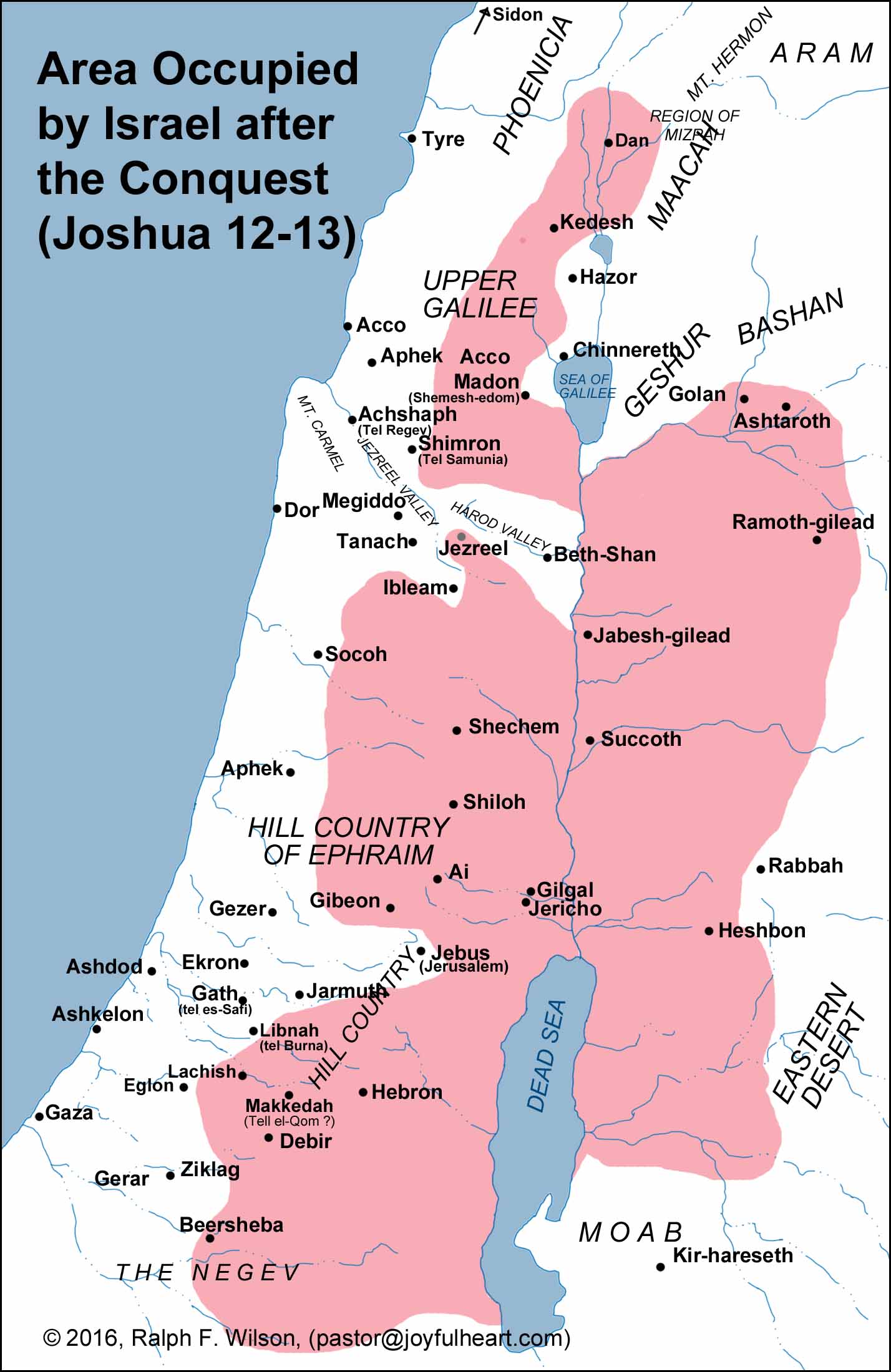
Joshua and the Israelite army had conquered thirty-one kings and territories in the past seven years.  But Joshua was getting old, commentators think about a hundred years old.  It's amazing to think that a man in his nineties could have done what he had done in the past seven years!  But there was still much land to be conquered all around on the outskirts of the conquered area.  This map I found on Pinterest said to have come from jesuswalk.com clearly shows the conquered lands in relation to the whole:


I find it interesting to note that although Joshua had defeated their kings as noted in the last chapter, some of their territories remained outside of Israelite occupation (Gezer, Aphek, Dor, Megiddo, etc.).  It seems reasonable to assume that Joshua may have continued to try to conquer the rest of the lands, but God stopped him because of his advanced age.  Adam Clarke, in his Commentary on the Bible, had an interesting perspective.  As nothing God does is by accident, he suggested that God may have wanted some of the original inhabitants to remain in order to keep the oftentimes unfaithful Israel in check.  

(2) "This is the land that yet remains, all the borders of the Philistines, and all Geshuri,"

The Lord then detailed the lands that were still unconquered, undoubtedly so that Joshua and the Israelites would know what they had a right to claim.  There was the territory of the Philistines in the southwest of Canaan along the Mediterranean Sea, to Geshuri, which appears to be Geshur in the north.  This map borrowed from Big Springs Community Church shows the unconquered lands more clearly than the one above:


(3) "From Sihor before Egypt to the borders of Ekron northward, counted to the Canaanite, five lords of the Philistines, the Gazites, the Ashdodites, the Ashkelonites, the Gittites, and the Ekronites, also the Avites;"

God described in more detail the as of yet unconquered territories of the promised land.  Describing the land of the Philistines, He said it ranged from Sihor before Egypt in the south to Ekron in the north which can be seen in the first map, across from Jerusalem.  The land of Philistia was counted as belonging to the posterity of Canaan, but the Philistines had gotten possession of it.  Because it was counted as Canaanite land, it was part of the promised land.  There were five lords in Philistia rather than kings, and it contained the cities of Gaza, Ashdod, Ashkelon, Ekron, and their inhabitants, and to whatever cities the Gittites and Avites belonged.

(4) "From the south, all the land of the Canaanites and Mearah beside the Sidonians, to Aphek to the borders of the Amorites;"

As near as I can tell by these maps, God is describing all the land of the Canaanites that was not part of the Philistines, from the south upward to Aphek (note there are two Apheks, one in Upper Galilee) to Sidon.

(5) "And the land of the Gebalites, and all Lebanon, toward the sunrising, from Baal Gad under Mount Hermon to the entering into Hamath;"

Gebal was north of Sidon on the Mediterranean coast.  The land of the Gebalites was said to be that east of Tyre, Sidon, and Gebal, the land east of the Lebanon mountains in the north, from Mount Hermon to the entrance of Hamath, seen clearly in this map borrowed from The Biblical Zionist:


(6) "All the inhabitants of the hill country from Lebanon to Misrephoth Maim, all the Sidonians, them I will drive out from before the children of Israel; only divide it by lot to the Israelites for an inheritance as I have commanded you."

The Lord continued to describe the land that was yet unconquered that also included all the hill country from Lebanon to Misrephoth Maim which was south of Tyre, all the land of the Sidonians.  All that very much land yet to be possessed (v. 1) included all the lands described from verse 2 to the Sidonians in verse 6.  All those the Lord would drive out from before the children of Israel.  Even though they were not yet driven out, the Lord wanted Joshua to divide all the promised land by lot to the Israelites for their inheritance.  Most of the early commentators I study suggest that these people were not ever entirely driven out or their land completely possessed by the Israelites, that the promise was always part of a covenant that must be upheld by the Israelites, and they did not do their part.  However, I refer back to Exodus 23:30-31, when the Lord said:

"Little by little I will drive them out from before you, until you have increased, and you inherit the land. And I will set your bounds from the Red Sea to the sea of the Philistines, and from the desert to the river; for I will deliver the inhabitants of the land into your hand, and you shall drive them out before you."

God specifically said that it would be little by little, and indeed all the land was subdued under the reign of David.  Some say that still the people were not specifically driven out, only subdued.  However, throughout ancient and modern history, Israel's borders have changed, and indeed the future Millennial Israel will include all of the promised land.

(7) "Now therefore divide this land for an inheritance to the nine tribes and the half tribe of Manasseh," (8) With whom the Reubenites and the Gadites have received their inheritance which Moses gave them beyond Jordan eastward, as Moses the servant of the Lord gave them,

The Lord told Joshua to divide the land on their present side of the Jordan River for an inheritance to the nine and a half tribes that had not yet received their inheritance.  Reuben, Gad, and the other half tribe of Manasseh had already received their lots on the east side of the Jordan River, given them by Moses.

(9) From Aroer which is on the bank of the River Arnon, and the city that is in the midst of the river, and all the plain of Medeba to Dibon, (10) And all the cities of Sihon king of the Amorites who reigned in Heshbon, to the border of the children of Ammon;

Further describing the lands given to Reuben, Gad, and the half tribe of Manasseh, it was from Aroer in the middle of the Arnon River that separated the land of the Amorites from Moab, and all the plain and cities of Sihon king of the Amorites to the Jabbok River which was the border of the Ammonites.

(11) And Gilead, and the border of the Geshurites and Maachathites, and all Mount Hermon, and all Bashan to Salcah, (12) All the kingdom of Og in Bashan who reigned in Ashtaroth and in Edrei, who remained of the remnant of the giants; for these did Moses smite and cast them out.

They had also received all the kingdom of Og, which included Gilead, the border of the Geshurites and Maachathites, all Mount Hermon, and all Bashan to Salcah.  All that land of Og that had been taken by Moses had been given to Israel, but they had not taken possession of much of it.

(13) Nevertheless, the children of Israel did not expel the Geshurites, nor the Maachathites, but the Geshurites and the Maachathites dwell among the Israelites until this day.

Indeed, Joshua went on to write that the Israelites had not driven out the Geshurites and Maachathites, and they still dwelt with them at the time of his writing.

(14) Only to the tribe of Levi He gave no inheritance; the sacrifices of the Lord God of Israel made by fire are their inheritance, as He said to them.

The tribe of Levi received no land inheritance on either side of the Jordan River.  As they were God's priests, He was to be their inheritance; they were to live off the sacrifices to their Lord God (Deuteronomy 18:1).

(15) And Moses gave to the tribe of the children of Reuben according to their families. (16) And their coast was from Aroer which is on the bank of the river Arnon, the city in the midst of the river, and all the plain by Medeba;

Moses had given to the tribe of Reuben the land from Aroer in the southeast and all the plain of Medeba.

(17) Heshbon, and all her cities in the plain, Dibon, and Bamoth Baal, and Beth Baal Meon, (18) And Jahazah, and Kedemoth, and Mephaath, (19) And Kirjathaim, and Sibmah, and Zereth Shahar in the mount of the valley, (20) And Beth Peor, and Ashdoth Pisgah, and Beth Jeshimoth, (21) And all the cities of the plain, and all the kingdom of Sihon king of the Amorites, who reigned in Heshbon, whom Moses smote with the princes of Midian, Evi, and Rekem, and Zur, and Hur, and Reba, dukes of Sihon dwelling in the country.

Reuben's inheritance included all these cities in the former kingdom of Sihon.  It had been taken by Moses when he defeated the king of Sihon and all his princes.  I can't begin to try to locate all these cities, but I found this map at Psalms to God Podcast that shows a general view of all the tribes and their allotments:


(22) Balaam also, the son of Beor, the soothsayer, the children of Israel killed with the sword, among those who were killed by them. 

The Israelites had also killed Balaam, the soothsayer, at the same time as the princes (Numbers 31:8).

(23) And the border of the children of Reuben was Jordan and its border. This was the inheritance of the children of Reuben after their families, the cities and the villages.

The northwestern border of the land possessed by the descendants of Reuben was the Jordan River.  All the land, cities, and villages between the Jordan and Aroer in the southeast made up the inheritance of the children of Reuben.

(24) And Moses gave to the tribe of Gad, to the children of Gad according to their families. (25) And their coast was Jazer and all the cities of Gilead, and half the land of the children of Ammon, to Aroer before Rabbah; (26) And from Heshbon to Ramath Mizpah and Betonim, and from Mahanaim to the border of Debir; (27) And in the valley Beth Haram, and Beth Nimrah, and Succoth, and Zaphon, the rest of the kingdom of Sihon king of Heshbon, with the Jordan as border to the edge of the Sea of Chinnereth on the other side of the Jordan eastward. (28) This is the inheritance of the children of Gad after their families, the cities and their villages.

Moses gave as an inheritance to the children of Gad the land from Jazer in the south to Rabbah in the west, with the Jordan River as the western border.  The northern border was quite unique, and I will let the map show the general area that was allotted to Gad.  Once again trying to locate all those cities is quite a dizzying task.  The Aroer before Rabbah would have to be a different Aroer from the one at the middle of the Arnon River.  Also Debir would have to be a different Debir.  All the cities of Gilead would only pertain to those cities within the area of Gad, as half of Gilead was given to the half tribe of Manasseh.  The same would have to be said for all the kingdom of Sihon that was given to Reuben (v. 21), as it states here that there was the rest of the kingdom of Sihon that was given to Gad.  Half the land of the children of Ammon refers to that part that Sihon king of the Amorites took from the Ammonites.

(29) And Moses gave to the half tribe of Manasseh, and this was of the half tribe of the children of Manasseh by their families. (30) And their coast was from Mahanaim, all Bashan, all the kingdom of Og king of Bashan, and all the towns of Jair, which are in Bashan, sixty cities; (31) And half Gilead, and Ashtaroth, and Edrei, cities of the kingdom of Og in Bashan, to the children of Machir the son of Manasseh, to the one half of the children of Machir by their families.

To the half tribe of Manasseh, the land from Mahanaim, which must have been the southern border as Gad also had that border (v. 26), including all the land of Bashan that included sixty cities, half of Gilead, and the royal cities of Og, Ashtaroth and Edrei.  The land is said to have been given to half the children of Machir, who was Manasseh's son.

(32) These are what Moses had distributed for inheritance in the plains of Moab on the other side of the Jordan by Jericho eastward.

The lands described above from verse 9 to this verse were all the lands that had been distributed by Moses to the tribes of Reuben, Gad, and the half tribe of Manasseh, on the eastern side of the Jordan River, east of Jericho.

(33) But to the tribe of Levi Moses did not give inheritance; the Lord God of Israel was their inheritance, as He said to them.

Once again, Joshua points out that the tribe of Levi did not receive any land as their inheritance, because as priests, the Lord God was their inheritance.

As Joshua was now old, God had him rest from his battles, even though there was still much land to be conquered.  However, for now, He wanted Joshua to portion out the lots of inheritance, and it was to include all the land that had been promised, even those not yet conquered.  This chapter began with the allotments that had already been given to the tribes of Reuben, Gad, and the half tribe of Manasseh. 

Wednesday, December 4, 2024

The Twelve Memorial Stones from the Jordan

Continuing a chronological Bible study:

(Joshua 4:1) And it came to pass, when all the people were clean passed over Jordan, that the Lord spoke to Joshua, saying,

In chapter 3 of Joshua, the Lord had dried up the Jordan River so that His people could pass over into their promised land.  Now that all the people were completely across the Jordan, the Lord spoke to Joshua. 

(2) "Take you twelve men out of the people, out of every tribe a man."

In Joshua 3:12, Joshua had instructed the people to select one man from each of their tribes, twelve men in all, but it was not told to us why.  Now the Lord told Joshua to call those twelve men.

(3) "And command them, saying, 'Take out of the midst of the Jordan, out of the place where the priests' feet stood firm, twelve stones, and you shall carry them over with you and leave them in the lodging place where you shall lodge tonight.'"

The Lord told Joshua to command the twelve men to go back to the place where the priests' feet had stood and collect twelve stones, each man a stone, and carry them to the place where they would lodge for the night.

(4) Then Joshua called the twelve men, whom he had prepared of the children of Israel, out of every tribe a man.

Joshua called the twelve men whom he had already prepared in Joshua 3:12; there was one man from each of the twelve tribes.

(5) And Joshua said to them, "Pass over before the ark of the Lord your God into the midst of Jordan and take up every man of you a stone upon his shoulder, according to the number of the tribes of the children of Israel."

Joshua told the men to pass over before the ark in the midst of the Jordan River.  Many commentators took this to mean they were to go back to where the priests were still standing in the Jordan; they were to pass over the Jordan to right before the ark.  To me it sounds as if the priests had already crossed over with the people, and the twelve men were to pass by the ark and go into the midst of the river where the priests' feet had stood, as God had used that past tense in verse 3, not where they were standing at that present time.  Regardless, the twelve men were to take up twelve stones from the place where the priests had stood bearing the ark of the covenant of the Lord, each man a stone, bearing it on his shoulder, according to the number of tribes of the Israelites.

(6) "That this may be a sign among you when your children ask in time to come, saying, 'What do you mean by these stones?'"

The twelve stones were to be placed on this side of the Jordan, the side of their promised land, and they were to be a sign in times to come that would have their children asking what was meant by the stones.

(7) "Then you shall answer them that the waters of the Jordan were cut off before the ark of the covenant of the Lord; when it passed over Jordan, the waters of Jordan were cut off, and these stones shall be for a memorial to the children of Israel forever."

When their children asked about the meaning of the stones, they would tell them about how the waters of the Jordan River had been cut off before the ark of the covenant of the Lord.  Those stones would be an everlasting memorial of how the waters had been cut off from that area where the ark stood where the people crossed over.

(8) And the children of Israel did so and took up twelve stones out of the midst of the Jordan, as the Lord spoke to Joshua, according to the number of the tribes of the children of Israel, and carried them over with them to the place where they lodged and laid them down there.

The people did as Joshua had told them to do, as commanded by God.  They had a man from each of their tribes go to the place where the ark had stood while the people crossed over the Jordan River, and each man took up a stone and carried it back over the Jordan to the place where they would lodge that night, and they laid the stones there, one stone representing each tribe of Israel, twelve stones in all.

(9) And Joshua set up twelve stones in the midst of the Jordan in the place where the feet of the priests who bore the ark of the covenant stood, and they are there to this day.

It appears that Joshua took another twelve stones and set them up in the place in the Jordan River where the priests had stood bearing the ark, as a memorial to the exact spot, and they were still there at the time Joshua wrote this account which was evidently some time afterward.

(10) For the priests who bore the ark stood in the midst of the Jordan until everything was finished that the Lord commanded Joshua to speak to the people, according to all that Moses commanded Joshua, and the people hasted and passed over.

This is a rather difficult verse, but I believe it refers only to the priests standing in the midst of the Jordan until all the people passed over the river, as Moses had not commanded Joshua anything about the setting of the stones.  I believe it must be the general commandment that Joshua would lead the people over the Jordan into their promised land.  While the priests stood in the midst of the Jordan, and the waters were cut off, the people hurried across the river to their promised land.

(11) And it came to pass, when all the people were clean passed over, that the ark of the Lord passed over, and the priests, in the presence of the people.

Once the people had completely crossed over the Jordan River, then the priests bearing the ark of the covenant crossed over in the presence and sight of all the people.

(12) And the children of Reuben, and the children of Gad, and half the tribe of Manasseh, passed over armed before the children of Israel, as Moses spoke to them.

The men of the tribes of Reuben, Gad, and the half tribe of Manasseh who were settled on the other side of the Jordan, also crossed over the Jordan River, armed and ready for battle, as they had promised Moses they would do (Numbers 32:17).

(13) About forty thousand prepared for war passed over before the Lord to battle, to the plains of Jericho.

40,000 men from those two and a half tribes crossed over the Jordan, prepared for battle with their brethren, to the plains of Jericho.

(14) On that day the Lord magnified Joshua in the sight of all Israel, and they feared him as they feared Moses all the days of his life.

On that day the Lord had magnified Joshua, making him great and honorable in the sight of the Israelites, and the people respected and reverenced him all the days of his life as they had done Moses.

(15) And the Lord spoke to Joshua, saying, (16) "Command the priests who bear the ark of the testimony that they come up out of the Jordan."

Joshua didn't write very smoothly in a clean order, as he already told us in verse 11 that after all the people had crossed over the Jordan, the priests bearing the ark crossed over.  Here he told us that the Lord Himself had told him to command the priests to come out of the Jordan after the people had passed over.

(17) Joshua therefore commanded the priests, saying, "Come up out of the Jordan."

Joshua did as the Lord instructed him and told the priests to come up out of the Jordan River.

(18) And it came to pass, when the priests who bore the ark of the covenant of the Lord had come up out of the midst of the Jordan, and the soles of the priests' feet were lifted up onto the dry land, that the waters of Jordan returned to their place and flowed over all its banks as before.

Once the priests carrying the ark stepped onto dry land on the other side of the Jordan River, the waters of the river began flowing downstream again and flowed over its riverbanks as it had before.

(19) And the people came up out of the Jordan on the tenth of the first month and camped in Gilgal on the east border of Jericho.

The people had crossed over the Jordan River into their promised land on the tenth day of their first month, Nissan or Abib, as it was called; from the time of the people's exodus from Egypt, it was appointed the first month of the year (Exodus 12:2).  Now was their new beginning in their promised land in the first month of the year.  They camped in Gilgal on the east border of Jericho.

(20) And those twelve stones which they took out of the Jordan, Joshua pitched in Gilgal.

Joshua set up the twelve stones that the twelve men had taken out of the Jordan River there at their encampment as a memorial of their passage over the Jordan into their promised land.

(21) And he spoke to the children of Israel, saying, "When your children shall ask their fathers in time to come, saying, 'What are these stones?' (22) Then you shall let your children know, saying, 'Israel came over this Jordan on dry land.'" 

As Joshua had already told the people when he instructed them regarding the twelve stones in verses 6 and 7, the stones were to be commemorative and a visual sign that might prompt their children to ask what they meant, and they could then tell them the story about how the Lord dried up the Jordan River to allow them to cross safely into their promised land.

(23) "For the Lord your God dried up the waters of Jordan from before you until you were passed over, as the Lord your God did to the Red Sea which He dried up from before us until we were gone over, (24) That all the people of the earth might know the hand of the Lord, that it is mighty, that you might fear the Lord your God forever."

The way this is worded, describing how the Lord dried up the waters from before you, this appears to be directed to the people who had just crossed over the Jordan, and not part of what they would tell their children when they asked about the stones.  Joshua reminded the people that the Lord had just done for them what He had done in the days of Moses when He parted the Red Sea to allow their safe escape from Egypt, and that He had done these things that all the people of the earth would know the power of the one true God, and that they themselves would always remember and respect and fear their Lord forever.

The words of Adam Clarke, in his Commentary on the Bible, really struck me, especially one part.  In general, he wrote of how important it was to pass down the things of God to the next generation and that it was God's will that we do that.  That has kept the Bible alive in all the earth for thousands of years.  It's a vital part of how we raise our children, teaching them knowledge and truth.  "A spirit of inquiry is common to every child: the human heart is ever panting after knowledge; and if not rightly directed when young, will, like that of our first mother, go astray after forbidden science."  I can't help but think about the forbidden science our world is going after in this day, science that says people can change their genders and artificial intelligence that men seek after to make them immortal and as gods.  As a society, we have neglected to teach the truths of God.  As a matter of fact, we have forcibly pushed God out of schools and the public square.  It's no wonder so many follow after forbidden science, only the things that God Himself has control over.  After all, there is no wisdom apart from God (Proverbs 21:30).

Saturday, November 23, 2024

God Commissions Joshua to Succeed Moses

Continuing a chronological Bible study:

(Joshua 1:1) Now after the death of Moses the servant of the Lord, it came to pass that the Lord spoke to Joshua the son of Nun, Moses's minister, saying, 

After an interlude of psalms, I return to a chronological order of Bible events.  Moses had died and was buried at the end of Deuteronomy.  After his death, the Lord spoke to Joshua, Moses's minister or assistant.

(2) "Moses My servant is dead; now therefore, arise, go over this Jordan, you, and all this people, to the land which I give to them, to the children of Israel."

The Lord told Joshua that as His servant Moses was dead, Joshua was to lead the people of Israel over the Jordan River and into their promised land.

(3) "Every place that the sole of your foot shall tread upon, that have I given to you, as I said to Moses. (4) From the wilderness and this Lebanon even to the great river, the River Euphrates, all the land of the Hittites, and to the great sea toward the going down of the sun, shall be your coast."

The Lord told Joshua that every place his foot was about to tread upon He had given to them, from the Wilderness of Zin in the south to the Lebanon mountains in the north to the River Euphrates in the east, all of the land of Canaan, to the Mediterranean Sea in the west.  This is the best map I could find, labelling three of the four boundaries God mentioned:


(5) "There shall not any man be able to stand before you all the days of your life; as I was with Moses, so I will be with you; I will not fail you or forsake you."

Imagine getting such a personal promise from God!  He told Joshua that no man would be able to stand against him all the days of his life.  As He had been with Moses, He promised to be with Joshua, to advise, guide, and protect him, and bring him success.  He promised to never fail or forsake him.

(6) "Be strong and of a good courage, for to this people you shall divide for an inheritance the land which I swore to their fathers to give them."

The Lord told Joshua to be strong and have good courage, for he was going to take possession of the land the Lord had promised to the Israelites' forefathers, and he would divide it among them.

(7) "Only be strong and very courageous, that you may observe to do according to all the law which Moses My servant commanded you; do not turn from it to the right hand or the left, that you may prosper wherever you go."

However, to be assured of God's promise to him, he was to be strong and very courageous in upholding the law which Moses had handed down to the people.  God told him not to veer away from the law so that he might prosper wherever he went.

(8) "This book of the law shall not depart out of your mouth, but you shall meditate in it day and night that you may observe to do according to all that is written in it, for then you shall make your way prosperous, and then you shall have good success."

The Lord told Joshua His book of the law was to be with Joshua continually.  He was to read it, recite it, and speak it.  He was to meditate on it day and night that he might act according to it and that would make his way prosperous and successful.

(9) "Have I not commanded you? Be strong and of a good courage; do not be afraid nor be dismayed, for the Lord your God is with you wherever you go."

The Lord repeated His command to Joshua that he be strong and of good courage.  He told him not to be afraid or dismayed of what might come his way as he went forward, for the Lord would be with him wherever he went.

(10) Then Joshua commanded the officers of the people, saying, (11) "Pass through the camp and command the people, saying, 'Prepare provisions, for within three days you shall pass over this Jordan to go in to possess the land which the Lord your God gives you to possess it.'"

Then Joshua commanded the officers of the people to go through the camp and tell all the people to prepare provisions for themselves because within three days they would pass over the Jordan River to go in and possess the land that the Lord was giving them.

(12) And to the Reubenites and to the Gadites and to half the tribe of Manasseh, Joshua spoke, saying, (13) "Remember the word which Moses the servant of the Lord commanded you, saying, 'The Lord your God has given you rest and has given you this land.'"

Then Joshua spoke to the tribes of Reuben, Gad, and the half tribe of Manasseh, reminding them that Moses had told them in Numbers 32:29 that the Lord would give them the land and rest on that side of the Jordan River if they would agree to send their men into battle with their brethren when they crossed over to their promised land.

(14) "Your wives, your little ones, and your cattle, shall remain in the land which Moses gave you on this side of the Jordan, but you shall pass before your brethren armed, all the mighty men of valor, and help them, (15) Until the Lord has given your brethren rest, as you, and they also have possessed the land which the Lord your God gives them; then you shall return to the land of your possession and enjoy it, which Moses, the Lord's servant, gave you on this side of the Jordan toward the sunrising."

Indeed, Joshua went on to remind the two and a half tribes that their wives, children, and livestock, could remain in the land Moses had agreed to give them on their present side of the Jordan River, but their fighting age men were to go into the promised land on the other side of the Jordan to help the other tribes conquer the land until the time the Lord gave them rest from their battles.  Then their brothers could also have rest in their land as the two and a half tribes had in theirs, and they could then return to their land and enjoy it.

(16) And they answered Joshua, saying, "All that you command us, we will do, and wherever you send us, we will go."

The tribes of Reuben and Gad and the half tribe of Manasseh agreed and told Joshua they would do whatever he commanded and would go wherever he sent them.

(17) "According as we hearkened to Moses in all things, so we will hearken to you; only the Lord your God be with you as He was with Moses."

The two and a half tribes told Joshua that just as they listened to and obeyed Moses, they would obey Joshua, as long as the Lord was with him just as He was with Moses.  I don't believe they meant that as a condition for their obedience, as if they would judge whether or not God was with Joshua, but rather it was a desire and a prayer that He would be with Joshua just as He had been with Moses.

(18) "Whoever rebels against your commandment and will not hearken to your words in all that you command him, he shall be put to death; only be strong and of a good courage."

They assured Joshua that if any man refused to do as Joshua commanded and would not go over the Jordan to fight with his brethren. he would be put to death.  They encouraged Joshua to be strong and of a good courage.  Adam Clarke, in his Commentary on the Bible, reminded his readers that the people's fathers had at one time rejected Moses's authority and mutinied against him and even attempted to stone Joshua to death (Numbers 14:4-10).  However, they now assured Joshua they would heed his commands, and anyone who didn't would be put to death.

Saturday, September 28, 2024

The Blessing of Moses

Continuing a chronological Bible study:

(Deuteronomy 33:1) And this is the blessing with which Moses the man of God blessed the children of Israel before his death.

In the last chapter, Moses had recited the Song of Moses that the Lord had directed him to write and to teach to the people.  He now offered the following blessing to the people.

(2) And he said, "The Lord came from Sinai and rose up from Seir to them; He shined forth from Mount Paran, and He came with ten thousands of saints; from His right hand a fiery law for them."

Moses began his blessing by stating that the Lord had come from Sinai, where His first appearance to Moses was.  He showed Himself to the Israelites in Seir like the sun when it rose up and continued shining on them to Paran.  He came with tens of thousands of saints or holy angels of heaven who attended Him in His great and glorious work of delivering His fiery law which came directly from Him, a law which pierced and penetrated the consciences of men like fire.

(3) "Yea, He loved the people, all His saints in Your hand, and they sat down at Your feet and shall receive of Your words."

Moses declared that the Lord loved His people Israel, and now calls them His saints in His hands, in His care and protection.  His people sat at His feet, perhaps alluding to them being at the foot of Mount Sinai when He gave the law from the top of the mount, and they received His words.

(4) "Moses commanded us a law, the inheritance of the congregation of Jacob."

Moses spoke of himself in the third person and said he had commanded to the people the law that had been given to them by the Lord Himself, they the congregation of Jacob considered His inheritance, His own special people.

(5) "And He was king in Jeshurun when the heads of the people and the tribes of Israel were gathered together."

The Lord was king in Israel, Jeshurun being another name He sometimes gave Israel, when the heads and tribes of Israel were gathered at Mount Sinai to hear the law recited by Moses.

(6) "Let Reuben live and not die, nor let his men be few."

Moses's blessing was that the tribe of Reuben live and not die, although Reuben had deserved to be cut off or greatly diminished because of his sin against his father (Genesis 49:4).  

(7) And this of Judah, and he said, "Hear Lord, the voice of Judah, and bring him to his people; let his hands be sufficient for him and You be a help from his enemies."

Regarding Judah, Moses asked that the Lord hear the prayers of Judah, which John Gill believes "was eminently fulfilled in David, Asa, Jehoshaphat, Hezekiah, and other kings."  Bring him back safely and victorious to his people and make him able to defend and provide for himself with the Lord's protection and preservation from his enemies.

(8) And of Levi he said, "Your Thummim and Your Urim be with Your holy one whom You tested at Massah, with whom you strove at the waters of Meribah, (9) Who said to his father and to his mother, 'I have not seen him;' neither did he acknowledge his brothers, nor knew his own children, for they have observed Your word and kept Your covenant."

Regarding Levi, Moses said that the Lord's Thummim and Urim, objects used to determine God's will worn by the high priest, be with Aaron of the tribe of Levi, the same Aaron the Lord had reproved and contended with at Massah and Meribah.  I believe the sense of verse 9 is that the Levite priests had no natural affection or respect for their parents and family over the Lord.  They followed God and His command fully and kept His covenant.

(10) "They shall teach Jacob Your judgments and Israel Your law; they shall put incense before You and whole burnt sacrifice upon Your altar."

The Levite priests would teach Jacob, that is Israel, the Lord's statutes and laws, and they were the only ones who could put incense on the altar before the Lord and offer whole burnt sacrifices on His altar.

(11) "Bless, Lord, his substance, and accept the work of his hands; strike through the loins of them who rise against him and of those who hate him that they rise not again."

Moses asked that the Lord bless Levi's substance because the Levites had no inheritance of their own and were wholly dependent on the Lord's blessing.  He asked that the Lord accept the work of the priests' hands in their administration of their priestly duties and thoroughly destroy those who would rise up against them.

(12) Of Benjamin he said, "The beloved of the Lord shall dwell in safety by Him who shall cover him all the day long, and he shall dwell between His shoulders."

Regarding Benjamin, the temple would be built in Benjamin's lot.  Benjamin was the beloved of his father Jacob and is so called the beloved of the Lord.  His tribe would dwell in safety near the temple of the Lord who would continually protect him and support him as a father might carry his son upon his shoulders.

(13) And of Joseph he said, "Blessed of the Lord his land, for the precious things of heaven, for the dew, and for the deep that lies beneath, (14) And for the precious fruits by the sun, and for the precious things put forth by the moon, (15) And for the chief things of the ancient mountains, and for the precious things of the lasting hills, (16) And for the precious things of the earth and its fullness, and the good will of Him who dwelt in the bush, let the blessing come upon the head of Joseph, upon the top of the head of him separated from his brothers."

Regarding the tribe of Joseph, his land was blessed by the Lord and extremely fruitful, blessed by the precious rain from heaven, by the dew, by the deep springs of water coming out of the earth, by the light and warmth of the sun, and by the coolness and moisture put forth by the moon.  He was blessed by the excellent fruits, grapes, olives, and figs, which grew in the mountains, and the precious minerals that were contained there.  He would be blessed by all the precious things of the earth, and by the good will of the Lord who dwelt in the burning bush and appeared to Moses.  Let all these blessings come upon the tribe of Joseph, he who had been separated from his brothers when they sold him into slavery in Egypt.

(17) His glory the firstling of his bullock, and his horns the horns of unicorns; with them he shall push the people together to the ends of the earth, and they the ten thousands of Ephraim and they the thousands of Manasseh.

Joseph's glory was like that of a firstborn bull, an emblem of power and strength.  His horn was like the horn of a unicorn.  The unicorn in the Bible is not what we picture today.  It was more likely a now extinct wild bull with a single horn, more like a rhinoceros.  Wherever it is mentioned in the Bible, it is an animal of great strength.  That is the animal that could push the people together to the ends of the earth, referring to his enemies.  The tribes of Joseph were in his sons, Ephraim and Manasseh.  Although Manasseh was the eldest son of Joseph, fewer people were ascribed to him and more to the younger Ephraim, according to Jacob's prediction in Genesis 48:19.

(18) And of Zebulun he said, "Rejoice Zebulun, in your going out, and Issachar, in your tents."

Moses blessed the tribe of Zebulun as it went out to sea as it was a maritime tribe with its portion of land by the sea, also predicted by Jacob in Genesis 49:13.  He included his brother Issachar in the blessing, who would be just as blessed, but in his tents, or at home with his land and his livestock.

(19) "They shall call the people to the mountain; there they shall offer sacrifices of righteousness, for they shall suck the abundance of the seas and of treasures hid in the sand."

Referring again to Zebulun, his people would call people back to the mountain, to the temple of God, where they would offer sacrifices of righteousness.  They would grow rich by their traffic on the seas and by treasures hidden in the sand, but they would not forget their duty at home, and they would even call Gentiles to the true faith in the one true God.

(20) And of Gad he said, "Blessed He who enlarges Gad; he dwells as a lion and tears the arm with the crown of the head."

Regarding the tribe of Gad, Moses first acknowledged the Lord who enlarged Gad, delivering him out of his troubles mentioned in Genesis 49:19 that he would overcome at last.  He would then dwell as a lion, bold, courageous, and secure, and would destroy his enemies, both the arm of their strength and the crown, their kings and governors.

(21) "And he provided the first part for himself, because there a portion of the lawgiver, seated, and he came with the heads of the people; he executed the justice of the Lord and his judgments with Israel."

Gad provided the first part of the promised land for himself because he asked for and was given it by Moses, the lawgiver.  There he seated and secured his wives and children, while he would go with the heads of the people into war against Canaan.  He and the rest of the Israelites would execute the judgment of God against the Canaanites.

(22) And of Dan he said, "Dan, a lion's whelp; he shall leap from Bashan."

The tribe of Dan was like a young lion, bold and strong, and able to leap from Bashan, a mountain place inhabited by many lions.  This is not meant to be said of Dan himself as his tribe doesn't have any special relationship with Bashan, but with the strong lion that leapt from the mountain of Bashan upon its prey.  The tribe of Dan was courageous and strong like that lion.

(23) And of Naphtali he said, "O Naphtali, satisfied with favor and full with the blessing of the Lord; possess the west and the south."

Naphtali would have great favor, perhaps among men, but mainly with God, and he would have great blessing of the Lord.  Adam Clarke, in his Commentary on the Bible, pointed out the tribes of Naphtali and Zebulun enjoyed wondrous favor from the Lord as Jesus spent most of His time there in Capernaum (Matthew 4:13,15, 9:1).  Jesus called Capernaum "exalted unto heaven" (Matthew 11:23).  All the commentators I study agree that possessing the west and the south did not mean the tribe of Naphtali would inhabit the west and the south, as they did not.  The main definition of "yam" that was transcribed as "west," is more often "sea."  "Darom" transcribed as "south" also meant "south wind" and may be used here in a characteristic way here to mean warm and sunny.  Naphtali would possess a warm and sunny sea region.  Albert Barnes, in his Notes on the Bible, wrote, "The possession of Naphtali included nearly the whole west coast of the Sea of Galilee, the Lake of Merom, the modern Bahr el Hulch, and the well watered district near the springs of Jordan. It contained some of the grandest scenery and some of the most fertile land in Palestine."

(24) And of Asher he said, "Asher blessed with children, let him be acceptable to his brothers, and let him dip his foot in oil."

Asher would be blessed with large numbers, in union and harmony with the other tribes, and he would have such plenty that he would be able to dip his feet in oil, meaning not only anointing his head, but his feet also.

(25) "Your shoes iron and brass, and as your days, your strength."

It is said that mines of iron and copper were in Asher's portion, but this verse might also mean that the tribe was strong and steadfast.  Their strength would continue all their days; they would not become feeble with age.

(26) "None like the God of Jeshurun, riding upon the heaven to help you, and in His excellency on the sky."

There is no god who compares to the God of Israel.  Their almighty sovereign God of the heavens and the sky was there to help His people Israel.

(27) "The eternal God your refuge, and underneath the everlasting arms; and He shall thrust out the enemy from before you, and shall say, 'Destroy!'"

The eternal God was Israel's refuge and protection.  Underneath the everlasting arms of the eternal God, they were safe and secure.  God would thrust out their enemies from before them to clear the land for them and would direct them to carry out His righteous judgment by destroying them.

(28) "Israel then shall dwell in safety alone; the fountain of Jacob upon a land of corn and wine; also His heavens shall drop down dew."

Once their enemies were destroyed, Israel would dwell in safety alone.  I found the words of Adam Clarke on this verse to be profound, "This people shall not be incorporated with any other people under heaven. A prophecy which continues to be fulfilled to the very letter. Every attempt to unite them with any other people has proved absolutely ineffectual."  Even to this day there are attempts at a two-state solution in Israel which has never worked.  The descendants of Jacob that would spring forth as from a fountain would be in a fertile land abounding in corn and wine and all good things.  The Lord would continue to drop actual dew making the land fruitful, but also drop blessings as dew from heaven.

(29) "Happy, you, O Israel! Who is like you, a people saved by the Lord, the shield of your help and the sword of your excellency? And your enemies shall be found liars to you, and you shall tread upon their high places."

Israel should be the happiest in the world as there are no others like her, a people chosen and saved by the Lord, the one true God who shields and protects her and destroys her enemies and lifts her to excellency.  The Israelites' enemies would be found to be liars in that when they said they would destroy Israel, they would never be able to fulfill their intent.  Israel would possess their enemies' high places.

The Song of Moses in the last chapter highlighted the calamities that would befall Israel when she turned from God, but these blessings of Moses describe the glory and greatness that in God's love and mercy He would crown her.  Every tribe was blessed with the exception of Simeon.  Jacob had cursed Levi and Simeon as "instruments of cruelty" in Genesis 49:5 and said they would be scattered in Israel (Genesis 49:7).  In His mercy God chose the Levites to be His priests, but they would not have their own inheritance in the promised land.  Simeon was given only a select number of cities within Judah's inheritance (Joshua 19:1-9).