Showing posts with label Ehud. Show all posts

Saturday, May 10, 2025

Deborah and Barak

After a brief interlude with the story of Ruth that was concurrent with the time of the first judges, Othniel, Ehud, and Shamgar, Judges 4 continues to chronicle Israel's judges.  Continuing the chronological Bible study:

(Judges 4:1) And the children of Israel again did evil in the sight of the Lord when Ehud was dead.

At the end of the third chapter of Judges, Ehud had delivered the Israelites from Moab.  Shamgar had a brief mention as he delivered them from at least 600 Philistines, but it appears that Ehud was the stabilizing force that allowed Israel rest for eighty years (Judges 3:30).  However, after he died, Israel returned to her wicked ways.

(2) And the Lord sold them into the hand of Jabin, king of Canaan, who reigned in Hazor, the captain of whose host was Sisera who dwelt in Harosheth of the Gentiles.

Because they did evil in His sight, the Lord delivered them into bondage to Jabin, the king of Canaan.  During the time of Joshua, there was a King Jabin of Hazor whom Joshua killed (Joshua 11).  This was evidently a successor by the same name who had rebuilt and reinhabited Hazor.  It appeared that Jabin kept a standing army to keep Israel in check, and Sisera was the captain of his army.  He dwelt in a place called Harosheth of the Gentiles.

(3) And the children of Israel cried to the Lord, for he had nine hundred chariots of iron, and twenty years he mightily oppressed the children of Israel.

The children of Israel cried out to the Lord after twenty years of oppression by Sisera.  He had cruelly kept them in check with nine hundred chariots of iron.  These were not chariots made of iron, but rather they were chariots equipped with iron scythes that stood out from the orbs of the wheels and could slash through any group of people, thus striking fear in the Israelites, and they cried out to their Lord for deliverance.

(4) And Deborah, a prophetess, the wife of Lapidoth, she judged Israel at that time.

Deborah, a prophetess, a female prophet who by the Spirit of God declared His will, judged Israel at that time.  It is said she was the wife of Lapidoth.  However, he is not mentioned anywhere else.  As the original word "ishshah" that was translated as "wife" can also mean "woman," this might have as easily been translated as "a woman of Lapidoth," making Lapidoth a place rather than a man.  However, there is not a place known by Bible scholars with the name of Lapidoth, so who knows?  The fact that it is only mentioned one time in the Bible makes it of little importance either way.

(5) And she dwelt under the palm tree of Deborah between Ramah and Bethel in Mount Ephraim, and the children of Israel came up to her for judgment.

It appears Deborah sat in judgment in the open air under a palm tree that was called by her name.  It was located between Ramah and Bethel in the mountains of Ephraim.  The Israelites came to her there for judgment.

(6) And she sent and called Barak the son of Abinoam out of Kedesh Naphtali, and said to him, "Has not the Lord God of Israel commanded, saying, 'Go and draw toward Mount Tabor and take with you ten thousand men of the children of Naphtali and of the children of Zebulun'?"

Deborah called for Barak, the son of Abinoam, from Kedesh in Naphtali.  She asked Barak if he knew it to be true that the Lord had commanded Israel to go to Mount Tabor and bring ten thousand men from Naphtali and Zebulun.  Whether or not Barak knew that the Lord had commanded him to do that, I'm not sure.  It might be that this was Deborah's way of informing him that that was what the Lord had said to her, and therefore he could not dare question it.  

(7) "'And I will draw to you to the river Kishon, Sisera, the captain of Jabin's army, with his chariots and his multitude, and I will deliver him into your hand.'"

Deborah continued with the words of the Lord, that He would draw Sisera, the captain of Jabin's army, to Barak at the river Kishon with all his army and 900 chariots of iron.  The Lord declared through Deborah that He would deliver them into his hand.

(8) And Barak said to her, "If you will go with me, then I will go, but if you will not go with me, I will not go."

I suppose Barak's answer does show faith that the Lord would deliver Sisera into his hand, as confirmed by Hebrews 11 where he is listed as one of the heroes of faith.  However, it seems to show a little weakness in him that he must have a woman, Deborah, go with him into battle.  Maybe it was because he highly regarded her as an oracle of God and wanted that word of the Lord leading him into battle.

(9) And she said, "I will surely go with you, notwithstanding the journey that you take shall not be for your honor, for the Lord shall sell Sisera into the hand of a woman." And Deborah arose and went with Barak to Kedesh.

Deborah instantly agreed to go with Barak, but she told him that by her accompanying him, he would not be given the glory for defeating Sisera, but the Lord would deliver Sisera into the hand of a woman.  Indeed, I believe Deborah is better remembered than Barak.  Deborah rose up and went with Barak to Kedesh.

(10) And Barak called Zebulun and Naphtali to Kedesh, and he went up with ten thousand men at his feet, and Deborah went up with him.

Barak called the tribes of Zebulun and Naphtali to him in Kedesh, where ten thousand men were chosen, and those being under Barak's command, and Deborah, went forward with him.

(11) Now Heber the Kenite of the children of Hobab, the father-in-law of Moses, had severed himself from the Kenites and pitched his tent to the plain of Zaanaim which is by Kedesh.

Heber, a Kenite from the children of Hobab, actually the son of Moses's father-in-law Jethro, along with all the children of Hobab (see Joshua 1:16), had severed himself from the Kenites, and he dwelt in the plain of Zaanaim which was close to Kedesh.

(12) And they showed Sisera that Barak the son of Abinoam had gone up to Mount Tabor.

It was reported to Sisera that Barak had gone up to Mount Tabor.  It does not say exactly who reported it.  It could have been Canaanites, but it also could have been some of the Kenites who had remained at peace with Jabin as we will see in verse 17.  Whether it was out of good will or perhaps ill will to further God's will, either way it was surely God's will that Sisera be informed about Barak being at Mount Tabor.

(13) And Sisera gathered together all his chariots, nine hundred chariots of iron, and all the people with him, from Harosheth of the Gentiles to the river of Kishon.

Therefore Sisera gathered together all his nine hundred chariots of iron and all his people from Harosheth of the Gentiles where he resided to the Kishon River which was near Mount Tabor where Barak and his men were.

(14) And Deborah said to Barak, "Up! For this is the day in which the Lord has delivered Sisera into your hand; is not the Lord gone out before you?" So Barak went down from Mount Tabor and ten thousand men after him.

Deborah told Barak to rise up for she had been told by a spirit of prophecy that that was the day when the Lord had delivered Sisera into his hand.  She assured Barak that the Lord had gone out before him so he might be sure of victory.  Therefore he and his ten thousand men went down from Mount Tabor.

(15) And the Lord discomfited Sisera, and all his chariots, and all his host, with the edge of the sword before Barak, so that Sisera lighted down off his chariot and fled away on his feet.

The word that was translated as "discomfited" literally meant "to put in commotion."  The Lord confused, troubled, and frightened Sisera and his men and even his chariots.  The historian Josephus wrote that there was a great storm of rain and hail, and a great wind blew rain in the faces of the enemy that blinded their eyes.  The hail numbed their hands so that they could not hold their swords.  If all that is true, there would be no doubt that it was the Lord who stirred up the commotion that allowed Barak to come in with the sword and destroy them.  However, Sisera jumped off his chariot and ran away.

(16) But Barak pursued after the chariots and after the host to Harosheth of the Gentiles, and all the host of Sisera fell on the edge of the sword; there was not a man left.

Barak pursued after the chariots and Sisera's army all the way back to where they had started at Harosheth of the Gentiles.  Everyone of Sisera's army was killed.  There was not a single man left of his army, but Sisera himself had escaped.

(17) However, Sisera fled away on his feet to the tent of Jael the wife of Heber the Kenite, for there was peace between Jabin the king of Hazor and the house of Heber the Kenite.

Sisera had fled to the tent of Jael, the wife of Heber, because there had been peace between Jabin the king and the house of Heber, so he felt he would be safe there.  

(18) And Jael went out to meet Sisera and said to him, "Turn in, my lord, turn in to me; fear not." And when he had turned in to her into the tent, she covered him with a rug.

Indeed, Jael went out to meet Sisera and invited him to turn into her tent and not be afraid, insinuating he would be safe there.  When he came into her tent, she covered him with a rug perhaps to hide him, or it may have been a blanket made similarly as a rug just to comfort and warm him.

(19) And he said to her, "Give me, I pray you, a little water to drink for I am thirsty." And she opened a bottle of milk and gave him drink and covered him.

Sisera asked Jael for some water because he was thirsty.  She actually gave him milk, possibly as a courtesy to give him something more nourishing, or perhaps something more than water to make him sleep.  She then covered him.

(20) Again he said to her, "Stand in the door of the tent, and it shall be when any man comes and enquires of you, and says, 'Is there any man here?' that you shall say, 'No.'"

Sisera spoke to Jael again and asked her to stand in the doorway of her tent, so that if anyone came looking for a man, they would have no need to enter her tent for she would be in the doorway and would answer that there was no one in her tent besides her.

(21) Then Jael, Heber's wife, took a nail of the tent and took a hammer in her hand and went softly to him and struck the nail into his temples and fastened it into the ground, for he was fast asleep and weary. So he died.

When Sisera was fast asleep for he was so weary, Jael took a tent spike and a hammer and went quietly to him and drove the spike through his temples, fastening him to the ground, where he, of course, died.  Some of the Biblical scholars I study had a moral dilemma with what Jael did.  Only God knows the heart, but He definitely used Jael to deliver Sisera into the hand of a woman as Deborah had prophesied (verse 9).  Jael may have been sincere when she encouraged Sisera to come into her tent, but she was later struck by the Spirit of God to kill him.  She may have witnessed the rain and hail and chaos that had struck Sisera and his army and may have come to realize that it was of God, and she was therefore led to do what she did.  Whatever was in her heart and spirit at the time, we can be sure that God put it there, or He knew what was there and used it for His purposes.

(22) And behold, as Barak pursued Sisera, Jael came out to meet him and said to him, "Come, and I will show you the man whom you seek." And when he came into her tent, behold, Sisera lay dead, and the nail was in his temples.

As Barak was still pursuing Sisera and neared Jael's tent, she went out to meet him and told him she would show him the man for whom he was seeking.  This tells me that she was probably Spirit led to do what she did as she knew without a doubt that Barak was looking for Sisera, and she felt safe to invite him into her tent to see him for himself.  Indeed, Barak went into Jael's tent and saw that Sisera was dead with the spike still in his temples.

(23) So God subdued on that day Jabin the king of Canaan before the children of Israel. (24) And the hand of the children of Israel prospered and prevailed against Jabin the king of Canaan until they had destroyed Jabin king of Canaan.

Thus God had subdued Jabin, the king of Canaan, before the children of Israel.  The Israelites prevailed against the king of Canaan until they had destroyed him.  Scripture does not tell specifically how King Jabin died, but his army and its captain being defeated, the king was apparently easily destroyed.

Monday, April 21, 2025

The First Judges, Othniel, Ehud, and Shamgar

Continuing a chronological Bible study:

(Judges 3:1) Now these are the nations which the Lord left to prove Israel by them, as many as had not known all the wars of Canaan.

The last chapter of Judges told how the Lord had purposely left some nations in the Israelites' promised land in order to prove their need for Him.  These were the people who had not lived during the time of Joshua and his conquest and did not personally know of God's mighty works in delivering Canaan to His people.  A list of the nations that remained follows.

(2) (Only that the generations of the children of Israel might know, to teach them war, at the least such as before knew nothing of it.)

It was important that the next generation of Israelites understand war as there would always be enemies in the world that would try to destroy them.  Adversity is an important teacher.  We learn the most through conflict and distress.  That which does not kill us makes us stronger.  And people draw closer to their God in times of trouble.

(3) Five lords of the Philistines, and all the Canaanites, and the Sidonians, and the Hivites who dwelt in Mount Lebanon, from Mount Baal Hermon to the entering in of Hamath.

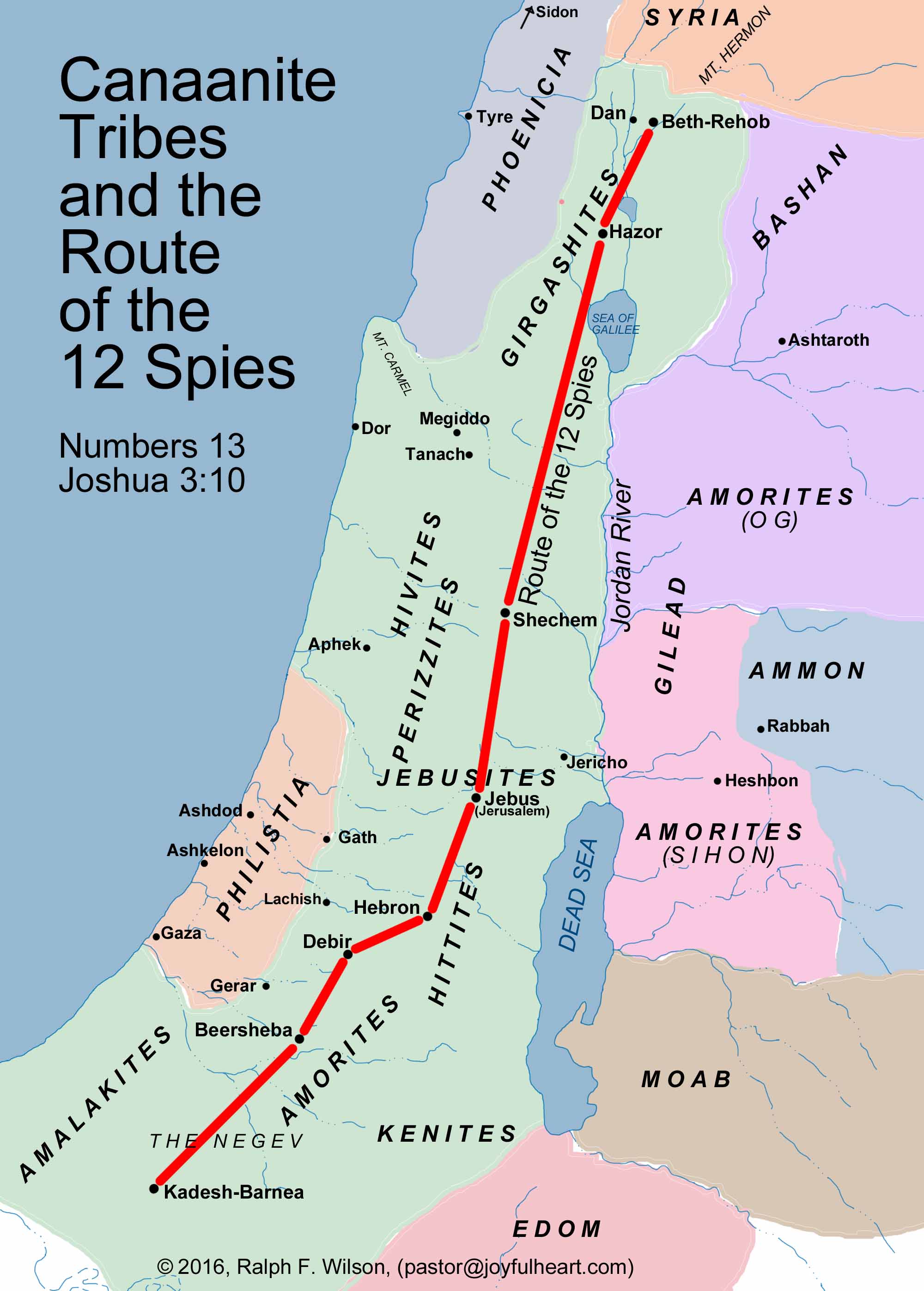
The list of the nations the Lord had let remain in the land of Canaan began with the Philistines, the lords of Gaza, Ashdod, Ashkelon, Gath, and Ekron (Joshua 13:3).  In Judges 1:18, we were told that Judah had taken Gaza, Ashkelon, and Ekron, after the death of Joshua, but apparently they recaptured the cities and remained thorns in Israel's sides.  The Canaanites remained.  In Judges 1:4, the Lord had delivered the Canaanites into Judah's hand.  That referred to the specific tribe of Canaanites, not Canaanites as the whole of all the tribes that inhabited Canaan.  Since the scripture said, "all the Canaanites," I am assuming this refers to all the Canaanites who were dispersed throughout the land.  The Sidonians, inhabitants of the city of Sidon, also remained, as well as the Hivites who dwelt in Mount Lebanon, north of where the Israelites dwelt to the east of Lebanon to Mount Hermon and northward to the entrance of Hamath.  This map from JesusWalk.com shows the areas left unconquered in white:


(4) And they were to prove Israel by them, to know whether they would hearken to the commandments of the Lord which He commanded their fathers by the hand of Moses.

Those nations were left in Canaan in order to try the Israelites' courage and prove their faithfulness to their Lord to know whether or not they would follow the commandments of the Lord that He gave them through His servant Moses.  It's not that the Lord had to do this in order to know what they would do.  Of course, the Lord already knew what they would do.  That's why He left the nations.  The people had to be repeatedly reminded of why they needed their Lord God.  They could not prosper without Him.

(5) And the children of Israel dwelt among the Canaanites, Hittites, and Amorites, and Perizzites, and Hivites, and Jebusites.

Because the Lord did not completely drive out all the nations from Canaan, the Israelites lived among the Canaanites, Hittites, Amorites, Perizzites, Hivites, and Jebusites.

(6) And they took their daughters to be their wives and gave their daughters to their sons and served their gods.

The Israelites intermarried with the pagan inhabitants of Canaan and served their pagan gods, which was disobedience to the direct command of God (Deuteronomy 7:3).  That is a natural occurrence in such situations.  That's why the Lord had told them to drive out all the nations.  That is the reason the Apostle Paul said, obviously by inspiration of the Lord, "Do not be unequally yoked together with unbelievers. For what fellowship has righteousness with unrighteousness? And what communion has light with darkness?" (2 Corinthians 6:14)

(7) And the children of Israel did evil in the sight of the Lord and forgot the Lord their God and served Baalim and the groves.

As a result of their intermarriages and serving of their spouses' gods, they forgot their one true God and did only evil in His sight.  They served the Baals and the groves, as trees and groves were worshipped by the Canaanites.  As the original word for groves is "asherah," perhaps Ashtaroth was meant, as the female gods were also often worshipped with groves of trees.

(8) Therefore the anger of the Lord was hot against Israel, and He sold them into the hand of Cushan-Rishathaim king of Mesopotamia, and the children of Israel served Cushan-Rishathaim eight years.

The anger of the Lord burned hot against Israel, and He allowed them to become subjects of Cushan-Rishathaim, which meant literally Cushan of double wickedness.  He was the king of Aram in the northeast corner of the map above.  Aram was the same as Syria.  Mesopotamia was the Greek name for Aram Naharaim, which is the name some other Bible translations besides the KJV used.  That name meant Aram or Syria of the two rivers (Tigris and Euphrates).  The Israelites became subjects of the king of that region in the northeast.  John Wesley, in his Notes on the Bible, pointed out that that region lay at such a far distance from Israel, one wouldn't think the Israelites would have any trouble with it, but that may be all the more reason to believe God's hand was in it.  The Israelites served that king for eight years.

(9) And when the children of Israel cried to the Lord, the Lord raised up a deliverer to the children of Israel, who delivered them, Othniel, the son of Kenaz, Caleb's younger brother.

When the Israelites cried out in distress to their Lord because of their oppression, He raised up a deliverer, the first judge, Othniel, the son of Kenaz who was Caleb's younger brother.  Othniel was Caleb's nephew who received the hand of his daughter Achsah in Judges 1:12, because he took Kirjath Sepher.

(10) And the Spirit of the Lord came upon him, and he judged Israel and went out to war, and the Lord delivered Cushan-Rishathaim king of Mesopotamia into his hand, and his hand prevailed against Cushan-Rishathaim.

The Spirit of the Lord came upon Othniel to move him to act as judge and deliverer of Israel, and he went to war against Cushan-Rishathaim, the king of Aram, and the Lord gave him victory over the king, and he delivered the people out of the hand of Aram.

(11) And the land had rest forty years. And Othniel the son of Kenaz died.

With Othniel as its judge, the land had rest from their enemies for forty years, and then Othniel died.

(12) And the children of Israel did evil again in the sight of the Lord, and the Lord strengthened Eglon the king of Moab against Israel because they had done evil in the sight of the Lord.

After forty years, another generation passing, the Israelites began to do evil in the sight of the Lord again, most likely serving idols again.  The Lord strengthened Eglon, the king of Moab, and stirred him to rise up against Israel.  Moab was southeast of Israel.

(13) And he gathered to him the children of Ammon and Amalek and went and struck Israel and possessed the city of palm trees.

Eglon gathered the Ammonites and the Amalekites to him, which may have been the strengthening the Lord gave him, and they went and struck Israel and possessed the city of palms, which was Jericho.

(14) So the children of Israel served Eglon the king of Moab eighteen years.

Therefore the Israelites became servants of the king of Moab for eighteen years.  It may be noteworthy that this was ten years longer than they had been in servitude to the king of Aram.  Perhaps it was God's will that they should have a longer oppression this time in order to press upon them more greatly their need to resist the temptation to follow after false gods and follow only their Lord God.

(15) But when the children of Israel cried to the Lord, the Lord raised them up a deliverer, Ehud the son of Gera, a Benjamite, a man left-handed, and by him the children of Israel sent a present to Eglon the king of Moab.

When the children of Israel cried out to the Lord after being so long oppressed, the Lord raised up another deliverer, or judge, Ehud, a Benjamite from the family of Gera, the son of Bela, Benjamin's first born.  It's interesting that it was of note that he was a left-handed man.  Albert Barnes, in his Notes on the Bible, wrote that this was most likely not to be seen as a defect but rather power to use left and right hands equally well, as was the sense in other scriptures (Judges 20:16, 1 Chronicles 12:2).  Ehud delivered a present to the king of Moab from the children of Israel.

(16) But Ehud made him a dagger which had two edges, of a cubit length, and he girded it under his clothing on his right thigh.

However, Ehud had made a dagger that had two edges and was about 18 inches in length.  He hid it under his clothing on his right thigh which was probably the proper side for a left-handed man.  It would probably give the appearance that he was unarmed and thus is the reason it was noted that he was a left-handed man.

(17) And he brought the present to Eglon king of Moab; and Eglon was a very fat man. (18) And when he had made an end to offer the present, he sent away the people who bore the present.

Ehud brought "the present" to King Eglon with attendants he had with him.  When he had made an end to offer the present, which may have been a speech to the king made in the name of the Israelites, he sent away his attendants, whom it appears had indeed borne a present.  It was noted that King Eglon was a very fat man.

(19) But he himself turned again from the quarries by Gilgal, and said, "I have a secret errand to you, O king," who said, "Keep silence!" And all who stood by him went out from him.

I believe the sense is that Ehud had turned away from the king to dismiss his attendants, and he now turned back to the king.  As the original word that was translated as "quarries" most often meant "graven or carved images, idols," I'm sure that is what was meant here.  Perhaps there was an abundance of them in one area.  Regardless of the exact meaning, the point was that Ehud now turned back to the king and told him that he had secret business for him.  With that, the king sent away his attendants.

(20) And Ehud came to him, and he was sitting in a summer parlor which he had for himself alone. And Ehud said, "I have a message from God to you." And he arose out of his seat. (21) And Ehud put forth his left hand and took the dagger from his right thigh and thrust it into his belly.

The king was now alone sitting in his summer parlor.  Ehud told him that he had a message from God for him.  As the original word for message was "dabar" which actually meant either a word or a thing, it is true Ehud had something he called from God for the king.  The king arose out of his seat to receive the message, either out of some sort of respect or perhaps fear.  John Wesley wrote that the name Ehud used for God was Elohim which did not always mean the one true God, but gods in general.  Ehud then took the dagger from his right thigh with his left hand and thrust it into the king's belly.

(22) And the haft also went in after the blade, and the fat closed on the blade so that he could not draw the dagger out of his belly, and the dirt came out.

Ehud had thrust so hard that the handle of the dagger went into the king's fat belly as well as the blade.  The king's excessive fat closed over the blade so that Ehud could not draw it back out.  Dirt here actually meant excrement; either the content of his bowels came out as the intestines were ripped, or his bowels emptied the normal way as they often do upon death.

(23) Then Ehud went forth through the porch and shut the doors of the parlor on him and locked them.

It appears that instead of running for his life, Ehud calmly and methodically went forth in that sun porch and shut and locked the doors of the summer parlor and went calmly on his way with confidence that he had performed the will of God.

(24) When he was gone out, his servants came and when they saw that, behold, the doors of the parlor were locked, they said, "Surely he covers his feet in his summer chamber."

After Ehud had left, the king's servants attempted to enter the summer parlor and found it locked.  The consensus of the commentators I study is that the servants used an expression that the Jews used that meant "he was going to the bathroom," as we would say today.  As one would sit down to relieve himself, his long garments would naturally fall and cover his feet.  The servants assumed the king had locked his parlor as he desired privacy for that reason.

(25) And they tarried till they were ashamed, and behold, he did not open the doors of the parlor; therefore they took a key and opened, and behold, their lord was fallen down dead on the earth.

The servants waited embarrassingly long and still the king had not opened the doors of his parlor.  They finally took a key and opened the doors themselves, and there they found their king dead on the ground.

(26) And Ehud escaped while they tarried and passed beyond the quarries and escaped to Seirath.

While the king's servants waited on their lord to open the doors of the summer parlor, Ehud was able to escape.  He passed beyond the quarries of idols which would have been in the king's kingdom and escaped to Seirath.  It is not known exactly where Seirath was located, but as seen in the next verse, it was located in the mountainous area of Ephraim.

(27) And it came to pass when he had come, that he blew a trumpet in the mountain of Ephraim, and the children of Israel went down with him from the mount, and he before them. (28) And he said to them, "Follow after me, for the Lord has delivered your enemies the Moabites into your hand." And they went down after him and took the fords of Jordan toward Moab and did not allow a man to pass over.

When Ehud had come to Mount Ephraim, he blew a trumpet which summoned the Israelites, and he led the people down from the mountain.  He told them to follow him and be assured that the Lord had delivered the Moabites into their hands.  The people went down after him and took the fordable places of the Jordan River and did not allow anyone of the Moabites to cross over.  There were surely Moabites in Israel as they controlled their land, so the Israelites wouldn't let those Moabites go back into their country, nor would they let any Moabites back into Israel.

(29) And they killed of Moab at that time about ten thousand men, all stout and men of valor, and there escaped not a man. (30) So Moab was subdued that day under the hand of Israel. And the land had rest eighty years.

The Israelites killed ten thousand Moabites, even though they were large men of bravery.  Not one Moabite was able to escape the Israelites.  Moab was subdued under Israel.  It's not that the Israelites destroyed Moab, but they killed the Moabites in their land and were therefore no longer subject to them.  Israel then had rest for eighty years.  

Adam Clarke, in his Commentary on the Bible, struggled with and took many pains to describe how what Ehud had done to the king was an immoral sin of murder.  Indeed, the Lord commanded man not to murder.  Clarke points out that the scripture does not indicate that Ehud ever inquired of the Lord before his action.  However, I have to believe that Ehud was justified in what he did.  The Lord had initially told the people to kill all the inhabitants of the land which they had failed to do.  It was always His will that the Canaanites should be punished for their wickedness.  Additionally, verse 15 states that the Lord raised up Ehud to deliver the people from the Moabites.  And the fact that they had rest for eighty years thereafter certainly seems like a blessing from the Lord after a job well done.  Yes, it seems harsh and immoral, but the Old Testament times were different times.  God used mortal men to exact His punishment.  When God told someone to kill, it cannot be seen as murder.  God cannot murder; He is without sin and only holy.  He cannot abide sin, and it must be eliminated.  The Old Testament was the perfect illustration of what all sinners deserve.  And that is all of us!  Jesus came in the New Testament to provide salvation from what we deserve.  The Old Testament killings had a just purpose.  If there was nothing to be saved from, what would have been Jesus's purpose?  And we must remember that God is the author of life; He gives it and He takes it away.  But as a just and perfect God, we can be sure that anyone who died or was killed as a righteous person, is in eternal joy with Him in heaven.

(31) And after him was Shamgar the son of Anath, who slew of the Philistines six hundred men with an ox goad, and he also delivered Israel.

After Ehud, God raised up Shamgar as a judge.  He fought against the Philistines in the south and west regions of Israel and killed six hundred Philistines with only an ox goad, a prod for driving oxen.  That could have only been possible by the Lord, and he also delivered Israel.