Continuing a chronological Bible study:
(Joshua 15:1) This then was the lot of the tribe of the children of Judah by their families, to the border of Edom, the wilderness of Zin southward, the uttermost part of the south coast.
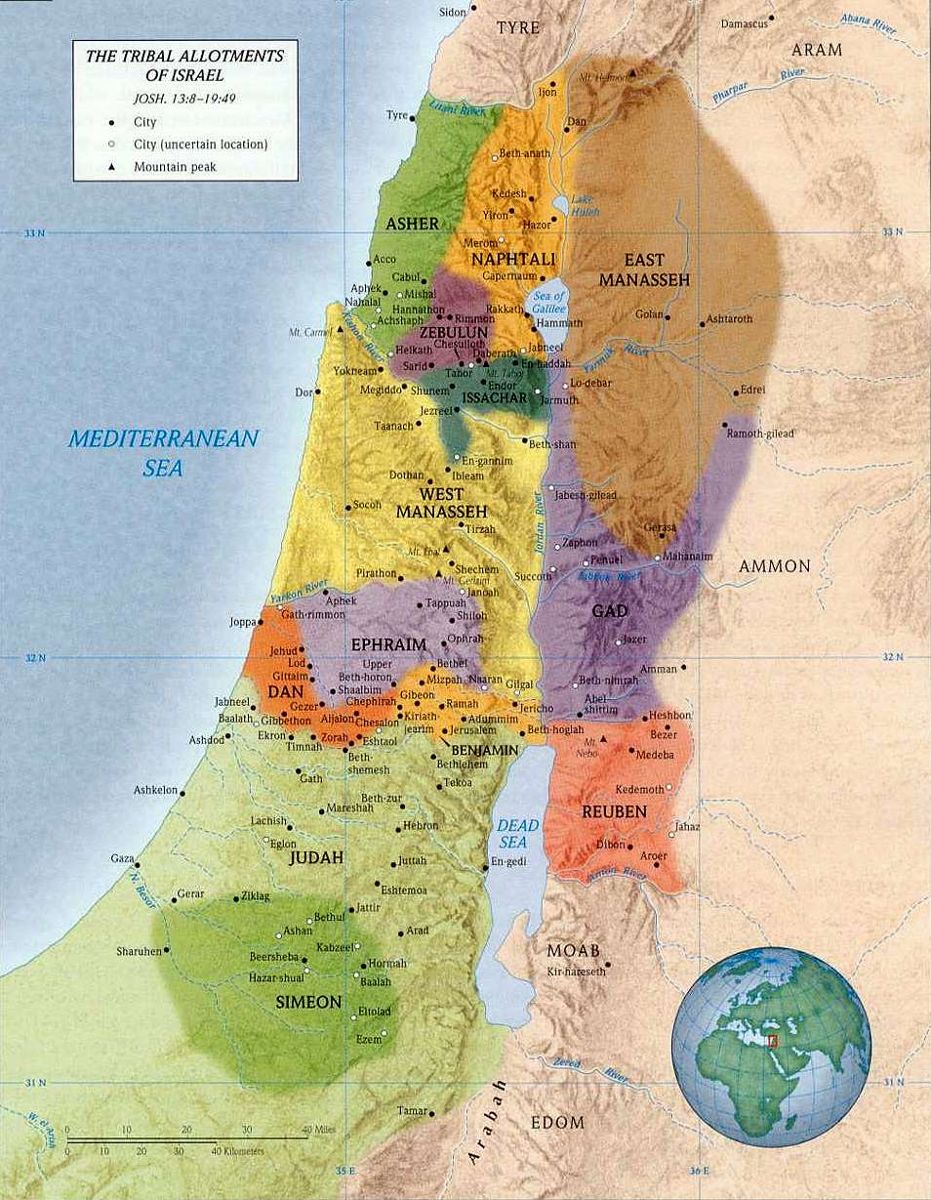
In the last chapter, Caleb had requested and was granted the land of Hebron for his inheritance. As he was from the tribe of Judah, it was within Judah's inheritance. Now a description of all the boundaries of the tribe of Judah were given. It ranged from Edom in the southeast to the wilderness of Zin in the south wherein lay Kadesh Barnea. This map from the last chapter shows Judah's lot in the southern region of the land of Canaan:
(2) And their south border was from the shore of the Salt Sea, from the bay that looked southward.
Their south border ran from the southern tip of the Salt Sea, also called the Dead Sea.
(3) And it went out to the south side to Maaleh-Akrabbim and passed along to Zin, and ascended up on the south side to Kadesh Barnea, and passed along to Hezron, and went up to Adar, and fetched a compass to Karkaa.
The border went from the southern tip of the Salt Sea southward to the ascent of Akrabbim, which literally meant Mount of Scorpions, and went along Zin in the south, to Kadesh Barnea, and then up to Hezron and Adar, two cities evidently along the southwestern coast. And it curved around to Karkaa. I can't locate all those cities, so the general map above is good for me. However, it was very important to God that the promised inheritance was well defined. As discussed before, there will come a time when the people possess their full inheritance.
(4) It passed toward Azmon and went out to the river of Egypt, and the goings out of that coast were at the sea; this shall be your south coast.
The southern border continued toward Azmon out to the river of Egypt which might be the most eastern branch of the Nile, although Biblical scholars disagree on whether the promised land reached that far, so it might mean some other river of Egypt that extended to the promised land. From there, the southern border ended at the Mediterranean Sea.
(5) And the east border the Salt Sea to the end of Jordan. And the border in the north quarter was from the bay of the sea at the mouth of the Jordan.
The eastern border was the Salt Sea, or the Dead Sea, to the place where the Jordan River flowed into it. The northern border began from that point.
(6) And the border went up to Beth Hoglah and passed along by the north of Beth Arabah, and the border went up to the stone of Bohan the son of Reuben.
Beth Hoglah and Beth Arabah were said to be cities within the tribe of Benjamin, so they must have been on the border between Benjamin and Judah. No one seems to know where the stone of Bohan was or why it was placed where it was, but it would have certainly been well known at the time.
(7) And the border went up toward Debir from the valley of Achor and so northward looking toward Gilgal, which is before the going up to Adummim, which is on the south side of the river, and the border passed toward the waters of En Shemesh, and the goings out of it were at En Rogel.
I begin to get lost here, except to look at the map above. There has to be a third place called Debir as neither one of the other Debirs fits here. Also there must be another Gilgal. En Shemesh and En Rogel are along that northern border of Judah.
(8) And the border went up by the valley of the son of Hinnom to the south side of the Jebusite, the same is Jerusalem, and the border went up to the top of the mountain before the valley of Hinnom westward, which is at the end of the valley of the giants northward.
Again I can't locate the exact places, but the border runs along the line of the former Jebusite city, Jebus, renamed Jerusalem, on the border of the tribe of Benjamin.
(9) And the border was drawn from the top of the hill to the fountain of the water of Nephtoah and went out to the cities of Mount Ephron, and the border was drawn to Baalah, which is Kirjath Jearim. (10) And the border compassed from Baalah westward to Mount Seir and passed along to the side of Mount Jearim, which is Chesalon, on the north side, and went down to Beth Shemesh, and passed on to Timnah. (11) And the border went out to the side of Ekron northward, and the border was drawn to Shicron and passed along to Mount Baalah and went out to Jabneel, and the goings out of the border were at the sea.
The northern border of Judah continued to be drawn as described above and ended at the Mediterranean Sea.
(12) And the west border was to the great sea and its coast. This is the coast of the children of Judah round about according to their families.
The western border of the tribe of Judah was the Mediterranean Sea. That ended the description of the boundaries of Judah's lot all around.
(13) And to Caleb the son of Jephunneh he gave a part among the children of Judah, according to the commandment of the Lord to Joshua, the city of Arba the father of Anak, which is Hebron.
Joshua gave Caleb his own part among the tribe of Judah, according to what the Lord had promised, and Caleb was given in the last chapter (Joshua 14:13). He gave him the land of Hebron, formerly called Kirjath Arba for Arba, the father of Anak, a great man among the Anakim (Joshua 14:15).
(14) And Caleb drove out the three sons of Anak, Sheshai, and Ahiman, and Talmai, the children of Anak.
Caleb drove out the sons of Anak, the giants in the land, as he said he would if the Lord was with him (Joshua 14:12).
(15) And he went up from there to the inhabitants of Debir, and the name of Debir before was Kirjath Sepher.
After he conquered Hebron, Caleb went up to that third Debir which was surely close to Hebron, and was before named Kirjath Sepher.
(16) And Caleb said, "He who strikes Kirjath Sepher and takes it, to him I will give Achsah my daughter to wife."
Caleb announced that whoever struck and took Kirjath Sepher would be given his daughter Achsah as wife. Such was the custom in those days, and to be married into the family of the chief prince of the tribe of Judah would have been a very great honor.
(17) And Othneil the son of Kenaz, the brother of Caleb, took it, and he gave him Achsah his daughter to wife.
Othneil, who appears to be Caleb's nephew, the son of his brother Kenaz, took Kirjath Sepher and was given Caleb's daughter Achsah as his wife. Often the term brother was used to denote a kinsman, not necessarily a brother, but first cousins were allowed to be married then.
(18) And it came to pass as she came, that she moved him to ask of her father a field; and she lighted off her donkey, and Caleb said to her, "What do you want?"
As Achsah came to her husband Othneil, she persuaded him to ask for a field from her father. I suppose she had been riding a donkey to go off with her new husband, but she dismounted, and her father asked her what she wanted.
(19) Who answered, "Give me a blessing, for you have given me a south land; give me also springs of water." And he gave her the upper springs and the lower springs.
Achsah asked her father Caleb to give her a blessing or a gift. Apparently he had already given her land. She called it a south land which may have meant it was dry, so she asked for the extra blessing of springs of water. Caleb gave her springs in the upper part of her land or perhaps in an additional field adjacent to her land, and he also gave her springs in the lower part.
(20) This is the inheritance of the tribe of the children of Judah according to their families.
The description of the land in the first part of this chapter above and the following list of cities described the inheritance of the tribe of the children of Judah.
(21) And the uppermost cities of the tribe of the children of Judah toward the coast of Edom southward were Kabzeel, and Eder, and Jagur,
I found the following map on the same page previously mentioned,
Psalms to God, that shows a little more detail of the cities within the tribe of Judah. Judging by the location of Kabzeel, I suppose the meaning of the verse is that the "outermost" cities southward, the southern boundary, went from the coast of Edom at the tip of the Dead Sea westward across to Gaza on the Mediterranean Sea, and included the cities of Kabzeel, Eder, and Jagur. As most of the cities mentioned do not appear on any maps I can find, I'll let the general lines of the boundaries of the tribe depicted in the map below be the best interpretation I have at this point in my study:
(22) And Kinah, and Dimonah, and Adadah, (23) And Kedesh, and Hazor, and Ithnan, (24) Ziph, and Telem, and Bealoth, (25) And Hazor-Hadattah, and Kerioth-Hezron, which is Hazor,
I am completely lost as to where all these cities are located and will rely only on the general location in the map above. There must have been at least four different Hazors as supposedly the Hazor in verse 23 is not the same as Hazor in Joshua 11:1. Then we have Hazor-Hadattah which means New Hazor, and Kerioth-Hezron which is Hazor. That should be as clear as mud! Continuing with a list of the cities in this section of Judah's inheritance:
(26) Amam, and Shema, and Moladah, (27) Hazar Gaddah, and Heshmon, and Beth Pelet, (28) And Hazar Shual, and Beersheba, and Bizjothjah, (29) Baalah, and Iim, and Azem, (30) And Eltolad, and Chesil, and Hormah, (31) And Ziklag, and Madmannah, and Sansannah, (32) And Lebaoth, and Shilhim, and Ain, and Rimmon; all the cities, twenty-nine, with their villages.
I counted thirty-six cities listed. However, it is said that some of these cities were given to the tribe of Simeon (Joshua 19:1), which does indeed appear to be in the middle of the tribe of Judah.
(33) And in the valley, Eshtaol, and Zorah, and Ashnah,
The valley within the tribe of Judah appears to begin in the north central part of Judah where Eshtaol and Zorah are seen on the map and continues south (north of the southern boundary) and westward:
(34) And Zanoah, and En Gannim, Tappuah, and Enam, (35) Jarmuth, and Adullam, Socoh, and Azekah, (36) And Sharaim, and Adithaim, and Gederah, and Gederothaim, fourteen cities with their villages.
Fourteen cities were in the valley region. I counted fifteen, but ancient scholars said that Gederah and Gederothaim were one and the same, and it should have been translated "Gederah (or Gederothaim)."
(37) Zenan, and Hadashah, and Migdal Gad, (38) And Dilean, and Mizpeh, and Joktheel, (39) Lachish, and Bozkath, and Eglon, (40) And Cabbon, and Lahmam, and Kithlish, (41) And Gederoth, Beth Dagon, and Naamah, and Makkedah, sixteen cities with their villages.
These appear to be sixteen other cities in the valley region of Judah.
(42) Libnah, and Ether, and Ashan, (43) And Jiphtah, and Ashnah, and Nezib, (44) And Keilah, and Achzib, and Mareshah, nine cities with their villages.
This appears to be a list of nine more cities in the valley or plain region.
(45) Ekron with her towns and her villages, (46) From Ekron to the sea, all that is near Ashdod with their villages, (47) Ashdod with her towns and her villages, Gaza with her towns and her villages, to the river of Egypt and the great sea and its border.
Judah's inheritance included Ekron in the northwestern region to Ashdod on the Mediterranean Sea and along that coast down to Gaza with all their suburbs.
(48) And in the mountains, Shamir, and Jattir, and Socoh, (49) And Dannah, and Kirjath Sannah, which is Debir, (50) And Anab, and Eshtemoh, and Anim, (51) And Goshen, and Holon, and Giloh, eleven cities with their villages.
The mountain region included those eleven cities.
(52) Arab, and Dumah, and Eshean, (53) And Janum, and Beth Tappuah, and Aphekah, (54) And Humtah, and Kirjath Arba, which is Hebron, and Zior, nine cities with their villages.
These nine cities were also in the mountainous or hill country of Judea.
(55) Maon, Carmel, and Ziph, and Juttah, (56) And Jezreel, and Jokdeam, and Zanoah, (57) Cain, Gibeah, and Timnah, ten cities with their villages.
These were ten more cities in the mountainous or hill country.
(58) Halhul, Beth Zur, and Gedor, (59) And Maarath, and Beth Anoth, and Eltekon, six cities with their villages.
These appear to be six more cities in the mountain region of Judah.
(60) Kirjath Baal, which is Kirjath Jearim, and Rabbah, two cities with their villages.
These appear to be two more cities in the mountain region.
(61) In the wilderness, Beth Arabah, Middin, and Secacah, (62) And Nibshan, and the city of Salt, and En Gedi, six cities with their villages.
There were six cities in the wilderness region of Judah.
(63) As for the Jebusites, the inhabitants of Jerusalem, the children of Judah could not drive them out, but the Jebusites dwell with the children of Judah at Jerusalem to this day.
Although Jerusalem was within the tribe of Benjamin, it was on the border between Benjamin and Judah. It is mentioned here because surely some of the Jebusites who had not been completely driven out of Jerusalem inhabited the outer regions of Jerusalem into Judah. At the time of Joshua's writing, they still lived among the Israelites.
Thus ended the description of the allotment for the tribe of Judah, which included Caleb's portion and the blessing he gave his daughter.