
Continuing a chronological Bible study:
(1 Chronicles 12:8) And of the Gadites there separated themselves to David into the hold to the wilderness men of might, men of war fit for the battle, who could handle shield and buckler, whose faces the faces of lions and as swift as the roes on the mountains.
David had overtaken Jerusalem. The Philistines heard that David had been made king over all of Israel and came looking for him. This passage in 1 Chronicles 12 does not belong here chronologically. I have been following a chronological study created by Skip Andrews and can't change now or I would surely miss something. This passage refers to a time when David was still hiding out from Saul long before he was king and residing in Jerusalem. It was obviously missed earlier and perhaps placed here to name the men who had previously joined David. Men from the tribe of Gad on the other side of the Jordan River had joined with David. They were valiant and courageous men of war, who were skilled in the instruments of war, and whose faces were like the faces of lions, bold, stern, and fierce. Additionally, they were very swift.
(9) Ezer the first, Obadiah the second, Eliab the third, (10) Mishmannah the fourth, Jeremiah the fifth, (11) Attai the sixth, Eliel the seventh, (12) Johanan the eighth, Elzabad the ninth, (13) Jeremiah the tenth, Machbanai the eleventh.
Those eleven warriors named above from the tribe of Gad joined with David.
(14) These were the sons of Gad, captains of the host, one of the least over a hundred and the greatest over a thousand.
Those Gadites who joined David were captains of large numbers of men in their own tribe, or perhaps the meaning is that David made them captains.
(15) These are they who went over Jordan in the first month when it had overflowed all its banks, and they put to flight all in the valleys, toward the east and toward the west.
These men had come over to David at a time when the Jordan River had overflowed its banks, at a time when it was probably so deep they had to swim over it, another sign of their fearless boldness. It seems this band of warriors had put to flight all in the valleys on their way over.
(2 Samuel 5:18) The Philistines also came and spread themselves in the valley of Rephaim. (1 Chronicles 14:9) And the Philistines came and spread themselves in the valley of Rephaim.
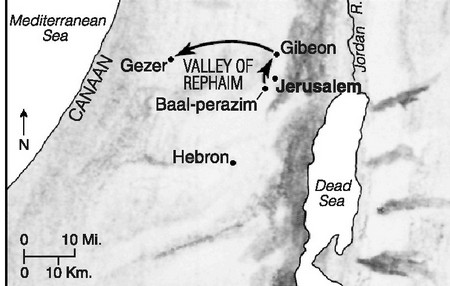
Meanwhile, back to David and the Philistines at Jerusalem, the Philistines came and spread themselves out in the Valley of Rephaim, which this map borrowed from Precept Austin shows to be just west of Jerusalem.

(1 Chronicles 14:10) And David enquired of God, saying, "Shall I go up against the Philistines? And will You deliver them into my hand?" And the LORD said to him, "Go up, for I will deliver them into your hand." (11) So they came up to Baal Perazim; and David struck them there. Then David said, "God has broken in on my enemies by my hand like the breaking forth of waters." Therefore they called the name of that place Baal Perazim. (12) And when they had left their gods there, David gave a commandment, and they were burned with fire.
1 Chronicles 14 told of the same incident with only a little added detail that David commanded the pagan gods to be burned which they then were.
(2 Samuel 5:22) And the Philistines came up yet again and spread themselves in the valley of Rephaim.
More Philistines came forth and spread themselves in the valley of Rephaim.
(23) And when David enquired of the Lord, He said, "You shall not go up, but circle around behind them and come upon them over against the mulberry trees."
David wisely consulted his Lord before each of his advances, for the Lord told him this time not to go forth against the Philistines, but to encircle them from behind specifically in an area across from mulberry trees.
(24) "And let it be when you hear the sound of a going in the tops of the mulberry trees, then you shall stir yourself, for then shall the Lord go out before you to strike the host of the Philistines."
The Lord went on to instruct David that when he heard the rustling of the trees indicating the advancement of the Philistines, he was then to move toward the Philistines for the Lord would go out before him to strike them. The Lord purposely used different methods to keep David dependent on Him. If He struck His enemies the same way every time, David could become complacent and believe it was of himself that his enemies were overcome.
(25) And David did so as the Lord had commanded him and struck the Philistines from Gibeon until you come to Gezer.
David did as the Lord instructed and struck the Philistines all across the valley of Rephaim from Gibeon to Gezer, as seen on the first map above.
(1 Chronicles 14:13) And the Philistines yet again spread themselves abroad in the valley. (14) Therefore David enquired again of God, and God said to him, "Go not up after them; turn away from them, and come upon them over against the mulberry trees. (15) And it shall be, when you shall hear a sound of going in the tops of the mulberry trees, then you shall go out to battle, for God is gone forth before you to strike the host of the Philistines." (16) David therefore did as God commanded him, and they struck the host of the Philistines from Gibeon even to Gezer.
1 Chronicles 14 told of the same incident.
(17) And the fame of David went out into all lands, and the Lord brought the fear of him upon all nations.
Because of his exploits, David became famous throughout the surrounding lands, and the Lord caused the nations to fear him.
(1 Chronicles 13:1) And David consulted with the captains of thousands and hundreds, with every leader.
Then David consulted with all the captains of his troops of varying numbers.
(2) And David said to all the congregation of Israel, "If it seems good to you and of the Lord our God, let us send abroad to our brethren everywhere left in all the land of Israel and with them to the priests and Levites in their cities and suburbs, that they may gather themselves to us."
David spoke to the representatives of all the congregation of Israel and suggested that if it seemed good to them and was in accord with the will of God, they should send word to all their brethren left in Israel who had not yet come there and to all the priests and Levites, that they all might gather there to them.
(3) "And let us bring again the ark of our God to us for we did not enquire at it in the days of Saul.
David proposed that they should bring the ark of the Lord, that symbol of God's divine presence, to the royal city, for they had not enquired of it in the days of Saul, him being rather indifferent to it.
(4) And all the congregation said that they would do so, for the thing was right in the eyes of all the people.
All the congregation of Israel agreed that was what they should do as it seemed right to all of them. One of David's first concerns as king was to restore religion which had been corrupted and neglected in the days of Saul.

No comments:
Post a Comment