Sunday, March 16, 2025

The Inheritance of the Tribes of Issachar and Asher

Continuing a chronological Bible study:

(Joshua 19:17) The fourth lot came out to Issachar for the children of Issachar according to their families.

The previous chapters and posts have been describing the lots that were given to each of the tribes of Israel.  After a pause from giving out the lots, seven tribes remained that had not yet received their inheritances (Joshua 18:2).  This was the fourth of those seven that came up for Issachar.

(18) And their border was toward Jezreel, and Chesulloth, and Shunem,

From Zebulun that was described at the end of the last post, Issachar's border went to Jezreel bordering on Manasseh and included the cities of Chesulloth and Shunem.  This map borrowed from Biblical Toolbelt shows the inheritance of Issachar:


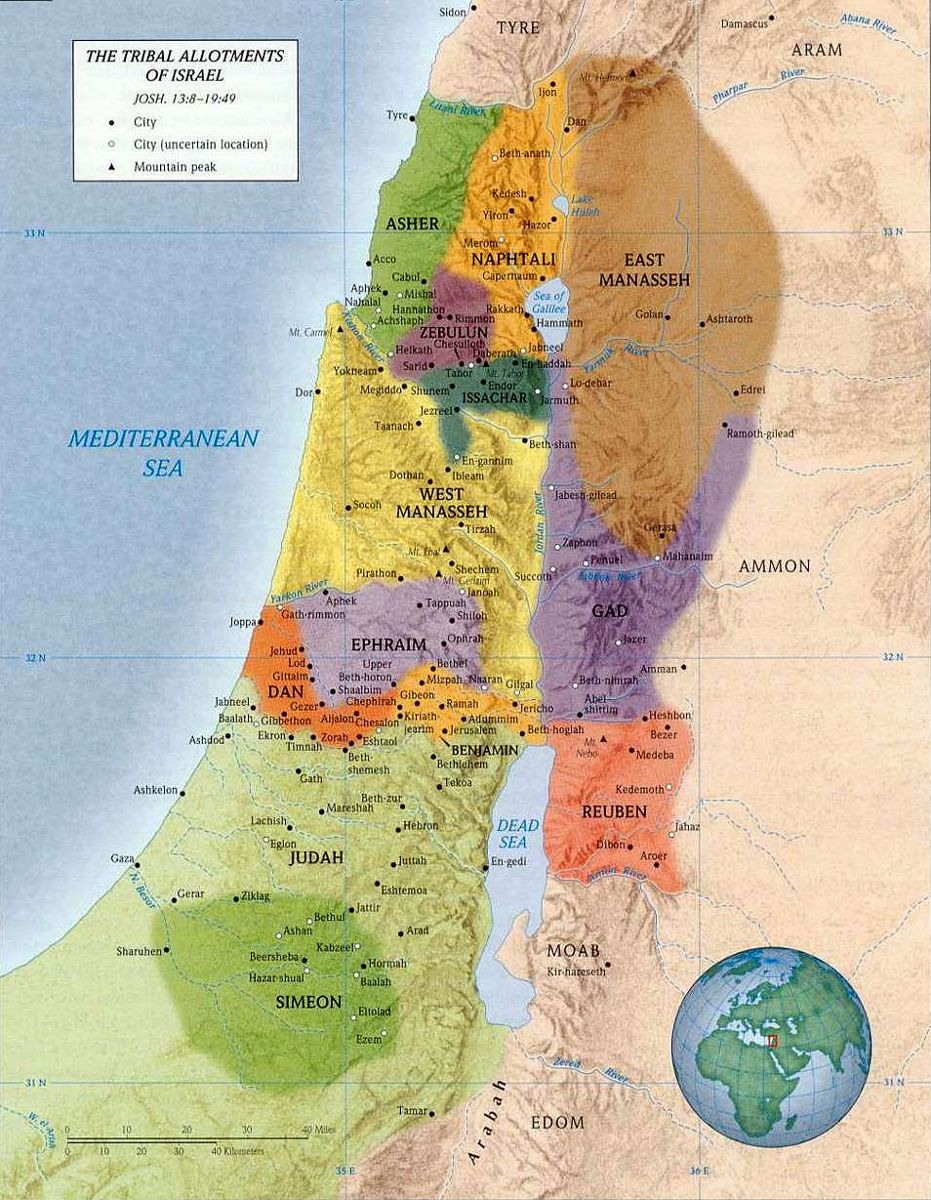
And this map from the same site shows Issachar in relation to the other tribes:


(19) And Hapharaim, and Shion, and Anaharath, (20) And Rabbith, and Kishion, and Abez, (21) And Remeth, and En Gannim, and En Haddah, and Beth Pazzez.

The inheritance of Issachar included all the cities above, although very few are shown on the map.  

(22) And the coast reached to Tabor, and Shahazimah, and Beth Shemesh, and the outgoings of their border were at Jordan, sixteen cities with their villages.

Issachar's territory included the sixteen cities named above, and its eastern border was the Jordan River.  It was suggested by John Wesley in his Notes on the Bible that since the lot of Issachar lay between other tribes on all its other sides, and those tribes' borders had been described, it was not necessary to describe them again.  That may be, but it borders Naphtali, and those borders have not yet been described.  It just may be that these later tribes are of less importance than the first tribes described.

(23) This is the inheritance of the tribe of the children of Issachar according to their families, the cities and their villages.

Thus ended the description of the inheritance of the tribe of Issachar.

(24) And the fifth lot came out for the tribe of the children of Asher according to their families.

The fifth of those seven remaining lots after the pause went to the tribe of Asher.

(25) And their border was Helkath, and Hali, and Beten, and Achshaph,

The inheritance of Asher included the cities of Helkath and Achshaph seen in the following map borrowed from History of Israel.  In the map of the twelve tribes above you can see Asher north of Issachar in relation to the other tribes.


(26) And Alammelech, and Amad, and Mishal, and reached to Carmel westward and to Shihor Libnath.

It included the cities of Alammelech and Mishal seen in the map above and went westward toward Mt. Carmel at the Mediterranean Sea.

(27) And turned toward the sunrising to Beth Dagon and reached to Zebulun and to the valley of Jiphthah El toward the north side of Beth Emek and Neiel and goes out to Cabul on the left hand.

Toward the east the border reached to Zebulun and the valley of Jiphthah El up to Cabul and Neiel, and the territory included Beth Emek going back toward the Mediterranean Sea.  Once again, the directions in the verse made no sense and I just followed the map to see where the territory was.  However, Dr. John Gill implied in his Exposition of the Bible that no one knew where Beth Emek was, so perhaps the map above is incorrect about the location of that city.  On the map there is a question about the location of Neiel, so perhaps it was south of Cabul, and when faced eastward, the left would be the north, and now the text makes sense.

(28) And Hebron, and Rehob, and Hammon, and Kanah, to great Sidon.

The territory went northward and included the cities of Rehob, Hammon, and Kanah, seen on the map, up to Sidon which was north of Tyre.  It was called great for its antiquity, riches, and glory, according to John Wesley.

(29) And the coast turned to Ramah and to the strong city Tyre, and the coast turned to Hosah, and the outgoings of it are at the sea from the coast to Achzib.

This seems to be describing the western border going southward from Sidon to Tyre to Achzib along the Mediterranean Sea, although Hammon is probably misplaced on the map.  

(30) Ummah also, and Aphek, and Rehob, twenty-two cities with their villages.

The territory also included the cities of Ummah and Aphek.  Rehob had already been mentioned, and Sidon was not actually in their territory, but their border reached up to it.  Carmel being a mountain and not a city, and Jiphthah El being a valley, the list comes to twenty-two cities with their villages within the tribe of Asher.

(31) This is the inheritance of the tribe of the children of Asher according to their families, these cities with their villages.

Thus ended the description of the inheritance that went to the tribe of Asher.

Saturday, March 15, 2025

The Inheritance of the Tribes of Simeon and Zebulun

The past few chapters and posts have been describing each of the tribe's inheritance that was given to them by lot.  Continuing with that chronological Bible study:

(Joshua 19:1) And the second lot came forth to Simeon, for the tribe of the children of Simeon according to their families, and their inheritance was within the inheritance of the children of Judah.

The second of the seven remaining lots that were cast after a break of some time went to Simeon.  It's interesting that a lot would be made within another lot, but Simeon's inheritance was within the inheritance of Judah.  This fulfilled prophecy of Jacob when he cursed Simeon's anger and speaking the words of the Lord, said He would divide and scatter Simeon in Israel.  It may have been decided that Judah's inheritance was much larger than its tribe needed, but the prophecy of God would be fulfilled whatever the reasoning.

(2) And they had in their inheritance Beersheba, or Sheba, and Moladah,

Simeon had in their inheritance the cities of Beersheba and Moladah, cities within the tribe of Judah (Joshua 15:26, 28).  I found this map of Simeon's tribe within the tribe of Judah at If I Walked With Jesus:


(3) And Hazar Shual, and Balah, and Ezem, (4) And Eltolad, and Bethul, and Hormah, (5) And Ziklag, and Beth Marcaboth, and Hazar Susah, (6) And Beth Lebaoth, and Sharuhen, thirteen cities and their villages.

They also had these cities, thirteen cities with their villages, which appear to be in the north and east of the territory of Simeon.

(7) Ain, Remmon, and Ether, and Ashan, four cities and their villages, (8) And all the villages round about these cities to Baalath Beer, Ramath of the south. This is the inheritance of the tribe of the children of Simeon according to their families.

Four more cities and their villages were within the tribe of Simeon, and I would have assumed they were in the south of Simeon by the description above.  However, the following copy of an 1840 map borrowed from Antico Gallery shows all these cities, but interestingly they are in different locations from the first map.  This shows the difficulty of identifying the exact locations of ancient cities and explains why sometimes the scriptures detailing these places don't make sense.  Places move or they don't exist anymore.  But these are details which don't affect the big picture in a Bible study.  We know all the cities mentioned above were within the tribe of Simeon at the time it was allotted to Simeon, as well as all the smaller villages around them.


(9) Out of the portion of the children of Judah was the inheritance of the children of Simeon, for the part of the children of Judah was too much for them; therefore the children of Simeon had their inheritance within the inheritance of them.

As speculated above, indeed, the tribe of Simeon was placed within the tribe of Judah because Judah had much more land and many more cities than they could fill, and Simeon, being a small tribe, could easily exist within the area given them.

(10) And the third lot came up for the children of Zebulun according to their families, and the border of their inheritance was to Sarid.

The third lot of the seven remaining lots came up for the tribe of Zebulun.  This map borrowed from If I Walked With Jesus shows his small lot with its southern border near Sarid.


And this map used before from iBiblemaps.com shows the location of the tribe of Zebulun in relation to the other tribes:


(11) And their border went up toward the sea and Maralah and reached to Dabbasheth and reached to the river that is before Jokneam.

From Sarid in the south the border continued westward toward the Mediterranean Sea to Dabbasheth and a river that was before Jokneam, which appears to be the Kishon River in the map above.

(12) And turned from Sarid eastward toward the sunrising to the border of Chisloth Tabor and then goes out to Daberath and goes up to Japhia.

From Sarid in the south the border went eastward toward the Sea of Galilee to Daberath and a little beyond.  Zebulun was nestled between two great seas which fulfilled Jacob's prophecy that Zebulun would dwell by the sea and be a haven of ships (Genesis 49:13).

(13) And from there passed on along on the east to Gath Hepher, to Eth Kazin and goes out to Rimmon to Neah.

From the southwest corner the border went northward to Rimmon.

(14) And the border compassed it on the north side to Hannathon, and the outgoings of it are in the valley of Jiphthah El.

The language is difficult, but from the map, it appears that the northern border went around in the north and came back to Hannathon.  The original word that was translated as "compassed" was "sabab" and meant "revolve, surround," so the meaning seems to me that the northern portion of their land went in a big circle northward from Rimmon and back to Hannathon.

(15) And Kattath, and Nahallal, and Shimron, and Idalah, and Bethlehem, twelve cities with their villages.

These cities were included within the tribe of Zebulun.  Bethlehem within Zebulun is not the same place as Bethlehem in Judah where Christ was born.  Twelve cities with their villages were within the lot of Zebulun.  Since only five are mentioned in verse 15, as well as the fact that the western border was not described, some Biblical scholars have been led to think there may have been some text lost from the original manuscripts.

(16) This is the inheritance of the children of Zebulun according to their families, these cities with their villages.

Thus ended the description of the lot that fell to Zebulun.

Sunday, March 9, 2025

The Inheritance of the Tribe of Benjamin

Continuing a chronological Bible study:

(Joshua 18:1) And the whole congregation of the children of Israel assembled together at Shiloh and set up the tabernacle of the congregation there. And the land was subdued before them. (2) And there remained among the children of Israel seven tribes which had not yet received their inheritance.

The past few chapters have been describing the lots of land the first few tribes had received.  The tribes of Benjamin, Simeon, Zebulun, Issachar, Asher, Naphtali, and Dan, had not yet received their inheritance.  It seems a break was taken from the casting of lots, and the whole congregation met together at Shiloh and set up the tabernacle of the congregation there, moving it from their camp in Gilgal.  The land was subdued and quiet at that time.

(3) And Joshua said to the children of Israel, "How long will you be slack to go to possess the land which the Lord God of your fathers has given you?"

Joshua spoke to the Israelites who had thus far not received their lots of inheritance.  He asked how long they would be slothful about going in to possess their land.  It's not that they could claim land that had not yet been assigned by lot, but they were apparently not eager to get on with it.  They were probably happy living in camps off the spoils of the enemy and not earnest about receiving their own land where they might have to work to clear or to drive out the Canaanites who remained or might have come back. 

(4) "Give out from among you three men per tribe, and I will send them, and they shall arise and go through the land and describe it according to the inheritance of them, and they shall come to me."

Joshua asked that each tribe select three men from their tribe, and Joshua would send them out to the unallotted land to survey and describe and bring the information back to him.

(5) "And they shall divide it into seven parts; Judah shall abide in their coast on the south, and the house of Joseph shall abide in their coasts on the north."

The three men selected from each of the remaining seven tribes were to divide the land into seven parts for those seven tribes.  Judah already had his lot in the south, and the sons of Joseph, Ephraim and Manasseh, had their lots north of Judah, so those were established, and there was no need to survey their lands.

(6) "You shall therefore describe the land in seven parts and bring it here to me, that I may cast lots for you here before the Lord our God."

Speaking about the three men from each of the seven tribes, Joshua said they were to survey and describe the land in each of the seven parts and bring that information back to him so that he could cast lots for each of the lots of land before their Lord God.

(7) "But the Levites have no part among you, for the priesthood of the Lord is their inheritance, and Gad, and Reuben, and half the tribe of Manasseh, have received their inheritance beyond Jordan on the east, which Moses the servant of the Lord gave them."

Joshua pointed out that the Levites would not be receiving any land inheritance because as priests, the Lord was their inheritance.  Also the tribes of Reuben and Gad and half the tribe of Manasseh had already received their lots on the east of the Jordan River.  He had already mentioned the tribes of Judah and the sons of Joseph who had their allotments, so that left the tribes of Benjamin, Simeon, Zebulun, Issachar, Asher, Naphtali, and Dan, who needed to receive their inheritance.

(8) And the men arose and went away, and Joshua charged them who went to describe the land, saying, "Go and walk through the land and describe it and come again to me, that I may here cast lots for you before the Lord in Shiloh."

Joshua spoke directly to the three surveyors from each tribe, telling them to go do their surveys and bring their descriptions back to him so that he could cast lots for the tribes there in Shiloh before the Lord.  The men arose and went their way.

(9) And the men went and passed through the land and described it by cities into seven parts in a book and came to Joshua to the host at Shiloh.

The men went through the remaining land and described it by cities and divided it into seven parts and put their information in a book that they brought back to Joshua at Shiloh.

(10) And Joshua cast lots for them in Shiloh before the Lord, and there Joshua divided the land to the children of Israel according to their divisions.

There in Shiloh Joshua cast lots for each of the seven remaining tribes, dividing the remaining land among them.

(11) And the lot of the tribe of the children of Benjamin came up according to their families, and the coast of their lot came forth between the children of Judah and the children of Joseph.

The first lot went to Benjamin.  It was a small lot, called "little Benjamin" in Psalm 68:27, but the land was said to be very pleasant and fruitful.  It lay between Judah and the children of Joseph, Ephraim and Manasseh.  This map borrowed from Biblical Toolbelt shows the lot of Benjamin:


(12) And their border on the north side was from Jordan, and the border went up to the side of Jericho on the north side and went up through the mountains westward, and the goings out of it were at the wilderness of Beth Haven.

The eastern border was the Jordan River.  The northern border went from the Jordan westward to just north of Jericho and through the mountains west of Jericho and went out to the wilderness of Beth Haven, which was said to be a place near Bethel and Ai, to which there was a wilderness adjacent.

(13) And the border went over from there toward Luz, to the side of Luz, which is Bethel, southward, and the border descended to Ataroth Addar near the hill on the south side of the lower Beth Horon.

The border went from Bethel southward to Ataroth Addar to near the hill on the south side of Lower Beth Horon.  These places are better seen on this map taken from Precept Austin:


(14) And the border was drawn and compassed the corner of the sea southward from the hill before Beth Horon southward, and the goings out of it were at Kirjath Baal, which is Kirjath Jearim, a city of the children of Judah; this was the west quarter.

The border went from the hill on the south side of Lower Beth Horon and went southward to Kirjath Jearim, a city on the border of Judah.  This described the western border of Benjamin.  No one seems to know what sea is meant in verse 14.

(15) And the south quarter was from the end of Kirjath Jearim, and the border went out on the west and went out to the well of waters at Nephtoah. (16) And the border came down to the end of the mountain before the valley of the son of Hinnom, which is in the valley of the giants on the north, and descended to the valley of Hinnom to the side of Jebusi on the south and descended to En Rogel.

The southern border went from west of Kirjath Jearim, and it went down and eastward to Jebusi, which is Jerusalem, and to En Rogel.  The southwestern corner reached the northern part of the Rephaim, giants.

(17) And was drawn from the north and went forth to En Shemesh and went forth toward Geliloth, which is across the going up of Adummim, and descended to the stone of Bohan, the son of Reuben.

The southern border then veered northward to En Shemesh, seen on the first map above.  It continued across some of the same unknown places that were mentioned when defining the northern border of Judah (Joshua 15:6-7).

(18) And passed along toward the side across from Arabah northward and went down to Arabah, (19) And the border passed along to the side of Beth Hoglah northward, and the outgoings of the border were at the north bay of the Salt Sea at the south end of Jordan; this was the south coast.

The language is difficult to follow, but you can see the southern border going across to Beth Hoglah and then to the Jordan River at the north bay of the Salt Sea.

(20) And Jordan was the border of it on the east side. This was the inheritance of the children of Benjamin by its coasts all around, according to their families.

The Jordan River was the eastern border of Benjamin's lot.  Thus ended the description of the borders of the inheritance of Benjamin.

(21) Now the cities of the tribe of the children of Benjamin according to their families were Jericho, and Beth Hoglah, and the valley of Keziz,

The cities belonging to the tribe of Benjamin were Jericho and Beth Hoglah in the eastern part of the lot of Benjamin, and the valley of Keziz which must have been in that region.

(22) Beth Arabah, and Zemaraim, and Bethel, (23) And Avim, and Parah, and Ophrah, (24) And Chephar Haammoni, and Ophni, and Geba, twelve cities with their villages.

These appear to be twelve cities in eastern Benjamin, a few of which can be seen on the maps.

(25) Gibeon, and Ramah, and Beeroth, (26) And Mizpah, and Chephirah, and Mozah, (27) And Rekem, and Irpeel, and Taralah, (28) And Zelah, Eleph, and Jebusi, which is Jerusalem, Gibeah, and Kirjath, fourteen cities with their villages. This is the inheritance of the children of Benjamin according to their families.

And these appear to be fourteen cities in western Benjamin, a few of which are seen on the maps.  All these cities and the description of the borders before that made up the inheritance of the tribe of Benjamin.

Monday, March 3, 2025

The Inheritance of Manasseh West of the Jordan

Continuing a chronological Bible study:

The past few and future chapters of Joshua described the lots of inheritance that fell to the twelve tribes of Israel.  This same map from iBiblemaps.com shows the general division of the tribes:


(Joshua 17:1) There was also a lot for the tribe of Manasseh for he, the firstborn of Joseph, for Machir the firstborn of Manasseh, the father of Gilead; because he was a man of war, therefore he had Gilead and Bashan. 

The last chapter spoke of the lots that fell to the children of Joseph but only described the one that fell to Ephraim.  This chapter described the lot that went to the other son of Joseph, Manasseh, half already having been given on the east of the Jordan River.  The lot of Manasseh described in verse 1 was allotted to Machir the son of Manasseh and through his son Gilead.  It seems Machir was known as a man of war.  I suppose the sense was that because he was a valiant warrior, he had been given the land on the east of the Jordan that he or his descendants had conquered (Bashan, the kingdom of Og), and he received part of Gilead, and he was also to be given a portion on the west of the Jordan.

(2) There was also a lot for the rest of the children of Manasseh by their families, for the children of Abiezer, and for the children of Helek, and for the children of Asriel, and for the children of Shechem, and for the children of Hepher, and for the children of Shemida; these were the male children of Manasseh the son of Joseph by their families.

There was also a lot given to the other half of the tribe of Manasseh on the west side of the Jordan River.  It was said to be for the children of Abiezer, also called Jeezer (Numbers 26:30), a son of Gilead who was the son of Machir.  It was also for the children of the other sons of Gilead, Helek, Asriel, Shechem, Hepher, and Shemida (Numbers 26:30-32).  These were the male children or descendants of Manasseh.

(3) But Zelophehad, the son of Hepher, the son of Gilead, the son of Machir, the son of Manasseh, had no sons, but daughters, and these are the names of his daughters, Mahlah, and Noah, Hoglah, Milcah, and Tirzah.

Normally only the males inherited, but Zelophehad, the son of Hepher, had no sons, only daughters, Mahlah, Noah, Hoglah, Milcah, and Tirzah.  His daughters had requested and were granted their father's inheritance (Numbers 27:7).

(4) And they came near before Eleazar the priest and before Joshua the son of Nun and before the princes, saying, "The Lord commanded Moses to give us an inheritance among our brethren." Therefore, according to the commandment of the Lord, he gave them an inheritance among the brethren of their father.

Indeed, the daughters of Zelophehad, the son of Hepher, came before the priest, and Joshua, and the ten princes who were appointed along with Eleazar and Joshua to divide the land (Numbers 34:17), and claimed their inheritance according to the commandment of the Lord to Moses (Numbers 27:7), and it was given to them.

(5) And there fell ten portions to Manasseh, besides the land of Gilead and Bashan on the other side of the Jordan, (6) Because the daughters of Manasseh had an inheritance among his sons, and the rest of Manasseh's sons had the land of Gilead.

The lot on the west side of the Jordan that fell to the half tribe of Manasseh was divided into ten portions, for the five sons of Gilead who had male descendants and for the five daughters of Zelophehad, the son of Hepher.  Apparently, Hepher had only the one son, Zelophehad, who had only daughters, so there were no males among Hepher's descendants to receive an inheritance.  The rest of Manasseh's sons, the sons of Machir, had the land of Gilead and Bashan on the east side of the Jordan.

(7) And the coast of Manasseh was from Asher to Michmethah that lies before Shechem, and the border went along on the right hand to the inhabitants of En Tappuah.  

The boundary of West Manasseh went from the border of Asher in the northwest corner to Michmethah in the south.  Or perhaps there was a city of Asher, not the tribe of Asher, in the southwest corner of West Manasseh that went across to Michmethah, which was said to be before Shechem, to En Tappuah.  The map at the beginning of this post shows the tribe of Asher in relation to West Manasseh, and this map borrowed from Precept Austin shows the southern cities of Michmethah and Shechem.


(8) Manasseh had the land of Tappuah, but Tappuah on the border of Manasseh belonged to the children of Ephraim.

West Manasseh had the territory of Tappuah, but Ephraim had the city of Tappuah, one of those cities within West Manasseh that were given to Ephraim, according to Joshua 16:9.

(9) And the coast descended to the river Kanah, southward of the river; these cities of Ephraim are among the cities of Manasseh; the coast of Manasseh also was on the north side of the river, and the outgoings of it were at the sea.

I believe the meaning is that from the city of Tappuah that belonged to the children of Ephraim, the border continued west along the Kanah River and eventually reached the Mediterranean Sea.  The cities southward of the river were among the cities in West Manasseh that belonged to Ephraim.  North of the river belonged to Manasseh.

(10) Southward was Ephraim's and northward Manasseh's, and the sea is its border, and they met together in Asher on the north and in Issachar on the east.

The land south of the river belonged to Ephraim and north of it was Manasseh's, and the Mediterranean Sea was West Manasseh's western border.  The western border met the northern border at the border of Asher's lot and went eastward to Issachar's in the northeast.

(11) And Manasseh had in Issachar and in Asher Beth Shean and her towns and Ibleam and her towns and the inhabitants of Dor and her towns and the inhabitants of En Dor and her towns and the inhabitants of Taanach and her towns and the inhabitants of Megiddo and her towns, three countries.

As Ephraim had cities within the tribe of Manasseh, it seems that Manasseh had cities within Asher and Issachar.  It seems to me that everyone's borders should have been pushed northward a little, but I imagine that the lots were determined before they knew who would get which lot, and as some tribes were much larger than others and required more land than perhaps had been allotted to them, adjustments were made to accommodate them.  The cities of Beth Shean, Ibleam, Dor, Taanach, and Megiddo all appear to be completely within West Manasseh in the map above, so perhaps the border was adjusted from what was previously intended to be Asher's and Issachar's lots.  I believe the sense of the three countries is that all these cities were in three regions in the north that became part of West Manasseh, perhaps the northwest region around Dor from Asher, the north central region around Megiddo and other cities in the north central from Issachar, and the northeast region around Beth Shean, also from Issachar.

(12) Yet the children of Manasseh could not drive out those cities, but the Canaanites would dwell in that land.

The tribe of Manasseh did not entirely drive out the Canaanites from those cities, so those Canaanites continued to dwell in the land.

(13) Yet it came to pass, when the children of Israel grew strong, that they put the Canaanites to tribute, but did not utterly drive them out.

When the Israelites grew stronger, perhaps meaning they grew greater in number, they made the Canaanites pay tribute to them and allowed them to stay.  It seems that if they were strong enough to force them to pay tribute, they would have been strong enough to drive them out as God had commanded they do, but they didn't, perhaps for some selfish gain.

(14) And the children of Joseph spoke to Joshua, saying, "Why have you given me one lot and one portion to inherit, seeing I am a great people, for as much as the Lord has blessed me till now?"

The children of Joseph were Ephraim and Manasseh.  It seems they thought they should have more than one lot each seeing that they were a great people, most likely meaning great in number as the Lord had blessed them up to that point, but perhaps they also looked forward to the future as Jacob had blessed them, his grandsons, as his sons (Genesis 48:19), and said they would be great, especially Ephraim whose descendants would become a multitude of nations.  

(15) And Joshua answered them, "If you are a great people, get up to the forest and cut down for yourself there in the land of the Perizzites and of the giants, if mount Ephraim is too narrow for you."

However, Joshua said that if they were indeed a great people, then they should get themselves into the wood country and clear more land for them in the land of the Perizzites and the Rephaim, the giants, if what they now occupied was too small for them.  This map borrowed from Big Springs Community Church clearly shows much land west of Megiddo, Beth Shean, and Shechem, that they did not occupy: 


(16) And the children of Joseph said, "The hill is not enough for us, and all the Canaanites that dwell in the land of the valley have chariots of iron, they of Beth Shean and her towns and they of the valley of Jezreel."

The children of Joseph said that that hill country was not enough for them, and all the Canaanites that dwelt in Beth Shean and all the valley of Jezreel were too much for them.  Most all the commentaries I study suggest that chariots of iron did not mean they were made of iron, but rather they were armed with scythes and dangerous.  This response of the children of Joseph hearkens back to the time the first spies came back with the report that the Canaanites were giants and too strong for them, and they were punished for having no faith in God to give them the land as He had said.

(17) And Joshua spoke to the house of Joseph, to Ephraim and to Manasseh, saying, "You are a great people and have great power; you shall not have one lot, (18) But the mountain shall be yours, for it is a wood and you shall cut it down, and the outgoings of it shall be yours, for you shall drive out the Canaanites, though they have chariots, though they be strong."

I have to hand it to Joshua; even though he was from the tribe of Ephraim, he did not back down and give in to give them more land.  I also can't help but think of Jacob who loved Joseph so much and made his sons his own.  He might have been disappointed to learn that they were acting so weak and faithless.  Joshua told Ephraim and the half tribe of Manasseh that they were indeed a great and powerful people, and they would not have only the one lot they occupied, but they would have almost twice as much land if they went in and cut down the woods and even the outgoings of that region to the Mediterranean Sea would be theirs because they would drive out the Canaanites, even though they were strong.  After all, their Lord was stronger and had promised them all that territory.

There is a great lesson in this.  God never promised us a rose garden.  He said we will be saved, and we will overcome, but we will be persecuted.  Life will be hard; we lost the Garden of Eden long ago.  God will make a way if we rely on Him, but we must have that whole armor of God, truth, righteousness, the gospel of peace, faith, salvation, and the word of God (Ephesians 6:13-17), and we must endure till the end (Matthew 24:13).  But be of good courage, Paul told us in 1 Corinthians 3:15, that even in weaknesses, such as slothfulness, which might be said of the children of Joseph at this point, we will suffer loss but we ourselves will still be saved as one barely escaping a fire.  However, God desires the best for us, and if we will trust in Him to lead us, we can live that best life.

Monday, February 17, 2025

The Inheritance of the Tribe of Ephraim

Continuing a chronological Bible study:

The last chapter began descriptions of the lands allotted to each of the tribes of Israel, beginning with the tribe of Judah.  Following is the same map before used to show the division of the twelve tribes:


(Joshua 16:1) And the lot of the children of Joseph fell from Jordan by Jericho to the water of Jericho on the east to the wilderness that goes up from Jericho throughout Mount Bethel.

Now began a description of the lot of land that fell to the children of Joseph, Ephraim and Manasseh.  Half the tribe of Manasseh had already taken their land on the east side of the Jordan River, so this allotment included the other half of the tribe of Manasseh and Ephraim.  These lots began on the west side of the Jordan River by Jericho to the water of Jericho that lay east of Jericho throughout the wilderness of Mount Bethel, said to be the wilderness of Beth Haven.  I found this wonderfully detailed map at Precept Austin that gives a more comprehensive view of the land:


(2) And goes out from Bethel to Luz and passes along to the borders of Archi to Ataroth, (3) And goes down westward to the coast of Japhleti to the coast of Beth Horon the lower and to Gezer and the goings out of it are at the sea. (4) So the children of Joseph, Manasseh and Ephraim, took their inheritance.

The southern boundary of the lot given to the sons of Joseph, Manasseh and Ephraim, went from Jericho and along a line through Bethel, Ataroth, Lower Beth Horon, and Gezer that went toward the Mediterranean Sea, as seen on the map above.

(5) And the border of the children of Ephraim according to their families was: the border of their inheritance on the east side was Ataroth Addar to Beth Horon the upper,

The description of the land continued with what would be Ephraim's lot.  Ataroth Addar and Upper Beth Horon are clearly seen on the map above.  I'm not sure why it is called the eastern border, but I got some comfort when I saw that John Wesley himself wrote in his Notes on the Bible:

It is no wonder, if some of these descriptions are dark to us at this distance of time; there having been so many alterations made in places, and so many circumstances, being now altogether undiscoverable. But this is certain, that all the descriptions here mentioned, were then evident to the Israelites, because these were the foundations of all the possessions which then they took, and peaceably possessed in succeeding ages.

(6) And the border went out toward the sea to Michmethah on the north side, and the border went around eastward to Taanath Shiloh and passed by it on the east to Janohah, (7) And it went down from Janohah to Ataroth and to Naarath and came to Jericho and went out at Jordan.

The boundary went westward to the Mediterranean Sea and then on the north ran along a line through the cities of Michmethah, Taanath Shiloh, and Janoah, and down to Jericho, as seen on the map above.

(8) The border went out from Tappuah westward to the river Kanah, and the goings out of it were at the sea. This is the inheritance of the tribe of the children of Ephraim by their families.

Back to the northern border, it went from Tappuah westward to the Kanah River and out to the Mediterranean Sea.  That completed the description of the inheritance of the tribe of Ephraim.

(9) And the separate cities for the children of Ephraim among the inheritance of the children of Manasseh, all the cities with their villages.

However, the tribe of Ephraim was also given some of the cities that were within the tribe of Manasseh, perhaps because the tribe of Ephraim was much larger than the half tribe of Manasseh and needed more territory than the lot that fell to it.

(10) And they did not drive out the Canaanites that dwelt in Gezer, but the Canaanites dwell among the Ephraimites to this day and serve under tribute.

The tribe of Ephraim never did drive out the Canaanites that dwelt in Gezer, and they continued to live among the Ephraimites to the day of Joshua's writing, but they did serve under them and paid them tribute.

Although this chapter began by describing the land that went to both the sons of Joseph, it mainly dealt with the inheritance of Ephraim, with the inheritance of the half tribe of Manasseh described in the next chapter.

Sunday, February 16, 2025

The Inheritance of the Tribe of Judah

Continuing a chronological Bible study:

(Joshua 15:1) This then was the lot of the tribe of the children of Judah by their families, to the border of Edom, the wilderness of Zin southward, the uttermost part of the south coast.

In the last chapter, Caleb had requested and was granted the land of Hebron for his inheritance.  As he was from the tribe of Judah, it was within Judah's inheritance.  Now a description of all the boundaries of the tribe of Judah were given.  It ranged from Edom in the southeast to the wilderness of Zin in the south wherein lay Kadesh Barnea.  This map from the last chapter shows Judah's lot in the southern region of the land of Canaan:


(2) And their south border was from the shore of the Salt Sea, from the bay that looked southward.

Their south border ran from the southern tip of the Salt Sea, also called the Dead Sea.

(3) And it went out to the south side to Maaleh-Akrabbim and passed along to Zin, and ascended up on the south side to Kadesh Barnea, and passed along to Hezron, and went up to Adar, and fetched a compass to Karkaa.

The border went from the southern tip of the Salt Sea southward to the ascent of Akrabbim, which literally meant Mount of Scorpions, and went along Zin in the south, to Kadesh Barnea, and then up to Hezron and Adar, two cities evidently along the southwestern coast.  And it curved around to Karkaa.  I can't locate all those cities, so the general map above is good for me.  However, it was very important to God that the promised inheritance was well defined.  As discussed before, there will come a time when the people possess their full inheritance.

(4) It passed toward Azmon and went out to the river of Egypt, and the goings out of that coast were at the sea; this shall be your south coast.

The southern border continued toward Azmon out to the river of Egypt which might be the most eastern branch of the Nile, although Biblical scholars disagree on whether the promised land reached that far, so it might mean some other river of Egypt that extended to the promised land.  From there, the southern border ended at the Mediterranean Sea.

(5) And the east border the Salt Sea to the end of Jordan. And the border in the north quarter was from the bay of the sea at the mouth of the Jordan.

The eastern border was the Salt Sea, or the Dead Sea, to the place where the Jordan River flowed into it.  The northern border began from that point.

(6) And the border went up to Beth Hoglah and passed along by the north of Beth Arabah, and the border went up to the stone of Bohan the son of Reuben.

Beth Hoglah and Beth Arabah were said to be cities within the tribe of Benjamin, so they must have been on the border between Benjamin and Judah.  No one seems to know where the stone of Bohan was or why it was placed where it was, but it would have certainly been well known at the time.

(7) And the border went up toward Debir from the valley of Achor and so northward looking toward Gilgal, which is before the going up to Adummim, which is on the south side of the river, and the border passed toward the waters of En Shemesh, and the goings out of it were at En Rogel.

I begin to get lost here, except to look at the map above.  There has to be a third place called Debir as neither one of the other Debirs fits here.  Also there must be another Gilgal.  En Shemesh and En Rogel are along that northern border of Judah.

(8) And the border went up by the valley of the son of Hinnom to the south side of the Jebusite, the same is Jerusalem, and the border went up to the top of the mountain before the valley of Hinnom westward, which is at the end of the valley of the giants northward.

Again I can't locate the exact places, but the border runs along the line of the former Jebusite city, Jebus, renamed Jerusalem, on the border of the tribe of Benjamin.

(9) And the border was drawn from the top of the hill to the fountain of the water of Nephtoah and went out to the cities of Mount Ephron, and the border was drawn to Baalah, which is Kirjath Jearim. (10) And the border compassed from Baalah westward to Mount Seir and passed along to the side of Mount Jearim, which is Chesalon, on the north side, and went down to Beth Shemesh, and passed on to Timnah. (11) And the border went out to the side of Ekron northward, and the border was drawn to Shicron and passed along to Mount Baalah and went out to Jabneel, and the goings out of the border were at the sea.

The northern border of Judah continued to be drawn as described above and ended at the Mediterranean Sea.

(12) And the west border was to the great sea and its coast. This is the coast of the children of Judah round about according to their families.

The western border of the tribe of Judah was the Mediterranean Sea.  That ended the description of the boundaries of Judah's lot all around.

(13) And to Caleb the son of Jephunneh he gave a part among the children of Judah, according to the commandment of the Lord to Joshua, the city of Arba the father of Anak, which is Hebron.

Joshua gave Caleb his own part among the tribe of Judah, according to what the Lord had promised, and Caleb was given in the last chapter (Joshua 14:13).  He gave him the land of Hebron, formerly called Kirjath Arba for Arba, the father of Anak, a great man among the Anakim (Joshua 14:15).

(14) And Caleb drove out the three sons of Anak, Sheshai, and Ahiman, and Talmai, the children of Anak.

Caleb drove out the sons of Anak, the giants in the land, as he said he would if the Lord was with him (Joshua 14:12).

(15) And he went up from there to the inhabitants of Debir, and the name of Debir before was Kirjath Sepher.

After he conquered Hebron, Caleb went up to that third Debir which was surely close to Hebron, and was before named Kirjath Sepher.

(16) And Caleb said, "He who strikes Kirjath Sepher and takes it, to him I will give Achsah my daughter to wife."

Caleb announced that whoever struck and took Kirjath Sepher would be given his daughter Achsah as wife.  Such was the custom in those days, and to be married into the family of the chief prince of the tribe of Judah would have been a very great honor.

(17) And Othneil the son of Kenaz, the brother of Caleb, took it, and he gave him Achsah his daughter to wife.

Othneil, who appears to be Caleb's nephew, the son of his brother Kenaz, took Kirjath Sepher and was given Caleb's daughter Achsah as his wife.  Often the term brother was used to denote a kinsman, not necessarily a brother, but first cousins were allowed to be married then.

(18) And it came to pass as she came, that she moved him to ask of her father a field; and she lighted off her donkey, and Caleb said to her, "What do you want?"

As Achsah came to her husband Othneil, she persuaded him to ask for a field from her father.  I suppose she had been riding a donkey to go off with her new husband, but she dismounted, and her father asked her what she wanted.

(19) Who answered, "Give me a blessing, for you have given me a south land; give me also springs of water." And he gave her the upper springs and the lower springs.

Achsah asked her father Caleb to give her a blessing or a gift.  Apparently he had already given her land.  She called it a south land which may have meant it was dry, so she asked for the extra blessing of springs of water.  Caleb gave her springs in the upper part of her land or perhaps in an additional field adjacent to her land, and he also gave her springs in the lower part.

(20) This is the inheritance of the tribe of the children of Judah according to their families.

The description of the land in the first part of this chapter above and the following list of cities described the inheritance of the tribe of the children of Judah.

(21) And the uppermost cities of the tribe of the children of Judah toward the coast of Edom southward were Kabzeel, and Eder, and Jagur,

I found the following map on the same page previously mentioned, Psalms to God, that shows a little more detail of the cities within the tribe of Judah.  Judging by the location of Kabzeel, I suppose the meaning of the verse is that the "outermost" cities southward, the southern boundary, went from the coast of Edom at the tip of the Dead Sea westward across to Gaza on the Mediterranean Sea, and included the cities of Kabzeel, Eder, and Jagur.  As most of the cities mentioned do not appear on any maps I can find, I'll let the general lines of the boundaries of the tribe depicted in the map below be the best interpretation I have at this point in my study:


(22) And Kinah, and Dimonah, and Adadah, (23) And Kedesh, and Hazor, and Ithnan, (24) Ziph, and Telem, and Bealoth, (25) And Hazor-Hadattah, and Kerioth-Hezron, which is Hazor, 

I am completely lost as to where all these cities are located and will rely only on the general location in the map above.  There must have been at least four different Hazors as supposedly the Hazor in verse 23 is not the same as Hazor in Joshua 11:1.  Then we have Hazor-Hadattah which means New Hazor, and Kerioth-Hezron which is Hazor.  That should be as clear as mud!  Continuing with a list of the cities in this section of Judah's inheritance:

(26) Amam, and Shema, and Moladah, (27) Hazar Gaddah, and Heshmon, and Beth Pelet, (28) And Hazar Shual, and Beersheba, and Bizjothjah, (29) Baalah, and Iim, and Azem, (30) And Eltolad, and Chesil, and Hormah, (31) And Ziklag, and Madmannah, and Sansannah, (32) And Lebaoth, and Shilhim, and Ain, and Rimmon; all the cities, twenty-nine, with their villages.

I counted thirty-six cities listed.  However, it is said that some of these cities were given to the tribe of Simeon (Joshua 19:1), which does indeed appear to be in the middle of the tribe of Judah.

(33) And in the valley, Eshtaol, and Zorah, and Ashnah, 

The valley within the tribe of Judah appears to begin in the north central part of Judah where Eshtaol and Zorah are seen on the map and continues south (north of the southern boundary) and westward:

(34) And Zanoah, and En Gannim, Tappuah, and Enam, (35) Jarmuth, and Adullam, Socoh, and Azekah, (36) And Sharaim, and Adithaim, and Gederah, and Gederothaim, fourteen cities with their villages.

Fourteen cities were in the valley region.  I counted fifteen, but ancient scholars said that Gederah and Gederothaim were one and the same, and it should have been translated "Gederah (or Gederothaim)."

(37) Zenan, and Hadashah, and Migdal Gad, (38) And Dilean, and Mizpeh, and Joktheel, (39) Lachish, and Bozkath, and Eglon, (40) And Cabbon, and Lahmam, and Kithlish, (41) And Gederoth, Beth Dagon, and Naamah, and Makkedah, sixteen cities with their villages.

These appear to be sixteen other cities in the valley region of Judah.

(42) Libnah, and Ether, and Ashan, (43) And Jiphtah, and Ashnah, and Nezib, (44) And Keilah, and Achzib, and Mareshah, nine cities with their villages.

This appears to be a list of nine more cities in the valley or plain region.

(45) Ekron with her towns and her villages, (46) From Ekron to the sea, all that is near Ashdod with their villages, (47) Ashdod with her towns and her villages, Gaza with her towns and her villages, to the river of Egypt and the great sea and its border.

Judah's inheritance included Ekron in the northwestern region to Ashdod on the Mediterranean Sea and along that coast down to Gaza with all their suburbs.

(48) And in the mountains, Shamir, and Jattir, and Socoh, (49) And Dannah, and Kirjath Sannah, which is Debir, (50) And Anab, and Eshtemoh, and Anim, (51) And Goshen, and Holon, and Giloh, eleven cities with their villages.

The mountain region included those eleven cities.

(52) Arab, and Dumah, and Eshean, (53) And Janum, and Beth Tappuah, and Aphekah, (54) And Humtah, and Kirjath Arba, which is Hebron, and Zior, nine cities with their villages.

These nine cities were also in the mountainous or hill country of Judea.

(55) Maon, Carmel, and Ziph, and Juttah, (56) And Jezreel, and Jokdeam, and Zanoah, (57) Cain, Gibeah, and Timnah, ten cities with their villages.

These were ten more cities in the mountainous or hill country.

(58) Halhul, Beth Zur, and Gedor, (59) And Maarath, and Beth Anoth, and Eltekon, six cities with their villages.

These appear to be six more cities in the mountain region of Judah.

(60) Kirjath Baal, which is Kirjath Jearim, and Rabbah, two cities with their villages.

These appear to be two more cities in the mountain region.

(61) In the wilderness, Beth Arabah, Middin, and Secacah, (62) And Nibshan, and the city of Salt, and En Gedi, six cities with their villages.

There were six cities in the wilderness region of Judah.

(63) As for the Jebusites, the inhabitants of Jerusalem, the children of Judah could not drive them out, but the Jebusites dwell with the children of Judah at Jerusalem to this day.

Although Jerusalem was within the tribe of Benjamin, it was on the border between Benjamin and Judah.  It is mentioned here because surely some of the Jebusites who had not been completely driven out of Jerusalem inhabited the outer regions of Jerusalem into Judah.  At the time of Joshua's writing, they still lived among the Israelites.

Thus ended the description of the allotment for the tribe of Judah, which included Caleb's portion and the blessing he gave his daughter.

Sunday, February 9, 2025

Caleb's Inheritance

Continuing a chronological Bible study:

(Joshua 14:1) And these what the children of Israel inherited in the land of Canaan, which Eleazar the priest, and Joshua the son of Nun, and the heads of the fathers of the tribes of the children of Israel, distributed for inheritance to them.

In the last chapter and post, Joshua had detailed the inheritance that was divided among Reuben, Gad, and the half tribe of Manasseh on the east side of the Jordan River.  What is to follow will be the land on the west side of the Jordan that was to be divided among the remaining tribes.  However, it seems there is a long parenthetical section in this chapter, followed by a description of the land in the next chapter.  Eleazar the priest, Joshua, and ten princes, a prince from each tribe as detailed back in Numbers 34:17-29, would be the ones to distribute the land of Canaan as an inheritance to each tribe.

(2) By lot their inheritance, as the Lord commanded by the hand of Moses, for the nine tribes and the half tribe. (3) For Moses had given the inheritance of two tribes and a half tribe on the other side of the Jordan, but to the Levites he gave no inheritance among them.

The inheritance of the nine and a half tribes that had not yet been given land was to be divided by casting lots as the Lord had commanded Moses in Numbers 26:55.  Once again it is stated that the Levites received no land inheritance because they were the priests, and God was their inheritance.

(4) For the children of Joseph were two tribes, Manasseh and Ephraim; therefore they gave no part to the Levites in the land, except cities to dwell in within their suburbs for their cattle and for their substance.

The children of Joseph were divided into two tribes, Manasseh and Ephraim, Joseph receiving the double portion of inheritance that was usually granted to the firstborn.  That would have been Reuben, but he forfeited his rights as the firstborn when he defiled his father's bed (Genesis 49:4).  There was no land inheritance given to the Levites, and that explained how there were nine and a half tribes remaining to receive a land inheritance.  As the priests, the Levites received no land inheritance of their own, but they were given cities in the other tribes' portions in which to live and have cattle and keep their substance (Numbers 35:2).

(5) As the Lord commanded Moses, so the children of Israel did, and they divided the land.

The Israelites did as the Lord had commanded Moses, and they divided the land, but again, not until the next chapter.

(6) Then the children of Judah came to Joshua in Gilgal, and Caleb the son of Jephunneh the Kenizzite, said to him, "You know the thing that the Lord said to Moses the man of God concerning me and you in Kadesh Barnea. (7) Forty years old I was when Moses the servant of the Lord sent me from Kadesh Barnea to spy out the land, and I brought him word again as was in my heart."

The tribe of Judah came to Joshua, and Caleb from that tribe spoke to Joshua.  He reminded him of what the Lord had said to Moses concerning him in Kadesh Barnea.  That was the time that Moses sent Caleb when he was forty years of age as one of the twelve spies to spy out the land of Canaan.  He came back with a good report, which he now says was what was in his heart, and said they should go at once and possess their promised land (Numbers 13:30).

(8) "Nevertheless, my brethren who went up with me made the heart of the people melt, but I wholly followed the Lord my God."

Caleb gave a good report of the land and wholly followed God who had told the Israelites to go possess their land.  However, his fellow spies came back with a bad report and frightened the people.  They claimed the people were too strong, many of them giants, and the cities were too fortified and strong (Numbers 13:28).

(9) "And Moses swore on that day, saying, 'Surely the land where your foot has trodden shall be your inheritance, and your children's forever, because you have wholly followed the Lord my God.'"

Moses had told the people at that time that because the ten spies (excepting Caleb and Joshua) had come back with bad reports and all the people believed them, they and all the people would not be able to enter the promised land, but would have to wander in the wilderness forty years until they died off.  However, he said that Joshua and Caleb would live to enter the promised land.  He said specifically that Caleb would be given the land that he had trod upon because he had wholly followed the Lord (Deuteronomy 1:36).

(10) "And now, behold, the Lord has kept me alive as He said these forty-five years, ever since the Lord spoke His word to Moses while Israel wandered in the wilderness; and now, lo, I am this day eighty-five years old."

Caleb said that the Lord had kept him alive as He had promised (Numbers 14:24, Deuteronomy 1:36).  The Lord had told Moses that all that present generation would die out as they wandered in the wilderness, except for Joshua and Caleb.  Now Caleb was eighty-five years old and still alive as the Lord had promised.

(11) "As yet I am as strong this day as in the day that Moses sent me, as my strength was then, even so my strength now, for war, both to go out and to come in."

Caleb went on to say that he was as strong now as he was in the day that Moses had sent him as a spy.  He was just as strong as he had been back then, for war, or for whatever he had need to do.

(12) "Now therefore give me this mountain of where the Lord spoke in that day; for you heard in that day how the Anakims were there, and the cities were great and fenced; if so, be the Lord with me, then I shall be able to drive them out as the Lord said."

Caleb requested that he be given that mountainous region of Judea.  It seemed very important to Caleb that he have that region because of what the Lord had spoken in that day.  Even though the reports of the other spies had been that there were giants in the region and that the cities were great and walled, he still had great faith in the Lord to drive them out as He had said.

(13) And Joshua blessed him and gave to Caleb the son of Jephunneh Hebron for an inheritance.

Even though the Lord had said the land should be divided by lot (v. 2), Joshua was well satisfied that it was the will of God that Caleb be given the land of Hebron for his inheritance, and he blessed Caleb and gave him that land.

(14) Hebron therefore became the inheritance of Caleb the son of Jephunneh the Kenezzite to this day, because he wholly followed the Lord God of Israel.

The land of Hebron became the inheritance of Caleb and the tribe of Judah to the day of Joshua's writing because he had wholly followed his Lord God and still had full faith in Him to that day.  I found this map at iBiblemaps.com that shows the division of the tribes' lands, including Caleb's (Judah):


(15) And the name of Hebron before was Kirjath Arba, a great man among the Anakims. And the land had rest from war.

Previously, the name of the main city of the land was Kirjath Arba, which meant City of Arba, who was a great man among the Anakim.  Caleb may have renamed it Hebron for his grandson as he had the same name (1 Chronicles 2:42).  The promised land of Canaan had rest from war.

In this chapter, the division of the inheritance west of the Jordan River had begun.  Caleb first made his request and was granted it.  Adam Clarke, in his Commentary on the Bible, wrote a beautiful epilogue to this chapter that deserves serious contemplation:

The Jewish economy furnishes, not only a history of God’s revelations to man, but also a history of his providence, and an ample, most luminous, and glorious comment on that providence. Is it possible that any man can seriously and considerately sit down to the reading even of this book, without rising up a wiser and a better man? This is the true history which everywhere exhibits God as the first mover and prime agent, and men only as subordinate actors. What a miracle of God’s power, wisdom, grace, justice, and providence are the people of Israel in every period of their history, and in every land of their dispersions! If their fall occasioned the salvation of the Gentile world, what shall their restoration produce! Their future inheritance is not left to what men would call the fortuitous decision of a lot; like Caleb’s possession it is confirmed by the oath of the Lord; and when the end shall be, this people shall stand in their lot at the end of the days, and shall again be great to the ends of the earth.

Sunday, February 2, 2025

The Inheritance East of the Jordan River

Continuing a chronological Bible study:

(Joshua 13:1) Now Joshua was old, stricken in years, and the Lord said to him, "You are old, stricken in years, and there remains yet very much land to be possessed."

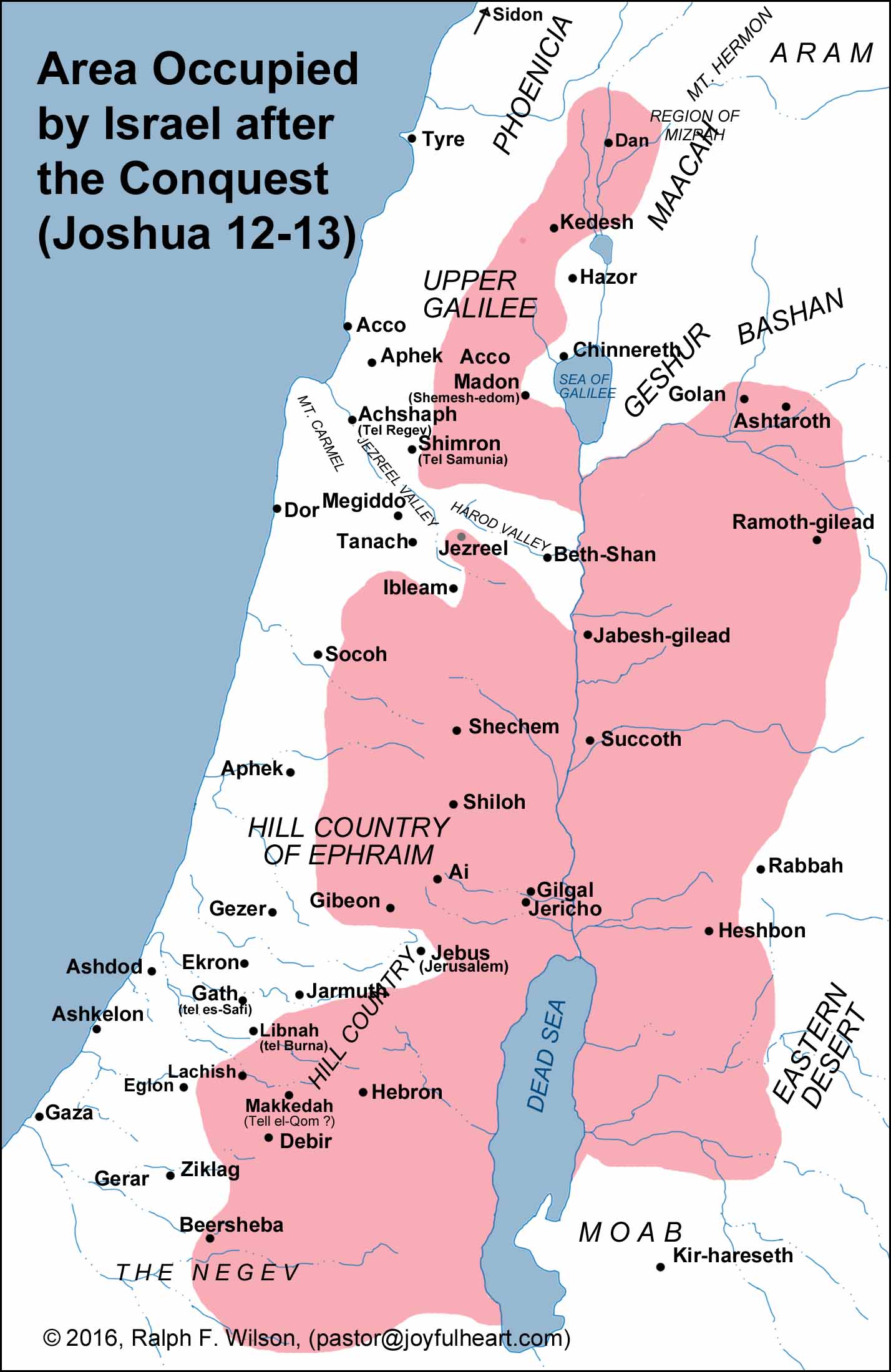
Joshua and the Israelite army had conquered thirty-one kings and territories in the past seven years.  But Joshua was getting old, commentators think about a hundred years old.  It's amazing to think that a man in his nineties could have done what he had done in the past seven years!  But there was still much land to be conquered all around on the outskirts of the conquered area.  This map I found on Pinterest said to have come from jesuswalk.com clearly shows the conquered lands in relation to the whole:


I find it interesting to note that although Joshua had defeated their kings as noted in the last chapter, some of their territories remained outside of Israelite occupation (Gezer, Aphek, Dor, Megiddo, etc.).  It seems reasonable to assume that Joshua may have continued to try to conquer the rest of the lands, but God stopped him because of his advanced age.  Adam Clarke, in his Commentary on the Bible, had an interesting perspective.  As nothing God does is by accident, he suggested that God may have wanted some of the original inhabitants to remain in order to keep the oftentimes unfaithful Israel in check.  

(2) "This is the land that yet remains, all the borders of the Philistines, and all Geshuri,"

The Lord then detailed the lands that were still unconquered, undoubtedly so that Joshua and the Israelites would know what they had a right to claim.  There was the territory of the Philistines in the southwest of Canaan along the Mediterranean Sea, to Geshuri, which appears to be Geshur in the north.  This map borrowed from Big Springs Community Church shows the unconquered lands more clearly than the one above:


(3) "From Sihor before Egypt to the borders of Ekron northward, counted to the Canaanite, five lords of the Philistines, the Gazites, the Ashdodites, the Ashkelonites, the Gittites, and the Ekronites, also the Avites;"

God described in more detail the as of yet unconquered territories of the promised land.  Describing the land of the Philistines, He said it ranged from Sihor before Egypt in the south to Ekron in the north which can be seen in the first map, across from Jerusalem.  The land of Philistia was counted as belonging to the posterity of Canaan, but the Philistines had gotten possession of it.  Because it was counted as Canaanite land, it was part of the promised land.  There were five lords in Philistia rather than kings, and it contained the cities of Gaza, Ashdod, Ashkelon, Ekron, and their inhabitants, and to whatever cities the Gittites and Avites belonged.

(4) "From the south, all the land of the Canaanites and Mearah beside the Sidonians, to Aphek to the borders of the Amorites;"

As near as I can tell by these maps, God is describing all the land of the Canaanites that was not part of the Philistines, from the south upward to Aphek (note there are two Apheks, one in Upper Galilee) to Sidon.

(5) "And the land of the Gebalites, and all Lebanon, toward the sunrising, from Baal Gad under Mount Hermon to the entering into Hamath;"

Gebal was north of Sidon on the Mediterranean coast.  The land of the Gebalites was said to be that east of Tyre, Sidon, and Gebal, the land east of the Lebanon mountains in the north, from Mount Hermon to the entrance of Hamath, seen clearly in this map borrowed from The Biblical Zionist:


(6) "All the inhabitants of the hill country from Lebanon to Misrephoth Maim, all the Sidonians, them I will drive out from before the children of Israel; only divide it by lot to the Israelites for an inheritance as I have commanded you."

The Lord continued to describe the land that was yet unconquered that also included all the hill country from Lebanon to Misrephoth Maim which was south of Tyre, all the land of the Sidonians.  All that very much land yet to be possessed (v. 1) included all the lands described from verse 2 to the Sidonians in verse 6.  All those the Lord would drive out from before the children of Israel.  Even though they were not yet driven out, the Lord wanted Joshua to divide all the promised land by lot to the Israelites for their inheritance.  Most of the early commentators I study suggest that these people were not ever entirely driven out or their land completely possessed by the Israelites, that the promise was always part of a covenant that must be upheld by the Israelites, and they did not do their part.  However, I refer back to Exodus 23:30-31, when the Lord said:

"Little by little I will drive them out from before you, until you have increased, and you inherit the land. And I will set your bounds from the Red Sea to the sea of the Philistines, and from the desert to the river; for I will deliver the inhabitants of the land into your hand, and you shall drive them out before you."

God specifically said that it would be little by little, and indeed all the land was subdued under the reign of David.  Some say that still the people were not specifically driven out, only subdued.  However, throughout ancient and modern history, Israel's borders have changed, and indeed the future Millennial Israel will include all of the promised land.

(7) "Now therefore divide this land for an inheritance to the nine tribes and the half tribe of Manasseh," (8) With whom the Reubenites and the Gadites have received their inheritance which Moses gave them beyond Jordan eastward, as Moses the servant of the Lord gave them,

The Lord told Joshua to divide the land on their present side of the Jordan River for an inheritance to the nine and a half tribes that had not yet received their inheritance.  Reuben, Gad, and the other half tribe of Manasseh had already received their lots on the east side of the Jordan River, given them by Moses.

(9) From Aroer which is on the bank of the River Arnon, and the city that is in the midst of the river, and all the plain of Medeba to Dibon, (10) And all the cities of Sihon king of the Amorites who reigned in Heshbon, to the border of the children of Ammon;

Further describing the lands given to Reuben, Gad, and the half tribe of Manasseh, it was from Aroer in the middle of the Arnon River that separated the land of the Amorites from Moab, and all the plain and cities of Sihon king of the Amorites to the Jabbok River which was the border of the Ammonites.

(11) And Gilead, and the border of the Geshurites and Maachathites, and all Mount Hermon, and all Bashan to Salcah, (12) All the kingdom of Og in Bashan who reigned in Ashtaroth and in Edrei, who remained of the remnant of the giants; for these did Moses smite and cast them out.

They had also received all the kingdom of Og, which included Gilead, the border of the Geshurites and Maachathites, all Mount Hermon, and all Bashan to Salcah.  All that land of Og that had been taken by Moses had been given to Israel, but they had not taken possession of much of it.

(13) Nevertheless, the children of Israel did not expel the Geshurites, nor the Maachathites, but the Geshurites and the Maachathites dwell among the Israelites until this day.

Indeed, Joshua went on to write that the Israelites had not driven out the Geshurites and Maachathites, and they still dwelt with them at the time of his writing.

(14) Only to the tribe of Levi He gave no inheritance; the sacrifices of the Lord God of Israel made by fire are their inheritance, as He said to them.

The tribe of Levi received no land inheritance on either side of the Jordan River.  As they were God's priests, He was to be their inheritance; they were to live off the sacrifices to their Lord God (Deuteronomy 18:1).

(15) And Moses gave to the tribe of the children of Reuben according to their families. (16) And their coast was from Aroer which is on the bank of the river Arnon, the city in the midst of the river, and all the plain by Medeba;

Moses had given to the tribe of Reuben the land from Aroer in the southeast and all the plain of Medeba.

(17) Heshbon, and all her cities in the plain, Dibon, and Bamoth Baal, and Beth Baal Meon, (18) And Jahazah, and Kedemoth, and Mephaath, (19) And Kirjathaim, and Sibmah, and Zereth Shahar in the mount of the valley, (20) And Beth Peor, and Ashdoth Pisgah, and Beth Jeshimoth, (21) And all the cities of the plain, and all the kingdom of Sihon king of the Amorites, who reigned in Heshbon, whom Moses smote with the princes of Midian, Evi, and Rekem, and Zur, and Hur, and Reba, dukes of Sihon dwelling in the country.

Reuben's inheritance included all these cities in the former kingdom of Sihon.  It had been taken by Moses when he defeated the king of Sihon and all his princes.  I can't begin to try to locate all these cities, but I found this map at Psalms to God Podcast that shows a general view of all the tribes and their allotments:


(22) Balaam also, the son of Beor, the soothsayer, the children of Israel killed with the sword, among those who were killed by them. 

The Israelites had also killed Balaam, the soothsayer, at the same time as the princes (Numbers 31:8).

(23) And the border of the children of Reuben was Jordan and its border. This was the inheritance of the children of Reuben after their families, the cities and the villages.

The northwestern border of the land possessed by the descendants of Reuben was the Jordan River.  All the land, cities, and villages between the Jordan and Aroer in the southeast made up the inheritance of the children of Reuben.

(24) And Moses gave to the tribe of Gad, to the children of Gad according to their families. (25) And their coast was Jazer and all the cities of Gilead, and half the land of the children of Ammon, to Aroer before Rabbah; (26) And from Heshbon to Ramath Mizpah and Betonim, and from Mahanaim to the border of Debir; (27) And in the valley Beth Haram, and Beth Nimrah, and Succoth, and Zaphon, the rest of the kingdom of Sihon king of Heshbon, with the Jordan as border to the edge of the Sea of Chinnereth on the other side of the Jordan eastward. (28) This is the inheritance of the children of Gad after their families, the cities and their villages.

Moses gave as an inheritance to the children of Gad the land from Jazer in the south to Rabbah in the west, with the Jordan River as the western border.  The northern border was quite unique, and I will let the map show the general area that was allotted to Gad.  Once again trying to locate all those cities is quite a dizzying task.  The Aroer before Rabbah would have to be a different Aroer from the one at the middle of the Arnon River.  Also Debir would have to be a different Debir.  All the cities of Gilead would only pertain to those cities within the area of Gad, as half of Gilead was given to the half tribe of Manasseh.  The same would have to be said for all the kingdom of Sihon that was given to Reuben (v. 21), as it states here that there was the rest of the kingdom of Sihon that was given to Gad.  Half the land of the children of Ammon refers to that part that Sihon king of the Amorites took from the Ammonites.

(29) And Moses gave to the half tribe of Manasseh, and this was of the half tribe of the children of Manasseh by their families. (30) And their coast was from Mahanaim, all Bashan, all the kingdom of Og king of Bashan, and all the towns of Jair, which are in Bashan, sixty cities; (31) And half Gilead, and Ashtaroth, and Edrei, cities of the kingdom of Og in Bashan, to the children of Machir the son of Manasseh, to the one half of the children of Machir by their families.

To the half tribe of Manasseh, the land from Mahanaim, which must have been the southern border as Gad also had that border (v. 26), including all the land of Bashan that included sixty cities, half of Gilead, and the royal cities of Og, Ashtaroth and Edrei.  The land is said to have been given to half the children of Machir, who was Manasseh's son.

(32) These are what Moses had distributed for inheritance in the plains of Moab on the other side of the Jordan by Jericho eastward.

The lands described above from verse 9 to this verse were all the lands that had been distributed by Moses to the tribes of Reuben, Gad, and the half tribe of Manasseh, on the eastern side of the Jordan River, east of Jericho.

(33) But to the tribe of Levi Moses did not give inheritance; the Lord God of Israel was their inheritance, as He said to them.

Once again, Joshua points out that the tribe of Levi did not receive any land as their inheritance, because as priests, the Lord God was their inheritance.

As Joshua was now old, God had him rest from his battles, even though there was still much land to be conquered.  However, for now, He wanted Joshua to portion out the lots of inheritance, and it was to include all the land that had been promised, even those not yet conquered.  This chapter began with the allotments that had already been given to the tribes of Reuben, Gad, and the half tribe of Manasseh.